
You've just finished an emotional intelligence test online, and the number on the screen is 72. It sits there, neither obviously good nor obviously bad. You feel a small pull to screenshot it and send it to someone, followed by a quieter worry: what if it means something I don't want it to mean?
That moment of confusion is the most important part of the whole exercise. A score without context is just a digit. What makes it useful is understanding what the test measured, what it didn't, and how the culture you live in, the week you've had and the way you see yourself all leave fingerprints on the result.
This is a plain-language guide to reading that number with some wisdom. Not to inflate it into a verdict on your character, and not to dismiss it either. Think of it as learning to read a dashboard rather than a report card.
What an Online Emotional Intelligence Test Measures
A student sits with a result of 72 and asks the only question that matters: is that good? The honest answer is that the test doesn't know yet. It measured a set of emotional skills, and 72 is a position on those skills, not a judgement on the person holding them.
Emotional intelligence is the ability to notice, understand, use and manage feelings, in yourself and in other people. That's the whole definition. It isn't charm, and it isn't being nice all the time. A person can be sharp-tongued and still score well, if they read a room accurately and recover from their own reactions quickly.
Here's the analogy that helps. A car dashboard doesn't tell you what kind of driver you are. It tells you fuel level, engine temperature, tyre pressure. Your emotional intelligence result works the same way. It shows where you're steady and where you're stretched, and it's meant to be checked again later, not framed on a wall.
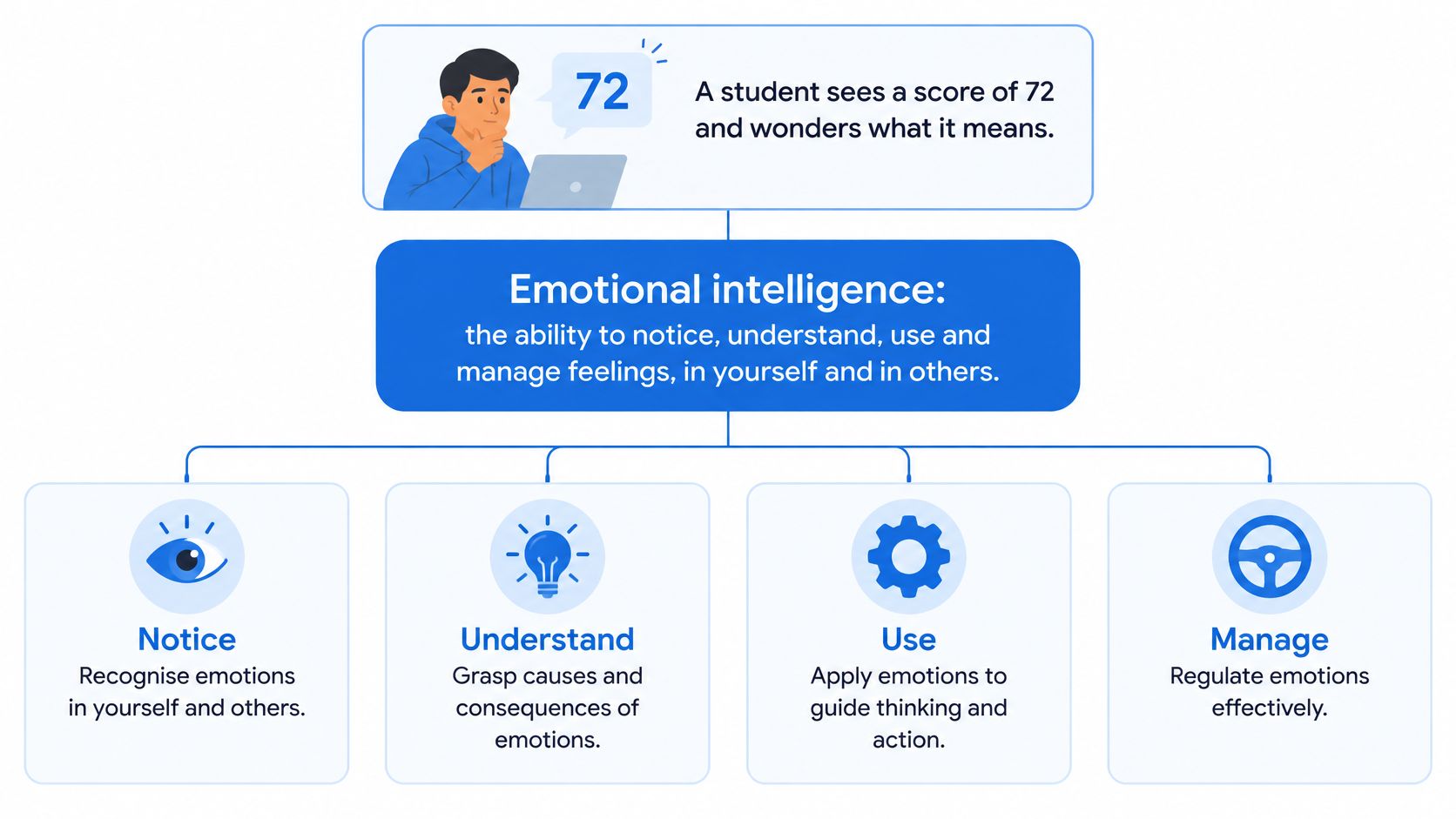
The four skills a good test reports separately
One well-known model, the Wong and Law Emotional Intelligence Scale, breaks the concept into four dimensions. A Haryana study of 350 employees in higher-education institutions applied it and reported overall reliability coefficients ranging from 0.77 to 0.91, which is a reasonable range for a self-report tool (Assessing Emotional Intelligence in the Indian workplace). The same study found regular employees scoring higher than contractual employees across the four dimensions, and government employees higher than private-sector employees on self-emotion appraisal and emotion regulation.
| Skill | What it means | Everyday example |
|---|---|---|
| Self-emotion appraisal | Noticing and naming your own feelings as they arise | Realising you are irritated before snapping at a colleague |
| Others' emotion appraisal | Reading other people's feelings from their words, tone and face | Sensing a friend is upset even though they say they are fine |
| Use of emotion | Directing feelings toward problem-solving and motivation | Channelling nervous energy into preparing for an interview |
| Regulation of emotion | Calming down and recovering from strong feelings | Taking a pause before replying to a heated message |
A test that gives you one EQ number and nothing else has flattened all four into an average. That's like a doctor reading only your temperature and skipping your blood pressure. Insist on the breakdown.
Try this before you read your results: name the skill in that table that feels most familiar, and the one that feels least familiar. That's where your eye should go first when the score arrives.
Test Types and Disclosure Checks
Two people can take an emotional intelligence test online, receive identical scores and still be holding completely different information. The phrase covers two very different measurement traditions, and knowing which one you took changes how you read the result. A 2024 systematic review of emotional-intelligence research among Indian teachers made the split clear: it identified 26 studies covering 6,005 participants for meta-analysis and sorted the tools they used into two camps (Indian emotional-intelligence research review).
Ability tests and self-report questionnaires
Ability-based tests put you inside an emotional situation and mark your answer right or wrong. You might read a short scenario and be asked what the person in it is most likely feeling, and one response is judged more accurate than the rest. It works a bit like a driving test: there is a correct answer, and your score depends on whether you found it.
Trait-based self-report questionnaires work the other way round. You rate a longer list of statements about yourself on a Likert scale, something like "I know exactly what I'm feeling at any moment", choosing anywhere from strongly disagree to strongly agree. Nobody marks you right or wrong. The score reflects how you see yourself.
That difference matters more than any single number. Ability scores show how you perform on emotional tasks. Self-report scores show your self-perception, which shifts with mood, confidence and how honest you feel like being that day. Both are useful. Neither is a diagnosis.
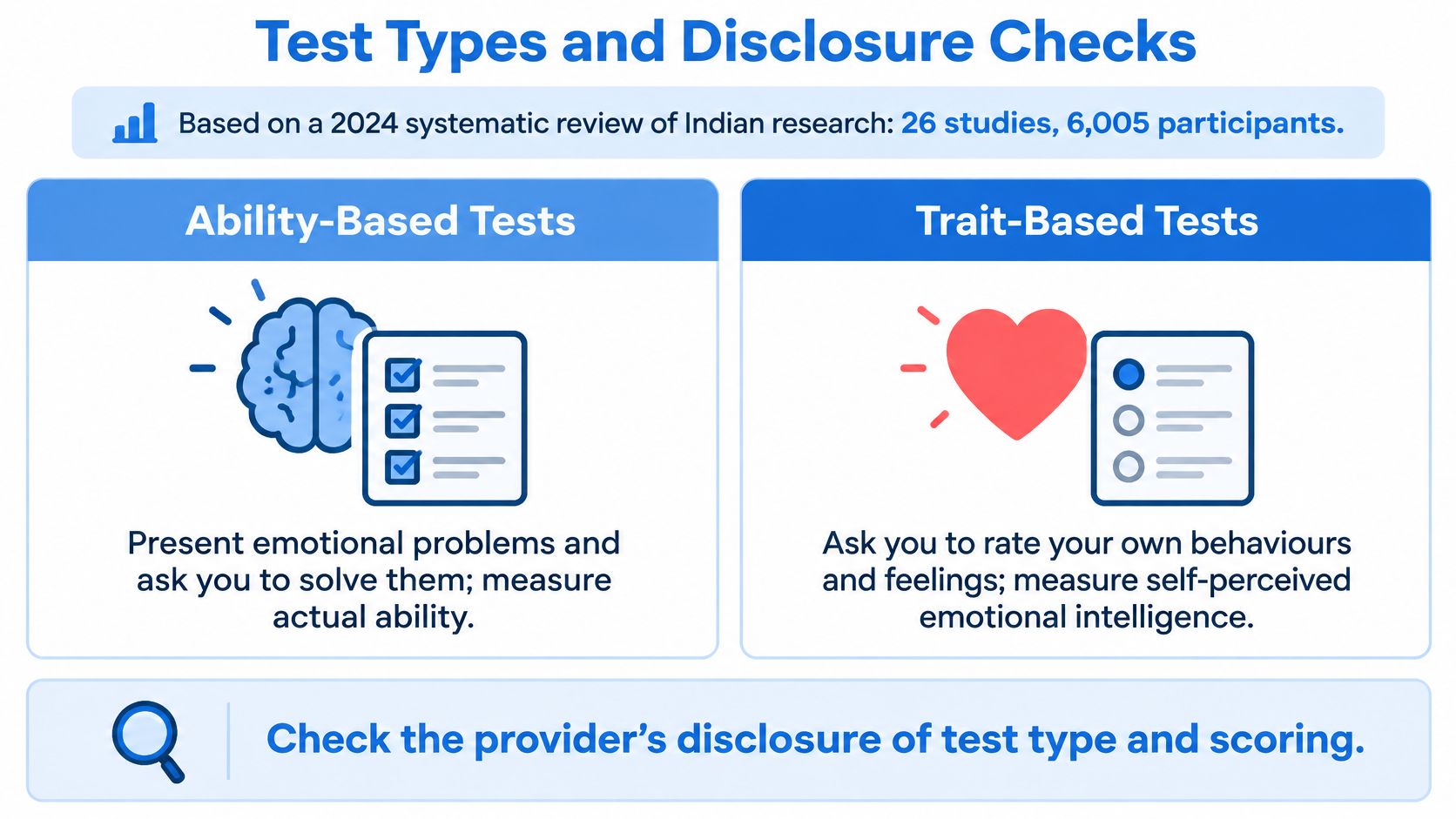
| Feature | Ability-based test | Self-report questionnaire |
|---|---|---|
| How it works | Presents emotional scenarios with right or wrong answers | Asks you to rate statements on a Likert scale |
| Typical length | Usually a compact set of scored tasks | Usually a longer list of statements to rate |
| What it captures | How well you handle emotional information in tasks | How you see your own habits and traits |
| Main risk | Scores depend on knowing the best answer | Scores depend on self-perception and social desirability |
| Best used for | Learning and skill-building | Self-reflection and starting conversations |
If you'd like a walkthrough of how these formats play out in practice, this short video covers the basics well.
Why validation evidence is thin in places
The review also noted something sobering. Indian scholars have built many different emotional intelligence instruments, yet plenty of them appear in only a small number of studies. They lack the widespread validity and reproducibility you would expect of a rigorous psychological tool. A test can exist, be published and sit at the top of a search result, and still have very little evidence behind it.
Practical rule: a test that won't tell you who it was validated on is a test you should read with caution.
The question of cultural validity
Indian readers deserve a straight answer to an awkward question: is a test measuring emotional skill, or is it measuring familiarity with Western communication norms?
The strongest evidence for caution comes from instrument-building work itself. One research team concluded that imported measures were not appropriate for Indian employees and built an India-specific IT/ITES instrument instead, drawing on 533 respondents from Bengaluru, Hyderabad, Chennai and Coimbatore and refining an 86-item pool down to 47 items (cultural validity in emotional-intelligence measurement).
So "validated in India" does not mean "equally valid for every Indian user." A tool built on technology-sector employees in the south may not fit a college student in Patna, a couple in Kochi or a client sitting with a psychologist in Ludhiana. Emotional expression runs through family hierarchy, mother tongue and local ideas about what is polite to say out loud. A questionnaire written for a different culture can mistake that context for low skill.
Five things to check before you trust a score
Before you take any result seriously, look for these disclosures. If a provider does not publish them, treat the score as tentative.
- Target population: a named Indian sample, not a vague claim of being "globally validated."
- Reliability: a coefficient such as Cronbach's alpha above 0.70, reported for the group you belong to.
- Scoring method: scoring direction and subscales explained in plain language, not buried.
- Language: a version reviewed for local use, not a straight machine translation.
- Intended use: clearly labelled informational, not diagnostic.
A low score can also reflect language, social conditioning or test format rather than poor emotional functioning. If English is not your first language, or the questions describe workplace norms that do not match your home or community, the number may be measuring your distance from the test's cultural centre. That tells you something about the test. It says far less about you.
Reading Your Score in Real Life
The page reloads, a number appears, and your first instinct is to treat it like a school mark: pass or fail. Resist that instinct for a moment. A score on an emotional intelligence test online is closer to a photograph than a portrait. It captures how you rated yourself on one particular day, under one particular set of pressures, and reading it well takes a little method.
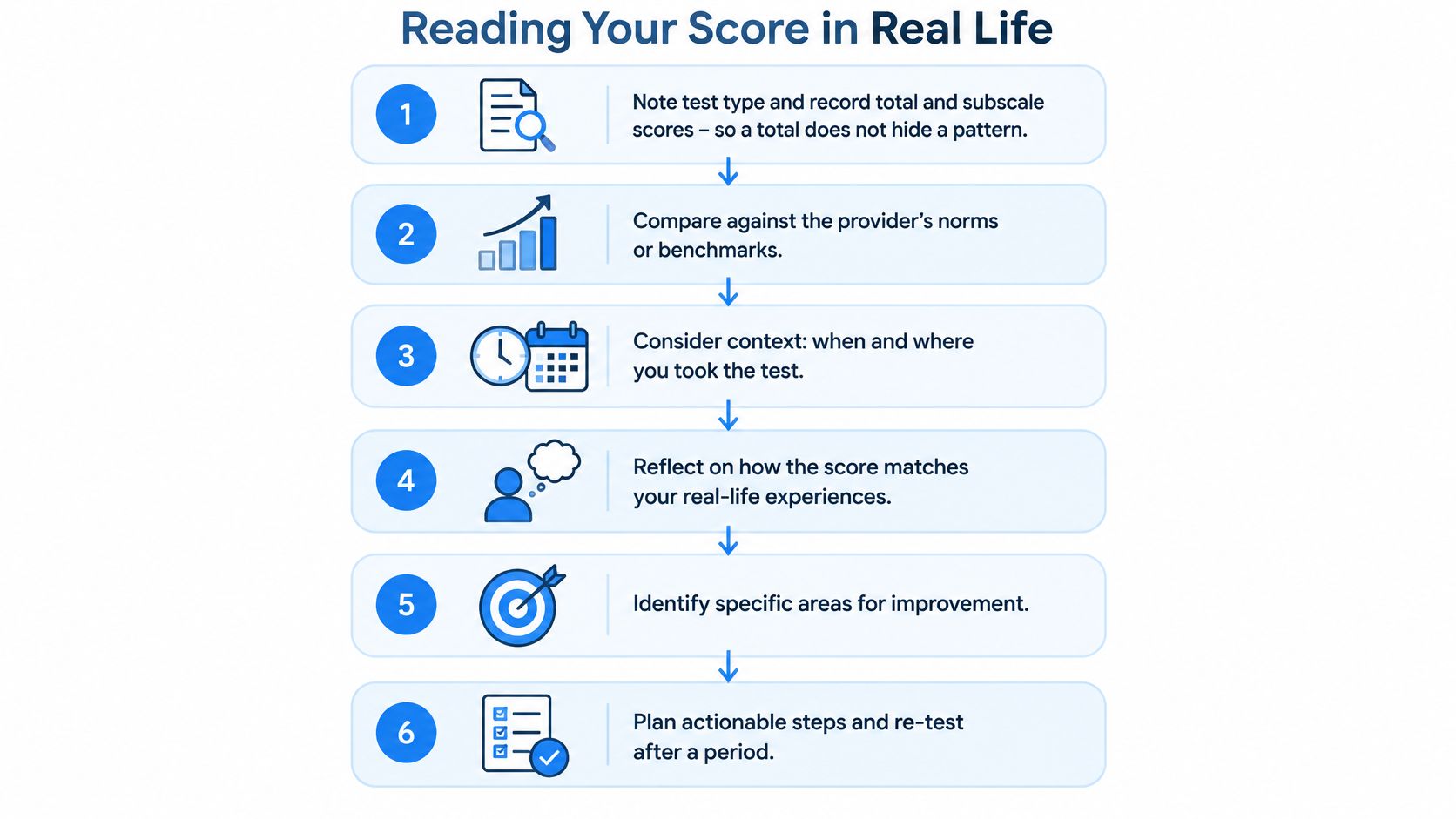
- Note the test type and record every number. Write down the total and each subscale score. A single total can hide a lopsided profile: strong empathy paired with shaky self-regulation. That pattern is far more actionable than an average.
- Compare against the provider's benchmark, nothing else. A score of 72 means something different on a test normed for Indian students than on one normed for Australian managers. A friend's result, or a number someone posted online, is a distraction rather than a reference point.
- Find your strongest and weakest subscale. That contrast holds the most useful information. Strength tells you what to lean on. Weakness tells you what to practise.
- Ask what kind of week you've had. Poor sleep, a deadline, a fight at home, a stretch of anxiety: all of it pushes self-ratings down. Self-reports also run through self-perception. Someone raised to deflect praise and stay modest may undersell their empathy in every answer, and the score will reflect the habit rather than the ability.
- Retake it in a few weeks, when calmer. If the pattern holds, treat it as a real pattern. If it swings wildly, you've learned something useful about how strongly mood shapes the way you see yourself.
- Choose one small action for your lowest area. One action only. If self-appraisal is low, name your feelings in a journal for a week. If regulation is low, practise the pause before replying.
What the Indian evidence actually supports
The Schutte Self-Report Emotional Intelligence Test, known as the SSEIT, contains 33 Likert-scored items, meaning statements you rate on an agreement scale, and showed high internal consistency in a recent sample of Indian medical undergraduates, with Cronbach's alpha of 0.831 (SSEIT reliability among Indian medical undergraduates). That's strong enough to support using the total score for preliminary self-reflection. It is nowhere near strong enough to sort people into fixed categories of "emotionally intelligent" and "not emotionally intelligent."
That study also points to a technical detail most users never see. An online version should preserve the original item wording, response scale, scoring direction and missing-data rules. Change the item order, rewrite the labels or alter the scoring, and comparability with the validation research breaks. If a provider has "improved" a validated questionnaire, the published reliability figures describe an instrument you never took.
Mood, personality and the honest limits of a score
A high score doesn't guarantee better relationships or a happier life, because emotional intelligence doesn't operate alone.
A study of 300 young Indian adults found that emotional intelligence was associated with life satisfaction, though the relationship was not independent of affectivity and personality traits such as neuroticism, extraversion, agreeableness and conscientiousness (emotional intelligence and life satisfaction in young Indian adults). Some of what looks like emotional intelligence is temperament wearing a different shirt. Other Indian research using the Wong-and-Law dimensions has reported acceptable validity and links to life satisfaction in emotionally demanding service work. Encouraging findings, and still associations between questionnaires, nothing firmer.
If you scored low this week because you're anxious, burnt out or sleeping badly, treat that as information about your current state. States move fast. Traits move slowly. Confusing the two is the most common reading error people make.
A useful distinction: a screening insight tells you where to look. A validated assessment tells you something firmer. An emotional intelligence test online belongs in the first category.
Matching your pattern to a next step
Different profiles call for different responses. Read the one that fits you.
- Low self-emotion appraisal: practise labelling. Three times a day, name what you're feeling and what triggered it. Naming is the entry point to regulation.
- Low others' emotion appraisal: before responding in a conversation, summarise what the other person said, then ask "what was that like for you?" It feels awkward for a week and then stops feeling awkward.
- Low use of emotion: connect daily tasks to something you care about. Motivation follows meaning more reliably than willpower.
- Low regulation: build a pause of a few seconds before replying to anything heated. Send the message after the pause, never during it.
- Distress affecting sleep, work or relationships: this is beyond self-help territory. Talk to a qualified professional.
The result you're left with is a profile you can discuss, and profiles are meant to be carried somewhere. Take yours into a coaching conversation or a session with a counsellor, where the context a questionnaire can't hold, your family, your workload, your week, fills in what the numbers miss.
Students, Workers and Couples Three Real Examples
Abstract scores become concrete fast when you see them land in real lives. Three situations cover most of the people who take these tests.
The student before exams
A second-year student is three weeks from exams. They take an emotional intelligence test online and score well on regulation but poorly on impulse control under pressure.
Exam stress is common among Indian students, and low moods during exam season are widely reported. In many households a result carries more than personal disappointment: it carries family expectations, comparisons with cousins and neighbours, and the feeling that one set of marks decides a future. Pressure like that can drag down any self-assessment taken in the weeks before papers.
That context reframes the result entirely. The student is learning that exam season strains a specific skill. The test cannot tell them whether they have anxiety or depression, and it should not be asked to. Sleep, time with friends, a counsellor and a realistic study plan do more for well-being than a score ever will. The strength to build here is resilience: recovering after a bad paper instead of spiralling.
The professional under job pressure
A mid-career employee scores low on use of emotion and high on others' emotion appraisal. Translated: they read colleagues well and struggle to channel their own feelings into action. They use the result to reflect on how they take feedback, and start writing down one thing to do differently after each review instead of replaying the criticism all evening.
Workplace stress is a real force here. A review of Indian workplace studies reported depression affecting 10% to 52.9% of workers, anxiety 7% to 57%, and workplace stress 3.8% to 75.5% (Indian workplace mental health review). Ranges that wide tell their own story: how common these struggles are depends on the industry, the city and the workload. Long hours, packed commutes and job insecurity are part of ordinary working life for many Indian professionals, and all three push scores down. If someone is carrying that load, a low emotional intelligence score is more likely a symptom of pressure than a verdict on their empathy.
HR teams should use these results for coaching and support, never for hiring, promotion or performance decisions. The strength to build is compassion, starting with how the person treats themselves after a hard quarter.
The couple reading each other differently
One partner scores high on others' emotion appraisal, the other low. In practice, that gap shows up as a familiar argument: one of them insists they know what the other is feeling, and the other insists they have got it wrong. In joint families, or households where relatives live close by, the gap can widen, because each partner is also reading the emotions of parents, in-laws and siblings, sometimes in a second or third language.
Used well, the result becomes a prompt. It gives a couple a way to talk about perception without accusing anyone of being cold or oversensitive. A counsellor can take that conversation further in one session than months of circular arguments at home. The strength to build is gratitude, directed at what each partner does well rather than at the friction.
If distress at any of these stages involves thoughts of self-harm or an urgent safety concern, skip the self-reflection and contact local emergency or mental-health services immediately.
Build Resilience, Compassion and Happiness
Self-assessment tends to orbit problems. The counterweight is the part of psychology that studies what makes life good, and it's worth building deliberately alongside whatever your score revealed.
Resilience is the first practice. Name a recent setback, then identify one thing that helped you recover. A call with a friend. A night of proper sleep. A decision to try again the next day. This exercise builds directly on regulation of emotion, because it shows you the mechanics of your own recovery, not just the fact that you got through.
Compassion is the second. When a score disappoints you, speak to yourself the way you'd speak to a student who came to you upset. Then turn the same attention outward by noticing how the people around you seem to be feeling. That's others' emotion appraisal in daily use. It costs nothing and changes how people experience you.
Gratitude is the third, and the simplest. Write down three small good moments each day. The tea that was exactly right. A colleague who made you laugh. A message from your mother. This routine is linked to well-being and happiness, and it's the one habit people quit too early because it feels too easy to matter.
Rest and connection is the fourth. Protect your sleep and your time with people you love. Social connection strengthens well-being for students and professionals alike, and it's the first thing to go when workplace stress rises.
Many readers are managing exam pressure, workplace stress or family expectations at the same time. These habits support you alongside professional care; they don't replace it when anxiety or depression persists. For educators and coaches who want structured ways to build these qualities in others, this collection of coaching activities for mental toughness offers practical exercises worth adapting.
Pick one. Choose a single practice for the coming week. One. Four good habits attempted and abandoned teach you nothing about yourself.
Choose the Right Next Step After Your Result
A score on a screen can feel like a verdict, especially in households where a low mark on any test tends to be read as a character flaw. Read this one differently. Your result is informational, not diagnostic: it cannot confirm anxiety, depression, burnout or any other condition, and no honest test should be treated as though it can.
The test still earns its place. Reflection tools have real value in a country where the need is enormous and often unmet. India's National Mental Health Survey 2015-16, conducted by NIMHANS, estimated that 10.6% of adults were living with a diagnosable mental health disorder, 15% needed mental-health intervention, and lifetime prevalence reached 13.7% (National Mental Health Survey findings). Against numbers like those, anything that helps a person notice their own patterns and consider seeking help is doing useful work.
From here, three paths. Take the one that fits.
If your profile looks strong across the board, keep doing what you're doing and protect it. The weekly practice you chose earlier is what maintains that strength, and consistency matters more than adding new habits.
If one skill stands out as low, give it four focused weeks, then retake the test. Pick one action from the pattern-matching list and repeat it until it stops feeling like effort. Skills move through repetition, and self-perception shifts slowly, so a second reading after steady practice tells you far more than a single attempt ever could.
If stress, sleep, work or relationships have been affected for more than a few weeks, speak with a qualified psychologist, therapist or counsellor. It is a sensible next step, the way you would consult a doctor for a fever that refuses to break. For those weighing a digital option as an interim measure, this look at whether AI therapy apps actually help gives a balanced picture before you decide.
For readers in India ready to speak with someone, the DeTalks directory brings psychologists, therapists and counsellors together in one place, covering career confusion, exam stress, professional stress and relationship difficulty alongside anxiety, depression and burnout. Finding support takes one search rather than ten phone calls, and browsing commits you to nothing.
Your score is a starting point. Growth is possible at any age and from any number, and asking for help takes strength.
If any urgent safety concern arises, reach out to local emergency or mental-health services right away.
DeTalks brings together a directory of psychologists, therapists and counsellors alongside a library of scientifically validated assessments, including the emotional intelligence test online you have just read about. Visit DeTalks to take the test, explore the assessments and find support that fits where you are right now.
Leave a Reply