
A software engineer in Bengaluru shuts her laptop at 9.40pm and then scrolls for another hour because her mind won't slow down. A Class 12 student in Jaipur reads the same revision page four times and retains none of it. A parent in Pune answers two work calls while cooking dinner, then snaps at a child who only wanted help with homework.
None of them needs a retreat, a Himalayan trek or an hour of free time. In the Ipsos World Mental Health survey, 53% of urban Indians said they had experienced stress severe enough to affect their daily lives during the previous year. What helps isn't a bigger commitment. It's a smaller one, tied to a moment that already exists in the day.
That's the organising idea here. Match the practice to the moment you're in, whether that's a tense meeting, a late-night scroll, a lunch break or a bedtime routine. Each of the eight practices below belongs to one of those slots, and each comes with what it can and cannot do.
You don't need equipment, an app subscription or a quiet room. A warm drink taken slowly is its own small ritual, and the attention that goes into matcha ceremony water temperatures is the same attention you can give a steel tumbler of chai on a balcony.
Professional care stays on the table throughout. Everything here supports well-being. Nothing here diagnoses or treats a condition.
1. Diaphragmatic and Box Breathing for a Tense Meeting
The ninety seconds before a review with your manager is the moment this practice was built for. Your chest tightens, your shoulders climb towards your ears, and your voice comes out a note higher than you intended. Slow breathing gives your body a different signal to follow.

Diaphragmatic breathing means breathing into the belly rather than the chest, so the lower ribs widen and the shoulders stay still. Box breathing adds a count: inhale for four, hold for four, exhale for four, hold for four. Both slow the breath enough to take the edge off physical tension, and both travel well, which is why pranayama has survived centuries in Indian schools, ashrams and now corporate wellness calendars.
The pattern, and how to check you're doing it
- Hand on the belly: rest one palm just below the navel and breathe so the hand rises before the chest does. If only the shoulders move, you're chest-breathing.
- Count softly: four in, four held, four out, four held. Drop to three counts if four feels strained.
- Lengthen the exhale: if the box pattern feels mechanical, breathe in for four and out for six. The longer out-breath is what helps many people settle.
- Stop if you feel lightheaded: return to normal breathing. Dizziness means the count is too high, not that the practice is failing.
Practical rule: Five minutes each morning is how the habit gets built. The two slow breaths before a hard conversation is where it pays you back.
What breathing won't do is treat an anxiety disorder. The National Mental Health Survey report recorded treatment gaps of 85.0% for common mental disorders, 85.2% for major depressive disorder and 84.0% for anxiety disorders, which is exactly why a free, portable skill matters and why it can't be the whole plan. If anxiety shows up most days, disturbs your sleep or comes with panic, a therapist or counsellor should be part of the picture.
Here's the four-count pattern walked through slowly, so you can follow the pace before trying it in a corridor.
2. Body Scan Meditation When Tension Hides
Tension often goes unnoticed until it becomes a headache or a broken night. A body scan finds it earlier, while it's still a tight jaw and a braced stomach. You lie down, move attention slowly from toes to scalp, and notice warmth, tightness, tingling or nothing at all, without trying to fix any of it.
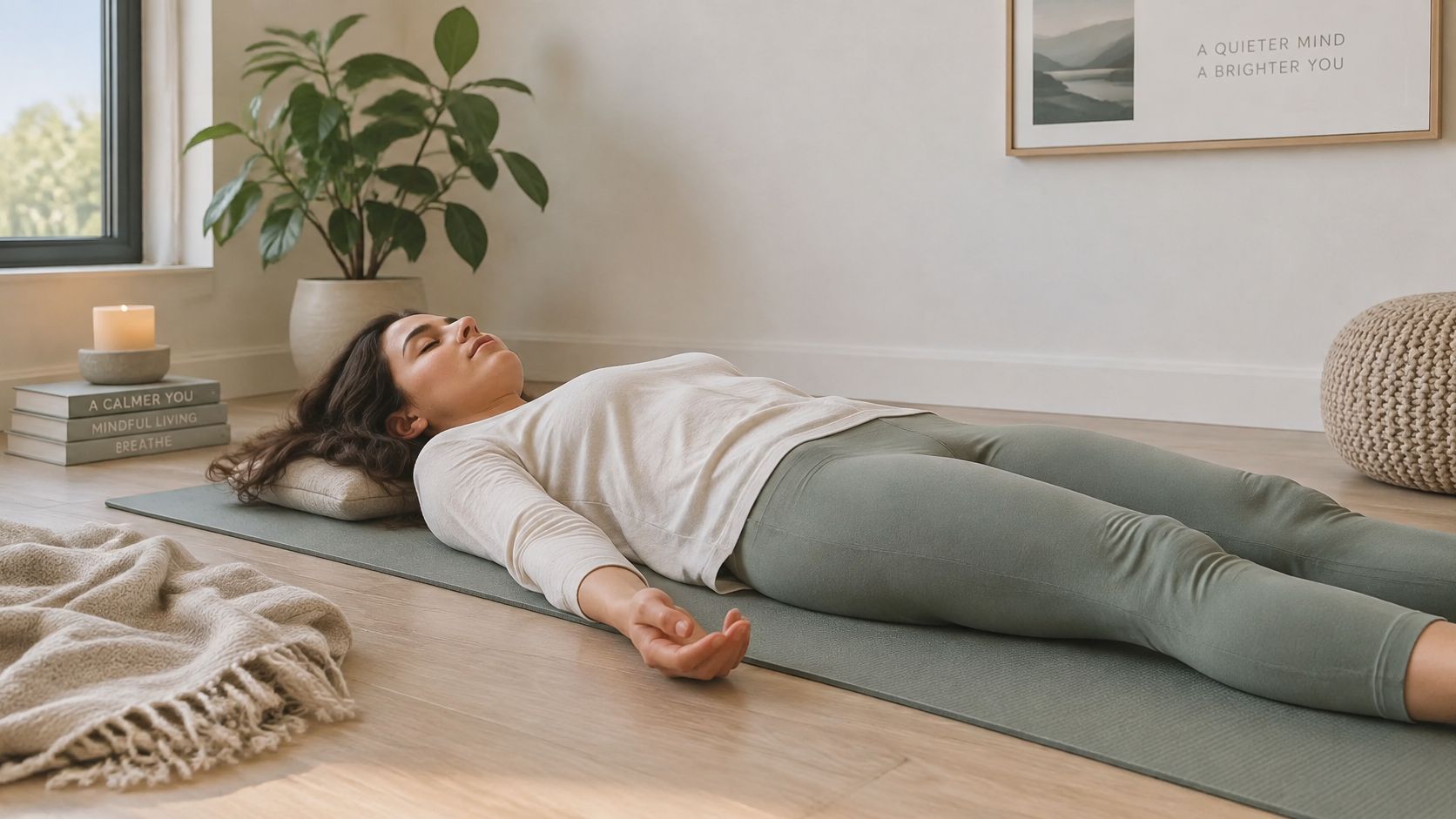
The practice reached hospitals and offices through Mindfulness-Based Stress Reduction, the eight-week programme Jon Kabat-Zinn developed for people living with chronic pain and stress. The mechanism is simple: attention moves, judgement stays parked, and the body gets noticed instead of overridden. For anyone who spends nine hours a day in their head, that noticing is the useful part.
The moment to borrow it is the mid-afternoon crash, when you've been in meetings since ten and your neck has seized. Ten minutes lying on the floor of a bedroom, before the evening starts, resets more than a third coffee will.
A ten-minute version you can run without an app
- Lie down somewhere warm: a mat, a bed, even a carpet. Cold rooms make the body brace, and bracing defeats the point.
- Start at the toes and move up: left foot, right foot, calves, knees. Spend a breath or two on each region.
- Name what you find: 'tight', 'warm', 'prickling'. Naming keeps attention steady and stops the mind from writing stories about the sensation.
- Don't force relaxation: if an area stays tight, observe it and move on. Forcing the body to soften usually tightens it further.
- Use a guided recording for the first fortnight: many beginners lose the thread at the third body part without one.
The goal is not to feel calm. The goal is to know what your body is doing. Calm tends to arrive afterwards, and often it doesn't arrive at all, which is fine.
A body scan is a self-awareness tool. It isn't a diagnosis and it isn't a treatment. If the distress you notice during practice is persistent, or if lying still brings up difficult memories, that's worth discussing with a qualified professional rather than pushing through alone.
3. Gratitude Journaling on the Way Home
The 6pm metro ride is an odd gap in the day. Work is finished, home hasn't begun, and the time often goes to reopening the same three apps. Three written lines put those ten minutes to better use.
Gratitude journaling is deliberately unglamorous. You write down specific things that went right: a colleague who took a call so you could leave on time, a chai stall that added extra ginger, a conversation with your mother that didn't turn into an argument. Over weeks, the exercise tilts attention towards what's working, which is the practical core of positive psychology.
Psychologists Robert Emmons and Sonja Lyubomirsky have studied this territory for decades, and their work links gratitude practices with better mood, sounder sleep and greater satisfaction with life. The effect is modest and cumulative. It doesn't erase a bad quarter at work or a difficult marriage, and it isn't meant to.
Three lines, written so they actually stick
- Name the person, not the feeling: 'Ravi took the client call so I could leave on time' does more than 'good day at work'.
- Keep it small: the auto driver who waited, the rain that held off until you reached the office door.
- Let the hard thing sit on the page too: one line about what went badly keeps the habit honest and stops it feeling forced.
- Share one line a week: send it to the person involved. Gratitude spoken aloud does more for a relationship than gratitude kept in a notebook.
What this won't do: journaling doesn't lift clinical depression. If low mood has lasted most of the day, most days, for several weeks, a counsellor or therapist should hear about it.
Students find the practice useful in the run-up to board exams, mainly because it turns down the volume on catastrophic 2am thinking. Couples in counselling sometimes use shared notes to restart conversation after a fight. The tool is small, and its smallness is the reason people keep it up.
4. A Self-Compassion Break After a Bad Moment
At 3pm a manager's comment lands harder than the comment deserved. The inner voice takes over within seconds: you're slow, you're careless, everyone noticed. A self-compassion break interrupts that voice before it runs the rest of the afternoon.
The practice has three movements. You acknowledge that this is hard. You remember that difficulty is shared by every human rather than proof of a personal defect. Then you offer yourself the sentence you'd say to a friend in the same position. Kristin Neff at the University of Texas has built most of the research base here, and her work connects self-compassion with lower anxiety, greater resilience and steadier emotional health.
This one is harder in India than it sounds. Many people grow up hearing that praise makes you complacent and self-criticism keeps you sharp, so kindness towards yourself can feel like letting yourself off the hook. In practice it does the opposite. Shame keeps people stuck. Kindness gets them moving again.
The three sentences, spoken silently
- Name it: 'This is a hard moment.' Say it once, plainly, without dramatising.
- Normalise it: 'Other people feel this too.' A missed deadline, a rejected proposal, an argument at home. None of it is unique, and none of it is shameful.
- Offer the phrase: 'May I be patient with myself.' Or 'May I be as kind to myself as I'd be to a friend.' Use whichever you can say without flinching.
Self-criticism is a habit, not a personality. Habits shift through repetition, not through one insight on a Tuesday afternoon.
Starting early matters. The WHO's India mental health profile reports that nearly 9.8 million adolescents aged 13 to 17 needed active intervention, with prevalence estimated at 13.5% in urban metros against 6.9% in rural areas. Those young people are learning right now whether their inner voice is an ally.
Self-compassion supports emotional growth, but it isn't a formal treatment. Where harsh self-criticism traces back to earlier experiences, a therapist can help you work through it rather than around it.
5. Digital Boundaries and the Late-Night Scroll
At 11.20pm the phone is still in your hand. You have read nothing memorable for forty minutes, you are vaguely irritated, and you know the 7am alarm will collect the debt. Digital boundaries exist for exactly this moment, the one almost nobody plans for.
A boundary is a rule made in daylight for a decision you would otherwise make at midnight. Notifications silenced after 9pm. The phone charging in the hall instead of on the pillow. One screen-free hour before bed. Each one removes willpower from the equation, which is the entire point: by 11pm, willpower is the resource you have already run out of.
The same mechanics explain why good intentions fail. A habit you want to repeat has to feel useful within about two minutes, and it has to be triggered by a cue rather than by resolve. "I'll just check less" fires nothing. A charger left in the hallway fires every night, because it makes the desired action the easy action.
What to change first
- Silence every notification that can wait during focused work: each banner is an invitation to leave the task you sat down to do.
- Charge the phone outside the bedroom: the most effective single change, and the one people resist most. A basic alarm clock costs less than a scroll tax on your sleep.
- Agree the rules out loud at home: phone-free dinners work only if everyone, including the person who suggested them, follows them.
- Watch for the substitution trap: swapping a social feed for a wellness app you open twenty times a day solves nothing.
A boundary is a decision about who gets access to your attention, taken while you are clear-headed enough to choose.
The rule scales beyond one household. After-hours email norms matter more than any wellness poster: if a team lead sends messages at 11pm, the team will read them at 11pm, and nobody has to be told twice. In homes where three generations share one wifi connection, agreed quiet hours carry further than individual resolve ever will.
Digital well-being is one strand of a wider approach. If loneliness, low mood or compulsive checking persist after the boundaries are in place, the phone was probably soothing something. A counsellor can help you look at what.
6. Mindful Movement on a Lunch Break
The walk from your desk to the canteen and back is already happening. Turning it into fifteen mindful minutes costs nothing and asks for no new clothes, gym membership or commute.
Mindful movement means pairing activity with attention: noticing your feet meeting the ground, the air on your arms, the rhythm of your breath as you pick up pace. Japan's shinrin-yoku tradition of unhurried time among trees carries the same idea, with the setting doing half the work. An evening walk in a park or along a river has long been the cheapest form of self care and mindfulness available in India.
Participation is uneven, though. In the LASI Wave 1 analysis of middle-aged and older adults, 14.4% of urban adults practised yoga, meditation or pranayama at least weekly, against 9.2% of rural adults. Opportunity shapes habit more than motivation does, which is why a short walk near where you already are beats an ambitious plan you'll cancel.

Across India, the intent to spend on health and fitness keeps growing, but intention rarely survives a crowded schedule on its own. A lunchtime walk is the version that depends on neither budget nor willpower, because the slot already exists in your day.
Making a walk mindful in five minutes
- Leave the headphones in your bag for the first five minutes: listen to traffic, birds, your own footsteps. Sound is the fastest anchor available outdoors.
- Pick a fixed loop: familiarity removes the decision-making that kills the habit on busy days.
- Try gentle yoga for the desk-bound body: a beginner class that emphasises breath and slow stretches does more for a stiff neck than a fast-paced session.
- Get near trees or water once a week: a park, a lake, even a row of old trees on the way home counts.
Exercise supports mood. It doesn't substitute for assessment or treatment. People living with depression or anxiety often find movement easier to begin when a professional is guiding the wider plan, and a doctor's opinion makes sense before you start something new if you have health concerns.
7. A Sleep Routine and Wind-Down Ritual
By 10pm the day should be over but the mind disagrees. It wants to re-litigate the 4pm email and rehearse tomorrow's presentation. A wind-down ritual exists to close the day deliberately, before the mind tries to do it for you at 1am.
The routine is a set of repeated cues rather than a single trick. Lights dimmed, caffeine stopped by mid-afternoon, tomorrow's three tasks written on paper, screens off, same bedtime each night. None of it is dramatic. Together, the cues tell the brain that the day has an ending, which is information a busy nervous system badly needs.
Sleep and low mood travel together. The survey's depression estimates put current depression at 2.7% and lifetime depression at 5.2%, roughly one in forty people and one in twenty. Poor sleep doesn't cause depression on its own, but it narrows the margin you have for coping with everything else.
The wind-down sequence that works for most people
- Fix the wake-up time first: a consistent morning alarm anchors the whole rhythm better than an early bedtime ever will.
- Stop caffeine after 3pm: filter coffee at 5pm is still in your system at 10pm, and people often underestimate this badly.
- Write tomorrow's top three tasks on paper: the page holds them so your head doesn't have to.
- Keep the room cool, dark and quiet: lightness signals morning to a brain that's trying to switch off.
- Make the last cue sensory: a warm shower, a heavy blanket, or a few drops of essential oils chosen for sleep on the pillow. The scent itself isn't medicinal. The repetition is what does the work.
If you're awake for more than twenty minutes, get up. Lying there frustrated teaches your brain that the bed is a place for worrying.
Persistent sleep problems deserve professional attention. Insomnia that lasts for weeks, early waking, or sleep that stays unrefreshing can point to a medical or mental-health condition, and a doctor or therapist can help identify the cause instead of guessing at it.
8. Connection and Seeking Professional Support
The Sunday-night dread is the moment this one belongs to. The week hasn't started, nothing has gone wrong yet, and the chest is already tight. That feeling tends to shrink when it's said out loud to one trusted person, and it tends to grow when it's carried alone.
Connection is self care in its plainest form: a call to a friend, an honest sentence to a partner, a conversation with a colleague who'll understand, or a session with a therapist or counsellor. This is the item on the list that many people skip and the one with the largest effect.
The need is large and it's measurable. The National Mental Health Survey 2015-16, covering 12 states and 34,802 participants, estimated that 10.6% of adults had a current mental-health condition and 13.7% had experienced one in their lifetime. Need also varies sharply by state, from 5.8% in Assam to 14.1% in Manipur, according to the government summary of the survey.
What good support looks like
- Pick one person this week: a friend, sibling or colleague you can say a true sentence to. Not a group.
- Check qualifications, not vibe: a therapist or counsellor should be able to describe their training and their experience with your specific concern.
- Keep the helpline saved: Tele-MANAS is free, runs at 14416 and 1-800-891-4416, and has been taking calls from across India since 2022. Save it before you need it.
- Treat online assessments as reflection: they're informational, not diagnostic. A qualified professional interprets results and decides what comes next.
For managers: confidential counselling through an employee assistance programme is only useful if people trust it. Say who runs it, what stays private, and how to reach it without going through a manager.
Stigma still keeps people quiet, and it's worth naming that plainly. Asking for help is a decision, not a confession. Therapy and counselling offer a structured, confidential space to work through emotions, relationships and work stress, and they're a normal part of looking after your health.
How the Eight Self Care and Mindfulness Practices Compare
| Practice | Time Needed | Equipment or Space | Best For |
|---|---|---|---|
| Diaphragmatic and Box Breathing | 1–5 minutes | No equipment or special space | Quick calm and stress relief anywhere |
| Body Scan Meditation | 10–30 minutes | Quiet, comfortable space; can be done lying down | Body awareness, tension release, and winding down for sleep |
| Gratitude Journaling | 5–10 minutes | Paper or a digital device | Noticing positive moments and supporting emotional well-being |
| Self-Compassion Break | 3–5 minutes | No equipment or special space | Easing self-criticism after difficult moments |
| Digital Boundaries and Screen-Free Time | Flexible; depends on chosen boundaries | Devices and settings for controlling notifications or screen use | Improving focus, sleep, and separation between work and rest |
| Mindful Movement: Walking, Yoga, and Nature Time | Flexible; can be a short walk or activity | Comfortable movement space, a local park, or green space | Supporting mood, energy, and physical and emotional well-being |
| Sleep Routine and Wind-Down Ritual | A recurring evening routine; duration varies | A calm, dim bedroom and optional reading or writing materials | Building consistent sleep habits and easing night-time worry |
| Connection and Seeking Professional Support | Varies by conversation or support session | In-person or online access to trusted people or professionals | Reducing isolation and getting emotional or professional support |
Small Steps Toward Steadier Days
No single practice on this list will fix every difficulty, and that isn't the goal. What works is narrow and repeatable. The two slow breaths before a hard meeting. The ten-minute walk that replaces a scroll. The three lines written on the metro. The one sentence told to someone who listens.
Pick one, not eight. A month of steady practice on a single ritual does more than a week of enthusiasm spread across all of them. If a practice doesn't fit the moment you live in, drop it and choose another. Fitting is the whole method.
The harder weeks need more than ritual. If stress, anxiety, low mood or burnout keep returning, or if the practices stop helping, a qualified therapist or counsellor can offer personalised support that no article can. That isn't failure. It's the same logic as seeing a doctor about a persistent cough instead of buying another cough syrup.
Use the assessments on platforms such as DeTalks for reflection, not for a verdict. They're informational and not diagnostic, so the output is a starting point for a conversation rather than an answer. Write down what you notice, bring it to a professional, and let them interpret it.
There's also room here for the good part. Resilience isn't only absorbing difficulty. It's the capacity to notice a warm cup of tea, a friend who calls, a walk with trees, an evening that ends on time. Compassion, gratitude and happiness are skills with ordinary, low-cost entry points, and most of them are already somewhere in your day.
Start where you are. Start with the moment you're in.
If the practices here are pointing at something bigger, DeTalks is a place to take the next step. You can browse a directory of psychologists, therapists and counsellors, explore evidence-based assessments to understand your own patterns, and read self-help resources on mindfulness, self-compassion and stress. Visit DeTalks to find qualified support and a calmer, steadier way forward.
Leave a Reply