Author: DeTalks

  • A Guide to Situational Anxiety and ICD-10 in India

    A Guide to Situational Anxiety and ICD-10 in India

    Feeling intense fear in specific situations is a common human experience. It's not a constant worry, but a powerful reaction tied to certain triggers, like public speaking or flying. In the medical world, this is often classified using the situational anxiety ICD 10 code, specifically F40.24 (Situational Type Phobia). This code helps professionals communicate clearly to provide the best support for your well-being.

    Understanding Situational Anxiety and Its Classification

    Image

    It’s one thing to feel nervous before a big meeting, but situational anxiety is much more intense. It’s an overwhelming wave of fear linked to a particular circumstance. You might feel calm most days, but the thought of getting into a crowded lift or crossing a high bridge can trigger powerful physical and emotional responses.

    This is a recognized mental health challenge, not a personal flaw. Its key feature is predictability; unlike general anxiety that can feel vague, situational anxiety is focused on specific triggers. This focus makes it easier to identify and manage with the right therapy and counselling.

    The Role of ICD-10 in Your Well-being Journey

    So, what is the International Classification of Diseases, 10th Revision (ICD-10)? Think of it as a universal health dictionary used by doctors and therapists everywhere, from Delhi to New York. This system ensures everyone speaks the same language about health conditions.

    Using this system is an important first step on your path to feeling better. It ensures your experience is understood correctly and helps you access the right kind of support, from effective therapy to potential insurance coverage for your treatment.

    Why a Specific Code Matters

    Having a precise code like F40.24 for situational phobias is more than just paperwork. It makes a real-world difference in your care.

    • Clarity in Assessment: It helps your therapist understand the exact nature of your anxiety, distinguishing it from other conditions like generalised anxiety or depression.
    • Tailored Support Plans: A clear assessment allows professionals to create a support plan that addresses your specific triggers, often using proven methods like therapy.
    • Access to Resources: This formal classification validates your experience and opens doors to professional mental health services and resources designed for your needs.

    In India, anxiety disorders are quite common, and understanding the situational anxiety ICD 10 classification helps shape how your challenges are understood and managed. For more clinical details, you can explore information about ICD-10 codes for specific phobias.

    How Clinicians Use ICD-10 Codes for Anxiety

    An ICD-10 code is like a universal shorthand in healthcare, ensuring every professional involved in your care is on the same page. In India's healthcare system, these codes are practical tools that bring clarity to your mental health journey.

    When a professional uses a code like F40.24 for situational anxiety, it helps them create a personalized support plan and points toward the most effective therapy or counselling. This connects your personal experience to a recognized framework, paving the way for targeted and helpful support.

    A Framework for Understanding and Support

    The code for situational anxiety belongs to a larger family of classifications. For instance, the F40 category covers phobic disorders, while F41 is for other anxiety disorders. Knowing this helps you and your therapist see the bigger picture of your mental well-being.

    This system helps demystify medical jargon, showing that these codes are simply tools designed to bring order to the process. Their purpose is to connect you with the support you need, whether for managing workplace stress or building emotional resilience.

    The International Classification of Diseases, 10th Edition (ICD-10) system plays an essential role in understanding anxiety in India, facilitating uniform documentation and policy-making. This framework supports care and helps measure therapeutic outcomes, especially for providers focusing on situational anxiety.

    To help you get a clearer picture, here's a look at some of the common codes related to anxiety.

    Common ICD 10 Codes Related to Anxiety

    This table breaks down key ICD-10 codes to help you understand the classification system. Remember, this is for informational purposes and not a substitute for a professional diagnosis.

    ICD 10 Code Diagnosis Common Examples or Triggers
    F40.00 Agoraphobia without panic disorder Fear of public transport, open spaces, or being in a crowd
    F40.10 Social phobia, unspecified Intense fear of social situations, public speaking, or being judged
    F40.248 Other specific phobia Fear of specific situations like flying, heights, or enclosed spaces
    F41.1 Generalised anxiety disorder Persistent and excessive worry about various things (work, health)
    F41.9 Anxiety disorder, unspecified Symptoms of anxiety that don't fit into a more specific category

    Understanding these codes shows how specific an assessment can be, which is crucial for getting the right kind of help.

    From Assessment to a Path Forward

    The real value of ICD-10 coding lies in its precision. To use a code, clinicians must document the specific situations that cause anxiety, like a fear of flying, and note the severity of your symptoms. This detail ensures your care is matched to your unique needs.

    As mental health awareness grows in India, standardized coding helps healthcare systems track trends and refine treatments for conditions like anxiety and depression. It's important to remember that these assessments are informational tools, not permanent labels. They are the start of a supportive journey toward building resilience and finding balance.

    Recognising the Symptoms of Situational Anxiety

    Image

    Let's talk about what situational anxiety actually feels like. Spotting the signs in your mind and body is the first step toward building resilience and finding the right support. This is about gently recognizing patterns with self-compassion, not labeling yourself.

    These feelings are valid responses to overwhelming situations. Acknowledging them is important because they are often your mind's way of suggesting it might be time to look into counselling or therapy.

    Physical Sensations: When Your Body Goes on High Alert

    Often, the first sign of situational anxiety is physical. You might notice your heart pounding, hands trembling, or a tightness in your chest that makes it hard to breathe. This happens when a specific trigger puts your body on high alert.

    Some people feel dizzy or lightheaded, while others experience a churning stomach. These are not random; they are your body's natural alarm system reacting to a perceived threat, even if that threat is a crowded metro in Mumbai or a looming deadline. This is a common human reaction, not a sign of weakness.

    Emotional and Mental Signs: The Internal Storm

    Beyond the physical feelings, situational anxiety can create an emotional storm. You might be hit with a sudden wave of dread or a sense of doom. Your thoughts may start racing, focusing on worst-case scenarios and making it hard to concentrate.

    This mental whirlwind can be draining and contribute to long-term workplace stress and even burnout. It's normal to feel irritable or overwhelmed, which can impact your overall well-being and happiness.

    A key feature is "anticipatory anxiety," where fear begins long before the event. Just thinking about an upcoming flight or presentation can trigger a strong reaction, trapping you in a cycle of worry.

    Behavioural Changes: The Powerful Urge to Escape

    One of the most telling signs is a change in your behavior. Situational anxiety creates an intense urge to avoid the triggering situation. If you fear public speaking, you might turn down a promotion to avoid presentations.

    While avoidance offers temporary relief, it can strengthen the anxiety over time, limiting your personal and professional life. Recognizing this instinct is a huge step. With professional guidance, you can learn healthier ways to manage anxiety and depression without putting your life on hold. These observations are a starting point for self-awareness, not a diagnosis.

    Situational Anxiety vs Other Anxiety Disorders

    Understanding your feelings is the first step toward managing them. While many experiences fall under the umbrella of "anxiety," different types function in unique ways. Knowing the difference is key to finding the right path forward, whether through self-help or professional therapy.

    Situational anxiety is linked to a specific, identifiable trigger. In contrast, Generalised Anxiety Disorder (GAD) is more like a constant, low-level worry about many different things, making it difficult to relax.

    Pinpointing the Core Differences

    The core difference between these conditions lies in the source of the worry and how long it lasts. This clarity is very helpful when speaking with a professional, as it guides them toward the most effective counselling for your needs.

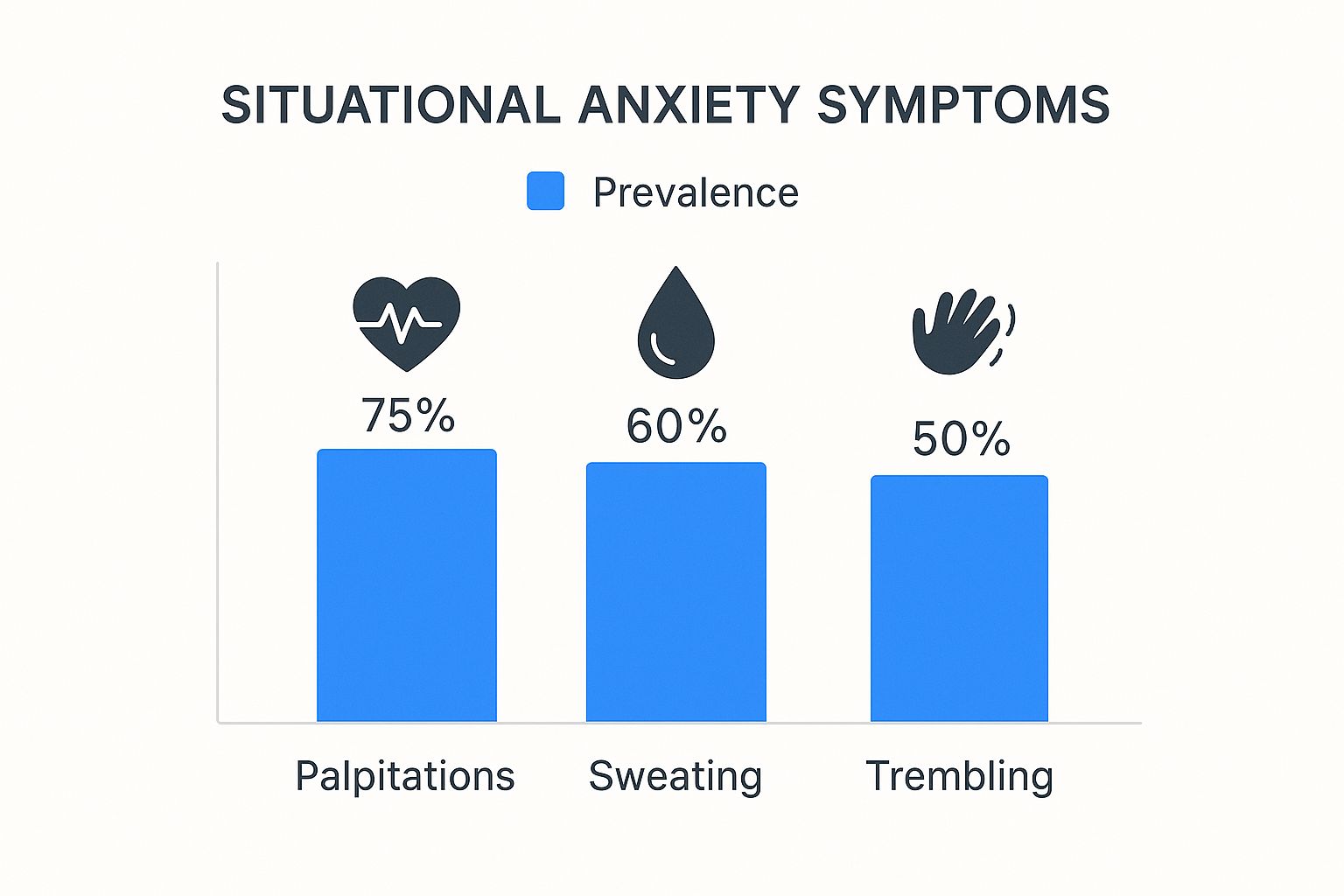
    This infographic shows how common certain physical symptoms are when situational anxiety hits, highlighting the intense bodily reaction to a trigger.
    Image

    As you can see, heart palpitations are a very common response. This reminds us how powerfully our minds and bodies are connected when we face a feared situation and how these triggers can affect our physical well-being.

    Situational Anxiety vs Other Anxiety Types

    This table can help clarify the differences between these conditions. Remember, this is an informational guide, not a substitute for a professional assessment.

    Feature Situational Anxiety (Specific Phobia) Generalised Anxiety Disorder (GAD) Social Anxiety Disorder
    Primary Fear A specific object or situation (e.g., flying, heights, enclosed spaces). Persistent, excessive worry about multiple things (e.g., health, work, family). Fear of being judged, scrutinised, or embarrassed in social situations.
    Trigger Direct exposure or anticipation of the specific trigger. Chronic and often free-floating; not tied to one specific thing. Social or performance-based situations (e.g., meetings, parties, eating in public).
    Duration of Worry Intense but generally limited to the time around the trigger. Occurs more days than not for at least six months. Persistent fear related to upcoming social events or interactions.
    Main Focus Avoiding the phobic trigger to prevent intense fear and panic. Managing uncontrollable worry and its physical symptoms, like fatigue. Avoiding social situations to escape judgement and embarrassment.

    Recognizing these distinctions can be empowering. It helps you name what you're feeling and describe it more accurately, whether you're navigating workplace stress, feelings of depression, or a specific fear.

    Building Resilience to Manage Anxiety

    Understanding situational anxiety is a great first step; the journey is about building your inner strength. Think of resilience as a muscle that gets stronger with practice. It helps you navigate life's challenges, including intense anxiety, with more balance and self-compassion.

    By equipping yourself with practical strategies, you can begin to manage the emotional and physical toll of anxiety. These tools can empower you to face triggers with more confidence and improve your overall well-being.

    Practical Strategies for Building Inner Strength

    One of the most effective tools is Cognitive Behavioural Therapy (CBT). This type of therapy helps you identify and reframe negative thought patterns that fuel anxiety. A therapist can also guide you through exposure therapy, where you gradually face your triggers in a safe, controlled way to build confidence.

    Mindfulness and deep-breathing exercises are also wonderful for calming your nervous system in the moment. Simple techniques can ground you, slow your heart rate, and bring a sense of calm. These practices are also great for managing chronic workplace stress and preventing burnout.

    "The greatest weapon against stress is our ability to choose one thought over another." – William James

    This quote captures the essence of building resilience. We can't always control external events, but we can learn to manage our responses. If you’re looking for more ways to support your journey, you might find it helpful to explore some therapeutic activities for mental health that can help nurture your mind.

    Your Path to Greater Well-Being

    Creating a personal toolkit for managing anxiety is about self-discovery and kindness. It involves finding what works for you and weaving small, positive habits into your daily life.

    • Mindful Moments: Start with just five minutes of mindfulness meditation each day to train your focus and quiet your mind.
    • Physical Movement: Regular exercise, even a short walk, is a proven way to reduce symptoms of both anxiety and depression.
    • Professional Support: Working with a counselling professional provides a safe space to explore your fears and develop coping strategies tailored to you.

    Remember that any online tools or assessments are for informational purposes only and are not a substitute for a professional diagnosis. The goal is to provide supportive takeaways that empower you to handle life's stressors and build a happier, more resilient life.

    Final Thoughts on Your Path Forward

    Image

    As we conclude, let's focus on the supportive steps you can take from here. By seeking to understand your anxiety, you've already taken a courageous step toward self-care.

    Reaching out for help is a sign of strength. Using tools like the situational anxiety ICD 10 code helps professionals provide the right support and clear the way for effective therapy.

    Embracing Your Unique Journey

    Your mental health journey is unique. Some days will be easier than others, and that is completely normal. The goal isn't a "cure," but the steady process of building resilience and self-awareness.

    Think of professional counselling as a safe space to explore your feelings and learn practical ways to cope with workplace stress, anxiety, and depression. A therapist can act as an experienced guide on your path.

    Managing anxiety is a journey, not a destination. Every step you take, no matter how small it feels, is a win. You're building a more balanced, fulfilling life, and your commitment to yourself is the most powerful tool you have.

    Gentle Reminders for the Road Ahead

    Treat yourself with the same kindness you would offer a friend. Acknowledge your progress and be patient with yourself during difficult moments.

    • You're not alone: Millions of people experience anxiety. Knowing this can reduce feelings of isolation that often accompany the struggle.
    • Support is available: Professional help is more accessible than ever. Platforms like DeTalks connect you with skilled therapists who understand.
    • Your well-being matters: Prioritizing your mental health is essential for being present in all areas of your life, from work to relationships.

    We hope you feel more informed, empowered, and a little less alone. With a clearer understanding of situational anxiety, you are better equipped to find the right support and move toward a life with more peace and happiness.

    Frequently Asked Questions

    It's natural to have questions as you navigate your mental health. Here are answers to some common queries about situational anxiety to provide more clarity on your journey to well-being.

    Is Situational Anxiety a Recognised Medical Condition?

    Yes, it is. While we may call it "situational anxiety" in daily conversation, the medical community formally classifies it within the situational anxiety ICD 10 framework. In this system, it is typically categorized as a specific phobia.

    This recognition validates your experience and is understood by doctors and therapists in India and globally. It also opens the door to effective support, such as targeted therapy and counselling, to help you manage your specific triggers.

    How Do I Know if I Need Therapy for My Anxiety?

    This is a personal question, but a good guideline is to consider its impact on your life. Is anxiety stopping you from doing things you enjoy or holding you back from professional or social opportunities?

    If you feel you are constantly battling distress from workplace stress or fear, professional support can make a significant difference. Counselling offers a confidential, non-judgmental space to explore these feelings and build resilience with practical coping strategies for anxiety or feelings of depression. Reaching out is a powerful step toward taking back control.

    Can Situational Anxiety Get Better?

    Yes, absolutely. With the right support, people can learn to manage situational anxiety and reduce its impact on their lives. There is every reason to be hopeful.

    Therapies like Cognitive Behavioural Therapy (CBT) have proven to be very effective. They help you challenge the thoughts that fuel fear, allowing you to gradually and safely face situations you once avoided. The goal is to build your confidence and skills so that anxiety no longer controls your life, empowering you to live more fully.


    At DeTalks, we can connect you with experienced professionals ready to support you on this journey. If you're ready to take the next step, you can explore our network of therapists today.


  • Navigating ADHD with Clarity: A Guide to ICD-10 Codes

    Navigating ADHD with Clarity: A Guide to ICD-10 Codes

    Understanding a health condition often starts with understanding the language doctors use. For Attention-Deficit/Hyperactivity Disorder (ADHD), this language includes a specific set of codes from the International Classification of Diseases, 10th Revision (ICD-10).

    In India and across the globe, the main ICD-10 code for ADHD is found in the F90 series. This code helps professionals communicate clearly about a person’s needs, which is a vital first step in creating a supportive plan for their well-being.

    A Practical Guide to ADHD ICD-10 Codes

    For anyone navigating a new diagnosis, clinical terms and codes can feel a little intimidating. However, knowing the ICD-10 code for ADHD is more than an administrative detail; it's a shared language that helps everyone involved, from doctors to therapists, understand an individual's unique journey. Getting this right is the first step toward effective support and therapy.

    This visual guide offers a gentle reminder of the focused effort that everyday tasks can require for individuals managing ADHD.

    As the image shows, maintaining concentration can take immense internal effort, highlighting the need for compassion and understanding.

    To help clarify, here is a quick reference table of the most common ICD-10 codes for ADHD. It’s a simple starting point for understanding how different experiences with ADHD are documented.

    ADHD ICD-10 Quick Reference Table

    ICD-10 Code ADHD Presentation Brief Description
    F90.0 Attention-deficit hyperactivity disorder, combined type Used when challenges with both inattention and hyperactivity-impulsivity are present.
    F90.1 Hyperkinetic conduct disorder Indicates ADHD symptoms alongside persistent behaviours that are disruptive or aggressive.
    F90.8 Other hyperkinetic disorders A code for presentations that fit the ADHD profile but don't perfectly match other categories.
    F90.9 Hyperkinetic disorder, unspecified Used when a diagnosis is clear, but more information is needed to specify the type.

    This table provides a snapshot, but it's important to remember that a thoughtful assessment by a professional is always needed to find the most accurate code for an individual's situation.

    Key ADHD Codes Used in India

    In India, just as in many parts of the world, clinicians use the ICD-10 framework to understand and document ADHD. The codes they use reflect the different ways ADHD can appear in a person's life.

    Here’s a simple breakdown of the key codes:

    • F90.0 (Attention-deficit hyperactivity disorder, combined type): This is the most common code, used when a person experiences a blend of inattention (like difficulty focusing) and hyperactivity/impulsivity (like fidgeting or acting without thinking).
    • F90.1 (Hyperkinetic conduct disorder): This code is used when ADHD symptoms are present alongside patterns of behaviour that are consistently disruptive or defiant.
    • F90.8 (Other hyperkinetic disorders): This category is for individuals who clearly show signs of ADHD, but their specific symptoms don't neatly fit the other definitions.
    • F90.9 (Hyperkinetic disorder, unspecified): This code is often used during initial consultations when a diagnosis is confirmed, but further details are needed to be more specific.

    For those looking to learn more, you can discover more insights about ADHD codes in India on sprypt.com, which offers additional context.

    Understanding the F90 Code Series

    The F90 series in the ICD-10 is the designated section for "Hyperkinetic disorders," which is the clinical term for ADHD. This classification allows healthcare professionals to document and communicate a person's specific challenges using a shared, precise language.

    Each code within the F90 series tells a slightly different story, capturing the unique ways ADHD can affect a person. This detail is important because it helps shape a supportive plan and can anticipate related challenges like workplace stress or anxiety, paving the way for a holistic approach to well-being.

    The Role of F90 in Diagnosis

    The F90 series provides a framework for translating observed behaviours—like inattention, hyperactivity, and impulsivity—into a standardized code. This shared language is vital for ensuring a person gets the right kind of support for their needs. It is important to remember that assessments are informational and are one part of a comprehensive evaluation, not a final diagnosis in themselves.

    A correct code ensures that everyone on the support team, from therapists to teachers, is on the same page. A solid understanding of the diagnostic criteria is essential for using these codes accurately. To learn more about the evaluation process, you can explore this detailed guide to the ADHD diagnostic criteria.

    Beyond the Codes to Personal Well-being

    It's so important to remember that behind every icd 10 code for adhd is a person navigating their world. The goal of a diagnosis isn't to apply a label, but to open doors to support that builds resilience and improves quality of life. Understanding how symptoms connect to related feelings like anxiety or depression is often the first step toward developing helpful coping strategies.

    By clarifying the picture with these codes, clinicians and individuals can work together on a path toward better mental health. The journey is not about finding a cure, but about developing self-compassion, managing stress, and nurturing overall happiness and well-being.

    A Closer Look at ADHD Presentations and Real-Life Scenarios

    Image

    When we talk about the ICD-10 code for ADHD, we are looking at a system that honours the different ways ADHD can show up. Understanding these variations is key to appreciating how unique each person's experience is.

    This shared language is invaluable for clinicians structuring effective therapy and counselling. An assessment should be seen not as a restrictive label, but as an informational starting point—a roadmap for a journey toward greater understanding and well-being.

    F90.0: The Inattentive Presentation

    This code is used when a person's main challenges relate to inattention, without significant signs of hyperactivity. Because these symptoms can be less outwardly disruptive, they are sometimes missed, especially in girls and adults.

    • Scenario 1: An employee consistently misses deadlines despite working hard. They find it difficult to organise tasks and are easily distracted, which can lead to significant workplace stress and feelings of burnout.
    • Scenario 2: A student often seems lost in thought, has a messy desk, and frequently loses their homework. They may be seen as quiet or unmotivated, when the real struggle is with maintaining mental focus.

    When these challenges are not understood, they can be mistaken for carelessness, which can harm a person's self-esteem and contribute to anxiety or depression. Building awareness and compassion is key.

    F90.1: The Hyperactive-Impulsive Presentation

    Here, the defining traits are high energy, a persistent feeling of restlessness, and a tendency to act on impulse. While this is a common picture of ADHD in children, these traits also continue into adulthood, though they may look different.

    • Scenario 1: A young child who is constantly fidgeting, leaves their seat when expected to sit, and often interrupts others. It can feel as though they have an internal motor that is always on.
    • Scenario 2: An adult might struggle in long meetings, constantly tap their feet, or make quick decisions about their finances or career without thinking through the consequences.

    F90.2: The Combined Presentation

    The most common presentation, F90.2 is used when a person shows clear signs of both inattentive and hyperactive-impulsive challenges. They navigate a blend of symptoms from both areas.

    • Scenario: A teenager has great difficulty following multi-step instructions for a school project (inattention). At the same time, they talk excessively and often interrupt the teacher (hyperactivity-impulsivity), creating challenges at school and home.

    Other and Unspecified ADHD: Navigating the Nuances

    ADHD doesn't always fit into neat boxes. Sometimes, a person's symptoms don't align perfectly with the three main presentations. For these situations, the ICD-10 code for ADHD system provides specific codes to ensure accurate and thoughtful documentation.

    These aren't just catch-all categories. Using F90.8 (Other hyperkinetic disorders) or F90.9 (Hyperkinetic disorder, unspecified) is a deliberate clinical choice. It reflects an understanding that everyone's experience is unique, and an accurate starting point is key to getting the right support.

    When to Use F90.8 and F90.9

    Deciding between these two codes depends on the information available during an assessment. They are important tools that prevent uncertainty from becoming a barrier to care.

    • F90.8 (Other hyperkinetic disorders): This code is for when the signs of a hyperkinetic disorder are clear, but the mix of symptoms is atypical. The person may not meet the full criteria for the other types, but the clinical picture strongly indicates ADHD.

    • F90.9 (Hyperkinetic disorder, unspecified): This code might be used when a clinician is confident in the ADHD diagnosis but lacks enough information to specify the type. This can happen in an initial consultation before a full evaluation is complete.

    Using these codes correctly keeps the path to therapy or counselling open. It means a person can start getting help for related challenges like workplace stress or anxiety, supporting their journey toward building resilience and self-awareness.

    Why Accurate ADHD Coding Is Essential for Care

    Pinpointing the correct ICD-10 code for ADHD is much more than an administrative task. It is the foundation of effective mental health support, creating a clear, shared language about a person's specific challenges. This precision directly shapes their care plan and is crucial for connecting them to the right therapy or counselling.

    Getting the coding right opens the door to necessary resources and support. In India, for example, the F90 codes are fundamental for clinical management and health policy. When coding is not specific, it can have real-world consequences; insurance reimbursement denials can increase, which highlights how much specificity matters.

    Connecting Codes to Well-Being

    Thoughtful documentation serves a purpose deeper than just meeting requirements. It validates a person's lived experience and provides a clear pathway to support for related struggles, such as workplace stress, anxiety, or depression.

    When a diagnosis is documented with care, it becomes easier to build a holistic plan that nurtures well-being. This plan can then address not only the core symptoms of ADHD but also their emotional impact. To learn more, it can be helpful to explore clinical documentation improvement strategies.

    The ultimate goal is to foster resilience, self-compassion, and long-term well-being. A precise diagnosis is not a label; it's a key that unlocks a personalised map for navigating challenges and building a more fulfilling life.

    Coding Common Co-occurring Conditions

    Image

    It is common for ADHD to exist alongside other conditions. Many people with ADHD also manage experiences like anxiety, depression, or learning disorders. Clinicians use additional ICD-10 codes to create a complete and accurate picture of a person’s health.

    This approach is not about applying more labels, but about acknowledging the full scope of a person's experience to ensure every challenge is seen and supported. Using an ICD-10 code for ADHD alongside codes for co-occurring conditions is key to providing truly integrated care.

    Why Coding Co-occurring Conditions Matters

    A person might be dealing with significant workplace stress that fuels their anxiety, all while managing their ADHD symptoms. Coding only for ADHD would miss other crucial parts of their experience. Documenting these overlapping conditions allows therapy and counselling to support the whole person, not just one aspect.

    By recognising and coding these interconnected challenges, healthcare providers can develop a plan that genuinely fosters resilience. It's about creating a supportive journey focused on long-term well-being, happiness, and personal growth.

    A Quick Look at Common Co-occurring Conditions and Codes

    Here are a few examples of conditions that frequently appear alongside ADHD, with their typical ICD-10 codes:

    • Anxiety Disorders (F40-F41): These codes are used when persistent worry or fear significantly impacts daily life alongside ADHD.
    • Depressive Episodes (F32): This code documents periods of low mood or loss of interest, which can be intensified by the challenges of managing ADHD.
    • Specific Learning Disorders (F81): It is common for individuals with ADHD to have difficulties with reading, writing, or maths. Coding for these ensures the right educational and therapeutic support is in place.

    Common Co-occurring Conditions and Their ICD-10 Codes

    To give you a clearer reference, here is a table of common conditions that often appear with ADHD. This is not an exhaustive list, but it covers some of the most frequent pairings.

    Condition Common ICD-10 Code(s) Relevance to ADHD
    Anxiety Disorders F41.1 (Generalised Anxiety Disorder), F40.1 (Social Phobia) The executive function challenges of ADHD can create situations that trigger or worsen anxiety.
    Mood Disorders F32 (Depressive Episode), F33 (Recurrent Depressive Disorder) Emotional regulation challenges in ADHD can overlap with or contribute to symptoms of depression.
    Oppositional Defiant Disorder (ODD) F91.3 Often seen in children with ADHD, characterised by a pattern of angry/irritable mood and defiant behaviour.
    Conduct Disorder (CD) F91.1, F91.2 A more severe pattern of behaviour where the rights of others or major societal norms are violated.
    Tic Disorders F95.2 (Tourette's Syndrome) A significant overlap exists between ADHD and tic disorders, suggesting a shared neurobiological basis.
    Specific Learning Disorders F81.0 (Reading), F81.2 (Maths), F81.8 (Writing) Difficulties with attention and focus directly impact the ability to acquire academic skills.
    Substance Use Disorders F10-F19 Individuals with ADHD may be at a higher risk due to impulsivity and attempts to self-soothe symptoms.

    Understanding these potential overlaps is vital for providing compassionate care. Proper coding does more than satisfy administrative needs; it forms the foundation of a comprehensive treatment strategy that sees the whole person.

    Your Questions About ADHD Coding, Answered

    When you're trying to make sense of a diagnosis for yourself or a loved one, the world of medical coding can feel complex. It’s natural to have questions, and getting clear answers is an important part of the journey toward well-being. Here are some common questions about ICD-10 codes for ADHD.

    How Is an Official Diagnosis Made?

    A diagnosis is made through a careful and thorough evaluation by a qualified professional, like a psychologist or psychiatrist. They will look for consistent patterns of behaviour across different settings—such as home, school, or the workplace.

    It’s helpful to view assessments as informational tools that gather valuable insights. They are one part of a larger process that a clinician uses to understand the complete picture and are not a diagnosis on their own.

    Do Adults and Children Use the Same ADHD Codes?

    Yes, the same F90 series of ICD-10 codes applies to both adults and children. What changes is how the symptoms may appear at different stages of life.

    For example, an adult’s hyperactivity might not involve running and climbing. Instead, it could be an internal feeling of restlessness, difficulty relaxing, or a sense of being constantly on the go. The underlying code is the same, but the clinical observation is tailored to the person's age.

    What's the Key Difference Between ICD-10 and DSM-5?

    Both are important diagnostic manuals, but they have different origins. The ICD-10 is published by the World Health Organisation, while the DSM-5 is from the American Psychiatric Association.

    While their criteria for ADHD are very similar, clinicians in India and many other countries use the ICD-10 for official medical coding. Understanding these details can help you feel more informed and empowered on your path to finding the right support.


    At DeTalks, we believe that understanding is the first step toward building resilience and finding balance. We can help you connect with qualified therapists and access science-backed assessments to better understand your mental health. Find supportive takeaways and resources on your journey at https://detalks.com.

  • Discover Psychological Facts About Crushes in India

    Discover Psychological Facts About Crushes in India

    Have you ever wondered why a particular person suddenly occupies your every thought? A crush can be a magical and confusing experience, filled with excitement but also potential stress and anxiety. Understanding the science behind these intense feelings offers clarity and helps you navigate them with greater self-awareness.

    These feelings are driven by powerful psychological forces, from your brain's chemical reactions to subtle mental shortcuts. This article explores key psychological facts about crushes, examining both the exhilarating aspects and the challenges, like workplace stress from an office crush. We'll also touch on how building resilience and well-being can help manage this emotional rollercoaster.

    Deeper frameworks like attachment styles also shape our attractions. To explore this further, you can delve into how attachment styles and self-worth influence our romantic inclinations. The insights here are for informational purposes, not diagnosis, designed to empower you with a better understanding of your emotional landscape.

    1. The Mere Exposure Effect: Familiarity Breeds Attraction

    Have you noticed your feelings for someone growing stronger the more you see them? This is the Mere Exposure Effect, a psychological principle explaining that we tend to like people simply because they are familiar to us. This is a fundamental fact about crushes, showing why closeness and regular contact are so powerful.

    Each time we see someone, our brain processes their presence with more ease, creating a subtle feeling of comfort. Over time, we start to associate this pleasant, safe feeling with the person, which can pave the way for a crush to develop. It is your brain recognising them as a familiar part of your world.

    Real-World Examples

    The Mere Exposure Effect is common in daily life, especially in India where community and workplace interactions are frequent. An office romance can blossom from months of sharing a workspace, just as a classmate might seem more appealing after many shared lectures. Even a neighbour can become the object of affection after repeated, brief encounters.

    This effect highlights a key insight: Attraction isn't always a dramatic, love-at-first-sight event. More often, it's a quiet, gradual process built on simple, consistent presence.

    How to Apply This Insight

    Understanding this principle can help you navigate your social interactions with more awareness.

    • Be Mindfully Present: Position yourself in shared spaces naturally, like joining a club or a group activity where your crush is present. The goal is genuine interaction, not forced encounters.
    • Focus on Quality Interactions: While frequency matters, the quality of interaction is key. A simple, warm greeting or a brief, positive conversation is more effective than just being a silent presence.
    • Use Social Media Thoughtfully: Seeing someone's profile repeatedly can intensify your feelings. Engage with their content in a low-pressure way, like a thoughtful comment on a post that genuinely resonates with you.

    By understanding the Mere Exposure Effect, you can see how familiarity quietly builds the foundation for attraction.

    2. The Dopamine Rush Phenomenon: The Brain’s Reward System

    That exhilarating feeling you get from a simple interaction with your crush is driven by your brain chemistry. This excitement comes from dopamine, a chemical linked to pleasure, motivation, and reward. When we have a crush, our brain’s reward system releases dopamine in response to that person.

    This process is amplified by unpredictable interactions, like wondering if they’ll text back or smile at you. Because the reward isn't guaranteed, our brain craves it more intensely. Each positive signal feels like a win, creating a powerful cycle of anticipation that can impact our emotional well-being.

    The Dopamine Rush Phenomenon

    Real-World Examples

    You’ve likely experienced the dopamine rush without realising it. Think of the sudden excitement when your crush likes your social media post or the simple anticipation of seeing them. That feeling is your brain’s reward circuit lighting up, and it's a universal experience.

    This effect reveals that the intensity of a crush is deeply rooted in our brain’s fundamental reward mechanisms, making the emotional highs feel incredibly potent and desirable.

    How to Apply This Insight

    Understanding dopamine’s power can help you manage these intense feelings and maintain your emotional well-being.

    • Recognise the Feeling: Acknowledge when you’re experiencing a dopamine high. Simply naming the feeling can help you respond thoughtfully instead of impulsively.
    • Maintain Balance: Invest time in other activities and friendships that bring you joy. This creates other sources of positive feelings, reducing your reliance on your crush for happiness.
    • Practise Mindfulness: When feelings of anticipation or anxiety become overwhelming, mindfulness techniques like deep breathing can help ground you and calm your nervous system.
    • Set Healthy Boundaries: Limit how often you check their social media. Constant checking can increase feelings of stress and anxiety, feeding an unhealthy cycle.

    3. The Halo Effect in Romantic Attraction

    Do you ever find yourself thinking your crush is perfect in every way? This is explained by the Halo Effect, a mental shortcut where one positive trait makes us see all their other qualities positively. If we find someone physically attractive or funny, we may unconsciously assume they are also kind and intelligent.

    This idealisation is a key reason why crushes can feel so intoxicating. We aren't just attracted to the person we see, but also to the perfect version of them our mind has created. This can sometimes lead to disappointment when we discover they are a complex human with flaws, just like anyone else.

    Real-World Examples

    The Halo Effect is constantly at play in our social lives. You might assume a physically attractive person is also successful, or admire someone's professional achievements and believe they are emotionally mature. This happens everywhere, from university campuses in Delhi to corporate offices in Mumbai.

    This insight reveals that the intensity of a crush often comes from the story we tell ourselves about a person, not just from who they actually are.

    How to Apply This Insight

    Understanding the Halo Effect helps you approach your feelings with more clarity and realism.

    • Look for Evidence: Instead of assuming your crush has certain positive traits, consciously look for real-world proof. Observe how they interact with others in different situations.
    • Explore Different Contexts: Get to know them in various settings. Seeing them in different environments, both relaxed and stressful, gives you a more rounded view of their personality.
    • Ask Deeper Questions: Move beyond surface-level chats. Gently inquire about their values and goals to understand who they are beneath the halo.
    • Acknowledge Your Bias: Simply being aware that you might be idealising your crush is a powerful first step. It allows you to pause and evaluate your feelings more realistically.

    4. Stress Response and Attraction Confusion

    Have you ever felt your heart pound during an exciting event and suddenly developed feelings for the person next to you? This could be due to a fascinating psychological fact: our brains can mistake feelings of arousal from stress or excitement for romantic attraction. This is especially relevant in high-pressure environments common in India's workplaces and bustling cities.

    When we are in an intense situation, our body produces a stress response: a racing heart and a rush of adrenaline. If someone is with us, our brain might incorrectly label these physical symptoms as attraction. Instead of thinking, "This situation is making me anxious," our mind concludes, "This person is making my heart race."

    Stress Response and Attraction Confusion

    Real-World Examples

    This phenomenon is more common than you might think. A classic 'office crush' can blossom during a period of intense workplace stress and tight deadlines, where shared pressure creates a powerful bond. Even sharing a scary movie or a thrilling adventure can create the conditions for your brain to confuse fear with romantic feelings.

    This insight reveals that the context of our interactions is just as important as the person themselves. Intense environments can act as a catalyst, amplifying or even creating feelings of attraction.

    How to Apply This Insight

    Understanding this can help you gain clarity on your feelings and support your emotional well-being.

    • Observe Your Feelings in Calm Settings: Before acting on a crush that developed in a high-stress environment, try spending time with them in a relaxed situation. See if the spark remains when the external excitement is gone.
    • Wait for Stress to Subside: If a crush forms during a period of intense work stress or anxiety, give yourself time for things to normalise. True attraction will persist beyond the stressful event.
    • Seek Genuine Connection: Ask if you enjoy the person's company during mundane activities, like grabbing a quiet coffee. A lasting connection is often built on shared values and personality, not just shared adrenaline.

    By recognising how stress can influence attraction, you can better understand your feelings and nurture authentic connections.

    5. The Reciprocity Principle: Liking Those Who Like Us

    Have you ever found your interest in someone growing the moment you suspected they might like you back? This is the Reciprocity Principle, which suggests we have a natural tendency to like people who show signs of liking us first. This creates a positive feedback loop where perceived interest fuels our own attraction.

    When someone shows interest in us, it affirms our value and makes us feel good. Our brain associates this positive feeling with the person, making them seem more appealing. This is a fundamental social mechanism that helps build connections and mutual trust.

    Real-World Examples

    This principle is seen everywhere. Imagine your feelings for a coworker intensifying after they praise your idea in a meeting. Or think of how your attraction to someone grows when they start saving you a spot in your favourite class. Even simple acts can deepen your feelings if they signal interest.

    This insight reveals that attraction is often a two-way street. The belief that our feelings might be returned can be the very catalyst that strengthens them.

    How to Apply This Insight

    Understanding reciprocity can help you decode your feelings and navigate social cues with more clarity.

    • Look for Consistent Patterns: A single smile might be simple friendliness. Look for multiple, consistent signs of interest, like them regularly initiating chats, before assuming reciprocity.
    • Gauge Their Baseline: Observe how your crush interacts with others. If they are equally friendly with everyone, their behaviour towards you may not be a special sign of interest.
    • Be Mindfully Open: Showing subtle, genuine interest yourself can initiate the cycle of reciprocity. A sincere compliment or a thoughtful question can open the door for them to reciprocate.
    • Avoid Over-analysing: It's easy to get lost trying to interpret every little sign. If you feel a strong connection, gentle and direct communication is often the clearest way forward when the time feels right.

    6. Parasocial Relationships and Celebrity Crushes

    Have you ever felt a genuine emotional connection to a celebrity, an influencer, or a fictional character? This is a parasocial relationship, a one-sided bond with media figures we've never met. This psychological fact explains why these crushes can feel surprisingly real and intense.

    Our brains are wired for social connection and don't always distinguish between real and screen-based interactions. When we repeatedly see a celebrity or follow a character's journey, our mind processes this as a form of social interaction. This creates a sense of intimacy and familiarity, activating the same brain pathways as real-life relationships.

    Real-World Examples

    Parasocial relationships are a common part of modern life, from Bollywood fans in India to K-pop followers globally. Think of the affection fans feel for a musician whose lyrics seem to speak directly to them. This also extends to the bonds people form with influencers who share their lives daily.

    This phenomenon reveals a fascinating aspect of human psychology: our capacity for connection is so strong that it can thrive even without reciprocation, finding a home in the one-sided world of media.

    How to Apply This Insight

    Understanding parasocial relationships can help you navigate these feelings in a healthy and balanced way.

    • Maintain Healthy Perspective: Gently remind yourself of the one-sided nature of the connection. Enjoy the admiration and inspiration, but recognise the difference between a media persona and a real person.
    • Use Your Crush as Inspiration: Let your admiration for a public figure motivate you. If you admire their creativity or confidence, channel that into your own personal growth.
    • Balance with Real Connections: Ensure you are also investing time and energy into your real-life relationships with friends and family. Parasocial bonds should not replace genuine, mutual connections.
    • Recognise Potential Impacts: Be mindful if a celebrity crush starts to negatively affect your real-world relationships or self-esteem. If it does, consider therapy or counselling to refocus on your immediate world.

    7. The Scarcity Effect in Romantic Interest

    Have you ever found yourself more drawn to someone who seems a little distant or hard to get? This is the Scarcity Effect, a principle stating that we place a higher value on things we perceive as rare or difficult to obtain. This can dramatically intensify our feelings of attraction and lead to anxiety.

    When someone doesn’t immediately reciprocate our interest, our brain interprets their attention as a scarce and therefore more valuable resource. The pursuit becomes more compelling, and the potential reward feels more significant. This psychological trigger can amplify a mild interest into a full-blown crush.

    Real-World Examples

    The Scarcity Effect often fuels the classic "playing hard to get" dynamic. Consider the intense crush you might develop on someone who seems "out of your league" or is emotionally unavailable. A person who is mysterious or selective with their attention can seem far more intriguing than someone who is openly interested.

    This highlights a crucial insight: The intensity of a crush is not always a reliable indicator of a healthy connection. Sometimes, it’s just our brain reacting to the perceived rarity of someone's affection.

    How to Apply This Insight

    Understanding this principle can help you evaluate your feelings more objectively and build healthier connections.

    • Evaluate Beyond Availability: When you feel a strong pull towards someone unavailable, pause and ask if the attraction is based on their actual qualities or just the challenge. Focus on their values, kindness, and compatibility instead.
    • Recognise Manipulation vs. Authenticity: Be aware that some people may intentionally create a sense of scarcity. Prioritise connections with those who show genuine, consistent interest.
    • Value Reciprocation: Don't mistake a lack of interest for a sign of high value. A healthy relationship is built on mutual effort, not a one-sided pursuit, and supports your overall well-being.

    By understanding the Scarcity Effect, you can navigate attraction with greater awareness, investing your emotional energy in connections that are truly promising.

    8. The Proteus Effect and Identity Shifting

    Have you ever found yourself suddenly interested in a band you’d never heard of, just because your crush mentioned them? This is the Proteus Effect, where we unconsciously alter our behaviours and interests to align with what we believe our crush finds attractive. It shows how a crush can influence our identity.

    This temporary identity shift is a subconscious effort to increase our chances of being liked back. Your brain identifies the qualities your crush appreciates and encourages you to adopt them to create a sense of similarity. This is an adaptive mechanism aimed at fostering a bond and signalling "we are the same."

    Real-World Examples

    The Proteus Effect is common in the early stages of a crush. Someone might start going to the gym after learning their crush is a fitness enthusiast. Another example is changing your fashion sense to match what you think your crush values, a relatable experience for many young people in India.

    This effect reveals how deeply a crush can influence our identity, pushing us to explore new versions of ourselves in the hope of winning someone's affection.

    How to Apply This Insight

    Understanding this tendency can help you navigate your feelings with greater self-awareness and authenticity.

    • Maintain Self-Awareness: Acknowledge when your interests are changing. Ask yourself if this new hobby genuinely resonates with you or if it’s solely to attract your crush.
    • Distinguish Growth from People-Pleasing: Use the crush as inspiration for positive growth and building resilience. But avoid changes that contradict your core values just for validation.
    • Communicate Authentically: Don’t hide your genuine interests. True connection is built on authenticity, not a manufactured persona. Share your real passions and see if there's a genuine spark.

    By recognising the Proteus Effect, you can harness its motivational power for positive self-improvement while staying true to yourself.

    Psychological Facts About Crushes: 8-Item Comparison

    Item Implementation Complexity 🔄 Resource Requirements ⚡ Expected Outcomes 📊 Ideal Use Cases 💡 Key Advantages ⭐
    The Mere Exposure Effect Low – natural, unconscious process Minimal – repeated exposure needed Increased attraction through familiarity Frequent physical or social interaction settings Builds natural connections; works without effort
    The Dopamine Rush Phenomenon Medium – depends on unpredictable positive cues Moderate – interaction variability Heightened excitement and craving for interaction Early-stage romantic interactions Enhances motivation and memory of positive moments
    The Halo Effect in Romantic Attraction Low – automatic cognitive bias Minimal – perceptual Idealized perceptions, intensified attraction Initial attraction and first impressions Facilitates bonding, creates positive impressions
    Stress Response and Attraction Confusion Medium – occurs under emotional arousal Moderate – novel or stressful events Intense but sometimes misleading romantic feelings Exciting or high-stress environments Sparks connections in adventurous situations
    The Reciprocity Principle Medium – relies on social cue interpretation Moderate – requires social interactions Mutual attraction feedback loops, increased confidence Situations with perceived mutual interest Builds confidence, identifies compatibility quickly
    Parasocial Relationships and Celebrity Crushes Low – one-sided, media-based Low – media consumption Genuine emotional bonds despite lack of real interaction Media and celebrity fandom Safe exploration of romantic feelings; emotional comfort
    The Scarcity Effect in Romantic Interest Medium – psychological assessment Low – perception-based Increased value of unavailable partners, intensified desire Pursuit of selective or elusive partners Motivates growth and passion in dating
    The Proteus Effect and Identity Shifting Medium – unconscious behavior changes Moderate – requires identity shifts Temporary identity modifications to align with crush’s preferences Self-presentation and impression management Encourages new experiences and personal growth

    Navigating Your Feelings with Clarity and Compassion

    The journey through a crush is a whirlwind of emotions, but it is far from random. The psychological facts about crushes reveal a fascinating interplay of brain chemistry and human needs. Understanding these mechanisms empowers you to step back from the intensity and observe your feelings with greater awareness.

    Recognising these patterns is the first step towards navigating them effectively and building emotional resilience. When you understand that proximity fuels attraction or scarcity can amplify interest, you gain control over your emotional responses. This awareness is crucial for enjoying the happiness of a crush without letting anxiety disrupt your overall well-being.

    From Insight to Action: Supportive Takeaways

    The goal isn't to remove the magic from attraction but to approach it with wisdom and self-compassion.

    • Practise Mindful Observation: When a crush develops, pause and reflect. Ask yourself: Is this attraction influenced by frequent exposure, stress, or something else? Acknowledging the drivers can ground you in reality.
    • Challenge Your Assumptions: Actively question the Halo Effect. Recognise that your crush is a whole person with flaws and complexities, just like you. This balanced perspective can prevent disappointment.
    • Focus on Your Own Growth: Crushes often highlight what we admire. Use these feelings as a catalyst for personal development. You might consider improving your emotional intelligence to gain clarity.

    Understanding the psychology of crushes transforms them from a source of potential stress into an opportunity for self-discovery. These experiences teach you about your emotional patterns, boost your resilience, and prepare you for healthier connections.

    If you find that crushes consistently trigger significant anxiety, stress, or feelings of depression, exploring these patterns with professional therapy or counselling can be helpful. It offers a safe space to build self-esteem and develop skills for your long-term well-being. Seeking support is a powerful act of self-care.


    Ready to explore your emotional patterns with professional guidance? DeTalks connects you with qualified therapists who can help you navigate relationship challenges, manage anxiety, and build lasting resilience. Start your journey towards greater self-awareness and healthier connections today at DeTalks.

  • How to Improve Communication: Building Stronger, More Meaningful Connections

    How to Improve Communication: Building Stronger, More Meaningful Connections

    Improving your communication is about more than just getting your point across. It’s about building genuine connections, listening with intention, and expressing yourself with clarity and kindness. These skills are essential for strong relationships and are a powerful way to support your own well-being.

    The Foundation of Meaningful Connection

    Communication is the thread connecting every part of our lives, from professional projects to personal relationships. When this thread weakens, misunderstandings can lead to workplace stress, anxiety, or feelings of isolation. Learning how to improve communication is a profound step toward better mental health.

    The first step is to see communication as a two-way street that requires deep listening, not just talking. In today’s fast-paced world, especially in contexts like India where daily pressures are high, it’s easy to slip into autopilot during conversations. We hear words but often miss the feelings behind them, leading to unresolved tension.

    Building a Stronger Communicative Core

    Getting better at this takes conscious effort. It’s about creating a safe space where people feel heard and respected, which is key to building resilience against life's challenges. For more strategies, this guide on effective communication in relationships is a great resource.

    Here are a few core principles to start with:

    • Empathy Before Ego: Try to understand the other person's perspective before forming your reply. This simple shift can lower defenses and build a bridge toward connection.
    • Clarity and Simplicity: Use straightforward language to get your message across. A clear, honest message is always more powerful than a complicated one.
    • Patience and Practice: No one gets this right every time. Be patient with yourself and others, and view every conversation as a chance to learn and grow.

    Remember, the goal isn't to win an argument. It’s to deepen your understanding and strengthen the connection you share.

    To get you started, here is a quick summary of foundational strategies you can begin using today.

    Quick Guide to Better Communication

    Strategy Why It Matters Simple Action to Start Today
    Active Listening Shows respect and ensures you fully understand the other person's point of view before responding. Put your phone away. Next time someone talks to you, just listen without planning what you'll say next.
    Notice Nonverbal Cues A huge part of communication is unspoken. Body language and tone can reveal more than words. Pay attention to someone's posture and facial expressions during your next conversation. Do they match their words?
    Give Clear Feedback Vague feedback causes confusion. Specific, constructive comments lead to real improvement. Instead of saying "good job," try "I really liked how you handled that client's question with such patience."

    Ultimately, working on your communication is an act of compassion for yourself and others. As you build these skills, you invest in your own emotional well-being, reducing anxiety and making stress more manageable.

    If you feel stuck, remember that professional support from therapy or counselling can offer a safe space to practice and untangle communication habits. These supports offer helpful tools, not a diagnosis, for building a happier, more resilient you—one conversation at a time.

    Mastering the Art of Active Listening

    Real connection isn't just about what you say; it’s about how well you listen. Active listening is a deliberate choice to listen to understand, not just to wait for your turn to talk. This shift in focus is one of the most powerful things you can do to build stronger relationships.

    When people feel genuinely heard, it builds trust and a sense of psychological safety. This foundation is crucial for everything from handling workplace stress to navigating a personal disagreement. It turns a simple conversation into an opportunity for true connection and happiness.

    Beyond Hearing Words to Understanding Meaning

    At its heart, active listening is about curiosity. It means setting your own judgments aside to fully explore the other person's perspective. This is especially important in emotional conversations, as it can de-escalate tension and prevent misunderstandings.

    Let’s break down a few practical techniques you can start using today:

    • Paraphrase and Summarise: After someone shares a thought, try saying it back in your own words. For example, "It sounds like the deadline is causing stress because you're waiting on key information. Is that right?" This shows you're engaged and gives them a chance to clarify.
    • Ask Open-Ended Questions: Avoid questions with a simple "yes" or "no" answer. Instead of "Are you upset?" you could ask, "How are you feeling about all of this?" This opens the door for a more honest and detailed response.
    • Acknowledge Their Feelings: You don't have to agree with someone to validate their emotions. A simple phrase like, "It sounds like that was a really frustrating experience," demonstrates empathy and compassion, which helps build emotional resilience.

    This visual captures the flow of a genuinely engaged conversation, where listening is just as active as speaking.

    Image

    This image highlights that great communication is a dynamic exchange. Focused listening creates space for clearer expression and mutual understanding.

    Creating a Space for Honest Dialogue

    The first and most important step is to remove distractions. Putting your phone away sends a powerful non-verbal message: "I value you and what you have to say." This simple act can reduce any anxiety the other person might be feeling.

    Imagine a tense chat with a colleague over a missed deadline. Instead of defending yourself, try pausing and saying, "Talk me through what happened from your perspective." That small shift can turn a potential conflict into a problem-solving session, strengthening your working relationship and boosting team well-being.

    The goal of active listening isn’t to gather ammunition for your rebuttal; it’s to understand the other person’s world so completely that they feel seen and respected.

    This skill improves all interactions, from catching up with a partner to brainstorming with your team. To dive deeper, resources like What Is Active Listening are a fantastic place to start.

    If you find it hard to stay present in conversations due to stress or other concerns, it may be helpful to explore why. Sometimes, challenges like anxiety or depression can make it difficult to focus. Remember, assessments are informational, not diagnostic, but reaching out for therapy or counselling is a proactive step toward building stronger mental health.

    Decoding Unspoken Language and Nonverbal Cues

    So much of what we communicate has nothing to do with words. Our posture, tone of voice, and facial expressions reveal our true emotional state. Understanding this silent language is key to learning how to improve communication effectively.

    This skill is critical for your well-being. When your body language doesn't match your words, it can create mistrust and lead to stress or anxiety. Authentic connection comes from aligning what you say with what you show.

    Image

    Reading the Room to Build Rapport

    Have you ever heard someone say "yes" while their body language screamed "no"? This disconnect is where misunderstandings grow, fueling workplace stress and burnout. Paying attention to these signals is a form of empathy.

    It helps you notice hesitation or excitement that isn't being put into words. While cultural nuances exist, like the head wobble in India, a closed-off posture is an almost universal sign of resistance. This awareness allows for more compassionate and effective conversations.

    To start building stronger rapport, focus on these key areas:

    • Body Posture: An open stance with relaxed shoulders signals approachability. Slouching or turning away can suggest disinterest or insecurity.
    • Facial Expressions: A genuine smile involves the eyes, not just the mouth. Notice a furrowed brow or a tight jaw, as these can be signs of stress or concern.
    • Tone of Voice: The same words can have different meanings based on your tone. A calm, steady voice builds trust, while a rushed tone can signal anxiety.

    Aligning Your Own Nonverbal Signals

    Becoming a better communicator also means ensuring your own nonverbal cues send the intended message. When your body language aligns with your words, people see you as trustworthy and genuine. This alignment is foundational for building resilience in relationships.

    For example, when giving supportive feedback, leaning in slightly shows you are engaged. Maintaining comfortable eye contact conveys sincerity. These small actions create a safe atmosphere where others are more receptive to what you have to say.

    The best communicators don't just say the right things; they create an emotional environment where their words can actually be heard.

    Think about a difficult conversation where you kept glancing at your phone. Your actions likely undermined your words, sending a signal that the other person wasn't a priority. Becoming aware of these habits is a skill often developed through practices like therapy and counselling.

    Actionable Tips for Nonverbal Awareness

    Mastering nonverbal communication is an ongoing practice that requires mindfulness.

    • Observe Without Judging: Start by noticing the body language of people around you. The goal isn't to draw conclusions but to simply observe patterns.
    • Look for Mismatches: When you sense a disconnect between words and actions, you can gently ask a clarifying question. Try, "You said you're fine, but I'm sensing some hesitation. Is there anything to talk through?"
    • Practice Mindful Self-Correction: Notice your own physical habits, like fidgeting when nervous. Acknowledging these tendencies is the first step toward choosing more open gestures.

    If you find that nonverbal signals are consistently driven by anxiety or depression, it can be helpful to explore the root cause. While this guide offers practical tools, professional support can help with persistent challenges. Therapy provides a safe space to build stronger, more authentic communication habits for long-term well-being.

    Giving and Receiving Feedback with Grace

    Feedback is a powerful tool for growth, but it can often make us feel defensive or anxious. The key is to see it not as criticism, but as a compassionate act meant to help someone improve. When we shift our perspective, feedback becomes a gift.

    Feedback delivered with care strengthens relationships and boosts well-being. When we learn to receive it openly, it becomes a guide for growth rather than an attack. This approach helps build a culture of trust and support.

    Image

    A Framework for Delivering Supportive Feedback

    Giving good feedback is a learned skill. The goal is to be clear, kind, and specific, focusing on the behavior, not the person. This distinction prevents others from feeling personally attacked and helps them stay open to your message.

    Think of your feedback as an observation. Instead of a vague comment like, "Your presentation was weak," offer concrete details. Separating the action from the person's identity creates the psychological safety needed for a real conversation.

    Here's a simple, effective model you can use:

    • Be Specific and Objective: Start with a neutral fact. For example, "During this morning's client call, I noticed we went over our scheduled time by about 15 minutes." This is an observation, not a judgment.
    • Explain the Impact: Connect that observation to a consequence. "Because of that, we had to rush the last few agenda items, and I’m worried the client felt their questions weren’t fully addressed."
    • Suggest a Collaborative Next Step: Frame the solution as a team effort. "For the next call, maybe we could set a timer to keep us on track. What do you think?"

    Real-World Scripts for Graceful Feedback

    Let's put this into practice. Imagine you're a manager in a Mumbai office and need to address missed deadlines with a team member. A blunt approach could cause workplace stress and damage their confidence.

    Try this instead: "Hi Rohan, do you have a moment? I wanted to check in about the project timeline. I noticed the last two reports came in a day late, which impacted the design team. Can I help clear any roadblocks, or should we look at the workload together?"

    This script works because it's private, specific, and supportive. It explains the impact without blame and opens the door for a problem-solving discussion. This is how you build a resilient and trusting team.

    How to Receive Feedback with an Open Mind

    Receiving feedback well is just as important as giving it. It's normal to feel a jolt of anxiety or defensiveness. The key is to manage that initial reaction by taking a breath before you respond.

    Remind yourself that this information is an opportunity to learn. Before you say a word, focus on listening to understand, not to form a defense. This mindset shift is crucial for personal growth and happiness.

    Remember, feedback is data—not a verdict. It’s information you can use to build a better version of yourself.

    To get the most out of the experience, try these strategies:

    1. Listen Fully and Avoid Interrupting: Let the person finish their thought completely without jumping in with excuses.
    2. Ask Clarifying Questions: Once they're done, ask questions to ensure you understand. For example, "Could you give me a specific example of when you noticed that?"
    3. Show Appreciation: Thank them for their perspective. A simple, "Thank you for bringing this to my attention," shows maturity and keeps communication open.

    If receiving feedback consistently triggers overwhelming anxiety or feelings of depression, it may be helpful to explore why. Remember that assessments are informational and not a substitute for a diagnosis. Therapy or counselling can offer a supportive space to build the emotional resilience to turn feedback into a positive force.

    Navigating Difficult Conversations and Conflict

    No one enjoys conflict, but avoiding difficult conversations often creates bigger problems like resentment and burnout. Learning to handle these moments with grace can turn a tense situation into something productive. This skill helps you manage anxiety and build more resilient relationships.

    Staying Centred Under Pressure

    When you feel misunderstood, your body's stress response can take over, making it hard to think clearly. The most important first step is to manage that internal storm. Before you say a word, take a slow, deep breath.

    This simple pause can interrupt that knee-jerk reaction and help you shift from a defensive to a problem-solving mindset. This technique, often taught in therapy and counselling, puts you back in control of your emotions. It's a powerful tool for maintaining your well-being during a challenge.

    Using 'I' Statements to Express Yourself

    One of the most effective shifts you can make is starting sentences with "I" instead of "You." "You" statements can sound like accusations and put the other person on the defensive. In contrast, "I" statements allow you to share your experience without assigning blame.

    Here’s how it works in practice:

    • Instead of: "You're stressing me out with all these last-minute changes."
    • Try: "I feel overwhelmed when project details change unexpectedly at the last minute."
    • Instead of: "You never listen to what I have to say."
    • Try: "I feel unheard when I'm not able to finish my thought."

    This is not a trick; it's an invitation to a real dialogue. It creates a space where both people can be honest without feeling attacked, which is vital for long-term well-being in any relationship.

    Finding Common Ground in Disagreements

    Even in conflict, there is almost always a shared goal hidden beneath the surface. Finding this common ground can anchor the conversation, reminding both of you that you're a team solving a shared problem. For example, an argument over finances might really be about a shared desire for future security.

    Starting from that shared goal—"We both want to be financially secure, so how can we create a plan together?"—changes the entire dynamic. You begin collaborating instead of competing. This approach builds incredible resilience and proves you can navigate tough spots without damaging the relationship.

    Conflict is not the enemy; unresolved tension is. A difficult conversation handled with compassion is an investment in your relationship and your peace of mind.

    If you find that conflict consistently overwhelms you, leading to severe anxiety or feelings of depression, it may be time to seek support. While assessments can offer insight, they are never a substitute for a professional opinion. Therapy can provide a safe space to develop better coping strategies for managing workplace stress and personal disagreements.

    Putting It All into Practice

    Mastering communication is a lifelong journey of small, mindful changes. The strategies we've covered are a toolkit to help you build stronger, more authentic connections. Remember, this is about progress, not perfection.

    When an old habit resurfaces, show yourself compassion. Every interaction is a new chance to practice and learn. Celebrate the small wins along the way as you build healthier communication habits.

    Weaving These Skills into Your Daily Life

    Mindful communication blends active listening, reading nonverbal cues, and handling disagreements with grace. Together, these skills create a foundation of trust and respect. The best way to make these habits stick is to focus on one at a time.

    • For one week, make active listening your main focus. Put your phone away and truly listen to understand what someone is saying before you reply.
    • The next week, shift your attention to body language. Notice your own posture in meetings and try to keep your stance open and approachable.

    This journey toward better communication is a powerful act of self-care. Every step you take not only makes your relationships stronger but also builds your own resilience and inner calm.

    Knowing When You Might Need More Support

    This guide offers practical tools, but sometimes our communication struggles are linked to deeper challenges like anxiety, workplace stress, or depression. If you feel these hurdles are holding you back, reaching out for professional support is a sign of strength.

    Therapy or counselling provides a safe, confidential space to explore these patterns. A professional can offer personalized strategies to improve your self-awareness and overall well-being. Remember, any self-assessments are for informational purposes only and are not a diagnosis.

    Ultimately, committing to improving how you connect with others is one of the best investments you can make in your own happiness. Be patient with yourself, stay present in your conversations, and trust the process. The path to more mindful communication is incredibly rewarding.

    A Few Common Questions About Communication

    Starting the journey to better communication often brings up a few questions. It’s a big topic, after all. Let's tackle some of the most common ones that people ask as they get started.

    How Quickly Can I Actually See Improvements?

    You can use a technique like active listening in your next conversation and see an immediate positive effect. However, real, lasting improvement takes time and consistent practice.

    Think of it like building a muscle rather than flipping a switch. Focus on small, steady efforts every day. That consistent practice is what builds genuine skill and confidence in your communication.

    What If I Get Anxious During Conversations?

    That's incredibly common, as social anxiety can make simple chats feel challenging. A good starting point is to focus on your breathing before and during a conversation to help ground yourself.

    If anxiety is a constant barrier, talking to a therapist can be a powerful way to build confidence and understand those feelings better.

    It's important to remember that this guide offers supportive takeaways, not a diagnosis. Professional counselling gives you a safe space to work through these challenges with an expert.

    Do These Skills Work for Texts and Emails, Too?

    Absolutely. In digital communication, where you can't see body language or hear tone, the principles of clarity and empathy are even more crucial.

    A good habit is to reread messages before hitting send, specifically checking for tone. If a text exchange becomes tense, suggest a quick phone or video call to clear things up.

    How Does All This Relate to Stress at Work?

    There's a massive link between communication and well-being at work. Constant misunderstandings and unresolved conflicts are huge drivers of workplace stress and burnout.

    When a team communicates with clarity and compassion, it builds psychological safety. People feel heard and respected, which reduces friction and builds the kind of trusting relationships that lower stress for everyone.

    If you feel your communication struggles are tangled up with deeper challenges like depression, please know that support is available. Working with a professional to explore these connections is a brave and empowering step towards feeling better.


    Ready to take the next step toward better mental health and communication? DeTalks connects you with qualified therapists and provides science-backed assessments to guide your journey. Find the right support for you.

  • A Compassionate Guide to Online Therapy in India

    A Compassionate Guide to Online Therapy in India

    Deciding to start therapy is a courageous step toward prioritizing your well-being. If you're looking into online therapy in India, you’ve found a path that is flexible, private, and genuinely supportive. Think of this guide as a warm conversation, designed to help you confidently find the right support.

    Starting Your Online Therapy Journey in India

    Choosing to seek support is a powerful first move toward better mental health. It’s an act of acknowledging that everyone needs a safe space to explore their thoughts and feelings. Online therapy makes getting that support simpler and more discreet than ever before.

    This modern approach to counselling brings a qualified professional to you, on your terms. Instead of commuting, you can connect with a therapist from wherever you feel most comfortable. It removes traditional barriers like distance, busy schedules, and the hesitation some feel about seeking help.

    A New Era of Accessible Well-being

    The shift to digital mental health support is growing quickly. In India, the online mental health market was valued at around USD 133.47 million and is projected to reach USD 451.73 million by 2033. This growth is driven by better internet access and a welcome cultural shift where talking about mental health is becoming more common. You can read more about the growth of India's online mental health market.

    This expansion means more options and easier access for everyone. It shows we are moving toward a future where seeking help is seen as a proactive step toward a stronger, more resilient life.

    Here is a quick summary of what online therapy in India offers.

    Aspect Key Benefit
    Accessibility Connect with a therapist from anywhere, removing geographical barriers.
    Convenience Sessions fit into your schedule, saving you travel time and hassle.
    Privacy Discuss personal matters from the comfort and confidentiality of your own space.
    Choice Access a wider pool of therapists with diverse specialisations.

    Ultimately, online therapy makes professional support a practical and realistic option for more people across the country.

    What Can Online Therapy Help With?

    Online counselling is a valuable tool for personal growth, helping you build resilience for life's ups and downs. It provides a confidential space to explore a wide range of concerns, from everyday challenges to personal development.

    Here are a few areas where therapy can make a real difference:

    • Managing Daily Challenges: Learn effective ways to handle workplace stress, anxiety, and burnout, creating a healthier work-life balance.
    • Navigating Emotional Difficulties: A professional can guide you through feelings of depression, grief, or difficult experiences with empathy and practical support.
    • Fostering Positive Growth: Therapy isn't just about problems; it helps you cultivate more happiness, self-compassion, and resilience so you can thrive.
    • Improving Relationships: Understand communication patterns and build stronger, healthier connections with your partner, family, and friends.

    A friendly reminder: If you come across online mental health assessments, please remember they are for informational purposes only. They can offer useful insights to discuss with a therapist, but they are not a substitute for a professional diagnosis.

    At its core, online therapy is about empowering you to take charge of your own well-being. It gives you the tools, support, and understanding to navigate life with more confidence and clarity.

    Why Online Counselling Is Gaining Trust in India

    More people across India are choosing online counselling as a practical and empowering way to care for their mental health. This modern approach is breaking down long-standing barriers, making professional support more accessible. It’s like having a trusted guide for your personal journey, available from the comfort of your home.

    Online therapy directly addresses common hurdles, like the difficulty of finding a qualified therapist in a smaller town. It also respects the discomfort many feel about visiting a clinic in person.

    Image

    This shift is particularly important in India, where there's a significant need for mental health support. Online counselling acts as a crucial bridge, connecting people to help while offering a level of privacy that helps overcome hesitation. You can learn more about this and understand more about this treatment gap.

    Overcoming Traditional Barriers with Ease

    A major benefit of online therapy is that it removes geographical boundaries. Living outside a major Indian city can make finding a specialist difficult. Online platforms open up a vast network of professionals from across the country.

    This means you can connect with a therapist who has the right qualifications and understands your cultural background. Whether you're navigating workplace stress, anxiety, or relationship issues, technology gives you choices to find a genuine connection.

    The convenience is also a significant advantage. Online sessions can fit into a lunch break or evening, making consistent support a realistic part of a busy routine.

    A Focus on Privacy and Comfort

    For many, the thought of being seen at a therapist's office is a barrier. Online counselling offers a level of confidentiality that makes taking the first step feel much safer. Your sessions take place in your own secure space.

    This sense of privacy encourages more open and honest conversations. When you feel at ease, it's easier to talk about sensitive topics, whether it's feelings of depression or personal insecurities.

    Online therapy isn’t just about talking through problems; it’s a proactive step toward building a healthier, more balanced life. It empowers you to invest in your own well-being on your own terms.

    Cultivating Resilience and Positive Growth

    While therapy is invaluable for managing challenges like anxiety and depression, its benefits extend much further. It is also a powerful space for personal development and building a positive mindset. Online counselling provides a dedicated space to learn skills that help you flourish.

    You can work with a therapist to strengthen your emotional resilience, making you better equipped to handle life's challenges. Sessions can focus on learning self-compassion, practising mindfulness, or finding more joy in daily life.

    • Building Resilience: Learn how to bounce back from setbacks with greater strength.
    • Enhancing Self-Awareness: Gain a clearer understanding of your thoughts, feelings, and actions.
    • Improving Relationships: Develop healthier ways to communicate and connect with others.
    • Finding Purpose: Explore what truly matters to you and work toward a more meaningful life.

    The growing trust in online therapy in India comes from its people-first approach. It meets you where you are, respects your privacy, and gives you tools not just to cope, but to thrive.

    Navigating Costs and Platform Features

    Thinking about therapy is a big step, and it's natural to wonder about the cost. Investing in your mental health is one of the best things you can do. Let's walk through what to expect financially and what to look for in an online platform.

    The good news is that online therapy often has clear pricing. In India, you can typically expect to pay between ₹1,200 and ₹2,500 per session. This is often more affordable than traditional therapy, as online platforms have lower overhead costs. Reputable platforms use encrypted systems to protect your privacy, following Indian legal standards. You can explore the legal requirements for online therapy in India.

    Image

    Understanding the Pricing Models

    As you explore different platforms, you'll find a few payment structures. These options are designed to fit your budget and your well-being goals.

    Here are the three most common models:

    • Pay-Per-Session: This is the most straightforward option, where you pay for one session at a time. It’s perfect for flexibility if you're not ready to commit to a fixed schedule.
    • Monthly Subscriptions: Many services offer a monthly plan with a set number of sessions for a flat fee. This is often more economical if you plan on regular weekly sessions.
    • Package Deals: Some platforms let you buy a bundle of sessions upfront at a discounted rate. This is a great middle ground if you want to commit to a few months of therapy.

    The cost may also reflect the therapist's experience. A seasoned psychologist will naturally have different rates than a counsellor who is newer to the field.

    Key Platform Features to Look For

    While price is important, the platform's features will shape your experience. A great platform is more than a video chat tool; it's a supportive environment built to help you feel safe.

    Think of these features as the support system for your therapy. They make the process smoother and more secure, so you can focus on your growth and healing.

    When comparing options, keep an eye out for these essentials. They are what separate a high-quality service from a basic one, especially when you're exploring topics like anxiety, workplace stress, or building resilience.

    Essential Tools for a Better Experience

    A well-designed platform should feel easy and intuitive. The right tools make a big difference in your comfort and progress.

    Make sure the platform includes:

    • Secure Video and Messaging: End-to-end encryption is essential for privacy. A secure chat feature is also a plus for connecting with your therapist between sessions.
    • Easy Scheduling and Reminders: A simple interface for booking appointments makes life easier. Automatic reminders are also helpful for busy schedules.
    • Resource Libraries: Many platforms offer articles, worksheets, or guided meditations on topics like depression or mindfulness, which can support your sessions.
    • Digital Journaling Tools: Some services have a private in-app journal. This is a great feature for noting down thoughts to share with your therapist.

    Choosing the right online therapy in India comes down to balancing cost, therapist fit, and platform features. Knowing what to look for will help you make a confident choice.

    How to Find the Right Therapist for You

    Finding the right therapist is the most important part of your journey. The connection you build with your counsellor is the foundation for your progress. The goal is to find the best therapist for you, based on your unique needs and personality.

    This is a personal decision, so let's walk through how to check qualifications and what to ask. Considering the cultural context is also a key part of finding a good fit in India.

    Start with Qualifications and Specialisations

    First, ensure the professional you choose is properly qualified. Look for counsellors with at least a master's degree in psychology, counselling, or a related field. Reputable platforms like DeTalks vet their professionals, but it's always good practice to check credentials.

    Next, consider their area of specialisation. Therapists often focus on specific concerns. If you're dealing with workplace stress and burnout, a counsellor who specialises in career-related issues will be a better fit.

    Most platforms have filters to help you search by:

    • Issues Addressed: Look for keywords that resonate with you, like anxiety, depression, relationship troubles, or grief.
    • Therapeutic Approach: You might see terms like CBT (Cognitive Behavioural Therapy). A quick search can help you see if their style aligns with your needs.
    • Experience Level: Decide if you'd prefer someone with decades of experience or a newer therapist with fresh perspectives.

    The Importance of Cultural and Linguistic Connection

    In a country as diverse as India, feeling understood is crucial. A therapist who gets the cultural nuances of your life can offer more relevant guidance. This shared understanding helps build trust faster.

    Language is another important factor. Expressing complex emotions is easier without a language barrier. Most online therapy in India platforms let you filter for therapists who speak your preferred language, whether it's Hindi, Tamil, Bengali, or English.

    Choosing a therapist who understands your world, both culturally and linguistically, helps create a safe and effective therapeutic space. It means you don't have to spend your sessions explaining the context of your life.

    Cost is also a practical consideration. As this chart shows, online therapy can be a more affordable and accessible option.

    Image

    The data here shows that online sessions can be up to 50% more affordable, which makes consistent support possible for more people.

    Questions to Ask in Your First Consultation

    Most platforms offer a brief initial consultation, often for free. This is your chance to see if you connect with the therapist. Remember, it's a two-way conversation.

    Don't hesitate to ask questions. A good therapist will welcome them and provide the clarity you need.

    Here’s a quick checklist to help you choose the right therapist.

    Checklist for Choosing Your Therapist

    Factor to Consider What to Look For
    Credentials & Education At least a master's degree in psychology or a related field. Licensed and registered with a professional body.
    Specialisation Experience and training in the specific issues you're facing (e.g., anxiety, relationships, trauma).
    Therapeutic Approach A style that resonates with you. Do you prefer a structured, goal-oriented approach like CBT, or something more exploratory?
    Cultural & Linguistic Fit Someone who understands your cultural background and speaks your preferred language fluently.
    Communication Style Do they sound warm, empathetic, and non-judgemental? Do you feel heard and respected during the initial consultation?
    Logistics & Policies Clear policies on session length, fees, cancellations, and how to communicate between sessions.
    Your Gut Feeling Do you feel a sense of comfort and safety talking to them? This is often the most important factor.

    After reviewing your options, you should have a clearer idea of who is the best fit for your mental health journey.

    Listen to how you feel during the conversation. Do you feel seen, respected, and comfortable? Trust your intuition. A warm, non-judgemental presence is just as important as qualifications.

    Preparing for Your First Online Session

    It’s completely normal to feel a little nervous before your first therapy session. Taking this step is an act of self-care, and it's natural to wonder what it will be like. Let's walk through what to expect so you can feel more at ease.

    Think of this first meeting as a conversation. It's a chance for the therapist to understand what brought you to them, and for you to see if their style feels right. The goal is to make a connection and set the stage for your work together.

    Image

    Setting the Stage for a Successful Session

    A little preparation can make a big difference. The most important step is creating a comfortable, private environment. This is your safe space to speak freely without worry, which is essential for building trust.

    Before your session, run through this quick checklist:

    • Find a Quiet Spot: Choose a room where you can be alone. Using headphones can increase privacy and improve sound quality.
    • Check Your Tech: A few minutes beforehand, make sure your internet, camera, and microphone are working well.
    • Minimise Distractions: Silence your phone and close other tabs on your computer. Giving the session your full attention honors the time you've set aside for your well-being.

    What to Expect During the Conversation

    Your therapist will likely start by introducing themselves and explaining how they work, including confidentiality. They will then gently guide the conversation to get to know you better. You are always in control of what you choose to share.

    The conversation may cover areas such as:

    • What prompted you to seek therapy now.
    • The challenges you're currently facing, like workplace stress or anxiety.
    • A little about your personal history.
    • What you hope to achieve through counselling.

    The first session is a two-way street. It’s as much about you seeing if the therapist is a good fit as it is about them getting to know you. Pay attention to how you feel—are you heard, respected, and understood?

    Making the Most of Your First Meeting

    To feel even more prepared, you might jot down a few thoughts beforehand. This is just a simple way to gather your thoughts. There's no pressure to have it all figured out; your therapist is there to help you connect the dots.

    You could think about:

    1. What are my main concerns? List the key things you want to work on, like a specific feeling such as depression or a difficult situation.
    2. What are my goals? Think about what change you'd like to see, such as learning new coping skills or building more resilience.
    3. What questions do I have? You can ask your therapist about their experience, their approach, or what future sessions might look like.

    Remember, any assessments you've taken on a platform like DeTalks are informational tools, not a diagnosis. You can bring up the results as a starting point for discussion.

    Preparing for your first online therapy in India session is about creating a space for honesty and openness. These small steps set you up for a positive, empowering experience.

    Common Questions About Online Therapy

    Taking the first step into online therapy in India is a significant one. It’s natural to have questions as you consider a new way to support your well-being.

    To help provide clarity, here are some straightforward answers to common questions. This can help quiet any doubts so you can move forward with confidence.

    Is Online Therapy as Effective as In-Person Therapy?

    This is a common question, and for many people, the answer is yes. Research shows that for issues like anxiety, stress, and mild-to-moderate depression, online counselling is just as effective as meeting in person.

    The key to successful therapy is the relationship you build with your counsellor. For many, the convenience of online sessions means they can attend more consistently, which is a major factor in making progress. The best option is always what feels right for you and fits into your life.

    How Is My Privacy Protected During Online Sessions?

    Your privacy is the foundation of good therapy. Reputable online platforms in India use end-to-end encryption for all communications. This means your conversation is secure between you and your therapist.

    These platforms are also bound by data protection laws like the Mental Healthcare Act. It's always a good idea to review a platform's privacy policy. On your end, finding a private space for your sessions adds another layer of confidentiality.

    "Confidentiality is the cornerstone of effective therapy. A secure digital environment isn't just a feature; it's a promise that allows individuals to be vulnerable, explore their deepest concerns, and engage in the healing process with complete trust."

    Knowing a platform is secure helps you relax and open up, which is essential for building trust with your therapist.

    What if I Don’t Connect With My Therapist?

    It happens, and it is completely okay. Finding the right therapist is personal, and sometimes the connection isn't there. A strong therapeutic relationship is vital for progress.

    Most online platforms understand this and make it easy to switch to a new counsellor. Don't be discouraged if the first one isn't the right fit. See it as part of the process of finding the best person to support your mental health journey.

    Is Online Therapy Suitable for Severe Mental Health Issues?

    Online therapy is a fantastic tool for a wide range of challenges. It is excellent for navigating workplace stress, relationship issues, or managing symptoms of anxiety and depression. It provides accessible support to build emotional resilience.

    However, it is not a one-size-fits-all solution. For severe conditions like psychosis or active suicidal thoughts, in-person care is often the safer choice. A professional online therapist will recognize this and help guide you to appropriate in-person resources if needed.

    How Does Online Therapy Promote Positive Psychology?

    Therapy is not just about addressing difficulties; it's also a powerful space for building on your strengths. It’s about learning to thrive. Online platforms make this proactive side of mental well-being very accessible.

    A therapist can guide you in positive psychology, helping you cultivate a happier, more meaningful life.

    • Building Resilience: Learn skills to bounce back from setbacks with a flexible mindset.
    • Practising Self-Compassion: Work on developing a kinder inner voice, which is fundamental to emotional health.
    • Cultivating Happiness: Discover practical techniques to focus on what's good and find more joy in the everyday.

    Therapy is not a promise of a cure. Instead, it offers a supportive space and a toolkit of skills to help you navigate your own mind with more confidence and clarity.


    At DeTalks, we're here to help you find the right support for your unique path. Our platform gives you access to a wide network of qualified professionals and scientifically validated assessments to guide you toward greater self-awareness and emotional balance. Take the next step today by exploring our resources and connecting with a therapist who understands your needs at https://detalks.com.

    Article created using Outrank