
Feeling insecure in a relationship can be a painful and confusing experience. It's often a deep-down fear that you aren't enough, or that your partner might leave, turning small worries into major internal stress.
This guide is a supportive space to explore these feelings. We will look at what causes insecurity, how it affects you, and most importantly, what steps you can take to build a stronger sense of self and a more secure partnership.
What Does Relationship Insecurity Actually Feel Like?
Living with relationship insecurity is like having an internal alarm that’s overly sensitive. It constantly scans for threats, often seeing danger where there isn't any. This isn't a flaw in your character; it's a very human response that often stems from past experiences and self-perception.
This constant state of high alert can be emotionally draining. It makes it hard to relax and truly enjoy the connection you have with your partner, even during happy moments.
The Emotional Weight of Insecurity
When you're caught in a cycle of insecurity, your mind can feel like a battlefield of worry and doubt. This isn’t just a passing thought—it’s a heavy emotional load that can lead to constant stress and anxiety, affecting your overall well-being.
You might find yourself replaying conversations or analysing your partner’s actions, searching for hidden meanings that confirm your fears. This emotional turmoil makes it difficult to feel present and can create a barrier to true intimacy, leaving you feeling isolated.
You're Not Alone in This
It’s important to know that feeling insecure is a widely shared human experience. Across India and the world, many people grapple with these same feelings, often made worse by the pressures of modern life and social media.
This insecurity can show up in several common ways:
- Needing constant reassurance: You may feel a frequent need to ask if everything is okay or if your partner still loves you.
- Comparing your relationship: You might look at other couples, online or in real life, and feel that your own connection falls short.
- Fearing conflict: You may avoid disagreements, fearing that any argument could threaten the entire relationship.
Insecurity can whisper lies that you're unlovable or destined to be left. Learning to challenge this inner voice is a powerful first step toward healing and resilience.
Recognising how common these feelings are can reduce feelings of shame and isolation. By acknowledging these emotions with compassion, you can begin to address their roots and build a happier, more secure relationship with yourself and your partner.
Understanding the Psychological Roots of Your Insecurity
Insecurity in a relationship rarely begins with a recent event. Its roots often run much deeper, connected to our earliest experiences with caregivers, which form a blueprint for how we connect with others later in life.
Psychologists often use attachment theory to explain these patterns. This theory suggests that our first bonds shape our expectations for love, trust, and intimacy in adult relationships.
How Your Attachment Style Shapes Your Relationships
Our early experiences create an attachment style, which is your unique way of connecting with others. Understanding your style can provide clarity on your emotional reflexes in relationships and is a key step toward feeling more secure.
For many, understanding your attachment style through self-assessments can be an enlightening experience. Remember, these tools are informational and not a clinical diagnosis, but they can offer valuable insights.
Here’s a brief overview of common styles:
- Secure Attachment: If your caregivers were reliable and supportive, you likely feel confident in your relationships, trust your partner, and see conflict as manageable.
- Anxious Attachment: Stemming from inconsistent care, this style can lead to craving deep connection while constantly worrying about abandonment, creating a need for frequent reassurance.
- Avoidant Attachment: If your caregivers were emotionally distant, you may have learned to be highly independent, feeling uncomfortable with too much closeness and preferring to handle problems alone.
Recognising your style is not about blame, but about fostering self-compassion. It helps you understand the "why" behind your feelings, which is essential for building emotional resilience.
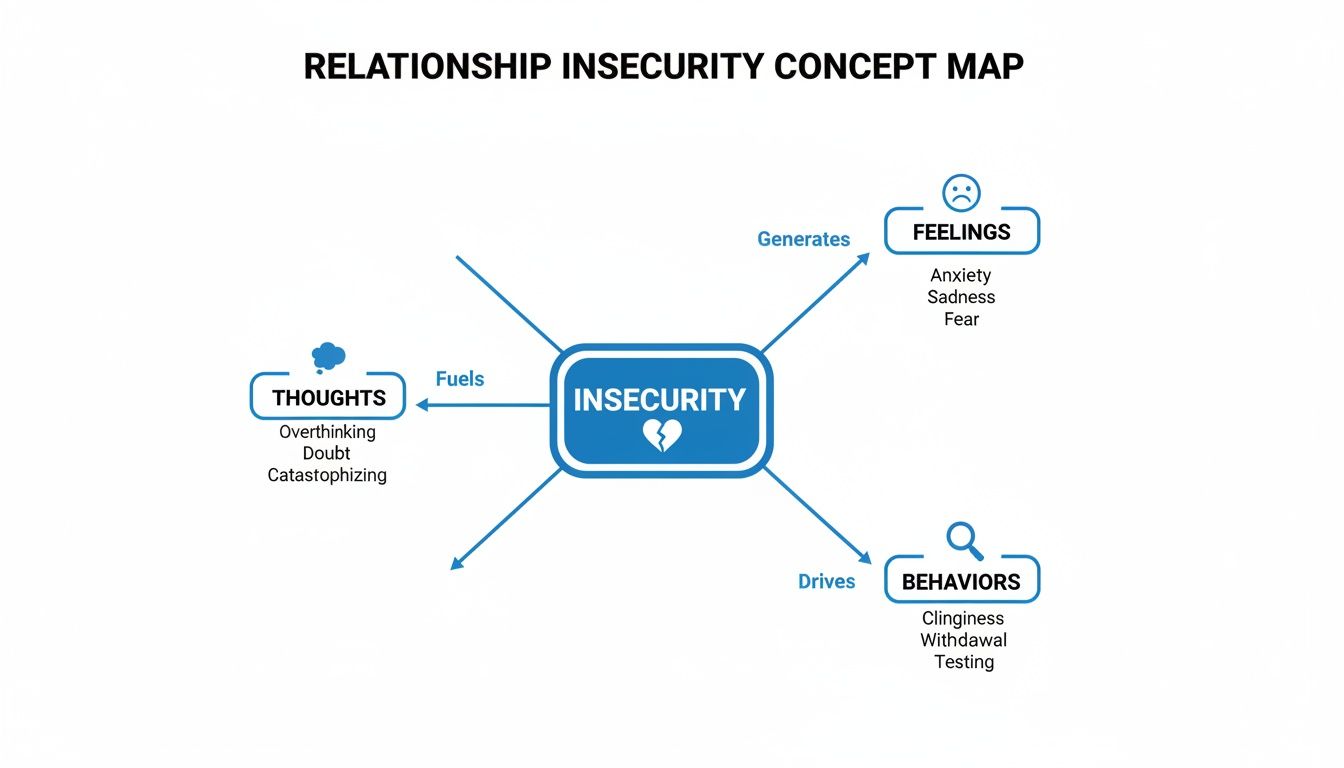
As this map shows, insecurity is a painful cycle. Anxious thoughts trigger difficult emotions, which then lead to reactive behaviours like seeking constant validation or emotionally withdrawing.
Other Factors That Fuel Insecurity
While attachment is a major factor, other life experiences can intensify insecurity in a relationship. These events can amplify old fears, making it hard to feel safe even with a loving partner.
Past betrayals, for example, can make you more guarded in future relationships as a form of self-protection. Low self-esteem also plays a significant role, acting as a filter that makes you doubt your own worthiness of love and acceptance.
Your mind will always believe what you tell it. Feed it faith. Feed it truth. Feed it with love.
Furthermore, mental health conditions like anxiety and depression are deeply connected to relationship insecurity. They can create persistent worry or a negative outlook, contributing to emotional burnout and making it hard to see situations clearly.
In India, these psychological roots have a tangible impact on relationships, mixing with modern pressures like workplace stress. Understanding where your insecurity comes from is the first step toward healing, allowing you to see it not as a personal flaw but as a learned response that can be changed.
How Insecurity Affects Both You and Your Partner
In a relationship, insecurity is a shared burden that can create distance and tension, affecting both individuals. It quietly erodes the connection, leaving both partners feeling exhausted and misunderstood.
Understanding its impact on each person is crucial for finding a way forward together. By recognising these dynamics, you can begin to address them with empathy and build a healthier bond.

The Internal Storm of the Insecure Partner
If you are the one struggling with insecurity, your inner world may feel like a constant state of high alert. This persistent undercurrent of anxiety and stress is draining and can lead to emotional burnout.
This vigilance makes it difficult to be present and enjoy moments with your partner. You may desperately want to feel closer, but your own fears can inadvertently push that connection away.
The Exhaustion of the Supporting Partner
For the supporting partner, loving someone with deep insecurity can be emotionally taxing. You might find yourself constantly offering reassurance and choosing your words carefully, which can lead to frustration and helplessness.
Over time, this dynamic can wear down trust and lead to resentment. To protect their own mental well-being, the supporting partner might begin to withdraw, unintentionally creating the very distance the insecure partner fears.
Insecurity can starve a relationship of its oxygen—the spontaneity, trust, and joy that help it thrive. Both partners end up feeling isolated, trapped in a cycle of hurt and misunderstanding.
The Destructive Cycle and Its Impact
Insecurity often creates a painful, repeating cycle in a relationship. It may start with the insecure partner's fear, which leads to questioning or accusations. The other partner, feeling unfairly judged, may become defensive or withdraw.
This reaction can feel like "proof" of the original fear, intensifying the anxiety and perpetuating the cycle. This pattern erodes trust and makes open communication feel risky. In some contexts, as seen in India and globally, unresolved relationship insecurity can contribute to serious domestic conflict. For more details, you can read the full analysis of domestic violence reports.
Breaking this cycle requires empathy from both people. It involves building personal resilience, seeking support through therapy or counselling, and learning new communication strategies that foster connection instead of conflict.
Actionable Strategies to Cultivate Security and Resilience
Understanding the source of your insecurity is the first step, but turning that awareness into action is where real change begins. This involves building your inner strength while learning healthier ways to connect with your partner.
By creating a solid foundation of security within yourself, you create a stable anchor for your relationship to flourish. This journey toward happiness and well-being starts with you.

Building Your Inner Security First
Before you can build a secure partnership, you must cultivate a secure home within yourself. This is about being a compassionate friend to yourself, especially during moments of vulnerability. It involves using practical techniques to manage difficult emotions and challenge unhelpful thoughts.
A powerful first step is to practise self-soothing when anxiety arises. Instead of immediately turning to your partner for reassurance, try a grounding exercise to create a sense of calm and control.
Here are a few simple yet effective techniques:
- The 5-4-3-2-1 Grounding Method: When your mind is racing, pause and name 5 things you can see, 4 things you can touch, 3 things you can hear, 2 things you can smell, and 1 thing you can taste. This pulls your attention into the present moment.
- Mindful Breathing: Place a hand on your stomach and focus on slow, deep breaths. This simple action helps calm your nervous system and breaks the cycle of panic.
Another helpful strategy is to gently question your insecure thoughts, a core technique in modern counselling. Instead of accepting fears as facts, use a journal to explore them with curiosity.
Writing down your fears allows you to see them for what they are—thoughts, not truths. It creates the space needed to challenge them and choose a more balanced perspective.
Try these journaling prompts inspired by cognitive-behavioural therapy (CBT):
- What is the insecure thought I’m having? (e.g., "My partner is losing interest in me.")
- What evidence actually supports this thought? (Be objective and stick to facts.)
- What evidence contradicts this thought? (Recall moments of connection and love.)
- What’s a more balanced, compassionate way to see this? (e.g., "My partner is dealing with workplace stress, and it's not a reflection of their feelings for me.")
This process strengthens your mental well-being by training your brain to break free from automatic negative thought patterns, building your emotional resilience.
Strengthening Your Connection Together
While individual work is crucial, fostering security is also a team effort. Effective communication can transform your relationship from a source of anxiety into a safe haven of support.
Learning to share your feelings without blame and to listen with empathy is key. To build a deeper bond, it's essential to understand how to be more emotionally available.
Communication Scripts for Tough Conversations
Finding the right words when you feel vulnerable can be challenging. Using a structured approach helps you express yourself clearly and constructively. The "I feel" statement is a classic tool for this reason.
Instead of saying: "You never text me back. You obviously don't care." (This sounds like an accusation.)
Try saying: "I feel anxious when I don't hear from you for a while. A quick text to say you're busy would help me feel more secure."
This approach focuses on your feelings and needs, inviting your partner to be part of the solution rather than putting them on the defensive. This compassionate communication style, often taught in therapy, helps break cycles of conflict and builds a happier, more connected partnership.
When It’s Time to Bring in a Professional
While self-help strategies are valuable, sometimes a guiding hand is needed. Reaching out for professional support is a sign of strength and a commitment to your well-being and the future of your relationship.
Think of it as a proactive investment in your happiness. If insecurity in a relationship is causing constant distress or leading to persistent anxiety or depression, an expert can offer the tools you need to move forward.
Recognising the Signs You Need Support
Deciding to see a therapist can feel like a big step, but certain patterns indicate you could benefit from professional guidance. It's about a persistent, draining dynamic that you can't seem to solve alone.
Consider seeking professional help if you experience:
- Constant Conflict: Small issues frequently escalate into major fights about trust or commitment.
- Emotional Exhaustion: You and your partner feel perpetually drained or burnt out from the stress.
- Controlling Behaviours: Insecurity leads to actions like checking phones or monitoring social media, eroding trust.
- Loss of Intimacy: Emotional and physical closeness has been replaced by suspicion and distance.
In India, relationship insecurity often manifests as a deep fear of abandonment. For instance, the research into relationship dynamics shows how these fears can create destructive patterns. Professional support can help identify and address these issues early on.
How Therapy and Assessments Can Point the Way
Professional counselling provides a safe, neutral space to explore the roots of insecurity without blame. A therapist can guide you and your partner in learning healthier communication skills and building individual resilience.
Platforms like DeTalks also offer scientifically-backed psychological assessments that can serve as a starting point for understanding your emotional patterns.
A Quick Note: These assessments are fantastic for gaining insight into your emotional patterns and relationship dynamics. However, they are informational tools, not diagnostic ones. They are never a substitute for a full evaluation by a qualified professional.
These assessments can provide clarity and help you decide if individual therapy or couples counselling is the right path for you. Seeking help is a compassionate choice for yourself and your partner, opening the door to healing and a more secure, loving connection.
Burning Questions About Relationship Insecurity
Let's address some common questions about insecurity to provide extra clarity. These answers can help you as you work toward building a stronger, more secure bond.
Is a Little Insecurity Normal in a Relationship?
Yes, moments of doubt are a normal part of being human. The problem arises when insecurity in a relationship becomes a constant state, shaping your reactions and damaging the connection.
The goal isn't to eliminate insecurity entirely, but to build emotional resilience so these feelings don't take control. This helps protect the trust you and your partner have built.
Can My Partner Fix My Insecurity for Me?
While a supportive partner is a great asset, they cannot fix your insecurity for you. Lasting security is an inside job, as it often stems from your past experiences and self-perception.
Your partner can create a safe environment, but the work of challenging negative thoughts and building self-worth is a personal journey. This is where individual therapy or counselling can be transformative for your overall well-being.
True security is an inside job. Your partner can be a wonderful ally, but the real work of building self-worth and challenging fear is a journey you must take for yourself.
How Do I Talk to My Partner About Their Insecurity?
Approach the conversation with empathy and gentleness. Use "I" statements to share how their behaviour affects you, such as, "I feel hurt when it seems like you don't trust me."
Choose a calm moment for this discussion, not during a conflict. Reaffirming your care for them can also help, and you might suggest couples counselling as a way to learn better communication tools together as a team.
Will Insecurity Ever Fully Go Away?
While it may not vanish completely, its influence can significantly decrease. With self-awareness, new coping strategies, and a stronger bond with your partner, you'll learn to see insecure thoughts as just thoughts, not facts.
Over time, that loud voice of insecurity can become a quiet whisper you can easily manage. This shift helps in managing related feelings of anxiety or depression, allowing you to build lasting trust in yourself and your relationship.
If insecurity is casting a shadow over your life and relationship, please know you don't have to face it on your own. DeTalks is here to connect you with experienced therapists who can equip you with the right tools for building a more secure and joyful connection. Take the first step and explore our network of professionals to begin your healing journey at https://detalks.com.
Leave a Reply