You're probably here because the search started casually and then stopped feeling casual.
You typed ADHD screening near me after another missed deadline, another argument about “not listening”, or another day where your mind felt noisy and scattered. Now you have too many tabs open, too many opinions in your head, and no clear sense of what to do first.
That confusion is normal. In India, people often find a mix of online quizzes, therapy listings, psychiatry clinics, counselling platforms, school advice, and social media content, all talking as if they mean the same thing. They don't.
When Searching for ADHD Screening Near Me Feels Overwhelming
Many people don't start this search in a calm, organised mood. They start when they're tired, worried, and trying to make sense of patterns that may have been there for years. Adults often wonder if they're overreacting. Parents worry they waited too long. Partners notice stress, anxiety, burnout, or constant forgetfulness and push for answers.
The first thing to get straight is simple. A screening is not the same as a diagnosis. A screening is a brief check that flags whether ADHD could be worth exploring. A full diagnostic assessment is a longer clinical process that looks at history, symptoms across settings, functioning, and other possible explanations.
What people usually mix up
A lot of “near me” results blur that line. You'll see short forms, symptom quizzes, or one-session consultations presented as if they can settle everything. They can't. They're useful, but only if you treat them as informational, not diagnostic.
That distinction matters even more for people who don't fit the stereotype. Women, adults, and high-functioning people are often missed because their struggles can look like perfectionism, chronic stress, workplace stress, anxiety, or plain exhaustion instead of obvious hyperactivity. A rushed process can miss the picture.
Practical rule: If a clinic promises certainty after a very quick checklist, slow down and ask harder questions.
Indian evidence shows ADHD is common enough that screening is clinically relevant. A systematic review and meta-analysis pooling Indian studies found an overall prevalence of 63.2 per 1,000 children aged 4 to 19 years, with 75.1 per 1,000 in school-based studies and 18.6 per 1,000 in community-based studies, while individual studies ranged from 1.3% to 28.9% depending on setting and method (Indian ADHD prevalence review). That wide variation is exactly why the next step matters more than the nearest result.
If you want to understand how a structured ADHD care pathway can look in practice, even outside India, Wald Behavioral Health ADHD care is a useful example of the difference between evaluation, ongoing support, and treatment planning.
What to aim for instead
Look for a process that gives you clarity, not speed for its own sake. Good screening should help you decide whether you need therapy, counselling, a psychiatric review, educational support, or a closer look at sleep, anxiety, depression, or daily well-being habits that may be affecting focus.
The goal at this stage isn't to label yourself. It's to stop guessing and start sorting.
Where to Find ADHD Screening in India
Start with the kind of provider you need, not just the one who appears first on a map. If symptoms are affecting school, work, relationships, or daily functioning, choose someone who can either assess ADHD directly or clearly refer you onward without wasting weeks.
The most practical places to look
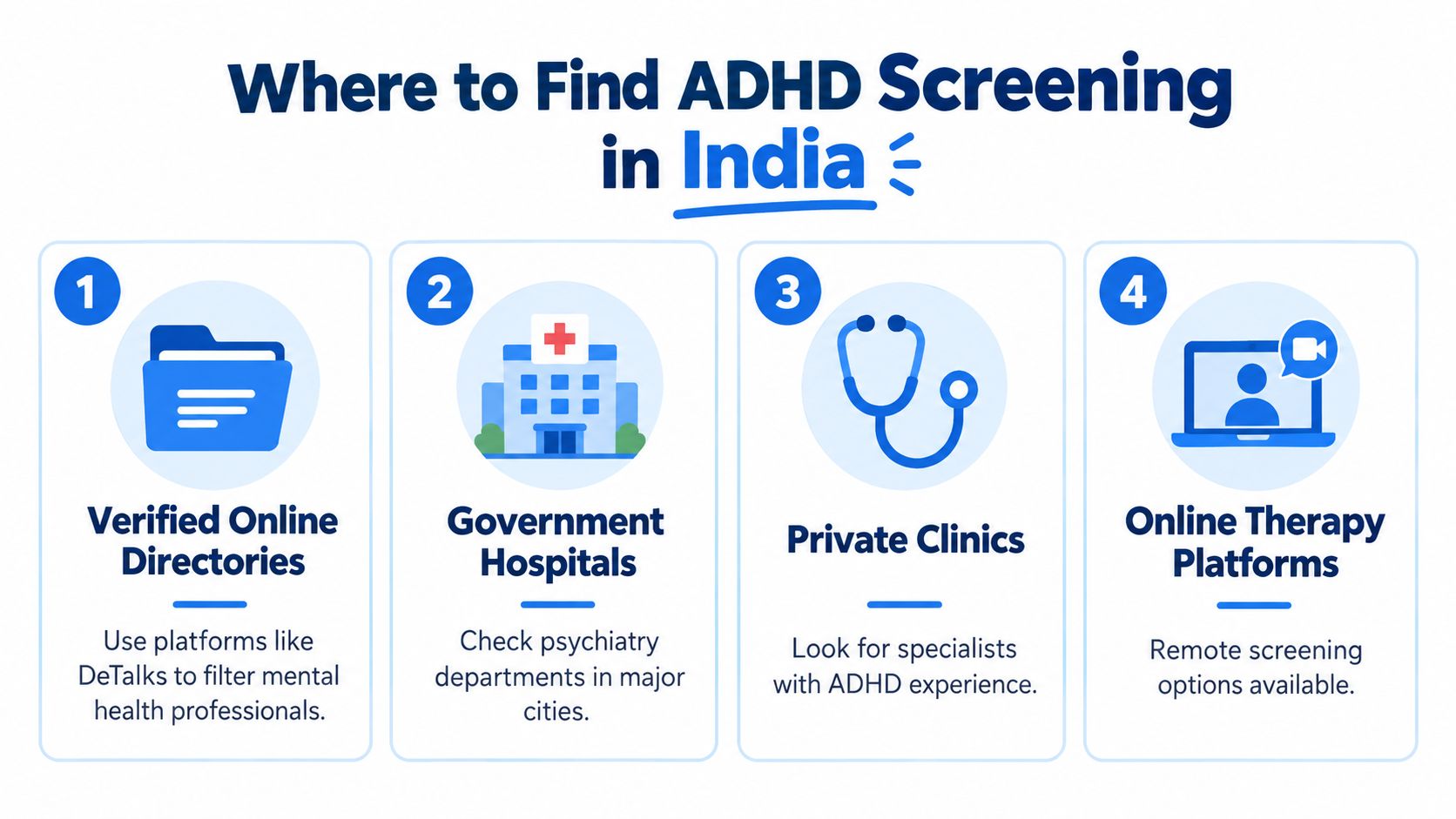
Use a directory first if you want to compare options across cities. One practical route is to use DeTalks to filter mental health professionals by location, qualifications, and whether they work with attention-related concerns. That helps you avoid random listings that say “mental wellness” but don't mention ADHD screening, therapy, or counselling experience.
If access is limited where you live, start with any of these:
- Family doctor or primary care physician: Useful when you're unsure whether the issue is ADHD, sleep loss, anxiety, depression, thyroid concerns, or medication side effects.
- Psychiatrist: Best when symptoms are severe, you suspect co-existing anxiety or depression, or you want a medical evaluation that can later include medication discussion if needed.
- Clinical psychologist: Strong option for structured assessment, interviews, behavioural history, and detailed functional analysis.
- Hospital psychiatry OPD: Often a solid choice in major cities when private clinics feel confusing or expensive.
- Child development or adolescent mental health clinic: Better than a general listing if the concern is school performance, behaviour, or emotional regulation in children.
A lot of people also want to know whether remote care is reasonable. It often is, especially for first-step screening and follow-up counselling, as long as the clinician is clear about what can be done online and what still needs an in-person review.
Here's a short explainer that helps many people understand what to expect from an assessment pathway:
How to filter providers properly
Don't pick based only on distance. Check whether the provider lists training and role clearly.
- For psychiatrists: Look for recognised medical credentials and active registration.
- For psychologists: Check for RCI-recognised qualifications if they are practising in a clinical role.
- For ADHD-specific work: Prefer profiles that mention child, adolescent, or adult ADHD directly, not just “stress management” or generic well-being support.
- For credibility: Read reviews carefully for signs that the clinician listens, explains the process, and doesn't rush to conclusions.
Some of the best care won't be the closest clinic. It'll be the provider who knows how to tell ADHD apart from burnout, anxiety, depression, or a bad fit between your environment and your coping style.
If you're comparing how specialist-focused local search content is framed elsewhere, ADHD care in Florida is a useful example of how people often think through provider type, symptoms, and fit before booking.
Screening Tools You Will Likely Encounter
The names can sound intimidating, but most ADHD screening tools fall into a few practical categories. Some are filled out by parents or teachers. Some are self-reports. Some are clinician-led checklists based on DSM-5 criteria. None of them should be treated as a diagnosis on their own.
Indian guidance is clear on this point. The recommended approach starts with a detailed developmental and psychiatric history from multiple informants, then checks symptom pattern, age-appropriateness, persistence, pervasiveness across settings, severity, and co-existing conditions. Rating scales support that process, but they aren't stand-alone proof, and some commonly used scales haven't been validated in the Indian population (Indian Psychiatric Society guideline).
What the common tools are for
| Common ADHD Screening Tools in India | Completed By | Best For |
|---|---|---|
| SNAP-IV Rating Scale | Parent and teacher, sometimes clinician review | Child and adolescent symptom screening, especially in school-linked concerns |
| Vanderbilt Assessment Scale | Parent and teacher | Paediatric evaluations where school behaviour and classroom functioning matter |
| DSM-5-based clinical interview or criteria checklist | Clinician, with patient and family input | Structured assessment in children, adolescents, and adults |
| INCLEN ADHD-related items | Clinician or trained assessor with caregiver input | Indian child screening contexts where locally validated items are relevant |
| ASRS | Self-report | Adult attention-related concerns and whether full assessment is worth pursuing |
| Conners rating scales | Parent, teacher, self, depending on version | Broader behavioural pattern review when ADHD is one part of the question |
Which tools have Indian validation
Locally adapted tools matter. A tertiary-centre study from northern India validating a DSM-5-based ADHD diagnostic tool in children aged 6 to 18 years reported 100% sensitivity, 90% specificity, and 95.45% diagnostic accuracy in a suspected-ADHD sample. Another Indian criterion-validation study of INCLEN ADHD-related items reported 90% sensitivity, 80% specificity, 94.74% positive predictive value, 66.67% negative predictive value, 4.50 positive likelihood ratio, 0.13 negative likelihood ratio, and 88% overall diagnostic accuracy (Indian validation study).
That's encouraging, but don't overread it. Even strong tools still leave uncertainty. A good clinician uses them to organise evidence, not replace judgement.
A blunt recommendation
Ask the clinic in advance which tool they use, who fills it out, and whether they also assess sleep, mood, learning issues, and functioning. If they can't answer clearly, keep looking.
How to Prepare for Your Appointment
Preparation makes the appointment better. It also makes it cheaper in the long run, because the clinician gets cleaner information faster and is less likely to need a second visit just to rebuild the history from scratch.
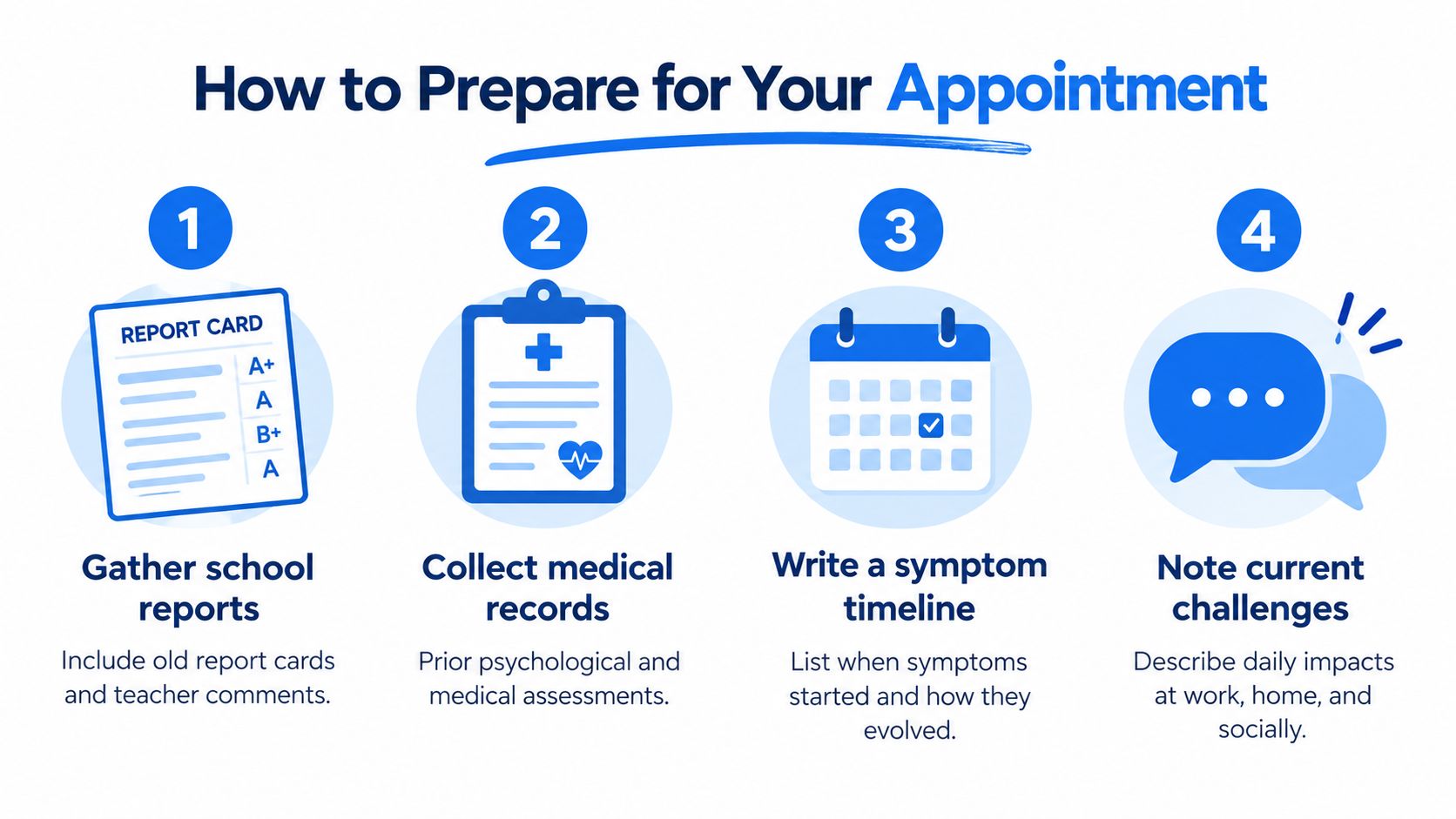
What to gather before you go
Bring old school reports if you have them. Teacher comments, report cards, disciplinary notes, and past psychological or medical records can help show whether the pattern has been present over time.
If you're an adult and school records are gone, write your own short timeline. Keep it plain. When did the problems begin? Did they show up at school, at home, in college, at work, or in relationships? What gets worse under stress? What improves when life is more structured?
A useful prep list includes:
- Written symptom timeline: Note inattention, impulsivity, forgetfulness, task avoidance, emotional overload, and how long these patterns have been around.
- Daily functioning examples: Missed bills, unfinished tasks, messy routines, constant lateness, careless mistakes, or difficulty switching attention.
- Collateral input: Ask a parent, partner, sibling, or close colleague what they've noticed.
- Medication and substance list: Include prescriptions, supplements, caffeine use, nicotine, and sleep aids.
Track patterns for a short stretch
Spend two weeks noting your attention, sleep, energy, distractions, and workload. You don't need a fancy format. A notebook works. So does a simple note on your phone.
Bring examples, not just feelings. “I feel unfocused” is less useful than “I missed three deadlines because I kept switching tasks and couldn't return to the original one”.
Attention problems can overlap with anxiety, depression, burnout, and plain sleep deprivation. In urban Indian workplaces, a review covering workplace mental health reported that among 1,764 white-collar employees in 2022, nearly 29% showed moderate-to-severe signs of depression, 55% had moderate-to-severe signs of anxiety, and 78% had moderate-to-high stress (Indian workplace mental health review). That's one reason careful assessment matters. ADHD isn't the only explanation for poor focus.
Questions worth asking the clinician
Ask direct questions. You are allowed to.
- Do you screen only, or do you also do full diagnostic assessment?
- Do you work with adult ADHD, or mostly with children?
- Which tools do you use, and who fills them out?
- How do you rule out anxiety, depression, sleep problems, and burnout?
- Will I get a written summary and next-step recommendations?
Arrive early if you can. Rushing into an assessment when you're already stressed rarely helps.
Costs, Insurance, and Telehealth Options
This is the part many people avoid until the last minute. Don't. Cost confusion leads people to pick the cheapest quick screen, then pay again for a proper review later.
What usually changes the price
Brief screenings generally cost less than full diagnostic assessments. Private psychiatrists, clinical psychologists, and multispecialty clinics may all price differently based on time, city, complexity, and whether rating scales, interviews, school reports, or follow-up sessions are included.
I'm not giving you made-up price bands because that's exactly how bad health content misleads people. Ask for the fee structure in writing before you book. Specifically ask whether the quoted amount covers only a consultation, or also includes rating scales, report writing, follow-up discussion, and coordination with school or family.
A simple comparison to use when you call clinics
| ADHD Screening Options and Cost Comparison in India | Typical Cost Range (INR) | Insurance/EAP Coverage | Telehealth Available |
|---|---|---|---|
| Government hospital psychiatry OPD | Varies by institution | May reduce out-of-pocket burden | Sometimes limited |
| Private psychiatrist consultation | Varies by city and clinician | Sometimes covered if linked to psychiatric care, often limited for screening alone | Often yes |
| Clinical psychologist assessment | Varies by time and depth | EAP or employer plans may help in some cases | Often yes |
| Multispecialty mental health clinic | Varies by bundled services | Depends on policy wording and package | Often yes |
| Online platform screening plus referral | Varies by provider and tool | Sometimes EAP-friendly for first-step support | Yes |
Insurance and free or lower-cost routes
Many people are surprised by how patchy coverage still is. Some policies are more likely to support treatment linked to a recognised mental health condition than a stand-alone screening step. Corporate EAPs may cover a limited number of counselling sessions or triage support, which can still be useful for deciding what kind of specialist you need.
If money is tight, don't assume care is impossible. Psychiatry departments in government hospitals, teaching hospitals, and district mental health services can be a practical route. Access may be slower, but slower is better than abandoned.
India's broader mental health need is large enough that this matters far beyond ADHD. The National Mental Health Survey 2015 to 2016 estimated that about 150 million Indians were affected by some type of mental illness, with adult mental morbidity at 10.6%, lifetime prevalence of mental disorders at 13.7%, and about 15% of Indian adults needing active intervention for one or more mental health issues (Rajya Sabha committee report citing the National Mental Health Survey).
Telehealth can work, but ask one key question
Ask whether the provider uses telehealth for screening only or for the broader assessment process too. That answer tells you how careful they are. Reputable clinicians know the limits of video assessment and will say so plainly.
Avoid any service that guarantees a diagnosis, pushes expensive packages before hearing your history, or treats a short questionnaire as final truth.
After the Screening What Comes Next
A positive screen means “look closer”, not “case closed”. That's the most important sentence in this whole topic.
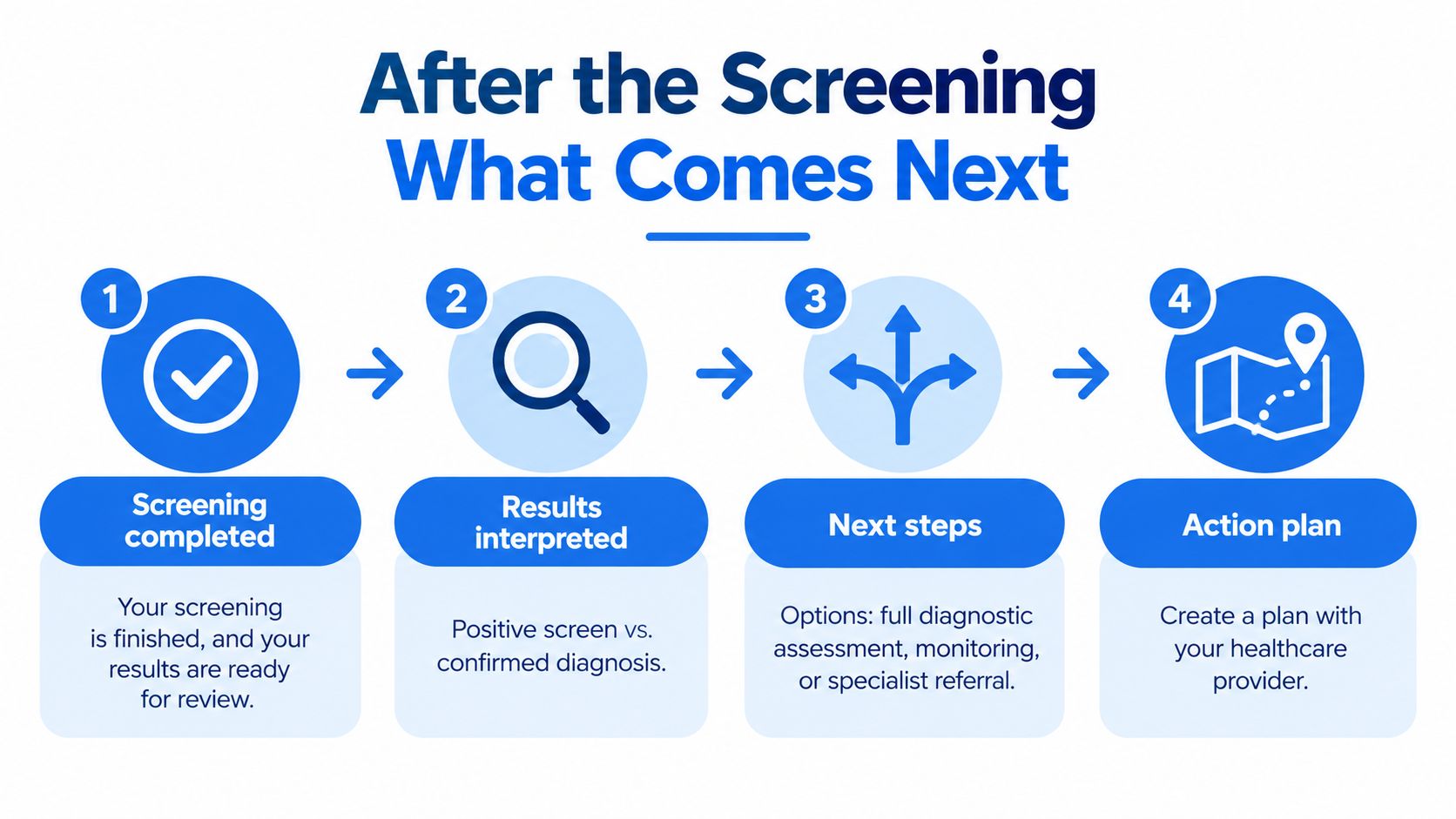
If the screen suggests ADHD
Book a full diagnostic assessment with a qualified psychiatrist or clinical psychologist. The Indian Academy of Pediatrics states that any child aged 4 through 18 years with academic or behavioural problems and symptoms of inattention, hyperactivity, or impulsivity should be evaluated, and it also makes clear that formal diagnosis requires assessment, exclusion of other diagnoses, and review of co-existing emotional, behavioural, or medical conditions (Indian Academy of Pediatrics guideline).
For adults, the same principle applies even if the wording comes from paediatric guidance. Diagnosis should look at lifelong pattern, impairment, other explanations, and the settings where symptoms show up. If the first clinician only gives you a score without a next-step plan, that's incomplete care.
If the result is mixed or borderline
Don't force certainty. Borderline results often mean you need a wider look at sleep, stress, anxiety, depression, trauma, work overload, or learning differences.
A review of Indian evidence reported adult ADHD prevalence ranging from 5.48% to 25.7% across studies, which tells you two things at once. Need is real, and methods are inconsistent (India-focused adult ADHD review). That's why the best follow-up question is not “Do I have it, yes or no?” It's “What problem are we most confident I need help with first?”
Screening should narrow the field. It shouldn't trap you inside a label that doesn't fully fit.
The follow-up options that actually help
Once the picture is clearer, the plan may include more than one path:
- Psychoeducation: Learning how ADHD traits affect work, routines, and relationships.
- Therapy or counselling: Useful for coping skills, shame, self-criticism, resilience, and emotional regulation.
- Workplace or academic support: Practical adjustments, structure, reminders, and task design.
- Parent guidance: Especially helpful when a child's home and school supports need to align.
- Medication consultation: Appropriate only after proper assessment and when clinically indicated.
- Lifestyle review: Sleep, routine, overstimulation, workload, and digital habits still matter.
Get a written summary if possible. Bring it to any follow-up clinician. Don't rely on memory after a heavy appointment.
Supportive Takeaways and Common Questions
Here's my honest view. Searching for ADHD screening near me is a good first step, but only if you refuse to let a quick result become the whole story.
The right provider matters more than the nearest provider. The follow-up matters more than the form. And your well-being usually improves fastest when you look at the full picture, including anxiety, depression, resilience, workplace stress, self-compassion, routines, and support systems.
The three takeaways I'd want a friend to remember
- Screening is a snapshot: It can open the right door, but it doesn't diagnose you.
- Provider fit matters: Choose someone who can explain process, not just deliver a score.
- Real change comes after clarity: Therapy, counselling, habits, workplace support, and medical review all have a place depending on what the assessment shows.
Common questions
Can adults still get screened if they're over 30?
Yes. Adults often seek help after years of coping, especially when work pressure, parenting, or burnout strips away the systems that used to keep them afloat.
What if I did well in school, so nobody noticed anything?
That doesn't rule ADHD out. Some people compensate for years through intelligence, fear of failure, family structure, or long hours of effort that nobody sees.
Why are women often missed?
Because many don't present in the loud, disruptive way people expect. Indian reviews note underdiagnosis in females, and a 2026 Nature report highlighted how predominantly male ADHD research can skew diagnosis of women in India (report on women and missed diagnosis).
Should I screen my child early?
If there are persistent academic or behavioural concerns, don't wait for things to get severe. Early evaluation is usually kinder than years of blame.
What if the result feels inaccurate?
Ask for a second opinion, especially if the process ignored sleep, mood, family history, school feedback, or functioning across settings. A bad assessment isn't your fault.
If you also want a broader reminder that mental health deserves practical support, not guilt or delay, financial advisors read My Policy Quote offers a simple perspective that applies far beyond finance.
You don't need to be certain before you ask for help. You just need enough honesty to admit that what you're doing now isn't working.
DeTalks offers two things that are useful here: informational assessments that can help you understand whether your attention concerns need a closer look, and a directory where you can find therapists, psychologists, and mental health professionals across India. If you want a calmer, more organised first step toward screening, counselling, or a full referral pathway, visit DeTalks.