
You're at your desk with twelve tabs open, a task list you keep rewriting, and a brain that won't settle on one thing. You search for a therapist for ADHD near me, hoping for someone nearby who can help with focus, overwhelm, or burnout. Then the results blur together, and it's hard to tell who offers what.
That's normal, because therapy, counselling, screening, and a full assessment aren't the same thing. Therapy and counselling help you build routines, manage emotions, and handle workplace stress, anxiety, or low mood. A screening tool flags patterns worth exploring, and assessments are informational, not diagnostic on their own. A full assessment is a longer clinical process that looks at history, daily functioning, and other possible explanations.
The need in India is real. A 2024 study of 1,665 college students aged 18 to 25 in Delhi-NCR found that 14% screened positive for ADHD symptoms using a standardized assessment. That doesn't confirm a diagnosis, but it shows why many young adults are looking for clear answers and practical support.
This list is India-first, with online options if you don't live near a specialist. Each option is matched to what it offers, whether that's therapy, assessment, medication review, or a mix. If you're also reading about understanding ADHD assessment pathways with XO, keep in mind that pathways and professional roles can differ by country.
1. ReACH Psychiatry
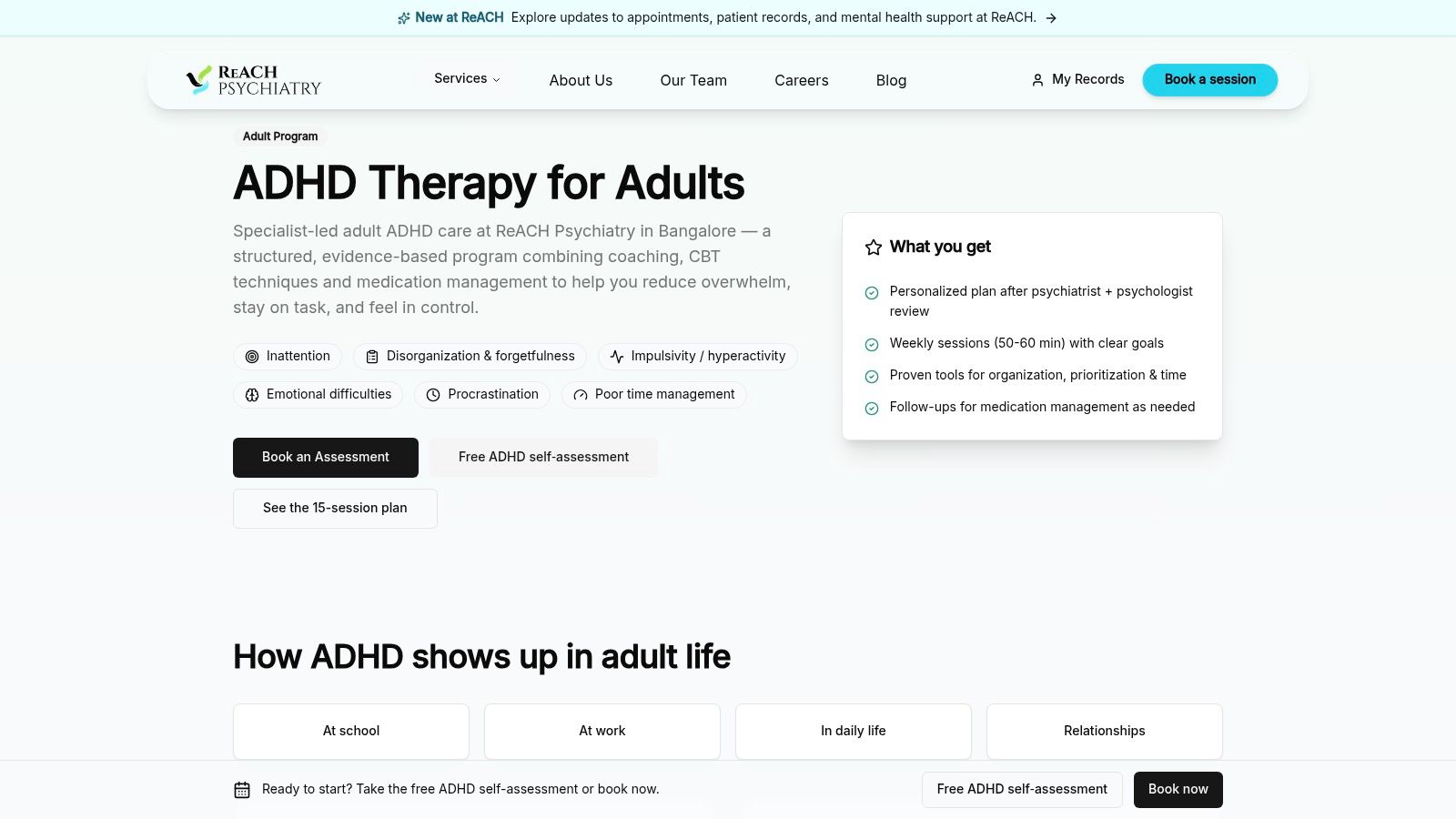
If procrastination, messy planning, and constant time pressure are your main worries, ReACH Psychiatry takes a structured approach. Its adult ADHD program combines therapy, coaching-style strategies, and psychiatrist involvement when needed. That mix can suit adults who want practical change, not only a space to talk.
What the program includes
Your plan is personalised after review by a psychiatrist and psychologist, so the work starts with a shared picture of your needs. Sessions run weekly for 50 to 60 minutes, which gives you a regular rhythm for trying new habits. You'll work on planning and prioritisation tools you can use between sessions, at work or at home.
Medication reviews are available when they're needed, so you don't have to coordinate separate services yourself. You can attend at the Bengaluru clinic or choose online appointments if travel is difficult. That flexibility helps if you're balancing work, family, or study.
Practical rule: ask what's included in the ADHD program fee before you book, because program pricing varies by format.
The clear strength here is coordination between psychological and psychiatric care in one ADHD-specific program. The trade-off is cost clarity, since the published ₹3,500 therapy fee may not apply to the ADHD program itself. Confirm the full price, session count, and review schedule in writing before you commit.
2. Amaha
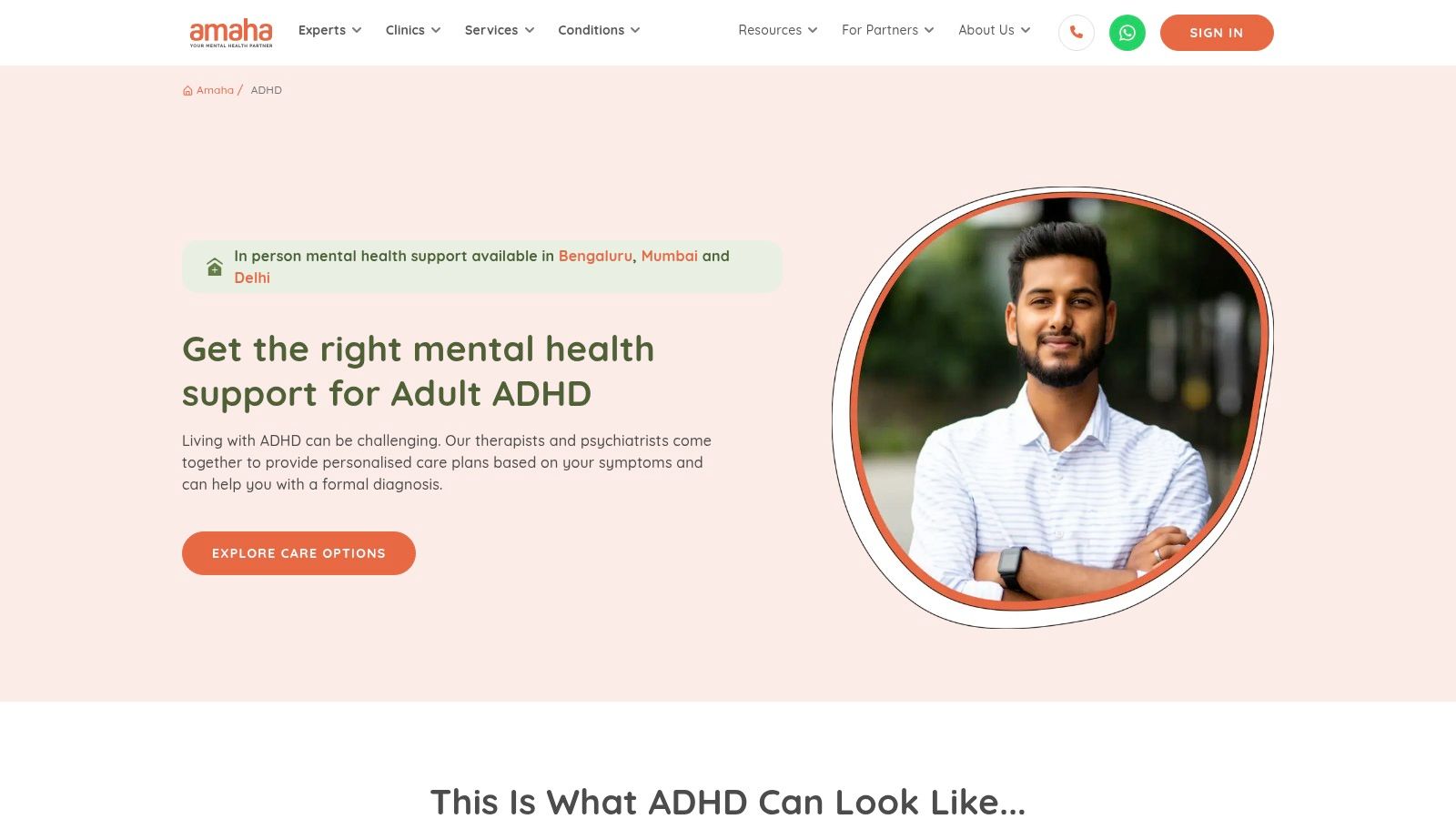
Some people don't know yet whether they need therapy, an assessment, or both. Amaha is built for that in-between stage, with adult ADHD consultations and an assessment pathway alongside therapy and psychiatry. You can start with a conversation and let the clinician guide the next step.
In-person care is listed in Bengaluru, Mumbai, and Delhi, with online appointments for people elsewhere. That matters because specialist help isn't evenly spread across India. A 2025 Indian review on ADHD care access reports that specialist evaluation is concentrated in metropolitan areas, while rural and smaller urban regions face limited access.
- Adult ADHD consultations: a starting point to discuss symptoms and history
- Therapy and psychiatry services: different kinds of support under one service
- Online appointments: useful if you can't reach a clinic easily
The main benefit is choice. You're not limited to counselling alone, and you can reach a broader clinical team if your needs change. Sessions can also touch on anxiety, depression, and emotional balance, which often sit alongside attention difficulties.
The main caution is expectation. An initial consultation helps decide whether a diagnostic assessment is needed, and it isn't automatically a diagnosis. Fees also depend on the clinician and service, so ask for the full cost of each step before you book.
3. Mitsu
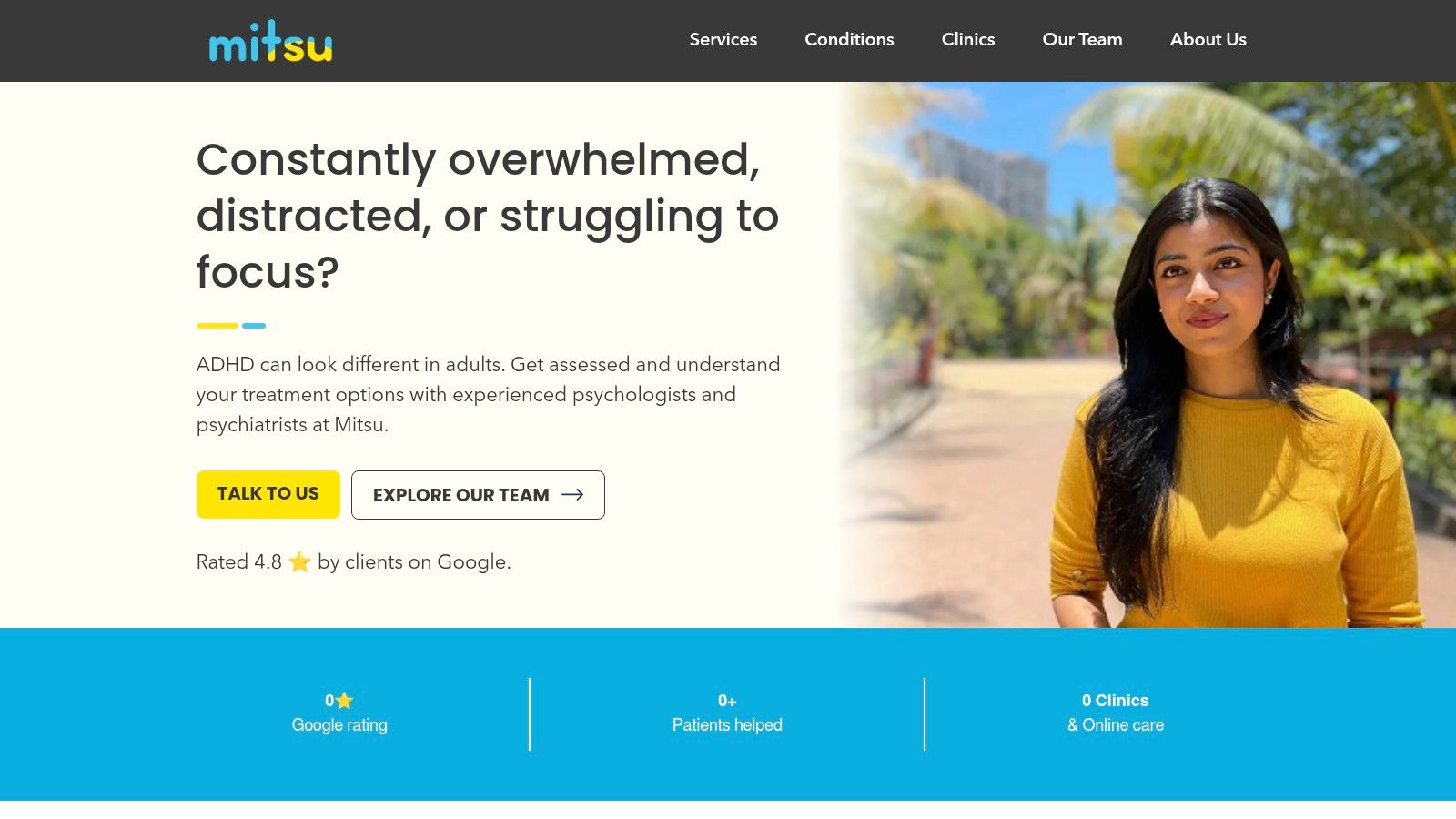
Mitsu focuses on adult ADHD, which can feel reassuring if you've spent years being told to put in more effort. Its work centres on understanding your ADHD-related patterns and building practical strategies over time. That steady, pattern-based approach suits people who want insight and skills, not quick fixes.
You can choose in-person clinics in Powai and Andheri, Mumbai, or online appointments across India. Both therapy and psychiatric support are available, so one service can cover different parts of your care. That's helpful if medication questions come up later and you don't want to start again elsewhere.
Who it may suit
Mitsu also supports overlapping concerns such as anxiety and burnout, which commonly travel with attention difficulties. If workplace stress is draining your energy, you can talk about workload, sleep, and self-compassion alongside focus. The goal is better daily functioning and resilience, built gradually.
The adult focus is clear, and the mix of clinic and online care gives you flexibility. The multidisciplinary setup is another plus, especially if your needs aren't yet clear.
The downside is price transparency. Session prices aren't shown on the service page, and availability can vary by clinician. Ask about fees, wait times, and who you'd see if your therapist is away.
4. Centre for Behavioural Sciences (CBS India)
What if your first question is, "Should I get checked?" The Centre for Behavioural Sciences in New Delhi lists ADHD screening among its tests, alongside psychological and psychiatric services. That makes it worth considering if you want screening and follow-on support from the same organisation.
The team includes psychologists and psychiatrists, with online and in-person appointments for children and adults. Parents searching for a child and adults searching for themselves can both start here. Having several professional types in one place can make referrals inside the service simpler.
Screening needs careful interpretation, though. An Indian school study of 3,253 students in Kancheepuram, Tamil Nadu reported 8.8% prevalence using the Conners' Teacher-Parent Rating Scale. Rates shift with the tool and population used, which is why one questionnaire can't settle a diagnosis.
- ADHD screening: explicitly listed, so you know where to start
- Broad clinical team: psychological and psychiatric input in one place
- Online and in-person access: local care in Delhi, remote care elsewhere
The trade-off is that screening may not equal a full diagnostic assessment or ongoing therapy. Ask what happens after the screening result and who provides follow-up counselling. Also note that bookings can't be cancelled or rescheduled according to the site, so choose your slot with care.
5. LeapHope

Living far from a metro city shouldn't end your search for a therapist for ADHD near me. LeapHope offers online adult ADHD therapy with clinical psychologists for adults across India. You can attend from home, a hostel, or wherever you have privacy.
The work covers executive functioning, emotional regulation, organisation, and focus. In plain terms, that means help with starting tasks, planning your day, calming frustration, and finishing what you begin. These are the daily skills that shape well-being far beyond a label.
Remote care is now a normal route into support in India. A government update on the National Tele-Mental Health Programme states it had handled more than 1.81 million calls by February 7, 2025, through 53 Tele-MANAS cells. Teletherapy reduces distance, though it doesn't replace specialist assessment when that's what you need.
Online therapy works best when you have a private space, a steady connection, and a clear plan for follow-up between sessions.
LeapHope lets you compare psychologists by experience, therapeutic focus, and session fee before booking. The service distinguishes therapy from an official diagnostic assessment, so don't expect a diagnosis from therapy alone. Fees and availability vary by psychologist, so check both when you shortlist.
6. Like Minds Psychiatry Clinic
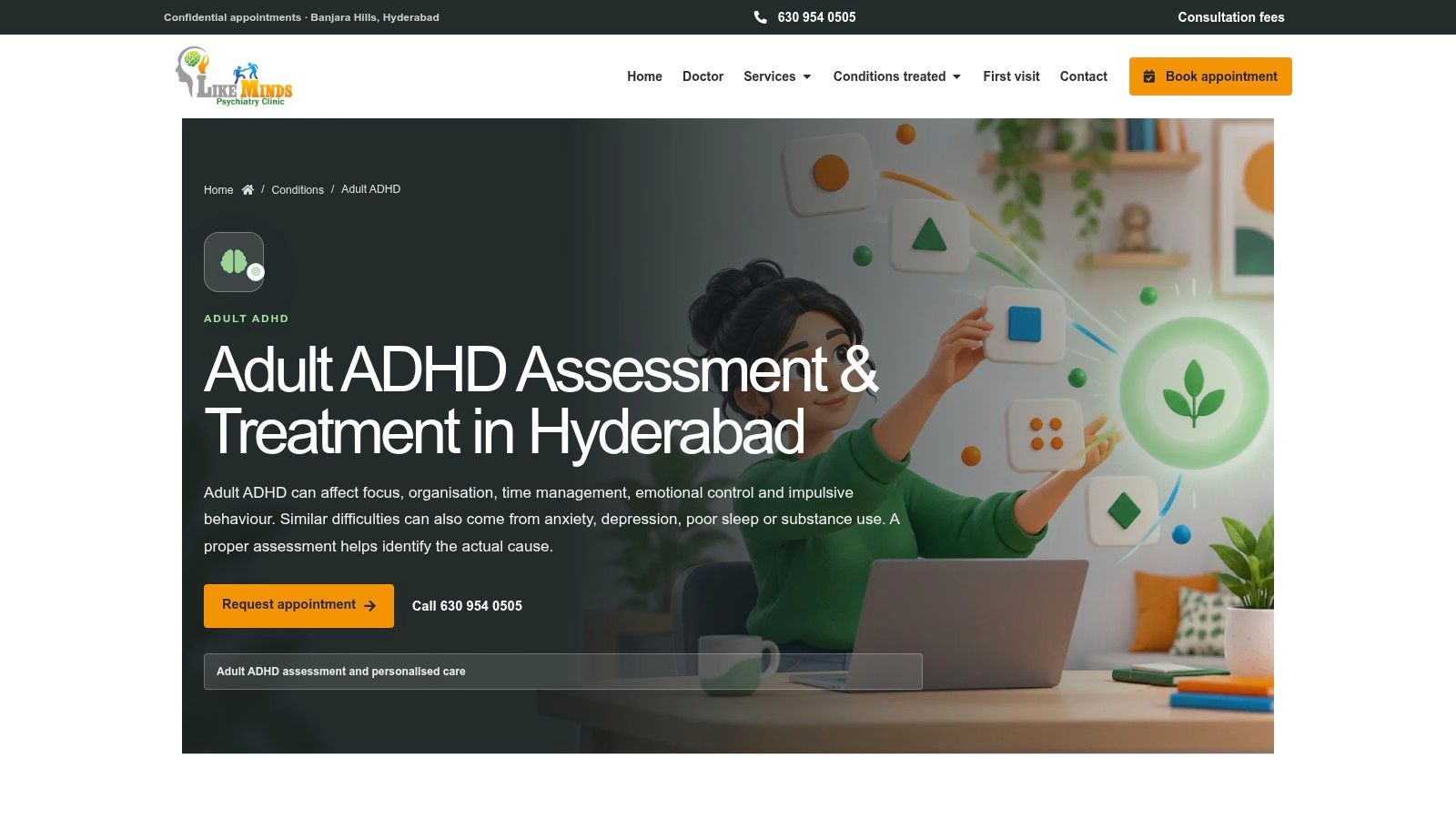
A good assessment looks at your whole life, not one test score. Like Minds Psychiatry Clinic, in Banjara Hills, Hyderabad, describes adult ADHD assessment and treatment through its psychiatry clinic. Its approach considers developmental, school, work, relationship, sleep, and mental-health history.
That broad picture helps the psychiatrist weigh ADHD against overlapping or alternative explanations. Poor sleep, anxiety, depression, and long-term stress can all affect attention. Sorting out what's driving your difficulties leads to a safer, more useful plan.
What to expect from the process
You'll start with a psychiatric consultation and a review of your developmental and functional history. Treatment planning may then include psychological support, practical strategies, and medication, depending on your needs. The clinic names its consulting psychiatrist and location, so you know who you're seeing.
The strength here is depth. The emphasis on a full clinical picture, rather than a single test, is exactly what careful adult assessment requires. It's a solid option if you want clarity before starting longer-term counselling.
The limits are practical. In-person appointments are in Hyderabad, so distance may rule it out for many readers. Published pricing also isn't available, so ask about consultation and follow-up fees when you enquire.
7. Dr. Roshan Jain
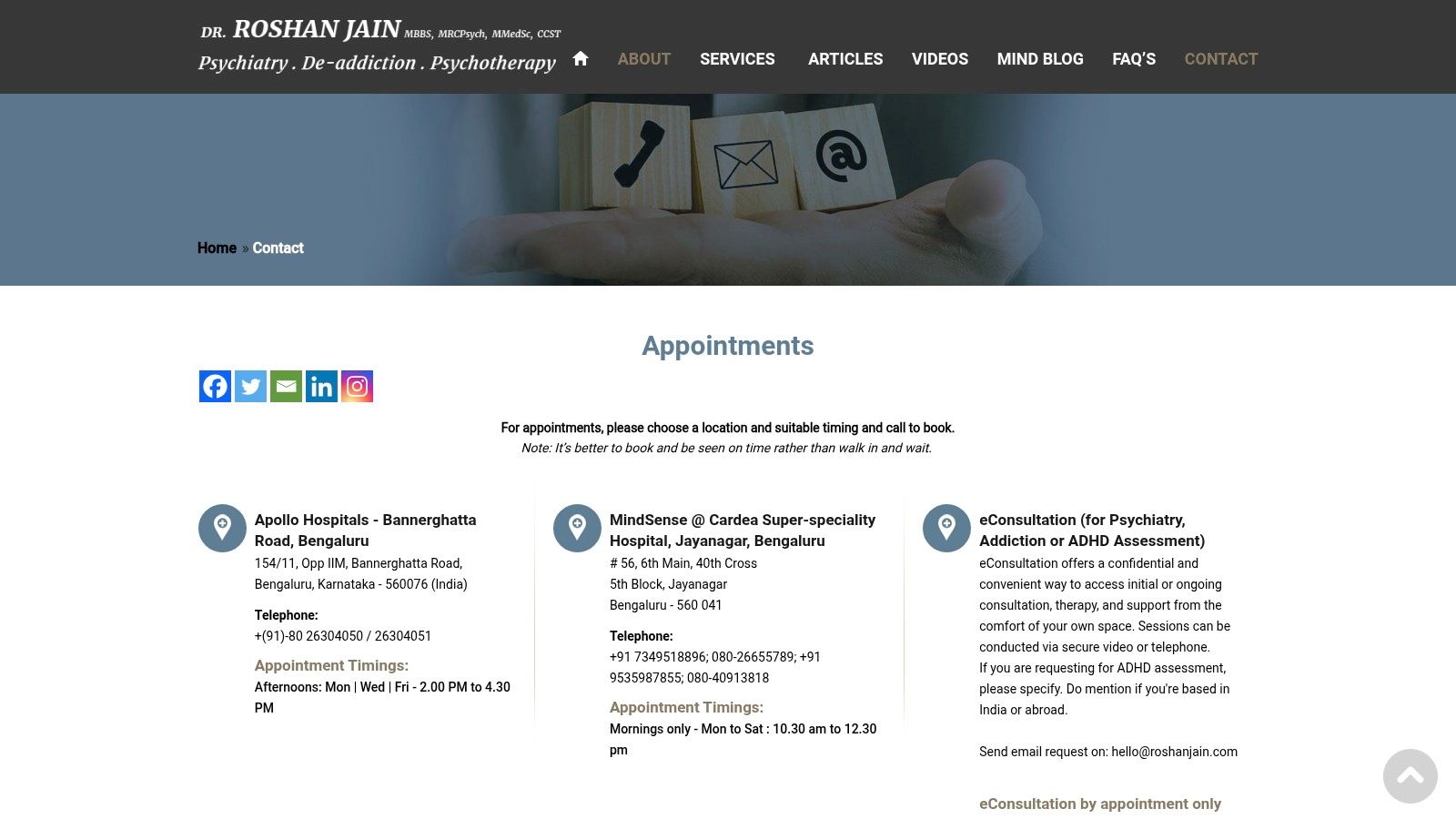
Sometimes you don't need a large platform, you need one named psychiatrist you can approach directly. Dr. Roshan Jain offers appointments in Bengaluru and e-consultations for psychiatry, addiction, or ADHD assessment. When you request an e-consult, you can specify that you want an ADHD assessment.
The described assessment may consider current and childhood symptoms, developmental history, and functional difficulties. It may also cover relevant medical and psychiatric history, with supporting information where useful. That outline helps you prepare notes about school, work, and daily life before your appointment.
- Online video or telephone appointments: helpful if video isn't comfortable for you
- In-person appointments in Bengaluru: an option if you prefer face-to-face care
- Childhood and current symptoms reviewed: important for adult assessment
Knowing what an assessment may cover reduces first-appointment nerves. You can gather old reports or examples of difficulties in advance, which makes the conversation more productive. It also helps you explain how symptoms affect relationships and workplace stress.
The trade-off is coordination. Access is by request, so appointment timing may need some back and forth. Fees aren't listed on the contact page either, so confirm costs and session length before you confirm a slot.
8. Mindtalk by Cadabams
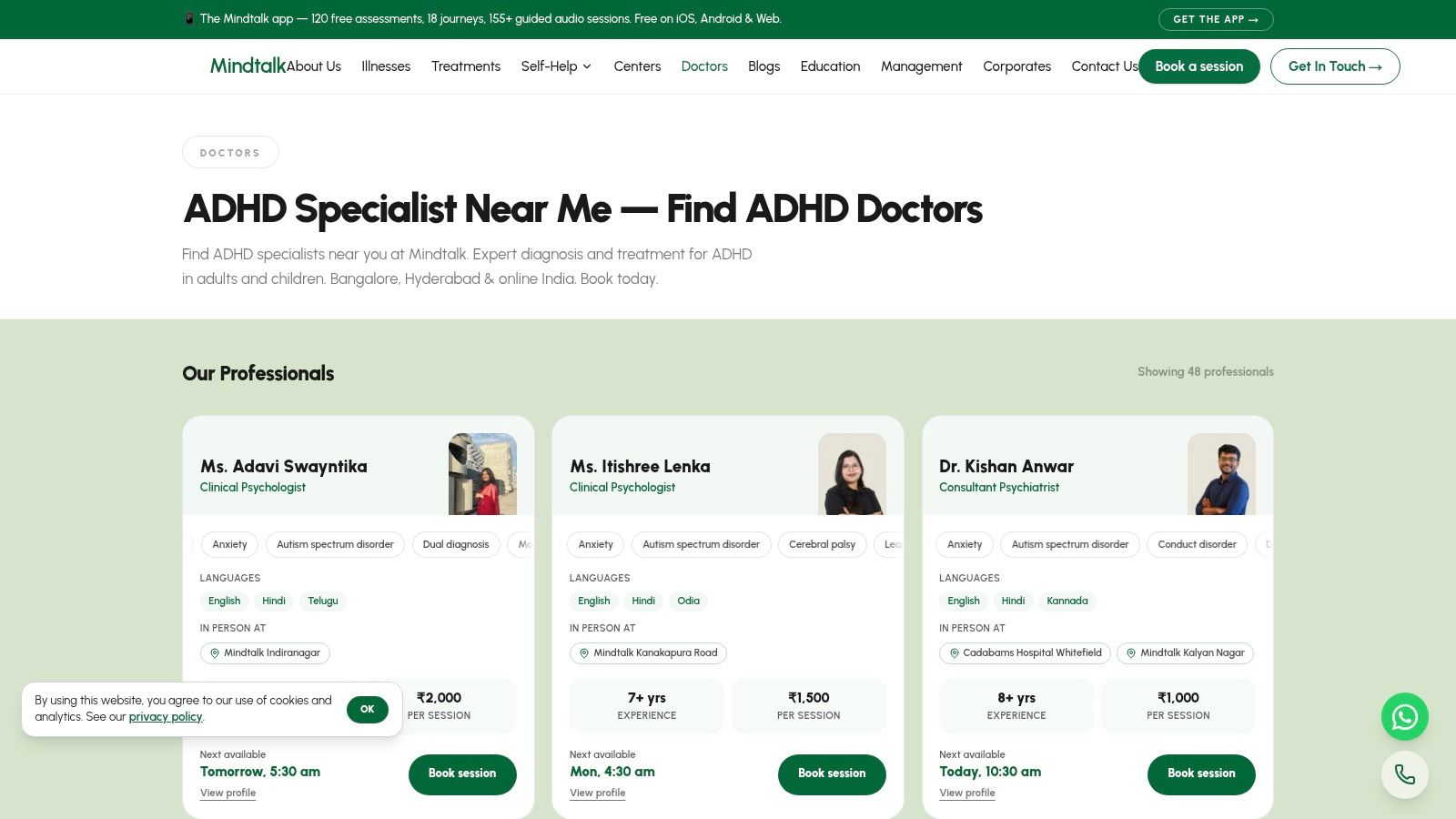
If you want to compare several professional types in one place, Mindtalk by Cadabams connects you with psychiatrists, clinical psychologists, and other mental-health professionals. That's useful when you aren't sure whether therapy, medication, or both might help. You can look at city-specific services or choose online consultations.
Options listed include CBT, behavioural therapy, psychoeducation, and medication management when indicated. Psychoeducation means learning how ADHD affects your brain and habits, which can ease self-blame. CBT and behavioural work then turn that understanding into routines that support focus and resilience.
Online care has shown it can work at scale in India. An Indian rapid-response online mental-health service delivered 2,245 sessions over 17 months through 63 clinicians. That kind of delivery shows remote support can be organised and sustained, even across many clinicians.
Mindtalk also describes assessment as involving more than a single test, which is a healthy sign. Costs need care, though, because a starting fee may not cover a full assessment over multiple sessions. Clinician experience and approach can differ too, so check individual credentials before you book with anyone.
9. Kyan Practice – Urvashi Jain
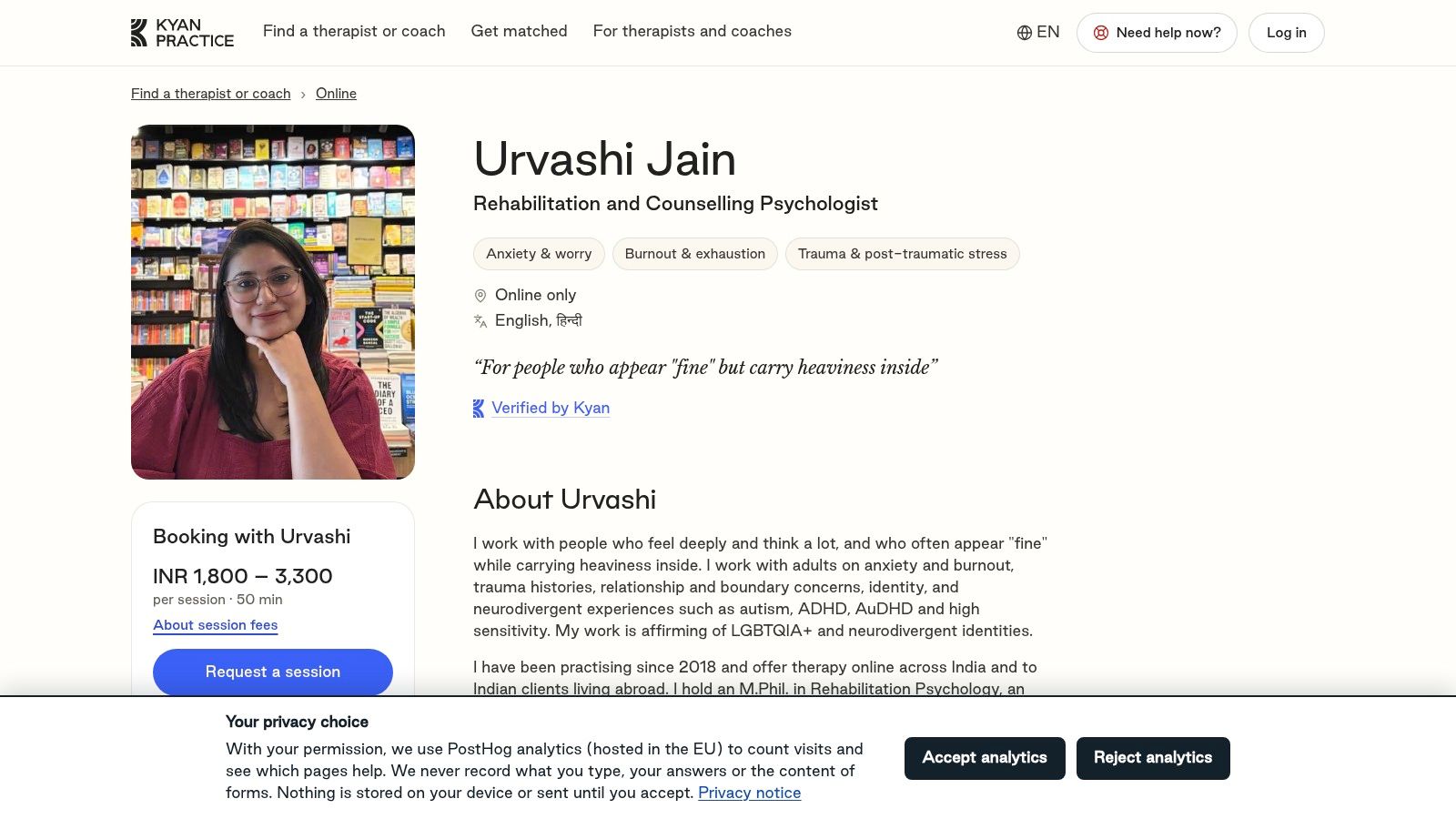
For some people, feeling understood matters as much as any technique. On Kyan Practice, Urvashi Jain is listed as a rehabilitation and counselling psychologist offering online therapy across India. Her stated areas of work include ADHD and AuDHD, alongside anxiety, burnout, trauma, and relationships.
Her profile describes a neuro-affirming approach, which means your brain isn't treated as something broken to fix. Instead, therapy can build on your strengths while easing the parts of life that feel hard. That tone can help if shame or self-criticism has built up over years.
Sessions run for 50 minutes in English or Hindi, which widens access beyond English speakers. Individual online counselling across India also suits people in hostels, small towns, or busy households. The listed fee is ₹1,800 for clients in India, so you can budget before booking.
A warm fit still needs clear boundaries, so check what a service offers and what it doesn't before your first session.
Be clear about scope here. The profile doesn't present the service as ADHD diagnosis, and it isn't an emergency service. Listed education and memberships are self-reported and not verified by Kyan, so verify credentials yourself if that matters to you.
10. Dr. Anindo Mitra
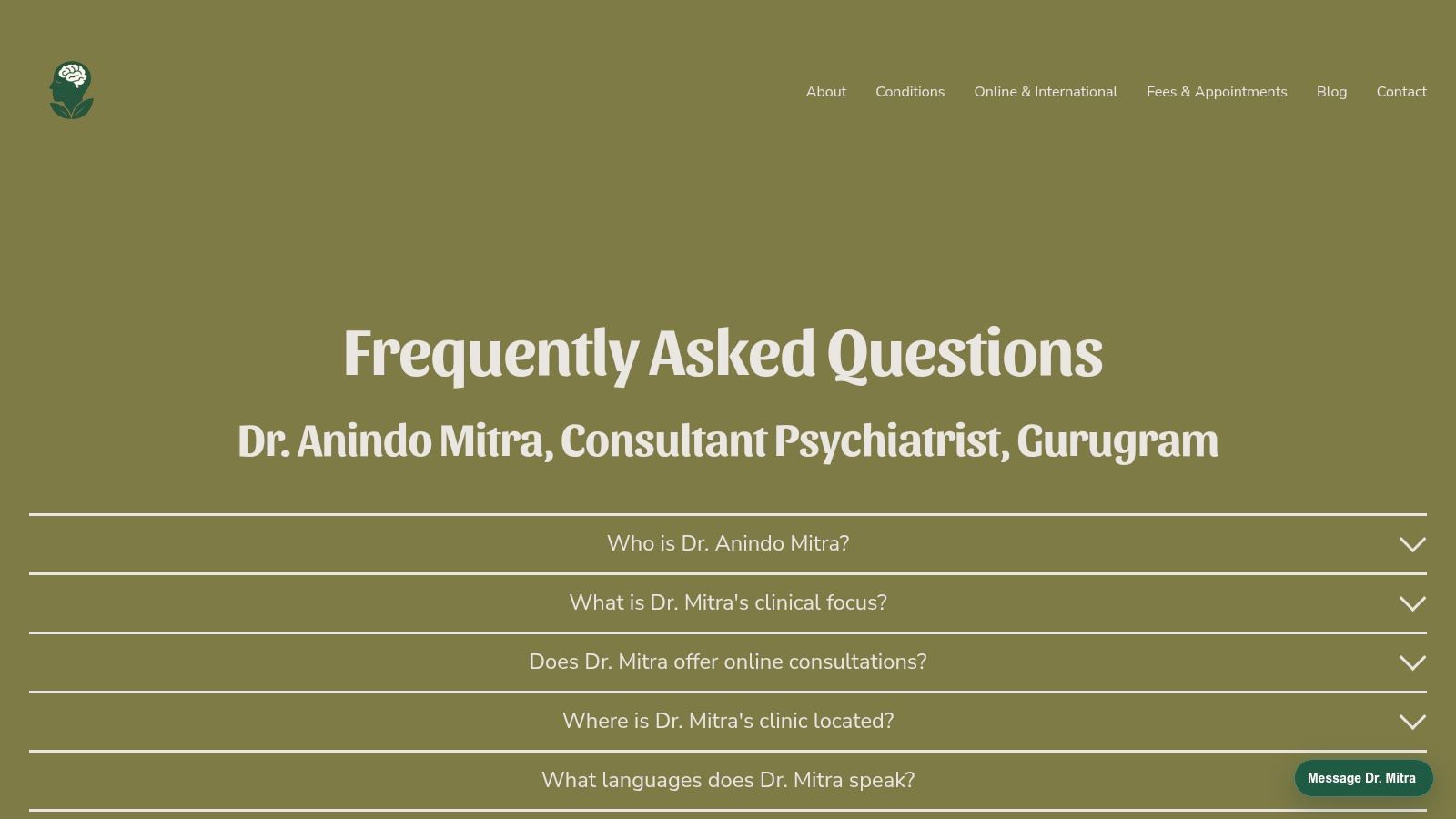
Not every search for a therapist for ADHD near me really needs a therapist first. Dr. Anindo Mitra is a psychiatrist whose stated clinical areas include adult ADHD. That makes this option relevant if you need assessment, diagnosis, or medication review rather than therapy alone.
Appointments are available at Athena Behavioural Health in Gurugram and online across India. Consultations are offered in English, Hindi, Bengali, and Tamil, so language needn't be a barrier to explaining your history. Speaking in the language you're most comfortable in often leads to a clearer assessment.
When psychiatry is the right first step
Choose a psychiatry appointment first if you need a formal diagnostic opinion or medication advice. A psychiatrist can assess your symptoms, consider other explanations, and manage medication if it's appropriate. You can then add therapy or counselling for skills, routines, and emotional support.
The access picture in India explains why online psychiatry matters. A government summary of national mental-health data estimated India's psychiatrist density at 0.75 psychiatrists per 100,000 people. With specialists in short supply, a remote consultation may be the fastest safe route.
Remember the boundary, though. A psychiatry appointment isn't the same as ongoing ADHD psychotherapy, and fees aren't listed, so ask before booking.
Comparing ADHD support options
| Provider | Location / Access | Type of ADHD Support | Session Format | Best For |
|---|---|---|---|---|
| ReACH Psychiatry | Bengaluru clinic and online | Adult ADHD therapy, coaching-style strategies, and psychiatric care when needed | Weekly 50–60-minute sessions | Practical support with organization, time management, and overwhelm |
| Amaha | In person in Bengaluru, Mumbai, and Delhi; online | Adult ADHD consultations, assessment pathway, therapy, and psychiatry | Online or in-person appointments | People seeking therapy and psychiatric assessment through one service |
| Mitsu | Clinics in Powai and Andheri, Mumbai; online across India | Adult ADHD therapy and psychiatric support | Online or in-person appointments | Adults seeking multidisciplinary care, including support for anxiety or burnout |
| Centre for Behavioural Sciences (CBS India) | New Delhi location and online | ADHD screening, psychological and psychiatric services | Online or in-person appointments | People seeking screening and follow-on care from one organization |
| LeapHope | Online across India | Adult ADHD therapy focused on executive functioning and daily coping | Online sessions with clinical psychologists | People comparing therapist experience, focus, and fees |
| Like Minds Psychiatry Clinic | Banjara Hills, Hyderabad | Adult ADHD assessment, psychiatric consultation, and treatment planning | In-person clinic appointments | People seeking a broad psychiatric assessment in Hyderabad |
| Dr. Roshan Jain | Bengaluru locations and online | ADHD assessment and psychiatric consultation | In-person, video, or telephone appointments | People seeking an assessment that considers current and childhood history |
| Mindtalk by Cadabams | Online and city-specific services | Assessment, CBT, behavioural therapy, psychoeducation, and medication management when indicated | Online or city-based consultations | People exploring therapy or medication pathways with different clinician types |
| Kyan Practice, Urvashi Jain | Online across India | Therapy for ADHD and AuDHD; not presented as diagnosis | Individual 50-minute online sessions in English or Hindi | People seeking neuro-affirming online therapy |
| Dr. Anindo Mitra | Gurugram appointments and online across India | Psychiatric assessment and medication management for adult ADHD | Online or in-person consultations | People seeking psychiatric assessment or medication review |
Making Your Choice and Taking the First Step
Start by naming what you need today. If you want coping skills, routines, and emotional support, look for therapy or counselling with ADHD experience. If you need a formal opinion or medication advice, find a qualified ADHD diagnostician or a psychiatrist who can assess you properly.
Then verify the basics before you pay anything. Check the professional's qualifications, registration, and experience with adult or child ADHD, depending on who the care is for. Ask what's included in the fee, whether assessment costs extra, and whether insurance or reimbursement is possible.
Online and in-person care both have honest trade-offs. Online sessions save travel and open up specialists across India, but they need privacy and a reliable connection. In-person care can feel more personal and may suit detailed assessment, though travel and wait times can be harder.
The wider context shows why persistence is sometimes needed. The National Mental Health Survey 2015-16 summary in PMC found that 10.6% of adults had a current mental-health condition, with large gaps in treatment. If your first enquiry doesn't lead anywhere, that reflects the system, not your worth.
Prepare a few questions for your first appointment. Ask how the professional assesses ADHD, what therapy would involve, how often you'd meet, and when they'd refer you to psychiatry. Also ask how progress is reviewed, so you can notice changes in focus, mood, and daily functioning over time.
You can use the DeTalks directory alongside this list to browse qualified psychologists and therapists and book sessions. Its science-backed self-assessments can help you organise your concerns before an appointment, and they're informational rather than diagnostic. Independent practitioners running their own practice can also join and be found through such platforms, since DeTalks supports psychologist sign-up for professionals. That gives you another way to check a therapist's professional standing before booking.
One more figure puts help-seeking in perspective. A national survey report hosted by the Ministry of Health and Family Welfare used a sample of 34,802 people across 12 Indian states and reported treatment gaps of 70% to 92% across disorders. Reaching out puts you ahead of a very common barrier, and that's something to feel good about.
Take this with you. Seeking help for ADHD, anxiety, depression, or workplace stress is a sign of self-awareness, not failure. Good support builds resilience, self-compassion, emotional balance, and well-being gradually, and it doesn't promise a cure. Small, steady steps, with the right professional beside you, can still change daily life in real ways.
If you're ready to compare qualified psychologists, therapists, and counsellors for ADHD support, visit DeTalks to browse profiles, explore confidential informational assessments, and book a session that fits your city, language, and budget. You'll find a calm place to start, whether you need therapy, counselling, or guidance toward assessment.