
You've had a lovely evening together, but on the way home you're wondering whether you should stay. Your partner feels familiar and comforting, yet a conversation about marriage, moving cities or meeting the family leaves you unsettled.
That tension deserves curiosity, not an immediate verdict. Ambivalence in relationships means there's something to understand about your feelings, your circumstances or the partnership itself. You don't have to dismiss the doubt, and you don't have to let it make the decision for you.
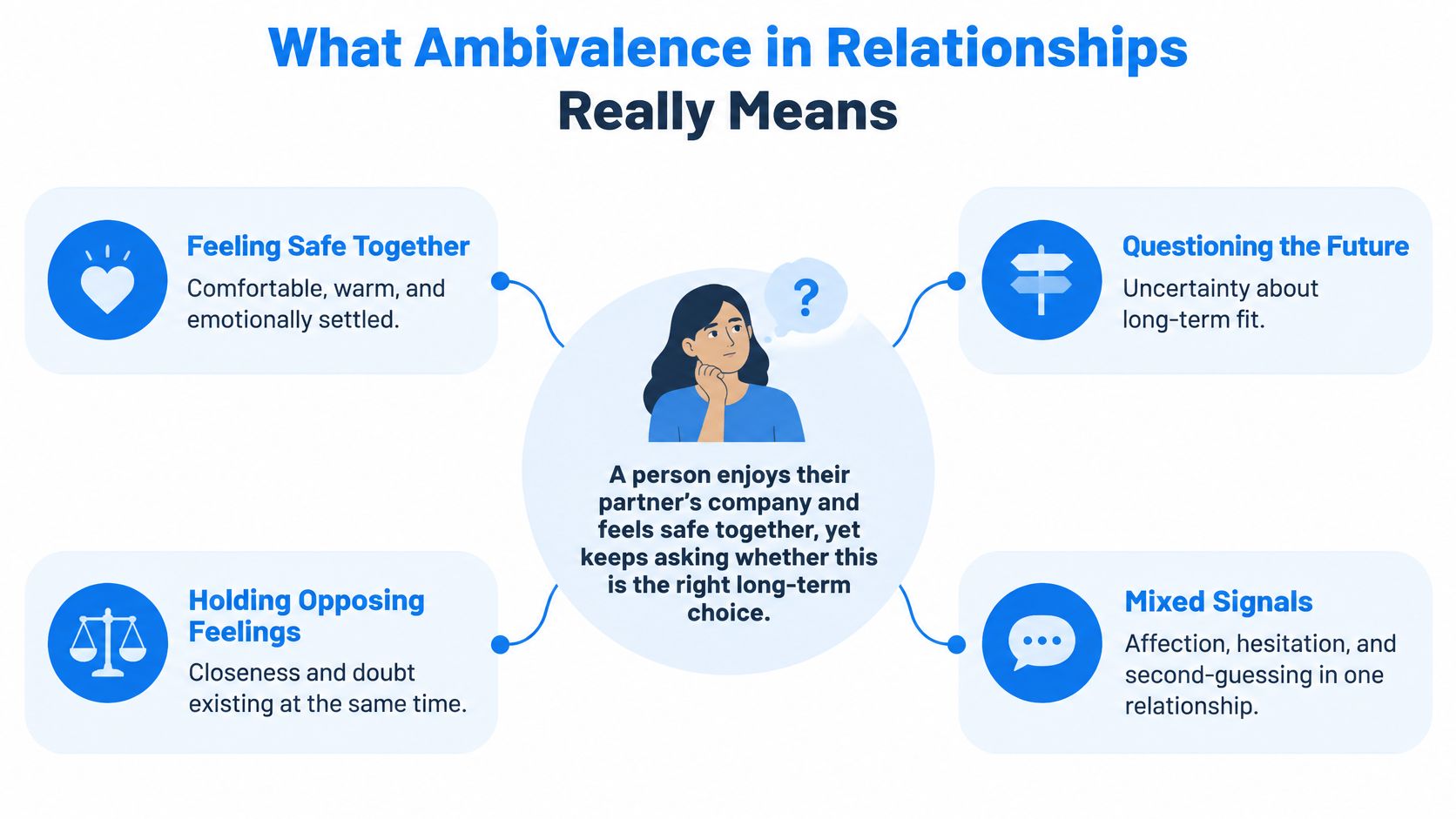
What Ambivalence in Relationships Really Means
You might enjoy your partner's company, feel safe beside them and still question whether you want a future together. Neither experience necessarily cancels out the other.
Ambivalence means holding positive and negative feelings towards the same person or commitment at once. It differs from simple indecision, which is difficulty choosing, and it doesn't automatically mean you've stopped loving someone.
Both sides can be real
Think of a two-sided coin. Both faces belong to the same object, even when only one is visible; affection may feel strongest during a relaxed evening, while doubt becomes louder during marriage discussions.
This concept map brings those experiences together.
A 2022 qualitative study published in Psychological Studies interviewed seven committed couples, comprising 14 young adults aged 21–25 in New Delhi, and identified trajectories involving ambiguity, stability and a relationship culminating in marriage. Its small, interview-based sample, drawn primarily from middle- and upper-middle-class backgrounds, cannot establish national percentages.
The useful insight is that commitment and uncertainty can coexist. Young adults may be negotiating intimacy alongside education, identity, careers and family expectations, rather than evaluating affection in isolation.
Understanding the Indian context
In India, the question may not be whether you love your partner alone. It may also involve parental approval, caste or community compatibility, marriage expectations, and economic readiness.
Try distinguishing between these concerns:
- Feelings about the person: Do I enjoy and respect this relationship?
- Concerns about the arrangement: Could we agree on where to live, family involvement and responsibilities?
- Pressure surrounding the decision: Would I choose this freely without fear of disappointing others?
Mixed feelings are human, not a character flaw. For an additional perspective on persistent love-and-frustration conflicts, Therapy with Ben discusses when relationship ambivalence calls for counselling.
The important distinction is between a concern you can explore together and a situation that compromises your freedom, safety or essential needs.
Signs You Feel Torn and What They Often Reflect
Common signs of ambivalence and gentle first steps
| Sign | What it often reflects | Gentle first step |
|---|---|---|
| Loving moments but dread about the future | Fear of long-term conflict or unclear roles | Write the specific future worry in one sentence |
| Wanting closeness, then pulling away | Avoidant regulation or fear of being overwhelmed | Notice what triggers withdrawal and name it calmly to your partner |
| Constant checking of how the partner feels | Anxious attachment seeking reassurance | Set a daily limit on reassurance-seeking and journal instead |
| Relief when the partner is away | Unmet needs for support, closeness or autonomy | Identify which need is missing, not only which person is at fault |
| Family or community voices feel louder than your own | Expectations from parents or community | Separate what you want from what you feel obliged to want |
| Work stress makes you irritable at home | Workplace stress spilling into the relationship | Talk about the stress before discussing the relationship |
These are possible patterns, not conclusions. Relief during time apart, for example, might reflect a healthy need for solitude, exhaustion from conflict or discomfort you haven't yet named.
How to use the self-check
Choose the rows that feel most familiar and record when they appear. Notice whether the shift follows a family call, a shared plan, an argument or an otherwise quiet evening.
Then match the sign to a possible explanation and try the gentle first step for a week. Treat that period as an observation exercise, not a deadline for deciding whether to stay.
Say you feel affectionate until your partner mentions moving in together. Writing down the worry might reveal that you're concerned about losing privacy or taking on unequal household work, rather than about sharing life with that person.
Likewise, repeatedly checking whether your partner still loves you doesn't prove you have an attachment difficulty. Ask whether reassurance settles you briefly, whether your partner's behaviour is inconsistent, or whether both are happening.
Practical rule: Describe what happened before deciding what it means.
If you experiment with reducing reassurance-seeking, don't turn it into withholding legitimate questions. The aim is to interrupt repetitive checking while preserving your right to ask for clarity.
What the table cannot tell you
A checklist can't establish compatibility, consent or the full context of a relationship. Self-checks and assessments are informational, not diagnostic, and no score can decide whether you should marry or separate.
Threats, controlling behaviour, fear for your safety or pressure to conceal your whereabouts require outside support, not extended self-analysis. If being honest could expose you to retaliation, seek confidential individual help before attempting a relationship conversation.
Causes Behind Mixed Feelings in Partnerships
Mixed feelings can arise from several overlapping sources. Understanding the source helps you choose a response instead of treating every doubt as evidence that something is wrong with you.
Attachment and earlier experiences
Attachment describes patterns in how people approach closeness and security. An anxious pattern may involve seeking reassurance and fearing abandonment; an avoidant pattern may involve pulling back when emotional dependence feels uncomfortable.
A more secure pattern allows room for both connection and independence. These descriptions are useful ways to notice behaviour, not fixed identities or diagnoses.
Consider a man who withdraws after every argument. His silence might be an attempt to manage overwhelm, a learned response to conflict or unwillingness to engage; you need to understand the context rather than assign him a label.
Earlier betrayal, family conflict or a painful breakup can also influence what feels risky now. If present-day closeness brings up older experiences, Embodied Living Counseling offers information for people looking to find support for early relational wounds.
Culture and current pressures
A 2014 comparative study available through PubMed Central found that Indian respondents reported greater collectivism, stronger romantic beliefs, more traditional mate preferences and greater anticipation of marital difficulties than participants in the comparison settings. Collectivism and traditional gender-role beliefs also predicted preferences for traditional partner characteristics.
Those findings describe the study's participants, not all Indians. They help explain how someone can value romance while worrying about the obligations attached to marriage.
For example, a woman may feel happy with her partner but worry about future in-laws expecting her to leave her job. The concern deserves a concrete discussion about employment, living arrangements and whose preferences will guide decisions, not reassurance that love will solve everything.
Present pressures can add another layer:
- Financial strain: Debt or insecure employment may make shared commitments feel harder to manage.
- Career transitions: Relocation can create a genuine conflict between personal goals and partnership plans.
- Workplace stress: Exhaustion may leave little capacity for patient conversation or reflection.
Ask whether your hesitation is about the relationship, the timing or the conditions being proposed. These causes can combine, and separating them reduces self-blame while pointing towards more suitable help.
How Ambivalence Shapes Both Partners
For the person who feels torn, distance may bring temporary relief. For their partner, the same distance may feel confusing or rejecting, particularly after a warm, connected interaction.
The contrast can look like this.

Following the interaction rather than blaming a person
A couple-level study of 152 couples from Northeast India found that husbands' avoidant attachment significantly mediated the association between perceived partner responsiveness and husbands' marital satisfaction, while anxious attachment did not show a significant mediating pathway. In plain language, avoidance helped statistically explain that association; the finding doesn't prove a universal causal sequence.
A useful pattern to examine is feeling unheard, withdrawing, then becoming less satisfied. One person may hesitate to disclose a concern because they expect dismissal, while the other interprets the silence as indifference and stops asking.
Observable behaviours offer better starting points than accusations about someone's personality:
- Delayed disclosure: Important worries are mentioned only after decisions have been made.
- Emotional distancing: Practical conversations continue, but personal feelings remain unspoken.
- Avoided commitment talks: Discussions are repeatedly postponed without an agreed return.
- Conflict disengagement: Someone leaves an argument and never resumes the conversation.
The study's regional sample warrants caution about applying its findings to every Indian couple. It's a reason to examine responsiveness and withdrawal, not to assume husbands always withdraw or wives always pursue.
This accompanying video offers another opportunity to reflect on relationship difficulties.
Making uncertainty less destabilising
Unspoken uncertainty can resemble a door left ajar: the steady draft affects everyone in the room. Partners may struggle to plan marriage, parenthood or a move because neither knows which agreements will hold.
The person receiving mixed signals also needs boundaries. Compassion doesn't require accepting indefinite uncertainty or repeatedly putting personal plans on hold.
You can acknowledge uncertainty while being clear about what you can offer today.
A more useful response names the concern, specifies what needs discussion and follows through on agreed conversations. Both partners can practise responding differently, but neither can create mutual engagement alone.
Ambivalence Before Marriage and in Long-Term Partnerships
India's mix of arranged and love marriages means doubt may involve personal choice, family participation and social obligation simultaneously. Neither the way a couple met nor family approval can answer every question about their future.
A 2025 sociological study of 200 married people across Ahmedabad, Surat, Rajkot and Vadodara identified emotional compatibility, communication, financial security and family dynamics as central factors, rather than treating either love or arranged marriage as a guarantee of stability.
Before making a commitment
Ask which of those factors is driving your hesitation. A disagreement about household spending may be negotiable; an inability to say no freely requires a different response.
Consent isn't a problem to solve through compromise. Family embarrassment, wedding expenses or an engagement announcement don't remove your right to reconsider.
When the relationship has no clear ending
In situationships and established partnerships, loyalty can coexist with loneliness, boredom or attraction to somebody else. Attraction isn't, by itself, a complete assessment of the relationship, but it can prompt an honest examination of needs and choices.
Coverage of a 2025 survey of more than 1,500 adults in Tier-1 and Tier-2 Indian cities described openness to explicitly negotiated relationship boundaries. Separately, Times of India's coverage of Bumble's 2025 findings reported that 62% of Indian women surveyed sought a partner offering emotional consistency, reliability and clear life goals.
These survey findings aren't national prevalence rates. Negotiating boundaries also requires genuine mutual consent, not deception or pressure to accept unwanted arrangements.
Consider these questions alone or with a counsellor:
- The missing need: Which need is unmet?
- The conversation: What have I said directly?
- The conditions: What would make a decision feel safe enough to make?
Practical Ways to Manage Mixed Feelings
You don't need complete certainty before taking a constructive step. Begin with specific observations and requests, while keeping your freedom to reach a different conclusion.
A routine for clearer conversations
Name both feelings precisely.
You might say that you feel safe together but dread moving in because you haven't agreed on household responsibilities. Specific language gives your partner something understandable to respond to, rather than leaving them to interpret a broad statement of doubt.Map different parts of the relationship.
Consider emotional closeness, perceived support, expectation alignment and conflict intensity separately. You may feel connected during leisure time but unsupported during family disagreements; a single satisfaction rating could hide that distinction.Hold a weekly structured review.
Each partner can name a validating behaviour, an unmet expectation and a recurring conflict pattern. Turn the unmet expectation into a request you can observe, such as agreeing to discuss family visits before confirming them.Use personal statements and a pause agreement.
Describe what you feel and need without claiming to know your partner's motives. If either person becomes overwhelmed, pause and agree when you'll return; an unexplained disappearance isn't a shared pause.Keep a simple thought record.
This cognitive behavioural therapy technique separates the situation, your thought, your feeling and a more balanced alternative. After a delayed reply, for example, you might distinguish fear of rejection from the fact that you don't yet know why the response was late.Protect capacity for resilience.
Make room for regular sleep, movement, mindfulness and self-compassion, especially during demanding work periods. These practices aren't substitutes for addressing unfairness, but they can support the steadiness needed to reflect and speak clearly.Choose a review date.
Agree on a date to examine whether requests were followed through and whether conversations became more respectful. Don't use an observation period to postpone responding to danger, coercion or an essential incompatibility.
Aim for connection and less damaging conflict
A study of 91 urban Indian couples, comprising 182 married individuals married for an average of 11 years, found that intimacy predicted greater happiness while conflict predicted lower happiness. Agreement, empathy, validation, support and fulfilled expectations were also associated with marital happiness.
The sample included different socioeconomic classes, family structures, and arranged and love marriages, but comprised urban Hindu couples. It therefore offers useful guidance without representing every Indian relationship.
A useful measure of progress: Look for changed behaviour, not only a reassuring conversation.
If conflict stays high or requests are repeatedly dismissed, more conversation on its own may not be enough. Consider professional support or a closer examination of what each person is willing to change.
Therapy Options and Assessments to Compare
Therapy approaches and assessments for mixed feelings
| Option | Type | Best suited for | What to expect |
|---|---|---|---|
| Cognitive behavioural therapy (CBT) | Individual therapy | Overthinking, anxiety and decision paralysis | Structured sessions with thought tracking and practical exercises |
| Emotionally focused therapy (EFT) | Couples therapy | Attachment-driven distance and recurring conflict | Work with both partners on emotional needs and interaction patterns |
| Acceptance and commitment therapy (ACT) | Individual therapy | Living by personal values while holding mixed feelings | Mindfulness, acceptance and values-based action |
| Gottman-based couples therapy | Couples therapy | Communication habits and conflict patterns | Skills-focused sessions with both partners |
| Pre-commitment or premarital counselling | Counselling | Engaged or serious couples with doubts about marriage | Focused conversations about expectations and family roles |
| Experiences in Close Relationships-Revised (ECR-R) | Self-report assessment | Understanding attachment anxiety and avoidance | Informational only, not diagnostic |
| Dyadic Adjustment Scale (DAS) | Self-report assessment | Exploring overall adjustment as a couple | Informational only, not diagnostic |
| PHQ-9 and GAD-7 | Screening questionnaires | Checking low mood and anxiety symptoms | Informational screening only, not diagnostic; discuss results with a qualified professional |
These are options to discuss, not a prescription based on a checklist. Session frequency and duration should be agreed with the professional after understanding your needs.
Choosing the kind of conversation you need
Counselling often focuses on a particular concern or decision, while therapy may involve more sustained work on recurring patterns. The terms overlap in practice, so ask how the professional works rather than relying on the service label alone.
Individual therapy may fit when you replay every argument, struggle to identify your preferences or want private space before discussing a decision. You don't need your partner's participation to explore your own boundaries.
Couples therapy may fit when both people want to understand a shared interaction, such as withdrawing whenever conflict begins. Premarital counselling can offer a focused setting for discussing children, finances, care responsibilities and family involvement before committing.
- Ask about relevant experience: Does the professional work with relationship uncertainty and your family or cultural context?
- Clarify the aim: Will sessions focus on decision-making, communication, emotional patterns or a combination?
- Discuss confidentiality: Ask how individual disclosures and shared sessions are handled.
What an assessment can and cannot answer
Every assessment is informational, not diagnostic. ECR-R responses may help organise a conversation about attachment, while the DAS can help explore couple adjustment; neither decides whether a relationship is right for you.
PHQ-9 and GAD-7 questionnaires screen for depression-related and anxiety symptoms. A qualified professional must consider responses alongside your circumstances, functioning and wider history rather than treating a score as a diagnosis.
You can also decline an assessment or ask why it's being suggested. A useful tool should support understanding, not make you feel reduced to a category.
If threats or coercion are present, seek confidential individual support before arranging joint sessions. The immediate priority is a safe setting where you can speak freely, not practising vulnerability in front of someone you fear.
Deciding When to Reach Out for Support
Ambivalence alone doesn't mean you have a mental illness. Professional help becomes particularly relevant when distress affects your sleep, concentration, relationships or ability to manage daily life.
A review of Indian workplace research reported estimates ranging from 10% to 52.9% for depression, 7% to 57% for anxiety and 3.8% to 75.5% for workplace stress, reflecting different samples and measures; it also described a 2022 urban white-collar sample of 1,764 employees in which 29% showed moderate-to-severe depressive signs, 55% moderate-to-severe anxiety and 78% moderate-to-high stress. These screening results are informational, not diagnostic, and don't establish that relationship uncertainty causes illness.
Signs that outside help could be useful
- Persistent distress: Mixed feelings continue for several weeks and leave you unable to think clearly.
- Disrupted functioning: Sleep, concentration, work or friendships are affected.
- Repeated conflict: Arguments return without meaningful repair.
- Shrinking support: You withdraw because explaining your experience feels too difficult.
Fear of judgement can make reaching out harder. A 2023 workplace survey reported by Madhyamam, covering more than 1.85 million employees across over 210 companies, found that 56% experienced burnout, while one in four found it difficult to discuss stress, burnout, anxiety or depression without fear of judgement.
Get urgent help when safety is involved
Threats, control, fear for your safety or thoughts of self-harm call for immediate outside help. If danger is immediate, contact local emergency services or go to the nearest emergency department; India's national Tele-MANAS helpline is available on 14416 for mental health support.
Mixed feelings deserve compassion, and small steps can support resilience and well-being. Choose a relevant self-check row and try a practical routine for two weeks if it's safe, but don't wait for a crisis to seek support.
DeTalks offers a directory of psychologists, therapists and counsellors where you can compare professionals and book confidential support for relationship concerns. Visit DeTalks to find a qualified professional who can help you explore mixed feelings, clarify your needs and consider your next step without pressure to reach a particular decision.