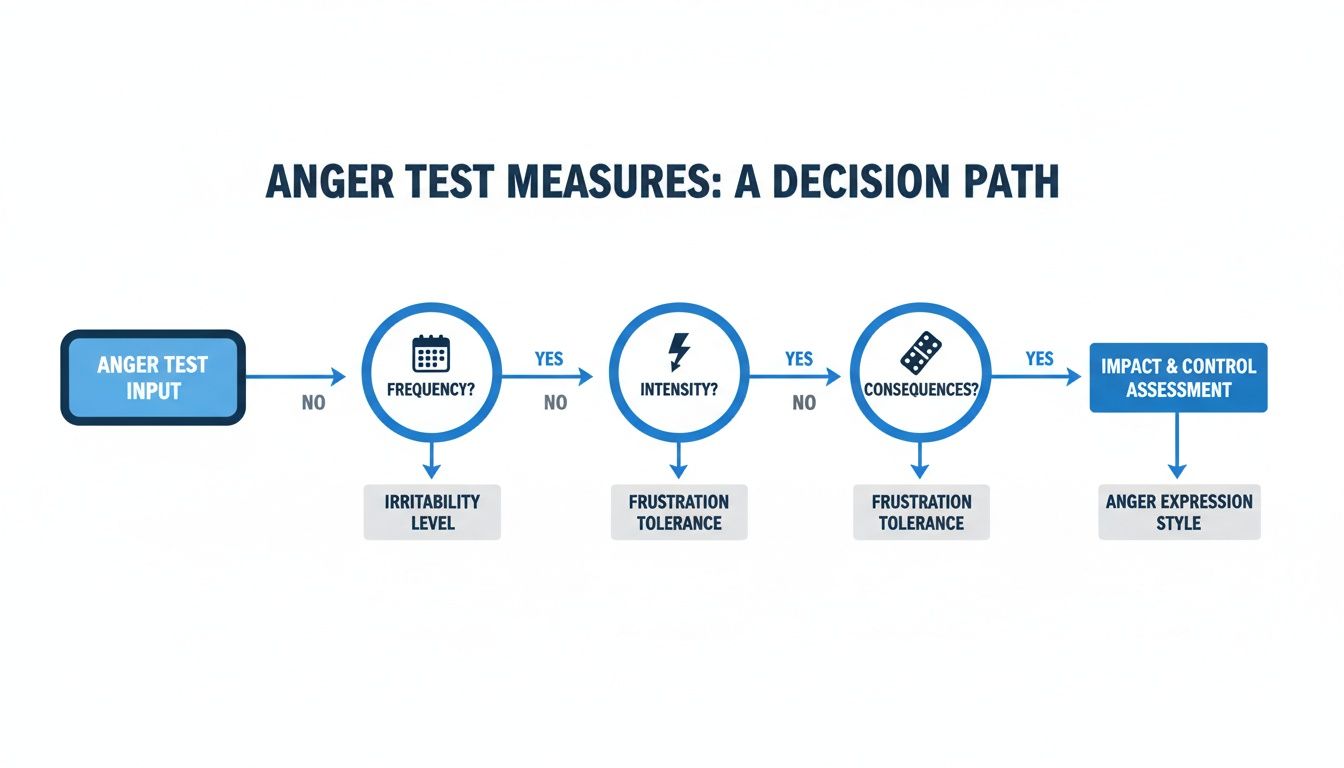
Your thoughts about anger are more than just passing feelings; they are the blueprint for your emotional world. Understanding this is powerful because it means you have the ability to review and change that blueprint. By shifting your thoughts, you can transform your relationship with this strong and often misunderstood emotion.
Why Your Thoughts on Anger Shape Your Reality

First, it’s important to know that everyone gets angry. It is a normal human emotion, not a sign of a personal flaw. Simply acknowledging this is a significant step toward managing it better and improving your overall well-being.
This guide isn't about trying to eliminate anger. Instead, we’ll explore the powerful thoughts that often fuel it. When our inner narrative is left unchecked, anger can deeply affect our lives, especially in high-pressure environments like many workplaces in India and around the globe.
The Impact of Unmanaged Anger
When angry thoughts are not addressed, they can create significant challenges. This isn't always about big, explosive outbursts. Often, it’s a quiet, slow burn that can lead to difficulties in different areas of life.
These challenges can include:
- Workplace Stress: Ongoing frustration can affect your performance, create tension with colleagues, and contribute to burnout.
- Relationship Issues: When anger isn’t handled constructively, it can damage trust and create distance between you and the people you care about.
- Mental Health Concerns: Over time, persistent anger is often connected to higher levels of anxiety and can sometimes contribute to depression.
The key to managing anger, in my humble opinion, is awareness and proper expectation management. The “Road To Recovery” is not always a straight line; there can be twists and turns.
This guide presents therapy and counselling as practical tools for building resilience, not just as interventions for a crisis. Think of this as a starting point for getting to know yourself better and treating yourself with more compassion. Please remember, any assessments mentioned here are for informational purposes and are not a substitute for a professional diagnosis.
Our goal is to help you see anger not as an enemy, but as a signal. When you learn to listen to that signal and understand what it’s telling you, you can build a healthier, more fulfilling life. This journey is about making progress toward happiness and balance, not achieving perfection.
How Your Inner Script Turns Events Into Anger
Think about the last time you were stuck in traffic before an important meeting. The traffic itself is a neutral event—just a line of cars. What truly sparks frustration is the story you tell yourself about it. This internal script, your specific thought on anger, is what turns a simple delay into a personal crisis.
Psychologists call this split-second interpretation an appraisal. It's the immediate, often unconscious, judgment your mind makes about a situation. Your mind asks: Is this unfair? Is this a threat? Is this a personal attack? The answers, not the traffic, dictate your emotional reaction.
The Mental Traps That Fuel Anger
These appraisals can happen so quickly that we don’t even notice them. They may feel like automatic reactions, but they are often rooted in unhelpful thought patterns known as cognitive distortions. These patterns can bend our perception of reality, making a situation feel more threatening or unfair than it is.
These mental shortcuts can affect our ability to manage our emotions, contributing to everything from workplace stress to general anxiety. For example, if your manager offers constructive feedback, a distorted thought might be, “They think I’m incompetent.” That interpretation, not the feedback itself, is what sparks anger. Learning to spot these patterns is a huge step toward greater emotional well-being.
“Such as are your habitual thoughts, so also will be the character of your mind. For the soul is dyed by its thoughts.” — Marcus Aurelius
The Roman emperor Marcus Aurelius understood this nearly two millennia ago. Our minds are shaped by our most frequent thoughts. If our thinking is consistently colored by blame or frustration, our emotional world will reflect that, sometimes affecting our overall mental health and even contributing to feelings of depression.
Common Thought Patterns That Fuel Anger
Learning to recognize these thought patterns is like learning the recipe for your own anger. Once you can identify the ingredients, you can decide if you want to use them. This is not about judging yourself for having these thoughts—we all do. It's about building awareness so you can choose a different path.
The table below outlines common cognitive distortions that fuel anger. This information is purely for educational purposes and should not be used as a diagnostic tool.
Common Thought Patterns That Fuel Anger
| Cognitive Distortion | What It Means | Example Thought on Anger |
|---|---|---|
| Catastrophising | You expect the worst-possible outcome, blowing things out of proportion. | "This traffic will make me late, my boss will fire me, and my career will be ruined." |
| Mind-Reading | You assume you know what others are thinking, usually something negative, without evidence. | "My friend cancelled our plans. They must be angry with me and are avoiding me." |
| Personalisation | You believe that you are the cause of events, even when you are not primarily responsible. | "The team missed its deadline because my part wasn't good enough. It's all my fault." |
| Black-and-White Thinking | You see things in all-or-nothing terms, with no middle ground. It's either a total success or a complete failure. | "If I don't get this promotion, my entire career is a failure." |
When you understand how your inner script works, you gain the power to direct your own emotional responses. The key to managing anger isn't about stopping the feeling itself. It's about calmly rewriting the thoughts that give it life, building profound emotional resilience with practice and, if needed, the support found in therapy or counselling.
Anger and Stress in Today's Workplace
Our jobs take up a significant part of our lives, so it’s no surprise that work affects our emotional well-being. In places like modern India, high-stress roles, remote work pressures, and intense competition are common. This environment can easily stir up emotions, where a passing thought on anger can lead to chronic workplace stress, anxiety, or even depression.
If you feel like you are constantly juggling these pressures, you are not alone. While some data may suggest India has lower levels of daily work stress compared to other countries, this doesn't capture the full picture. Many professionals are dealing with intense feelings beneath the surface.
The Hidden Emotional Toll of Work
The reality is that a large number of us are grappling with strong emotions every day. A recent report revealed a startling figure: 33% of employees in India deal with daily anger and sadness. This number clearly illustrates the emotional cost of our modern work lives.
Interestingly, while India's reported daily work stress (32%) is below the global average (41%), the country leads the world in daily anger. A remarkable 35% of professionals in India report feeling angry each day, far surpassing the global average of 21%.
These figures confirm what many of us feel: the workplace can be a major source of emotional strain. Learning to handle challenges like navigating toxic workplace behavior is essential. Unresolved issues can lead to burnout, job dissatisfaction, and a decline in overall happiness.
Finding a Path Toward Resilience
Just acknowledging this widespread challenge is a powerful step toward building resilience. The goal is not to eliminate stress entirely, as some pressure can be healthy for professional growth. The real aim is to develop healthier ways of responding to it. This is where professional support can make a significant difference.
When we feel overwhelmed, it’s easy to think we are failing. But reaching out for support is a sign of incredible strength and a commitment to your own well-being.
Therapy and counselling offer a safe, confidential space to explore the triggers behind your workplace anger and stress. A professional can help you develop personalized strategies for managing difficult colleagues, handling deadlines, or setting better boundaries. These tools empower you to change your relationship with work, leading to more emotional balance and self-compassion.
Mapping the Four Stages of an Anger Episode
Anger rarely appears out of nowhere. It might feel like a sudden explosion, but it often follows a predictable pattern. Think of it less like a random lightning strike and more like a storm that brews over time.
By breaking down an anger episode into its phases, we can see where we have the power to change its course. This is often called the 'anger cycle,' a map with four key stages: Trigger, Escalation, Crisis, and Aftermath. Every thought on anger fits somewhere on this path.
Let's use a common example. A parent, tired after a long day, is helping their child with homework. The child becomes restless and complains, which is the trigger. The parent's thought might be, "They're being difficult on purpose," a feeling often amplified when workplace stress comes home with us.
The Escalation and Crisis
Once triggered, the escalation phase begins, and the initial irritation grows. The parent’s body might tense up, and their voice may become sharp. Internally, thoughts spiral: "Why won't they listen? I feel like a failure."
This leads to the crisis stage—the peak of the storm. This is the moment of explosion, where the parent might shout or say something they later regret. Rational thought is overwhelmed by emotion, and this is often where the most damage to our relationships and our own well-being occurs.
The diagram below shows how these daily flare-ups are connected to our broader emotional state.

As you can see, what feels like a single moment of anger is often part of a larger pattern that shapes our overall mood.
The Aftermath and Reflection
After the storm passes, the aftermath begins. The intense energy is gone, often replaced by feelings of guilt, regret, or sadness. Over time, these feelings can contribute to persistent anxiety or even depression. The parent may apologize, but the emotional impact can linger for everyone involved.
Understanding this cycle isn't about judging yourself. It’s about recognizing the choice points—the moments where you can step off the path and try a different route. This is how you build true emotional resilience.
When you start to map your own experiences onto these four stages, anger becomes a process you can understand and influence. The first step is to notice your triggers and the thoughts that fuel them. With this awareness, you can begin to intervene long before a crisis hits, sometimes with the gentle guidance of professional counselling or therapy.
Practical Strategies to Reframe Your Angry Thoughts

Knowing what causes your anger is a great first step, but how do you manage it in the moment? Here, we move from theory to practice. Let's build a toolkit with simple, effective strategies to challenge a negative thought on anger and cultivate lasting emotional resilience.
These methods, drawn from approaches like Cognitive Behavioural Therapy (CBT), aren't about suppressing your emotions. They are about creating a small pause between a trigger and your reaction. This pause gives you the space to choose a healthier path forward for your well-being and relationships.
The Power of Cognitive Reframing
Cognitive reframing is a core technique in therapy where you learn to question the automatic stories you tell yourself when you feel angry. Once you spot a negative thought, you can consciously look for a more balanced perspective. For example, if a colleague misses a deadline, your first thought might be, “They are so unreliable and have no respect for my time!”
Reframing means you pause and ask helpful questions:
- Is there another way to see this? Perhaps they are overwhelmed with other tasks or dealing with a personal issue.
- What’s a more balanced way to think? "I’m frustrated that this is late, but I don’t know the full story. I’ll check in to see what’s going on."
This small mental shift can lower the emotional intensity, moving you from blame to problem-solving. With practice, you can rewire your brain for a calmer response.
In-the-Moment Grounding Techniques
Sometimes anger arises so quickly that you need a way to stop the spiral immediately. Grounding techniques are like an emergency brake. They pull your focus away from racing thoughts and into the physical reality of the present moment.
A simple and effective method is the 5-4-3-2-1 technique. Wherever you are, silently name:
- 5 things you can see: Your laptop, a pen, a plant, a shadow, the color of your shirt.
- 4 things you can feel: The chair beneath you, the fabric of your clothes, the air on your skin, the surface of your desk.
- 3 things you can hear: The sound of a fan, your own breathing, distant traffic.
- 2 things you can smell: The scent of coffee or the faint smell of paper.
- 1 thing you can taste: The mint from your tea or the lingering taste of your last meal.
This simple exercise helps your rational brain re-engage, interrupting the emotional hijack.
Constructive Communication with I-Statements
Expressing anger can be healthy; it’s how you express it that matters. Blaming language like “You always…” or “You never…” often makes others defensive. "I-statements" are a powerful tool for voicing your needs clearly without pointing fingers.
The structure is simple:
"I feel [your emotion] when [the specific behavior happens] because [the impact it has on you]."
Instead of saying, "You never listen to me!" which can start a fight, try: "I feel unheard when I’m interrupted because it makes me think my opinion isn’t valued." This approach invites a constructive conversation instead of escalating conflict and helps reduce workplace stress.
Given that 53% of urban Indians report stress so severe it disrupts their daily lives, tools like these are more important than ever. You can learn more about the connection between stress and mental health in urban India on ipsos.com.
When to Seek Professional Support for Anger
Taking steps to manage your thoughts on anger is a wonderful start. But what if these strategies don't feel like enough? Sometimes, anger can feel like a constant, heavy presence. If that sounds familiar, you are not alone, and it is perfectly okay to seek support.
Deciding to talk to a professional is not a sign of defeat; it is a powerful move toward building lasting emotional resilience. Therapy and counselling provide a confidential space to explore the roots of your anger with a trained guide. Recognizing you deserve that support is a true act of self-compassion.
Is It Time to Talk to Someone?
If you are wondering whether professional help is the right next step, consider if these situations feel familiar. This is not a diagnosis but a gentle guide to help you decide if an expert could improve your well-being:
- Your anger is creating distance or conflict in your relationships.
- You are dealing with frequent workplace stress or have been told your anger is an issue at your job.
- You feel constantly "on edge" and irritable over small things.
- After an outburst, you are left with overwhelming feelings of shame, guilt, or anxiety.
These experiences are becoming more common, especially among young people. A recent Sapien Labs report highlighted a significant mental health challenge among Indian adolescents, marked by a decline in well-being and a rise in aggression.
Acknowledging you need help is the first, most powerful step toward healing. It is a commitment to yourself and your happiness, showing profound courage and self-compassion.
If you are ready to take that step, a good place to start is by exploring available resources. You can find guides to services like Penticton counselling options to see what support looks like. For those in India and globally, platforms such as DeTalks make finding a therapist a straightforward and private process, connecting you with qualified professionals.
Supportive Takeaways for Your Emotional Journey
As we conclude, let’s focus on a few key ideas to carry with you. Managing every thought on anger is not about becoming perfectly anger-free. It’s a process of growing self-awareness and building resilience, where progress is more important than perfection.
Remember, anger is often a messenger, not a villain. It’s a signal from your mind and body that a boundary may have been crossed or something you value feels threatened. Learning to listen to that signal without judgment is a huge step toward lasting change and greater happiness.
You Are the Author of Your Emotional Story
Your thoughts, not external events, are the primary source of your feelings. A frustrating situation is just a situation. The story you tell yourself about it—your personal appraisal—is what gives anger its power. This is great news, as it puts the ability to respond thoughtfully back in your hands.
By gently questioning those automatic thoughts, you can begin to rewrite your emotional script. This is not just about managing anger; it's a skill that protects your overall mental well-being from life’s pressures, including workplace stress, relationship challenges, or private struggles with anxiety and depression.
The journey toward emotional balance is not about never feeling anger. It's about developing the wisdom to understand it, the skill to manage it, and the compassion to forgive yourself when you stumble.
Ultimately, this is your path, but you do not have to walk it alone. Committing to your emotional health is a brave and vital act. Whether you are just beginning to explore these ideas or feel you need deeper support through counselling or therapy, please know that help is always within reach.
Your journey toward a more peaceful and resilient life is a powerful one. If you’re ready to take the next step with compassionate, professional guidance, DeTalks is here to support you. Explore our resources and connect with a qualified therapist today.