
Tag: anxiety and procrastination

  • Causes of procrastination: Uncover Why You Delay and How to Act

    Causes of procrastination: Uncover Why You Delay and How to Act

    Procrastination is not about laziness. It is often an emotional response our brain uses to cope with difficult feelings like anxiety, perfectionism, or a fear of failure.

    Seeing it this way is the first step toward treating yourself with more kindness. This understanding helps you find a supportive way forward.

    Why Procrastination Is Not a Character Flaw

    It's common to feel guilty for putting things off, calling it poor time management. But procrastination is less about defiance and more about a need to avoid uncomfortable feelings.

    Think about preparing for a competitive exam in India or a big project at work. If the task triggers stress, your brain seeks relief by pushing it away, which can harm your mental well-being.

    Shifting from Judgment to Understanding

    Instead of feeling angry with yourself, try asking why you are avoiding the task. This compassionate curiosity is more productive than self-criticism.

    This flowchart helps show how deeper psychological factors are often the true causes of procrastination.
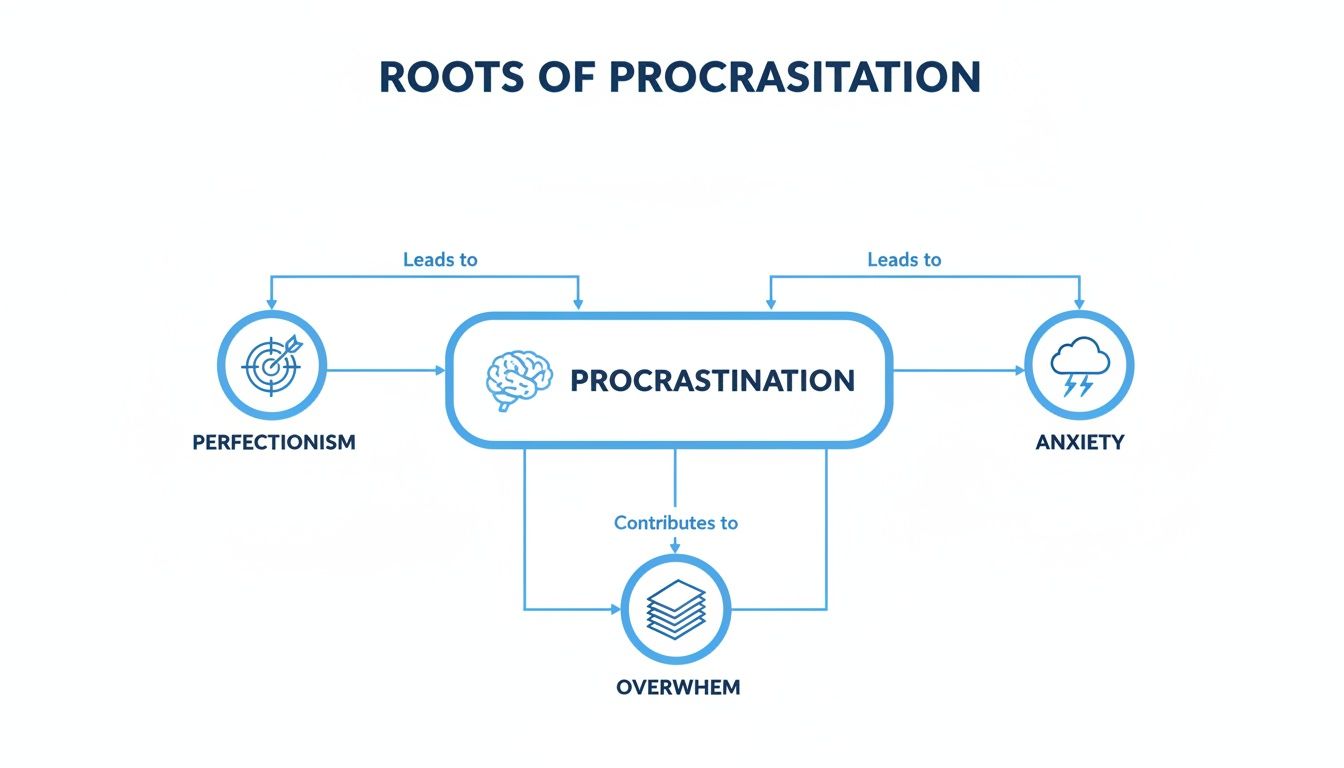
    A flowchart titled 'Roots of Procrastination' showing perfectionism leading to procrastination, which causes anxiety and contributes to overwhelm.

    Factors like perfectionism can create a challenging cycle. The fear of not doing perfect work leads to procrastination, which then increases your anxiety.

    Common Procrastination Triggers at a Glance

    Pinpointing the feelings that trigger procrastination can help you break the pattern. This table outlines some common emotional triggers behind this behaviour.

    Trigger Category Specific Examples Impact on Well-being
    Fear of Failure Avoiding a project because you worry the outcome won't be good enough. Not applying for a job because you fear rejection. Leads to missed opportunities, chronic self-doubt, and a feeling of being 'stuck'.
    Perfectionism Delaying the start of a report because the "perfect" opening sentence hasn't come to you. Reworking a simple email dozens of times. Creates immense pressure and anxiety, making any starting point feel impossible and draining mental energy.
    Anxiety & Overwhelm Seeing a massive to-do list and not knowing where to begin, so you do nothing. A task feels too complex or vague. Triggers a 'freeze' response, leading to complete avoidance and shutdown. Increases stress and guilt.

    These feelings are human, especially in high-pressure environments. Persistent workplace stress or academic demands can turn occasional procrastination into a regular habit.

    This is a signal that your emotional needs may require attention. Addressing these underlying causes through self-compassion or professional counselling can help you move forward with more ease.

    Please note: assessments mentioned are informational, not diagnostic. They are not a substitute for advice from a qualified mental health expert.

    The Connection Between Anxiety and Procrastination

    Procrastination is often a way to manage difficult emotions. When a task brings up feelings of anxiety or stress, our first impulse is to avoid it.

    For a student in India facing board exams or a professional with a big presentation, the pressure can feel huge. Putting things off provides a brief, temporary escape from that anxiety.

    Why Avoidance Feels Like a Solution

    When we feel anxious, our brains seek safety. Delaying a stressful task gives us a moment of relief, making it feel like we've solved the problem for now.

    But this is a short-term fix. The initial relief is soon replaced by guilt and the pressure of a looming deadline, creating a cycle of anxiety and procrastination.

    Procrastination is often an attempt to manage negative moods. It’s an emotion regulation challenge, not a time management problem.

    This viewpoint shifts the focus from self-blame to self-compassion. Recognising the pattern is the first step toward building healthier strategies that support your long-term well-being.

    The Fear of Being Judged

    The fear of being evaluated often fuels this anxiety. We worry about failing an exam, getting negative feedback, or not meeting expectations.

    Procrastination can feel like a shield. The flawed logic is that if you rush a task at the last minute, you can't be judged on your true ability. Learning how to reduce test anxiety can directly help with these delays.

    The Cycle of Stress and Self-Doubt

    Putting things off often makes the feelings you were trying to avoid even stronger. The relief is temporary, followed by panic as the deadline gets closer.

    This creates a difficult feedback loop:

    1. Anxious Trigger: A task sparks feelings of fear or dread.
    2. Avoidance Behaviour: You procrastinate to sidestep these emotions.
    3. Temporary Relief: For a short time, you feel better.
    4. Increased Guilt and Panic: Guilt and panic set in, making the original anxiety feel worse.

    This cycle can damage self-confidence and contribute to challenges like chronic workplace stress or even depression. Breaking free is about addressing the emotional root of the issue.

    Understanding this helps you see that the solution lies in building resilience and managing emotions. Support from counselling or therapy can provide tools to untangle this cycle for better productivity and happiness.

    How Perfectionism Paralyzes Progress

    The drive to do something perfectly can sometimes stop us from doing it at all. This all-or-nothing mindset can be a major source of procrastination.

    Imagine a gifted artist staring at a blank canvas. They might feel so afraid of making an imperfect brushstroke that they cannot begin.

    A stressed student sits at a desk, face in hands, surrounded by books and papers.

    The Fear of Not Being Good Enough

    At its core, this paralysis is often rooted in a fear of judgment. For a perfectionist, their work feels like a reflection of their personal worth.

    This dynamic is often explored in therapy and counselling. The internal critic becomes so loud that avoiding the task seems like the only escape, fuelling a cycle of anxiety and procrastination.

    Healthy Striving Versus Unhealthy Perfectionism

    It is important to know the difference between high standards and unhealthy perfectionism. Healthy striving is about growth and accepts that mistakes are part of the process.

    Unhealthy perfectionism demands a flawless outcome, leading to rigid thinking and harsh self-criticism. This pressure is a major driver of workplace stress and can lead to burnout or depression.

    Seeing this pattern is an opportunity to practice self-compassion. The key to getting unstuck is to embrace the idea of 'good enough'.

    Building Resilience Through Self-Compassion

    The first step to breaking free is to shift from self-criticism to self-compassion. This means treating yourself with the same kindness you would offer a friend.

    When you feel the urge to procrastinate, pause and acknowledge the feeling without judgment. Taking small steps, like breaking a project into tiny tasks, helps build resilience and gets you moving again.

    Understanding Your Brain’s Role in Procrastination

    Procrastination is often more about brain wiring than a lack of willpower. Your brain has a control centre for planning and starting tasks, known as executive functions.

    When this system faces challenges, it's a neurological difference, not laziness. This can be a primary reason why you put things off.

    Artist's hand holding a brush, ready to paint on a white canvas in a creative studio.

    Neurodiversity and the Procrastination Puzzle

    Neurodiversity helps us see that brain differences are normal human variations. Conditions like Attention-Deficit/Hyperactivity Disorder (ADHD) are different neurological setups, not character flaws.

    For someone with ADHD, procrastination can feel like a constant battle. This is because key executive functions are often challenged.

    • Task Initiation: Just getting started can feel incredibly difficult.
    • Time Perception: A challenge in sensing how long tasks will take can lead to last-minute rushes.
    • Emotional Regulation: It can be hard to stick with boring or frustrating tasks.

    This is not a choice; it's a result of brain chemistry. Understanding this helps you find strategies that work with your brain instead of against it.

    The Role of Stress in a Neurodiverse Brain

    For students and professionals, these neurological hurdles can feel even larger. Research in India has found a strong link between exam-time procrastination and mental health struggles like depression and anxiety. You can explore further research on student mental health00257-2/fulltext).

    Understanding your unique brain is not an excuse. It is an explanation that empowers you to find the right tools and support.

    Professional guidance through counselling and therapy can make a real difference. A good therapist can help you create personalised strategies that build genuine resilience and support your overall well-being.

    Assessments for conditions like ADHD are informational, not diagnostic. They offer insights to help you find the right resources and a deeper, kinder understanding of yourself.

    When Burnout and Depression Drain Your Motivation

    Sometimes, the inability to start a task is a sign of a deeper lack of resources. When dealing with depression or burnout, even a small to-do item can feel overwhelming.

    This is not a failure of willpower. It's a critical signal that your well-being needs attention.

    The Heavy Weight of Exhaustion

    Think of your motivation like a phone battery. With burnout or depression, you might start the day with very little energy left.

    Simple actions can feel monumental. This is a clear sign your mind and body are running on empty, and acknowledging this is a step toward getting help.

    Procrastination in this context can be a form of self-preservation. Your system is trying to conserve what little energy it has.

    This inaction is tied to your mental health. An Indian study with college students showed that procrastination was linked to lower mental well-being and academic performance. You can read the full research about these findings.

    Recognising the Signs of a Deeper Issue

    How can you tell if procrastination is from burnout or depression? It often comes with a wider sense of apathy and exhaustion.

    Look for these signs:

    • Persistent Fatigue: A deep tiredness that rest does not seem to fix.
    • Loss of Interest: Feeling disconnected from activities you once enjoyed.
    • Feelings of Hopelessness: A sense that nothing you do matters.
    • Cynicism or Detachment: Feeling cynical about your job or emotionally distant.

    If these feelings are familiar, they are valid and deserve professional care. Realising your inaction stems from a deeper struggle helps you shift from self-blame to seeking healing and resilience.

    A Path Toward Recovery

    If this section feels familiar, your well-being should be your top priority. Pushing through it will likely make things worse.

    Seeking professional support through counselling is an effective step. Therapy can help you explore the roots of your exhaustion and address the underlying depression or burnout. This supportive journey helps you rebuild your resources and feel whole again.

    Finding Supportive and Actionable Next Steps

    Realising that procrastination is an emotional response is a breakthrough. It moves you away from self-blame and toward practical steps that help.

    When you see delays as a signal of anxiety, depression, or burnout, you can seek the right support. The goal is to build a healthier relationship with yourself and your tasks. It's about developing the resilience to start, even when it’s hard.

    A tired man sleeps on a sofa next to a dead plant, laptop, and drink.

    When to Consider Professional Support

    If procrastination is harming your work, relationships, or well-being, it may be time to talk to a professional. Reaching out for therapy is a courageous step toward feeling better.

    Consider professional support if:

    • Procrastination is paired with constant sadness, hopelessness, or fatigue.
    • Your avoidance is driven by overwhelming anxiety or fear.
    • You feel stuck, and nothing you've tried has helped.

    A therapist provides a safe space to explore the causes of procrastination specific to you. They can help you untangle the feelings driving the behaviour and guide you toward lasting change.

    What Therapy for Procrastination Looks Like

    Therapy for procrastination digs into root causes like perfectionism or workplace stress. Methods like Cognitive Behavioural Therapy (CBT) help you challenge unhelpful thought patterns.

    In therapy, you learn to quiet your inner critic and practice self-compassion. The aim is to build emotional skills to face challenges with confidence.

    This process is about empowerment. It gives you tools to understand your triggers and respond constructively, helping you build a more balanced and fulfilling life.

    Building Resilience and Self-Compassion

    The path forward involves learning how to overcome procrastination through emotional understanding. The journey rests on two pillars: resilience and self-compassion.

    These are skills you build through practice. Professional counselling can offer structured support as you learn. Remember, the goal isn't perfection—it's progress.

    Supportive Takeaways for Your Journey

    • Acknowledge Without Judgement: When you procrastinate, gently ask, "What feeling am I trying to avoid?" Curiosity is a kinder guide than criticism.
    • Embrace 'Good Enough': Give yourself permission to be imperfect. A messy first draft is better than a blank page.
    • Celebrate Small Wins: Break large projects into tiny steps. Completing even the smallest task is a victory to celebrate.

    This is a journey of hope. Effective help is available, and you have the power to create lasting, positive change.

    Please remember, assessments mentioned are informational, not diagnostic. They are not a substitute for a formal diagnosis from a qualified mental health professional.

    Your Questions About Procrastination, Answered

    Is Procrastination a Sign of a Mental Health Condition?

    It can be. While not a diagnosis itself, chronic procrastination is often a symptom of deeper struggles like anxiety, depression, or ADHD.

    If delaying tasks causes significant distress to your work, relationships, or general well-being, it is a strong indicator. It is about gaining understanding to find the right support.

    How Does Therapy Actually Help with Procrastination?

    Therapy is effective because it addresses the root causes of procrastination. A therapist helps you uncover the anxious thoughts or perfectionistic beliefs driving your avoidance.

    Counselling is about building emotional regulation skills and self-compassion. This creates lasting change, boosting your overall resilience and happiness.

    A key takeaway is that procrastination is rarely about laziness. It is a response to feeling overwhelmed or anxious, and professional support helps you navigate those core emotions.

    What's the Real Difference Between Laziness and Procrastination?

    Understanding this difference is key to self-compassion. Laziness is an unwillingness to do something, often without much stress attached.

    Procrastination is an active process. You want to do the task but delay anyway, which comes with guilt, anxiety, and stress.

    How Can I Support Someone Who Procrastinates?

    Offer empathy instead of judgment. Calling someone 'lazy' or telling them to 'just do it' can deepen their feelings of shame.

    Instead, listen without judgment and ask what makes the task feel difficult. Helping them break it down into smaller steps or offering patient encouragement can be more supportive.


    If you see these patterns in yourself and feel ready to understand what's driving your procrastination, DeTalks is here to help. Explore our directory of qualified therapists or use our confidential assessments to gain clarity on your journey toward better well-being. Find the right support for you at https://detalks.com.


  • Uncover the Real Reasons for Procrastination and How to Move Forward

    Uncover the Real Reasons for Procrastination and How to Move Forward

    Procrastination is not a sign of laziness. It's an emotional response our brain uses to avoid uncomfortable feelings tied to a task, like anxiety, self-doubt, or boredom. This isn't a character flaw; it’s a deeply human way of coping with challenging emotions.

    Understanding this helps us shift from self-blame to self-compassion. When you know the real reasons for procrastination, you can find kinder, more effective ways to move forward.

    Why Procrastination Is More Than Just a Bad Habit

    Have you ever scrolled through your phone when a deadline is near, feeling a growing sense of dread? This common experience shows that procrastination is less about managing time and more about managing emotions. It's a way we protect ourselves from feelings of stress and anxiety.

    Our brains are wired to seek immediate comfort. Faced with a difficult task, we often choose a distraction to get a quick sense of relief, even if it leads to more stress later. In the high-pressure academic and professional settings in India and globally, this can affect our well-being and lead to burnout.

    This mind map shows how procrastination is often linked to our emotional state.

    As you can see, putting things off is often a direct response to internal challenges, not just a lack of effort. Recognising this pattern in our own lives is the first step toward building resilience.

    Common Procrastination Triggers and Their Emotional Roots

    Task Trigger Common Underlying Emotion Immediate Relief Sought
    Writing a complex report Fear of failure or criticism Distraction (e.g., watching videos)
    Making a difficult phone call Social anxiety or dread Avoidance (e.g., cleaning the house)
    Studying for an exam Feeling overwhelmed or inadequate Numbing (e.g., scrolling social media)
    Starting a new creative project Self-doubt ("Am I good enough?") "Productive" procrastination (e.g., organising files)

    Recognising these connections is a key step. The goal isn't to eliminate the feeling but to learn how to act with self-compassion even when it’s present.

    Shifting from Self-Blame to Self-Compassion

    Once you understand the emotional roots of procrastination, you can change your approach. The next time you delay a task, gently ask, "What feeling am I trying to avoid right now?" This shift opens the door to kinder and more effective solutions.

    Procrastination can also be linked to executive dysfunction, which affects the brain's ability to plan, organise, and start tasks. Learning about executive dysfunction help and practical strategies can offer a new way to understand these challenges.

    Procrastination is an emotion regulation challenge, not a time management problem. By addressing the underlying feelings with kindness, we can begin to break the cycle and improve our well-being.

    Ultimately, this journey is about creating a supportive inner environment. A compassionate mindset helps you acknowledge your feelings without letting them take over, which is key to breaking free from the procrastination loop.

    Exploring the Emotional Roots of Delay

    Often, the real reasons we procrastinate are not on our to-do lists but deep within us. Delay is a way we protect ourselves from feelings that seem too uncomfortable to face. Understanding these emotional drivers is the first step toward a healthier relationship with our tasks and ourselves.

    At its heart, procrastination is often tied to anxiety. This isn't just a vague worry but a specific fear of being judged negatively. For example, a student in India might put off a major project not because they can't do the work, but because the thought of their professor's critique feels overwhelming.

    Young man sitting at a desk, looking intently at his glowing smartphone with a notebook nearby.

    This kind of avoidance is common in high-pressure settings. Research shows that evaluation anxiety is a major reason for procrastination among college students in India and around the world. One study found that 35.7% of students delayed weekly reading assignments, often due to a fear of being assessed poorly. You can read the full research about academic procrastination here.

    The Perfectionism Paralysis

    Perfectionism is another powerful trigger for delay. It traps us in an all-or-nothing mindset where the pressure to be flawless is so great that we avoid starting at all. The internal thought is often, "If I can't do it perfectly, I won't do it."

    This isn't about high standards; it's about setting impossibly high ones that lead to inaction. This cycle fuels workplace stress and gets in the way of both well-being and personal growth.

    The Weight of Low Self-Esteem

    How we see ourselves plays a huge role in our motivation. When we struggle with low self-esteem, we often believe we are not capable of succeeding. This internal story can be shaped by past experiences, making us hesitant to take on new challenges.

    Each new task can feel like another opportunity to fail, creating a difficult cycle. Breaking this pattern requires more than time management; it demands building self-compassion and resilience. This is where therapy and counselling can be very helpful, offering a safe space to challenge these beliefs and cultivate a more supportive inner voice.

    Please clarify: assessments mentioned in this article are for informational purposes only. They are tools for self-reflection and not a substitute for a professional diagnosis.

    These emotional reasons for procrastination are not signs of weakness. They are deeply human responses to perceived threats. Acknowledging these feelings without judgment is the most compassionate and effective first step toward regaining control and improving your overall well-being.

    How Your Thoughts and Surroundings Can Trap You in Procrastination

    Sometimes, the reasons for procrastination are hiding in plain sight—in our thoughts and our environment. The stories we tell ourselves about a task or our own abilities can either help us get started or stop us completely.

    This is more than just a lack of willpower; it's often about how we think. Many of us are not good at guessing how long a task will take. This is known as the planning fallacy, and it's a common setup for procrastination.

    The Problem of "Decision Paralysis"

    Have you ever felt so overwhelmed by choices that you did nothing at all? That's decision paralysis. It happens when a task is too vague or the options are too numerous, making it feel easier to avoid making a choice.

    A student in India choosing a project topic might feel lost in hundreds of options, making it impossible to start. This isn't laziness; it's a common reaction to feeling overloaded that can trigger stress and anxiety.

    Facing these mental hurdles is completely normal. Recognising these patterns is the first real step toward finding supportive strategies to overcome them and improve your well-being.

    When Your Environment Is the Enemy

    Our physical space matters a great deal. It’s hard to focus when your environment is working against you. Trying to work in a chaotic room or study in a noisy space is an invitation to procrastinate.

    Lacking the right tools for a job can also be a real barrier. These practical issues are not just excuses; they can make getting started feel like an enormous effort.

    Poor time management is a common thread, especially in high-pressure situations. An Indian study found that 95% of medical undergraduates cited poor time management as the top reason they procrastinated. You can discover more insights from this study on academic procrastination. This cycle of stress can impact mental health, sometimes contributing to anxiety and depression if not addressed.

    The Link Between Procrastination and Mental Health

    Putting things off occasionally is normal. But when procrastination becomes a constant, draining pattern, it might be a sign of a deeper mental health challenge. The internal struggle can make getting started feel impossible.

    Understanding this connection is a compassionate first step toward getting support. Chronic procrastination often co-exists with conditions like ADHD, anxiety, and depression. This is for awareness, not self-diagnosis, but exploring these links can be helpful.

    Stressed male student studying at a desk with a laptop and papers in a dorm room.

    The Role of ADHD and Executive Function

    For someone with ADHD, procrastination is often a result of executive dysfunction. Executive functions are your brain's management system for planning, organising, and starting tasks. When this system faces challenges, it's a neurological hurdle, not a lack of effort.

    This can show up in a few key ways:

    • Trouble Starting: The task seems so big or vague that the first step feels overwhelming.
    • Difficulty Sustaining Focus: Distractions can easily pull you off track.
    • Time Blindness: Gauging how long something will take can be difficult, leading to last-minute rushes.

    The Cycle of Anxiety and Avoidance

    Anxiety and procrastination can create a difficult cycle. When a task makes you anxious, your brain's instinct is to avoid it. This brings a moment of relief, reinforcing procrastination as a coping strategy.

    However, that relief is temporary. The task remains, which increases anxiety and workplace stress. Breaking this pattern often means addressing the root cause of the anxiety, sometimes with the help of professional counselling.

    Always clarify: any assessments you may find are informational tools for insight, not a clinical diagnosis. For an accurate understanding of your mental health, please consult a qualified professional.

    Depression and the Loss of Motivation

    Depression can make even simple actions feel incredibly difficult. Its core symptoms—fatigue, loss of interest, and feelings of hopelessness—directly impact motivation. In this context, procrastination isn't a choice; it's a symptom.

    The self-criticism that often accompanies it can worsen feelings of worthlessness and fuel the cycle of depression. Rebuilding your strength takes self-compassion, patience, and often professional therapy. Building resilience starts with acknowledging that the struggle is real and that you deserve support on your journey to well-being.

    Building Resilience with Compassionate Strategies

    https://www.youtube.com/embed/VBifDZwPiI4

    Knowing why you procrastinate is a breakthrough. The next step is learning to respond to yourself with compassion instead of criticism. This shift helps you move from harsh self-discipline into the world of positive psychology and builds lasting resilience.

    Building resilience is about creating a kinder inner dialogue. Instead of asking, "What's wrong with me?" you can start asking, "What do I need right now?" This small change in perspective can make a big difference in breaking the cycle of avoidance and building positive momentum toward happiness.

    Start with Small, Actionable Steps

    Feeling overwhelmed is a major trigger for procrastination. Breaking tasks down into very small pieces can lower the barrier to starting. This helps rebuild trust in your ability to follow through.

    Here are a couple of simple yet powerful techniques:

    • The Two-Minute Rule: Commit to working on something for just two minutes. This tiny push is often all you need to overcome the initial hurdle and keep going.
    • Task Chunking: Break a large project into small, specific mini-tasks. Instead of "write report," your list becomes "open document" and "write one paragraph." This makes the project feel less intimidating.

    Remember to celebrate these small wins. Every task you complete is proof of your progress. This is how you build the resilience and confidence needed to take on bigger challenges. For more great ideas, check out these 10 practical ways to stop procrastination.

    Prioritise Compassion and Well-Being

    Lasting change comes from treating yourself with kindness. Self-compassion is about acknowledging that challenges are difficult without adding self-judgment. It’s a powerful antidote to the shame that fuels procrastination and can worsen feelings of anxiety or depression.

    By treating ourselves with compassion, we create the psychological safety needed to face difficult tasks. It is not an excuse for inaction but the foundation for sustainable action and improved well-being.

    This kind approach should extend to all parts of your life, including rest. "Bedtime procrastination"—delaying sleep for leisure activities despite being tired—is a growing issue, especially for students.

    One study found that about 20% of Indian university students regularly did this, often due to academic pressure and late-night digital use. Improving your sleep by setting a consistent bedtime is a crucial act of self-care. These are supportive takeaways, not promises of a cure, to help you move forward in a healthier way.

    When to Seek Professional Support

    A smiling woman checks off a task on a paper checklist, next to a cup with a '2-minute rule' note.

    While self-help strategies can be very effective, sometimes procrastination is a sign of a deeper issue that needs professional support. Reaching out for help is a sign of strength and an investment in your long-term well-being. It shows you are ready to take charge when the struggle feels too difficult to manage alone.

    Signs It Might Be Time for Therapy

    How do you know when it's time to seek support? If procrastination consistently disrupts your work, relationships, or mental health, it may be time to consider professional therapy or counselling.

    Look out for these recurring patterns:

    • Chronic Overwhelm: You constantly feel swamped by your to-do list, which increases workplace stress and makes it hard to start anything.
    • Significant Impact on Life: Procrastination is causing real problems, such as missed deadlines at work or friction in your relationships.
    • Co-occurring Symptoms: Procrastination appears alongside persistent sadness, worry, or hopelessness, which could be linked to underlying anxiety or depression.

    Therapy and counselling offer a safe, non-judgmental space to explore the real reasons you procrastinate. A professional can help you understand your challenges and build coping skills that work for you.

    A therapist acts as a guide, helping you see the connections between your feelings and actions. They can provide practical tools to manage difficult emotions, reframe unhelpful thoughts, and develop strategies that build genuine resilience. The goal is a deeper understanding of yourself and a more balanced, compassionate approach to life.

    Frequently Asked Questions About Procrastination

    You might still have some questions, and that's perfectly normal. Let's walk through some common ones to provide more clarity on the reasons for procrastination.

    Is Procrastination a Sign of Laziness?

    No, it’s a common misconception. Procrastination is not about being lazy; it's an emotional coping mechanism. Our brain tries to avoid feelings like stress, boredom, or fear of failure.

    Understanding this allows you to stop self-criticism and approach the problem with more kindness. This shift is the first step toward real change and improved well-being.

    Can Procrastination Be Linked to Anxiety or Depression?

    Yes, there is a strong connection. If you are dealing with anxiety, the fear of not doing something perfectly can be paralysing. With depression, symptoms like low energy and hopelessness can make even small tasks feel overwhelming.

    If you suspect your procrastination is tied to these deeper feelings, seeking professional counselling can be a supportive step. A therapist can help you untangle these overlapping challenges.

    What Is the First Step I Can Take to Stop Procrastinating?

    The best place to start is with a small, kind action. Try the 'two-minute rule': commit to doing a task for only two minutes. This simple trick lowers the mental barrier and often helps you continue for longer.

    The goal isn't to solve the problem all at once. It's about breaking the initial paralysis with one tiny, achievable step. That small win builds momentum and resilience, helping you chip away at the core reasons for procrastination.

    This small action interrupts the cycle of avoidance that fuels workplace stress and personal anxiety. It creates space for something new to happen. These supportive takeaways are practical steps, not promises of a cure, to help you on your journey.


    Ready to understand your own patterns and start building a more resilient you? Explore our confidential, science-backed assessments or connect with a qualified therapist on DeTalks. Find the support you need to move forward with confidence and happiness at https://detalks.com.