Tag: anxiety management

  • How to Control My Thoughts for Mental Clarity

    How to Control My Thoughts for Mental Clarity

    Learning how to control my thoughts isn't about forcing your mind into silence. It's a gentler process of listening to your inner dialogue and guiding the conversation with kindness, which builds resilience and improves your overall well-being.

    This skill helps you understand that you are not your thoughts; you are the one who observes them. This small shift in perspective is the first step toward managing stress, anxiety, and the pressures of daily life with greater calm.

    Understanding Your Inner Dialogue

    Before you can guide your thoughts, you have to get to know them. Our minds are constantly active, and much of this inner chatter happens automatically, influenced by our past experiences and core beliefs.

    These automatic thoughts can be triggered by everyday challenges, from workplace stress to personal anxiety. Learning to notice them without judgment is a key step toward improving your mental well-being and building emotional strength.

    The Nature of Automatic Thoughts

    Imagine you have a major presentation at work in Mumbai. A thought like, "I'm going to mess this up," might suddenly appear. This isn't a conscious choice but an automatic reaction, perhaps rooted in past fears.

    Recognising that these thoughts are just mental events—not facts—is incredibly freeing. The goal isn't to stop thinking, but to change your relationship with your thoughts, observing them with curiosity instead of fear.

    The Broader Context of Mental Well-being

    Managing our thoughts is especially important in a place like India, where the pressures of work and family life can feel intense. This environment can often fuel feelings of anxiety, self-doubt, and burnout.

    When challenges like depression or anxiety are present, managing your thoughts can feel even harder. Exploring mental health issues in India shows just how common these experiences are.

    This is why developing thought-management skills is so vital. It helps you build a foundation of self-awareness and compassion, allowing you to navigate life's challenges with greater ease and happiness.

    This process isn't about fighting with your mind. It's about treating yourself with kindness and curiosity, creating a safe internal space where you can build resilience and find greater peace.

    This gentle approach allows you to become an explorer of your thoughts rather than a prisoner to them. Understanding where they come from is the first step toward guiding them to a more balanced and supportive place.

    How to Observe Your Thoughts Without Judgment

    The first skill in managing your mind is to simply watch your thoughts without getting caught up in them. This creates a small but powerful space between you and your thoughts, which is key for building resilience.

    When you can see a thought as just a mental event, it loses its power to trigger an immediate emotional reaction. This helps you handle everything from workplace stress to feelings of anxiety with more calm and clarity.

    Create Space with Mindful Breathing

    A simple way to step back from a racing mind is to focus on your breath. This isn't about stopping your thoughts, but gently shifting your attention to the physical sensation of breathing.

    When you feel overwhelmed, find a quiet spot and bring your awareness to the air moving in and out of your body. If your mind wanders, just notice it and gently guide your focus back to your breath.

    Label Your Thoughts Gently

    Once you have a little distance, you can start to gently label what your mind is doing. This isn't about deep analysis; it’s simply a way of categorising your thoughts, like "planning" or "worrying."

    For example, if the thought "They'll think I'm an idiot" appears, you can label it as a "judging thought" or a "fear thought." This act of naming helps you see it as a mental habit rather than a fact.

    By simply naming what your mind is doing, you shift from being in the thought to being an observer of the thought. This simple change in perspective is a powerful tool for improving your well-being.

    Start a Thought Journal

    A thought journal is a private space to notice your recurring thought patterns. This simple practice can help you identify triggers for anxiety or low moods without pressure to fix anything.

    You can use a notebook or a notes app with a simple structure:

    • The Situation: What was happening? (e.g., "My boss sent a one-word email: 'Urgent'.")
    • The Thought: What did your mind say? (e.g., "I've messed something up badly.")
    • The Feeling: What emotion came up? (e.g., Panic, dread.)

    Remember, these informational self-assessments are for your awareness and are not a substitute for a professional diagnosis. If the patterns you notice feel overwhelming, seeking professional counselling can provide supportive guidance.

    Gently Questioning Unhelpful Thinking Patterns

    Once you're comfortable observing your thoughts, you can begin to question them with gentle curiosity. This isn't about self-criticism, but about checking if your thoughts are as true as they feel in the moment.

    This practice builds mental flexibility, a key skill for improving your well-being and strengthening your resilience against workplace stress and other life challenges.

    Identify Common Thought Traps

    Our brains sometimes take mental shortcuts that aren't very helpful, often called "thought traps." Learning to recognise them is the first step toward loosening their hold on your mood and actions.

    Here are a few common ones:

    • Black-and-White Thinking: Seeing things as all-or-nothing. For example, a small mistake makes you think, "I'm a complete failure," instead of, "I made an error I can correct."
    • Catastrophising: Assuming the worst-case scenario will happen. A friend not replying to a text immediately leads to, "They must be angry with me."
    • Mind Reading: Believing you know what others are thinking without evidence. You might assume, "My boss thinks I'm incompetent," after a brief interaction.

    These patterns can feel particularly strong when dealing with anxiety or depression. In a high-pressure environment like India, these thoughts can feel very real and powerful.

    Becoming aware of these patterns is not about self-criticism. It’s about understanding your mind's habits so you can respond with more wisdom and self-compassion.

    Ask Compassionate Questions

    After you notice an unhelpful thought, you can explore it with a few simple questions. Approach this with kindness, as if you were helping a friend.

    Try asking yourself:

    • What's the evidence for this thought? And what's the evidence against it?
    • Is there a more balanced or realistic way of looking at this situation?
    • What would I say to a friend who was having this exact thought?

    Practising this helps build mental strength. You can explore critical thinking exercises to develop these skills further. This self-exploration is for your benefit and is not a clinical diagnosis; if you feel overwhelmed, professional counselling can offer personalised support.

    Reframing Thoughts for a Kinder Inner Voice

    After you've learned to notice and question your thoughts, the next step is to cultivate a kinder inner voice. Reframing is the skill of shifting a harsh thought into one that is more balanced, compassionate, and constructive.

    This isn't about ignoring problems but about finding a more helpful perspective. This small shift can have a big impact on your well-being and build the resilience you need to navigate workplace stress and personal challenges.

    Turning Criticism into Compassion

    The first step is to catch a self-critical thought and consciously replace it with something more supportive. Think of it as swapping an inner critic for a compassionate coach.

    Here’s an example:

    • Harsh Inner Critic: "I completely failed that job interview. I'm so useless."
    • Supportive Coach: "That interview was challenging. It was a good learning experience for next time."

    Another example might be:

    • Harsh Inner Critic: "I can't believe I made that mistake. Everyone must think I'm incompetent."
    • Supportive Coach: "I made a mistake, which is human. I can fix it and learn from it."

    With practice, you begin to strengthen neural pathways linked to self-compassion and problem-solving. This is how you can guide your thoughts in a way that truly supports your well-being.

    Reframing doesn't change the facts of a situation, but it fundamentally changes the story you tell yourself about it. This shift in narrative is where your power lies.

    Cultivating a More Positive Focus

    You can also build a more positive mindset through simple, daily habits from positive psychology. These practices train your brain to notice what's good and what's working in your life.

    Two helpful habits include:

    1. Practising Gratitude: Each day, take a moment to identify three specific things you're grateful for. This could be a warm cup of chai, a kind word, or a moment of peace.
    2. Acknowledging Small Wins: Celebrate your small accomplishments instead of waiting for a huge success. Finishing a difficult task or handling a stressful conversation with grace are both wins worth noting.

    Reframing your thoughts effectively is supported by strong cognitive skills. It can be helpful to improve your executive function, as these abilities are key to regulating thoughts and actions.

    These practices are valuable tools for building a stronger mindset, but they are not a cure for conditions like anxiety or depression. They are supportive habits for your mental well-being, helping you build a foundation of inner strength.

    When to Seek Professional Support

    While self-help strategies are powerful, sometimes our thoughts are too heavy to manage alone. Reaching out for professional support through therapy or counselling is a proactive and courageous step toward lasting well-being.

    A therapist provides a safe, confidential space to explore your thoughts without judgment. They offer expert guidance and personalised strategies that can help you build resilience and navigate challenges more effectively.

    Signs It Might Be Time to Reach Out

    Knowing when you need extra support is a sign of self-awareness. It may be time to seek professional help if your thoughts are consistently interfering with your daily life.

    Consider reaching out if you notice these signs:

    • Persistent Distress: Your thoughts regularly cause significant emotional pain, anxiety, or sadness that doesn't go away.
    • Interference with Daily Life: Your thinking patterns make it difficult to focus at work, maintain relationships, or care for yourself.
    • Feeling Overwhelmed: You feel like you're losing the battle with your thoughts, and your coping strategies aren't enough to manage workplace stress or other pressures.
    • Lack of Joy: You've lost interest in activities you once enjoyed, which can sometimes be a sign of depression.

    Seeking therapy isn't an admission of weakness; it's an investment in your mental fitness. It’s dedicated time to build the resilience and skills you need to face life’s challenges with more clarity and kindness towards yourself.

    Normalising the Conversation in India

    In India, there can be a gap between needing and receiving mental health support due to social stigma and other barriers. This can make the journey of managing your thoughts feel isolating. You can learn more about India’s mental health challenges.

    Choosing to seek counselling is a meaningful decision for your own well-being and helps normalise the conversation for others. Therapy is a supportive partnership that can empower you to build a healthier inner world.

    A Few Common Questions

    It's natural to have questions as you begin to explore how to manage your thoughts. Here are some straightforward answers to common concerns.

    How Long Will This Take to Work?

    The timeline is different for everyone. Some people feel relief right away just by becoming more aware of their thoughts, while for others, it takes a few weeks of consistent practice.

    Be patient and compassionate with yourself. Focus on small, steady progress rather than expecting an overnight transformation, as each small win helps build resilience.

    What if I Feel Totally Overwhelmed by My Thoughts?

    When your thoughts feel like a storm, don't try to fight them. Instead, focus on grounding yourself in the present moment with simple, calming techniques.

    You can try these grounding exercises:

    • Tune into your senses: Name five things you can see, four you can feel, three you can hear, two you can smell, and one you can taste.
    • Get moving: A short walk or a few gentle stretches can help release the built-up energy that comes with anxiety.
    • Just breathe: Place a hand on your stomach and take a few slow, deep breaths to help calm your nervous system.

    When you feel overwhelmed, the goal isn't to silence your thoughts. It's to gently shift your focus and anchor yourself until the storm calms down. This is a skill that’s fundamental to long-term well-being.

    If you often feel overwhelmed, professional counselling can offer more targeted support to help you manage these intense moments.

    Is This Normal Worry, or Is It Something More?

    It can be difficult to distinguish between everyday worry and a condition like an anxiety disorder. The key differences are often in the intensity, frequency, and impact on your daily life.

    If your worries feel constant, uncontrollable, and interfere with your work, relationships, or happiness, it might be more than just stress. Conditions like anxiety or depression often involve persistent, distressing thought patterns.

    The techniques in this guide can support your well-being, but they are not a replacement for a professional assessment. If you have concerns, speaking with a therapist is the best way to get clarity and find the right path forward.


    At DeTalks, we help you find qualified mental health professionals who can offer personalised guidance for your unique journey. Take a look at our directory to connect with a therapist who can help you build a healthier, more balanced inner world. You can find the right support for you today.


  • How to Stop Overthinking Everything

    How to Stop Overthinking Everything

    The first step to stop overthinking is to notice when you're doing it. Catch yourself in the thought loop, and gently guide your focus back to the present moment. This simple act of awareness is powerful—it breaks the cycle and creates a space for calm and clarity.

    Breaking the Cycle of Repetitive Thoughts

    It's easy to get stuck replaying a conversation or worrying about a future decision. If you've ever laid awake at night dissecting a comment from a colleague, you know how overwhelming this can feel. This isn't a personal flaw; it's a common human experience that can impact your well-being.

    A person sitting calmly with their eyes closed, representing a quiet mind.

    Understanding why our minds get stuck is the first step toward regaining control. These repetitive thoughts often stem from our brain's attempt to protect us from uncertainty. However, they can create significant challenges for our mental health and contribute to burnout.

    Recognising Your Thought Patterns

    Overthinking often appears in specific situations. You might experience intense workplace stress, replaying a presentation in your head and criticising every detail. Social situations can also be a trigger, leading to anxiety as you over-analyse conversations with friends or strangers.

    These thought loops are mentally exhausting and are linked to broader mental health challenges. Constant worrying can fuel anxiety, while replaying negative events can deepen feelings of sadness and depression. This creates a difficult cycle where overthinking worsens the very feelings that cause it.

    "Understanding your unique overthinking triggers is like finding a map to your own mind. It shows you where thought spirals begin, giving you the power to choose a different path toward calm and improved well-being."

    The Broader Context of Mental Well-Being

    In India, the challenge of overthinking exists within a wider context of mental health awareness. While conversations around well-being are growing, many people still face barriers to support. The stigma surrounding mental health can make it difficult for individuals to seek help for issues like anxiety or depression.

    You can find more details on the state of mental health support in India on Business Standard. Realising that overthinking is a common response to stress can be incredibly empowering. It shifts the focus from self-blame to finding practical ways to build resilience and cultivate a healthier inner world.

    Actionable Techniques to Calm Your Mind Now

    When your mind is racing, you need something that works in the moment. The good news is that you don't need special equipment or a lot of time to break the cycle. You can pull yourself out of the spin wherever you are.

    Think of these techniques as your mental first-aid kit. They are simple but powerful tools for managing everything from a sudden spike of workplace stress to the nagging worries that keep you up at night. These strategies can help you build compassion for yourself and find happiness in the present moment.

    A person practicing a calming grounding technique in a natural setting.

    Let's move from understanding why you overthink to the practical how of stopping it.

    Ground Yourself in the Present Moment

    One of the quickest ways to quiet a racing mind is to bring your attention back to the here and now. The 5-4-3-2-1 grounding technique is excellent for this because it shifts your brain's focus to your immediate surroundings. It works by engaging all your senses to anchor you firmly in the present.

    Here’s how you can do it. Wherever you are, take a quiet moment to:

    • Notice 5 things you can see: Look around you. Name five objects in the room—your laptop, a plant, the colour of a mug.
    • Notice 4 things you can feel: Bring your focus to physical sensations. It could be the chair beneath you or your feet on the floor.
    • Notice 3 things you can hear: Listen carefully. Can you hear the hum of a computer, birds outside, or your own breathing?
    • Notice 2 things you can smell: Try to identify two distinct scents, like the aroma of coffee or soap.
    • Notice 1 thing you can taste: Focus on one taste. Can you still taste something you ate, or just the neutral taste in your mouth?

    This simple exercise redirects your brain from abstract worries to concrete information, which can instantly reduce feelings of anxiety.

    Schedule Time to Worry

    It might sound counterintuitive to schedule time for worrying. However, giving your anxious thoughts a specific, contained appointment can be incredibly freeing. Instead of letting them interrupt your day, you put them in their place.

    Choose a 15-20 minute slot in your day, but avoid scheduling it right before bed. When a concern appears outside of this time, write it down and promise yourself to address it during your scheduled slot. You may find that by the time your "worry appointment" arrives, the issue seems smaller or has resolved itself.

    By containing your worries to a specific timeframe, you regain control over your mental energy. This practice teaches your brain that there is a time and place for problem-solving, allowing you to focus on the present for the rest of the day.

    This technique is about managing your thoughts, not suppressing them. It’s a powerful way to build mental resilience and improve your overall well-being. You can find more ideas in this list of therapeutic activities for mental health.

    Whether you use these methods alone or alongside counselling, they're practical steps toward greater peace. Please remember, this advice is informational and is not a substitute for a professional diagnosis.


    To give you a clearer picture, here’s a quick guide to some immediate techniques you can try.

    Quick-Relief Techniques for Overthinking

    This table breaks down a few in-the-moment strategies to help you manage overthinking, explaining what each involves and when it might be most helpful.

    Technique What It Involves Best For
    5-4-3-2-1 Grounding Using your five senses (sight, touch, hearing, smell, taste) to connect with your immediate surroundings. When you feel overwhelmed by a sudden rush of anxiety or your thoughts are racing uncontrollably.
    Scheduled Worry Time Designating a specific, short period each day (e.g., 15 minutes) to actively think about your worries. When you find yourself distracted by recurring anxious thoughts throughout the day and need to regain focus.
    Deep Belly Breathing Taking slow, deep breaths that engage your diaphragm, inhaling through the nose and exhaling slowly through the mouth. When you're feeling physically tense and need to calm your body's stress response quickly.

    Having a few of these tools ready means you're better prepared to handle moments when your thoughts spiral, giving you a sense of control and immediate relief.

    Building Long-Term Mental Resilience

    While quick techniques can help in the moment, learning how to stop overthinking everything for good is about building lasting mental strength. It's about changing your relationship with your thoughts, not fighting them. Think of it as cultivating a compassionate inner guide to navigate uncertainty.

    A person watering a small plant, symbolising the cultivation of mental resilience and growth.

    This kind of shift is a practice that requires conscious effort to build healthier mental habits. By focusing on reframing your thoughts and practising self-compassion, you can lay a solid foundation for long-term well-being and emotional balance.

    Learning to Reframe Your Thoughts

    Overthinking thrives on negative thought loops. Cognitive reframing is a technique for identifying these automatic thoughts, questioning their truth, and choosing a more balanced perspective. It's like stepping back to see the whole picture instead of focusing on one negative detail.

    For example, the thought, "I'm going to fail this important presentation," is a common trigger for workplace stress. To reframe it, you could shift to something more constructive: "I've prepared for this presentation and I'll do my best. Whatever happens, it's a chance to learn and grow."

    This isn't about forced positivity. It’s about finding a viewpoint that is more realistic and genuinely helpful. When you consistently challenge your harshest assumptions, you slowly strip them of their power and build resilience against self-doubt and anxiety.

    The Power of Self-Compassion

    Self-criticism often fuels the cycle of overthinking. Practising self-compassion means treating yourself with the same kindness you would offer a friend. It's about accepting that making mistakes and feeling uncertain are part of being human.

    Instead of criticising yourself for a mistake, try acknowledging the feeling without judgment. You could say to yourself, "This is a tough moment, and it’s okay to feel this way." This simple act can reduce the internal pressure that drives repetitive, anxious thoughts, leading to greater happiness.

    To build long-term resilience, it's also important to address underlying issues like chronic stress. You can find helpful strategies for reducing chronic stress and improving your overall well-being.

    Cultivating a Healthier Inner Dialogue

    Developing mental resilience is an ongoing journey supported by good systems. In India, there's a growing recognition of mental health's importance. This positive shift is reflected in the growth of awareness and accessible digital support platforms that foster connection and compassion.

    These practices are about creating a healthier internal dialogue that supports your long-term well-being. Whether you work on these techniques alone or with the guidance of therapy or counselling, you’re taking a powerful step toward a quieter mind. Please remember, these assessments are for informational purposes, not a diagnosis.

    Simple Lifestyle Shifts for a Quieter Mind

    Addressing overthinking is connected to how you care for your body. Your daily habits—what you eat, how much you move, and your sleep quality—are the foundation of your mental well-being. Making small, consistent shifts in these areas can have a big impact on taming anxiety and building resilience.

    A person practicing yoga peacefully in a sunlit room, embodying a quiet and centred mind.

    The goal isn't a complete life overhaul, which can be overwhelming. Instead, focus on weaving in simple, sustainable changes that support a calmer state of mind and contribute to your happiness.

    Fuel Your Brain and Body

    There's a strong connection between your diet and your mental state. A diet rich in whole foods—like fresh fruits, vegetables, and whole grains—provides your brain with essential nutrients. This can help stabilise your mood and cut through the mental fog associated with workplace stress.

    You can start with simple changes:

    • Stay Hydrated: Even mild dehydration can affect your mood and focus. Keep a water bottle with you during the day.
    • Eat Mindfully: Try to eat without distractions like your phone or TV. Focusing on your food is a powerful way to ground yourself.
    • Watch Caffeine and Sugar: Too much of either can increase feelings of jitteriness, which can fuel overthinking.

    These aren't strict rules but gentle guidelines for nourishing your brain for better clarity.

    The Power of Movement and Rest

    Physical activity is one of the most effective ways to break a mental loop. Movement releases endorphins and burns off stress hormones. A brisk walk, gentle yoga, or a few minutes of stretching can work wonders to clear your head.

    Equally important is good-quality sleep. Sleep deprivation makes you more susceptible to negative thought spirals. A tired brain struggles to regulate emotions, making it harder to escape an overthinking cycle.

    A simple but game-changing habit is to create a calming pre-sleep routine. This signals to your brain that it's time to switch off. Maybe it's reading a book, listening to soft music, or just doing ten minutes of deep breathing before turning out the lights.

    Finding Pockets of Stillness

    Living in a bustling city can make finding quiet feel difficult. The key is to intentionally create small moments of stillness, even amidst chaos. This could be as simple as wearing headphones with calming music during your commute or having a no-phone zone at home.

    These lifestyle adjustments work together to build a strong foundation for your mental resilience. While they are not a substitute for professional counselling or therapy, they provide practical, everyday tools to support a happier, less anxious life. Remember, this information is for educational purposes, not a diagnosis.

    Knowing When to Seek Professional Support

    While self-help strategies are powerful, sometimes they aren't enough, and that's perfectly okay.

    Reaching out for professional help is not a sign of weakness; it's a courageous step toward reclaiming your mental well-being. It shows a commitment to your own health and happiness.

    So, how do you know when it’s time? If overthinking consistently interferes with your daily life—affecting your sleep, work, or relationships—it might be time to talk to someone. If these looping thoughts are tied to overwhelming feelings of sadness or anxiety, professional guidance can make a significant difference.

    What Therapy and Counselling Actually Look Like

    The idea of therapy can feel intimidating. However, a counselling session is simply a safe, confidential space to explore your thoughts and feelings without judgment. A trained professional can help you identify the root causes of your overthinking and provide personalised strategies.

    They offer structured approaches to help you manage challenges like workplace stress, anxiety, and depression. Think of a therapist as a guide who helps you understand your own mind better. They empower you with tools and perspectives you might not find on your own.

    Seeking support is an act of profound self-compassion. It's about giving yourself the dedicated time and expert guidance you deserve to foster a healthier relationship with your thoughts and build a more peaceful inner world.

    The Bigger Picture in India

    The need for accessible mental health support in India is more urgent than ever. The economic impact is significant, with mental health challenges projected to cost the Indian economy over $1 trillion between 2012 and 2030 in lost productivity. You can explore the full research on the economic burden of mental illness to understand the scale of this issue.

    This highlights how vital mental healthcare is for the nation’s overall well-being. By seeking help, you are not only supporting yourself but also contributing to a positive cultural shift that normalises these important conversations.

    Remember, online information and self-assessment tools are guides, not diagnoses. If you feel stuck, reaching out to a qualified professional is a powerful and proactive step toward a more resilient and happy life.

    Got Questions About Overthinking? We’ve Got Answers

    It's completely normal to have questions when you're trying to manage overthinking. Let's walk through some of the most common ones.

    Is Overthinking a Mental Illness?

    This is a common question. On its own, overthinking isn't a formal mental health diagnosis. It's better understood as a thought pattern that can be draining and stressful.

    However, it often accompanies conditions like anxiety and depression. While everyone gets stuck in their thoughts sometimes, it becomes a problem when it disrupts your daily life, relationships, and overall well-being.

    If your thoughts feel unmanageable and cause you distress, speaking with a professional can help. A good counsellor can help you explore where these thought patterns come from. Please remember, this assessment is informational and not a substitute for a professional diagnosis.

    How Can I Help a Friend Who Overthinks?

    It's difficult to watch a friend struggle with overthinking. The most helpful thing you can do is listen without judgment. Avoid well-meaning but unhelpful phrases like "just stop worrying." To your friend, the thoughts feel very real, and such comments can feel dismissive.

    Instead, gently guide them back to the present moment. Ask them what they can see or hear right now. Suggest a simple, distracting activity like taking a walk or making tea together. If they seem open to it, gently encouraging them to seek professional therapy can be a powerful act of friendship.

    "One of the kindest things you can do is validate their feelings. A simple, 'Wow, that sounds incredibly tough,' shows you're in their corner. It’s far more powerful than trying to offer a quick fix."

    Can Medication Help with Overthinking?

    Medication can be part of the solution, especially if overthinking is linked to an anxiety disorder or depression. Some medications help balance brain chemistry, which can reduce the intensity of racing thoughts. This can make it easier to apply the techniques learned in therapy.

    However, medication is rarely a complete solution on its own and often works best when combined with therapy. This is a conversation to have with a doctor or psychiatrist, who can assess your situation and determine if it's the right option for you.

    Learning how to stop overthinking everything is a journey of building self-awareness and mental resilience. Whether you start with small lifestyle changes, self-help strategies, or professional support, every step you take is a supportive takeaway on the path to a quieter mind and a more peaceful life.


    At DeTalks, we're passionate about connecting you with the right support for your mental well-being. Our platform offers access to qualified therapists and science-backed tools to help you understand your inner world and build the resilience to thrive. Take the first step toward a clearer, calmer mind with DeTalks.

  • How to Deal with Insecurities and Reclaim Your Confidence

    How to Deal with Insecurities and Reclaim Your Confidence

    Tackling insecurity is not about fighting a war against yourself. It's a gentle process of understanding your feelings without judgment and learning what they are trying to tell you. It begins with self-awareness, questioning negative thoughts, and treating yourself with more compassion.

    Where Do Your Insecurities Actually Come From?

    A person sitting on the floor, looking thoughtfully out a window, representing introspection.

    Before you can work through an insecurity, it helps to understand its origins. These feelings don't appear from nowhere; they are complex responses to our life experiences, not a sign of failure. Insecurity can be a messenger, pointing toward an old wound or an unmet need that deserves attention.

    For many of us, these feelings are rooted in childhood, tangled in societal expectations, or stem from a single painful moment we have carried with us. Understanding this can help you see the insecurity as separate from your true self.

    Digging Into the Common Roots of Insecurity

    Pinpointing the source is a kind first step toward healing. When you know where a feeling comes from, it loses some of its power over you.

    Here are a few common sources:

    • Past Experiences: A critical comment from a parent, harsh feedback from a teacher, or bullying can plant seeds of self-doubt that grow into a persistent inner critic.
    • Societal Pressures: In India and globally, we are often shown unrealistic images of success, beauty, and happiness, which can lead to constant comparison and self-criticism.
    • Major Life Events: Losing a job, a painful breakup, or not meeting a personal goal can trigger a powerful wave of inadequacy that is hard to shake.

    Many insecurities form during our teenage years. For a deeper look into this stage, it can be helpful to explore resources on understanding and coping with teenage emotions.

    Common Insecurity Triggers and Mindful Responses

    Common Trigger Initial Feeling A Mindful First Step
    Seeing others' success on social media "I'm so far behind." Pause and remind yourself: "This is a curated highlight, not the whole story."
    Receiving constructive criticism at work "I'm not good enough." Take a breath. Separate the feedback from your self-worth. "This is about my work, not me as a person."
    A friend cancels plans last minute "They don't really like me." Gently challenge the assumption. "There could be a hundred reasons for this. It's not personal."
    Trying on clothes in a changing room "I hate how I look." Shift focus to a part of your body you appreciate or how the fabric feels. Offer yourself one kind thought.

    Becoming aware of your triggers is the first step. It helps you catch the thought before it spirals, giving you a chance to respond with more care.

    How Insecurity Spills Over Into Stress and Anxiety

    When insecurities are left unaddressed, they can affect your daily life. The constant need to prove yourself can lead to workplace stress and burnout as you try to hide what you perceive as flaws. This internal struggle can contribute to general anxiety.

    Over time, this can even feed into feelings of hopelessness associated with depression. Learning to trace your insecurity to its source is a proactive step in protecting your overall well-being and building resilience.

    Supportive Takeaway: Your feelings of insecurity are not a flaw. They are a shared human experience, often rooted in past events and external pressures. The first step to healing is simply noticing them with curiosity instead of criticism.

    Reaching out for professional support through therapy or counselling can make a real difference. It offers a safe, non-judgmental space to explore these origins and build a healthier relationship with yourself.

    Recognising How Insecurity Shows Up in Daily Life

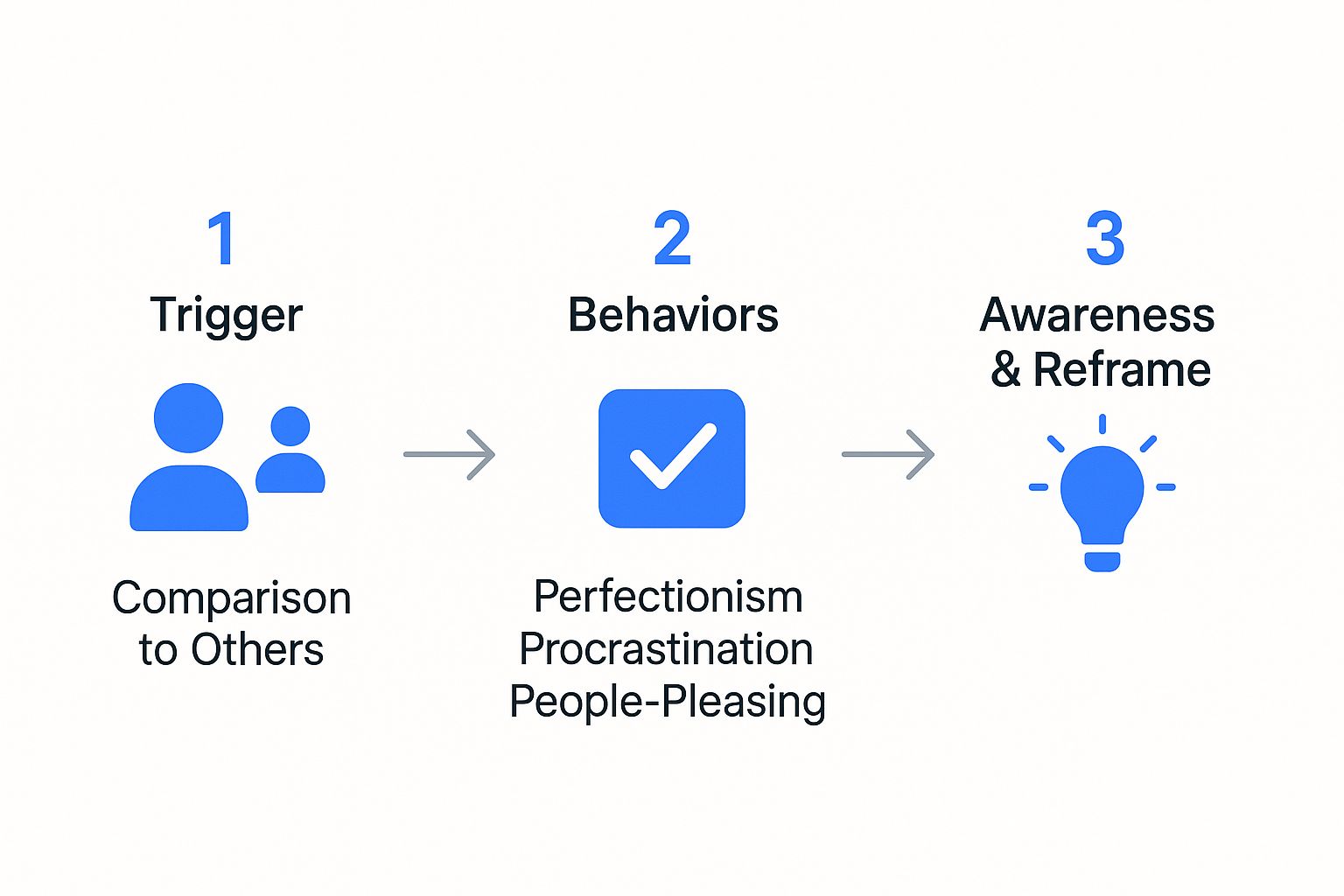
    Insecurity can be subtle, quietly weaving into our thoughts and actions. It often disguises itself as perfectionism, procrastination, or the need to please everyone. Learning to spot these patterns is the first step toward reclaiming your well-being.

    Have you ever held back an idea in a meeting, worried it wasn't good enough? Or felt a knot in your stomach at a party, convinced everyone was judging you? These are common ways insecurity can steer our choices and limit our potential.

    The Common Disguises of Insecurity

    Identifying these behaviours helps create space between who you are and the insecure voice in your head. This is not about self-blame but about cultivating gentle awareness so you can choose a different response.

    Here are a few common masks insecurity wears:

    • Perfectionism: This is the crippling belief that anything less than flawless is a failure. You might spend hours on a simple task, terrified of what someone might think.
    • Constant Apologising: Saying "sorry" for things that are not your fault can stem from a feeling that you are an inconvenience or a burden to others.
    • Procrastination: We often delay tasks not out of laziness, but out of fear that we won't do them perfectly. Procrastination becomes a way to protect ourselves from potential failure.
    • People-Pleasing: This is the strong need for everyone's approval. You might say "yes" to things you don't want to do just to avoid disappointing someone.

    The infographic below shows how a trigger can lead to these behaviours and how awareness can interrupt the cycle.

    Infographic showing a three-step process: A trigger like comparison leads to behaviours like perfectionism, which can be interrupted by awareness and reframing.

    Simply recognising the behaviour creates a crucial pause. In that pause, you have the power to respond thoughtfully instead of reacting out of fear.

    The Link Between Insecurity and Mental Health

    These daily challenges are deeply connected to our overall mental health. In the United States, which often reflects global trends, 23.1% of adults experienced a mental illness in 2022, with anxiety and depression being the most common. Insecurities often fuel these conditions, creating a cycle that can feel difficult to break.

    You can find more details in these important mental health statistics.

    Supportive Takeaway: Noticing how insecurity shows up in your life isn't an invitation for self-criticism. Think of it as an act of self-compassion. It's what empowers you to finally make choices that align with your true self, not your fears.

    This is where professional support can be a game-changer. Therapy or counselling provides a safe, non-judgmental space to unpack these patterns and build the resilience you need for lasting well-being and happiness. Please remember, any informational assessments here are for guidance, not diagnosis.

    Actionable Ways to Challenge Your Inner Critic

    A person journaling in a notebook, looking calm and focused.

    The nagging voice of insecurity can feel like the truth, but it's often a playlist of old, unhelpful stories. The key to turning down the volume is not forced positivity but gentle curiosity and questioning those automatic negative thoughts. This creates breathing room, giving you the power to choose a more balanced perspective.

    This is a gentle skill that helps you build genuine mental resilience. With practice, you can learn to respond to your inner critic with more compassion and wisdom.

    Questioning Your Automatic Thoughts

    Our brains use mental shortcuts that can become negative when we are stressed. These flawed thinking patterns, known as cognitive distortions, include jumping to conclusions or seeing things in black-and-white. Asking a few simple questions can help dismantle them.

    If you think, "I completely failed that presentation," pause and ask yourself:

    • Is this thought 100% true? Were there any parts that went well?
    • What’s a kinder way to look at this? Perhaps, "I was nervous and stumbled, but I also shared valuable information."
    • What would I say to a friend in this situation? Try offering yourself the same grace and encouragement.

    This practice is about finding a more complete and less punishing story. It can slowly rewire your default thinking and improve your overall well-being.

    Using a Journal to Spot Patterns

    Getting swirling, critical thoughts onto paper can be incredibly powerful. They become words you can observe objectively instead of an overwhelming feeling.

    Here are a few prompts to get you started:

    1. When did I feel most insecure today? Note the situation, your thoughts, and how it felt in your body.
    2. What is my inner critic’s go-to line? Identify recurring phrases like "You're not smart enough."
    3. Find one piece of evidence that proves that thought wrong. Did a friend send a kind message? Write it down.

    Over time, your journal reveals your thought patterns. You will see connections between triggers like workplace stress and your insecurities, which is the first step toward managing anxiety or depression.

    Supportive Takeaway: Learning to challenge your inner critic is a skill that gets stronger with practice. Every time you question a negative thought, you're building a healthier, more compassionate relationship with yourself. These small acts add up to real change.

    If these thoughts feel too big to handle alone, therapy or counselling can provide a safe, structured space to work through them. Remember that self-assessments are for informational purposes and are not a substitute for a professional diagnosis.

    Building a Foundation of Self-Compassion and Resilience

    A person watering a small plant, symbolising the nurturing of self-compassion and resilience.

    Managing insecurities is about changing the relationship you have with yourself to be kinder and more understanding. This is built on two powerful concepts: self-compassion and resilience. Self-compassion means treating yourself with the same care you would offer a friend.

    It involves accepting that mistakes and setbacks are part of being human, not personal failures. This mindset is the foundation for genuine emotional well-being.

    Cultivating Everyday Self-Compassion

    Self-compassion is built through small, consistent acts of kindness toward yourself, especially when you feel anxious or inadequate. Start by noticing your self-talk. When you make a mistake, do you immediately criticize yourself?

    Try to pause and approach the thought with gentle curiosity. For instance, replace "That was so stupid" with "That didn't go as planned. What can I learn?" This shift can soften the impact of workplace stress and daily pressures, helping to prevent feelings from spiralling into anxiety or depression.

    Supportive Takeaway: Treating yourself with compassion isn't selfish. It’s a crucial practice for building the inner strength needed to handle life's challenges with more grace and achieve greater happiness.

    Practical Steps to Build Resilience

    Resilience is the ability to bounce back from difficult experiences without letting them diminish your self-worth. It is like an emotional muscle that grows stronger with use.

    Here are ways to strengthen your resilience:

    • Celebrate Small Wins: Acknowledge your accomplishments, no matter how small. These victories create momentum and remind you of your capabilities.
    • Set Healthy Boundaries: Learning to say "no" to protect your energy is an act of self-respect. It reinforces that your needs matter.
    • View Vulnerability as a Strength: Opening up to a trusted friend or seeking counselling is a courageous step toward connection and emotional honesty.

    This is especially vital in situations like new motherhood, where support can be limited. Research on maternal mental health risks on PolicyCenterMMH.org shows a need for accessible ways for mothers to build resilience. Ultimately, these practices help you create a safe inner space where it is okay to be imperfect and grow.

    Knowing When and How to Seek Professional Support

    Asking for help is a powerful act of self-care and a sign of strength. If insecurities consistently affect your happiness, relationships, or daily life, it might be time to consider professional support like therapy or counselling. This is not admitting defeat; it is adding an expert to your team.

    A therapist provides a safe, confidential space to explore the roots of your insecurities without judgment. They can help you build personalised strategies for your mental well-being.

    What to Expect in Therapy

    The first therapy session is usually a conversation. Your therapist will ask what brought you in and what you hope to achieve. This is also your chance to see if you feel comfortable with them, as a strong therapeutic relationship is built on trust.

    Therapy is a collaborative journey to build lasting resilience against challenges like workplace stress, anxiety, and depression. The goal is to empower you to understand your patterns and make healthier choices.

    Supportive Takeaway: Seeking professional help is a proactive choice for your well-being. It’s like hiring a personal trainer for your mind—someone to guide, support, and challenge you to become the strongest version of yourself.

    Finding the Right Professional for You

    Finding a therapist who is a good fit is crucial. Look for licensed professionals with experience in the issues you are facing. In a diverse country like India, it can be helpful to find someone who understands your cultural background.

    Don't hesitate to have initial chats with a few therapists before deciding. Platforms like DeTalks can connect you with qualified professionals across India, making the first step less intimidating.

    Accessible care leads to better outcomes, as shown in The State of Mental Health in America 2025 report from mhanational.org. Reducing stigma and improving access are proven ways to help people manage their insecurities. Finally, please remember any self-assessments are informational and not a substitute for a professional diagnosis.

    Common Questions About Overcoming Insecurity

    As you build self-confidence, it is normal for questions to arise. Here are answers to some common ones to support you on your journey.

    Can Insecurities Ever Be Completely Cured?

    It is more helpful to think of managing insecurities rather than "curing" them. Everyone feels insecure at times; it is part of being human. The goal is to reduce their power over your life so they no longer prevent you from pursuing your goals and finding happiness.

    With consistent self-compassion and practice in challenging negative thoughts, you learn to handle these feelings when they appear. They may show up less often and with less intensity, improving your overall well-being.

    How Can I Support Someone Dealing With Insecurity?

    The best thing you can do is listen without judgment. Offer a safe space for them to share their feelings, and validate their experience by saying something like, "That sounds really difficult." Resist the urge to give advice or say, "Just be more confident."

    Instead, gently remind them of their strengths and past accomplishments. If their insecurities are significantly impacting their life, you can encourage them to consider professional support through therapy or counselling.

    Supportive Takeaway: True progress isn't about erasing insecurity, but about learning to live alongside it more peacefully. Every small step you take towards self-awareness and self-compassion builds a stronger, more resilient you.

    Is There a Difference Between Low Self-Esteem and Insecurity?

    Yes, though they are closely related. Low self-esteem is a more general, persistent feeling of not being "good enough." Insecurity is often more specific to a situation, like feeling insecure about public speaking due to workplace stress.

    However, persistent insecurities can erode your overall self-esteem over time. Working on specific insecurities can, in turn, boost your self-esteem and help reduce feelings of anxiety and depression.

    How Long Does It Take to See Progress?

    Everyone's journey is different, and progress is rarely a straight line. Some people notice small shifts in their thinking within a few weeks, while deeper insecurities may take months or years of dedicated work, often with a therapist.

    Focus on consistent effort rather than a deadline. Celebrate small wins and be patient and kind with yourself throughout the process. Please note that any assessments mentioned are for informational purposes only and are not a substitute for a professional diagnosis.


    At DeTalks, we believe everyone deserves to find the right support for their mental well-being. Whether you're ready to explore therapy for deep-seated insecurities, want the clarity of a psychological assessment, or simply want to build resilience for a happier life, our platform connects you with trusted professionals across India. Take the next step on your journey by exploring support options at DeTalks.

  • ADHD Symptoms in Adults: 7 Key Signs to Recognize

    ADHD Symptoms in Adults: 7 Key Signs to Recognize

    Attention-Deficit/Hyperactivity Disorder (ADHD) is often thought of as a childhood condition, but it affects many adults, too. For adults, the experience can be complex, often leading to challenges with focus, emotions, and organisation that may be mistaken for personal shortcomings. This misunderstanding can cause significant workplace stress and anxiety, impacting overall well-being.

    This guide offers a warm and supportive look into the common ADHD symptoms in adults, moving beyond stereotypes. Our goal is to provide clear insights, helping you recognise patterns that might affect your life or someone you care about. We will explore both the challenges and the unique strengths, like resilience and creativity, that can come with an ADHD mind.

    This article provides information, not a diagnosis. If these descriptions feel familiar, it could be a helpful first step toward seeking professional counselling or an assessment for personalised support.

    1. Inattentive Type – Difficulty Sustaining Focus

    A core ADHD symptom in adults is a constant challenge in holding focus. This isn't just boredom; it's a genuine difficulty in paying attention to tasks or conversations that aren't highly engaging. An adult might feel like their brain has too many tabs open at once, pulling their attention in different directions.

    In adults, this can look different than in children. Instead of being physically restless, an adult might seem quiet while their mind wanders during an important meeting or a conversation with a loved one. This internal experience of a constantly shifting mind can make it exhausting to complete projects that require long-term mental effort.

    How It Manifests in Daily Life

    Difficulty with focus can impact well-being in both personal and professional life, sometimes leading to workplace stress and feelings of inadequacy.

    • At Work: A talented professional might miss important details in reports or make simple mistakes, not due to lack of skill but because their focus drifts.
    • At Home: A parent may forget appointments or struggle to finish household chores, often starting several tasks but completing none.
    • In Relationships: Partners may feel unheard when the person with ADHD loses track of conversations, which comes from an attention challenge, not a lack of care.

    Actionable Strategies to Improve Focus

    While a professional assessment is important, you can try strategies to manage this symptom. Structuring your tasks and environment can make a real difference.

    • Use Time-Blocking Techniques: The Pomodoro Technique, using focused 25-minute work periods with short breaks, can make large tasks feel more manageable.
    • Externalise Your Plans: Use detailed checklists or apps to keep track of steps. Resources like the best focus apps for people with ADHD can offer practical support.
    • Minimise Distractions: Create a calmer environment by using noise-cancelling headphones, turning off phone notifications, or finding a quiet space to work.

    2. Hyperactivity-Impulsivity – Restlessness and Hasty Decision Making

    While childhood hyperactivity often involves visible energy like running and climbing, it shows up more subtly in adults. It can feel like an inner restlessness or a mind that is always on the go. This is often paired with impulsivity—acting on sudden urges without fully thinking about the consequences.

    Hyperactivity-Impulsivity - Restlessness and Hasty Decision Making

    This inner drive can make quiet activities feel difficult and can lead to fidgeting, tapping your feet, or pacing. Impulsivity is not a character flaw; it’s a challenge with self-regulation that can affect work, finances, and relationships, sometimes leading to workplace stress and anxiety.

    How It Manifests in Daily Life

    The mix of restlessness and impulsivity can create challenges that affect an adult's sense of control and well-being.

    • At Work: A colleague might interrupt others in meetings, not to be rude, but because an idea feels too urgent to hold back.
    • At Home: An individual might make a large, impulsive purchase online that affects the family budget, or suddenly start a big home project without a plan.
    • In Relationships: This can show up as saying things without thinking, which might be hurtful, or making big life decisions, like quitting a job, without discussion.

    Actionable Strategies to Manage Impulses

    Learning to manage hyperactivity and impulsivity involves building awareness and creating pauses. While professional counselling can offer a tailored approach, these strategies can help.

    • Implement a 'Waiting Period': For big decisions, try to create a 24 to 48-hour waiting period. This provides a buffer between the impulse and the action.
    • Channel Restless Energy: Using a discreet fidget tool during long meetings can help manage excess energy. Short, frequent breaks to walk or stretch also help.
    • Practise Mindfulness: Mindfulness exercises can strengthen your brain's ability to notice thoughts and feelings without immediately acting on them.

    3. Executive Functioning Deficits – Problems with Mental Management

    Beyond attention, many ADHD symptoms in adults are linked to challenges with executive functions. These are the brain's "management" skills, responsible for organising, planning, and getting tasks done. When this system is less effective, it creates challenges in managing daily life.

    Executive Functioning Deficits - Problems with Mental Management

    This isn't about intelligence or effort; it's a neurobiological difference in high-level thinking skills. An adult with these challenges might feel constantly overwhelmed, as if they are always trying to keep up. This can lead to significant workplace stress and a persistent feeling of being behind.

    How It Manifests in Daily Life

    Difficulties with executive function can affect an adult's ability to reach long-term goals and manage daily tasks, which may contribute to anxiety.

    • At Work: A project manager may find it hard to estimate how long tasks will take, leading to missed deadlines and team frustration.
    • At Home: An individual might find it very difficult to organise a multi-step task like preparing for a festival or managing household bills.
    • In Personal Growth: A student might have wonderful ideas but struggle to structure them, create an outline, or manage their time to complete their work.

    Actionable Strategies to Improve Management

    Building external support systems can help compensate for internal executive function challenges, creating a "scaffolding" for the brain.

    • Break Down Large Projects: Turn overwhelming goals into small, clear, and actionable steps. For example, "organise office" becomes "clear desk," then "sort papers."
    • Use Time-Blocking: Schedule specific blocks of time in a calendar for every task, including breaks, and set multiple reminders to help with time perception.
    • Externalise Your Memory: Don't rely on your memory alone. Use external aids like phone notes, voice memos, or a physical notebook to keep track of ideas and to-do lists.

    4. Emotional Dysregulation – Intense and Rapidly Changing Emotions

    Though not an official diagnostic criterion, emotional dysregulation is one of the most impactful ADHD symptoms in adults. It means having difficulty managing emotional responses in a way that feels balanced for the situation. This can look like intense reactions to small frustrations or quick mood shifts.

    Emotional Dysregulation - Intense and Rapidly Changing Emotions

    Living with this can feel like being on an emotional rollercoaster, causing both personal and workplace stress. An adult with ADHD might experience sudden anger over a minor issue or feel overwhelming sadness from gentle criticism. This is a challenge with emotional control, linked to the brain's executive functions.

    How It Manifests in Daily Life

    Unmanaged emotional responses can strain relationships and are often misunderstood by others, which can lead to anxiety and feelings of isolation.

    • At Work: A team member might get very frustrated over a small technical glitch, affecting team morale. A manager’s mood could shift quickly, creating an unpredictable environment.
    • At Home: A small disagreement with a partner could escalate into a big argument. An individual might feel overwhelmed for hours after a stressful event.
    • In Relationships: Friends and family might feel like they need to be very careful, unsure what might trigger an intense emotional reaction.

    Actionable Strategies for Emotional Regulation

    Building emotional awareness is key to managing this symptom. While professional counselling provides tailored support, these strategies can help build emotional resilience.

    • Practise the STOP Technique: When you feel a strong emotion rising, Stop. Take a breath. Observe your feelings without judgement. Proceed mindfully.
    • Develop an Emotional Recovery Routine: Create a personal toolkit for when you feel overwhelmed. This could be a short walk, listening to calming music, or deep breathing.
    • Communicate Your Needs Clearly: Let trusted friends and family know you sometimes experience intense emotions and explain what helps you in those moments.

    5. Rejection Sensitive Dysphoria (RSD) – Extreme Fear of Criticism

    One of the most intense emotional ADHD symptoms in adults is Rejection Sensitive Dysphoria (RSD). This is an extreme emotional sensitivity to the perception of being rejected, criticised, or failing. It’s an overwhelming emotional response to situations that others might not find as painful.

    This intense reaction can seem out of proportion, but for the person experiencing it, the emotional pain is very real. The constant fear of this pain can lead to behaviours like trying very hard to please others or avoiding situations where criticism is possible.

    How It Manifests in Daily Life

    The fear of rejection can create chronic anxiety and impact self-worth, making it difficult to pursue goals and maintain healthy relationships.

    • At Work: An employee might take constructive feedback as a personal attack, leading to feelings of worthlessness or a defensive reaction.
    • At Home: A person might avoid discussing difficult topics with their partner to prevent potential disapproval, which can lead to unresolved issues.
    • In Social Situations: Someone might avoid a new hobby or opportunity, not because they can't do it, but to avoid the risk of perceived failure.

    Actionable Strategies to Manage RSD

    Managing RSD involves building emotional resilience and finding new ways to view feedback. While professional therapy is very helpful, these strategies can offer support.

    • Practise Cognitive Reframing: When you feel rejected, gently question your first interpretation. Ask yourself: "Is there another way to see this?"
    • Develop a Support Network: Talk about your experiences with a trusted friend, partner, or therapist. A supportive person can offer a different perspective and reduce feelings of isolation.
    • Use Mindfulness Techniques: Practise noticing your emotions without judgement. Acknowledge the feeling as a symptom, rather than a fact. This creates a little space between the trigger and your reaction.

    6. Hyperfocus – Intense Concentration on Preferred Activities

    While ADHD is known for a lack of focus, a surprising symptom in adults is hyperfocus. This is a long, intense state of concentration on an activity that is interesting or rewarding. The brain locks onto a stimulating task, often tuning out everything else.

    During hyperfocus, an adult can become so absorbed that they lose track of time and forget basic needs like eating or sleeping. While this can lead to amazing productivity and creativity, it can also disrupt balance in daily life and contribute to workplace stress or personal neglect.

    How It Manifests in Daily Life

    Hyperfocus can be both a great strength and a challenge, leading to high achievement but also missed responsibilities.

    • At Work: A developer might code for 12 hours straight to fix a complex problem but miss important meetings and forget to take a break.
    • At Home: An artist could get so lost in a project that they miss family dinner or ignore phone calls, which can cause strain in relationships.
    • In Personal Pursuits: A person might spend an entire weekend absorbed in a fascinating new hobby, making great progress but neglecting household chores.

    Actionable Strategies to Manage Hyperfocus

    Learning to channel hyperfocus is key to making it an asset. The goal is not to stop it but to manage its timing and intensity.

    • Set External Cues: Use alarms or timers to create "break points." These reminders can pull you out of a hyperfocused state to check on other priorities.
    • Schedule Hyperfocus Time: Set aside time for engaging activities when it won’t disrupt other important responsibilities.
    • Communicate with Loved Ones: Explain your hyperfocus patterns to your family and partner. This helps them understand and reduces misunderstandings when you become temporarily absorbed in something.

    7. Time Blindness – Distorted Perception of Time Passage

    One of the more disorienting ADHD symptoms in adults is "time blindness," a difficulty in accurately sensing the passage of time. This isn't just poor time management; it's a neurological challenge where the brain struggles to feel how much time has passed or how long a task will take. It can lead to chronic lateness and missed deadlines.

    This symptom is a core part of executive function challenges in ADHD and can cause significant workplace stress and anxiety. It explains why a "quick five-minute" task can turn into an hour, or a deadline that seems far away suddenly arrives tomorrow.

    How It Manifests in Daily Life

    Time blindness can affect all areas of life and is often misunderstood as carelessness, which can harm relationships and self-esteem.

    • At Work: A person might consistently arrive late for meetings, not from a lack of respect, but from underestimating travel time.
    • At Home: A parent might find mornings chaotic and stressful, frequently running late for school drop-offs.
    • In Relationships: Someone might get lost in a hobby and forget a planned dinner with their partner, which can be perceived as neglect.

    Actionable Strategies to Manage Time Blindness

    While a professional assessment can bring clarity, you can use strategies to make time more concrete. The goal is to create external structures to help with the brain's internal timing.

    • Make Time Visible: Use analog clocks where you can see the hands move, or countdown timers. This makes the passage of time more tangible.
    • Build in Buffer Time: If you think a task will take 30 minutes, schedule 45. Adding extra time to schedules can reduce the stress of being late.
    • Use External Reminders: Set multiple alarms for important events—for example, an hour before, 30 minutes before, and when it's time to leave.
    • Track Your Time: To learn more about managing this, you can explore effective time management strategies specifically for adults with ADHD.

    7-Point ADHD Symptom Comparison in Adults

    Symptom / Aspect Implementation Complexity 🔄 Resource Requirements 🔄 Expected Outcomes 📊 Ideal Use Cases 💡 Key Advantages ⭐
    Inattentive Type – Difficulty Sustaining Focus Moderate – requires consistent strategies Moderate – checklists, apps, environment control Moderate improvement in focus and task completion Office work, project management, household tasks Enhanced creativity, detail orientation
    Hyperactivity-Impulsivity – Restlessness and Hasty Decision Making Moderate – mindfulness and structure needed Moderate – mindfulness tools, fidget devices Improved impulse control and decision-making accuracy Fast-paced environments, sales, dynamic team settings High energy, quick decisions
    Executive Functioning Deficits – Problems with Mental Management High – involves complex organizational methods High – calendar apps, memory aids, methodologies Significant improvement in planning and deadlines Project management, academia, entrepreneurship Strong crisis management, creative solutions
    Emotional Dysregulation – Intense and Rapidly Changing Emotions Moderate – emotional regulation techniques Moderate – apps, therapy, mindfulness practices Better emotional stability and relationship quality Professions requiring emotional resilience, caregiving Deep empathy, passionate engagement
    Rejection Sensitive Dysphoria (RSD) – Extreme Fear of Criticism High – cognitive and behavioral adjustments High – therapy, medication, support networks Reduced emotional pain and improved social interactions Creative professions, social work, client-facing roles High empathy, motivation to excel
    Hyperfocus – Intense Concentration on Preferred Activities Low to Moderate – scheduling and alarms Low – timers, reminders Exceptional productivity in focused tasks Creative arts, research, programming, emergency medicine Exceptional work quality under focus
    Time Blindness – Distorted Perception of Time Passage Moderate – requires external aids and awareness Moderate – apps, alarms, visual tools Improved punctuality and deadline management Consulting, writing, parenting Ability for flow states, reduced time anxiety

    Embracing Your Unique Mind: Your Path Forward

    Understanding your mind is the first step on a positive path forward. We've explored the diverse and often misunderstood adhd symptoms in adults, from the quiet challenge of inattention to the intense feelings of emotional dysregulation. Recognising these patterns is not about finding flaws but about seeing the unique way your brain works.

    Perhaps you saw yourself in "time blindness" or connected with the idea of hyperfocus. Understanding these traits is the foundation for self-compassion. It allows you to move away from self-criticism and toward building a life that works for you.

    From Recognition to Actionable Strategy

    Living with unmanaged ADHD symptoms can contribute to workplace stress, anxiety, and feelings of depression. It can be exhausting to constantly manage organisation, priorities, and emotions. However, identifying these patterns empowers you to seek the right support and build a life that honours your brain's natural style.

    The goal is not to "fix" a core part of who you are but to build skills and strategies that support your well-being and resilience. This journey can include:

    • Seeking Professional Insight: A formal assessment with a qualified professional can provide clarity and open the door to support like therapy or counselling. Remember, an assessment is informational, not just a label.
    • Developing Personalised Systems: Work with your brain, not against it. If you struggle with time, visual timers can become your friend. If emotions feel big, counselling can help you develop mindfulness techniques.
    • Leveraging Your Strengths: Remember that an ADHD brain has incredible strengths. The same mind that wanders can also achieve amazing hyperfocus, leading to creativity and innovation. Building on these strengths is key to confidence and happiness.

    Supportive Takeaways for Your Journey

    Understanding common adhd symptoms in adults is an act of self-advocacy. It’s the key to transforming daily struggles into manageable challenges and using your unique strengths to live a more balanced and joyful life. This journey requires patience, self-compassion, and a willingness to seek support. You are not alone, and help is available to guide you toward a life where you can truly thrive.


    Ready to take the next step in understanding your mind? On DeTalks, you can explore scientifically validated assessments for deeper insights or connect with qualified mental health professionals across India who specialise in adult ADHD. Start your journey towards clarity and well-being today at DeTalks.