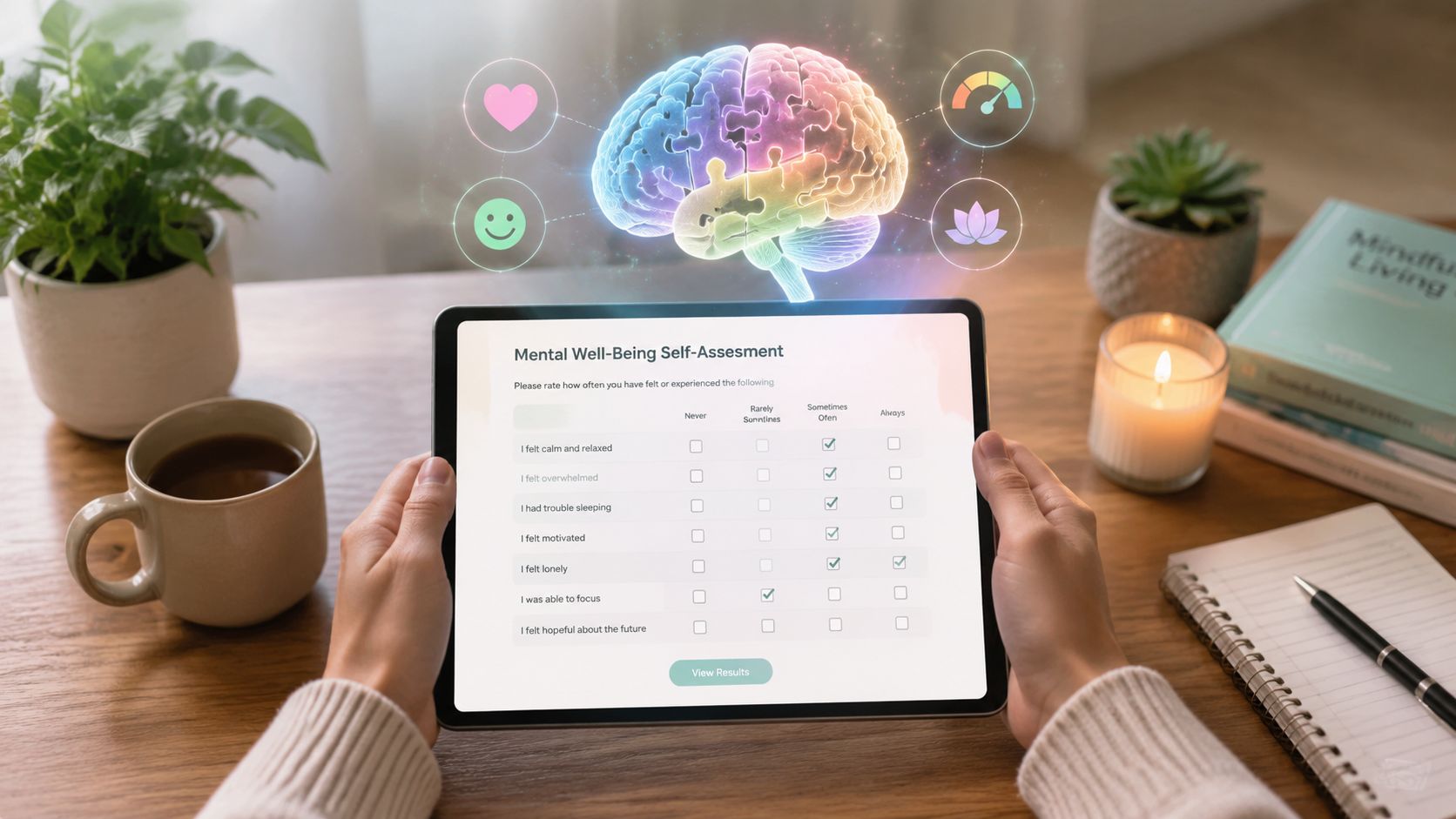
Tag: anxiety test

  • Mental Health Assessments for Adults: A Guide to Insight

    Mental Health Assessments for Adults: A Guide to Insight

    Some days you're getting through work, replying to messages, meeting responsibilities, and still feeling unlike yourself. You may be sleeping enough but waking up tired, snapping at people you care about, or finding that small tasks suddenly feel heavy. That's often the moment people start wondering whether they're dealing with ordinary stress, workplace stress, anxiety, burnout, or something that needs closer attention.

    A mental health assessment can help at that stage. Not to label you, and not to diagnose you, but to give you a clearer picture of what your mind and body may be signalling.

    Your First Step Toward Mental Clarity

    A common story goes like this. Someone is doing “fine” on paper. They're attending meetings, paying bills, showing up for family, and keeping life moving. But inside, they feel restless, low, irritable, or emotionally flat, and they can't tell whether it's pressure, depression, anxiety, or simple exhaustion.

    That uncertainty can be unsettling. It can also make people delay support because they think, “If I can still function, maybe it's not serious enough.” In practice, many adults seek therapy or counselling long before there's a full crisis. They want language for what they're feeling and guidance on what to do next.

    In India, this need is far from rare. In 2017, one in seven Indians, approximately 197.3 million people, were affected by mental disorders of varying severity, and depressive and anxiety disorders were the most common among adults, according to the Global Burden of Disease Study overview on mental health in India.

    When feeling off is hard to explain

    Mental health changes don't always arrive dramatically. Sometimes they show up as procrastination, body tension, trouble focusing, a short temper, or a sense that joy has gone missing. You might still be coping well enough that friends don't notice.

    That's why mental health assessments for adults can be useful. They turn vague discomfort into something more concrete. Instead of asking yourself, “What's wrong with me?”, you begin asking better questions, such as:

    • Is this stress or burnout from work and constant pressure?
    • Are these signs of anxiety that have been building slowly?
    • Is low mood affecting my daily well-being more than I realised?
    • Do I need self-help, counselling, or a deeper professional conversation?

    You don't need to be at your worst to check in with your mental health.

    A gentle starting point

    Think of an assessment as a structured pause. It helps you notice patterns in mood, sleep, energy, focus, resilience, and coping. That information can be calming because uncertainty often feels worse than clarity.

    The most important point is simple. An assessment is informational, not diagnostic. It offers insight. A qualified mental health professional decides whether further evaluation, therapy, counselling, or medical support is appropriate.

    What Are Mental Health Assessments Really

    Mental health assessments are best understood as screening tools. They ask structured questions about how you've been feeling, thinking, and coping over a recent period. The goal is to spot patterns, not to hand out a final answer.

    A useful analogy is a car's dashboard light. If the check engine light comes on, it tells you something deserves attention. It doesn't tell you the exact fault, and it doesn't repair the car by itself.

    An infographic explaining that mental health assessments act as screening tools rather than a formal medical diagnosis.

    What these tools actually do

    A good assessment usually helps with three things.

    • It organises your experience so your feelings don't stay vague and confusing.
    • It highlights possible areas of concern such as stress, anxiety, depression, burnout, alcohol use, or low resilience.
    • It guides next steps so you can decide whether self-care, therapy, counselling, or medical consultation makes sense.

    That's why many clinicians use them at the beginning of care. They create a starting map.

    What they cannot do

    An online score can't understand your whole life. It doesn't know your family pressures, work culture, grief history, health conditions, or recent life events unless a professional helps place your answers in context.

    Practical rule: Treat the score as a conversation starter, not a verdict.

    This matters even more in India, where many available tools have historically leaned toward clinical diagnosis rather than everyday occupational strain. A government note highlights a gap for high-functioning working adults facing workplace burnout and stress, and also notes that 22% of professionals report burnout in India's corporate sector, as discussed in the Press Information Bureau note on workplace mental health and burnout.

    When you need more than one kind of assessment

    Some people aren't trying to understand mood alone. They may be wondering whether substance use, trauma, attention problems, or more than one concern is involved. In those cases, more layered evaluation can help, including assessments for dual diagnosis treatment when emotional symptoms and substance-related concerns overlap.

    That doesn't mean something is “seriously wrong.” It means your experience may be more complex, and complexity deserves careful support.

    Common Types of Assessments for Well-being

    Not all assessments ask the same questions, and that's a good thing. One tool may focus on low mood and anxiety. Another may explore burnout, coping style, or resilience. A third may look at alcohol use or attention difficulties.

    Assessments that focus on distress

    Many adults first encounter tools that screen for emotional strain. These often explore sadness, worry, tension, irritability, sleep, concentration, and loss of interest.

    The common themes include:

    • Mood screeners that look at patterns linked with depression, low motivation, and reduced pleasure.
    • Anxiety screeners that ask about worry, fear, restlessness, and physical tension.
    • Stress and burnout tools that focus on overload, emotional exhaustion, and workplace stress.
    • Substance use screeners that examine whether alcohol or other coping habits may be creating problems.

    These can be especially helpful when you can tell something feels off, but you don't yet know the main driver.

    Assessments that look at strengths

    Mental well-being isn't only about symptoms. Some assessments explore what supports you when life gets hard. They may ask about compassion, optimism, emotional balance, problem-solving, or happiness.

    That matters because treatment planning becomes stronger when it includes existing strengths. A person with high resilience but poor boundaries may need a different strategy from someone with low social support and severe self-criticism.

    Strong mental health work doesn't only ask, “What hurts?” It also asks, “What helps?”

    Assessments designed for specific contexts

    Some tools are built for a life stage, setting, or cultural context. For example, the Mental Health Assessment Scales for Students (MASS) was validated for Indian university students and covers six domains: Stress, Psychiatric Symptoms, Mental Health Risk, Risk Factors, Positivity, and Functioning, as described in the MASS validation study for Indian students.

    Even if you're not a student, this example shows an important point. Good assessments don't just measure distress. They can also measure positivity and functioning, which gives a more balanced view of a person's mental state.

    How to choose the right kind

    If you're unsure where to begin, ask yourself what prompted your search.

    Situation Most useful assessment focus
    You feel low, withdrawn, or numb Mood or depression screening
    You feel tense, restless, or overthinking constantly Anxiety screening
    Work leaves you drained and detached Stress or burnout screening
    You want to understand coping strengths Resilience, compassion, or well-being tools
    You're worried about drinking as a coping method Substance use screening
    You suspect more than one issue is overlapping A broader professional assessment

    The best choice is usually the one that matches your most immediate concern. You can always widen the lens later.

    A Closer Look at Widely Used Assessment Tools

    Once you start exploring mental health assessments for adults, you'll notice a cluster of well-known names. They can look technical at first, but most are short questionnaires used to screen specific areas.

    A simple comparison of common tools

    Here's a practical overview.

    Tool Name What It Measures
    PHQ-9 Depressive symptoms such as low mood, energy changes, and loss of interest
    GAD-7 Anxiety symptoms such as worry, nervousness, and difficulty relaxing
    DASS-21 Depression, anxiety, and stress in one combined screener
    ASRS Attention-related concerns associated with adult ADHD screening
    AUDIT Alcohol use patterns and possible alcohol-related risk
    Burnout questionnaires Emotional exhaustion, detachment, and strain related to work
    Resilience scales Capacity to recover, adapt, and cope under pressure
    Self-compassion measures How kindly and realistically you respond to your own struggles

    These tools don't compete with each other. They answer different questions.

    How people usually use them

    A person worried about constant overthinking may start with GAD-7. Someone who feels flat, tired, and disconnected might begin with PHQ-9. If the concern is broader and mixed, DASS-21 can give a wider snapshot.

    If work is the main source of distress, a burnout-focused tool can be more relevant than a purely clinical screener. This is one reason many adults feel disappointed after taking a general mental health quiz. It may miss the texture of workplace stress, role overload, people-pleasing, or emotional fatigue.

    Why names matter less than fit

    You don't need to memorise acronyms. What matters is choosing a tool that matches the question you're trying to answer.

    A useful way to think about it is this:

    • PHQ-9 and GAD-7 are often used when mood and anxiety are the central concern.
    • DASS-21 is handy when you're unsure whether the bigger issue is stress, depression, or anxiety.
    • ASRS is a starting point when focus, organisation, and follow-through have been long-term concerns.
    • AUDIT is useful when drinking may be affecting sleep, mood, work, or relationships.
    • Strength-based tools are helpful when you want to build resilience, compassion, and well-being, not just reduce symptoms.

    When broader self-assessment can help

    Sometimes the question isn't only about mood or anxiety. A person may be curious about relationship patterns, identity, coping style, or traits that affect daily life. In that case, more specialised reading can be useful alongside formal screening. Some people find Cedar Hill mental health resources helpful when they want to understand how self-assessment fits into a wider picture of personality and behaviour.

    The best assessment is the one that helps you take the next honest step.

    Interpreting Your Results and Their Limitations

    When you get a score, it's easy to react as if you've received a final judgement. Many people see words like “moderate” or “severe” and immediately think, “So this is my diagnosis.” That isn't how screening works.

    A score reflects the answers you gave at that moment. It suggests the intensity of reported symptoms, not a confirmed condition.

    An infographic titled Decoding Your Assessment Results with four steps for interpreting mental health evaluation scores.

    What score ranges usually mean

    Many tools sort results into ranges such as minimal, mild, moderate, or severe. These categories help organise what you reported. They don't replace clinical judgement.

    For example, a moderate anxiety score may mean:

    • you've been worrying often,
    • your body has been carrying tension,
    • your mind may be struggling to switch off,
    • and these symptoms deserve attention.

    It does not automatically mean you have an anxiety disorder.

    Why context changes everything

    Two people can get similar scores for very different reasons. One may be grieving a recent loss. Another may be in a toxic work setting. A third may have a long history of depression. The score alone can't tell those stories apart.

    That's why professionals ask follow-up questions about timing, triggers, functioning, relationships, medical issues, and safety. They're not doubting your score. They're giving it context.

    A number can point to distress. It can't explain your whole life.

    Cultural fit matters more than many people realise

    Screeners aren't perfectly universal. Language, local stressors, stigma, and cultural expression all affect how people answer questions. This is especially relevant in a diverse country like India.

    A study from Kashmir showed why this matters. Researchers found that the standard cut-off for a depression screener was too high for that setting, which could misclassify people and underestimate depression. The study supports the need for region-specific validation in India, as shown in the Kashmir validation study of the HSCL-25.

    A good way to read your result

    Try this four-part lens:

    1. Notice the pattern. What symptoms stood out?
    2. Check the impact. Is work, sleep, appetite, focus, or relationships being affected?
    3. Look at duration. Has this been a rough week, or a longer trend?
    4. Decide on support. Would self-help be enough, or would therapy or counselling help more?

    That approach keeps the result useful and grounded.

    Taking the Next Step After Your Assessment

    The most helpful question after any assessment isn't “What label do I have?” It's “What would support me now?” That shift changes everything. It turns a score into a decision tool.

    This matters in India because many people live with distress for a long time before reaching care. The 2016 National Mental Health Survey found an 80.4% treatment gap for common mental disorders in India, meaning many affected people didn't receive care, as noted in The Lancet Regional Health Southeast Asia discussion of the survey findings00160-9/fulltext).

    If your score is on the lower side

    A lower score doesn't mean “ignore it.” It may mean your next step is light-touch support and better observation.

    Consider:

    • Strengthening routines such as sleep, meals, movement, and breaks from constant stimulation.
    • Tracking patterns in mood, worry, energy, and triggers for a couple of weeks.
    • Using self-help intentionally through journalling, mindfulness, boundary-setting, or relaxation practice.
    • Building positive psychology habits such as gratitude, self-compassion, and resilience practice.

    These steps can improve well-being, especially when the issue is emerging stress rather than entrenched suffering.

    If your score is in the middle range

    This is often the best time to reach out. You don't need to wait until life becomes unmanageable.

    A few sessions of therapy or counselling can help you:

    • understand what's feeding the symptoms,
    • learn coping skills for anxiety or workplace stress,
    • improve communication and boundaries,
    • and decide whether you need more specialised support.

    For many adults, this middle zone is where support is most effective because insight and functioning are still intact enough to work with.

    If your score is high or feels alarming

    A high score is not a diagnosis, but it is a stronger signal that professional assessment should happen soon. If your distress is intense, persistent, or affecting safety, work, caregiving, or basic functioning, don't try to carry it alone.

    You might need:

    • A therapist or counsellor for structured emotional support
    • A psychologist for fuller assessment
    • A psychiatrist if medication or medical evaluation may be relevant

    Reaching out early is a sign of judgement and courage, not weakness.

    If your assessment includes thoughts of self-harm or suicide risk, seek urgent support from a qualified local professional or an immediate crisis service in your area.

    How DeTalks Can Guide Your Well-being Journey

    Insight is most useful when it leads somewhere practical. That's where a platform can help simplify the next step, especially for adults who don't know whether they need self-help, counselling, therapy, or a more formal consultation.

    DeTalks brings together assessments, therapist discovery, and support pathways in one place. That matters because many people don't stop at “What does my score mean?” They quickly move to, “Who should I talk to?” and “What kind of help fits my situation?”

    Turning results into action

    A useful platform doesn't just show a number. It helps you connect that result to action.

    That may mean:

    • finding a therapist for anxiety or depression,
    • booking counselling for relationship strain or workplace stress,
    • exploring self-help resources to strengthen resilience and emotional balance,
    • or identifying when a more specialised consultation makes sense.

    This kind of guidance is especially valuable in India's evolving mental health context. India faces an 80.4% treatment gap for common mental disorders, and support infrastructure is growing. As of November 27, 2025, 36 States/UTs have established 53 Tele MANAS Cells under the National Tele Mental Health Programme, offering 24×7 toll-free counselling through helpline 14416 in 20 languages, according to the Lok Sabha annex on Tele MANAS services.

    That means help is no longer limited to one path. Digital platforms, counselling networks, and public helplines can work alongside each other.

    A short explainer can also make this journey feel less intimidating.

    What to remember most

    Mental health assessments for adults can be powerful when you use them as intended. They're tools for insight, reflection, and direction. They are not diagnoses, and they are not predictions about your future.

    If your results raise concern, that doesn't mean you're broken. It means you've learned something useful about your present state. From there, the next step can be small, steady, and supportive.


    If you want a calm, structured way to understand your emotional well-being and find the right support, DeTalks can help you explore assessments, connect with therapists and counsellors, and choose the next step that fits your life.

  • A Guide to Taking a Mental Health Assessment Online

    A Guide to Taking a Mental Health Assessment Online

    Taking the first step to understand your mental health is a brave and positive move. An mental health assessment online is a private, gentle way to gain personal insight. Think of it as a helpful check-in for your mind, not a formal diagnosis.

    Your First Step to Understanding Your Mind

    Exploring your well-being can feel overwhelming when you're not sure where to start. An online mental health assessment offers a comfortable and private starting point, helping you put words to your feelings. It's a simple opportunity to check in with yourself, just as you would for your physical health.

    A woman with short dark hair thoughtfully works on a laptop at a bright table.

    These tools explore a wide range of your well-being, from common challenges like workplace stress and burnout to feelings associated with anxiety or depression. The process can help you recognize patterns you might not have noticed on your own.

    But it’s not just about challenges. A key part of mental health is recognizing your strengths. Many assessments also highlight positive psychology, measuring qualities like:

    • Resilience: How you bounce back from difficult situations.
    • Compassion: Your capacity for kindness toward yourself and others.
    • Happiness: Your general sense of contentment and life satisfaction.

    A Guide, Not a Diagnosis

    It is very important to remember that these assessments are informational tools. They offer helpful clues and can point you in a supportive direction, but they do not replace a diagnosis from a qualified therapist or doctor.

    Think of the results as a conversation starter. They can help you organize your thoughts before considering therapy or counselling, empowering you to have a more focused discussion with a professional if you choose to.

    This guide will walk you through what these assessments are and how they can support your journey toward feeling better. Platforms like DeTalks offer these tools to help people in India and globally find clarity. Exploring resources like a dedicated mental health page can also provide extra support as you begin to understand your mind.

    What Is a Mental Health Assessment Online?

    An online mental health assessment is like a thoughtful, guided conversation with yourself. It uses a series of carefully crafted questions to give you a snapshot of your current emotional state. This helps you make sense of your feelings with more clarity.

    The main purpose is to screen for common challenges like depression and anxiety, or to measure positive qualities like resilience. Good assessments are often scientifically validated tools designed to gather specific information, helping to paint a clearer picture of your inner world.

    Remember, these assessments offer valuable insights but are meant to be informational guides. They are excellent for self-reflection and building awareness but do not provide a formal medical diagnosis.

    A mental health assessment online is a private, secure space to explore your thoughts and feelings. It paves the way for a deeper understanding of your own mind and is the first step in a personal journey of self-discovery.

    Taking this first step can be empowering. It helps you organize your thoughts and identify specific areas you might want to work on, such as managing workplace stress or building personal resilience.

    A Bridge to Understanding and Support

    In India, the need for accessible mental health tools is significant. The National Mental Health Survey found that 10.6% of adults experience a mental health condition, yet the gap between needing and receiving care can be as high as 90%. A mental health assessment online helps bridge this gap by offering initial screenings for conditions like depression and anxiety from your own device. You can find more details in these important mental health findings from the survey.

    Platforms like DeTalks place scientifically validated tools directly in your hands. You can take them confidentially to better understand issues like stress and burnout before deciding if therapy is a helpful next step for you.

    This easy access helps make mental health support feel less intimidating. It provides a private starting point for anyone curious about their emotional well-being.

    Focusing on Both Strengths and Challenges

    A truly helpful assessment doesn't just look for problems; it also highlights your strengths. It considers the whole picture, from the challenges you may be facing to the positive qualities you already have.

    Here’s a glimpse of what you can explore:

    • Identifying Challenges: These tools can help you spot signs related to anxiety, stress, and burnout, allowing you to recognize patterns that may be affecting your daily life.
    • Discovering Strengths: Many assessments also measure concepts from positive psychology, like your capacity for resilience, your level of compassion, and your overall sense of happiness.

    Seeing both your challenges and your strengths provides a more balanced view of your mental state. This perspective is vital for personal growth and for deciding what kind of support, such as counselling, might be right for you.

    Exploring the Different Types of Online Mental Health Assessments

    The term mental health assessment online covers a variety of tools, each designed to explore a specific aspect of your inner world. Just as a doctor uses different instruments, these assessments come in various forms to provide the clarity you are looking for.

    Some assessments offer a broad overview of your emotional landscape, while others focus on a particular feeling or challenge. Knowing the difference helps you choose the tool that best fits your needs.

    This image below shows the typical journey—from an initial check-up to gaining insights and planning your next steps.

    Online assessment concept map showing a check-up process, including screening, insights, and guidance.

    The process often starts with a screening, which leads to personalized insights. These insights can then guide you toward helpful next steps.

    Screening Tools for Specific Concerns

    The most common type of mental health assessment online is a screening tool. Think of these as a quick, preliminary check-in to help you spot early signs of specific mental health challenges.

    For example, if you have been feeling constantly on edge, an anxiety screener can help you understand those feelings better. If a persistent low mood is making it hard to enjoy things, a screener for depression could offer some initial perspective.

    It is vital to understand these are not diagnostic tools and do not give you a label. They simply provide a starting point for self-awareness and can help you decide if it’s time to talk to a professional for counselling.

    Measures for Well-being and Resilience

    Mental health is not just about the absence of problems; it is also about nurturing your strengths. Well-being and resilience measures shift the focus from what might be challenging to what is already strong within you.

    Instead of looking for symptoms, these assessments explore your inner resources, such as:

    • Your overall sense of happiness and life satisfaction.
    • Your capacity for self-compassion and kindness.
    • Your ability to bounce back from stress and adversity.

    Recognizing your strengths is just as important as identifying your challenges. It can empower you to find more joy, build better relationships, and cultivate a stronger sense of purpose and well-being.

    A resilience assessment can be an incredibly affirming experience. It shows you the skills you already possess and can lean on during difficult times—a powerful reminder of your own inner strength.

    Workplace Stress and Burnout Assessments

    In today's fast-paced world, workplace stress is a major factor in our overall well-being, especially for professionals and students across India. Specialized assessments exist to measure how your job or studies are impacting you.

    These tools can help you gauge things like:

    • Burnout levels: Are you feeling emotionally drained or cynical about your work?
    • Job satisfaction: How fulfilled do you feel in your current role?
    • Work-life balance: Is your professional life impacting your personal time?

    The insights from a workplace assessment can be a valuable reality check. They might encourage you to set healthier boundaries or realize that therapy could help you develop better coping mechanisms for professional pressure. Platforms like DeTalks offer tools to help you find balance.

    How to Find and Trust an Online Assessment

    With many options for a mental health assessment online, choosing a trustworthy one is the most important first step. You want to know it’s credible, secure, and created by professionals. Getting this right empowers you and protects your privacy.

    A tablet on a wooden desk displaying an app interface with options like 'Pronivacy' and 'Expert Development'.

    The growth of digital health tools is clear. In India, the market for mental health apps, which often include these assessments, is rapidly expanding, making it even more critical to choose wisely. You can read more in this market growth report.

    Your Checklist for a Credible Assessment

    To ensure the mental health assessment online you choose is reliable, here is a simple checklist. These are signs of quality that can give you confidence in the tool you're using.

    • Is it scientifically validated? A validated assessment has been tested by researchers to confirm it reliably measures what it claims to. It's an evidence-based tool designed for real insight, not just a quiz.

    • Does it have a clear privacy policy? Your personal information is sensitive. A reputable platform will be transparent about how it handles your data, so look for a clear policy before you begin.

    • Was it developed by mental health professionals? The best assessments are created by experts like psychologists and therapists. Their involvement ensures the questions are thoughtful, relevant, and grounded in a real understanding of topics from workplace stress to personal resilience.

    Prioritising Your Privacy and Security

    Feeling safe is essential when exploring something as personal as your mental health. Trustworthy platforms invest in security to protect your information at every step.

    A key sign of a platform's dedication to privacy is its use of practices like secure and HIPAA-compliant document sharing. This shows they take their responsibility to safeguard your data seriously, creating a safe space for self-discovery.

    Remember, an assessment is meant to be a supportive and informational tool. It should never leave you feeling judged or exposed, so always choose platforms that are transparent about their methods and security.

    Taking a few minutes to check these points makes a real difference. Choosing a credible assessment ensures the insights you receive are not only useful but are also handled with the care and respect you deserve.

    How to Make Sense of Your Assessment Results

    Receiving your results from a mental health assessment online can bring a mix of emotions. Remember that these results are not a final judgment, but simply a snapshot of how you are feeling right now.

    Think of your scores as helpful signposts, not permanent labels. They are a starting point for looking inward and understanding your mind a little better, which is a powerful step toward improving your well-being.

    Understanding Your Scores as Signposts

    Most online assessments present results in categories like low, moderate, or high. This is not a grade but a way to highlight areas that might benefit from more attention.

    A high score for anxiety, for example, simply suggests you are currently experiencing symptoms that align with anxiety. This insight is the first move toward finding practical ways to cope, whether through counselling or mindfulness techniques.

    An online assessment result is a conversation starter, not a conclusion. It is a tool to help you ask better questions about yourself and guide you toward the right support for your needs.

    Adopting this mindset transforms the experience from one of judgment to a journey of discovery. This is a much healthier way to approach personal growth.

    When Results Suggest a Challenge

    If your results from a mental health assessment online indicate a potential challenge, like symptoms of depression or high workplace stress, try not to feel discouraged. See it as a clear signal that it might be time to talk to someone.

    A therapist can offer a proper evaluation with the context that a digital tool cannot provide. Your assessment results can be a fantastic way to start that conversation, helping you and your therapist focus on what matters most. This one step can be the beginning of finding effective strategies and support through therapy.

    When Results Highlight Your Strengths

    Your assessment might also shine a light on your strengths, such as strong resilience or a great capacity for compassion. This is just as valuable and offers an invitation to lean into these positive qualities.

    Think of these results as a green light to build on what’s already working for you. You could explore activities that nurture these strengths, such as:

    • Mindfulness exercises to improve self-awareness.
    • Gratitude journaling to boost feelings of happiness.
    • Connecting with others to share your compassion.

    Recognizing and building your inner resources is a vital part of long-term mental well-being. These strengths are your anchor, providing stability during life's challenges.

    From Insight to Action: What Happens Next?

    You’ve completed an online mental health assessment—what's next? Taking that confidential and accessible step puts you in control of your well-being and gives you the clarity to decide what to do.

    A hand holds a smartphone displaying an 'English Theory Directory' app in a bright room.

    Think of your assessment results as a bridge from wondering about your mental state to taking clear, actionable steps. Platforms like DeTalks are designed to guide you across that bridge, ensuring you feel supported from the start.

    Turning Your Results into Real Support

    You don't have to figure it all out alone. The next phase is about finding the support that feels right for you, and you have options.

    Here are a few ways to move forward:

    • Explore Professional Counselling: If your results point toward challenges with anxiety or depression, you can browse a directory of qualified therapists and start online counselling.
    • Dive into Self-Help Resources: If you want to handle workplace stress better or build your resilience, a library of self-help articles can provide practical techniques.
    • Nurture Your Strengths: If your assessment highlighted positive traits like compassion or happiness, you can find resources to build on those strengths for long-term well-being.

    Everyone's path is different. The choice is yours, whether you decide to start therapy, learn new coping skills, or focus on your positive qualities.

    An online mental health assessment is the start of a journey toward greater self-awareness and a kinder relationship with yourself. It's not a quick fix but a supportive first step.

    Your Supportive Takeaways

    This is an ongoing journey, not a final destination. Your mental health needs consistent care, and an assessment simply provides a map to start.

    This process is about building skills, understanding your emotional patterns, and learning to navigate life with more confidence. Taking an online mental health assessment is a powerful act of self-care. You have taken a brave step to understand yourself more deeply, and the support you need to continue is available.

    Frequently Asked Questions

    It’s completely normal to have questions before taking a mental health assessment online. Here are some common ones to provide clarity and help you feel more confident.

    Are Online Mental Health Assessments Accurate?

    Reputable online assessments are scientifically validated screening tools, offering a reliable snapshot of your current mental state. They are very good at indicating potential areas of concern.

    However, they are informational and not a substitute for a formal diagnosis from a qualified professional. They are a useful first step to help you decide if it’s time to speak with a therapist about your well-being.

    Is My Privacy Protected When I Take an Assessment?

    Your privacy is a top priority. Trustworthy platforms use secure, encrypted technology and have clear privacy policies to protect your personal information and results.

    Before starting any assessment, always take a moment to read the privacy policy. It is important to know you are in a safe, confidential space.

    A secure platform ensures your journey of self-discovery remains yours alone. This privacy is essential for honestly exploring challenges like anxiety or workplace stress without fear of judgment.

    What Should I Do After I Get My Results?

    Your results are a guide for your next step. If they suggest you might be struggling with something like depression or high stress, consider it a helpful nudge to connect with a professional.

    If your results highlight strengths like strong resilience, that’s wonderful! You can then look for resources to build on that foundation. The results are there to give you the insight to take a meaningful next step.

    Can an Online Assessment Replace Therapy?

    No, an mental health assessment online is a tool for self-awareness and screening, but it cannot replace therapy. It does not offer the personalized guidance and human connection you get from professional counselling.

    Think of an assessment as a starting point. It provides valuable information to help you decide the best way forward on your mental health journey.


    Taking that first step can feel like the biggest one, but understanding your mental health is a worthwhile journey. DeTalks offers a range of confidential, science-backed assessments to give you the clarity you’re looking for. Explore our tools and find the right path forward for you at https://detalks.com.