
Exposure therapy is the gradual, repeated facing of feared situations, thoughts or body sensations instead of avoiding them, guided by a trained mental-health professional.
If facing a fear were only a matter of willpower, why would so many people remain anxious despite trying hard to overcome it? The missing piece is often a planned, collaborative way to practise, rather than pressure to be brave.
For an Indian student avoiding seminars, a professional dreading team meetings, or someone frightened of crowded trains, the aim is to regain meaningful choices. You don't have to prove anything by confronting your biggest fear without support.
Exposure Therapy in Plain Language
Exposure therapy is a behavioural treatment that helps you approach what anxiety has taught you to avoid. A therapist helps you choose safe, manageable exercises, understand your reactions and learn from what happens.
Say someone has avoided lifts for years because they fear becoming trapped. Treatment wouldn't have to begin with stepping into a crowded lift and travelling to the highest floor.
Instead, the person and therapist might begin by standing near a lift, watching its doors open, and later considering a short journey. These aren't universal instructions, but examples of how a frightening task can be broken into smaller steps.
What the person is learning
The aim isn't to push fear away immediately. It's to discover that the predicted disaster may be less likely than expected, or that discomfort can be handled without escaping.
The central distinction: A therapist helps you test an anxious prediction, not prove your courage.
This matters in India. The National Mental Health Survey analysis reported a current weighted prevalence of anxiety disorders of 2.57% among adults, with prevalence higher among women at 3.01%, compared with 1.80% among men.
What makes it collaborative
You help decide which situations matter, what feels manageable and what support you need. Your therapist organises these situations into a hierarchy, a list arranged from less distressing to more challenging.
Consent continues throughout treatment. A family member pushing someone into a feared situation, even with good intentions, isn't the same as professionally planned exposure.
The simple message to remember is this: I can practise approaching fear safely, with support, rather than being forced through it.
Why Avoidance Keeps Fear Alive
Avoidance makes sense in the moment. If a situation feels threatening, leaving it can bring quick relief.
The difficulty is what you learn from that relief. You may conclude that escape prevented a disaster, without discovering whether the situation was dangerous.
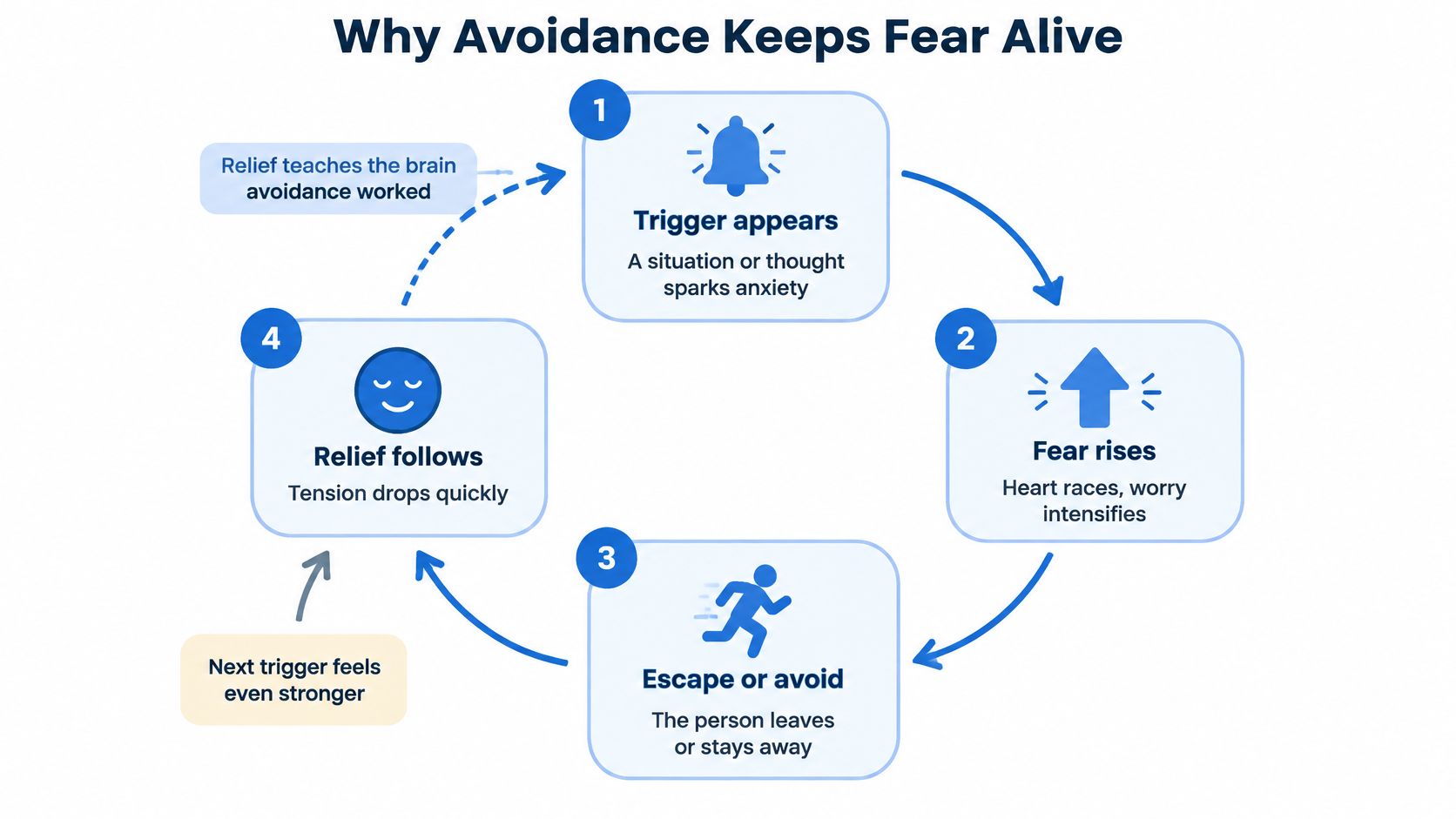
The avoidance loop
- A trigger appears. A student sees a crowded bus approaching and anticipates becoming overwhelmed.
- Fear rises. Their heart races, and they imagine being unable to get off.
- They escape or avoid. They skip the bus, miss class or ask someone to accompany them.
- Relief follows. They feel better immediately and become more likely to avoid the next journey.
The student might eventually avoid unfamiliar routes or leaving home alone. That's a possible pattern, not an inevitable progression.
The diagram shows how immediate relief can encourage repeated avoidance.
When protection becomes a requirement
Safety behaviours are actions someone believes they must use to prevent catastrophe. Examples include gripping a phone throughout a journey, rehearsing every sentence or carrying water because they believe panic would otherwise become unbearable.
These actions aren't automatically problematic. Carrying water in hot weather is sensible; the concern is believing you cannot cope without it when there's no medical need.
Think of a smoke alarm that sounds when toast burns. You don't want to remove a useful alarm, but you do want to distinguish smoke from a house fire.
During exposure, distress may decrease as you remain in a situation, a process called habituation. Another important process is inhibitory learning, which means developing a new expectation, such as discovering you can feel anxious and still complete a journey.
For a driving-specific illustration, BDISchool's gradual exposure practice for fearful drivers offers context for discussing smaller practice steps. Driving must still follow road-safety requirements and your instructor's guidance.
Consider these questions:
- What am I avoiding? Identify the situation, sensation or thought.
- What do I predict? Name the outcome you fear.
- What does avoidance cost me? Notice missed activities, opportunities or independence.
Conditions Exposure Therapy Targets in India
How might exposure differ for someone afraid of injections, someone worried about social judgement and someone who fears bodily sensations? The target depends on the difficulty, so a clinician tailors the plan rather than using one exercise for every person.
The National Mental Health Survey of India reported current prevalence of phobic anxiety disorders at 1.9%, including 2.4% among women and 1.5% among men. It also reported social phobia at about 0.5%, panic disorder at 0.5% and generalised anxiety disorder at 0.6%. These figures describe different conditions, not how any one person will respond to treatment.
Anxiety conditions, exposure targets and evidence notes
| Condition | What Exposure Targets | Evidence Note |
|---|---|---|
| Specific phobia | Feared objects or situations such as animals, heights or injections | Clinical guidance identifies exposure as a treatment of choice; real-life exposure generally outperforms imagined exposure |
| Social anxiety | Speaking, eating or performing in front of others | Exposure is a core component of treatment, often combined with other CBT elements and adapted to the person's concerns |
| Agoraphobia | Leaving home, crowds or public transport | Exposure can address feared situations as part of a clinician-guided treatment plan |
| Panic-related fear | Feared body sensations such as a racing heart | A clinician can guide work with feared sensations, particularly when panic is severe or frequent |
| Generalised anxiety disorder | Worry triggers and everyday tasks avoided because of worry | Exposure may be part of broader cognitive behavioural therapy, alongside work on worry and daily functioning |
| Obsessive-compulsive disorder | Obsessive triggers and the rituals that follow | Specialist assessment is needed; treatment must address both triggers and rituals |
Real-life exposure, also called in-vivo exposure, involves approaching an appropriate feared situation directly. Imagined exposure involves working with a situation mentally under a therapist's guidance. For a specific phobia, direct practice may be appropriate, but the clinician decides what is safe and which format fits the person's needs.
Match treatment to the difficulty
For a student worried about speaking in class, a planned task might test the prediction that a brief pause will lead to rejection. For someone at work who fears presenting, a therapist might help shape a manageable practice step rather than asking them to face the most intimidating situation at once. The same collaborative approach can be adapted to family settings, such as speaking up in a conversation where judgement is feared.
With panic-related fear, treatment may focus on what a person believes bodily sensations mean, following appropriate medical screening. For obsessive-compulsive disorder, approaching a trigger without addressing the rituals that follow can miss the treatment target. Generalised worry may call for additional work on uncertainty, thinking patterns and everyday functioning.
Exposure is one component of an individual treatment plan, not a single exercise for every anxiety problem. Assessment, a clear explanation of the condition and monitoring of daily functioning help the therapist decide whether it is appropriate and how to tailor it. Exposure is a core part of treatment for several anxiety conditions, but it is commonly combined with other CBT elements. Its fit and pace depend on the person and the clinician's guidance.
Findings from a small group or one condition do not establish a guaranteed outcome for everyone. A treatment approach that helps with one type of fear should not automatically be assumed to work in the same way for every person experiencing anxiety.
When Exposure Needs Caution or a Different Approach
Exposure addresses anxiety-driven avoidance, not genuine danger. Nobody should be encouraged to tolerate abuse, discrimination or unsafe working conditions as a way of becoming less anxious.
A qualified clinician should screen for risks before planning exercises. Some concerns require a different treatment, additional support or a delay before exposure begins.
Situations and the right next step before exposure
| Situation | Suitable Next Step | Why It Matters |
|---|---|---|
| Mild to moderate fear with stable home and support | Guided exposure with a qualified therapist | Structured steps keep progress manageable |
| Thoughts of self-harm or suicide | Immediate professional or crisis help before any exposure | Risk must be assessed first |
| Trauma-related symptoms or dissociation | Trauma-informed assessment before exposure | Exposure may need modification or delay |
| Ongoing domestic violence or unsafe workplace | Safety planning and support before exposure | Real danger differs from anxiety-driven overestimation |
| Psychosis or unexplained medical symptoms | Medical and psychiatric evaluation first | Exposure doesn't replace clinical assessment |
| Self-guided online exposure only | Therapist-guided digital CBT where appropriate and available | Evidence for unsupervised usability and safety is limited |
If you're at immediate risk of harming yourself, seek emergency help or go to the nearest emergency department. Don't begin an exposure exercise while trying to manage a crisis alone.
Respect family, culture and privacy
A relative can help with agreed practice tasks if the person wants their involvement. They shouldn't shame, surprise or physically pressure someone into participating.
A therapist can explain the process in Hindi or another preferred regional language. They should also understand how caste, gender, religion and workplace authority affect what is safe and socially possible.
Respectful religious practice isn't automatically a compulsive safety behaviour. The clinician needs to understand its meaning, whether the person freely chooses it and whether fear makes repetition feel compulsory.
Cultural sensitivity means understanding the person's life, not treating every unfamiliar practice as a symptom.
Be careful with digital shortcuts
Online access doesn't automatically establish that unsupervised exposure is suitable. The Cambridge article on Indian chat-based counselling highlights limitations in India-specific evidence about chat-based therapy outcomes.
Shared devices, limited privacy and unreliable connectivity can complicate treatment. A digital plan needs clear arrangements for therapist contact, interrupted sessions and escalation if distress becomes difficult to manage.
Stepped care means beginning with screening and explanation, proceeding to guided treatment when suitable, and referring for specialist care when needed. Easier access should mean better-supported care, not removing essential supervision.
How an Exposure Plan Unfolds Step by Step
The Indian clinical practice guideline for cognitive behavioural therapies in anxiety describes exposure as deliberate contact with feared cues while addressing escape, avoidance and safety behaviours. It identifies exposure as the treatment of choice for specific phobia and notes that in-vivo exposure generally outperforms imagined or simulated exposure.
A plan should connect that treatment model to something the person wants to do again. Being able to attend college or travel independently is more meaningful than completing a difficult exercise.
From assessment to practice
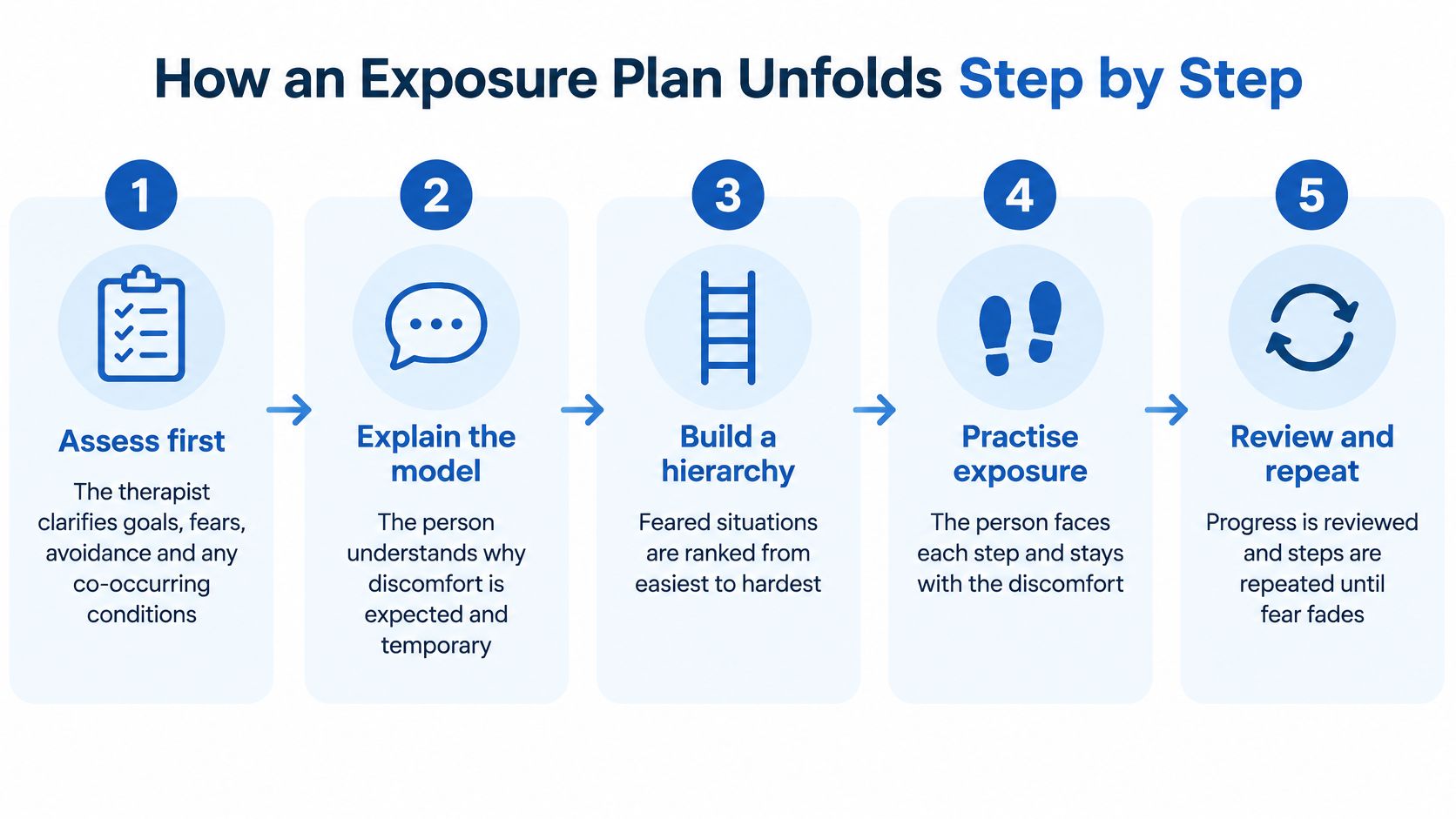
Assess first. Your therapist explores your goals, feared outcomes, avoidance and other mental-health concerns. They also consider medical risks and circumstances that could change the plan.
Understand the model. You discuss why approaching a trigger may bring discomfort and what the exercise is intended to teach. You should know the purpose before agreeing to practise.
Build a hierarchy together. You arrange feared situations from easier to harder, using a subjective distress scale agreed with your therapist. The ranking reflects your experience, not what someone else thinks you ought to find easy.
Choose a manageable starting point. For someone anxious about train travel, looking at a timetable might be a useful beginning if planning itself triggers avoidance. Another person might need to begin closer to the actual travel situation.
Repeat and observe. The therapist checks distress, avoidance and what you learned before, during and after practice. An exercise can be useful even if you don't feel completely calm.
Adjust the challenge collaboratively. When a step becomes manageable, you consider a more demanding task. If it's overwhelming, the therapist can divide it into smaller parts rather than framing difficulty as failure.
Review daily functioning. You look for changes such as attending class, speaking in meetings or making fewer avoidance-driven decisions. These show whether practice is helping outside the therapy setting.
Practise in everyday settings. Later work helps you apply learning across relevant places and situations. You also plan how to respond to setbacks without abandoning your progress.
The visual groups these activities into the main phases of treatment.
What sessions can feel like
The first appointment may focus mainly on assessment and explanation. Later sessions can include planned exercises in the consulting room, through a suitable online arrangement or in an appropriate everyday setting.
Your therapist may agree on practice between sessions, with clear boundaries and a way to review difficulties. The course length should follow your needs and goals rather than an assumed universal timetable.
Discomfort can rise during early practice and may ease within or across sessions. It doesn't follow a predictable schedule, and remaining anxious doesn't automatically mean the exercise failed.
Measure learning, not endurance: The useful question is what you discovered, not how much distress you forced yourself to tolerate.
Everyday Examples From Student and Work Life
What does a planned exposure look like when the fear appears in a seminar or a Monday meeting?
A university student may know her subject and still dread speaking. She worries that classmates will judge her if her voice shakes, so she lets others answer even when she has something useful to say. A presentation can become a meaningful treatment goal without being the starting exercise. The plan works like wading in from the shallow end: she and her therapist choose the depth together, instead of someone pushing her into deep water.

A student practising participation
With her therapist, she might begin by contributing a short comment in a small discussion. Later, she could practise presenting to a few classmates before attempting a seminar presentation. Family expectations can shape that ladder. A parent may treat silence as good manners, or treat a top mark as the only acceptable result. Those pressures can be named in the plan. Relatives do not become the exercise.
Her learning task is to find out whether she can participate despite a shaky voice, a pause, or uncertainty about other people's opinions. A trained clinician agrees the pace. Trying the same step alone because someone at home said "just speak" is a different, and riskier, arrangement.
A professional facing meetings and deadlines
An employee may rewrite an update many times and still avoid giving it in a team meeting. Their therapist might help them practise a brief contribution, while separately asking whether workload, bullying, or unrealistic deadlines need practical action. Speaking fear and an unfair timetable ask for different responses.
In a survey of 509 employees across Indian metropolitan areas reported by The Economic Times, 48% felt stressed by task deadlines. These were survey responses, not clinical diagnoses or an estimate for every Indian worker. One percentage cannot decide whether exposure fits a particular person.
For people whose work also involves driving, Lendrum's Driving School's techniques for overcoming driving anxiety can provide discussion points for an instructor and therapist. Reading advice isn't a substitute for clinical assessment or safe driving instruction.
For an additional explanation in video format:
Both scenarios need more than repeated challenge. Resilience includes rest, supportive relationships, and a kind response when a class or meeting goes badly. Burnout is not a signal to push harder. A walk with a friend, or a family meal where nobody reviews your performance, can sit alongside treatment. Small moments of happiness and connection do not require ignoring anxiety, low mood, or persistent workplace stress.
Find a Qualified Therapist Before You Start
If you're asking what is exposure therapy for anxiety, a useful next step is finding someone who can explain how it would apply to your particular fears. Look for a psychologist or therapist with relevant training in anxiety and exposure-based CBT.
An assessment should consider the whole person. Ministry of Health and Family Welfare guidance includes treatment goals, fears and beliefs about illness, psychosocial stressors, co-occurring conditions, suicide risk and medication dependence.
Questions to bring to an appointment
- Relevant experience: How do you treat the kind of fear I'm experiencing?
- Planning and monitoring: How would we choose exercises and review their effects?
- Support during difficulty: What should I do if distress rises between sessions?
Assessments are informational, not diagnostic. An online questionnaire may help you notice patterns in anxiety, depression, stress or resilience, but it can't confirm a condition, predict recovery or replace clinical evaluation.
DeTalks lists psychologists and counsellors whose profiles readers can browse and whose sessions they can book. A professional can consider low mood, family pressures, workplace stress and wider well-being when discussing therapy, counselling or psychiatric care.
Exposure should be gradual and collaborative. Progress means less avoidance and greater participation in life, with support available as your needs change.
DeTalks offers therapist and counsellor profiles, session booking and informational mental-health assessments to help you explore suitable support. Visit DeTalks to find a professional and ask whether a guided exposure plan could fit your anxiety, circumstances and goals.