Tag: anxiety treatment

  • A Practical Guide to Cognitive Behavioral Therapy in India for 2026

    A Practical Guide to Cognitive Behavioral Therapy in India for 2026

    If you're seeking a practical, proven way to navigate mental health challenges in India, Cognitive Behavioral Therapy (CBT) may be an excellent choice. It has become a trusted approach for many individuals and professionals looking to manage common issues like workplace stress, anxiety, and burnout, helping them build the resilience needed to thrive.

    Your Guide to Mental Well-Being in India

    Life in modern India is full of energy and opportunity, but it can also feel overwhelming. Juggling demanding careers, academic pressures, and family responsibilities can leave you feeling stretched thin and emotionally drained. In these moments, therapy can offer a supportive space to find your balance, and Cognitive Behavioral Therapy (CBT) is one of the most effective forms of counselling available.

    So, what is it exactly? CBT is a practical training program for your mind, built on one core idea: our thoughts, feelings, and actions are all connected. By learning to identify and gently reframe unhelpful thought patterns, you can positively influence how you feel and what you do. It's a goal-oriented approach that equips you with skills you can use for life.

    Building Resilience for Modern Challenges

    The pace of modern Indian life brings a unique mix of high-stakes opportunities and equally high-stress situations. While our ambitions drive us to achieve great things, they can also pave the way for chronic stress and burnout. This is where CBT offers real, concrete strategies to support your well-being.

    Instead of only talking about a problem, a CBT therapist works with you like a compassionate coach. Together, you will:

    • Pinpoint the specific thoughts that fuel feelings of anxiety or sadness.
    • Develop practical coping strategies for stressful situations.
    • Set small, achievable goals that improve your daily life and relationships.
    • Build a foundation of resilience to better handle life's challenges.

    The aim of CBT is not to promise a magic cure, but to give you the self-awareness and tools to become your own guide. It’s about empowering you to take charge of your mental health, fostering everything from self-compassion to a greater sense of happiness.

    In this guide, we’ll explore what makes cognitive behavioral therapy in India a trusted path toward mental balance. We’ll also cover how to find the right support, including how informational assessments can offer a gentle starting point. Please remember, these assessments are for personal insight and are not a substitute for a professional diagnosis.

    Understanding How CBT Actually Works

    Cognitive Behavioral Therapy (CBT) might sound complex, but its core idea is refreshingly straightforward and practical. It all centers on the powerful link between your thoughts, your feelings, and your behaviors. Simply put, what you think affects how you feel, and how you feel influences what you do.

    Consider a common scenario in India: you're stuck in traffic and running late for an important meeting. A thought like, “This is a disaster, I’m going to look so unprofessional,” might appear. This thought can immediately trigger feelings of stress and anxiety, which might lead you to honk impatiently or compulsively check your phone—actions that only increase your stress.

    CBT teaches you to notice this cycle as it happens, like pressing a pause button on automatic reactions. This space allows you to gently question that initial thought, helping you navigate life's challenges with a clearer mind and a calmer approach.

    The Collaborative Journey of Therapy

    A CBT therapist is not a silent observer but an active partner in your journey. The process is structured and collaborative from the very first session. You'll work together to identify specific challenges and set clear, practical goals for your counselling experience.

    This goal-oriented approach makes the process feel focused and empowering. You aren’t just exploring issues; you're actively developing skills to address them. This hands-on nature is what makes CBT a highly regarded tool for managing challenges like anxiety and building genuine resilience.

    A key feature of CBT is the use of 'homework'—simple, practical tasks to try between sessions. You might be invited to keep a thought diary to notice your thinking patterns or practice a calming breathing exercise. This helps you integrate what you learn in the therapy room into your real, daily life.

    To give you a clearer picture of what to expect, a typical session is quite structured.

    The Core Components of a Typical CBT Session

    Session Component Purpose and What It Involves
    Check-in & Agenda Setting You’ll start by briefly discussing your week and collaboratively setting an agenda for the session. This ensures the time is focused on your most pressing goals.
    Review of 'Homework' You and your therapist will review the between-session task. What went well? What was challenging? This feedback is crucial for learning.
    Working on a Specific Issue This is the main part of the session, where you'll use CBT techniques to work on a specific thought pattern or behavioural challenge identified in your agenda.
    Learning a New Skill You will often learn a new cognitive or behavioural skill, like how to challenge a negative thought or a new relaxation technique.
    Summarising & New 'Homework' At the end, you'll summarise the key takeaways from the session and agree on a new, practical task to work on before your next appointment.

    This structure ensures every session builds upon the last, helping you make steady, measurable progress.

    Diagram: Cognitive Behavioral Therapy (CBT) applications in India, alleviating stress, anxiety, 'STRNOUT', and burnout.

    As the diagram illustrates, CBT offers a practical framework for tackling the stress, anxiety, and burnout that so many of us face. It empowers you to manage these pressures by changing the way you think and react.

    The ultimate goal of cognitive behavioural therapy in India isn't to keep you in therapy forever. It is to equip you with the skills to become your own therapist over time, empowering you to handle life's challenges long after your sessions have ended.

    From Unhelpful Thoughts to Healthy Coping

    A significant part of the CBT process is learning to spot and challenge "cognitive distortions." These are simply unhelpful thinking habits our minds can develop, such as jumping to the worst-case scenario (catastrophizing) or blaming yourself for things outside your control (personalization).

    For instance, imagine your boss offers constructive feedback. A distorted thought might be, “I’m terrible at my job, I’m going to get fired.” CBT teaches you to pause and examine that thought with curiosity. Is there actual evidence for this, or is there another, more balanced way to see the feedback?

    This skill is called cognitive restructuring. It's not about forcing "positive thinking" but about learning to see situations with more accuracy and kindness. Over time, you can replace rigid, negative thoughts with more realistic and helpful ones, which is one of the most effective therapeutic interventions for anxiety because it puts you back in the driver's seat.

    By gently changing your thoughts, you directly influence your emotional experience. This is a game-changer for managing conditions like depression and for building deep, lasting emotional resilience. It's a skill that fosters self-compassion and, ultimately, opens the door to greater happiness. Remember, any assessments you take are for your own insight; a formal diagnosis can only be provided by a qualified professional.

    Why CBT Is Gaining Trust Across India

    It’s no surprise that Cognitive Behavioral Therapy is quickly becoming one of India's most sought-after therapies. Its practical, no-nonsense approach is a perfect match for the unique pressures of modern Indian life. Whether you're navigating intense academic competition, a demanding career, or the sheer pace of city living, CBT offers real skills to manage your mental health.

    This isn't just talk therapy. Instead of simply exploring problems, CBT gives you a clear, structured roadmap to start solving them. It zeroes in on the powerful link between your thoughts, feelings, and actions, empowering you to break negative cycles. This goal-oriented style really clicks with students and professionals looking for effective ways to handle anxiety, depression, and workplace stress.

    A Proven Framework for Real-World Problems

    As conversations around mental health open up across the country, people are looking for therapy that actually delivers results. CBT's greatest strength is that it's backed by decades of solid research proving its effectiveness for a whole host of concerns. More importantly, studies right here in India have shown consistently positive outcomes, building huge confidence among both therapists and the people they help.

    Think of the tools you learn in CBT as life skills. When you learn to spot and challenge your own unhelpful thought patterns, you're not just managing a condition—you're building resilience, improving your relationships, and finding a greater sense of self-compassion. It's a proactive way to look after your mind, helping you handle challenges before they feel overwhelming.

    The rise of CBT points to a bigger, healthier shift in our mindset. We're moving away from seeing therapy as a last resort and starting to embrace it as a powerful tool for personal growth, resilience, and real happiness.

    The momentum is undeniable. Research confirms that since 2010, cognitive behavioural therapy in India has become the most widely practised evidence-based psychotherapy. This trend is marked by a huge jump in published studies, with the cognitive-behavioural model leading the pack. Tellingly, 93% of CBT sessions are for adults aged 19-59, directly addressing the needs of young adults and professionals dealing with career pressures and burnout. You can see the data for yourself in this research on the rise of empirical therapies in India.

    Practical Support for Today’s Challenges

    The structured, hands-on nature of CBT is a big part of its appeal. Rather than being an open-ended discussion, each session has a clear focus. You’ll often leave with practical “homework” to try out in your daily life—this might be keeping a thought journal, testing new beliefs, or practising a different way of reacting in a stressful situation.

    This hands-on approach helps you see progress, which is incredibly motivating. It makes the whole process feel less mysterious and more like a personal training programme for your mind. That kind of clarity is especially helpful if you’re new to therapy or counselling and aren't sure what to expect.

    Ultimately, the trust in CBT comes from its promise of empowerment. It doesn’t offer a magic wand. What it does is give you the understanding and the skills to become your own best advocate for your mental well-being. It’s a journey toward self-awareness that leaves you with practical tools you can use for the rest of your life. And remember, while online assessments can be a useful starting point, they are purely for your information and can never replace a professional diagnosis from a qualified therapist.

    Adapting CBT for Indian Culture and Values

    Therapy is not a one-size-fits-all formula, especially in a country as culturally rich and diverse as India. While the core principles of Cognitive Behavioral Therapy are universal, how they are applied matters greatly. A good therapist in India understands that a person's thoughts and feelings are deeply connected to their family, community, and cultural values.

    This cultural awareness is essential for making therapy effective and building trust. Instead of applying a purely individualistic Western model, skilled therapists in India weave in the collectivist fabric of our society. This transforms cognitive behavioural therapy in India from a clinical procedure into a respectful partnership.

    An Indian family, including a man, girl, and elderly woman, consults with a female therapist.

    Blending Individual Goals with Family Dynamics

    In India, family is often at the center of our lives, providing both our greatest support and, at times, our biggest stressors. A therapist practicing CBT here knows this and often incorporates elements of family counselling. They understand that major life decisions are rarely made in isolation.

    Consider how often our challenges are tied to family dynamics:

    • Marital Discord: Resolving issues with a spouse while navigating opinions from relatives.
    • Parenting Stress: The pressure to raise children according to specific cultural expectations.
    • Inter-Generational Conflict: Balancing tradition with the pulls of modern life.
    • Academic and Career Pressure: Fulfilling expectations set by parents and elders.

    By acknowledging the powerful influence of family, a therapist helps create a supportive environment for change. This ensures that the progress you make in sessions can be sustained at home, leading to more lasting improvements in your well-being.

    Making Therapy Relatable and Effective

    To make concepts like "challenging negative thoughts" feel intuitive, therapists in India often use relatable examples. They might draw on metaphors from local culture, stories, or familiar philosophies. This use of familiar language makes the entire process feel less clinical and more accessible.

    There's strong evidence for this approach. One study found that nearly 90% of practitioners in India blend CBT with other therapeutic styles. A significant 71% make direct changes to the standard CBT model to better fit the local context.

    Most tellingly, family therapy is combined with CBT in 70% of cases to address issues like marital friction and parenting stress. Therapists noted that without these cultural adjustments, it is hard to keep clients engaged, especially when they present with physical symptoms rather than directly stating feelings of anxiety or depression. You can read the full study in this analysis of cultural adaptation of CBT in India.

    A culturally adapted approach doesn't change the science of CBT; it changes how that science is delivered. It ensures that the therapy is not only effective but also feels deeply respectful and understanding of the individual's world.

    Building Resilience and Positive Growth

    Adapting CBT in India is about more than just managing workplace stress or family issues. It's also about fostering positive growth in a way that resonates with deep-seated cultural values like resilience, compassion, and inner harmony.

    For instance, a therapist might help you cultivate self-compassion by framing harsh self-criticism as something that goes against the value of kindness we're taught to show others. They might use mindfulness techniques—which have ancient roots in India—to help you manage anxiety and rediscover a sense of calm and happiness.

    By integrating these positive principles, therapy becomes more than just a tool for fixing problems. It becomes a path to personal growth, helping you build a stronger, more authentic self while staying connected to your roots. While informational assessments are a helpful starting point, they are no substitute for a professional diagnosis from a qualified practitioner.

    How to Find a Qualified CBT Therapist in India

    Taking the first step to find a therapist can feel huge, but it's also a move filled with hope. As conversations around mental health open up across India, finding a qualified professional for Cognitive Behavioural Therapy is easier than it has ever been. Think of this process as finding a partner—someone who will help you build the skills you need for long-term well-being.

    The right therapeutic relationship is founded on trust, solid expertise, and a genuine connection. This person will be your guide through challenges like workplace stress or persistent anxiety, so investing the time to find a good fit is one of the best things you can do for your mental health.

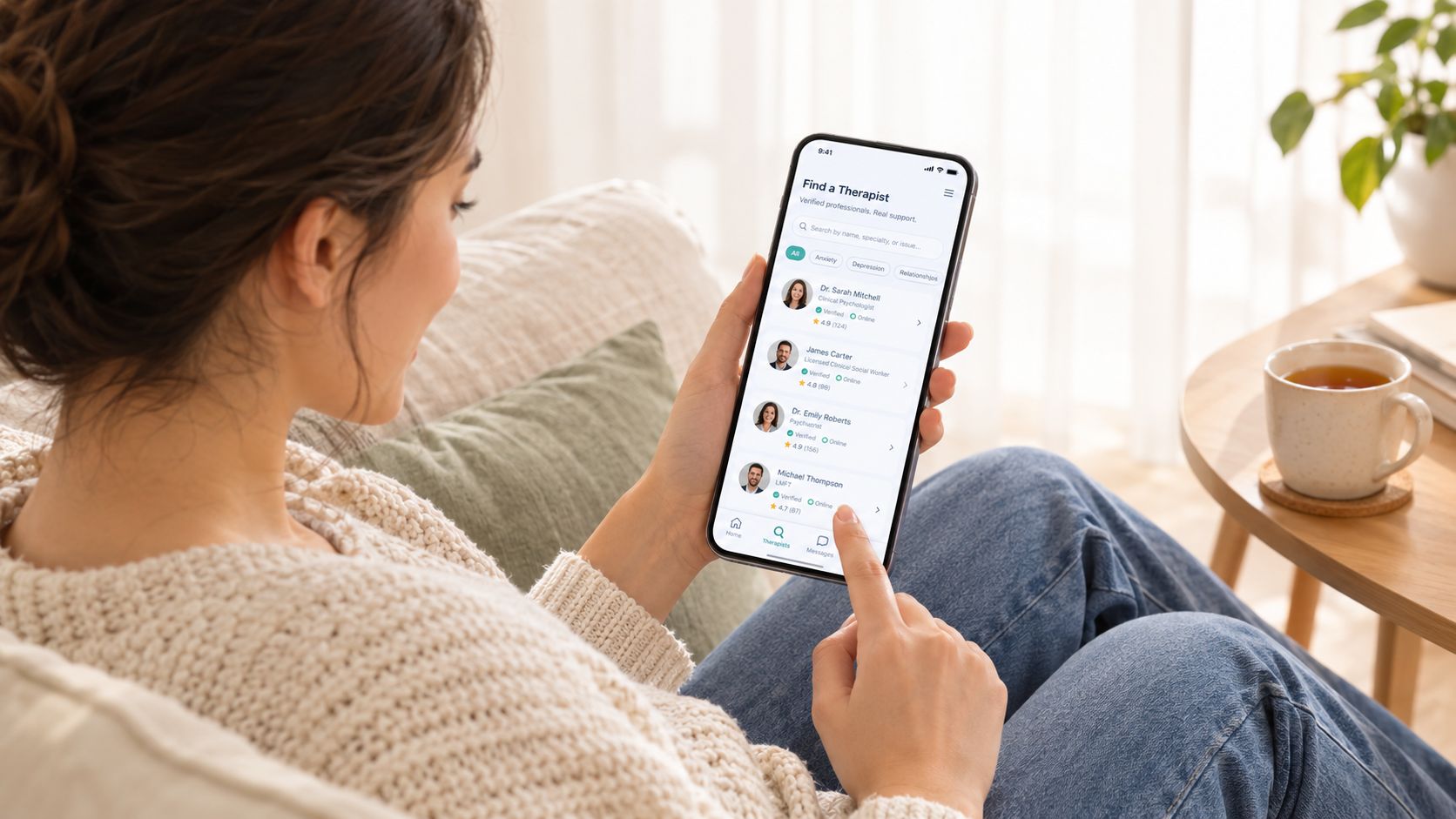
    A laptop displays an online profile for a licensed CBT therapist, alongside a calendar, mug, and smartphone on a white desk.

    Verifying Credentials and Qualifications

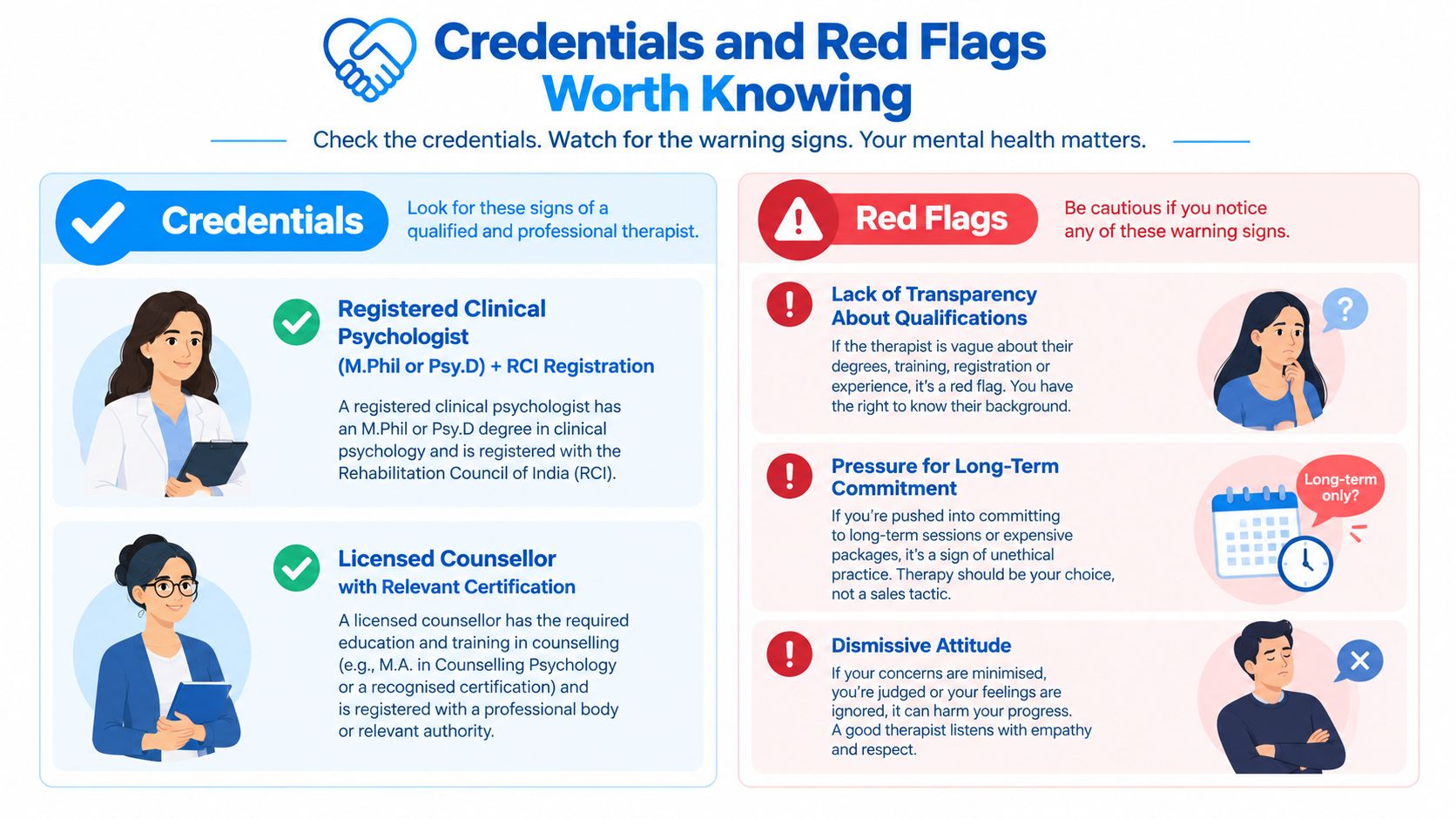
    Before you dive in, it’s important to understand who is qualified to help. In India, the mental health field has specific regulations to ensure you receive quality, ethical care. Checking a therapist’s credentials isn't about being difficult; it's about making sure they have the proper training to provide effective therapy.

    Here are the main qualifications to look for in India:

    • RCI Licence: The Rehabilitation Council of India (RCI) is the official body that regulates the training and practice of Clinical Psychologists. An RCI licence is your best sign that a professional is qualified to diagnose and treat mental health conditions.
    • Educational Background: A qualified psychologist should hold at least a Master’s degree (M.A. or M.Sc.) in Psychology or Clinical Psychology. Those with an M.Phil in Clinical Psychology have completed intensive, supervised practical training, which is a big plus.
    • Specialised CBT Training: A psychology degree is the foundation, but you need someone who has specifically trained in CBT. Don't be shy—ask if they have certifications or have attended specialised workshops in cognitive behavioural therapy in India.

    A therapist's qualifications are your assurance of their professional commitment. They confirm that the practitioner has undergone rigorous academic and practical training, and adheres to a recognised code of ethical conduct.

    Key Questions to Ask a Potential Therapist

    Finding a good fit goes beyond a CV. That first consultation call is your chance to see if you click with the therapist’s personality and approach. It’s completely normal to "interview" a few therapists before deciding on one.

    This initial chat is where you can gauge their experience with what you're going through, whether it’s depression, social anxiety, or a desire to build resilience. A good therapist will expect and welcome your questions, answering them openly to help you feel comfortable and understood.

    To make sure you cover the important bases, here are some essential questions to have ready.

    Questions to Ask a Potential CBT Therapist

    Question Category Sample Questions to Ask
    Experience and Specialisation "What is your experience in using CBT for issues like [mention your concern, e.g., workplace stress, anxiety]?"
    "Do you have specific training in Cognitive Behavioural Therapy?"
    Therapeutic Approach "How do you adapt CBT for the Indian cultural context?"
    "Can you describe what a typical CBT session with you looks like?"
    Logistics and Practicalities "What are your session fees, and what is your policy on cancellations?"
    "Do you offer online sessions, and how do they differ from in-person ones?"

    Asking these questions helps you make a choice you feel confident about. The goal is to find someone you believe can truly understand and guide you. Remember, a strong therapeutic alliance is one of the biggest predictors of successful counselling.

    Understanding Pricing and Affordability

    The cost of therapy in India varies quite a bit. It depends on the therapist’s experience, their location (a session in Mumbai or Delhi will likely cost more than in a smaller city), and the format (online is often more affordable than in-person).

    Generally, you can expect in-person sessions to range from ₹1,500 to ₹4,000. Many therapists also offer a sliding scale, where they adjust their fees based on your income, so it never hurts to ask.

    While insurance coverage for mental health is improving in India, it's not yet a given. Your best bet is to call your insurance provider directly to understand what your policy covers.

    Your mental well-being is a priority, and there are ways to make it work financially. Platforms like DeTalks can help you find therapists with different price points, making it easier to connect with support that fits your budget. This journey is about growth and empowerment, and finding the right guide is the perfect place to start.

    Your Journey Starts With a Single Step

    Deciding to explore therapy is a huge act of hope and a real commitment to your own well-being. Throughout this guide, we've seen that Cognitive Behavioral Therapy isn't just a clinical term—it's a practical, evidence-based toolkit. It gives you concrete strategies for handling everything from workplace stress and anxiety to achieving lasting personal growth.

    In India, we've learned that its power is magnified when therapists blend these proven techniques with a genuine understanding of our cultural context, family dynamics, and community values. Finding a qualified professional who gets this isn't just a bonus; it's fundamental to a successful journey. It’s a process that empowers you to build the skills for a more balanced and fulfilling life.

    What's a Comfortable Next Step for You?

    The path to better mental health rarely starts with a giant leap. It begins with a single, manageable step. Think of therapy less as a quick 'fix' for issues like anxiety or depression, and more as a collaborative partnership where you build self-awareness, resilience, and genuine self-compassion.

    Your next step can be as small or as structured as you feel comfortable with. For some, it might just be reading more and quietly exploring resources to better understand their own thought patterns and feelings. As you start out, looking into the principles of holistic mental wellness can be a great way to support your therapeutic path.

    Remember, the goal of therapy isn't to become someone new. It's about learning the skills to become more fully yourself—calmer, clearer, and more resilient in the face of life's challenges.

    For others, a good starting point is an informational self-assessment. These confidential tools are designed to offer a private look into your emotional patterns. It is always important to clarify that these assessments are for informational purposes only and are not a substitute for a professional diagnosis. They can, however, give you a useful foundation for a future conversation with a therapist.

    Finding Help Is Easier Than You Think

    If you feel ready, browsing a directory of qualified, compassionate professionals is an excellent next move. You can search for someone whose expertise aligns with what you're going through, whether it’s navigating career pressures or wanting to improve your relationships.

    The most important thing to remember is that you are not alone on this path. With so many options for counselling available online and in person across India, support is more accessible than ever. Your journey toward greater happiness and balance begins with the simple belief that you deserve to feel better. Taking that first step—whatever it looks like for you—is a true sign of your strength.

    Frequently Asked Questions About CBT in India

    It’s completely natural to have questions before you start therapy. In fact, it’s a great sign that you’re taking this step seriously. Let's tackle some of the most common queries we hear about Cognitive Behavioural Therapy in India, so you can feel more confident about what to expect.

    How Long Does CBT Take to Show Results?

    This is probably the number one question people ask, and for good reason. CBT is designed to be a focused, practical form of counselling, not a years-long commitment. Most people begin to feel a real shift and see positive changes within 8 to 12 sessions.

    Of course, everyone's pace is different. Your progress really depends on how you use the tools you learn. The work you do between sessions—practising the new ways of thinking and reacting in your everyday life—is what truly creates lasting change. Your therapist is your partner in this, helping you set clear goals and track your progress together.

    Is Online CBT as Effective as In-Person Therapy?

    Yes, absolutely. A lot of solid research shows that for common concerns like anxiety and depression, online CBT works just as well as face-to-face therapy. For many people in India, it's actually a much better fit.

    Think about it: no more battling city traffic, no need to rearrange your entire day for an appointment, and you can connect with a great therapist no matter where you live. It gives you access to quality care from the comfort and privacy of your own home, which is a huge advantage.

    What if I Don’t Feel a Connection With My Therapist?

    This is a crucial point. If you don't feel comfortable or understood by your therapist, the therapy simply won't be as effective. Finding the right 'fit' is everything.

    Don't be discouraged if the first therapist you speak with doesn’t feel right. This is a very normal part of the process. You have every right to find someone you connect with. A good therapist will completely understand and even encourage you to find a better match, because your well-being is always the top priority.

    The therapeutic relationship is the foundation of successful therapy. It is perfectly okay if you do not feel a strong connection with the first therapist you meet. Your comfort and trust are paramount.

    Can CBT Help With More Than Anxiety and Depression?

    Definitely. While CBT is famous for its success with anxiety and depression, its tools are incredibly useful for a whole range of life’s challenges.

    It’s highly effective for managing the pressures of workplace stress, building genuine self-esteem, tackling specific fears (phobias), and improving difficult relationships. At its heart, CBT teaches you a skill: how to catch, question, and change unhelpful thought patterns. That’s a superpower for building personal resilience and overall happiness in any area of your life.


    Taking that first step is often the hardest part, but it’s a true sign of strength. At DeTalks, our goal is to make that step a little bit easier. We can help you connect with a qualified, compassionate therapist anywhere in India. Whether you’re ready to start therapy, want to try our self-assessments, or just need more information, we're here to guide you.

    Find the support you deserve at https://detalks.com.

  • A Compassionate Guide to Anxiety Disorder ICD-10 Codes

    A Compassionate Guide to Anxiety Disorder ICD-10 Codes

    When a mental health professional identifies an anxiety disorder, the ICD-10 framework gives them a specific code, like F41.1 for Generalised Anxiety Disorder. Think of this as a shared, professional language. It is a system built to bring clarity to diagnosis and support, making sure everyone involved in your care is on the same page.

    Understanding the Language of Mental Health Support

    A serene image showing books and a magnifying glass, symbolizing the process of understanding and decoding information about mental health.

    The ICD-10 system acts as a common vocabulary for doctors and therapists around the world. The goal isn't to put people into boxes, but to create a clear understanding of health challenges, whether it's anxiety or depression. This ensures everyone is speaking the same clinical language, which is a vital part of effective care.

    This guide will walk you through how this system helps professionals communicate with clarity and compassion. We'll break down these codes, turning what might seem like technical jargon into something you can understand. These are simply tools to support the journey toward better well-being.

    A Tool for Clarity, Not a Label

    A diagnostic code is the beginning of a conversation about your health, not the end. It is a piece of information professionals use to get a clearer picture of the challenges you're facing. It's important to remember that these assessments are informational, not diagnostic; only a qualified professional can provide a diagnosis.

    The purpose of a framework like the ICD-10 is to create a shared understanding of a health condition. It helps create a structured path for support, like therapy and counselling, making sure the care you receive is consistent and well-informed.

    In India, as conversations around mental health become more open, understanding these systems can help reduce stigma. When we understand how conditions are clinically described, it empowers us and clarifies the path forward.

    From Stress to Resilience

    The mental health journey involves understanding both our challenges, like stress and anxiety, and our incredible capacity for resilience. Many conditions described in the ICD-10 are rooted in common life experiences.

    • Workplace Stress: The pressure of a demanding job can lead to feelings of anxiety and burnout.
    • Personal Challenges: Life events, relationship difficulties, and personal history all shape our mental well-being.
    • Building Resilience: Recognising these factors is the first step toward developing coping strategies and lasting emotional strength.

    The system provides a map, but you are the expert on your own journey. The goal isn't just to manage anxiety, but to cultivate resilience, self-compassion, and happiness. With supportive therapy or counselling, you can build a solid foundation for long-term well-being.

    How the ICD-10 Organises Anxiety Disorders

    Think of the ICD-10 as a large, well-organised library for health conditions. Just as a library system helps you find a specific book, the ICD-10 helps healthcare professionals navigate the vast world of human health, including mental well-being.

    This is not about labelling people, but about creating a common language. For anyone navigating challenges with anxiety or depression, this system ensures that every professional involved—from a doctor to a therapist—understands the nature of the challenge precisely. It is a shared map guiding the path to recovery.

    The F40-F48 Chapter for Anxiety

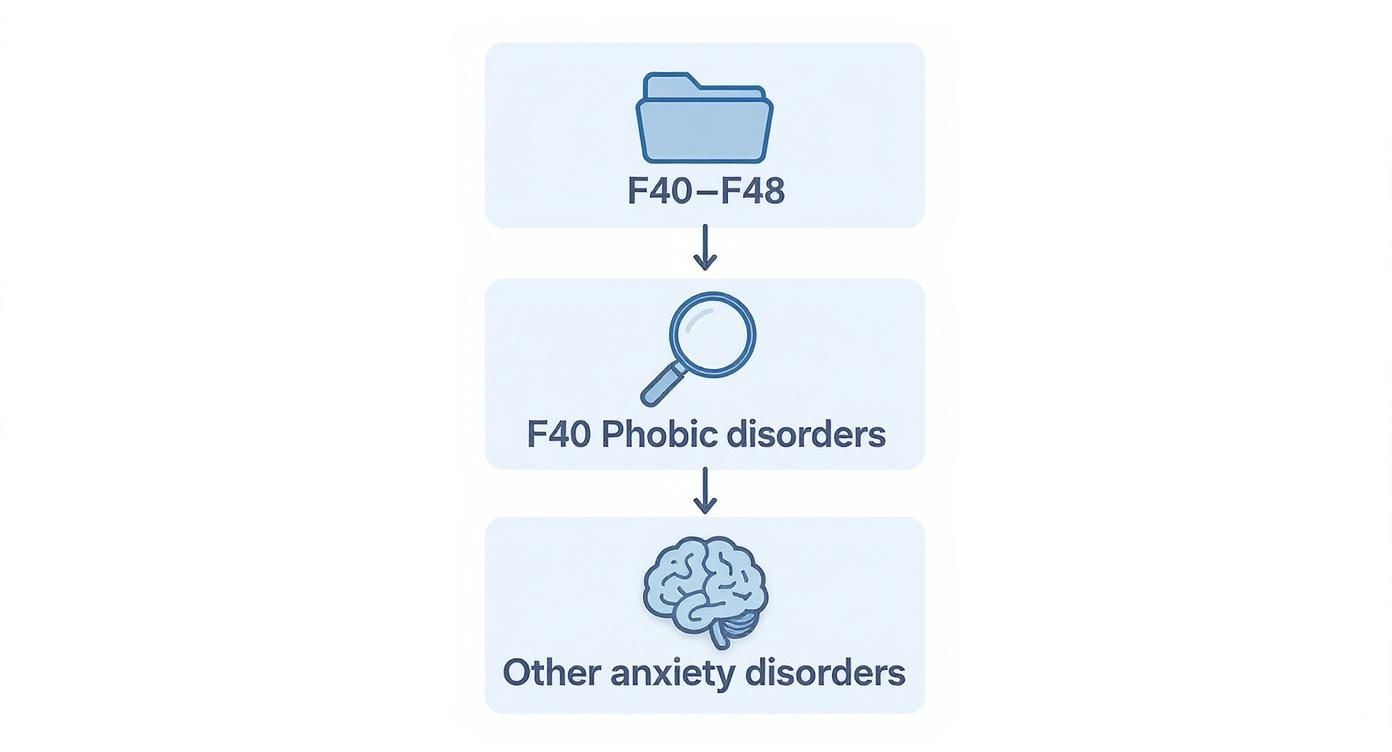
    Within this "library," anxiety disorders have their own section in the chapter on 'Mental and Behavioural Disorders'. This block is coded from F40 to F48 and is officially titled 'Neurotic, stress-related and somatoform disorders'.

    This specific grouping is clinically deliberate. It gathers conditions where anxiety is a central theme, whether it is tied to a specific fear, shows up as constant worry, or is a reaction to life events or workplace stress. Seeing them grouped together helps us understand how these related experiences are viewed.

    An anxiety disorder ICD 10 code is simply a diagnostic tool for professionals, not a label that defines a person. Think of it as a signpost that points toward the most effective route for therapy and counselling.

    Why This Grouping Matters

    Clustering these disorders together helps clinicians see the bigger picture. It recognises that conditions like panic attacks, generalised anxiety, and stress reactions often share similar roots and can appear together. This interconnected view is crucial for building a holistic plan for a person's well-being.

    For example, someone dealing with severe burnout might also show signs of generalised anxiety. The ICD-10 framework helps a therapist spot this connection, allowing them to address both the trigger (workplace stress) and the resulting anxiety. This leads to more effective and empathetic care.

    Ultimately, this logical system helps build personal resilience. By clearly defining the challenge, individuals and their support networks can focus on developing the right coping strategies to regain a sense of control and happiness.

    Here’s a simple look at the logic behind this classification:

    • Shared Core Symptoms: Most disorders in this block involve feelings of fear, worry, and physical tension.
    • Response to Stress: Many are triggered or worsened by stressful events, highlighting the link between our environment and our mental state.
    • Focus on Internal Experience: These are defined by internal emotional distress rather than a significant break from reality.

    This structured approach provides a solid foundation for mental healthcare. It allows professionals in India and across the globe to speak the same language, ensuring that a diagnosis using an anxiety disorder ICD 10 code translates into consistent, high-quality support.

    A Closer Look at Common ICD-10 Codes for Anxiety

    Let's unpack some specific ICD-10 codes for anxiety disorders. Seeing how different experiences of anxiety are categorised can be very insightful. Think of these codes as navigational tools that guide professionals toward the right kind of support, like therapy or counselling.

    This systematic approach brings much-needed clarity to mental health care. It is also an area where technology helps, as the use of artificial intelligence in medical coding improves accuracy and patient care.

    The infographic below shows how the ICD-10 system breaks down anxiety disorders into a clear hierarchy.

    Infographic about anxiety disorder icd 10

    This logical structure allows professionals to understand an individual's challenges with both precision and compassion.

    A Quick Guide to Common Codes

    Here’s a simplified table of some common ICD-10 codes for anxiety. It is a handy reference for understanding the key distinctions at a glance.

    ICD-10 Code Disorder Name Key Feature Description
    F40 Phobic Anxiety Disorders Intense, specific fear triggered by an object or situation that isn't inherently dangerous.
    F41.0 Panic Disorder Recurrent, unexpected panic attacks and a persistent fear of having more.
    F41.1 Generalised Anxiety Disorder Excessive, persistent worry about a wide range of everyday things.
    F42 Obsessive-Compulsive Disorder A cycle of intrusive thoughts (obsessions) and repetitive behaviours (compulsions).

    This table simplifies complex experiences, but it shows how each code points to a unique pattern, helping clinicians tailor their approach.

    F40 Phobic Anxiety Disorders

    This category covers anxiety triggered by specific situations or objects that are not actually dangerous. This is an intense, overwhelming response that can disrupt someone's life, contributing to workplace stress and social avoidance.

    A person with a phobia might go to great lengths to avoid the source of their fear. The goal of therapy is to help build resilience and gently guide the individual toward feeling safe again.

    F41 Other Anxiety Disorders

    This is a frequently used category, covering anxiety that isn't tied to a single, specific trigger. It includes several recognisable conditions.

    • F41.0 Panic Disorder: This involves unexpected and repeated panic attacks—sudden waves of overwhelming fear that can be terrifying.
    • F41.1 Generalised Anxiety Disorder (GAD): This code is for a state of persistent, excessive worry about many things. Living in this state of high alert is draining and often co-occurs with depression.

    Please remember, this information is for educational purposes only and not a substitute for professional guidance. A qualified mental health expert can offer a compassionate and accurate assessment to support your journey toward well-being.

    The prevalence of these conditions is a significant concern in India. A large-scale meta-analysis found the prevalence rate of neurotic disorders (including anxiety) to be 20.7%, with generalised anxiety disorder at 5.8% and phobias at 4.2%.

    F42 Obsessive-Compulsive Disorder (OCD)

    This code is for experiences defined by obsessions and compulsions. Obsessions are intrusive, unwanted thoughts that cause distress, while compulsions are repetitive behaviours performed to ease that anxiety.

    Contrary to myth, OCD is not about being neat; it is a difficult cycle of intrusive thoughts and compulsive actions. Counselling offers strategies to manage these patterns, helping individuals break the cycle and foster self-compassion.

    Getting familiar with these codes is a first step toward clarity. Understanding how your experiences are professionally recognised can empower you to find the right support and move from anxiety toward resilience and happiness.

    How Codes Shape Your Treatment Journey

    Think of an ICD-10 code for anxiety as the first sentence in a conversation with your mental health professional. It is a starting point for creating a shared understanding of what you're going through. This is not about boxing you in; it's about finding the right key to unlock effective support.

    A code is the outcome of a careful, compassionate assessment. It allows doctors, therapists, and insurance providers to communicate clearly, ensuring everyone on your support team is working together to help you feel better.

    From Diagnosis to a Personalised Care Plan

    Once a professional identifies the right ICD-10 code, the work of crafting a unique treatment plan begins. In the Indian context, this often means acknowledging the role of family and community in your well-being. The code gives a name to the challenge, opening up a richer discussion about your specific needs.

    For instance, a diagnosis of F41.1 (Generalised Anxiety Disorder) gives a therapist a clear picture. With that knowledge, they can recommend specific approaches, like certain types of therapy or counselling, known to be effective for managing persistent worry. The conversation shifts from "I'm always anxious" to "Let's work on strategies for this pattern of anxiety."

    A diagnostic code doesn't define you—it lights up the path ahead. It is a tool that helps your care team draw a map for your personal journey, focusing on building your resilience and finding your way back to happiness.

    This collaborative spirit ensures your treatment plan is anything but generic. It will be shaped by your life story, cultural background, and current situation, whether that involves workplace stress or family dynamics.

    Why Codes are Key to Quality Care

    Using a standardised system like ICD-10 helps maintain a high standard of care for everyone. A diagnosis is grounded in established clinical criteria rather than just subjective opinion. This consistency is important for several reasons:

    • Clarity in Communication: It lets a psychiatrist in Delhi instantly understand notes from a counsellor in Mumbai.
    • Evidence-Based Treatment: Codes are linked to research and treatment guidelines, helping professionals choose effective therapies.
    • Streamlining Support: For health insurance, the code provides a clear justification for why treatment is necessary, making the process smoother.

    This structured system removes guesswork, ensuring the support you receive is both professional and empathetic. It anchors the therapeutic process in a global framework while allowing for a deeply personalised approach.

    Building Resilience for the Long Haul

    The purpose of using an anxiety disorder ICD 10 code is to guide you towards a life with less distress and more joy. The focus is never just on the symptoms of anxiety or depression; it is about building lasting emotional strength. Your treatment plan is a living document, meant to adapt as you do.

    It might involve things like:

    1. Therapy Sessions: Learning coping skills and exploring the roots of your anxiety with a therapist.
    2. Mindfulness Practices: Discovering techniques to ground yourself in the present moment.
    3. Lifestyle Adjustments: Looking at how small changes to sleep, diet, and exercise can support your overall well-being.

    Remember, the code is a key, not a cage. It opens the door to targeted support and marks the first step on a journey that empowers you to face challenges, practise self-compassion, and build a more resilient life.

    Looking Beyond the Code to See the Whole Person

    A person stands silhouetted against a vibrant, colourful background, representing their complex inner world.

    It is easy to get lost in labels, but a person is more complex than a diagnostic number. An anxiety disorder ICD 10 code is a tool for professionals—a clinical shorthand. It gives a snapshot of what someone is experiencing, but it is never the whole story.

    A healthier way to see a diagnosis is as a signpost. It points toward the challenges someone is facing and illuminates the best path forward, whether that involves therapy or counselling. A code doesn't define your potential, your worth, or your capacity for happiness.

    The Person Behind the Diagnosis

    Our experiences, culture, and personal histories are what truly shape us. Especially in India, factors like family expectations, community bonds, and societal pressures play a massive role in our mental well-being. A clinician’s assessment is just one piece of a much larger puzzle.

    Real-world context, like intense workplace stress or navigating a major life change, feeds into feelings of anxiety and depression. Acknowledging this helps us approach mental health with more compassion.

    Assessments are meant to be informational, not diagnostic. They are guides to help you and your mental health professional explore what kind of support would be most helpful.

    This holistic view is crucial. It shifts the focus from a clinical label to the living, breathing person on their unique journey. The goal is always to build resilience and support the whole individual.

    Culture, Context, and Well-being

    Mental health is not a one-size-fits-all experience. The way we express distress and seek help is woven into our cultural fabric. Truly effective care must honour these nuances.

    Anxiety can show up in many different ways. The National Mental Health Survey of India found that specific phobia was the most common anxiety disorder, followed by panic disorder and generalised anxiety disorder. The survey also revealed a significant treatment gap, highlighting the need for more accessible support. You can read more on the National Library of Medicine website.

    Understanding statistics like these helps us see these challenges as shared human experiences, not personal failings. This knowledge can dismantle stigma and encourage more people to seek the compassionate care they deserve.

    Supportive Takeaways for a Balanced View

    When you see a diagnosis as a tool rather than a label, you empower yourself to take charge of your well-being. It becomes a stepping stone toward building a happier, more balanced life.

    Here are a few supportive takeaways:

    • You Are Not Your Diagnosis: A code is a clinical descriptor, not the sum of who you are.
    • Focus on Growth: Use the clarity a diagnosis may bring to focus on building skills for resilience and self-compassion.
    • Seek Holistic Support: True well-being involves strengthening relationships, finding purpose, and nurturing your mind and body.

    Ultimately, understanding the anxiety disorder ICD 10 system is about arming yourself with knowledge to move forward. It’s a practical step toward finding the right help and cultivating a life with meaning and a greater sense of peace.

    Your Journey to Understanding and Wellness

    Learning about mental health classifications can feel like learning a new language. But understanding a system like the ICD-10 is about gaining clarity, not collecting labels. These frameworks are just one tool on a much broader journey toward well-being.

    It's important to remember this guide is for educational purposes. Real insight comes from a conversation with a qualified professional. Clinical codes are there to guide professionals, not to replace the human connection you get from a supportive therapist or counsellor.

    Taking That First Step with Kindness to Yourself

    The most courageous step is often the first one. Reaching out for support is an act of profound strength and self-compassion. Whether it's workplace stress, persistent anxiety, or the weight of depression, professional guidance creates a safe space to find a path forward.

    A good therapist helps you build practical strategies for resilience. This is not about a quick fix, but about learning to navigate life's challenges with greater balance and well-being. You are not alone in feeling this way.

    Knowledge is a supportive tool, not a diagnostic one. Its value lies in empowering you to seek the right help and approach your mental health journey with confidence and hope.

    Building Your Personal Wellness Toolkit

    Your path to feeling better will be uniquely yours. Formal therapy and counselling are often the bedrock, offering structured guidance for managing anxiety and building healthier coping skills.

    Alongside professional support, exploring different methods for self-care can make a huge difference. For instance, you could look into simple, practical tips on how to reduce anxiety naturally. Weaving these practices into your daily routine can create a strong foundation for long-term emotional health.

    Here are a few supportive takeaways:

    • You are more than a code. A diagnosis is a clinical shortcut that does not define who you are or your potential.
    • Focus on resilience. Use what you've learned to build real-world skills for managing stress, practicing self-compassion, and finding joy.
    • Seek connection. Whether through professional therapy or trusted friends and family, connection is a powerful force for healing.

    I hope this guide has been a helpful companion. By arming yourself with knowledge and seeking compassionate support, you can move forward with hope, building a life defined by your own growing strength and resilience.

    Your Questions Answered

    Diving into clinical codes like the ICD-10 can bring up questions. This section provides straightforward answers to common queries. Think of this as a helpful guide to build your understanding, not as a substitute for a conversation with a professional.

    A diagnosis is a starting point, not a label. It provides clarity that can open the door to a supportive journey with therapy or counselling, helping you improve your well-being and build lasting resilience.

    What Is the Most Common ICD-10 Code for Anxiety?

    The code we often see is F41.1 for Generalised Anxiety Disorder (GAD). This reflects how common persistent, wide-ranging worry is in today's world. GAD is defined by excessive anxiety about many things, which can cause significant workplace stress and disrupt daily life.

    Knowing that countless others navigate similar feelings can be a comforting first step toward seeking help for anxiety. It is a shared human experience, and support is available.

    Can I Use ICD-10 Codes to Diagnose Myself?

    Simply put, no. It is not possible or advisable to self-diagnose using ICD-10 codes. These codes are part of a system for trained professionals who can weigh the criteria against your personal history and the nuances of your emotions.

    A compassionate professional offers a thorough evaluation, looking at you as a whole person. Attempting to self-diagnose can lead to misunderstanding and may prevent you from getting the right kind of support. These guides are for information, not diagnosis.

    An ICD-10 code is one piece of a much larger puzzle. A meaningful diagnosis comes from an empathetic conversation with a mental health expert who understands your unique context.

    Why Do Some Anxiety Codes Say "Unspecified"?

    You might see a code like F41.9, "Anxiety disorder, unspecified." A professional uses this when someone has significant anxiety, but their symptoms don't neatly fit a specific disorder at that time. It often serves as a temporary placeholder while the clinical picture becomes clearer.

    This practical approach allows a therapist to provide support right away. As they get to know you better through therapy, they can update the diagnosis to be more specific if appropriate.

    Do These Diagnostic Codes Ever Change?

    Yes, they do. The ICD system is updated by the World Health Organization to keep pace with the latest medical understanding. The world is slowly moving from ICD-10 to the newer ICD-11, which offers more detailed classifications.

    For you, this means the terms professionals use may evolve. What will not change is their commitment to providing compassionate care. The goal is always to use the best tools to support your journey toward mental well-being and emotional resilience.


    Finding the right professional to guide you is a crucial step towards healing and growth. DeTalks offers a safe, trusted platform where you can connect with qualified therapists and access scientifically validated assessments to better understand your mental health. Start your journey toward clarity and well-being today at https://detalks.com.