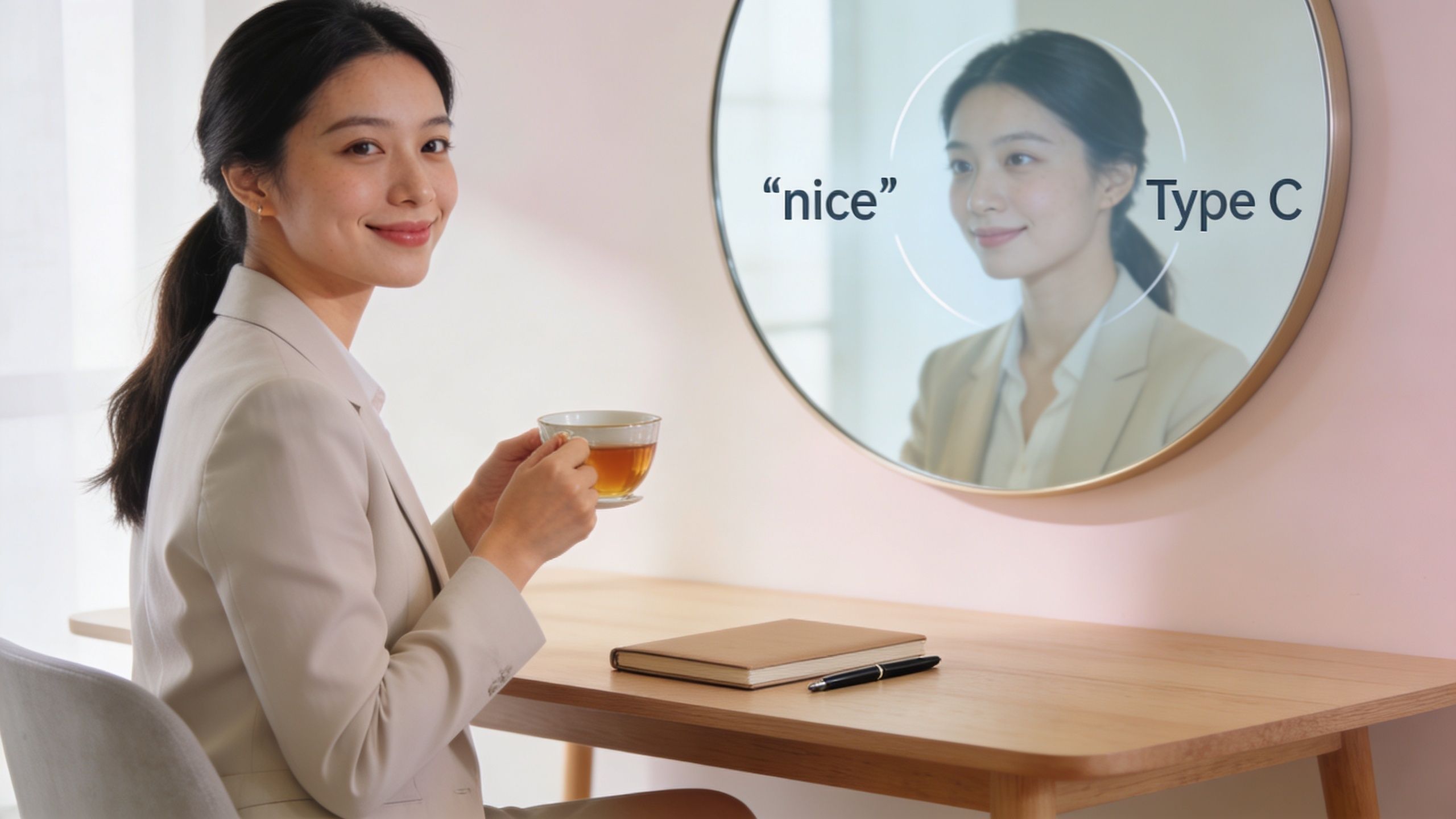
Some people are known as the dependable one in every room. They remember birthdays, finish tasks carefully, avoid arguments, and say “it’s fine” even when they’re running on empty.
If that sounds familiar, you may relate to the type c personality pattern. This isn’t a diagnosis, and it isn’t a box you have to live inside. It’s a useful way to understand why a kind, capable person can still feel drained, anxious, overlooked, or resentful.
Are You The 'Nice One' Who Secretly Feels Drained?
You agree to help a colleague, even though your own work is piling up. At home, you keep the peace during a family discussion by staying quiet. A friend asks for one more favour, and you say yes before checking how tired you already feel.
On the outside, people may describe you as calm, thoughtful, polite, and mature. On the inside, you may feel pressure, frustration, guilt, or loneliness that rarely gets spoken aloud.

Many people who relate to the type c personality don’t look distressed in obvious ways. They often function well, meet expectations, and stay responsible. That’s one reason their stress can go unnoticed by others, and sometimes even by themselves.
What this can look like in daily life
Riya is excellent at work. She checks details, meets deadlines, and rarely complains. Her manager trusts her. Her family sees her as sensible. Her friends call her supportive.
But Riya also struggles to say no. She avoids difficult conversations, tells herself not to be “too sensitive”, and keeps going even when she feels exhausted. Over time, that constant self-control can turn into workplace stress, fatigue, irritability, and a sense that nobody really sees how hard she’s trying.
You can be kind and capable, and still need rest, boundaries, and emotional support.
If you’ve been wondering why you feel worn down despite “doing everything right”, this pattern may help you make sense of it. It offers language for something many people experience but rarely name.
Why this matters for well-being
When someone keeps their feelings tightly managed for a long time, the body often carries part of the load. If tiredness has become part of your routine, these holistic insights on stress and fatigue can help you think about the connection between emotional strain and physical depletion.
The most important thing to remember is simple. You’re not weak. You’re not “too much”. You may have learned to survive by being the steady one, and now your mind and body might be asking for a gentler way to live.
What Is the Type C Personality?
The experience of a type c personality can be confusing because the outside and inside do not always match. A person may look calm, capable, and easy to work with, while privately carrying stress, disappointment, or resentment they have learned not to show.
In psychology, Type C is usually described as a personality style marked by conscientiousness, self-control, cooperation, emotional restraint, and a strong tendency to avoid conflict. Some researchers also connect it with suppressing difficult feelings and putting harmony ahead of self-expression (overview of Type C behaviour patterns and health psychology).

Calm on the surface, pressured underneath
Many people with this pattern become skilled at keeping things together. They may smile during tension, stay polite during criticism, and tell themselves to “adjust” instead of speaking openly. From the outside, that can look like maturity. On the inside, it can feel like holding a heavy bag for so long that your arm goes numb and you forget how much weight you are carrying.
This pattern can be especially common in Indian homes, schools, and workplaces where being respectful, accommodating, and family-oriented is often praised. Those values can be meaningful and grounding. But if you were taught that anger is disrespectful, saying no is selfish, or family peace matters more than personal comfort, you may have learned to silence yourself too well.
How it differs from Type A and Type B
People often hear about Type A and Type B first, so it helps to place Type C beside them.
- Type A is linked with urgency, competitiveness, and visible intensity.
- Type B is linked with a more relaxed, flexible style.
- Type C is more often linked with patience, precision, agreeableness, and holding emotions in.
These are broad personality patterns, not fixed boxes. Human beings are more complex than labels, and many people show a mix of traits depending on the situation.
Strengths that often get overlooked
This personality style comes with real strengths. Type C individuals are often dependable, thoughtful, careful with details, and sensitive to other people’s needs. In families, they may become the peacemaker. At work, they are often the person who notices errors, follows through, and keeps standards high.
That reliability is one reason Type C traits may be misunderstood in professional settings. A manager may see someone as “easy to work with” because they do not argue. A partner may assume everything is fine because there are no open fights. In reality, silence is not always comfort. Sometimes it is self-protection.
For readers who are curious about how personality frameworks get used in professional settings, this piece on behavioral assessments for hiring managers gives wider context on how structured personality tools are approached. It’s useful background, especially if you’re trying to separate self-reflection from labelling.
What this term can and cannot tell you
Type C is best understood as a pattern, not a diagnosis. It can help explain why some people over-manage emotions, avoid confrontation, or feel responsible for keeping everyone else comfortable. It cannot tell you everything about your mental health, your future, or your worth.
If this description feels familiar, try reading it as information, not judgment. The goal is not to label yourself as “too passive” or “too nice.” The goal is to notice a pattern with compassion, especially if that pattern has shaped your relationships, your stress levels, or your experience at work in ways other people have missed.
A Simple Checklist to See If You Relate
This checklist is for self-reflection only. It is not a diagnosis, and it doesn’t replace therapy, counselling, or a formal mental health assessment. You don’t need to “score” yourself. You’re noticing patterns.
Type C self-reflection checklist
| Statement | This feels familiar |
|---|---|
| I often put other people’s needs before my own, even when I’m tired. | Yes / No / Maybe |
| I stay quiet during disagreements to keep the peace. | Yes / No / Maybe |
| I find it hard to say no without feeling guilty. | Yes / No / Maybe |
| I try to stay calm on the outside, even when I’m upset inside. | Yes / No / Maybe |
| I spend a lot of time thinking through details and possible problems. | Yes / No / Maybe |
| I worry about making mistakes or disappointing others. | Yes / No / Maybe |
| I prefer solving problems logically rather than talking about feelings. | Yes / No / Maybe |
| I often feel responsible for keeping things smooth in relationships or at work. | Yes / No / Maybe |
| I delay difficult conversations because I don’t want conflict. | Yes / No / Maybe |
| I sometimes feel unseen, even though I do a lot for others. | Yes / No / Maybe |
How to read your answers
If several of these felt familiar, you may relate to the type c personality style. That doesn’t mean anything is “wrong” with you. It means your care for others, self-control, and high standards may come with a hidden emotional cost.
A helpful question is not “Do I have this type?” but “Which of these habits support my well-being, and which ones leave me drained?”
- If you recognised only a few items, you may share some traits without strongly identifying with the pattern.
- If many items felt very familiar, it may be worth paying closer attention to your stress, boundaries, and emotional expression.
- If these patterns are affecting sleep, relationships, mood, or daily functioning, therapy or counselling could help you build healthier ways to cope.
The checklist is meant to increase self-understanding, not self-criticism.
Some people feel relief when they see their inner experience named. Others feel uncertain because they’ve spent years being “the stable one”. Both reactions are normal.
How Type C Traits Affect Your Health and Relationships
You may be the person everyone relies on. At home, you smooth over tension before dinner gets uncomfortable. At work, you say, “It’s fine, I’ll handle it,” even when your body is asking for rest. From the outside, you look steady. On the inside, you may feel stretched thin.
That hidden strain is often the hardest part of a type c pattern. The stress does not disappear because it is contained. It often shifts shape.
When feelings like anger, sadness, hurt, or disappointment are pushed down again and again, the body can start carrying what the voice does not express. For some people, that shows up as headaches, poor sleep, fatigue, stomach discomfort, irritability, or a sense of emotional flatness. It can feel confusing because you are still functioning, yet something in you feels heavy.

The health side of emotional suppression
Emotions work a bit like pressure in a closed container. If there is no safe release, the pressure does not vanish. It builds and affects the whole system.
Research on emotional suppression has linked this coping style with poorer psychological well-being and higher stress burden, especially when people regularly inhibit negative emotions rather than processing them (review of emotional suppression and mental health effects). That does not mean a reserved or agreeable person is destined for illness. It means your emotional life is part of your health, just like sleep, food, and rest.
Many people with this pattern minimise their distress because they have learned to prize self-control. They tell themselves, “Other people have it worse,” or “There’s no point making an issue of this.” Over time, that habit can make real suffering harder to notice.
How stress builds under the surface
Type C traits often look admirable. You endure. You stay polite. You keep meeting responsibilities.
The problem is that endurance can hide overload, both from other people and from you.
Support often gets delayed until anxiety, burnout, or low mood has become hard to ignore. A person may seek help only after months of poor sleep, frequent tears, snapping at loved ones, or feeling detached from things that once mattered.
Common signs this pattern may be affecting your well-being include:
- Constant physical tension: Your shoulders, jaw, stomach, or chest rarely feel fully relaxed.
- Feelings that linger: You tell yourself to move on, but the hurt stays in your body and thoughts.
- Silent burnout: You are still managing daily tasks, but your patience, energy, and sense of pleasure keep shrinking.
- Low mood: You may not call it depression, yet you feel flat, hopeless, or emotionally exhausted.
Coping for a long time can hide how much you have been carrying.
How relationships become draining
In relationships, this pattern often shows up as over-adjusting. You say yes before checking what you feel. You avoid difficult conversations because harmony feels safer than honesty. You give care generously, but asking for care back feels uncomfortable.
At first, other people may describe you as easygoing, mature, or selfless. Over time, the relationship can become uneven. One person keeps adapting. The other may never fully see the cost.
Resentment then grows under the surface. It often sounds like, “Why do I always have to understand?” or “Why does no one notice I’m tired too?” Many Type C individuals feel guilty for having these thoughts, which makes them suppress even more. That creates a painful loop.
Why this can feel stronger in Indian families and partnerships
Indian cultural values often place real importance on respect, duty, family harmony, and sacrifice. Those values can offer belonging and stability. They can also make emotional self-silencing look like goodness.
In marriages, one partner may keep adjusting to avoid being seen as difficult. In joint families, a person may swallow hurt to maintain peace with elders. Women are often praised for endless caregiving. Men are often taught that vulnerability weakens their authority. In both cases, emotional restraint gets rewarded, even when it causes private distress.
This is why some Type C struggles are missed for years. The behaviour fits what the family or workplace expects, so the exhaustion underneath is treated as normal.
What healthier connection looks like
Healthy relationships do not require you to become harsh, confrontational, or dramatic. They ask for something simpler and harder. Truth.
That may mean saying, “I need time to think before I agree.” It may mean telling a spouse, “I’ve been handling too much alone.” It may mean letting a parent feel disappointed without rushing to erase their discomfort.
A useful goal is balance, not rebellion. Care for others matters. Care that always leaves you depleted does not. When your feelings, limits, and needs have space in a relationship, closeness becomes more genuine and much less tiring.
Type C Challenges in the Indian Workplace
At work, the type c personality often brings real strengths. These individuals tend to be careful, organised, and committed to doing things properly. They often notice errors others miss and take quality seriously.
That makes them valuable in roles that involve analysis, systems, research, quality checks, and risk awareness. Some descriptions of this style also note strong analytical processing and perfectionist standards, along with difficulty when decisions must be made in ambiguity or under rapid change (overview of analytical strengths and workplace vulnerabilities).
When a strength becomes a hurdle
The same traits that support excellence can also create strain.
If you think carefully before speaking, others may mistake you for lacking confidence. If you focus on accuracy, people may not notice how much invisible labour you’re doing. If you dislike self-promotion, louder colleagues may appear more “leadership ready” even when your work is stronger.
Research and commentary on overlooked personality types note that Type C individuals can be seen as too reserved, may miss out on recognition due to passive traits, and may struggle with assertiveness. In competitive Indian workplace hierarchies, where vocal self-promotion is often rewarded, this can lead to being overlooked for career advancement despite high competence (discussion of career invisibility and passive traits at work).
What this looks like in real offices
You may recognise one or more of these patterns:
- You do excellent work, but someone else presents it louder.
- You hesitate to speak in meetings unless you’re fully prepared.
- You accept extra tasks because saying no feels uncomfortable.
- You overthink before sending an email, making a proposal, or taking a decision.
- You feel intense workplace stress during unclear changes, shifting roles, or vague expectations.
Quiet competence deserves recognition. But many workplaces notice visibility before they notice depth.
Why Indian workplaces can feel especially hard
Many Indian professionals work within layered hierarchies. Respect for authority can be important. So can presentation, confidence, and relationship management.
For someone with type c personality, that creates a double demand. You’re expected to be reliable and precise, but also visible, persuasive, and comfortable advocating for yourself. If that doesn’t come naturally, work can feel emotionally expensive.
This can affect more than promotions. It can shape self-esteem, motivation, and mental health. A person may start believing, “Maybe I’m not leadership material,” when the underlying issue is often style mismatch, not lack of ability.
A balanced way to see your work self
Your reserve is not incompetence. Your caution is not weakness. Your thoughtful pace can be an asset.
At the same time, some habits may need updating if they’re costing you recognition or peace of mind. In many cases, growth means learning how to pair competence with visibility, and care with clear limits.
Building Resilience and Finding Your Voice
You agree to one more family obligation, one more office task, one more request to “adjust.” By the end of the day, nothing looks dramatic from the outside. Inside, though, your chest feels tight, your mind is tired, and a quiet thought keeps repeating. “Why does it feel so hard to be the good person all the time?”
That inner strain deserves care.
Resilience, in this context, means staying connected to yourself while you care for others. It is less like becoming harder and more like becoming steadier. A bamboo plant is a useful comparison here. It bends in strong wind, but it also stays rooted. Your goal is not to stop being thoughtful or considerate. Your goal is to stay rooted in your own needs, limits, and feelings.
Small shifts that make a difference
Many people with Type C patterns try to change all at once, then feel guilty when it does not last. A gentler approach usually works better. Small behavioural changes give your nervous system proof that honesty can be safe.
Name the feeling before you explain it away
Type C individuals often move straight into analysis. “It’s fine.” “Maybe I’m overreacting.” “There’s no point making an issue of it.”
Pause and use plain words first. “I feel dismissed.” “I feel pressured.” “I feel hurt.”
This is not self-indulgent. It helps your mind and body register what is happening.Practise one clear sentence each day
Assertiveness can feel unnatural if you were praised for being easy-going, especially in families or workplaces where harmony is valued. Start with one sentence that is respectful and direct.
“I’m not available today.”
“I need time to think about that.”
“I’m not comfortable with this plan.”
Short sentences often work better than long explanations.Create a pause before saying yes
Many Type C people answer quickly to avoid discomfort. That habit can look polite, but it often leads to resentment and exhaustion.
Try a holding sentence instead. “Let me check my schedule.” “I’ll confirm by evening.”
That pause works like a small gate. It gives you time to choose, instead of reacting from guilt.Choose clarity over perfection
Perfectionism can make even simple communication feel heavy. You may spend too long polishing a message, rehearsing a conversation, or waiting for the ideal moment.
In real life, clear and timely communication usually protects relationships better than perfect wording.
Finding your voice in Indian family and work settings
For many Indians, “speaking up” is not only a personal skill issue. It is tied to respect, age, gender roles, hierarchy, and the fear of being seen as rude or difficult. That is why generic advice such as “just be confident” often falls flat.
A more realistic goal is respectful firmness.
At work, that may sound like, “I can finish this by Friday if this becomes the top priority.” With family, it may sound like, “I want to help, and I also need rest tonight.” In a marriage or partnership, it may be, “I have been carrying a lot on my own. I want us to discuss how to share this better.”
These are not aggressive statements. They are honest statements. There is a difference.
Helpful reminder: A boundary is a clear line, not a punishment.
When therapy or counselling can help
Sometimes these patterns are so familiar that they feel like personality, duty, or culture itself. Therapy can help you separate what matters to you from what you learned to do for approval, safety, or peace.
Structured support is often especially helpful for people who are reflective, self-controlled, and used to solving problems through logic. Approaches such as cognitive behavioural therapy can help you notice hidden beliefs, reduce guilt around saying no, and practise healthier responses in a concrete way. The American Psychological Association describes CBT as a practical, skills-based approach that focuses on patterns of thinking and behaviour and how to change them in daily life (overview of cognitive behavioral therapy from the American Psychological Association).
Therapy can help you:
- notice suppressed emotions before they show up as burnout or physical stress
- reduce guilt around rest, limits, and saying no
- speak more clearly in close relationships
- handle anxiety, low mood, and workplace pressure
- build self-compassion without losing your sense of responsibility
- redefine success in a way that includes peace, not only performance
You do not have to wait for a crisis. Support can be useful when you feel chronically drained, unseen in relationships, or unable to express what you need without fear.
A deep shift often begins with one new question. Instead of asking, “How do I keep everyone comfortable?” you begin asking, “How do I stay honest, kind, and mentally well?”
That question can change a life.
If this article felt uncomfortably familiar, you don’t have to figure it out alone. DeTalks helps people across India connect with qualified therapists and counsellors, explore science-backed assessments for self-understanding, and find support for anxiety, depression, workplace stress, relationship struggles, burnout, and well-being. If you’re ready to understand your patterns with more clarity and compassion, it can be a supportive place to begin.