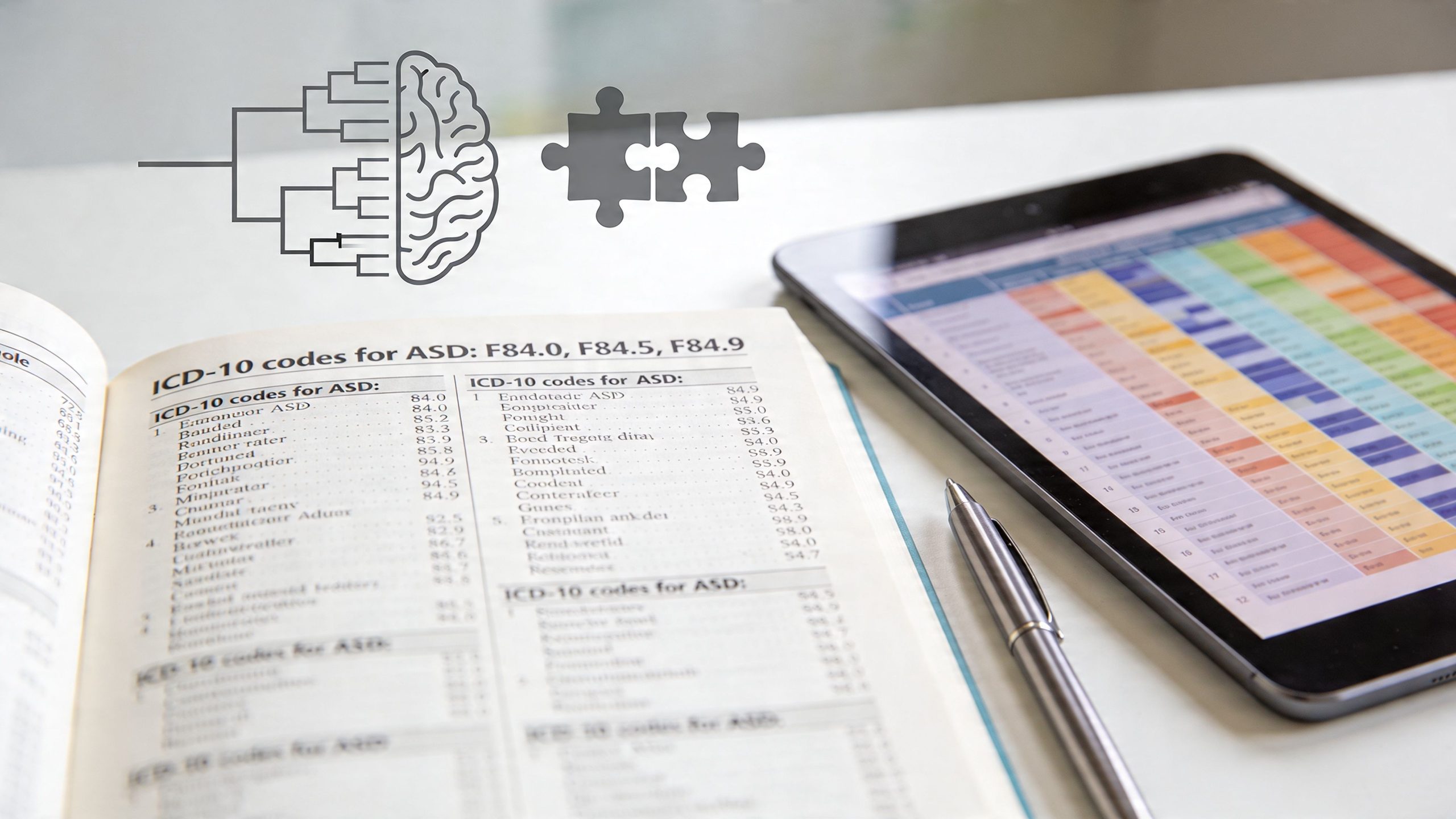
TL;DR: The most common icd 10 code for asd is F84.0, which denotes Autistic Disorder under the Pervasive Developmental Disorders (F84) category. In India, clinicians use this code for diagnosis, treatment planning, and insurance-related documentation.
You might be here because you saw F84.0 on a report and felt your stomach drop. Many parents, adults, and even teachers have that same moment of confusion. A code can look cold, but behind it is a practical tool that helps people access therapy, counselling, support, and a clearer plan for well-being.
For some families, the first question is, “What does this mean for my child?” For adults, it may be, “Will this affect work, relationships, anxiety, or the kind of help I can receive?” Those are valid questions. A diagnosis code doesn't tell the whole story of a person, but it can help organise care in a way that is easier to communicate across clinics, schools, hospitals, and insurers.
If you're already feeling stressed, burnt out, or worried about the future, take this one step at a time. Understanding the code is often the first move towards better support, not a reason to panic.
Decoding the Diagnosis Your Guide to Understanding ASD Codes
A parent receives a developmental report after months of appointments. Near the end, there it is: F84.0. The words may feel unfamiliar, and the fear often comes from not knowing whether this is just paperwork or something that changes daily life.
In practice, it is both administrative and meaningful. A code helps clinicians record a diagnosis in a standard way, so different professionals can understand the same clinical picture without rewriting everything from scratch.
That standard language matters when you move between a paediatrician, a psychiatrist, a clinical psychologist, a school counsellor, or a hospital desk handling reimbursement. If you want a simple primer on how this system works more broadly, this guide to understanding medical coding gives helpful context.
A medical code is not a judgement about character, intelligence, or future potential. It is a shared clinical label used to organise care.
Many readers get stuck on one common misunderstanding. They assume a code itself is the diagnosis process. It isn't. The code is the final shorthand that appears after clinical evaluation, developmental history, observation, and professional judgement.
Another point of confusion is emotional. People often worry that once a code appears, the person gets reduced to that label. Good therapy and counselling should do the opposite. It should use the diagnosis to support communication, reduce anxiety, build resilience, and improve day-to-day well-being at home, in school, and later at work.
Quick Reference for Common ASD Codes
Some reports mention a broader F84 family rather than only one code. This family sits under Pervasive Developmental Disorders in ICD-10, and older records may use several related entries.
Here is a simple quick-look table you can return to if you've seen one of these codes.
ICD-10 Codes for Pervasive Developmental Disorders (F84)
| Code | Official Name | Simple Explanation |
|---|---|---|
| F84.0 | Autistic Disorder | The main code commonly used for autism-related diagnosis in ICD-10. |
| F84.1 | Atypical Autism | Used when the presentation does not fully match the pattern expected for F84.0. |
| F84.2 | Rett syndrome | A separate neurodevelopmental condition listed within the same F84 group. |
| F84.3 | Other childhood disintegrative disorder | Used for a rare pattern involving marked developmental regression. |
| F84.5 | Asperger's syndrome | A historical ICD-10 label that many people still recognise from older reports. |
| F84.9 | Pervasive developmental disorder, unspecified | Used when the clinician documents a broader developmental picture without a more specific F84 code. |
How to read this table calmly
You don't need to memorise every code. Generally, you only need to recognise the one on your own report and understand why it was chosen.
If your report uses an older label like F84.5 or a less specific one like F84.9, that doesn't automatically mean anything is wrong with the assessment. Sometimes it reflects the time the report was written, the setting, or how much information was available at that stage.
Practical rule: Ask the clinician, “Which code are you using for records, and what does it mean for therapy, school support, or insurance?”
Deep Dive into F84.0 Autistic Disorder
A parent in India may leave an assessment with a short code on paper and a long list of questions in mind. If your report says F84.0, the code can feel impersonal at first, but in real life it often becomes the starting point for therapy planning, school conversations, and a clearer understanding of your child.

In ICD-10 records, F84.0 refers to Autistic Disorder. Many people today use the broader term Autism Spectrum Disorder (ASD) in everyday conversation, but older medical records, insurance forms, and institutional paperwork may still show F84.0. The code works like a filing label. It does not describe your child’s full personality, strengths, or future.
What clinicians usually mean is a developmental pattern that affects social communication and includes restricted or repetitive behaviours or interests. These signs begin early, even if they are understood much later. A family may first notice differences in eye contact, back-and-forth interaction, response to name, play style, sensory comfort, or a strong need for routine.
Some adults recognise this pattern only after years of feeling different without having words for it. That can bring relief, grief, clarity, or all three at once.
In the source already cited here, the overview of F84.0 and autism coding in India states that ASD prevalence is about 1 in 100 children, reports that a 2023 ICMR study noted over 1.5 million children under 14 diagnosed with ASD, with F84.0 used in 85% of cases, and says the code became billable under Ayushman Bharat in 2018. Even more important than the numbers is what families do with the diagnosis after it appears on a report.
That is the human side of coding. A diagnosis code often helps open doors to speech therapy, occupational therapy, behavioural support, parent training, school documentation, and mental health care for stress or anxiety that may build around daily struggles. In the Indian context, where families often have to explain a child’s needs across doctors, schools, and relatives, a clear code can reduce confusion and make those conversations easier.
Older reports may also pair F84.0 with terms such as autistic disorder, infantile autism, or Kanner's syndrome. This can sound alarming if you are comparing documents from different years. Usually, it reflects older classification language rather than a sudden change in the person themselves.
So if you see F84.0, read it as one part of the picture. The fuller picture includes how the person communicates, learns, copes with sensory demands, builds relationships, and grows with the right support.
Understanding Other Related F84 Codes
A parent may open an older school report and see F84.5 Asperger's syndrome, then hear a newer clinician say autism spectrum disorder. That can feel like the ground has shifted. In many cases, the person has not changed. The language in the paperwork has.

ICD-10 placed several developmental presentations under the F84 group. You can think of this group as a family of related labels used in medical records. Some of these terms still appear in India in older files, hospital notes, disability paperwork, or records carried forward from one clinic to another.
Two codes often cause confusion.
F84.5 refers to Asperger's syndrome, a term many adolescents and adults still know well.
F84.9 refers to pervasive developmental disorder, unspecified, which means the record noted a broader developmental concern but did not pin it down to a more specific F84 code.
That difference matters in everyday life. A school, insurer, therapist, or government office may focus on the code printed on the document, while the family is focused on the child's real needs. If the wording looks different across reports, people may worry that services will stop or that the earlier diagnosis was somehow "wrong." Usually, the variation reflects older classification habits, the stage of assessment, or the level of detail recorded at that time.
A simple comparison
| Code | What people often recognise | What it means in plain language |
|---|---|---|
| F84.0 | Autistic Disorder | The specific ICD-10 autism diagnosis used in many records |
| F84.5 | Asperger's syndrome | An older label that many people still identify with |
| F84.9 | PDD unspecified | A broader entry used when the description was less specific |
A practical way to read these codes is to treat them like file labels on the same cupboard. The label may change over time, but the goal stays the same. Understanding the person's communication style, sensory profile, learning needs, and daily supports.
Older terminology may be outdated clinically, yet still feel meaningful personally. Both realities can exist together.
This can be especially important in the Indian context, where families often have to explain the same child to a paediatrician, a speech therapist, a school coordinator, and extended relatives. Clear interpretation of older F84 codes helps reduce avoidable panic and keeps attention where it belongs. Accessing support, planning therapy, and helping the person build confidence and resilience.
ICD-10 vs DSM-5 A Practical Comparison for India
Many people in India hear two systems mentioned in the same month. A hospital record may use ICD-10, while a private psychologist may speak in DSM terms. That can feel contradictory, especially when a family is already dealing with uncertainty, anxiety, or decision fatigue.

The practical difference
In India, the healthcare system officially uses ICD-10, but many private practitioners use DSM-5-TR language in assessment and discussion. According to this clinician-focused guide on ICD-10 and DSM use for autism, this mismatch can affect insurance reimbursement and access to services, and coding inaccuracies can lead to billing denials and delays.
So the issue isn't which book is “better.” The key issue is whether the code on the formal paperwork matches the system required by the service, insurer, hospital, or institution you're dealing with.
What to ask your clinician
If you're unsure, ask direct questions:
- Which system is on the report: ICD-10, DSM-5-TR, or both?
- Which code will appear on insurance paperwork: This matters for reimbursement processing.
- Will the treatment plan use the same terminology: Consistency helps schools, employers, and allied professionals understand the report.
A short explainer may help if you'd rather watch than read:
Why this matters emotionally too
When language changes between professionals, families sometimes worry that the diagnosis itself has changed. Often, it hasn't. The underlying clinical understanding may be similar, while the administrative language differs.
That said, paperwork details do matter. If you're applying for therapy support, reimbursement, or workplace documentation, it's reasonable to ask for a clear written explanation in plain language.
Common Co-occurring Conditions and Their Codes
A parent may come in asking about speech delay or repeated meltdowns, then leave realizing the picture is a little wider. Autism can sit alongside other conditions that affect sleep, attention, mood, learning, or physical health. That does not make the child "more broken" or the diagnosis more frightening. It means the clinician is trying to describe the person more accurately, so support can fit real life.

Why more than one code may appear
A diagnosis code works a bit like a case file label. F84.0 may identify autism, while another code records a condition that also needs attention, such as epilepsy (G40) or ADHD (F90). In practice, this helps the paediatrician, psychiatrist, psychologist, therapist, and school team see the same needs on paper.
For many families in India, this matters beyond the clinic. A child may need speech therapy and behaviour support. A teenager may need help for anxiety that is making school attendance harder. An adult may seek care for burnout or depression before anyone recognizes autistic traits clearly. If the record captures only one part of the story, referrals can become less precise and treatment can miss daily struggles that are very real.
Common examples clinicians may code separately
- ADHD with ASD: Attention and impulsivity can affect classroom learning, routines, and how therapy sessions are paced.
- Epilepsy with ASD: Seizure care may require regular medical follow-up and coordination between specialists.
- Sleep problems: Poor sleep can increase irritability, distress, and exhaustion across the whole family.
- Phobias or anxiety symptoms: Fear responses may affect school, travel, medical visits, or social participation.
- Depression or chronic stress: Older children, teens, and adults may need mental health support alongside autism-related care.
A useful way to read multiple codes is this. One code names the neurodevelopmental profile. Another names barriers that may be getting in the way of learning, comfort, safety, or emotional well-being.
Good coding supports whole-person care. It helps the therapist, doctor, school, and family work from the same map.
This also has a human side that paperwork often hides. Families are often not asking for a code for its own sake. They are trying to get the right therapy, explain a child's needs to a school, reduce day-to-day stress at home, and build resilience over time. Clear coding cannot solve everything, but it can make it easier to ask for support that matches the person's actual challenges.
How ASD Codes Impact Therapy and Financial Support
A diagnosis code may look like a technical detail, but it often decides whether support moves smoothly or gets stuck in paperwork. Families in India commonly discover this when applying for insurance reimbursement, disability-related documentation, or school accommodations.
Correct coding matters because service systems need specificity. If a hospital, insurer, school administrator, or rehabilitation office asks for a recognised diagnosis entry, vague or inconsistent documentation can slow things down. That can increase stress in households already carrying emotional and financial pressure.
Where coding affects daily life
The impact often shows up in practical areas:
- Therapy access: A clear diagnosis can support referrals for speech, occupational therapy, behavioural intervention, or counselling.
- Documentation for benefits: Administrative systems usually require standard diagnostic language.
- School and workplace understanding: Formal records can support conversations about accommodations and support needs.
For families trying to understand disability-related documentation beyond India, it can also help to see how other systems approach proof and eligibility. This guide on how to qualify for the Disability Tax Credit in Canada is a useful example of how formal records connect to financial support in another country.
Why emotional support matters during the paperwork stage
Administrative tasks can trigger anxiety, especially when you're also coping with a new diagnosis, family disagreement, sleep loss, or work strain. Some parents feel guilty for focusing on forms when they want to focus on their child. Some adults feel exposed when they need documentation for workplace support.
Both reactions are understandable. This is one reason counselling can be helpful even outside the core ASD treatment plan. Support for caregiver stress, depression, burnout, and resilience often makes the practical side more manageable.
Beyond the Code Building Resilience and Well-being
A code can open doors, but it doesn't define a person's identity, relationships, or future. Once the clinical language is understood, the focus can shift to daily living, communication, strengths, and emotional balance.
Many people feel a mix of relief and grief after getting clarity. Relief because there is finally an explanation. Grief because they may be thinking about missed support, school struggles, social pain, or years of self-doubt.
What healing often looks like
It may involve therapy for anxiety, counselling for parents, support for depression, or tools to reduce workplace stress in autistic adults. It may also involve practical changes such as sensory adjustments, clearer routines, kinder communication, and more realistic expectations.
Positive psychology has a place here too. Resilience doesn't mean pretending things are easy. It means building skills, self-understanding, compassion, and supportive environments that make life feel more workable and more meaningful.
The code is a starting point for understanding. It is not the whole person.
When care is respectful and well matched, people can build confidence, healthier relationships, and greater well-being. Some need intensive support. Some need only a few targeted changes. In both cases, progress usually starts with being understood accurately and treated with dignity.
When to Consult a Professional or Use DeTalks
If you suspect ASD in yourself or someone you care about, speak with a qualified mental health professional or medical specialist. A formal diagnosis should come from a clinician such as a psychiatrist or clinical psychologist after proper evaluation.
If you already have a report but don't understand the code, ask for a plain-language explanation. You can also seek a second opinion if the wording is unclear or if treatment planning doesn't match the person’s real needs.
Use assessments carefully. Screening tools can offer insight, but they are informational, not diagnostic. They can help you notice patterns and prepare for a professional conversation, especially if anxiety, depression, stress, burnout, or social difficulties are also present.
If you're looking for a therapist, counsellor, or psychologist, choose someone who can explain both diagnosis and support in a respectful, practical way.
Frequently Asked Questions About ASD Coding
Will this code stay private
Medical information is generally handled within professional and administrative systems, but you should still ask who can access the report, where it will be shared, and whether you can receive a summary version for school or work.
Does an ASD code mean the future is fixed
No. A code helps describe support needs. It doesn't predict a person's full path, happiness, resilience, relationships, or capacity to grow.
Should I tell school, family, or my employer
Share it only when it serves a purpose, such as getting support, reducing misunderstanding, or arranging accommodations. If the conversation feels difficult, a therapist or counsellor can help you prepare what to say.
Are online assessments enough
No. They can be helpful for reflection, but they are informational, not diagnostic. A diagnosis requires professional evaluation.
If you're looking for trusted mental health support, DeTalks can help you find therapists, psychologists, and counsellors across India for concerns ranging from autism spectrum challenges to anxiety, depression, burnout, workplace stress, and relationship difficulties. The platform also offers psychological assessments for self-insight, but remember that these tools are informational and meant to guide your next step, not replace a formal diagnosis.