
A couple can share a home, manage demanding jobs, and still feel alone in the same room. Repeated arguments about money or household responsibilities may sit alongside emotional distance, anxiety, depression, burnout, or workplace stress that follows one or both partners home. The problem may look like communication, but the underlying pattern could involve attachment fears, unhelpful thoughts, grief, family expectations, or protective reactions.
That's why the best couples therapy isn't one universal method. It's the approach and qualified therapist that fit your shared goals, safety needs, cultural context, language preferences, time, and willingness to participate. India-focused service data reflects a meaningful demand for this support. In a NIMHANS-linked relationship-help dataset from Parivarthan, 21% of clients used couple services, while relationship problems accounted for 39% of presenting concerns. The Parivarthan and NIMHANS-linked dataset also describes differences in previous counselling experience and counsellor preferences.
Below are eight established approaches, compared by relationship pattern, emotional challenge, time commitment, and type of support. Any self-assessment or screening tool is informational, not diagnostic. If there's immediate danger, coercive control, severe depression, serious anxiety, trauma-related symptoms, or thoughts of self-harm, individual specialist or psychiatric care may be needed alongside, or before, couples counselling.
1. Emotionally Focused Therapy for Couples
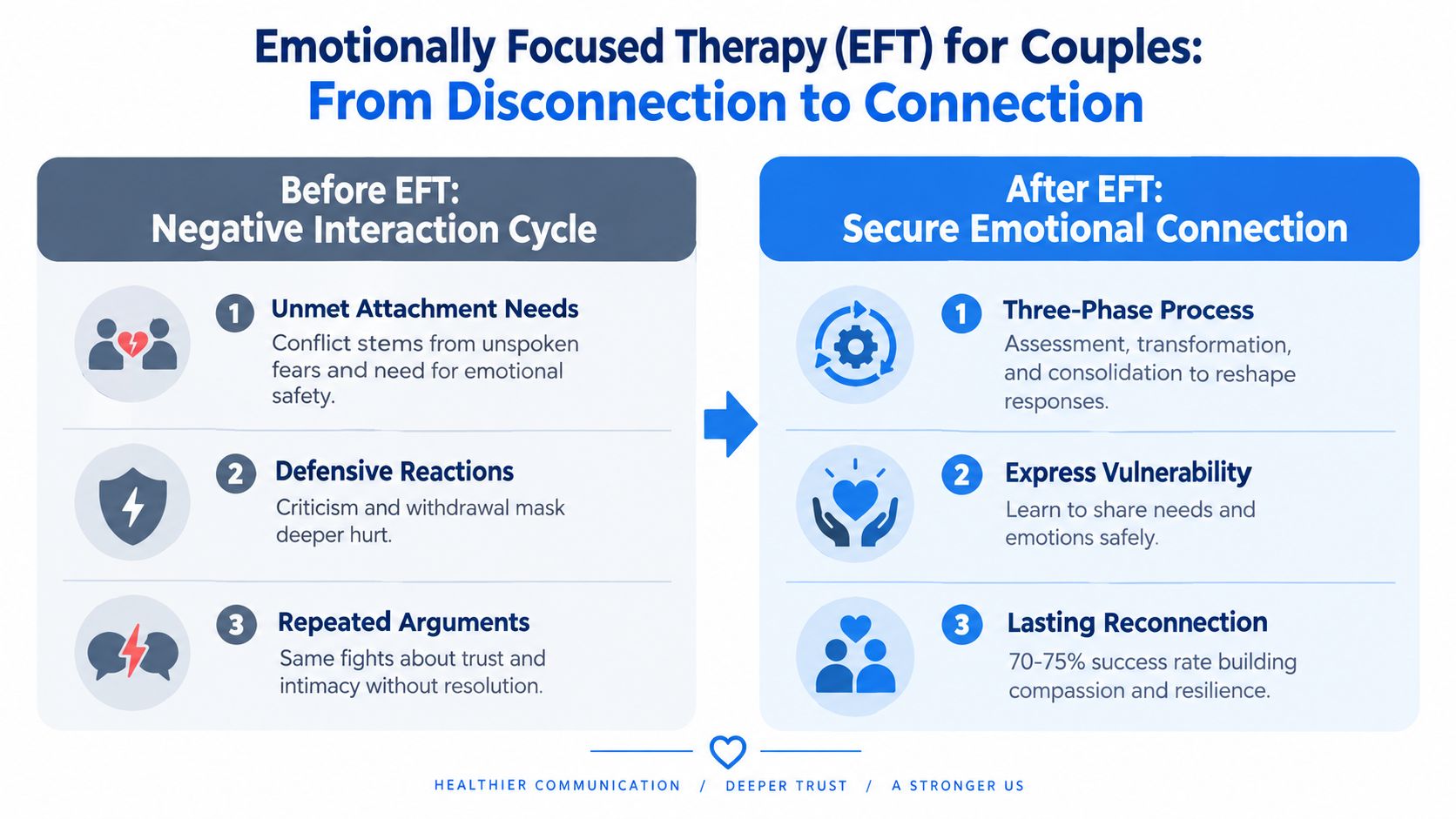
Emotionally Focused Therapy, often called EFT, is a strong fit when partners keep having the same argument but can't explain what they're really asking for. One person criticises, the other withdraws, the first becomes more distressed, and both leave the conversation feeling rejected. EFT helps the couple identify that cycle and express the deeper emotions and needs beneath the visible conflict.
Developed by Dr. Sue Johnson, the approach focuses on emotional responsiveness and attachment. A complaint such as “You never help me” may conceal “I feel unsupported and unimportant.” A retreat such as “I don't want to talk” may conceal “I'm afraid I'll fail you or make things worse.” Translating these reactions into clearer needs can reduce blame and create room for compassion.
Best suited to emotional disconnection
EFT may suit couples facing repeated arguments, loss of intimacy, or a painful rupture such as infidelity. For example, partners arguing about household responsibilities might learn to replace criticism with a direct request for support and appreciation. A long-married couple that feels emotionally distant may use structured vulnerability to reconnect, while partners rebuilding after betrayal may need a carefully paced process for trust and emotional safety.
The approach requires both partners to tolerate emotional honesty. It can feel uncomfortable for someone who prefers practical problem-solving or finds vulnerability unsafe. It may also need to be adapted when active violence, coercion, or untreated severe symptoms make joint emotional work unsafe.
Practical rule: Notice the defensive reaction, then ask what hurt, fear, or unmet need might be underneath it.
Between sessions, couples can practise softer language, schedule brief emotional check-ins, and observe whether emotional change appears before visible behavioural change. A therapist trained in EFT should guide this work rather than asking partners to force vulnerability on their own.
2. The Gottman Method
The Gottman Method suits couples who want a practical structure for conflict, friendship, intimacy, and shared meaning. Instead of assuming that every disagreement must be solved, it helps partners manage differences without damaging respect or emotional connection. That distinction matters for couples dealing with ongoing work demands, parenting pressure, or different personalities and priorities.
The method is associated with Dr. John Gottman and Dr. Julie Gottman. Sessions and exercises commonly focus on recognising destructive communication habits, making repair attempts, strengthening fondness and admiration, and discussing the values and life purposes that hold a partnership together.
A useful choice for busy working couples
Consider two professionals whose workplace stress spills into evenings at home. One arrives tense and becomes critical about dinner or household tasks. The other feels attacked and becomes defensive or withdrawn. Gottman tools can help them pause, repair the interaction, and discuss the practical problem without turning it into a verdict on the whole relationship.
Parents may also benefit from separating logistics from emotional connection. A weekly conversation can cover schedules and family responsibilities, while a separate exchange protects time for affection, appreciation, and shared hopes. Couples can practise identifying the “Four Horsemen” in their own communication, but the label matters less than the behaviour, criticism, contempt, defensiveness, or stonewalling, that needs changing.
This approach often appeals to people who prefer clear exercises and observable skills. It may feel less emotionally exploratory than EFT or IFS, and couples facing deep trauma, severe depression, or a major safety concern may need additional specialist support. Ask a therapist how they adapt the method to your cultural setting, language, family structure, and work schedule.
3. Cognitive Behavioral Therapy for Couples
Cognitive Behavioral Therapy for couples examines the relationship between thoughts, feelings, and actions. A disagreement can trigger a thought such as “We're incompatible,” which produces anxiety or hopelessness, followed by withdrawal, reassurance-seeking, criticism, or another behaviour that confirms the original fear. CBT helps partners slow this sequence and test whether their interpretation is accurate and useful.
This approach can be particularly relevant when anxiety, depression, burnout, or workplace stress affects the relationship. A partner with workplace anxiety may repeatedly seek reassurance, while the other becomes exhausted and less responsive. A depressed partner may withdraw because daily tasks feel overwhelming, and the withdrawal may then be interpreted as a lack of love.
Best suited to patterns that can be observed and practised
A therapist may use thought records, behavioural experiments, communication training, and structured problem-solving. Partners can record the situation, the automatic thought, the emotion, and the action that followed. They can then consider a more balanced alternative, such as replacing “If we disagree, our relationship is failing” with “Disagreements are part of partnership, and we can learn to handle this one more safely.”
The method can also include behavioural activation. A couple affected by burnout might schedule a short shared activity that feels manageable, rather than waiting for motivation or happiness to return first. That step doesn't erase depression or workplace pressure, but it can interrupt isolation and create evidence that connection remains possible.
CBT works best when partners are willing to practise between sessions. It can feel overly structured to couples who primarily want to explore history, identity, or emotional meaning. It also shouldn't be used to dismiss legitimate concerns, such as financial stress, discrimination, unequal domestic work, or unsafe behaviour, as mere “negative thinking.”
4. Imago Relationship Therapy
Imago Relationship Therapy helps partners explore why they trigger each other so strongly. Associated with Harville Hendrix, it proposes that early experiences can influence what people expect from love, safety, conflict, and care. The value of the approach lies less in proving a single explanation and more in helping partners connect present reactions with old emotional learning.
A partner raised by a highly critical parent may respond to ordinary feedback with shame. Another partner who experienced rejection may pursue reassurance intensely when the first partner goes quiet. Without awareness, each reaction strengthens the other. Imago gives couples a structured way to slow down, listen, mirror what was heard, and validate the partner's perspective without immediately arguing with it.

For couples seeking meaning and deeper listening
The Imago Dialogue can help partners from different cultural or family backgrounds understand why a seemingly small issue feels emotionally large. It may also support conversations about touch, sex, rejection, and safety, provided the therapist keeps the process respectful and trauma-informed. A couple facing workplace stress might use the dialogue to replace evening withdrawal with a compassionate explanation of what the workday activated.
Try a brief version outside therapy. One person speaks about an experience, the other mirrors the content, acknowledges the emotional reality, and asks whether they understood correctly. The speaker then clarifies rather than escalating. The goal isn't perfect agreement. It's a more accurate and humane understanding.
Listen for the wound without turning your partner into your parent.
The approach asks for patience and emotional curiosity. It may not satisfy couples looking for immediate practical decisions about finances or schedules, unless the therapist combines it with problem-solving. A trained practitioner should also avoid making childhood history sound like destiny.
A short educational explanation can help couples decide whether this listening style feels comfortable before booking a consultation.
5. Acceptance and Commitment Therapy for Couples
Acceptance and Commitment Therapy, or ACT, is useful when couples keep waiting for difficult feelings to disappear before they act with care. Anxiety, depression, grief, burnout, and professional pressure can make warmth harder to access. ACT doesn't ask partners to approve of painful experiences or stop wanting change. It asks them to notice internal experiences and choose actions connected to their values.
For a couple in a high-pressure work environment, one partner may become hypervigilant while the other becomes emotionally unavailable. Arguing about who is “right” can keep the cycle going. ACT offers a different question: “How do we want to treat each other while this stress is present?”
Values before mood
Partners can identify values such as kindness, honesty, reliability, playfulness, or family connection. They can then choose a small action that expresses one of those values, even when anxiety or sadness remains. Naming “I notice anxiety” creates some distance from the emotion, while saying “I'm having the thought that my partner doesn't care” creates distance from an assumption.
Couples may practise mindful breathing together, notice each other's presence, or take a short walk without trying to solve the relationship. These exercises can support resilience and well-being, but they're not substitutes for treatment of depression, severe anxiety, trauma, or other complex mental health needs.
ACT can suit partners who dislike arguing about whether a thought is true and prefer learning how to respond differently. It may feel abstract at first, especially for couples who want direct advice about chores, parenting, or finances. A skilled therapist should connect values work to concrete behaviour.
The strongest application is often modest. A couple may agree that, during a tense evening, the value of compassion means speaking without insults and taking a safe pause rather than disappearing without explanation. Repeated value-based actions can support trust even before happiness returns.
6. Narrative Therapy for Couples
Narrative Therapy treats the relationship story as something partners can examine and reshape, not as a fixed description of who they are. Couples often become trapped in identity statements such as “I'm the problem,” “You're impossible,” or “We're incompatible.” These statements compress a complicated relationship into a permanent verdict and leave little room for agency.
The approach externalises the problem. Instead of calling a partner lazy, a couple might explore how burnout, workplace stress, unequal expectations, or family pressure has affected their household partnership. Instead of saying “our marriage is broken” after infidelity, partners might describe betrayal as a serious event that changed the relationship and ask whether rebuilding is something they both want.
Rewriting inherited stories
India-first counselling needs to make space for stories shaped by family roles, community expectations, religion, gender norms, and ideas about duty. A couple from different cultural backgrounds may initially describe difference as evidence that they cannot work. Narrative conversations can help them identify the influence of those inherited expectations and decide which parts fit the partnership they want to create.
The therapist may ask about exceptions, moments when the problem had less influence. When did the couple cooperate during a difficult period? When did one partner show compassion? What allowed that moment to happen? These questions don't deny pain. They help partners see capacities that the conflict narrative has hidden.
Narrative Therapy can be especially helpful for hopelessness, shame, and identity-based conflict. It may feel less direct for couples needing immediate behavioural agreements. Many therapists combine storytelling and re-authoring with communication practice, safety assessment, and practical problem-solving.
A problem can influence a relationship without defining either partner.
Partners can write a shared account of their relationship that includes hardship, repair, humour, values, and strengths. The exercise isn't about creating a falsely positive story. It's about choosing a more complete one, where both people can imagine a next step.
7. Solution-Focused Brief Therapy for Couples
Solution-Focused Brief Therapy, or SFBT, begins with the couple's preferred future and the parts of the relationship that already work. It doesn't require a detailed analysis of every historical conflict. Instead, the therapist asks what improvement would look like, when the problem has been less powerful, and what small change could happen next.
This can suit working professionals, busy parents, or partners facing a defined challenge during a stressful phase. A couple may not have time or energy for long exploratory conversations, but they may be able to make one reliable reconnection ritual, improve a difficult handover with the children, or protect a short period for conversation.
Small changes create useful information
Scaling questions make progress concrete. Partners might describe where the relationship feels today and what would represent a small improvement, without treating the scale as a clinical score or diagnosis. The important question is what action would create that movement, such as a calmer response to a request or a phone-free conversation after work.
A couple experiencing business stress may discover that they connect better on mornings than evenings. That observation can guide a practical experiment. Parents dealing with parenting stress may identify one situation in which they already cooperate and repeat the conditions that made it possible.
SFBT's forward focus can build hope and reinforce positive psychology themes such as resilience, compassion, and happiness. It can also feel too brief or optimistic when partners need careful processing of trauma, betrayal, grief, or longstanding emotional injuries. A therapist should not use solution-focused language to rush a person past valid pain.
Look for the smallest change that gives both partners more choice.
Between sessions, notice exceptions rather than counting failures. One better conversation doesn't prove that every problem is solved, but it gives the couple a specific behaviour to understand and practise.
8. Internal Family Systems Therapy for Couples
Internal Family Systems, or IFS, views each person as having different “parts,” including protective strategies, anxious reactions, angry responses, and vulnerable emotional states. In couples work, one partner's anxious part may seek constant reassurance while the other's protective part withdraws to preserve independence. The conflict can intensify even though both reactions began as attempts to stay safe.
IFS helps each partner become curious about these reactions rather than identifying completely with them. The question shifts from “Why are you behaving like this?” to “What part of me became activated, and what is it trying to protect?” The therapist supports access to a calmer, compassionate state often described in IFS as Self-leadership.
Useful for triggers and protective cycles
A couple dealing with workplace stress might notice that one partner brings a hypervigilant work-part home, scanning for problems, while the other brings an exhausted defender-part that shuts down. Naming the pattern can create a pause before either reaction takes over. In a relationship affected by infidelity, anger may protect a betrayed partner from vulnerability, while defensiveness may protect the unfaithful partner from shame. That insight doesn't remove accountability, but it can support more honest work when safety and willingness exist.
IFS requires a therapist with appropriate training. Partners shouldn't use “parts” language to excuse cruelty, avoid responsibility, or diagnose each other. The framework is a way to understand internal reactions, not a reason to minimise harm.
Try a gentle pause: breathe, identify the activated reaction, and ask what it fears might happen. Then speak from a calmer position, for example, “I'm noticing that I want to withdraw. I'm afraid this conversation will become overwhelming, so I need a short, clearly agreed pause.”

This approach may suit couples who experience intense triggers or recurring pursue-and-withdraw cycles. It may feel unfamiliar to people who prefer worksheets or direct behavioural tools, and a therapist may combine it with another model.
Top 8 Couples Therapies Comparison
| Therapy | Implementation Complexity 🔄 | Resource Requirements ⚡ | Expected Outcomes 📊⭐ | Ideal Use Cases 💡 | Key Advantages ⭐ |
|---|---|---|---|---|---|
| Emotionally Focused Therapy (EFT) for Couples | Moderate–High: structured three-phase process; therapist-guided | 12–20 sessions; both partners committed; EFT-trained clinician | ⭐ High, ~70–75% improvement; durable change in interaction patterns | Couples with disconnection, repeated arguments, infidelity, intimacy issues | Attachment-focused; reshapes negative cycles; fosters lasting reconnection |
| The Gottman Method | Moderate: assessment-driven (Sound Relationship House); structured tools | Assessment materials; consistent practice; Gottman-trained therapist | ⭐ High, strong predictive data; improves friendship and conflict handling | Preventive couples; workplace-stress spillover; criticism/contempt issues | Empirically grounded (40+ yrs); concrete, actionable strategies |
| Cognitive Behavioral Therapy (CBT) for Couples | Moderate: structured, time-limited; homework-heavy | 12–20 sessions typical; CBT-trained therapist; active between-session work | ⭐ Good, measurable reductions in anxiety/depression-related conflict | Couples affected by anxiety, depression, burnout impacting relationship | Skills-based and evidence-backed; concrete tools for thinking and behavior change |
| Imago Relationship Therapy | Moderate: structured Imago Dialogue; introspective and relational work | Regular practice of dialogue; Imago-trained therapist; openness to childhood work | ⭐ Moderate, increases empathy and insight; gradual relational healing | Couples triggered by childhood wounds or seeking deeper understanding | Teaches simple dialogue skills; transforms triggers into healing opportunities |
| Acceptance and Commitment Therapy (ACT) for Couples | Low–Moderate: values & mindfulness focus; conceptually abstract for some | Mindfulness practice; ACT-trained clinician; commitment to values-based exercises | ⭐ Moderate, greater psychological flexibility; reduced distress | Couples facing chronic stress, anxiety, depression, grief | Builds resilience; promotes acceptance and value-driven action |
| Narrative Therapy for Couples | Low–Moderate: conversational, creative re-authoring | Skilled narrative therapist; time for storytelling and externalization | ⭐ Moderate, shifts blame/shame; increases agency and shared meaning | Identity/cultural conflicts; couples feeling stuck or hopeless | Reframes problems as separate from persons; culturally sensitive |
| Solution-Focused Brief Therapy (SFBT) for Couples | Low: brief, forward-focused techniques; simple to implement | Few sessions (5–10); therapist skilled in SFBT; busy-couple friendly | ⚡⭐ Rapid, quick, incremental improvements; increased hope | Time-limited couples: working professionals, busy parents, early-stage issues | Time-efficient; action-oriented; builds on existing strengths |
| Internal Family Systems (IFS) Therapy for Couples | High: complex parts-mapping and Self-leadership work | Many sessions; highly trained IFS therapist; sustained internal work | ⭐ High, deep reduction in reactivity; trauma-informed healing | Couples with high emotional reactivity, trauma, chronic triggers | Addresses root causes; fosters self-leadership and compassion; reduces blame |
Choose Support That Fits Your Shared Needs
Start with one shared concern, stated in ordinary language. “We keep having the same argument about household work” is more useful than “our relationship is bad.” “Work stress is making us distant” can guide a different conversation from “we need to fix communication.” If one partner wants to reconnect and the other is unsure about continuing the relationship, discernment-focused support may be more appropriate than beginning intensive couples therapy immediately.
Ask prospective therapists about their training, experience with couples, and approach to safety. A qualified professional should explain how sessions work, what happens if one partner becomes overwhelmed, how confidentiality is handled, and when individual sessions or referrals may be needed. Don't assume that a therapist who works well with individuals automatically has specialist couples experience.
India's mental health context also matters. The Government of India reports that the National Mental Health Survey found 13.7% lifetime prevalence and 10.6% current prevalence of any mental morbidity among adults, and describes District Mental Health Programme services at primary and community health levels as including assessment, counselling, psychosocial interventions, and continuing care. The government update on the National Mental Health Survey and DMHP services shows why couples counselling may need to sit within a wider care pathway rather than operate alone.
Questions to discuss before booking
- Shared goal: Are you seeking reconnection, conflict skills, a decision about the relationship, support after betrayal, or help managing stress?
- Therapist fit: Does the professional understand your language, culture, family structure, sexuality, faith context, and relationship stage?
- Safety boundaries: Are there threats, coercive control, fear, or violence that require specialist safety planning before joint sessions?
- Practical access: Can both partners attend consistently, online or in person, without creating another source of workplace or family pressure?
- Progress review: How will you and the therapist decide whether the work is helping, needs adjustment, or needs another form of care?
Workplace stress deserves specific attention rather than being treated as background noise. A 2024 India workplace mental health review reported that a 2022 survey of 1,764 urban white-collar employees found 29% with moderate-to-severe depression, 55% with moderate-to-severe anxiety, and 78% with moderate-to-high stress. The India workplace mental health review places relationship strain within a broader well-being context. A partner's exhaustion may need individual support, workplace changes, medical care, or rest alongside relationship counselling.
Indian intimacy-counselling evidence also points toward the value of structured communication and intimacy work. In a study of 60 married couples, mean marital satisfaction scores rose from 78.45 to 92.30, with Cohen's d = 1.21 and t(59) = 9.42, p < .001, after the intervention. The India-based intimacy counselling study is relevant evidence, but it doesn't establish that one programme works for every couple or that therapy guarantees a particular result.
A separate Indian study of 2,000 married individuals using Structural Equation Modeling found that egalitarian gender roles, economic stability, and effective communication significantly improve marital satisfaction, while urbanisation and traditional family structures have more complex effects. The study of marital satisfaction and relationship predictors supports a practical intake principle: discuss communication, money, gender expectations, and family-system pressure, not only arguments.
Assessments and screening tools can help people organise concerns and decide what to discuss with a professional, but they're informational, not diagnostic. Depression, severe anxiety, trauma, suicidal thoughts, substance-related risks, or safety concerns may call for individual therapy, psychiatric care, crisis support, or a specialist referral. Couples counselling can complement that care, but it shouldn't replace it.
DeTalks is an India-focused option for browsing psychologists, therapists, counsellors, and informational assessments. Couples can use a directory to look for professionals who work with relationship concerns and compare language, experience, availability, and online or in-person logistics. The broader aim is support for distress and growth, including well-being, resilience, compassion, happiness, mindfulness, emotional balance, and purpose.
No approach is a universal cure. The most useful choice is usually the one that matches the couple's actual pattern, respects safety and cultural context, offers a clear way to review progress, and gives both partners a realistic role in the work.
DeTalks offers a directory for finding psychologists, therapists, and counsellors, along with confidential informational assessments that can help you prepare for a conversation about relationship concerns, anxiety, depression, burnout, or workplace stress. Visit DeTalks to explore support options that fit your shared needs and take a practical first step toward stronger well-being and resilience.