
It's late and you've been reading for an hour. Someone you love cried twice this week, slept four hours on Tuesday, said something sharp about money on Wednesday, and by Thursday a relative has announced on the family group that this is definitely bipolar disorder. You want a name for it tonight, because a name feels like a plan.
A name isn't a plan. What helps more is a way to read the pattern: whether moods arrive as sustained episodes that hold for days, or as fast shifts that flare around conflict and settle again. That single distinction does more work than any quiz you'll finish at midnight.
Two things stay true throughout. Assessments and screening tools are informational, not diagnostic, and overlap between these conditions is common. A clinician who takes a careful history, over time, is worth more than any checklist.
Why Bipolar and BPD Get Mixed Up
A difficult week can look alarming from the outside: anger flares, tears come suddenly, sleep drops to four hours, and an unusual purchase follows. By Friday, those signs may seem to point to bipolar disorder. Yet the same visible changes can arise from different patterns, and one week alone may not reveal which is present.
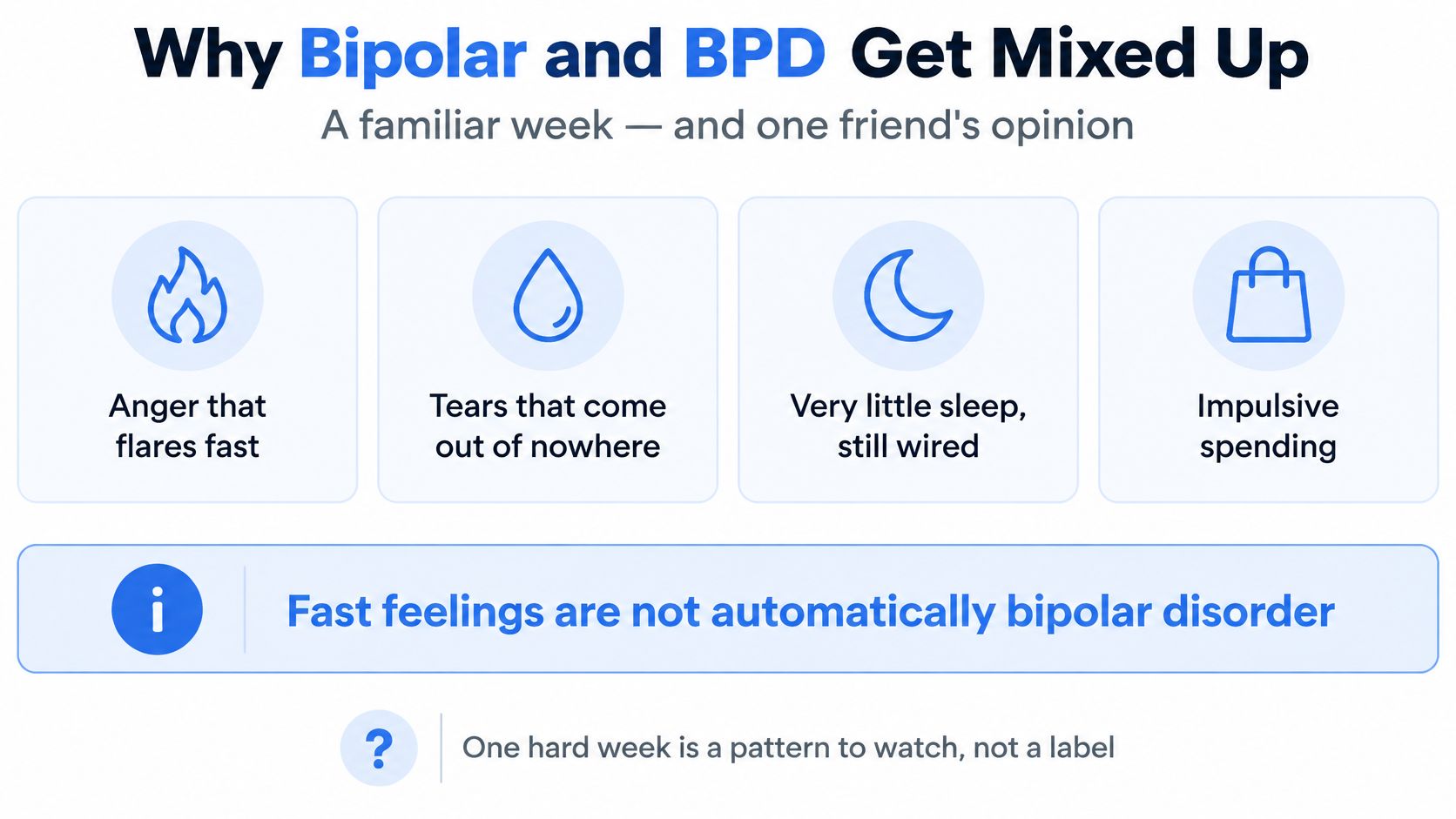
Bipolar disorder involves mood episodes. During mania or hypomania, a person's energy, speech, confidence and sleep can change together and remain changed for days or longer. Borderline personality disorder, usually written BPD, involves a longer-running pattern of intense emotions, fear of abandonment, unstable relationships and impulsive behaviour. Shifts may be closely tied to conflict, criticism or perceived rejection.
The distinction is not “days versus hours.” Relationship-triggered shifts can be intense, while bipolar episodes may unfold in different ways. Anxiety, depression, irritability and impulsivity can occur in both, and the conditions can coexist. An Indian review estimates that 10 to 20 percent of people with bipolar disorder also have BPD (review of overlap between bipolar disorder and BPD). A single label may therefore fail to capture the full picture.
This article cannot diagnose you or someone close to you. The comparison ahead can help you notice patterns, while mood tracking and screening scores can offer only part of the picture. Support can begin before anyone has settled on a perfect label.
Bipolar vs BPD at a Glance
A difficult week can include poor sleep, conflict, impulsive choices or intense sadness. The comparison below can help you notice patterns, but one row or one bad week cannot establish a diagnosis. Look for what tends to happen over time.
| Feature | Bipolar disorder | Borderline personality disorder |
|---|---|---|
| Mood course | Discrete episodes of depression and mania or hypomania | Rapid shifts often linked to stress or relationship events |
| What sets it off | Episodes can build and persist without an obvious daily trigger | Rejection, conflict, criticism or fear of abandonment may set off distress |
| Sleep and energy | High-energy episodes can involve less need for sleep, grandiosity or pressured speech | Distress may disrupt sleep without a sustained high-energy episode |
| Between difficult periods | Mood and energy may settle between episodes | Emotional sensitivity can continue between crises |
| Relationships | Strain may follow changes in mood and energy | Fear of abandonment and intense relationship shifts are central |
| Self-harm and suicide attempts | Can occur, especially during depression | Suicide attempts are a serious concern; direct safety questions belong in the first appointment |
| Family pattern | A family history of bipolar-spectrum illness may be relevant | Developmental strain and trauma context may be relevant |
| When the pattern starts | Episodes often begin in the late teens or adulthood | Emotional and relationship patterns may become visible during adolescence |
The three rows worth reading twice
Mood course is more useful than a simple hours-versus-days rule. Bipolar disorder involves distinct depressive, hypomanic or manic episodes. BPD can involve fast, intense shifts in response to events between people. The two patterns can overlap, so timing alone does not settle the question.
Sleep and energy add context. Sleeping little while feeling rested, speaking rapidly or feeling unusually capable can be part of a high-energy episode. Poor sleep alongside worry and emotional pain points to a different pattern, though it does not diagnose BPD.
The space between difficult periods matters too. With bipolar disorder, mood and energy may settle between episodes. With BPD, sensitivity to criticism or abandonment may remain even during calmer periods.
What India's numbers say, and what they cannot
Bipolar disorder has population data from India. A 2023 multi-site study in the Indian Journal of Psychiatry interviewed 34,802 adults and found a weighted current prevalence of 0.3% (95% confidence interval 0.29 to 0.31) and a lifetime prevalence of 0.5% (95% confidence interval 0.49 to 0.51). These estimates describe groups, not the likelihood that a particular person has bipolar disorder.
A Global Burden of Disease analysis cited in the same study estimated about 7.6 million people living with bipolar disorder in India in 2017, with prevalence near 0.6% and about 1.3-fold variation across states.
BPD has no equally reliable national figure. Indian clinical guidance on personality disorders notes that systematic prevalence studies are scarce, and that many estimates come from selected clinical or high-risk groups. Limited population data do not make a person's distress less real.
A population rate is not a personal verdict. It cannot identify what is happening to someone in your family.
Reading Mood Over Time and What Screening Can Tell You
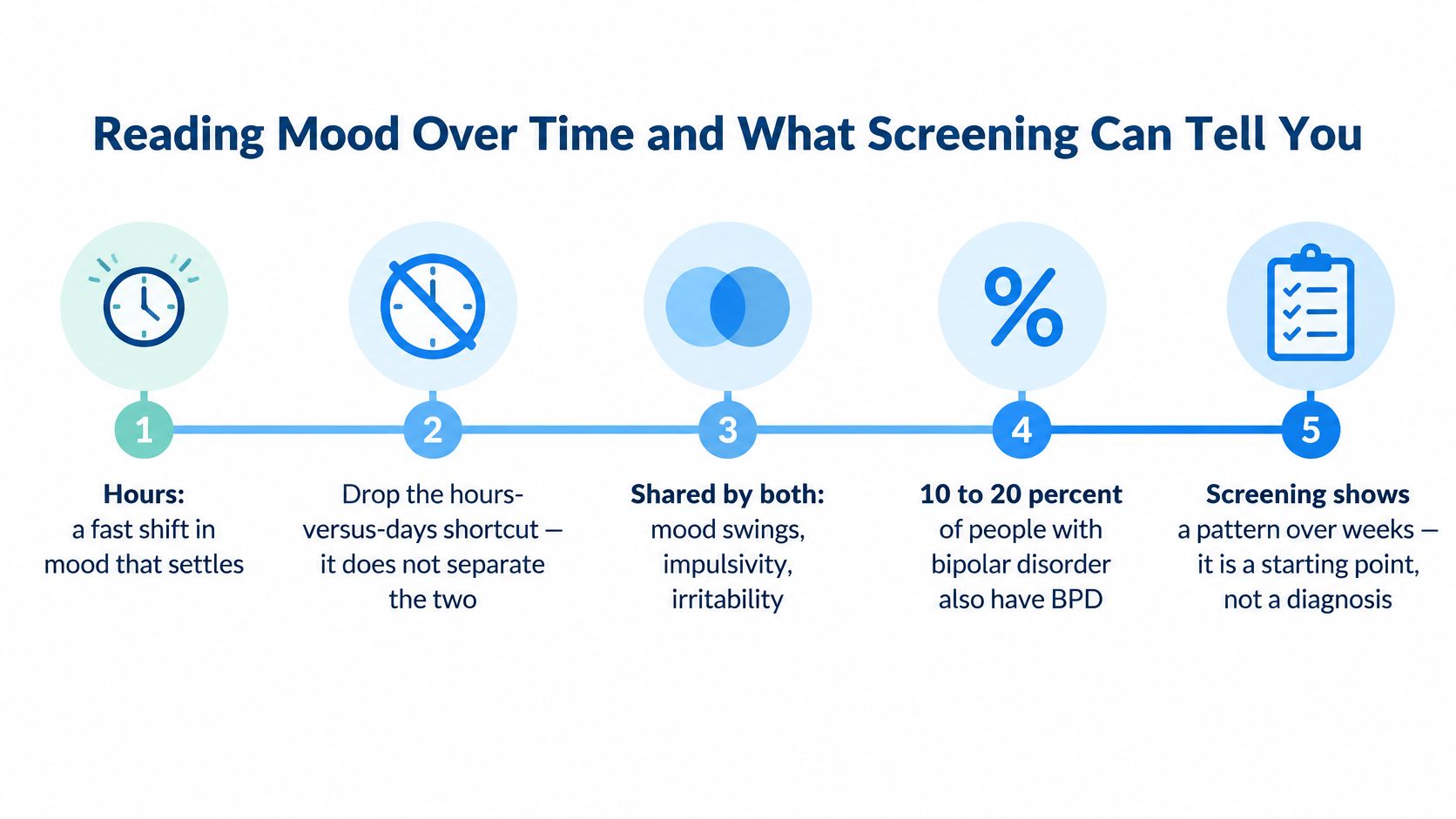
After a difficult week, a person may feel certain that their mood shifts mean bipolar disorder or BPD. One week cannot settle that question. Clinicians look for patterns over time: whether changes form sustained mood episodes, follow relationship stress, or involve both.
The familiar shortcut says bipolar mood swings last days, while BPD mood swings last hours. Duration can offer a clue, but it cannot separate the conditions on its own. Ask what the mood was responding to, and whether it continued after the event passed.
Drop the hours-versus-days shortcut
An Indian Journal of Psychiatry comparison study linked bipolar mood disorder with distinct depressive, hypomanic or manic episodes and a family history of bipolar-spectrum illness. It linked BPD with rapid emotional shifts in response to stress, difficulty regulating emotions, early developmental onset, sensitivity to criticism and stress-related dissociation.
A sustained change in mood may affect sleep, spending and speech for several days. A sharp emotional shift after a partner's tone changes may ease when the person feels reassured. These patterns can help guide an assessment, but they do not prove a diagnosis.
Bipolar disorder and BPD can also occur together. A Karnataka study of college students reported an odds ratio of 23.6 for bipolar-spectrum disorder alongside BPD. That finding supports checking for both patterns rather than assuming one rules out the other.
A four-step sketch of the last two weeks
Memory can blur the order of events during distress. A brief daily record can help make the pattern clearer. Bring it to an appointment.
- Log sleep, energy, speech and spending each day. Four short notes are enough. Look for changes that move together over several days, as well as spikes that settle within hours.
- Note whether the mood outlasted the event. Record what happened after an argument or other stressor passed. Did the low mood continue, or did it ease after reassurance?
- Mark possible triggers. Note criticism, a delayed reply, a fight, rejection or a work review. The timing may help a clinician understand the pattern.
- Ask someone who knows you to add observations. A partner, parent or flatmate may recall changes that were hard to notice or remember at the time.
A simple sheet can work. A guide to how a mood calendar works can help organise entries. The aim is to see a pattern across days, not to draw conclusions from one dramatic moment.
What screening can and cannot tell you
Screening tools estimate whether further assessment may help. They do not diagnose. A review of tools used to distinguish the two conditions reported that the Mood Disorder Questionnaire had 67.8% sensitivity and 83.7% specificity. The McLean Screening Instrument had 63.3% sensitivity and 73.2% specificity. Those results can inform triage, but a score cannot replace a clinical assessment.
The questions differ because they look for different patterns. Bipolar screening items ask about unusually high mood, grandiosity, increased energy, pressured speech, reduced need for sleep and hyperactivity. BPD indicators include self-harm or suicide attempts, distrust, irritability and emotional crises tied to relationships. A single score for mood swings cannot distinguish the two.
Clinic figures also need context. A review of Indian clinical research reported BPD in a Bangalore clinical sample assessed using DSM-III-R criteria. That kind of selected sample cannot be compared directly with a community prevalence estimate: the groups were drawn from different populations.
Screening tools and self-checks on DeTalks can help people reflect on what they are experiencing. A result that feels relevant can be a starting point for counselling, therapy or a psychiatric interview that considers the person's history over time.
Ask about safety early. Indian clinical work reports a higher risk of suicide attempts among people with BPD than in comparison groups. Direct questions about self-harm belong in the first conversation. Active self-harm or suicidal thoughts call for same-day clinical help, not an appointment next month.
When Work Love and Family Make It Harder
Three people walk into three different rooms this week. None of them needs a label by Friday. Each needs a better question.

The office scene. A team lead in an Indian city is snapping at colleagues, sleeping badly and skipping lunch. Workplace stress of this kind is measurable: a 2022 study of 1,764 urban white-collar employees in India reported moderate-to-severe anxiety symptoms in 55%, moderate-to-severe depression symptoms in nearly 29%, and moderate-to-high stress in 78%. Those are screening findings from one employee sample, not rates for all Indian workers. The question to ask next isn't "is this bipolar?" It's whether energy stays high on very little sleep for several days, which leans bipolar, or whether the emotional spikes follow feedback from a manager, which leans either BPD or ordinary burnout.
The couple scene. One partner disappears into a spending spree during a week of buoyant mood and fast talk. The other panics and rages when a message goes unanswered for three hours. Both look like mood swings. One follows a mood state that arrived on its own, the other follows a perceived withdrawal. Asking "what happened in the hour before it changed?" usually settles which conversation you're having.
The family scene. A college student is angry, sleeping late and has scratched their arm once. Anger and self-harm are not proof of either condition. Parents should note sleep, substance use, how long each state lasts, and whether anything resembling a sustained high has ever occurred.
Skills that help whichever pattern is at work, and that protect resilience while you wait for an assessment:
- Protect one wind-down hour. Same time nightly, screens down, lights low. Sleep regularity is the single most useful thing a family can help with.
- Name one person for collateral history. Someone who sees the person weekly and can describe changes plainly, without diagnosis.
- Use compassionate language. "You seemed to crash after that call" lands better than "you're overreacting again."
- Treat anxiety and depression as real on their own. They deserve care even while the mood diagnosis stays open.
Sleep, anxiety and depression all respond to care. None of them require a final label first.
Care That Fits Each Pattern
Care follows the pattern, not the label alone. Use this table as a conversation map for your first appointment.
| Situation | Care that usually leads | What therapy adds | What to avoid |
|---|---|---|---|
| Bipolar-leaning episodes | Psychiatric review and mood treatment | Relapse signs, sleep rhythm, family education | Treating every mood swing as a personality flaw |
| BPD-leaning relationship crises | Structured psychotherapy such as skills-based therapy | Emotion regulation, distress tolerance, safer relationships | Expecting medicine alone to stop abandonment fear |
| Both patterns together | Combined psychiatric care and psychotherapy | Episode plan plus self-harm and relationship skills | Forcing a single label before safety planning |
| Mainly anxiety, depression or burnout | Assessment first, then matched care | Counselling, workload recovery, compassion skills | Using a mood checklist as a final diagnosis |
When the pattern looks bipolar, psychiatric review usually sits at the centre, because episodes often need medical treatment alongside talking therapy. Counselling then does specific work: protecting sleep rhythm, spotting early relapse signs, and educating the person and family about what depression and mania look like in this individual.
When the pattern looks like BPD, structured psychotherapy leads. Skills-based approaches such as dialectical behaviour therapy, and mentalization-based work, target emotion regulation, distress tolerance and relationships. Medicines may still help with anxiety, depression or another condition, but they aren't a standalone fix.
When both seem present, combined care is reasonable and common. A clinician can stabilise episodes and still teach relationship and self-harm safety skills. Family sessions help in both cases with different jobs: spotting episode signs in one, agreeing crisis boundaries in the other.
If a mood stabiliser such as Depakote comes up in consultation, reading beforehand helps you ask better questions, and this guide to Depakote and depression from Integrative Psychiatry of America is a plain starting point.
Well-being practices sit beside treatment, never instead of it. Self-compassion, gratitude, small recovery breaks from workplace stress and resilience skills all support recovery. Stopping prescribed medicine to rely on happiness tips can trigger a bipolar episode, and no article, including this one, can promise how fast anyone improves.
Bring the table, not a conclusion. Show a clinician where your pattern sits and let them revise it over months.
Choose Support Without Waiting for a Perfect Label
Delay is the norm in India, and understanding why makes it less shameful. The National Mental Health Survey 2015–16 estimated that 10.6% of adults were living with a mental disorder, while the treatment gap ranged from 70% to 92% depending on the condition. The same survey found higher mental-health morbidity in metropolitan areas at 13.5%, against 6.9% in rural areas and 4.3% in smaller urban areas.
Waiting for a perfect online label leaves anxiety, depression and burnout untouched in the meantime.
A calm sequence works almost everywhere in the world:
- Safety first. If there's immediate danger of self-harm, get emergency help today. Nothing else on this list matters more.
- Timeline second. Book a clinician who will take a longitudinal history. Bring your two weeks of sleep and trigger notes, and invite one family member to describe what they've observed.
- Care third. Ask for therapy or counselling matched to the pattern, and ask what would change the clinician's mind over time.
DeTalks is one India-based place to browse qualified psychologists, therapists and counsellors, and to try informational assessments before a first session. The limit doesn't change: a score guides the first conversation, it doesn't diagnose.
While treatment is being sorted, protect what care can build. Compassion toward yourself on a bad day, a small resilience habit you can repeat, and honest hope that well-being can improve without anyone promising a cure.
Bipolar disorder and BPD both cause real distress, and neither is a character flaw. If this article described someone you love, DeTalks brings together psychologists, therapists and counsellors you can browse and book, along with informational assessments that help you arrive at a first session with a clearer picture of sleep, triggers and timing. Visit DeTalks to take that first step, and let a qualified professional read the pattern with you.