Tag: build confidence

  • How to Overcome Fear of Public Speaking: A Practical Guide

    How to Overcome Fear of Public Speaking: A Practical Guide

    Feeling anxious about public speaking doesn't mean you're weak; it means you're human. The journey to confidence isn't about eliminating fear, but learning to manage it with practical tools and a kinder mindset. This guide is here to support you every step of the way.

    We'll shift your focus from the pressure of a perfect performance to the power of authentic connection. This simple change can help calm a racing heart and quiet anxious thoughts, making this common fear much easier to navigate.

    Why Public Speaking Is So Hard and How to Start

    If the thought of speaking to a group fills you with dread, you are not alone. This fear, often called glossophobia, is a natural response linked to our deep need for social acceptance. It's your brain trying to protect you from potential judgment.

    This guide will help you understand the roots of your anxiety and give you practical strategies to build confidence. We'll explore techniques grounded in positive psychology and therapy to help you turn nervous energy into genuine presence.

    A young Asian man with closed eyes stands at a podium in an empty lecture hall, meditating.

    Let's begin with a few core principles. Think of these as your first steps toward turning feelings of stress and anxiety into a foundation for resilience and well-being.

    Your First Steps to Overcoming Speaking Anxiety

    Principle What It Means for You First Actionable Tip
    Understand the Fear It's about getting to the "why" behind your anxiety. What are the specific thoughts and physical feelings you experience? For your next presentation, jot down your top 3 specific worries (e.g., "I'll forget my words").
    Calm Your Body Your body's stress response is real. You need tools to calm your nervous system on the spot. Practise the 4-7-8 breathing technique: inhale for 4 seconds, hold for 7, and exhale for 8. Do this 3 times.
    Build Confidence Through Practice Confidence isn't something you're born with; it’s built through repeated, successful experiences. Rehearse the first 30 seconds of your talk out loud until it feels automatic. A strong start builds momentum.
    Reframe Your Mindset Shift your goal from "performing perfectly" to "connecting with my audience and sharing something valuable." Instead of thinking "Don't mess up," try thinking "What's the one key message I want to share with these people?"

    This table is just the starting point. Each of these pillars is a step toward building greater comfort and happiness in your communication.

    A Common Challenge Across India

    This isn't just a personal hurdle; it's a widespread challenge affecting people globally, including in India. The pressure to perform can contribute significantly to workplace stress and anxiety.

    One study revealed that a staggering 74% of Indian professionals experience "scary stage fear," ranking it as their number one fear. Knowing this helps you see that your feelings are not only valid but shared by many, which is the first step toward self-compassion.

    Building Your Foundation for Success

    Becoming a confident speaker is a journey, not a destination. We're not aiming for a flawless, nerve-free performance. The real goal is to build a toolkit that supports your well-being and allows you to share your ideas effectively.

    For a broader look at what makes a great speaker, it can be helpful to explore resources on how to improve public speaking skills and build confidence.

    Our process involves:

    • Understanding Your Anxiety: Pinpointing your triggers and how they affect your thoughts and body.
    • Managing Physical Symptoms: Using simple breathing and grounding exercises to calm your nervous system.
    • Strategic Preparation: Structuring your content and rehearsing in a way that builds competence.
    • Mindset Reframing: Shifting your internal dialogue from fear of judgment to a desire to connect.

    The goal is not to eliminate nerves but to transform them. A little adrenaline can sharpen your focus; the key is learning how to manage it so it works for you, not against you. This approach fosters resilience and sustainable well-being.

    Understanding the Roots of Your Speaking Anxiety

    Have you ever wondered why your heart pounds just thinking about a presentation? This is a normal human reaction, not a flaw. Your body’s 'fight-or-flight' system is designed to protect you, and for many, an audience can feel like a threat.

    This response floods your system with adrenaline, causing a racing heart, shallow breathing, and trembling hands. Your mind then creates anxious thoughts to explain these feelings, creating a cycle of stress. Recognizing this cycle is the first step toward breaking it.

    Close-up of a person's sweaty hands holding a small note with text during a public speech.

    Unpacking the Thought-Feeling Connection

    The link between thoughts, physical feelings, and actions is a key idea in approaches like therapy and counselling. Think back to a time you had to speak up. Perhaps a thought like, "What if I forget my words?" led to a feeling of panic and a tight throat.

    This experience is very common, especially among young people. Research shows that public speaking anxiety affects 77% of students in India, who report symptoms like sweating and a racing heart, all driven by fears of embarrassment. You can explore the research on student speaking anxiety in India to see the full findings.

    Identifying Your Personal Anxiety Triggers

    Your fears are unique to your experiences and the stories you tell yourself. Understanding these personal triggers is key to building resilience. Anxiety is often tied to specific, unhelpful thought patterns.

    Here are a few common thought traps:

    • Mind Reading: "Everyone thinks I'm boring." This assumes you know what others are thinking without any real evidence.
    • Catastrophising: "If I stumble over one word, my career is over." This blows a small mistake out of proportion.
    • Perfectionism: "I have to deliver this flawlessly." This sets an impossible standard that only increases stress.
    • Negative Filtering: "I saw one person yawn, so my entire talk was a failure." This focuses on one negative detail while ignoring all positives.

    Takeaway: Your thoughts are not facts. The moment you can simply notice these patterns without judging them, you create a bit of space between yourself and the anxiety. This small act of mindfulness is a powerful first step toward dismantling the cycle of fear.

    The Role of Past Experiences

    Often, our fear of public speaking is rooted in a past event, like being laughed at in class or receiving harsh criticism. That single memory can create a lasting blueprint in our minds, causing our internal alarm bells to ring loudly.

    Your brain is just trying to protect you from feeling that pain again. Acknowledging this protective instinct with self-compassion can make a huge difference. The goal is not to erase these memories but to create new, positive ones that build your confidence and well-being.

    Proven Techniques to Calm Your Mind and Body

    When your heart races and your thoughts spiral, you need simple tools to regain composure. The good news is that you can learn to manage the physical signs of anxiety. Think of these techniques as your practical toolkit for in-the-moment stress relief.

    These exercises are like physiological reset buttons. By consciously engaging your body, you send a direct message to your brain that the danger has passed. This simple act interrupts the anxiety feedback loop, helping you shift from panic to calm.

    Master Your Breath with Diaphragmatic Breathing

    The fastest way to calm your nervous system is by changing your breathing. Anxious breathing is often short and shallow, but deep belly breathing (diaphragmatic breathing) can reverse this. This technique stimulates a nerve that helps trigger your body's relaxation response.

    Here's how to try it:

    1. Find a comfortable spot. Sit or lie down with one hand on your chest and the other on your stomach.
    2. Breathe in through your nose. Take a slow, deep breath for a count of four, feeling your stomach expand.
    3. Hold for a moment. Pause for a count of two.
    4. Breathe out through your mouth. Exhale slowly for a count of six, feeling your belly fall.
    5. Repeat. Continue for a minute or two, noticing how your body begins to settle.

    Practising this daily helps it become a reliable anchor you can use whenever you feel anxiety rising.

    Ground Yourself in the Present Moment

    Anxiety often pulls our minds into a future filled with "what-ifs." Grounding exercises anchor you in the here and now by focusing your attention on your senses. The 5-4-3-2-1 Method is a simple and effective way to do this.

    Here’s how it works: Silently, just to yourself, identify:

    • 5 things you can see: The grain of wood on a table, a color in the room.
    • 4 things you can feel: Your feet on the floor, the texture of your shirt.
    • 3 things you can hear: The hum of a fan, distant traffic.
    • 2 things you can smell: The faint scent of coffee or soap.
    • 1 thing you can taste: The lingering taste of your last drink or meal.

    This exercise shifts your brain's focus from internal chaos to neutral, external information, which can immediately reduce feelings of being overwhelmed.

    Release Physical Tension with Progressive Muscle Relaxation

    Anxiety often causes physical tension, like a clenched jaw or tight shoulders. Progressive Muscle Relaxation (PMR) helps you release this by systematically tensing and then relaxing different muscle groups. This process makes you aware of where you hold tension and teaches you how to let it go.

    You can start from your feet and work your way up. Tense a muscle group (like your calves) for five seconds, then release it for 30 seconds. Focus on the feeling of the tension melting away, which has a powerful calming effect on your mind and body.

    Building Confidence Through Smart Preparation

    Solid preparation is your best defense against speaking anxiety. The goal isn't to memorize a script, but to know your material so well that you can talk about it naturally. When you're not worried about what to say, you can focus on connecting with your audience.

    This deep competence acts as an anchor against the fear of judgment. Smart preparation reduces uncertainty and helps you feel more in control, which is essential for managing workplace stress and building lasting confidence.

    Structuring Your Talk for Impact

    A clear structure makes your presentation easier to deliver and for your audience to follow. Think of your talk in three parts: a compelling opening, a logical body, and a memorable close. This framework acts as a roadmap, reducing your mental load.

    • The Opening: Start with a hook—a surprising fact, a relatable story, or a thought-provoking question. Your goal is to grab their attention in the first 30 seconds.
    • The Body: Focus on three key messages. Support each point with evidence, an example, or a story to make your talk engaging and credible.
    • The Closing: End with a strong summary of your core message and a clear call to action. A powerful ending leaves a lasting impression.

    Creating Effective Speaking Notes

    Your notes should be a safety net, not a script. Reading from a full page can sound robotic and disconnect you from your audience. Instead, use concise bullet points on small note cards or a tablet.

    Each bullet should be a simple trigger—a word or phrase to remind you of a concept. This encourages a more conversational style while ensuring you don't lose your place.

    Practise with Progressive Exposure

    Progressive exposure is a powerful technique where you gradually increase the challenge of your practice sessions. This steady, controlled method builds your confidence one small step at a time. It’s a core principle in therapy for anxiety because it works.

    You start small in a low-stakes environment and slowly build from there. The goal is to get comfortable with your material and the feeling of speaking in front of others. With each successful step, you build more self-belief.

    This method essentially teaches your brain a new lesson through experience: public speaking is a manageable activity, not a life-threatening event. This reframing is essential for long-term well-being and helps counter the roots of anxiety and potential depression linked to performance fears.

    This step-by-step table lays out a practical plan. Only move to the next level when you feel reasonably comfortable where you are.

    Your Progressive Practice Plan

    Practice Level Audience Goal Pro Tip
    Level 1 Yourself (in a mirror) Get comfortable with the flow and content of your talk without any external pressure. Focus on your body language and tone. Does your expression match your message?
    Level 2 One trusted friend or family member Practise making eye contact and get used to having another person's attention on you. Ask for constructive feedback on one specific thing, like your opening or your pacing.
    Level 3 A small, supportive group (2-4 people) Simulate a small meeting environment and learn to manage your attention across multiple people. Record this session (with permission) to watch back later. You'll notice things you missed.
    Level 4 The actual room (if possible) If you can, visit the space where you'll be speaking to familiarise yourself with the layout. Stand where you will be standing and run through your opening and closing lines out loud.

    This gradual approach is a proven way to desensitize your fear response and build unshakable confidence before the big day.

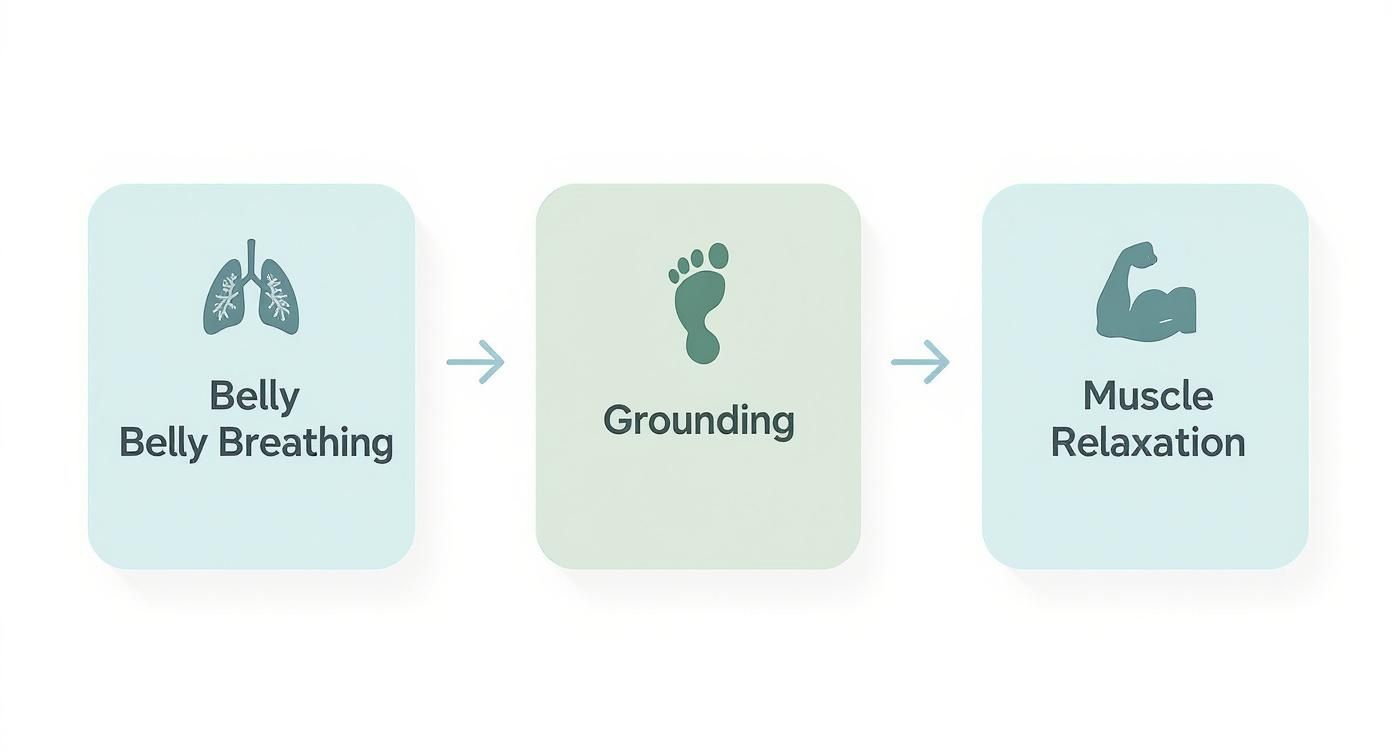
    Here’s a quick visual guide to some simple relaxation techniques you can use before any practice session to get centered.

    A three-step diagram illustrating belly breathing, grounding, and muscle relaxation techniques for stress relief.

    Making these quick exercises a habit before each practice run turns them into a powerful, automatic tool to calm your nerves when you need it most.

    Shifting Your Mindset from Connection to Performance

    The biggest battle in public speaking happens in your mind. While breathing exercises and preparation build a strong foundation, lasting change comes from shifting your perspective. It all starts with noticing the stories you tell yourself.

    Many of us adopt a "performance mindset," seeing a presentation as a test where we must be flawless. This thinking creates immense pressure, turning every speaking opportunity into a high-stakes event. It's a fast track to chronic workplace stress and anxiety.

    Identifying and Challenging Negative Thoughts

    Your mind can create compelling worst-case scenarios, whispering things like, "They’re all going to judge me." These are automatic negative thoughts, and they fuel your fear. The first step is to simply notice them without judgment.

    Once you spot a negative thought, gently question it. Is it really 100% true? This simple act of mindfulness, often used in therapy and counselling, helps you see your thoughts as suggestions, not facts, giving you back a sense of control.

    The Power of Reframing Your Perspective

    After noticing unhelpful thoughts, the next step is to replace them with more balanced and compassionate ones. This isn't about forced positivity; it's about finding a more realistic viewpoint. This practice is vital for building mental resilience and well-being.

    Here’s what this looks like in practice:

    • Instead of: "I'm going to forget everything and look like a fool."

    • Try: "I’ve prepared my main points. If I get stuck, I can glance at my notes. My goal is to share what I know."

    • Instead of: "They are all experts and will see right through me."

    • Try: "I bring a unique perspective. It's okay that I don't have every answer; I'm here to start a conversation."

    • Instead of: "If I stumble on a word, the whole presentation is ruined."

    • Try: "Little stumbles are human and make me more relatable. People care about my message, not perfection."

    This deliberate shift from self-criticism to self-compassion is the core of improving your well-being. It turns down the volume on that internal pressure that can lead to burnout or even symptoms of depression, and lets you approach speaking with a sense of calm.

    Moving from Performance to Genuine Connection

    The single most powerful mindset shift you can make is changing your goal from performing to connecting. Aim to be a helpful, authentic person sharing valuable ideas. When connection is your goal, your focus naturally shifts from yourself to your audience.

    You start asking better questions, like, "What does this group need to hear?" and "How can I make this message useful for them?" Suddenly, the spotlight isn't on your anxiety anymore—it's on your purpose. This shift is reflected in trends from India, where statistics show that fear of public speaking drops from 52% for those with less education to 24% for college graduates, suggesting that confidence grows with more opportunities to connect. You can see more on these fear of public speaking statistics in India.

    Ultimately, when you focus on connecting, small mistakes become trivial. What your audience will remember is the value you shared and the passion you brought. Embracing this truth is key to a more confident and joyful public speaking experience.

    When to Seek Professional Support for Your Anxiety

    The techniques in this guide are powerful and can make a real difference. For many, consistent practice is enough to transform public speaking from a source of dread into a manageable experience. However, it's also important to recognize when self-help strategies aren't enough.

    Reaching out to a professional is not a sign of failure. It is a courageous step toward taking care of your mental health and investing in your well-being.

    Recognising When It Is Time for Help

    Sometimes, an intense fear of public speaking can be linked to a broader challenge like an anxiety disorder or depression. When the fear feels overwhelming and starts to limit your life, professional guidance offers a structured, supportive path forward.

    It might be time to seek support if:

    • You avoid promotions, career opportunities, or important life events to avoid speaking.
    • You regularly experience intense physical symptoms like panic attacks, dizziness, or nausea.
    • The worry consumes your thoughts for weeks or months before a speaking event.
    • The stress is negatively affecting your sleep, relationships, or overall well-being, leading to burnout.

    Remember, professional assessments are informational tools to guide you, not definitive diagnoses. They offer valuable insights that can help you and a professional decide on the best steps for your mental health and resilience.

    Understanding Your Options

    A public speaking coach can help you refine your delivery and content structure. They are excellent for polishing your skills and building on an existing foundation. A therapist or counsellor, however, can help with the underlying emotional challenges.

    They can help you explore the root causes of your anxiety using proven methods. Learning how cognitive behavioural therapy for social anxiety works is a great starting point, as it offers a clear path for overcoming this fear. Platforms like DeTalks connect people with qualified professionals specializing in therapy and counselling to help manage workplace stress and other mental health concerns.

    The most important thing to remember is that overcoming this fear is possible. The right support is out there to guide you on your journey.

    Got Questions? Let's Get Them Answered

    We’ve covered a lot, but you might still have some questions. Let's address some of the most common ones about managing the fear of public speaking.

    Can I Actually Get Rid of My Fear Completely?

    The goal isn't to erase every nerve, as a little adrenaline can keep you focused. We're aiming to get your anxiety to a manageable level where you feel in control. Even experienced speakers feel butterflies; they've just learned how to channel that energy positively.

    How Long Until I Start Feeling Better?

    It's different for everyone. Some people feel physical symptoms calm down within a few weeks of practising relaxation techniques. Building deep, lasting confidence is more of a marathon than a sprint, so focus on small wins and steady progress toward building resilience.

    What if I Feel a Full-Blown Panic Attack Coming On?

    First, don't panic about the panic. If you feel that wave rising, find a quiet moment to anchor yourself in the present. Use slow, deep breaths and a grounding technique like the 5-4-3-2-1 method to pull your mind away from anxious thoughts.

    Does Therapy Really Work for This Kind of Fear?

    Yes, professional counselling is highly effective, especially approaches like Cognitive Behavioural Therapy (CBT). A therapist provides a safe space to dismantle negative thought patterns that fuel your fear. They can guide you with tailored exercises to build lasting resilience against workplace stress, anxiety, and even feelings of depression linked to performance pressure.

    Your feelings are completely valid, and making progress is always within reach. Remember, the goal isn't a flawless performance; it's about feeling confident enough to connect with your audience, one small step at a time.


    If you think professional guidance could make a difference, help is closer than you think. On DeTalks, you can browse a directory of qualified therapists and use science-backed assessments, which are informational, not diagnostic, to better understand your needs.

    Ready to start your journey towards more confidence? Find the right support for you on DeTalks.

  • How to Overcome Insecurity and Build Lasting Confidence

    How to Overcome Insecurity and Build Lasting Confidence

    Overcoming insecurity isn't about quick fixes. It’s about gently understanding its roots, learning to challenge negative thoughts, and being kinder to yourself in the process.

    This guide will help you identify personal triggers and reframe your inner critic. By taking small, consistent steps, you can build genuine, lasting confidence for improved well-being.

    Understanding Where Insecurity Comes From

    A person sitting on a window sill, looking thoughtfully outside, representing self-reflection and understanding insecurity.

    Before building confidence, it helps to understand what you're facing. Insecurity is a normal human feeling, not a personal flaw, and it often comes from past experiences or social pressures.

    These feelings of self-doubt can be traced to specific sources. Pinpointing your triggers helps you see insecurity not as a permanent trait, but as a thought pattern you can change.

    Common Roots of Self-Doubt

    Insecurity often grows from past experiences. Understanding its origins is the first step toward building a stronger sense of self and improving your overall well-being.

    • Past Experiences: Criticism during childhood or setbacks in your career can leave a lasting mark of self-doubt. These events may cause you to question your worth and abilities long after they've passed.
    • Social Comparisons: Constantly measuring yourself against others, especially on social media, can make you feel like you're not good enough. This is a common source of modern anxiety and stress.
    • Cultural Expectations: In places like India, societal pressure to meet certain career or family milestones can be intense. Falling short of these standards can significantly impact your self-worth.

    If this feels familiar, you are not alone. Research suggests many people in India experience social anxiety. The good news is that approaches like therapy are highly effective in reducing anxiety and boosting self-esteem. You can learn more in the Indian Journal of Psychiatry.

    It's crucial to remember that these feelings don't define who you are. They are learned responses, and just as you learned them, you can unlearn them with conscious effort and self-compassion.

    To help you connect the dots, let's look at common triggers and how they might show up in your life.

    Common Insecurity Triggers and Their Impact

    Source of Insecurity Common Thought Pattern Potential Impact on Well-being
    Social Media Comparison "Everyone else is so successful/happy/attractive. What am I doing wrong?" Increased anxiety, feelings of loneliness, and distorted self-perception.
    Workplace Feedback "My boss pointed out one mistake; I must be terrible at my job." Fear of taking risks, avoiding new projects, and chronic workplace stress.
    Family Expectations "I haven't achieved what my parents expected of me by this age." Feelings of guilt, shame, or being a disappointment, leading to low self-worth.
    Past Rejection "I was rejected before, so it will definitely happen again. I shouldn't even try." Avoidance of new relationships or opportunities, leading to social isolation.
    Body Image Concerns "I hate how I look. I need to change myself before I can be confident." Low self-esteem, social withdrawal, and preoccupation with appearance.

    Recognising your patterns in a table like this is a powerful step. It makes the feeling more tangible and something you can begin to work with.

    The Impact on Your Daily Life

    Insecurity can seep into your actions and create real challenges. It might show up as stress at work, making you hesitant to speak up in meetings or ask for a promotion.

    This cycle of doubt can also lead to more persistent issues like anxiety and sometimes depression. The good news is that building resilience begins with recognising how these feelings affect you personally, which is a huge step toward regaining control and finding happiness.

    Rewire Your Thinking to Silence Your Inner Critic

    A person calmly practising mindfulness, symbolizing the process of rewiring negative thoughts.

    We all have an inner critic—that voice that points out our flaws and tells us we're not good enough. This voice fuels insecurity by turning small mistakes into huge problems.

    Learning how to overcome insecurity means learning how to respond to this voice. Using tools from therapy like Cognitive Behavioural Therapy (CBT), you can build a kinder internal dialogue and quiet the noise of self-doubt.

    Identify Your Automatic Negative Thoughts

    First, you have to spot the critic in action. These automatic negative thoughts (ANTs) are harsh, knee-jerk judgments that often feel like the absolute truth.

    For example, a small mistake at work might trigger the thought, "I'm a complete failure." This all-or-nothing thinking can create relentless workplace stress and damage your confidence.

    Try to catch these thoughts as they happen by noting them down. When you feel insecure, pause and write down what just went through your mind.

    • The Situation: What happened right before the thought? (e.g., "My manager gave me feedback.")
    • The Emotion: How did it make you feel? (e.g., "Anxious, embarrassed.")
    • The Automatic Thought: What did your inner critic say? (e.g., "I can't do anything right.")

    This simple act of observation is a core practice in counselling. It creates space between you and the thought, helping you see it more clearly instead of being overwhelmed by it.

    Challenge and Reframe Your Inner Critic

    Once you can identify these thoughts, you can start to question them. Your inner critic relies on assumptions, not facts, so you can build mental resilience by challenging its claims.

    You don't need to argue with yourself. Just gently question the negative thought with a few logical questions to see if it holds up.

    Takeaway: Your feelings are always valid, but they are not always facts. A key skill in managing anxiety is learning to separate your emotional reaction from the objective reality of a situation.

    Here’s how you can dismantle common negative thoughts and find a more balanced perspective:

    Automatic Negative Thought The Challenge (Ask Yourself) A Balanced Reframe
    "Everyone in the meeting thought my idea was stupid." "Did anyone actually say that? What evidence do I have?" "My idea wasn't chosen, but I spoke up and contributed. That's a win."
    "I'll never be as successful as my friends." "Is success a competition? What does 'success' mean to me?" "My friends are on their own paths, and I'm on mine. I can celebrate their wins and focus on my own progress."
    "I'm so awkward in social situations." "Have I had positive social interactions before? What went well?" "Sometimes I feel nervous, but I'm capable of connecting with people. Each interaction is a chance to practise."

    This process isn't about ignoring weaknesses but seeing yourself as a whole person capable of growth. Regular practice can foster a more compassionate inner voice, which can ease feelings linked to depression and improve your daily well-being.

    Build Lasting Confidence with Self-Compassion

    A person practising a gentle, compassionate yoga pose indoors, with soft light creating a calm atmosphere.

    One of the kindest ways to quiet insecurity is to treat yourself as you would a dear friend. This is the heart of self-compassion, a powerful tool for building confidence from within. It helps reduce the stress and anxiety that fuel insecurity.

    Instead of fighting self-doubt, self-compassion invites you to meet it with warmth and understanding. Accepting that you are human and that mistakes are part of life builds profound emotional resilience and a stronger sense of self-worth.

    Start with Mindful Acceptance

    The first step is to notice your feelings without judgment. When insecurity arises, pause and acknowledge what's happening by saying to yourself, "This is a moment of pain," or "I'm feeling insecure right now."

    This mindful act creates space between you and your emotions, preventing a negative spiral. It is a foundational skill taught in therapy to help manage difficult feelings and improve your overall well-being.

    Remember, acknowledging your feelings isn't the same as giving in to your insecurities. It’s about creating the space to feel, without letting those feelings define who you are.

    Practical Self-Compassion Exercises

    Bringing self-compassion into your daily life can be simple. Here are a few practices to try when you're feeling low:

    • Comforting Touch: Place a hand over your heart or give yourself a gentle hug. This physical act can release oxytocin, a hormone that promotes feelings of safety and helps calm your nervous system.
    • Kind Self-Talk: Ask yourself, "What would I say to a friend going through this?" Then, turn that supportive and understanding language inward.
    • Journaling Prompts: Write about a recent setback. Describe what happened without judgment, then write a compassionate letter to yourself, offering gentle words of encouragement.

    Practising self-compassion often includes learning to set healthy boundaries. It can be challenging, but asserting your needs is a vital part of building self-respect and confidence.

    Fortunately, support is widely available. Mental health resources and mindfulness exercises can be powerful allies on your journey to overcoming insecurity.

    Find Strength in Your Relationships and Community

    Insecurity often thrives in isolation, making you feel completely alone. One of the most powerful ways to counteract this is through genuine human connection. A strong support system can buffer against the anxiety that self-doubt creates.

    Authentic relationships with trusted friends, family, or colleagues can reflect your true value back to you. When you share your vulnerabilities, you often find empathy and acceptance, which directly counters your inner critic and fosters a sense of belonging.

    Cultivate Your Support System

    Nurturing your relationships is an active choice. Invest your time and energy in people who make you feel seen, heard, and valued for who you are.

    Even one or two deep connections can make a huge difference. Reach out to the people you feel most comfortable with through a call, a coffee, or an honest conversation.

    Supportive relationships don’t just make us feel good; they actively build our resilience. Knowing you have people in your corner during tough times can make any challenge feel less overwhelming and reduce feelings of loneliness or depression.

    Research confirms this. Data shows that individuals with strong family and community ties report significantly lower levels of personal insecurity. Institutions like the Joint Research Centre track these indicators of social well-being.

    Set Healthy Boundaries

    While positive relationships are vital, it's just as important to manage those that drain you. Setting boundaries is an act of self-respect and a key part of learning how to overcome insecurity.

    This may mean limiting time with critical people or learning to say "no" to requests that cause workplace stress. It's about protecting your energy and well-being.

    Here are a few ways to start building healthier boundaries:

    • Identify Your Limits: Notice what makes you feel uncomfortable, resentful, or drained. This awareness is your starting point.
    • Communicate Clearly and Kindly: You can state your needs calmly. A simple phrase like, "I appreciate the offer, but I can't take that on right now," is effective.
    • Start Small: If setting boundaries is new to you, practice in low-stakes situations to build your confidence.

    The goal is a social environment that supports your growth and happiness. If relationship dynamics feel complex, professional counselling or therapy can offer a safe space to practice these skills.

    Turn Self-Doubt into Action with Small Wins

    Lasting confidence is built through action, not just positive thinking. Turning insights into small, tangible steps proves to yourself that you are capable.

    This isn't about grand leaps but about creating a series of small, meaningful wins. Each step builds momentum, chipping away at feelings of inadequacy and creating a sustainable engine for your self-esteem and well-being.

    Set Goals That Truly Matter

    For your actions to feel rewarding, they must be meaningful to you. Chasing external validation often magnifies anxiety, especially if it's not aligned with your true desires.

    Take a moment to look inward and ask what gives you a sense of purpose and happiness. When your goals align with your core values, your progress will feel authentic and satisfying, providing a powerful antidote to workplace stress and insecurity.

    Consider setting a small goal in one of these areas:

    • Personal Growth: Learn a new skill, like coding or public speaking.
    • Health and Well-being: Commit to a short daily walk or a five-minute meditation practice.
    • Relationships: Reconnect with an old friend or have a meaningful conversation with a loved one.
    • Creativity: Work on a passion project you've set aside.

    Pick one small, specific goal that genuinely excites you. This will kick-start a positive feedback loop where each success builds your resilience and courage for the next step.

    Focus on Progress, Not Perfection

    Perfectionism is insecurity's best friend, setting an impossible standard that keeps you stuck. To break free, you must learn to celebrate the process and your progress, no matter how small.

    The goal isn't to get it perfect; the goal is to get it done. Every small action you take is a vote for the person you want to become, reinforcing your capability and strengthening your self-belief.

    For example, if your goal is to speak up more in meetings, a win is simply sharing one idea, even if your voice shakes. This shift reframes success as effort and participation, which can ease performance-related anxiety and feelings of depression.

    Track Your Wins to Build Momentum

    Our brains tend to focus on failures while overlooking successes. Actively counter this by keeping a record of your accomplishments.

    At the end of each day or week, jot down three things you did that moved you closer to your goals. This simple habit creates tangible proof of your progress, which you can look back on when your inner critic reappears.

    If you struggle to maintain momentum, remember that professional counselling or therapy can provide structured support. A therapist can offer accountability to help you stay on track and build on your wins.

    Your Path Forward and When to Seek Professional Support

    Overcoming insecurity is a personal journey, not a race. It’s about slowly building a more compassionate and resilient relationship with yourself by weaving these practices into your daily life.

    Lasting change comes from small, consistent habits that reinforce your sense of worth. Remember, this path is about progress, not perfection.

    You will have days when self-doubt is loud and others when you feel confident. The goal isn't to silence doubt forever but to build a foundation that helps you manage it with kindness, improving your overall well-being.

    Knowing When You Need More Support

    Self-help strategies are powerful, but sometimes insecurity is too heavy to carry alone. Reaching out for professional help is a courageous step toward healing and investing in your happiness.

    It might be time to consider professional counselling or therapy if you notice:

    • Your feelings of insecurity are constant and disrupting your daily life, work, or relationships.
    • You’re struggling with overwhelming anxiety or symptoms of depression.
    • The strategies you've tried on your own aren't making a difference.
    • You suspect deep-rooted past issues are still affecting your self-worth.

    A therapist provides a safe, non-judgmental space to explore the roots of your insecurity. They offer personalised guidance and proven techniques to help you build healthier coping skills.

    What to Expect from Therapy

    Starting therapy can feel intimidating, especially where mental health conversations are still evolving, such as in India. A qualified therapist will work collaboratively with you.

    Together, you'll identify your unique triggers and develop tailored strategies to build your emotional resilience. Therapy can help you make sense of complex feelings and manage challenges like workplace stress or difficult relationships.

    Supportive Takeaway: Your journey is your own. The aim isn't to eliminate insecurity forever but to reduce its power over you, allowing you to live a more authentic and fulfilling life. Be patient and compassionate with yourself every step of the way.

    The tools mentioned here are for informational purposes to help you build self-awareness; they are not a substitute for a professional diagnosis. Whether you continue this journey on your own or with professional support, know that you are capable of building a more confident and peaceful inner world.


    If you're ready to take that next step, DeTalks is here to help. Our platform connects you with qualified therapists and provides scientifically validated assessments to guide your journey towards greater self-understanding and well-being. Explore our resources and find the right support for you.

  • How to Deal with Insecurities and Reclaim Your Confidence

    How to Deal with Insecurities and Reclaim Your Confidence

    Tackling insecurity is not about fighting a war against yourself. It's a gentle process of understanding your feelings without judgment and learning what they are trying to tell you. It begins with self-awareness, questioning negative thoughts, and treating yourself with more compassion.

    Where Do Your Insecurities Actually Come From?

    A person sitting on the floor, looking thoughtfully out a window, representing introspection.

    Before you can work through an insecurity, it helps to understand its origins. These feelings don't appear from nowhere; they are complex responses to our life experiences, not a sign of failure. Insecurity can be a messenger, pointing toward an old wound or an unmet need that deserves attention.

    For many of us, these feelings are rooted in childhood, tangled in societal expectations, or stem from a single painful moment we have carried with us. Understanding this can help you see the insecurity as separate from your true self.

    Digging Into the Common Roots of Insecurity

    Pinpointing the source is a kind first step toward healing. When you know where a feeling comes from, it loses some of its power over you.

    Here are a few common sources:

    • Past Experiences: A critical comment from a parent, harsh feedback from a teacher, or bullying can plant seeds of self-doubt that grow into a persistent inner critic.
    • Societal Pressures: In India and globally, we are often shown unrealistic images of success, beauty, and happiness, which can lead to constant comparison and self-criticism.
    • Major Life Events: Losing a job, a painful breakup, or not meeting a personal goal can trigger a powerful wave of inadequacy that is hard to shake.

    Many insecurities form during our teenage years. For a deeper look into this stage, it can be helpful to explore resources on understanding and coping with teenage emotions.

    Common Insecurity Triggers and Mindful Responses

    Common Trigger Initial Feeling A Mindful First Step
    Seeing others' success on social media "I'm so far behind." Pause and remind yourself: "This is a curated highlight, not the whole story."
    Receiving constructive criticism at work "I'm not good enough." Take a breath. Separate the feedback from your self-worth. "This is about my work, not me as a person."
    A friend cancels plans last minute "They don't really like me." Gently challenge the assumption. "There could be a hundred reasons for this. It's not personal."
    Trying on clothes in a changing room "I hate how I look." Shift focus to a part of your body you appreciate or how the fabric feels. Offer yourself one kind thought.

    Becoming aware of your triggers is the first step. It helps you catch the thought before it spirals, giving you a chance to respond with more care.

    How Insecurity Spills Over Into Stress and Anxiety

    When insecurities are left unaddressed, they can affect your daily life. The constant need to prove yourself can lead to workplace stress and burnout as you try to hide what you perceive as flaws. This internal struggle can contribute to general anxiety.

    Over time, this can even feed into feelings of hopelessness associated with depression. Learning to trace your insecurity to its source is a proactive step in protecting your overall well-being and building resilience.

    Supportive Takeaway: Your feelings of insecurity are not a flaw. They are a shared human experience, often rooted in past events and external pressures. The first step to healing is simply noticing them with curiosity instead of criticism.

    Reaching out for professional support through therapy or counselling can make a real difference. It offers a safe, non-judgmental space to explore these origins and build a healthier relationship with yourself.

    Recognising How Insecurity Shows Up in Daily Life

    Insecurity can be subtle, quietly weaving into our thoughts and actions. It often disguises itself as perfectionism, procrastination, or the need to please everyone. Learning to spot these patterns is the first step toward reclaiming your well-being.

    Have you ever held back an idea in a meeting, worried it wasn't good enough? Or felt a knot in your stomach at a party, convinced everyone was judging you? These are common ways insecurity can steer our choices and limit our potential.

    The Common Disguises of Insecurity

    Identifying these behaviours helps create space between who you are and the insecure voice in your head. This is not about self-blame but about cultivating gentle awareness so you can choose a different response.

    Here are a few common masks insecurity wears:

    • Perfectionism: This is the crippling belief that anything less than flawless is a failure. You might spend hours on a simple task, terrified of what someone might think.
    • Constant Apologising: Saying "sorry" for things that are not your fault can stem from a feeling that you are an inconvenience or a burden to others.
    • Procrastination: We often delay tasks not out of laziness, but out of fear that we won't do them perfectly. Procrastination becomes a way to protect ourselves from potential failure.
    • People-Pleasing: This is the strong need for everyone's approval. You might say "yes" to things you don't want to do just to avoid disappointing someone.

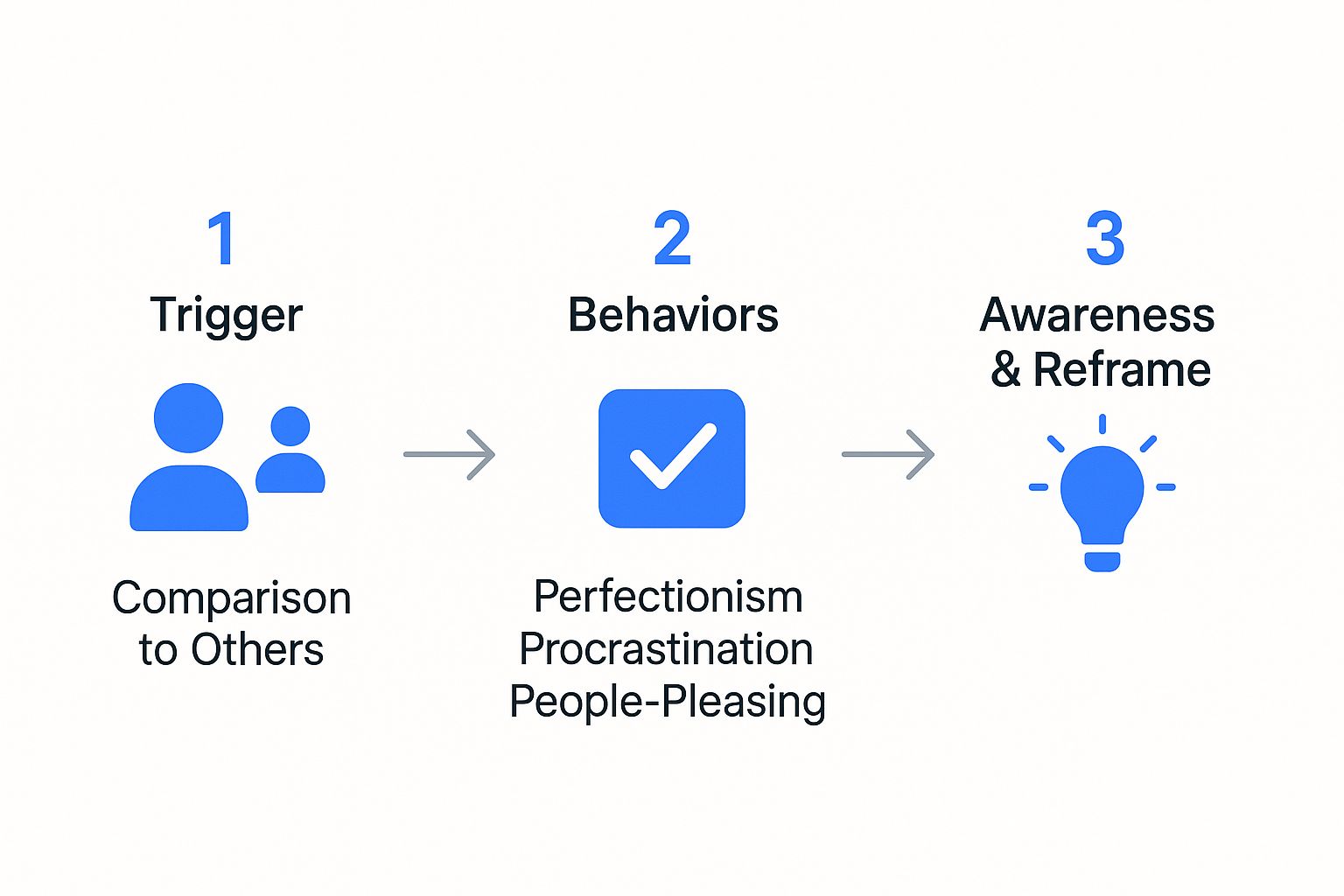
    The infographic below shows how a trigger can lead to these behaviours and how awareness can interrupt the cycle.

    Infographic showing a three-step process: A trigger like comparison leads to behaviours like perfectionism, which can be interrupted by awareness and reframing.

    Simply recognising the behaviour creates a crucial pause. In that pause, you have the power to respond thoughtfully instead of reacting out of fear.

    The Link Between Insecurity and Mental Health

    These daily challenges are deeply connected to our overall mental health. In the United States, which often reflects global trends, 23.1% of adults experienced a mental illness in 2022, with anxiety and depression being the most common. Insecurities often fuel these conditions, creating a cycle that can feel difficult to break.

    You can find more details in these important mental health statistics.

    Supportive Takeaway: Noticing how insecurity shows up in your life isn't an invitation for self-criticism. Think of it as an act of self-compassion. It's what empowers you to finally make choices that align with your true self, not your fears.

    This is where professional support can be a game-changer. Therapy or counselling provides a safe, non-judgmental space to unpack these patterns and build the resilience you need for lasting well-being and happiness. Please remember, any informational assessments here are for guidance, not diagnosis.

    Actionable Ways to Challenge Your Inner Critic

    A person journaling in a notebook, looking calm and focused.

    The nagging voice of insecurity can feel like the truth, but it's often a playlist of old, unhelpful stories. The key to turning down the volume is not forced positivity but gentle curiosity and questioning those automatic negative thoughts. This creates breathing room, giving you the power to choose a more balanced perspective.

    This is a gentle skill that helps you build genuine mental resilience. With practice, you can learn to respond to your inner critic with more compassion and wisdom.

    Questioning Your Automatic Thoughts

    Our brains use mental shortcuts that can become negative when we are stressed. These flawed thinking patterns, known as cognitive distortions, include jumping to conclusions or seeing things in black-and-white. Asking a few simple questions can help dismantle them.

    If you think, "I completely failed that presentation," pause and ask yourself:

    • Is this thought 100% true? Were there any parts that went well?
    • What’s a kinder way to look at this? Perhaps, "I was nervous and stumbled, but I also shared valuable information."
    • What would I say to a friend in this situation? Try offering yourself the same grace and encouragement.

    This practice is about finding a more complete and less punishing story. It can slowly rewire your default thinking and improve your overall well-being.

    Using a Journal to Spot Patterns

    Getting swirling, critical thoughts onto paper can be incredibly powerful. They become words you can observe objectively instead of an overwhelming feeling.

    Here are a few prompts to get you started:

    1. When did I feel most insecure today? Note the situation, your thoughts, and how it felt in your body.
    2. What is my inner critic’s go-to line? Identify recurring phrases like "You're not smart enough."
    3. Find one piece of evidence that proves that thought wrong. Did a friend send a kind message? Write it down.

    Over time, your journal reveals your thought patterns. You will see connections between triggers like workplace stress and your insecurities, which is the first step toward managing anxiety or depression.

    Supportive Takeaway: Learning to challenge your inner critic is a skill that gets stronger with practice. Every time you question a negative thought, you're building a healthier, more compassionate relationship with yourself. These small acts add up to real change.

    If these thoughts feel too big to handle alone, therapy or counselling can provide a safe, structured space to work through them. Remember that self-assessments are for informational purposes and are not a substitute for a professional diagnosis.

    Building a Foundation of Self-Compassion and Resilience

    A person watering a small plant, symbolising the nurturing of self-compassion and resilience.

    Managing insecurities is about changing the relationship you have with yourself to be kinder and more understanding. This is built on two powerful concepts: self-compassion and resilience. Self-compassion means treating yourself with the same care you would offer a friend.

    It involves accepting that mistakes and setbacks are part of being human, not personal failures. This mindset is the foundation for genuine emotional well-being.

    Cultivating Everyday Self-Compassion

    Self-compassion is built through small, consistent acts of kindness toward yourself, especially when you feel anxious or inadequate. Start by noticing your self-talk. When you make a mistake, do you immediately criticize yourself?

    Try to pause and approach the thought with gentle curiosity. For instance, replace "That was so stupid" with "That didn't go as planned. What can I learn?" This shift can soften the impact of workplace stress and daily pressures, helping to prevent feelings from spiralling into anxiety or depression.

    Supportive Takeaway: Treating yourself with compassion isn't selfish. It’s a crucial practice for building the inner strength needed to handle life's challenges with more grace and achieve greater happiness.

    Practical Steps to Build Resilience

    Resilience is the ability to bounce back from difficult experiences without letting them diminish your self-worth. It is like an emotional muscle that grows stronger with use.

    Here are ways to strengthen your resilience:

    • Celebrate Small Wins: Acknowledge your accomplishments, no matter how small. These victories create momentum and remind you of your capabilities.
    • Set Healthy Boundaries: Learning to say "no" to protect your energy is an act of self-respect. It reinforces that your needs matter.
    • View Vulnerability as a Strength: Opening up to a trusted friend or seeking counselling is a courageous step toward connection and emotional honesty.

    This is especially vital in situations like new motherhood, where support can be limited. Research on maternal mental health risks on PolicyCenterMMH.org shows a need for accessible ways for mothers to build resilience. Ultimately, these practices help you create a safe inner space where it is okay to be imperfect and grow.

    Knowing When and How to Seek Professional Support

    Asking for help is a powerful act of self-care and a sign of strength. If insecurities consistently affect your happiness, relationships, or daily life, it might be time to consider professional support like therapy or counselling. This is not admitting defeat; it is adding an expert to your team.

    A therapist provides a safe, confidential space to explore the roots of your insecurities without judgment. They can help you build personalised strategies for your mental well-being.

    What to Expect in Therapy

    The first therapy session is usually a conversation. Your therapist will ask what brought you in and what you hope to achieve. This is also your chance to see if you feel comfortable with them, as a strong therapeutic relationship is built on trust.

    Therapy is a collaborative journey to build lasting resilience against challenges like workplace stress, anxiety, and depression. The goal is to empower you to understand your patterns and make healthier choices.

    Supportive Takeaway: Seeking professional help is a proactive choice for your well-being. It’s like hiring a personal trainer for your mind—someone to guide, support, and challenge you to become the strongest version of yourself.

    Finding the Right Professional for You

    Finding a therapist who is a good fit is crucial. Look for licensed professionals with experience in the issues you are facing. In a diverse country like India, it can be helpful to find someone who understands your cultural background.

    Don't hesitate to have initial chats with a few therapists before deciding. Platforms like DeTalks can connect you with qualified professionals across India, making the first step less intimidating.

    Accessible care leads to better outcomes, as shown in The State of Mental Health in America 2025 report from mhanational.org. Reducing stigma and improving access are proven ways to help people manage their insecurities. Finally, please remember any self-assessments are informational and not a substitute for a professional diagnosis.

    Common Questions About Overcoming Insecurity

    As you build self-confidence, it is normal for questions to arise. Here are answers to some common ones to support you on your journey.

    Can Insecurities Ever Be Completely Cured?

    It is more helpful to think of managing insecurities rather than "curing" them. Everyone feels insecure at times; it is part of being human. The goal is to reduce their power over your life so they no longer prevent you from pursuing your goals and finding happiness.

    With consistent self-compassion and practice in challenging negative thoughts, you learn to handle these feelings when they appear. They may show up less often and with less intensity, improving your overall well-being.

    How Can I Support Someone Dealing With Insecurity?

    The best thing you can do is listen without judgment. Offer a safe space for them to share their feelings, and validate their experience by saying something like, "That sounds really difficult." Resist the urge to give advice or say, "Just be more confident."

    Instead, gently remind them of their strengths and past accomplishments. If their insecurities are significantly impacting their life, you can encourage them to consider professional support through therapy or counselling.

    Supportive Takeaway: True progress isn't about erasing insecurity, but about learning to live alongside it more peacefully. Every small step you take towards self-awareness and self-compassion builds a stronger, more resilient you.

    Is There a Difference Between Low Self-Esteem and Insecurity?

    Yes, though they are closely related. Low self-esteem is a more general, persistent feeling of not being "good enough." Insecurity is often more specific to a situation, like feeling insecure about public speaking due to workplace stress.

    However, persistent insecurities can erode your overall self-esteem over time. Working on specific insecurities can, in turn, boost your self-esteem and help reduce feelings of anxiety and depression.

    How Long Does It Take to See Progress?

    Everyone's journey is different, and progress is rarely a straight line. Some people notice small shifts in their thinking within a few weeks, while deeper insecurities may take months or years of dedicated work, often with a therapist.

    Focus on consistent effort rather than a deadline. Celebrate small wins and be patient and kind with yourself throughout the process. Please note that any assessments mentioned are for informational purposes only and are not a substitute for a professional diagnosis.


    At DeTalks, we believe everyone deserves to find the right support for their mental well-being. Whether you're ready to explore therapy for deep-seated insecurities, want the clarity of a psychological assessment, or simply want to build resilience for a happier life, our platform connects you with trusted professionals across India. Take the next step on your journey by exploring support options at DeTalks.