Tag: cbt

  • What Is Cognitive Behavioral Therapy and How It Works

    What Is Cognitive Behavioral Therapy and How It Works

    It's late, and a small worry from the day won't switch off. You replay a conversation, imagine what might go wrong tomorrow, and feel tense even though nothing new has happened. If that sounds familiar, you're not alone, and you're not failing at coping. You're noticing, in real time, how thoughts, feelings, and behaviour can amplify each other.

    A Practical Start to Understanding CBT

    There's a phone call you've been putting off all week. Each time you reach for your phone, your chest tightens, so you put the kettle on instead and promise yourself you'll do it after lunch. Tomorrow, the same thing happens.

    A thought set off a feeling, the feeling steered a behaviour, and the behaviour in turn confirmed the thought. Once you can see that sequence, it becomes something you can work with.

    What is cognitive behavioral therapy, in plain language? It's an active, structured, and time-limited form of therapy that helps you work with the links between thoughts, emotions, body reactions, and behaviour. Indian clinical history traces early behaviour therapy work to a 1952 paper by Ganguly in the Indian Journal of Neurology and Psychiatry, which means this approach has roots here rather than arriving as a wholly imported idea.

    A Learnable Skill, Not a Mystery

    CBT doesn't ask you to sit passively while someone interprets your life. You and your therapist choose a specific difficulty, map how it keeps going, and test small changes between sessions. Progress is reviewed as you go.

    Sessions feel closer to coaching than to a couch.

    That collaborative style suits everyday concerns alongside diagnosed conditions. People seek counselling for workplace stress, low mood, exam pressure, poor sleep, and burnout. CBT asks a few things of you in return:

    • A clear focus: One specific difficulty matters more than a vague wish to feel better
    • Practice between sessions: The therapy room works as rehearsal; meaningful change happens in ordinary life
    • Honest feedback: Telling your therapist when something doesn't fit is part of the work, especially when cultural context shapes what "helpful" means

    Children and neurodivergent clients may need CBT adapted in pace, language, and format. Families exploring that adaptation may find visual CBT strategies for autism useful as an example of how abstract ideas can be made concrete and visual.

    A gentle starting point: Feeling stuck in a loop doesn't mean you lack willpower. It often means the loop hasn't been made visible yet.

    Many people delay help because they imagine therapy must be endless or reserved for a crisis. CBT offers a clearer picture: skills learned step by step, practised in daily life, and built into resilience over time. How well it works also depends on fit and access, since cost, distance, language, and stigma still shape who can reach a trained therapist in India.

    How the Thoughts Feelings and Behaviour Loop Works

    A feedback loop in CBT works like an amplifier with a microphone held too close. A small input enters, the volume rises, and the sound feeds back until it feels overwhelming. A worry grows louder not because it is always true, but because each part of the system turns the others up.
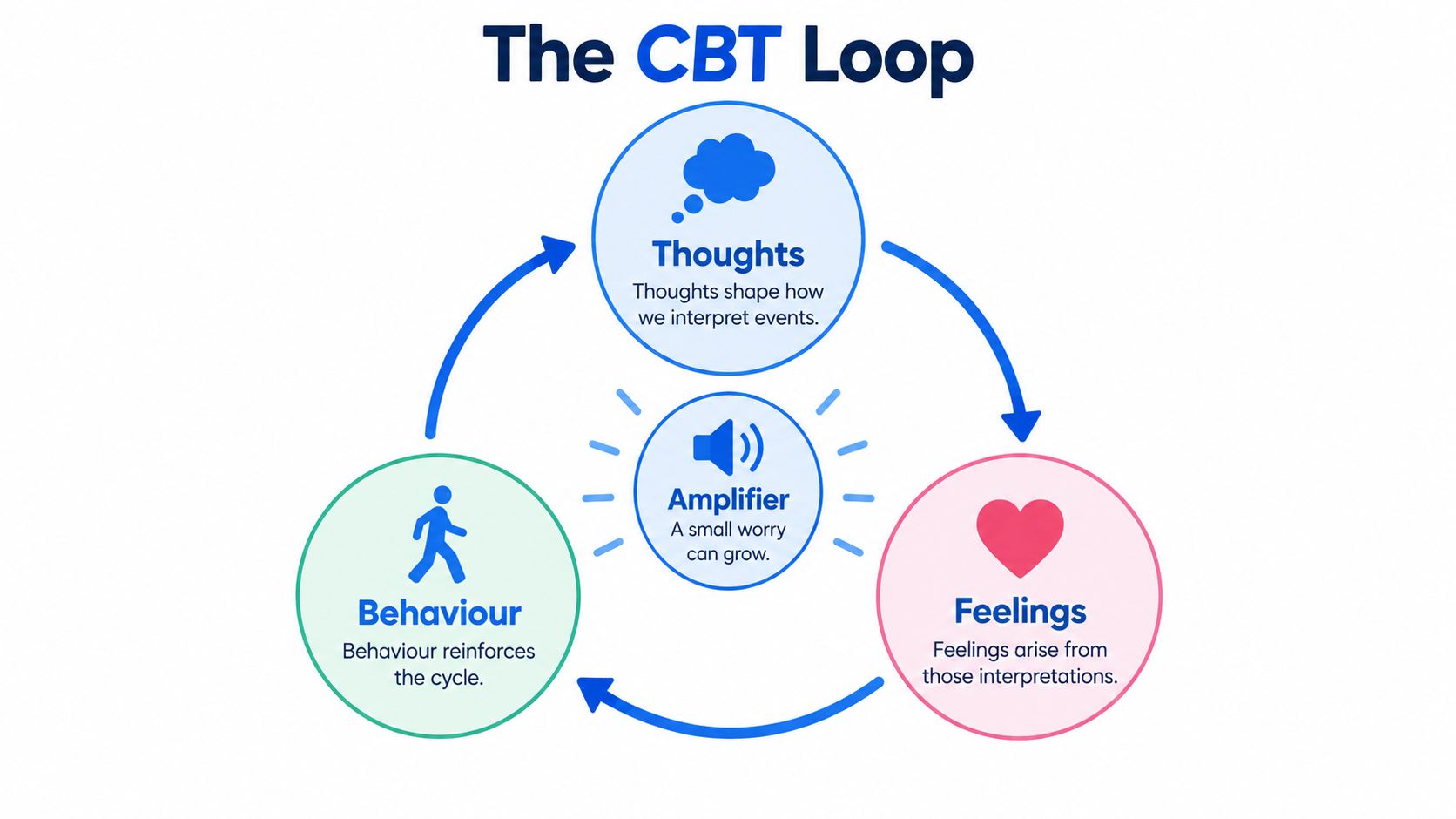
    A diagram of the CBT loop showing the circular relationship between thoughts, feelings, and behaviors with an amplifier.

    Take a presentation due at work. The thought "I must never make mistakes" arrives first, and anxiety follows close behind: racing heart, tight shoulders, restless sleep. Rehearsing feels like it would make the fear real, so you put it off.

    The relief is immediate, which is exactly the problem.

    Your brain records that avoidance worked and files the presentation under "dangerous." Less practice means lower confidence, and the original thought starts to look confirmed. CBT calls this a maintenance cycle, because each response helps keep the problem in place.

    The loop loosens when new information enters at one of four points.

    Point in the loop What CBT does there What it can look like
    Automatic thought Catch the quick interpretation before judging it Writing down "Everyone will judge me" and noting the trigger
    Prediction Test the forecast rather than argue with it Rehearsing for two minutes and observing what happens
    Behaviour Act against the urge to withdraw Scheduling one small, meaningful activity on a low-mood day
    Fear Approach it in graded steps Facing the feared situation from easier to harder versions

    Each row produces evidence the old loop could not. Rehearse briefly and cope better than expected, and the thought loses some authority. Take a short walk despite flat motivation, and you may notice energy or mood shift slightly afterward.

    Indian clinicians describe CBT as a skills-based, mechanism-oriented model: therapist and client build a shared formulation, then track practice and outcomes across treatment. One Indian social anxiety trial ran six weekly, two-hour group sessions and found gains that held at two-month follow-up, as reported in research on CBT formulation and delivery in Indian settings.

    That structure separates CBT from unstructured supportive counselling. Empathy and encouragement still matter, and a good therapist offers both. CBT adds a shared hypothesis, named techniques, and practice between sessions, so you learn which dial to reach for first and how to tell whether the volume changed.

    What Actually Happens in CBT Sessions

    A first CBT session usually feels more like a careful conversation than a test. Your therapist asks what brought you in, when the difficulty began, and how it affects sleep, work, relationships, and daily routines. You can share at your own pace.

    Together, you'll begin a formulation, a simple map of triggers, thoughts, feelings, body signals, and behaviour. That map helps you both decide what to work on first. It also prevents therapy from becoming a vague discussion of everything at once.

    The Rhythm of Middle Sessions

    Most sessions start with a brief check-in and review of practice from the previous week. You then set an agenda together, learn or rehearse a skill, and agree on a realistic task to try before the next meeting.

    1. Review: What did you notice when you tried the exercise?
    2. Focus: Which situation will you work on today?
    3. Practise: Can you rehearse the skill in session first?
    4. Plan: What's one small step you can repeat this week?

    Homework isn't schoolwork, and it isn't graded. It's where learning becomes real, because your difficult moments happen outside the therapy room. A two-minute thought record after a stressful meeting teaches more than only discussing that meeting a week later.

    If a worksheet feels impossible, say so. A good therapist will simplify the task, practise it with you, or choose a spoken or visual alternative.

    Measuring Change and Ending Well

    Therapists often track symptoms, sleep, avoidance, or activity levels to see whether the plan is helping. If progress stalls, the formulation can be revised. That flexibility is part of competent care, not a sign that you've failed.

    Length varies by concern, severity, and goals. For CBT for psychosis, Indian guidance describes treatment as individualised and commonly lasting 6 to 9 months, which you can read in the Indian Psychiatric Society guidance on CBT for psychotic disorders.

    Near the end, you'll review what helped, identify early warning signs, and make a plan for setbacks. The therapist acts as a guide, but the aim is for you to use the skills with growing independence. That clear ending can make booking a first session feel less like stepping into the unknown.

    Where CBT Has the Strongest Evidence

    A useful way to read the evidence is to ask what CBT is trying to change in each problem. For anxiety, the usual targets are threat interpretations and avoidance. For depression, the work often centres on withdrawal, inactivity, and harsh self-judgements that keep mood low.

    For post-traumatic stress disorder, CBT-based work may address trauma-related beliefs and avoidance of reminders, with specialist care. For obsessive-compulsive disorder, it focuses on intrusive thoughts, urges to neutralise them, and compulsive behaviour that prevents new learning.

    CBT Evidence at a Glance

    Condition What CBT Targets Evidence Snapshot
    Anxiety disorders Threat thoughts, avoidance, safety habits Supported in Indian clinical guidance, with honest limits on comparisons
    Depression Withdrawal, inactivity, self-critical thinking Practised and studied in Indian settings, including adolescent digital formats
    PTSD Trauma beliefs, avoidance, distress responses Listed among reported Indian CBT applications, specialist delivery matters
    OCD Intrusive thoughts and compulsive rituals Listed among reported Indian CBT applications, structured practice is central

    The Indian history matters mainly as context. As noted earlier, behaviour-therapy publication began modestly before CBT became more visible, and early reports were small rather than definitive. Their value is that clinicians were already testing whether these methods could fit Indian patients, languages, families, and clinic realities.

    That caution carries into current guidance. For generalised anxiety, Indian guidance supports CBT while staying careful about claims that it outperforms every other psychotherapy, because direct comparisons remain limited. Evidence-based means a method has been studied and shown to help enough people to take seriously. It still leaves room for judgement about culture, family setting, age, risk level, and goals.

    Reported Indian work spans panic disorder, schizophrenia, alcohol dependence, deliberate self-harm, tic disorders, and Asperger's disorder. Read that list as range, not as proof that one protocol fits all. Safety comes first: psychosis, self-harm risk, severe trauma responses, or substance withdrawal need assessment before self-guided tools.

    Follow-up in many Indian reports has often been short, so long-term outcomes are less clear than change measured soon after treatment. Online screening can help you name patterns, while diagnosis still needs a qualified clinician who can ask about history, risk, and context.

    Simple CBT Exercises You Can Try at Home

    A young engineer finishes a client presentation, watches her manager go quiet, and by dinner has decided she is about to be fired. Her job stayed the same through those hours. The only thing that changed was the thought she attached to a silent room, and home CBT practice begins in that gap between an event and the meaning the mind hands it.

    An open journal with a cognitive behavioral therapy template on a white desk with plants and coffee.

    A thought record is the gentlest entry point. Once the sharpest minute has passed, write down the situation, the automatic thought, and the feeling it produced. Then ask what evidence supports the thought, what pushes against it, and what a more balanced reading would be. Our engineer might land on: "I do not know why she went quiet, and my last review named specific strengths." A short honest note teaches more than a polished page.

    Behavioural activation enters the loop from the action side. Low mood usually makes motivation wait for action, so pick one small activity that once brought pleasure or a sense of finishing something, schedule it at a set time, and note your mood before and after. "Walk for ten minutes after lunch" gives the day a testable task. "Be more active" gives it a slogan.

    A graded exposure ladder suits avoidance. List the situations you skip, least difficult to most, then start with a step that feels challenging yet manageable. Repeat it until the fear flattens, then climb. The ladder works like physiotherapy: load gradually, and ease off if the strain feels unsafe.

    Across all three, keep steps specific, record what happened alongside what you feared, and read a missed day as information about barriers rather than failure.

    If the thought record still feels abstract, this short video shows how one is laid out before you try it yourself.

    Home exercises support learning, especially between sessions. Pause and take the practice to a qualified professional if it keeps raising distress, if trauma memories become overwhelming, or if symptoms feel severe, persistent, or unsafe. Practice builds skill. Assessment and safety decisions belong with a clinician.

    Common Myths and Cultural Fit in India

    The most common myth is that CBT means positive thinking. CBT doesn't ask you to replace a painful thought with a cheerful slogan. It asks whether the thought is accurate, helpful, and complete, then helps you test it in real life.
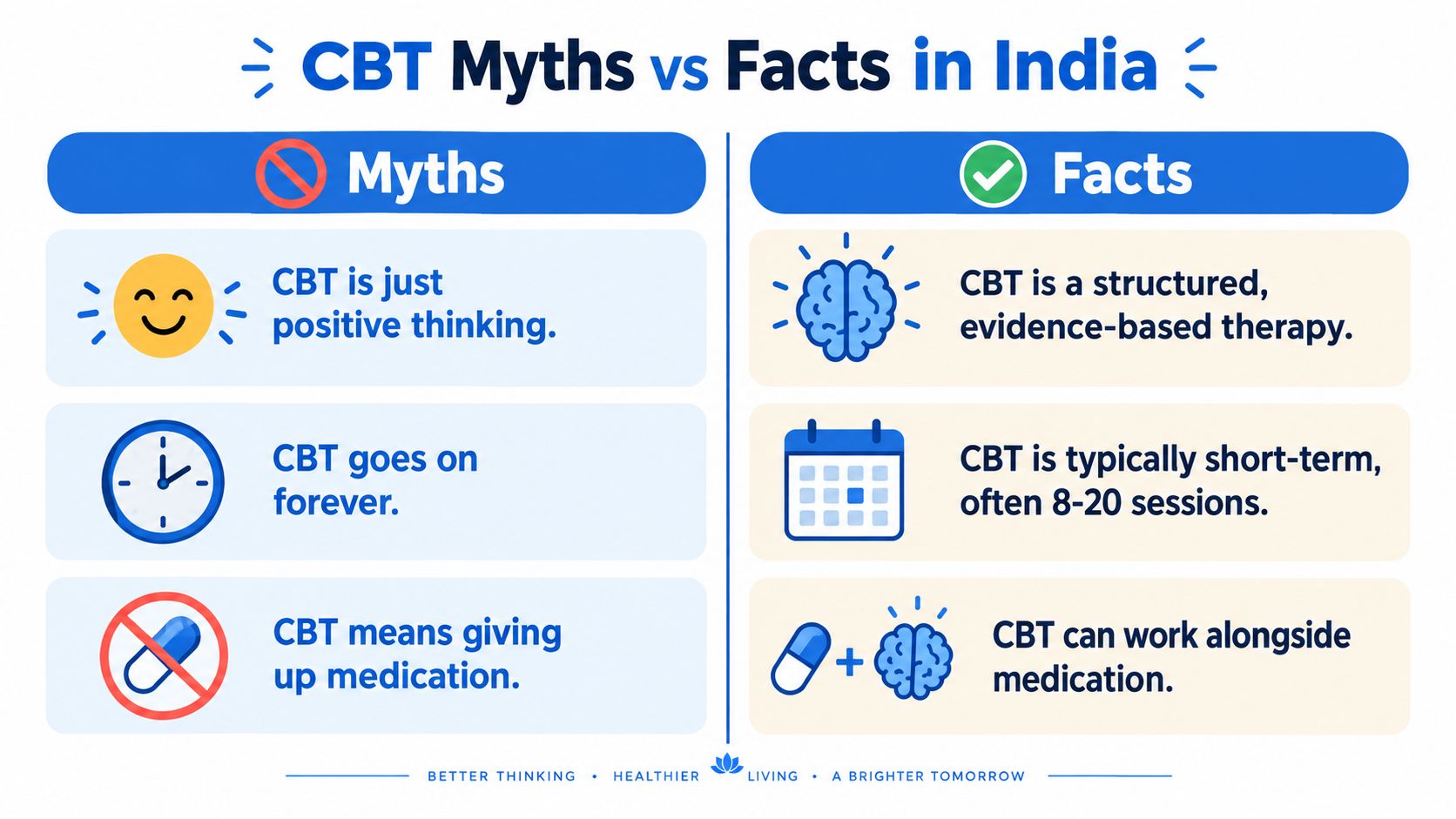
    A comparison chart showing common myths versus facts about cognitive behavioral therapy in the Indian context.

    Another myth is that CBT goes on forever. CBT is usually designed around goals and a defined course, although length varies with complexity. A third myth is that starting CBT means stopping medication, which isn't a decision to make alone or assume automatically.

    Will CBT Fit My Language and Family Life

    Many Indian readers think, worry, and describe distress in a regional language first. Therapy should make room for that language, because the words you use for fear, shame, heaviness, or bodily discomfort carry meaning. Simplified terminology, proverbs, and local stories can make concepts clearer without weakening the method.

    Distress may also appear through headaches, gastric discomfort, fatigue, or body pain. A culturally sensitive therapist won't dismiss those experiences as “just stress.” They'll explore body signals alongside thoughts, behaviour, family context, and medical needs, as discussed in qualitative research on cultural adaptation of CBT in India.

    Family involvement raises a fair concern. In some cases, a family member can support practice or understand the treatment plan, but that should happen with your consent and clear confidentiality boundaries. You're allowed to ask what will be shared, with whom, and why.

    A useful distinction: A cultural value deserves respect. An unhelpful belief is a rigid prediction or self-judgement that increases suffering and can be tested gently.

    For example, respecting elders is a value. Believing “If I disagree once, I am a bad person who will be rejected” is a prediction that may be examined. Good CBT doesn't ask you to abandon faith, family, or identity. It adapts examples and delivery while keeping the core skills intact, so therapy feels recognisable in your own life.

    Access Barriers and How to Find a CBT Therapist

    A teacher in Nagpur finally decides to try therapy. She searches online, finds profiles written in a language she only half-reads, sees fees she cannot compare, and closes the tab. That quiet moment, repeated across the country, shows why "CBT works" and "I can get CBT" are two different questions.

    The obstacles are real. Trained professionals are scarce and unevenly distributed, fees vary widely, stigma still discourages families, and many services operate only in English. Psychotherapy may also not be covered by insurance in many Asian settings, including India, as noted in commentary on CBT access and digital care challenges in India.

    The unmet need runs deep. India's National Mental Health Survey 2015–16 reported a treatment gap of 70% to 92% across mental health conditions, with 85% for common mental disorders. Clear information and accessible directories matter because many people who could benefit from care never receive it.

    A woman using a smartphone to search for a therapist while sitting next to a laptop computer.

    Choosing the Right Level of Care

    Different levels of distress call for different levels of help, and matching the two saves both money and time.

    If this describes you A reasonable starting point
    Mild stress; you are still managing day to day Guided self-help resources, while monitoring symptoms
    Distress persisting for weeks and affecting sleep, work, or relationships Counselling or structured CBT
    Severe symptoms, rapid changes, or any safety concern Psychiatric evaluation first

    Once you have a shortlist, a short first call tells you a great deal. Ask about qualifications, supervised CBT training, and experience with your specific concern. Ask how the therapist structures sessions, sets goals, uses between-session practice, and reviews progress. Ask about language, fees, format, confidentiality, and experience with family or cultural contexts. A good therapist welcomes these questions.

    DeTalks maintains a directory of psychologists and therapists across India, alongside scientifically validated assessments and self-help resources. It gives you one place to compare profiles and start a conversation. Any assessment result remains informational, not diagnostic, and should guide rather than replace professional evaluation.

    Digital CBT deserves the same scrutiny as in-person care. An English-language app is not automatically equivalent to therapist-supported treatment, especially when the content has not been adapted to Indian languages or contexts. Check who built the programme, whether human support exists, and how your data is handled.

    One caution sits above all of this. If you have suicidal thoughts, severe depression, possible bipolar symptoms, psychosis, or overwhelming trauma reactions, self-guided work is not enough. Those situations need prompt professional evaluation and a safety plan, and seeking urgent help is a responsible step toward well-being.

    Supportive Takeaways for Your Well-Being Journey

    CBT is one practical, evidence-based path for anxiety, depression, stress, and burnout. It doesn't promise a cure, and it doesn't require you to become a different person. It teaches you to notice a loop, test it, and respond with a little more choice.

    Well-being also grows through self-compassion, rest, connection, and meaning. Some readers draw encouragement from spiritual reading alongside therapy, such as a Bible verse encouragement guide, while others prefer reflection, community, or quiet time. Choose supports that respect your beliefs.

    Start small this week. Try one thought record, schedule one restorative activity, or book one exploratory session if distress is interfering with sleep, relationships, or work. Help-seeking is a responsible well-being practice, and small repeatable steps can strengthen resilience over time.


    If you're ready to explore CBT with professional support, DeTalks can help you find psychologists and therapists across India, explore confidential informational assessments, and access self-help resources matched to concerns such as anxiety, depression, and workplace stress. Visit DeTalks to compare qualified professionals and book an initial conversation when you're ready.

  • A Guide to Modern Techniques of Counselling

    A Guide to Modern Techniques of Counselling

    Welcome to the world of therapy—a space designed for growth, healing, and self-discovery. This guide is here to explain the core techniques of counselling in a simple, warm way. These are structured, proven methods that therapists use to help you navigate life's challenges, from everyday anxiety and workplace stress to building deeper happiness.

    Think of these techniques as a practical toolkit for building resilience and nurturing your mental well-being. This journey is about understanding yourself better and finding supportive ways to move forward.

    Your Journey into Counselling Techniques

    Deciding to start counselling is a brave and powerful step towards a healthier, more fulfilling life. It’s a partnership where a trained professional uses specific, thoughtful approaches to help you make sense of your thoughts, feelings, and behaviours. The entire process is designed to create a safe, supportive space for you to heal and grow.

    A person walks down a foggy park path at sunrise, holding a book, surrounded by trees.

    In this guide, we'll walk through everything from foundational skills like active listening to powerful, structured approaches like Cognitive Behavioural Therapy (CBT). Our aim is to give you a clear, empathetic overview, showing how different techniques are matched to different needs. Understanding these methods helps demystify what happens in a therapy session, making it feel much more approachable.

    The Evolution of Counselling in India

    The practice of counselling in India has grown immensely, blending global knowledge with local understanding. Early psychological labs, like the one at Calcutta University in 1915, laid the groundwork for modern mental health support.

    Today, the field has moved far beyond simple advice-giving, embracing evidence-based methods to address common challenges like anxiety and depression. This shift reflects a global move towards care that truly works, tailored to be relatable and effective for people across India and the world.

    Why Understanding These Techniques Matters

    When you know the basics of counselling techniques, you become an active partner in your own healing journey. Understanding the "why" behind your therapist's approach allows you to engage more deeply and build a stronger therapeutic relationship.

    This knowledge is helpful for managing issues like workplace stress and for cultivating positive qualities like resilience, compassion, and happiness. It’s about finding what works for you and gathering the tools to build a more balanced life.

    The most important thing to remember is that therapy is not a one-size-fits-all solution. The rich variety of techniques ensures that the support you receive can be tailored to your unique personality, background, and goals.

    For those considering a professional path in this field, grasping adult learning theory principles can make a world of difference in mastering these techniques. Ultimately, this journey is about finding what works for you and gathering the tools to build a more resilient, balanced life.

    The Power of Being Truly Heard

    Every meaningful counselling journey starts with something simple, yet incredibly profound: being truly heard. Active listening and empathy are the bedrock techniques of effective therapy. At its core, therapy provides a unique space where you can feel completely seen and understood, often for the very first time.

    When a counsellor truly tunes in, they are listening for the feelings beneath your words, which builds a powerful sense of trust. For anyone navigating the fog of depression or the constant buzz of anxiety, this simple act of being understood can be the first real step towards healing.

    What Active Listening Really Means

    Active listening is a structured way of hearing and responding that creates genuine understanding. It is one of the most vital techniques of counselling, involving more than just staying quiet while you talk. It's a fully engaged, dynamic process.

    Your therapist acts as an emotional mirror, reflecting back your thoughts and feelings without judgment. This helps you see your own emotions more clearly and feel validated for having them. This is especially important when you’re wrestling with overwhelming feelings from workplace stress or difficult relationships.

    Here’s what it looks like in practice during therapy:

    • Undivided Attention: Your therapist shows they are focused entirely on you with their body language and focus. It’s a non-verbal way of saying, "You matter."
    • Paraphrasing for Clarity: They might rephrase what you’ve said, like "It sounds like you're feeling completely overwhelmed." This isn't just repetition; it's a check to ensure they understand.
    • Reflecting Feelings: A good therapist listens for the emotion behind your words, saying something like, "That must feel incredibly frustrating."

    The Role of Empathy in Building Trust

    If active listening is the 'how', then empathy is the 'why'—it's the soul of the therapeutic connection. Empathy is the ability to genuinely step into your shoes and understand your experiences from your point of view.

    This authentic understanding forges the therapeutic alliance, the strong, trusting bond between you and your counsellor. Research shows that a strong alliance is one of the biggest predictors of a positive therapy outcome, no matter which techniques of counselling are used.

    A therapeutic relationship built on empathy creates a safe harbour. It’s a space where you can be vulnerable without fear of judgement, allowing for deeper exploration and growth toward better well-being.

    Empathy tells you that your feelings are valid, which is an incredibly powerful experience. When someone truly understands, the weight of carrying difficult emotions alone begins to lift. For anyone looking to foster this in other settings, exploring community circle questions to spark deeper connection can offer practical ideas.

    From Listening to Healing

    Active listening and empathy are powerful healing actions in themselves. This foundation is what allows all other therapeutic techniques to work effectively. It creates a stable ground from which you can start to build resilience and explore real change, transforming the counselling room into a space of safety.

    Ultimately, being truly heard is a fundamental human need. When that need is met within a professional, caring environment, it opens the door to self-compassion, new insights, and lasting positive change.

    How CBT Retrains Your Brain for Well-Being

    Of all the modern techniques of counselling, few are as widely practiced as Cognitive Behavioural Therapy, or CBT. The idea at its heart is simple and powerful: your thoughts, feelings, and actions are all connected. When you change one, the others follow.

    A man places sticky notes on a whiteboard labeled 'Negative' and 'Reframe'.

    This means that if you can learn to change unhelpful thought patterns, you can directly influence your emotional well-being and how you act. CBT is a hands-on, skill-building approach that gives you the tools to navigate life’s challenges long after your sessions are over.

    The CBT Triangle in Action

    Let’s make this real with an example of workplace stress. Imagine you have a big presentation coming up, and the thought, "I'm going to mess this up," pops into your head. That thought triggers a knot of anxiety in your stomach, which then leads you to avoid practicing.

    CBT works by showing you how to break this cycle at the source: the thought. A counsellor helps you spot these automatic patterns and gives you practical strategies to challenge that initial negative thought, building emotional control and resilience.

    "CBT is less about dwelling on the past and more about equipping you with practical skills for the present and future. It’s an active, collaborative form of therapy where you learn how to retrain your brain for healthier responses."

    Modern counselling in India has been profoundly shaped by these cognitive-behavioural techniques. Structured approaches like CBT have gained serious traction in both research and clinical practice. You can dig deeper into the growth of these methods in psychotherapy with Indian clients.

    Key CBT Tools for Your Everyday Life

    CBT is a collection of practical tools, and your therapist acts as a coach, guiding you through exercises to reshape how you think and act. While some assessments might be used to identify patterns, they are always informational tools, not rigid diagnostic labels.

    Here are a couple of the most common and powerful CBT techniques:

    • Cognitive Restructuring: This is the core skill of identifying, questioning, and changing unhelpful thoughts. You learn to catch "automatic negative thoughts" and examine the actual evidence for and against them.
    • Behavioural Activation: This technique is a game-changer for tackling depression and low motivation. It involves intentionally scheduling positive activities into your day to counteract the tendency to withdraw and help lift your mood.

    The table below summarises some key CBT techniques and where they are most helpful.

    Common CBT Techniques and Their Applications

    CBT Technique What It Does Commonly Used For
    Cognitive Restructuring Identifies and challenges negative or irrational thought patterns. Anxiety, depression, phobias, low self-esteem
    Behavioural Activation Schedules positive, rewarding activities to combat withdrawal. Depression, apathy, lack of motivation
    Exposure Therapy Gradually exposes a person to their fears in a safe setting. Phobias, panic disorder, obsessive-compulsive disorder (OCD)
    Journaling Tracks thoughts, feelings, and behaviours to identify patterns. General anxiety, stress management, self-awareness
    Problem-Solving Skills Breaks down overwhelming problems into manageable steps. Stress, anxiety, decision-making difficulties

    These techniques are the building blocks of CBT, helping you develop a more balanced and realistic perspective on life's challenges.

    Putting CBT into Practice

    So, what does this look like in the real world?

    Example 1: A Student with Exam Anxiety

    • Automatic Thought: "If I fail this exam, my future is ruined."
    • Cognitive Restructuring: A therapist would help the student challenge this by reframing it: "This exam is important, but my worth isn't defined by a grade."
    • Behavioural Activation: Instead of avoiding study out of fear, the student creates a structured study plan with small, achievable goals to build confidence.

    Example 2: A Professional Facing Workplace Burnout

    • Automatic Thought: "I can't cope with this workplace stress. I'm a complete failure."
    • Cognitive Restructuring: A counsellor helps them question this, reframing the thought to: "I'm feeling overwhelmed, which is normal. I need to find better strategies to manage my workload."
    • Behavioural Activation: The professional intentionally schedules restorative activities, like taking a proper lunch break or dedicating time to a hobby, to fight burnout.

    With practice, these CBT skills start to feel natural. You learn to pause, notice your thoughts without judgment, and choose a more helpful way forward, building lasting pathways to greater mental well-being.

    Fostering Growth with Person-Centred Therapy

    Person-centred therapy is built on a simple yet powerful idea: you already have the capacity to grow and find your own answers. The therapist is not an expert with all the solutions, but a genuine, supportive guide on your journey.

    This gentle form of therapy is all about helping you tap into your own inner resources. It creates a safe, non-judgemental space where you can freely explore your true feelings, build self-worth, and uncover the path that feels right for you. It's a journey of self-discovery, perfect for anyone looking to grow, boost their self-esteem, or find a clearer sense of purpose.

    The Three Core Conditions

    For person-centred therapy to work, the therapist cultivates a nurturing environment based on three core conditions. When a therapist embodies these qualities, they create the ideal soil for emotional growth and healing.

    These conditions are:

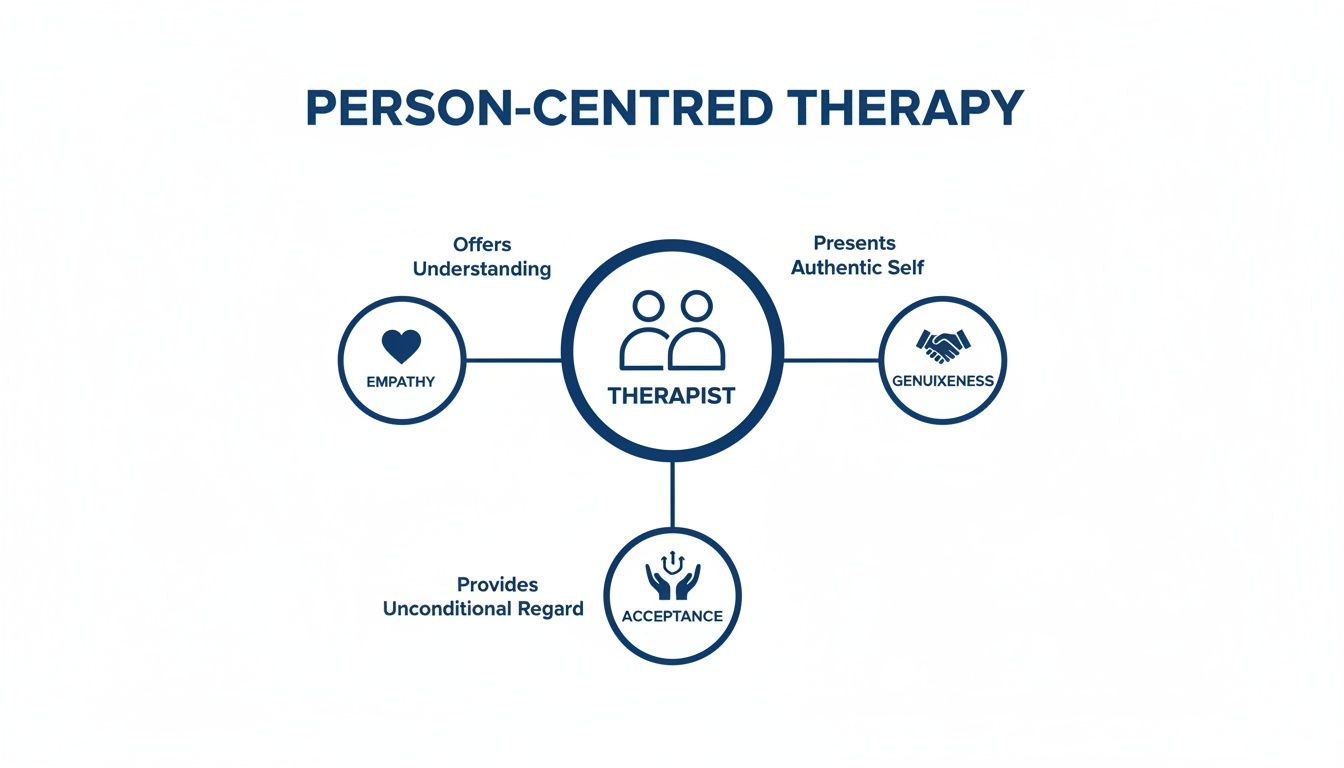
    • Unconditional Positive Regard: The therapist accepts you completely, without any "ifs" or "buts." You are valued for exactly who you are.
    • Empathy: The therapist works hard to understand your world from your point of view, helping you feel truly seen and understood.
    • Genuineness (or Congruence): Your counsellor is real with you, without a professional mask. This encourages you to be your true self, too.

    This approach is fantastic for improving your overall well-being by strengthening your relationship with yourself. It helps you move away from a harsh inner critic and towards a place of genuine self-acceptance and compassion.

    How Person-Centred Counselling Feels in Practice

    Unlike more structured therapies, a person-centred session feels more like a natural conversation. The session flows based on whatever you feel is most important to talk about that day. The focus is on your immediate experience—what you’re thinking and feeling in the here and now.

    Let's say you come to a session feeling overwhelmed by workplace stress. A person-centred therapist would first listen with deep empathy as you talk about feeling inadequate. They might reflect back with something like, "It sounds incredibly draining to feel like you have to be perfect all the time."

    Hearing your experience mirrored back without judgement is incredibly powerful. This process validates your feelings, helps you untangle them, and builds your resilience from the inside out.

    Who Benefits Most from This Approach

    While its core principles are a cornerstone of any good counselling relationship, this approach is brilliant for certain goals. It's an excellent choice if you're grappling with self-esteem, figuring out your identity, or feeling "stuck" in life.

    It's also a powerful way to work through mild to moderate anxiety and depression. By nurturing a strong sense of self-worth, it empowers you to manage your emotional world with more confidence. The skills you learn—like self-acceptance and trusting your inner voice—are tools you can carry with you for life.

    A Look at Other Powerful Counselling Methods

    The world of therapy is rich and varied, and different challenges call for different tools. Understanding the breadth of options can make the journey towards feeling better seem more hopeful. Specialised techniques offer unique pathways to healing, whether you're navigating family dynamics or processing a painful past.

    Exploring these different techniques of counselling reveals that support should be shaped to fit your life story and goals. It’s not about finding one "best" method, but about discovering the approach that resonates with you.

    Understanding Our Connections with Systemic and Family Therapy

    Sometimes, the problems we carry are tangled up in our relationships. Systemic and Family Therapy looks at us not in isolation, but within the context of our family and community. The core idea is that our struggles often emerge from the systems we're a part of.

    Instead of singling out one person as "the problem," this form of therapy explores the unspoken rules and communication habits within a group. It’s useful for resolving family conflicts or helping partners communicate better, aiming to forge healthier connections for everyone.

    The image below shows the core conditions of Person-Centred Therapy, which often provides a vital foundation for relationship-focused approaches.

    Diagram illustrating person-centred therapy, highlighting therapist conditions: empathy, genuineness, and acceptance.

    It’s a great visual reminder of how a therapist’s empathy, genuineness, and unconditional acceptance create the safe space needed to explore sensitive relationship issues.

    Finding Your Own Drive with Motivational Interviewing

    Have you ever felt completely stuck, knowing you need to make a change but lacking the motivation? That's where Motivational Interviewing (MI) comes in. It’s a collaborative counselling style designed to help you unearth and strengthen your own internal drive for change.

    A therapist using MI acts as a partner, helping you explore your own reasons for wanting something different. This technique works wonders for making lifestyle changes or breaking unhelpful habits. Because it’s built on respect for your autonomy, it empowers you to become the expert on your own life and build the resilience to follow through.

    Motivational Interviewing is based on a powerful idea: real, lasting change comes from within. A therapist's role is simply to help you find your own compelling reasons to grow, making the whole process feel more authentic and sustainable.

    In India, counsellors are brilliant at adapting Western models like these to better fit local culture. You can learn more about how Indian therapists adapt these models to provide care that’s both culturally sensitive and highly effective.

    Healing from Trauma with EMDR

    For anyone who has experienced trauma, certain memories can get "stuck," causing ongoing distress, anxiety, or other difficult symptoms. Eye Movement Desensitization and Reprocessing (EMDR) is a structured therapy developed to help people process these traumatic memories.

    During an EMDR session, the therapist guides you to focus on a memory while engaging in bilateral stimulation, like following their fingers with your eyes. This process helps the brain reboot its natural healing system, allowing you to reprocess the memory so it loses its disruptive emotional charge. EMDR is a well-researched technique for helping people find relief from the heavy weight of past trauma.

    Each of these methods shows that no matter what you're facing—from workplace stress to deep-seated trauma—there are effective techniques of counselling out there. The journey is about finding the right key to unlock your own path to healing and growth.

    Finding a Therapist Who's Right for You

    Taking that first step towards counselling is a huge win, and often the hardest part of the process. Now, let's talk about how to find a therapist and an approach that genuinely clicks with who you are. The secret isn't finding the "best" technique, but discovering what feels right for you.

    Remember, starting therapy is a proactive move towards building your well-being and resilience, not a quick fix. The connection you have with your therapist is one of the biggest factors in your progress, so it pays to find someone you trust.

    Starting Your Search with DeTalks

    Trying to find a qualified professional can feel overwhelming. Platforms like DeTalks make the process much clearer. You can easily browse profiles of verified therapists, read about their specialties, and get a sense of the techniques of counselling they use.

    As you look, see whose approach resonates with you. Maybe the practical nature of CBT appeals to you, or perhaps the gentle, self-exploratory space of Person-Centred therapy feels more fitting. Whatever it is, trust your gut.

    What to Look for in a Therapist

    When sifting through profiles, a few key things can help you narrow the field. A great therapeutic relationship is built on trust, respect, and feeling that someone truly understands you.

    Here are some practical points to keep in mind:

    • Specialisation: Does the therapist have experience with what you're dealing with, like workplace stress, anxiety, or relationship troubles?
    • Therapeutic Approach: Do they focus on a technique that interests you? Many therapists are integrative, but it’s helpful to know their main style.
    • Initial Consultation: Many therapists offer a short introductory call. This is your chance to ask questions and check the vibe. Do you feel comfortable opening up to them?

    It's completely okay to chat with a few different therapists before you decide. This is your journey, and finding a partner you connect with is the most important ingredient for success.

    Using Assessments to Point You in the Right Direction

    If you’re looking for more clarity on what you need, the scientifically validated psychological assessments on DeTalks can be a great resource. These tools can offer useful insights into your emotional patterns, personality, or specific challenges like depression.

    It’s crucial to remember that these are for information, not diagnosis. They act as a helpful starting point, giving you and a potential therapist some shared language for your first conversations. Your path to healing is your own, and finding the right support is a powerful first step.

    Frequently Asked Questions

    It’s completely normal to have questions when you’re thinking about starting counselling. Let's walk through some of the most common ones to help clear things up.

    How Do I Know Which Counselling Technique Is Right for Me?

    The good news is, you don’t have to have this figured out beforehand. A skilled therapist will get to know you first, often drawing from different techniques of counselling to create a plan that fits you perfectly.

    Those first few sessions are about conversation and connection. Your therapist will focus on understanding what you're going through, and together you will decide on the best way forward.

    Are Online Therapy Sessions as Effective as In-Person Ones?

    Yes, they absolutely can be. Research confirms that for common concerns like anxiety and depression, online therapy works just as well as face-to-face sessions. It offers a level of convenience that can make all the difference when you're juggling a busy life or dealing with workplace stress.

    What truly makes therapy work is the connection you have with your therapist. That sense of trust and rapport is the foundation for real progress, whether online or in an office.

    What Is the Difference Between Counselling and Therapy?

    You'll often hear these words used to mean the same thing, and that's generally okay. Both involve a trained professional helping you improve your mental health in a supportive way. Some might say counselling is for shorter-term problems, while therapy tackles deeper patterns, but in practice, the lines are blurry.

    The real goal for both is the same: to help you understand yourself better, learn new ways to cope, and build a more satisfying life. The most important thing isn't the label, but finding a qualified person you feel a genuine connection with.

    How Long Does Counselling Usually Take?

    There’s no one-size-fits-all answer, as everyone's journey is different. Some people get what they need in a few sessions, while for others, exploring deeper-rooted issues like chronic anxiety might mean longer-term support is more helpful.

    It’s something you and your therapist will figure out together. The focus is always on your progress and what you need to feel confident and supported, not on a rigid schedule.


    This guide is meant to offer supportive takeaways, not promises of a cure. The journey toward well-being is personal, and finding the right person to talk to is the most important step you can take. DeTalks makes that step easier by connecting you with verified therapists and providing informational assessments to help point you in the right direction. You can start exploring your options and find a professional who understands you at https://detalks.com.