EMDR therapy in India is commonly estimated at ₹2,000–₹6,000 per session, and the fee moves with the clinician's training, experience and city. An eight-session course therefore comes to roughly ₹16,000–₹48,000 before assessments, psychiatric consultations or travel.
That headline number is only half the story. The same country that hosts senior trauma specialists charging several thousand rupees an hour also runs public counselling services at a tiny fraction of that price, so the range you're quoted tells you as much about the setting as it does about the therapy.
Nothing here promises a result. It's a budgeting tool, so you can plan calmly instead of guessing.
Typical EMDR Therapy Costs in India by Provider Level
India has no nationally standardised EMDR tariff, so treat every figure below as an estimate rather than a fixed rate. A 2024 peer-reviewed article on psychotherapy insurance in India reported average therapy sessions in Indian metropolitan areas at roughly ₹1,000–₹1,500, covering digital and in-person formats, and counselling at NIMHANS in Bengaluru at about ₹100–₹200 per session, excluding psychological assessment.
EMDR sits above that baseline for a reason. The method calls for modality-specific training and supervised practice, and it is commonly used for trauma, PTSD and related anxiety, where sessions are planned and paced rather than open-ended. Quotes still vary widely between providers, since no regulator sets the fee.
Reference costs for therapy in India, by provider level
| Provider or service | Typical fee per session | Estimated 8-session cost | Best suited for |
|---|---|---|---|
| Public counselling, NIMHANS Bengaluru | ₹100–₹200 | ₹800–₹1,600 | Routine counselling, excluding assessment |
| Early-career or supervised therapist | ₹800–₹1,200 | ₹6,400–₹9,600 | Budget general therapy, not specialist EMDR |
| General private psychotherapy, metro cities | ₹1,000–₹1,500 | ₹8,000–₹12,000 | Everyday stress, anxiety and grief support |
| Senior or specialised psychologist, general therapy | ₹2,000–₹5,000 | ₹16,000–₹40,000 | Complex cases and experienced clinicians |
| Qualified EMDR therapist | ₹2,000–₹6,000 | ₹16,000–₹48,000 | Trauma, PTSD and related distress |
Read the table as one scale, not five separate markets. On these figures, a specialist EMDR session runs roughly 1.3 to 6 times the metro average for general therapy, depending on the clinician's seniority and setting.
The per-session column works like a nightly hotel rate: useful, but incomplete on its own. The eight-session column shows the cost of the full stay, and that is the number your budget needs. Two identical session fees can also buy different amounts of contact time, so dividing a quoted fee by the minutes you receive gives a fairer price-per-hour comparison than the headline figure. And because a quote covers the appointment itself, ask the provider to list anything billed on top of it before you commit.
Practical rule: budget for the course, not the appointment. A quoted session fee rarely equals your total spend.
If cost is the barrier right now, that is a legitimate clinical conversation. Say your budget out loud at the first enquiry and ask what is available within it.
What Drives the Price of an EMDR Course
Four things move the number: where the clinic is, what the clinician has trained in, how the session is delivered, and how long it runs. Picture the market as a ladder rather than a single average.
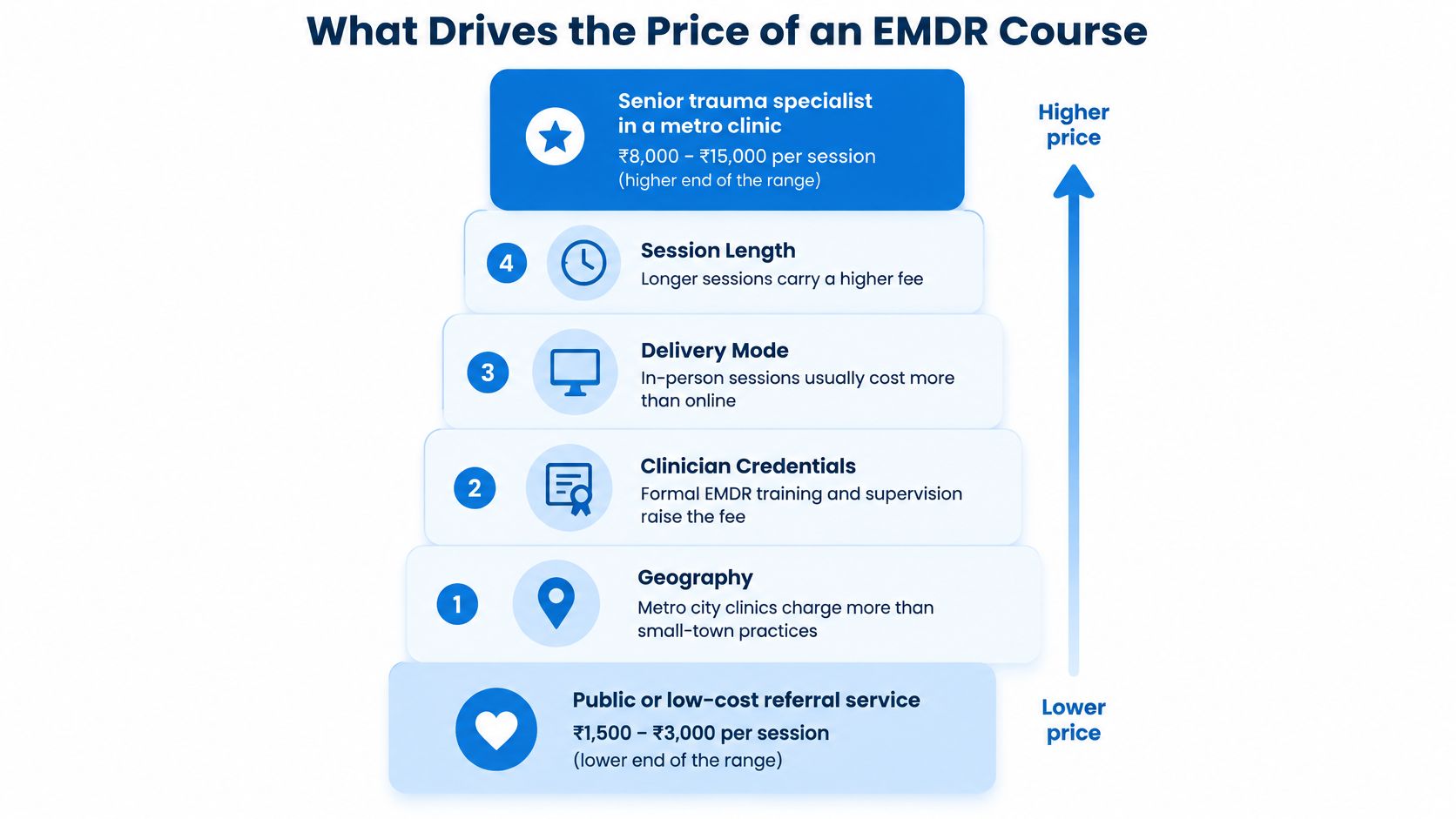
- Geography: a metro clinic with higher rents and stronger demand usually sits above a small-town practice.
- Credentials: formal EMDR training with ongoing supervision is a real cost to the clinician, and it shows in the fee.
- Delivery mode: some providers price online and in-person sessions differently, so ask rather than assume.
- Session length: a longer appointment carries a higher fee, which isn't the same as worse value.
Indian cost guides described in an India-focused therapy cost guide report general therapy at about ₹800–₹3,500 for a 50–60-minute session, while senior or specialised psychologists may charge ₹2,000–₹5,000. At the top of the ladder sits a senior trauma specialist in a metro clinic. Near the bottom sits a supervised early-career clinician or a subsidised service.
How a small gap multiplies
Per-session differences look minor until you multiply them. At ₹2,000 per session, six sessions total ₹12,000; at ₹6,000 per session, the same six sessions total ₹36,000. Stretch the plan to twelve sessions and the range becomes ₹24,000 to ₹72,000.
Those totals exclude intake assessments and medication, which may be billed separately, so treat them as a planning floor rather than a final bill.
Online care can trim the hidden side of the budget: no travel fare, no half-day lost at work, no childcare arrangement. It won't automatically cut the session fee, though, and a higher fee never guarantees a better clinical fit.
Public, Low-Cost and Private Options Compared
Three routes are open to people in India, and each serves a different situation. Think of the choice like picking transport: a bus gets you toward the same city, but a specialist vehicle may be needed for rough terrain. The affordability gap between routes is wide.
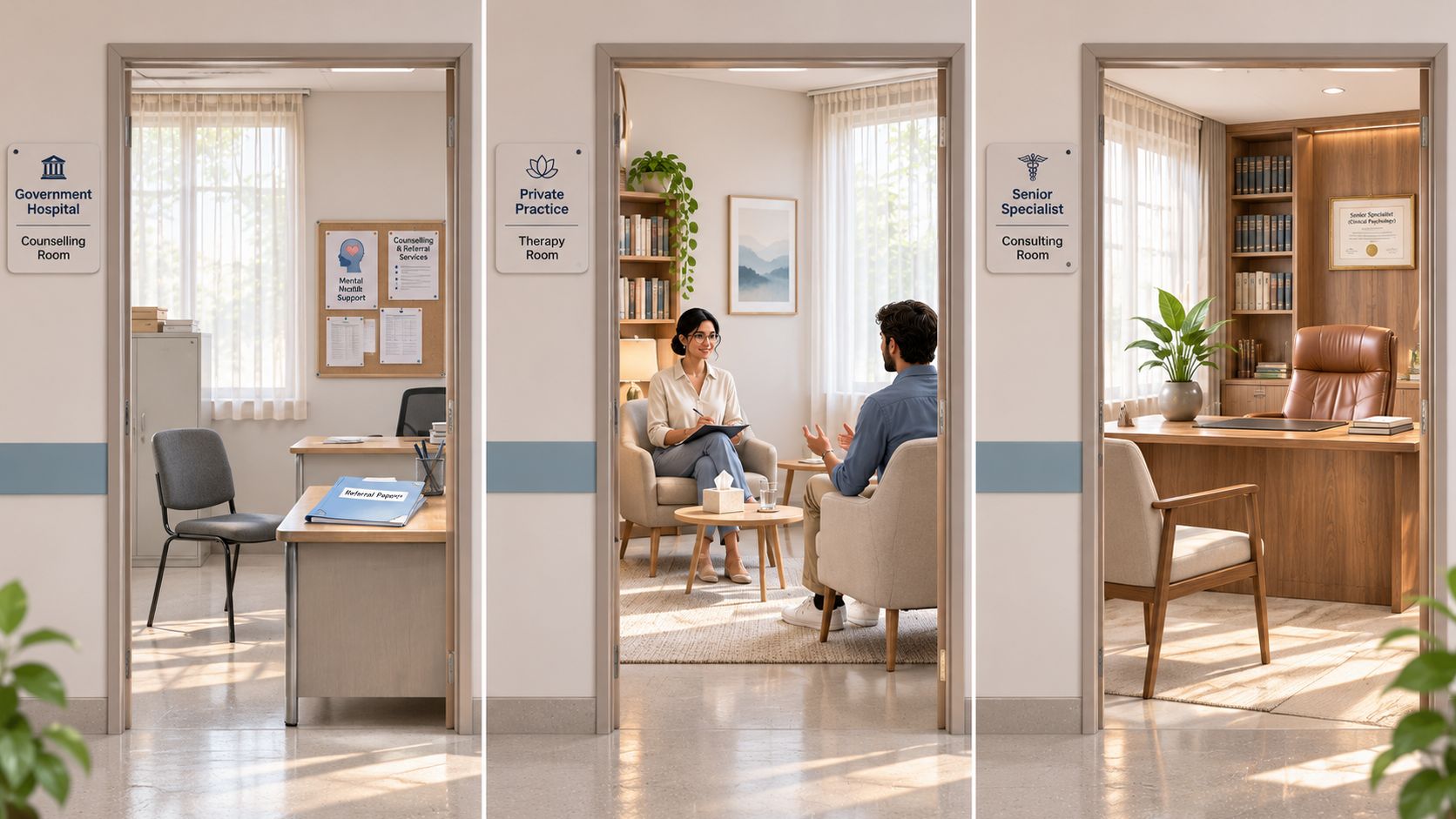
A Government of India NSS-based analysis published as an issue brief on the cost of care reported average monthly psychiatric-treatment expenditure of ₹770 per patient, including ₹390 for medicines and approximately ₹260 for consultation, and noted that public-sector consultations may be free or minimally priced while private care is chargeable. That isn't an EMDR tariff, but it explains why specialist trauma therapy can feel out of reach beside routine public care. The same headline fee can also hide different amounts of care, so compare the whole course and the effective price per treatment hour, not only the number quoted for one appointment.
Public or low-cost referral
This route suits you if you need support first and your budget is tight. Government hospitals, medical college psychiatry departments and community mental-health programmes can offer assessment, medication and counselling, and they can refer you onward. Ask specifically whether trauma-focused therapy is available on site, because general counselling and EMDR aren't the same service. A lower bill may mean fewer sessions, longer waiting time, or a consultation that does not include EMDR processing, so ask what the quoted amount covers before treating it as a course price.
A standard qualified therapist
For everyday stress, anxiety, grief or workplace stress, a qualified psychologist in private practice is often the sensible middle path. Private-practice psychologist fees in India vary widely by city and qualification, so one national average would mislead you badly. Filter by qualification and concern, then ask how many sessions the proposed plan includes. A modest per-session quote can become a larger course cost if assessment, reviews and extra appointments sit outside it.
A senior trauma specialist
If you're working with PTSD, a long trauma history or complex symptoms, specialist experience matters more than a lower fee. Ask whether a referral from a GP or psychiatrist is needed, since that appointment adds its own cost. A senior specialist may also suggest a longer course, which can raise the full cost even when the hourly price seems reasonable.
Ask every provider whether they offer a package covering assessment plus four or eight sessions, and what happens to unused sessions if you pause.
There's no single right route. Plenty of people start with low-cost support, then move to specialist work when they're ready and able.
Session Length and Hidden Costs to Plan For
A headline fee can mislead you when session lengths differ. Divide the fee by the hours delivered, and the picture often flips.
A ₹3,000 90-minute session works out to ₹2,000 per treatment hour, while a ₹2,500 50-minute session works out to ₹3,000 per treatment hour, as an India EMDR pricing guide illustrates. That guide places EMDR in India at approximately ₹1,500–₹5,000 per session, shaped by therapist experience, city, session duration and clinical complexity, with extended sessions of 50–90 minutes reaching ₹2,000–₹5,000.
Longer appointments may be chosen for complex PTSD, dissociation screening or several treatment targets. They aren't automatically better value without a clear clinical reason, so ask what the extra time is for.
Costs that sit outside the session fee
- Intake assessment: often billed separately from your first processing session, sometimes at a different rate.
- Psychiatric consultation: relevant if medication is part of your plan, and usually a separate provider with a separate fee.
- Travel and time: fares, parking, and the working hours you lose getting to an in-person clinic.
- Follow-up planning: check whether review appointments and between-session support are included or charged.
- Cancellation terms: a late-cancellation fee can add a full session to your month.
Say your intake is billed separately from your first therapy session. Your first month then carries two charges while later months carry one, which is why the opening month often feels disproportionately expensive.
EMDR is phased work. Assessment and stabilisation come before trauma processing, so the early appointments have their own purpose and their own fee, and the advertised per-session price can understate the whole pathway.
A longer session is a clinical decision, not a discount. Ask what the extra minutes are for before you treat them as better value.
The quote checklist
Before you book, ask for five things in writing: session duration, clinician credentials, assessment fees, cancellation rules, and whether online and in-person sessions are priced differently. A written quote on email or WhatsApp is enough. It turns a vague number into something you can compare line by line.
How to Check Value When Choosing a Provider
Compare providers on the same basis: their qualifications, how they explain treatment, and what the whole course could cost. A session fee alone leaves too much unanswered.
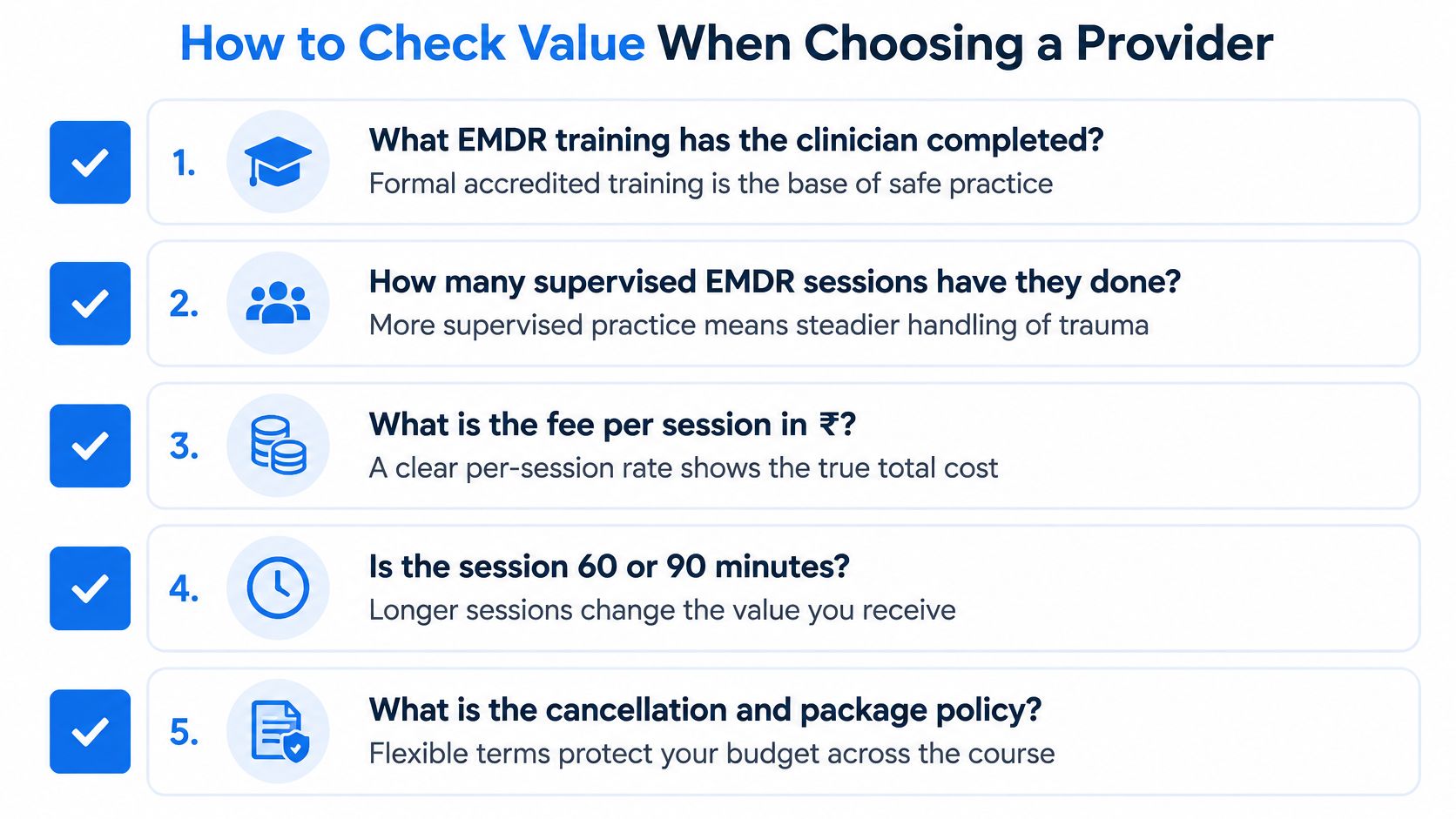
- What EMDR training have you completed, and with whom? Ask for the training details so you can distinguish a specific qualification from a general mention of EMDR.
- Are you a registered psychologist or another qualified clinician, and how long have you worked with trauma? Ask about both professional credentials and trauma experience rather than treating either as a guarantee of suitability.
- Can you walk me through the phases, including assessment and stabilisation? Look for a clear explanation of pacing, how distress will be handled, and when the treatment plan will be reviewed.
- Is the fee per session or per package, and what does cancelling cost? Ask which phases the quote covers and what falls outside it.
- Do online and in-person sessions cost different amounts, and do I need a referral? Clarify these conditions before comparing totals.
Then compare the effective price per treatment hour: divide the quoted treatment fees by the treatment hours included. Keep separately charged items visible. This is a budgeting comparison, not a measure of clinical quality or a reason to choose longer appointments.
Ask each provider for an estimated course cost and how that estimate might change as treatment progresses. Compare their explanations alongside their prices.
On DeTalks, use the same questions when reviewing practitioner profiles; missing details can be raised with support@detalks.com.
Keep optional self-care resources, such as the Luno Self Care FAQ, separate from your EMDR comparison. Ask whether any suggested extras carry charges outside the provider's quote.
Well-Being and Resilience Alongside Therapy
Many people looking up EMDR prices aren't only carrying trauma. They're carrying a job that never switches off, a commute, family expectations and a body that hasn't rested properly in months.
A 2022 survey of 1,764 urban Indian white-collar employees found that 78% reported moderate-to-high stress, 55% showed moderate-to-severe signs of anxiety, and 29% showed moderate-to-severe signs of depression. Deloitte's 2022 India workplace survey of 3,995 respondents across 12 industries found that more than 55% reported emotional exhaustion or burnout.
These are survey findings, not personal diagnoses. Any online screening or self-assessment is informational rather than diagnostic, so a qualified professional should interpret your results with you.
Support can layer. Counselling, medical care when appropriate, rest, social connection and an employee assistance pathway can all sit alongside EMDR rather than compete with it.
Well-being work isn't only about reducing symptoms. A positive-psychology pilot in a migrant community in Worli, Mumbai reported statistically significant improvements after its Hero Lab curriculum, with average happiness scores rising from 11.24 to 19.08 and gratitude from 16.88 to 27.98. It was a small pilot, not proof that one programme works for everyone, and not a substitute for clinical care.
Compassion, gratitude and resilience can grow while you're in treatment, not only afterwards.
Set Your EMDR Budget Before Booking
Set a total budget for a course rather than a single appointment. It changes how you read every quote you receive.
- Name the concern. Decide whether you're seeking trauma-focused work or support for general stress, anxiety, burnout or low mood. The answer shapes which tier you need, and it's fine to be unsure and ask.
- Pick the care tier that fits your budget. Public or low-cost referral, a standard qualified therapist, or a senior trauma specialist. Choosing a tier you can sustain beats starting one you'll have to abandon.
- Get a written quote and compare it. Ask for sessions, assessment fees and cancellation terms in writing, then put it beside at least one other provider's quote on the same criteria.
- Book a first session, then review. After three or four sessions, talk with your clinician about pacing, progress and whether the plan still fits. Revisit the budget if the plan changes.
A few honest takeaways. EMDR is a structured but relatively costly option for trauma-related distress, progress is often gradual rather than dramatic, and no price guarantees a cure. Anyone promising a fixed number of sessions to a fixed outcome is overselling.
Seeking help early usually makes choices easier, because you're comparing options before you're exhausted. You can ask for clear cost details at any point, including midway through treatment, and a good clinician won't treat that as awkward.
DeTalks brings together a directory of psychologists, therapists and counsellors across India, alongside science-backed assessments that are informational rather than diagnostic, so you can weigh provider credentials, session details and fit before you commit to a course. Browse profiles at DeTalks to compare qualified therapists for trauma, anxiety, workplace stress or personal growth, and email support@detalks.com if you need help reading a quote or finding a profile that shows the details you're looking for.