
In India, a clinical psychologist is generally not a medical doctor and cannot prescribe medicine; they practise under RCI-recognised qualifications and registration.
If someone has Dr. before their name, does that tell you whether they can prescribe, provide therapy, or both? It's a reasonable question, because the same title can signal different kinds of training.
The useful distinction isn't who sounds more qualified. It's which professional has the training and authority to provide the support you need.
Whether a Clinical Psychologist Counts as a Doctor
A clinical psychologist generally isn't a medical doctor in India. Medical-doctor status comes from an MBBS or equivalent medical qualification and appropriate medical registration, while clinical psychology follows a separate professional pathway.
The question “is a clinical psychologist a doctor?” has another meaning, though. A psychologist may hold a PhD or Psy.D., which is a doctoral qualification, and use Dr. as an academic title without being medically qualified.
India's Mental Healthcare Act, 2017 defines clinical psychologists through recognised clinical-psychology qualifications, not merely through possession of a doctorate. An academic title doesn't itself grant prescribing authority.
Titles, training and prescribing rights in India
| Title | Core training | Regulator | Can prescribe medicine? |
|---|---|---|---|
| Clinical psychologist | Psychology training with supervised clinical practice | Rehabilitation Council of India (RCI) | No |
| Psychiatrist | MBBS plus postgraduate degree or diploma in psychiatry | National Medical Commission and state medical council | Yes |
| General physician | MBBS or equivalent medical degree | National Medical Commission and state medical council | Yes |
| Psychologist with a doctorate | PhD or Psy.D. in psychology | RCI if also clinically registered; a doctorate alone provides no clinical registration | No, unless also medically qualified |
| Counsellor | Counselling training that differs by course | No single clinical register | No |
A clinical psychologist signals specialised clinical training, while a psychiatrist signals medical training followed by psychiatric specialisation. A general physician is medically qualified but isn't automatically a specialist in mental health.
A psychologist's doctorate signals advanced study, not necessarily eligibility for clinical practice in India. A counsellor's title needs closer checking because courses, supervised experience and areas of competence differ.
Practical rule: Check the qualification and registration behind the title, rather than choosing by the prefix alone.
For a quick initial check, look for the degree named, the regulator listed and whether medication falls within the professional's scope. The qualification pathway and checklist below give you a more complete way to verify those details.
This isn't a ranking of professions. A non-prescribing professional can offer highly specialised care, and a medical qualification doesn't mean every doctor provides psychotherapy.
Qualification Routes and Credential Checks
Clinical psychology involves more than studying human behaviour at university. Recognised clinical training includes supervised work with people seeking help, alongside learning how to practise responsibly.
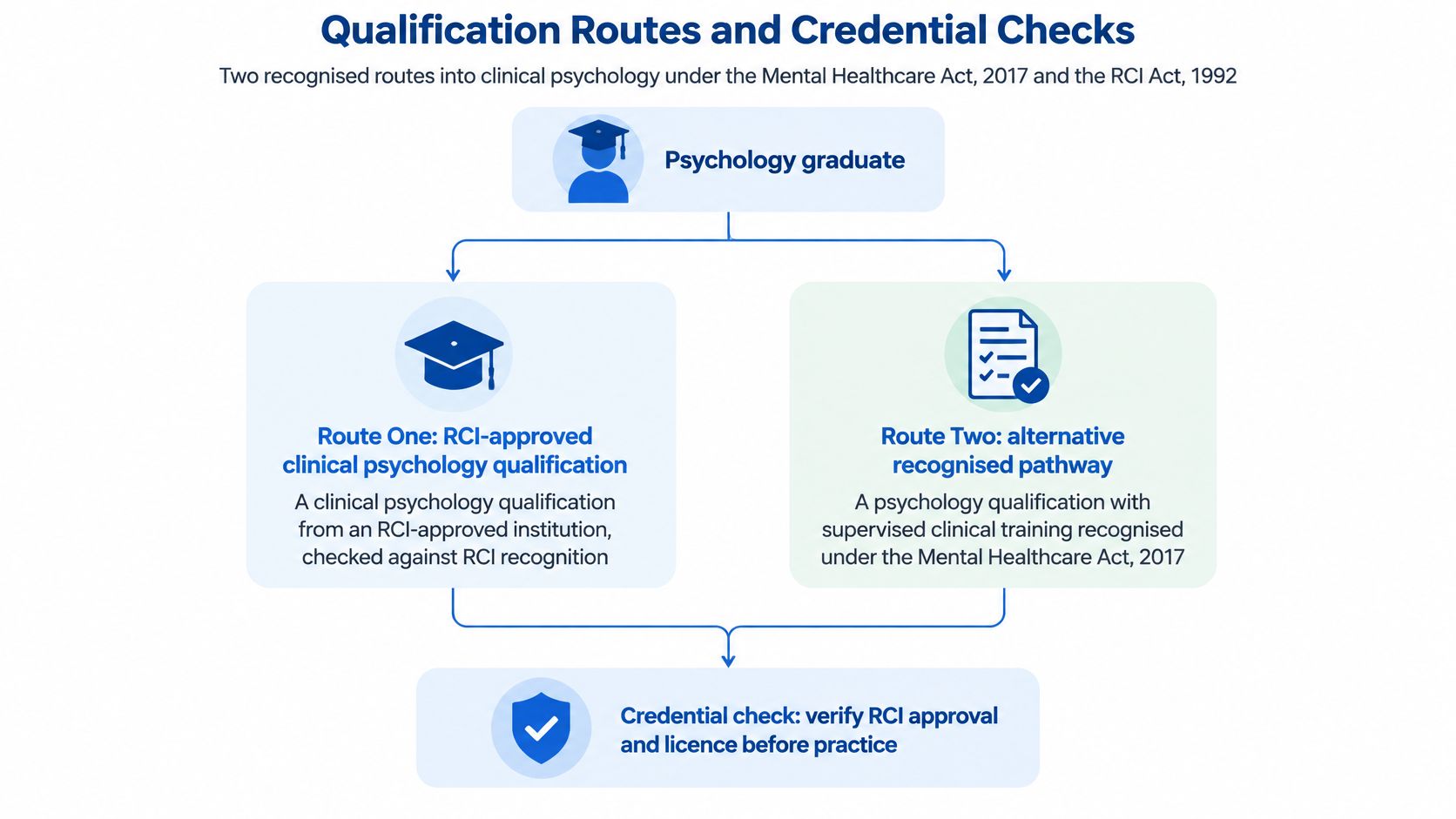
The Mental Healthcare Act, 2017, which refers to the RCI established under the RCI Act, 1992, recognises either a clinical-psychology qualification from an RCI-approved institution or a postgraduate degree in psychology, clinical psychology or applied psychology followed by a full-time, two-year M.Phil. in Clinical Psychology or Medical and Social Psychology, including supervised clinical training.
Understanding the training pathway
The sequence below is a practical overview, not a substitute for checking a programme's current entry requirements and recognition. Students should verify the exact qualification with RCI before enrolling.
- Build an undergraduate foundation. Psychology is the usual base because it introduces behaviour, development and research methods. Entry requirements should still be checked for the intended programme.
- Complete relevant postgraduate study. Psychology or a related field can prepare a student for further training, but a general postgraduate degree alone doesn't establish clinical eligibility.
- Choose an RCI-recognised clinical programme. Check the exact course and institution, rather than assuming recognition applies to every programme at a university.
- Complete supervised clinical placements. Experienced professionals observe and guide client work, helping trainees develop safe judgement alongside practical skills.
- Obtain appropriate registration before practising. Completing a course and being registered to practise are related but distinct checks.
The recognised routes can be understood visually as follows.
A PhD or Psy.D. can add academic or professional depth, but its title alone doesn't replace the clinical qualification and registration required for practice. For students comparing psychology with medicine abroad, Medical School Programs' guide for international medical students offers additional context on the medical education route, rather than Indian clinical-psychology eligibility.
A reassuring credential checklist
You don't need to become an expert in professional regulation before booking. Ask clear questions and expect understandable answers.
- Request the RCI registration number and qualification certificate. These let you verify the practitioner's professional identity and clinical eligibility.
- Match the qualification to the profile. The certificate should support the title and services being advertised.
- Ask about sessions, records and confidentiality. Understand how notes are kept, who can access them and the limits of confidentiality when safety is at risk.
- Ask about psychiatric coordination. Knowing how referrals work helps if medication evaluation becomes part of your care.
A responsible professional shouldn't treat these questions as an insult. You're checking whether their training fits your needs, just as you would with any other healthcare service.
Clinical Psychologist and Psychiatrist Roles Compared
Say you're experiencing anxiety that makes meetings difficult and keeps you awake. A clinical psychologist might help you understand anxious thoughts and practise coping skills, while a psychiatrist can consider whether medical evaluation or medication would also help.
The Mental Healthcare Act key-terms guide distinguishes clinical psychologists from psychiatrists, who are medical practitioners with a recognised postgraduate degree or diploma in psychiatry. Their roles can complement each other rather than compete.
Services by professional
| Service | Clinical psychologist | Psychiatrist |
|---|---|---|
| Psychological assessment | Yes | Yes |
| Psychotherapy such as CBT or counselling-based therapy | Yes | Yes, often alongside medication |
| Prescribing medicines | No | Yes |
| Medical and neurological checks | Refers out | Yes, with specialist referral where needed |
| Monitoring medication side effects | No medical monitoring; can flag concerns for referral | Yes |
Psychological assessments are informational, not diagnostic on their own. A qualified professional needs to interpret findings within a broader clinical evaluation, rather than treating a questionnaire score as a diagnosis.
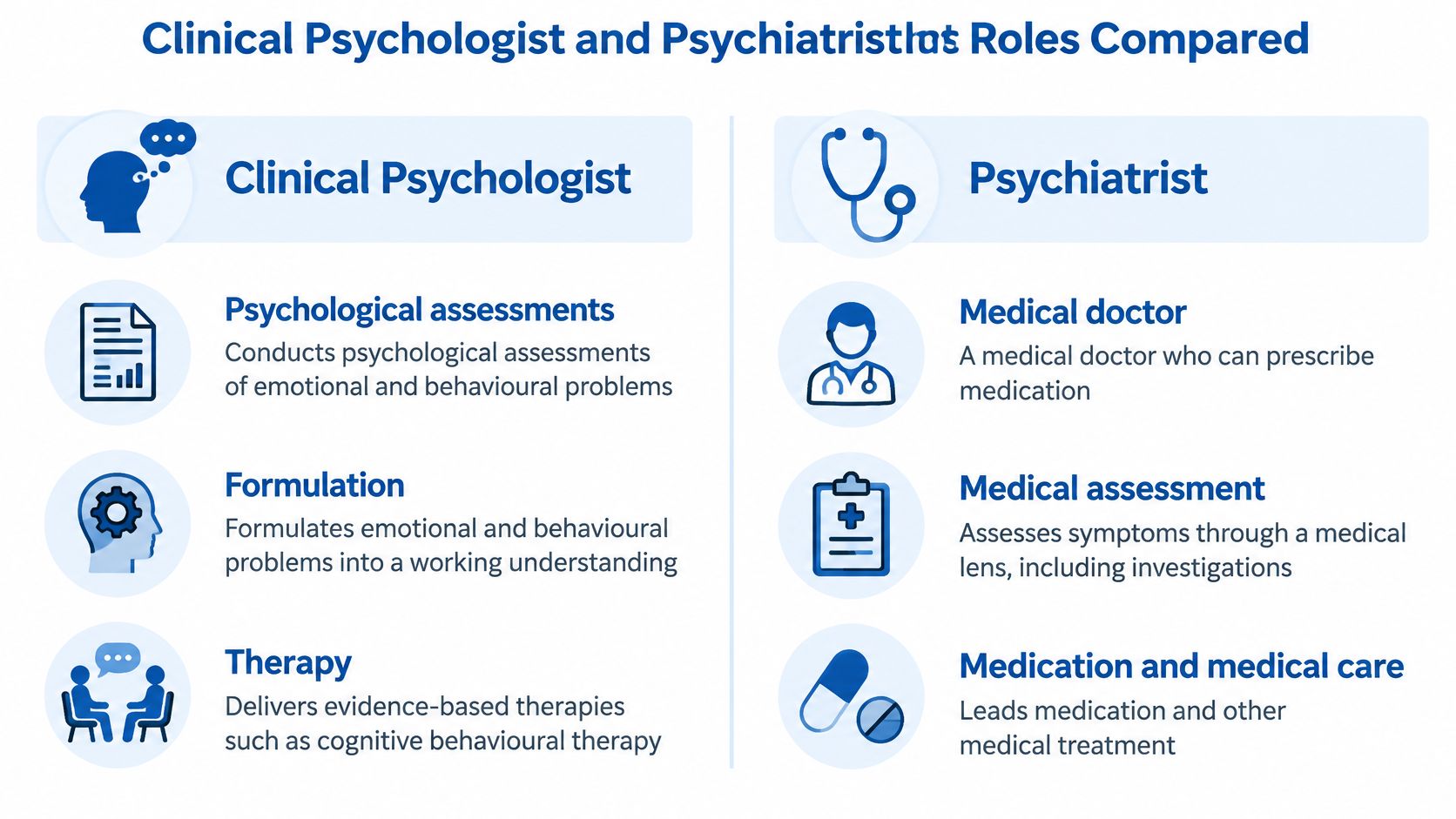
Clinical psychologists develop a working understanding of emotional and behavioural difficulties and provide psychological interventions, including cognitive behavioural therapy (CBT). Psychiatrists assess medical and psychiatric factors, including possible thyroid problems or medication effects, and prescribe and monitor medicines where appropriate.
The distinction is easier to see side by side.
Making shared care work
With your consent, a psychologist and psychiatrist can coordinate treatment so you don't have to explain every change from scratch. Ask who leads therapy, who handles medication questions and how relevant information will be shared.
You don't have to choose between being understood emotionally and having medical concerns taken seriously.
Parents considering care for an adolescent may also find California Teen Center's psychiatrist vs therapist for teens explanation useful. It offers a teen-focused perspective, although local credentials and prescribing rules should always be checked.
Neither role is better. The right fit comes from your symptoms, preferences and the kind of support required.
When a Psychiatrist Should Be the First Call
India's National Mental Health Survey (2015–16) estimated a treatment gap of approximately 83% for any mental health condition, according to the national survey report. Starting with counselling or an assessment may feel more approachable when you're unsure about seeking help.
For manageable concerns linked to a life event, that can be a reasonable beginning. Assessments are informational and don't establish a diagnosis, so discuss results with a qualified professional rather than deciding your next step from a score alone.
Signs that need prompt medical attention
- Severe or recurring symptoms: Seek psychiatric input when difficulties repeatedly disrupt work, relationships or basic daily activities.
- Possible psychosis or mania: Hearing or seeing things others don't, marked confusion, or unusually high energy with little need for sleep warrant prompt evaluation.
- Sudden changes: Major changes in sleep, appetite or behaviour deserve medical attention, particularly when they begin abruptly.
- Possible physical or medication-related causes: A psychiatrist or general physician can investigate these possibilities.
- Substance withdrawal: Seek medical guidance rather than trying to manage potentially dangerous withdrawal alone.
Which professional to contact first
| Situation | First professional to contact | Timing |
|---|---|---|
| Mild stress or worry linked to a life event or workload | Clinical psychologist for assessment and therapy | Routine booking |
| Low mood or worry lasting several weeks | Clinical psychologist, with a psychiatrist review if symptoms persist | Routine, within weeks |
| Symptoms that are severe, recurring or affecting daily functioning | Psychiatrist | Prompt |
| Signs of psychosis or mania, or sudden major changes in sleep or appetite | Psychiatrist | Prompt |
| Possible medication side effects, substance withdrawal or suspected medical cause | Psychiatrist, with a general physician if needed | Prompt |
| Thoughts of suicide or self-harm | Emergency services or Tele-MANAS (14416) | Immediate |
Thoughts of suicide or self-harm need immediate help. Contact emergency services or Tele-MANAS (14416); if there's immediate danger, go to the nearest emergency department and ask someone you trust to stay with you.
You don't need to wait until symptoms become severe to seek support. If manageable difficulties persist for several weeks, arrange a review rather than continuing without guidance.
Everyday Stress, Burnout and Growth With Therapy
Consider a software professional who finishes work exhausted but keeps checking messages late into the evening. They aren't sure whether they're experiencing burnout, anxiety or a difficult period, and they want help understanding the pattern.
Well-being deserves attention before someone reaches a crisis.

In a 2022 study of 1,764 white-collar employees, 78% showed moderate-to-high stress, 55% moderate-to-severe anxiety and 29% moderate-to-severe signs of depression; separately, a Deloitte survey of 3,995 employees across 12 industries found that more than 80% reported at least one adverse mental-health symptom, including emotional exhaustion or burnout in 55% and anxiety in 49%, as summarised in the Indian Journal of Psychiatry workplace review. These findings describe the surveyed groups, not every Indian workplace.
Turning reflection into practical change
In our hypothetical example, the professional keeps a five-minute daily reflection and reviews it weekly with a therapist. They notice that late messages, skipped breaks and fear of disappointing colleagues regularly precede difficult evenings.
- Manage workplace stress: Identify triggers, practise boundaries and protect sleep.
- Build resilience: Develop coping options and recognise when to ask for support.
- Practise self-compassion: Replace harsh self-criticism with realistic, respectful self-talk.
- Support happiness: Make room for gratitude, meaningful relationships and enjoyable activities without forcing positivity.
Therapy can also support emotional intelligence by helping someone recognise feelings and communicate needs. Employers still have a responsibility to address unreasonable workloads and unsafe working conditions.
For another perspective on mental health, you can watch the following video.
Screening tools and assessments offer informational insight, not a diagnosis. Discuss results with a qualified professional and use them to guide a conversation about well-being, not to label yourself.
What to Expect in a First Session
You might begin by saying that you're tired, worried and unsure what kind of help you need. That's enough to start; you don't need a polished explanation or a diagnosis before attending.
The professional will usually ask about your reasons for coming, current stress, mood, sleep, work pressures and available support. You can then discuss goals, the approach they recommend and what they can and can't offer.
Preparing without putting pressure on yourself
- Keep a simple daily note. If you have time, track mood, sleep and stress for two weeks before the appointment. Don't delay needed support just to complete a diary.
- Bring relevant information. Include your notes, current medicines and any recent medical checks so the professional can understand the wider picture.
- Write two or three questions. You might ask how progress is reviewed, how often sessions happen or what happens if the approach isn't helping.
A session may include screening questionnaires. These assessments are informational, not diagnostic, and their results should be interpreted alongside your circumstances and clinical history.
For a more detailed introduction, Uptown Psychology's explanation of what happens in a first session can help you prepare. The precise format will differ between professionals and settings.
Looking for a workable connection
Feeling nervous is normal, and you can say so openly. You can also ask to slow down, clarify a question or discuss what feels uncomfortable.
A helpful starting point: Tell the professional what you hope will become easier in everyday life.
Therapy and counselling can support well-being and resilience through steady work over time, not overnight change. If the connection doesn't feel right, it's reasonable to discuss your concerns or try another qualified professional.
A title alone isn't a guarantee of suitable care; verified credentials provide a firmer starting point. Seek immediate help for urgent risk, and look for steady support rather than promises of a cure.
DeTalks offers a directory of mental health professionals, therapy and counselling options, and informational assessments to help you understand where to begin. Visit DeTalks to explore support, compare professional qualifications and choose a next step that fits your needs.