
If you're torn between a counselling psychologist and a clinical psychologist, start here. Both are trained to offer talk-based therapy, and neither is better than the other. What sets them apart is depth of training, regulation and the kind of work they usually handle.
A counselling psychologist often helps with everyday emotional strain, such as relationship conflict, adjustment, workplace stress, academic worries and personal growth. A clinical psychologist is more often linked with assessment, diagnosis, psychometric testing and complex or long-standing concerns.
Quick Answer to Which Psychologist You Need

If you already feel low or overwhelmed, the difference between these roles can seem technical. You don't have to figure it out before reaching out.
A helpful way to think about it is this. Counselling psychologists tend to walk alongside people through life's pressures and transitions. Clinical psychologists are commonly sought when symptoms need a structured evaluation. Either route can lead to steady, trustworthy care.
For a quick read, match your concern to the professional:
| What You're Looking For | Who Fits Well |
|---|---|
| Everyday stress, anxiety or burnout | Counselling psychologist |
| Relationship or family difficulties | Counselling psychologist |
| Adjustment to life changes, academic concerns | Counselling psychologist |
| Personal growth, resilience, self-esteem | Counselling psychologist |
| Formal assessment or psychometric testing | Clinical psychologist |
| Long-standing, complex symptoms | Clinical psychologist |
| Diagnosis of mental health conditions | Clinical psychologist |
A gentle reminder: self-assessments and online screening tools are for information only. They can help you put words to what you're experiencing, but a qualified professional still needs to carry out the evaluation.
There is real overlap. Mild anxiety, grief after a change or a stretch of low mood may suit either professional. The safer guide is qualification, registration and experience with your concern, not the title alone.
Next, we look at how these roles work in India, then at training, scope, first-contact situations and how to verify credentials before you book. You don't need perfect certainty to begin. A reasonable first step is enough.
Looking at how things work in India helps explain why these two titles sound so alike yet lead down different paths. Most of the difference comes down to who regulates each role and how formal recognition is granted.
The Regulator Behind Clinical Psychologists
The Rehabilitation Council of India (RCI) is the statutory body that oversees the clinical psychologist category. Practitioners who meet its education and training requirements appear on the Central Rehabilitation Register.
When you need a formal assessment, this registration shows that the person has completed a defined training pathway. It is a useful checkpoint. It cannot, however, capture every quality a good professional brings to the room.
Registration confirms formal training, but a warm, attentive conversation matters just as much in everyday therapy.
Counting the Professionals Available
Recent published estimates put the number of RCI-registered clinical psychologists at around 3,372, or roughly 0.24 per 100,000 people.
Figures shared in Parliament in July 2025 recorded 4,309, or about 0.30 per 100,000. The gap is most likely due to reporting dates or differences between datasets, not a sudden jump in practitioners.
Counselling psychologists are harder to count. No single, consistently reported register exists for them, so nationwide numbers remain unclear.
Why Scarcity Is a System Issue
Limited numbers say more about how the system has grown than about any individual. If you are finding it hard to get a professional quickly, the bottleneck lies in infrastructure, not in your worth.
Several factors keep the gap wide:
- Training seats and registered professionals have grown only gradually
- Mental health services are unevenly spread across regions
- Reporting systems do not yet track every practitioner in one place
Waiting for the perfect match can leave anxiety, depression or workplace stress unaddressed for months. A counselling psychologist can offer steady support while you work out your options. A clinical psychologist can be consulted once your needs call for formal evaluation.
Assessments and screening tools are meant to inform, not to diagnose. Treat them as a starting point rather than a final verdict.
Building Resilience While You Wait
Support can begin well before a formal referral. Simple habits such as regular sleep, short breaks during the workday and talking with a trusted friend can build resilience and protect well-being. Many people find these steps make it easier to decide what kind of therapy suits them next.
Reaching out early takes real courage and self-respect. That first step may feel small, but it still counts. Start where you are today.
Choosing between a counselling psychologist and a clinical psychologist becomes much clearer once you stop comparing job titles and look at training, daily focus and scope of practice.
Both offer talk-based therapy, which is where many people get confused. The real difference lies in how far formal assessment, diagnosis and structured testing go, and which goals tend to shape the work in the room.
The comparison below sets out five points side by side, starting with the training pathway and ending with how each professional works alongside psychiatrists.
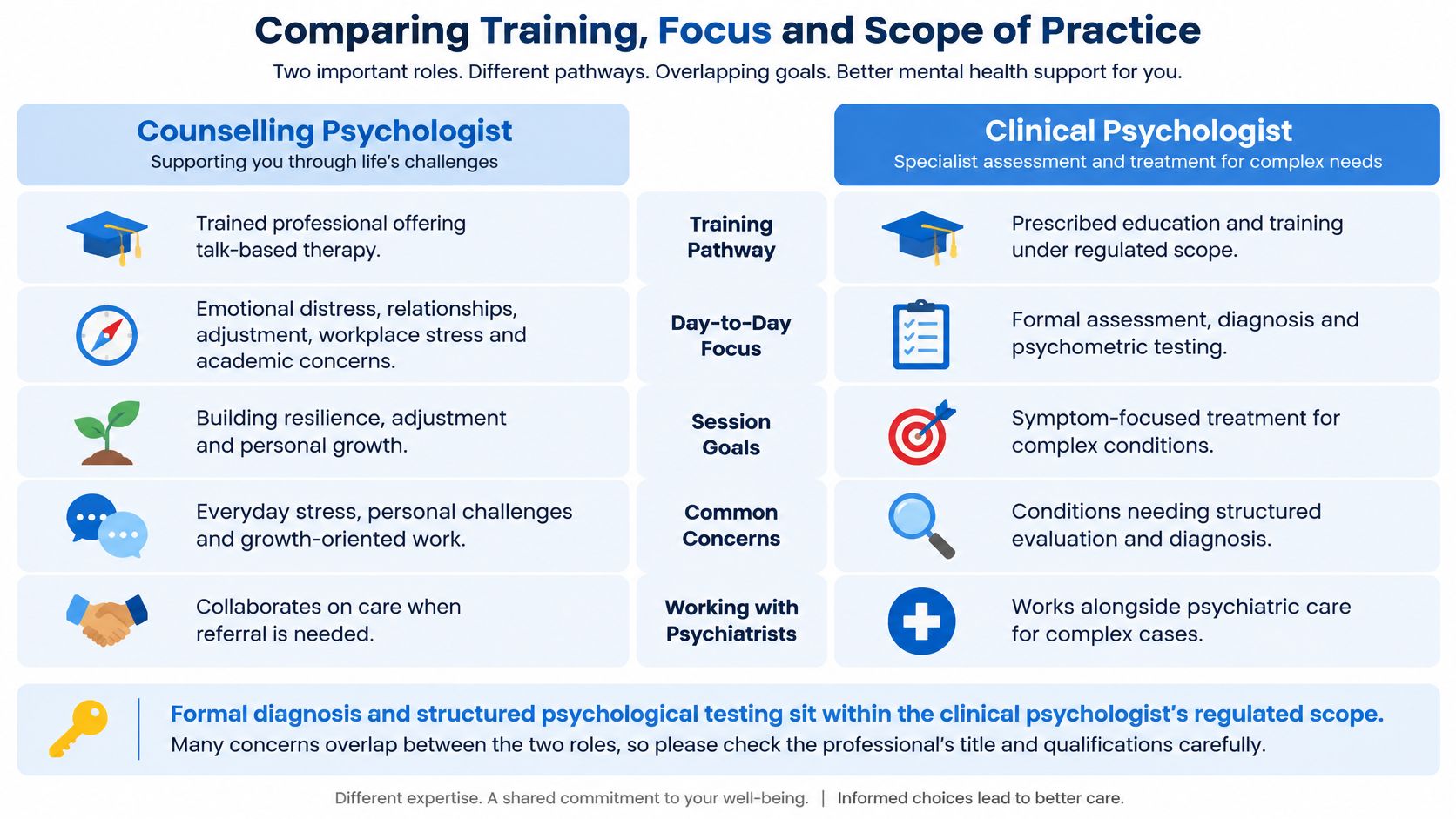
Taken together, the overlap is real. Both can help with everyday stress, anxiety and personal growth. Formal diagnosis and psychometric testing, however, remain within the clinical psychologist's regulated scope.
Training Pathways and Regulation
A counselling psychologist is trained to use counselling and therapy to support emotional distress, relationships, adjustment, workplace stress and academic concerns.
Training usually centres on talk-based work and well-being. Check the qualification listed on a profile, because regulation can vary depending on where and how it was earned.
A clinical psychologist follows a prescribed course of education and training within a regulated scope. In India, that recognition is what allows formal assessment when a clear evaluation is needed.
Looking at these pathways side by side helps explain how each professional is prepared for assessment and care. Families weighing specialist support may also read this guide for parents considering psychiatric care when a child's needs go beyond talk therapy alone.
Day-to-Day Focus and Session Goals
In practice, counselling often looks like steady conversations about adjustment, relationships and the strain of work or study.
Session goals usually aim at building resilience, self-compassion and personal growth. They also help ease anxiety, low mood or burnout.
Clinical sessions tend to begin with structured evaluation. From there, the goals lean toward focused treatment for complex conditions, with room for coping skills and recovery.
Many concerns can be supported by either professional. Mild anxiety, workplace stress or a difficult life change may suit counselling. Long-standing depression, or symptoms that need a clear evaluation, point more firmly toward clinical care.
What Each Role Typically Handles
| Criterion | Counselling Psychologist | Clinical Psychologist |
|---|---|---|
| Qualification signals | Training in talk-based therapy and counselling | Prescribed education and training under a regulated scope |
| Regulatory status | Confirm the stated qualification rather than assuming a register | Registration confirms the regulated clinical pathway |
| Common concerns | Everyday stress, relationships, adjustment, workplace stress and academic worries | Conditions that may need structured evaluation and diagnosis |
| Assessment capability | Supportive conversations; screening tools are informational, not diagnostic | Formal assessment, diagnosis and psychometric testing |
| Work with psychiatrists | Collaborates and refers when medical care may help | Works alongside psychiatric care for complex cases |
Formal diagnosis and structured psychological testing sit within the clinical psychologist's regulated scope.
Titles can sound alike, so it pays to check qualifications. The overlap is genuine, and either professional may support your well-being when the match is right.
Assessments and screening tools remain informational, not diagnostic. Choosing the person whose training fits your current need is a sensible, supportive step, though it does not guarantee a cure. If symptoms feel complex, ask early about a referral to psychiatric care rather than guessing from a title.

Titles start to make sense once you picture a real week. Most people comparing a counselling psychologist vs clinical psychologist are really asking which door to knock on first. The answer depends on what is pressing right now.
| Factor | Counselling Psychologist | Clinical Psychologist |
|---|---|---|
| Typical focus | Everyday stress, life changes, relationships, personal growth | Diagnosable conditions such as persistent anxiety or depression |
| Usual starting point | A goal-focused conversation | A structured assessment followed by a treatment plan |
| Common training route | A master's degree in counselling psychology or a related field | An M.Phil. in clinical psychology and RCI registration |
The practical difference is this: a counselling psychologist helps you work through a problem in your life, while a clinical psychologist assesses and treats a condition.
Support does not have to begin with a perfect label. A first conversation with a counsellor can be useful even if a fuller evaluation comes later. The goal is timely help for well-being, not a neat diagnosis on day one.
Exam Stress and Broken Sleep
A college student in Pune is preparing for her final exams. She is sleeping past 2 a.m., waking up tired and becoming short-tempered with her family. Exam stress has quietly grown into constant worry.
A counselling psychologist is a sensible first step here. Talk-based therapy can help her build steadier sleep habits, manage study pressure and ease the fear of letting her family down.
If panic, hopelessness or sleepless nights continue for several weeks, ask for a referral to an RCI-registered clinical psychologist. This adds structure while keeping the support already in place.
Burnout and Workplace Stress
A professional in Bengaluru is working late most nights and dreads Monday mornings. After a harsh remark from a manager, they feel numb and uneasy. Workplace stress and burnout often sit alongside a fear of speaking up about harassment.
Counselling can help with boundaries, confidence and a plan for rest. It can also offer a steady space to think through a difficult workplace before deciding what, if anything, to report.
If low mood, panic or trauma symptoms grow heavier, a clinical assessment is the safer next step. Psychiatric care may also be worth considering when daily functioning keeps slipping.
Couples and Family Strain
A couple in Delhi argues most evenings about money, in-laws and who carries the household load. Neither partner is the problem. Both are tired and feel unheard.
Relationship counselling suits this kind of situation well. Sessions can slow down the conflict and rebuild respect before blame hardens into distance.
A parent in a joint family may face something different, such as a teenager who has pulled away while tension runs between grandparents and parents. Family-focused therapy can open up a calmer conversation.
If a child's distress includes thoughts of self-harm, severe withdrawal or symptoms that need proper testing, bring in a clinical psychologist and, where needed, psychiatric care. Family work can continue alongside that care.
Anxiety, Depression and a Clearer Evaluation
Someone who has lived with anxiety or depression for years usually knows the pattern well. There is dread on waking, lost interest in things they once enjoyed and worry that won't switch off. Friends may say it is just stress.
Screening tools can point you in a useful direction. They are informational, not diagnostic, and they never replace a professional evaluation.
When symptoms are long-standing or getting worse, see a clinical psychologist first, or ask a counsellor for a referral early. A formal assessment, along with psychiatric care where it fits, gives a clearer picture than another round of guesswork.
Growth, Resilience and Purpose
Not every visit starts in crisis. Some people simply want more gratitude, mindfulness and self-esteem, along with a steadier sense of purpose after a quiet year.
A counselling psychologist is often the right fit for this kind of growth work. Building resilience and self-compassion can happen alongside care for stress, and ordinary hope does not need to be treated as a problem.
If this work uncovers deeper anxiety or depression, the plan can change. Begin where life is today, treat assessments as guidance rather than verdicts and let the recommendation follow the need, not a promise of a quick cure.
When you compare a counselling psychologist vs clinical psychologist, qualifications matter. So does a practical question: who can you actually reach? In much of India, that second question often decides the outcome.
The National Mental Health Survey of India, led by NIMHANS in 2015–16, estimated that 10.6% of Indian adults were living with a mental health condition. Set against that need, the country has fewer than one clinical psychologist per 100,000 residents.
That gap is not spread evenly. Two people with similar worries can face very different waits, depending on where they live.
How Uneven the Numbers Look Across States
State-level figures show how wide the differences can be. Reported rates have ranged from as low as 0.01 per 100,000 in Rajasthan to about 0.09 in Tamil Nadu.
Raw headcounts tell a similar story. Kerala has been reported with 211 psychologists, roughly 0.63 per 100,000, while Rajasthan has been reported with 9.
A person in a large city may have several practitioners to approach. Someone in a smaller town might wait weeks just for a first conversation about anxiety, low mood or workplace stress.
These figures do not mean a counselling psychologist can stand in for a clinical psychologist in every situation. What they do show is why a reachable first step matters so much.
Why First-Line Support Still Counts
Scarcity is a system problem, not a reason to put off help. Accessible counselling can steady well-being while you work out whether specialist care is needed.
Online therapy and counselling can close some of the distance for people in smaller cities. A video session might mean starting this week instead of travelling for hours to a clinic.
Clear referral pathways matter for people whose symptoms point toward specialist care. If depression, panic or long-standing distress is getting worse, a counsellor can help you move toward an RCI-registered clinical psychologist or psychiatric care.
What This Means for Your Next Step
Think of this comparison as a guide, not a test you have to pass on your own. The goal is timely support first, and a referral if your situation needs a fuller evaluation.
- Start with the professional you can realistically reach this month
- Describe what has been happening, including sleep, work and mood
- Ask early whether a formal assessment would help
- Treat screening tools as informational, not diagnostic
Resilience, compassion and small daily supports still matter while you look for the right fit. Making a start is a sensible step, not a promise of a cure.
Knowing how the roles differ helps, but the real question is who you can trust with your concerns. A few simple checks can make the search feel less overwhelming.

Reading a Practitioner Profile
The profile is usually the first thing you see, so start there. A good one names the degree, the training institute and the registration number, where one applies.
Pay attention to how specific the wording is. Look for details about areas of practice, years of experience and the kinds of concerns the person regularly works with. A line like "expert in everything" deserves a second look, because real specialists tend to describe their focus more precisely.
Checking Qualifications and Scope Before Booking
Compare the qualification on the profile with the title being used. For clinical psychologists in India, check for RCI registration on the Central Rehabilitation Register.
Before you book, go over these points:
- Qualification: the degree or certificate should match the kind of help you need
- Registration: RCI status matters most for formal assessment
- Scope of practice: ask what the person can and cannot do, such as diagnosis or prescribing medication
Questions to Ask in a First Session
The first conversation, often called an intake or consultation, is your chance to ask questions. Most practitioners are glad to answer them, and how they respond tells you something too.
- How do you approach therapy for anxiety or depression?
- How is confidentiality handled, and in what situations might it be broken?
- How long is each session, and how often would we meet?
- What are the fees, and are there any extra charges?
Noticing Fit and Switching Without Guilt
Fit usually becomes clear after two or three sessions. Ask yourself whether you feel heard, whether your goals feel clear and whether you leave with a plan for dealing with workplace stress.
If the connection doesn't feel right, it's fine to switch. Changing course is a sensible decision, not a failure, and it protects your time and energy.
Finding the right fit is part of the process, not proof that you chose badly.
Using Assessments and Platforms Wisely
DeTalks offers a directory of psychologists and therapists, along with scientifically validated assessments and screening tools. These tools can help point you toward self-help, counselling, coaching or psychiatric care.
Keep in mind that the tools give you information, not a diagnosis. They help you get oriented, but a qualified professional should always carry out any formal evaluation.
Psychologists who run their own practice can join through the practitioner sign-up page on DeTalks. Transparent profiles make choosing a professional safer for everyone involved.
Each step on its own is small. Taken together, they can turn a stressful search into a steady, well-informed choice for your well-being and peace of mind.
The right professional depends on what you need right now, not on which title sounds more serious. A counselling psychologist and a clinical psychologist both offer real, valid routes into therapy and counselling.
Starting somewhere is better than waiting for total certainty. Anxiety, depression and workplace stress often sit alongside resilience, compassion and everyday happiness. Well-being covers all of it, and what you need can shift as your life does.
Neither path promises a cure. Steady support, a good fit and an honest referral when symptoms need a closer look are the practical goals.
Can a Counselling Psychologist Help with Depression
Yes. Many people first seek help for low mood through talk-based therapy with a counselling psychologist. Sessions can build coping skills, steady daily routines and a gentler view of yourself.
If depression has lasted a long time, feels severe or is getting worse, ask for a referral to a clinical psychologist or a psychiatrist. Screening tools can point you in a useful direction, but they are informational, not diagnostic.
Do You Need an RCI Check for Talk Therapy
An RCI registration check matters most when you want a formal assessment or diagnosis from a clinical psychologist in India. For everyday counselling, focus on clear qualifications, relevant experience and a style you feel comfortable with.
Registration does not replace warmth or skill. It does tell you who is trained to carry out structured testing.
Can You Switch Professionals Mid-Journey
Yes, you can change professionals at any point. A poor fit is not a failure, and many people move between counselling and clinical care as things become clearer.
Tell the next person what has already helped. Assessments remain informational, not diagnostic, so a fresh conversation can still add something useful.
Do Online Sessions Work as Well as In-Person Ones
For common concerns like workplace stress, mild anxiety or strain in a relationship, online therapy often works just as well as a clinic visit. It can also be the only realistic option if you live outside a large city.
Choose in-person care if you need testing that requires a set room and specialised tools. Either way, begin with the support you can actually reach, and let well-being, resilience and compassion grow alongside the harder feelings.
DeTalks brings psychologists, therapists and informational assessments into one place, so a first step feels clearer. Browse qualified professionals and book at DeTalks.