
Thinking matters and you can learn to change it, but it's not the only problem in life, and 10.6% of Indian adults living with a current mental health condition need more than a new mindset. Biology, sleep, trauma, money, family pressure and access to care also shape how you feel and what help will work.
Popular advice often turns that truth into a simple promise. Change your thoughts, the advice says, and your life will change. That sounds hopeful, and sometimes it helps. It can also leave you blaming yourself when sleep is broken, work is unsafe, or debt and family conflict stay exactly the same.
A kinder way to look at the idea that wrong thinking is the only problem in life is to treat thoughts as one lever among several. You can pull that lever through therapy, counselling and daily practice. You also deserve support for the body, the home and the wider pressures around you.
Why Thinking Alone Does Not Explain Life Problems
The claim feels compelling because thoughts seem close and controllable. If a harsh inner voice is the problem, you can notice it, test it and answer it more fairly. That's real progress for many people dealing with anxiety, low mood or workplace stress.
The claim breaks down when it ignores everything else. A person who hasn't slept, lives with chronic pain, or fears losing their job isn't only interpreting life badly. Their body and circumstances are giving the mind hard material to work with.
What the Indian numbers show
The scale in India points beyond private mindset. The National Mental Health Survey 2015-16 found 10.6% of adults had a current mental health condition and 13.7% had one at some point in life. Those figures cover diagnosable conditions, not just people thinking wrongly.
That distinction protects you from blame. Depression, trauma responses and severe anxiety can produce hopeless thoughts as symptoms. Treating the thought as the whole cause misses why it keeps returning.
A helpful question isn't "How do I think positively?" It's "What's feeding this thought, and what kind of help fits that cause?"
Clinicians often look at body, mind and social life together. If you want a plain overview of that wider lens, you can explore biopsychosocial assessment guidance from PatientNotes. It shows why sleep, relationships, work and health belong in the same conversation as beliefs.
Contributors to life problems and what each needs
| Contributor | Typical example | Can changing thinking help? | When to seek professional help |
|---|---|---|---|
| Thought patterns | Believing one setback proves you will always fail | Yes, the belief can be tested and loosened | When low mood or worry lasts for weeks and disrupts work or study |
| Biology and sleep | Chronic sleep loss, thyroid problems or a family history of depression | Only a little, on its own | When low mood, panic or sleep loss persists, a doctor should check |
| Trauma and history | Abuse, bereavement or a violent home | Can ease reactions, but rarely removes the cause | When flashbacks or avoidance continue, trauma-focused therapy is usually needed |
| Money and work | Debt, job insecurity or long hours with no rest | Helps with planning and less self-blame, but not the income itself | When stress is constant, counselling and practical support are needed |
| Family and relationships | Conflict with parents, a partner or in-laws | Improves communication and boundaries | Couples or family therapy can help when conflict repeats |
| Neurodevelopmental differences | ADHD or autism traits that make routines hard | Coping strategies help | Assessment by a qualified clinician gives the right support |
Thought work helps most where thoughts keep a loop going. It can soften self-blame, reduce avoidance and make the next step clearer. It can't, on its own, undo an abusive home, repay a loan or repair months of broken sleep.
Cognitive Distortions That Feed Everyday Distress
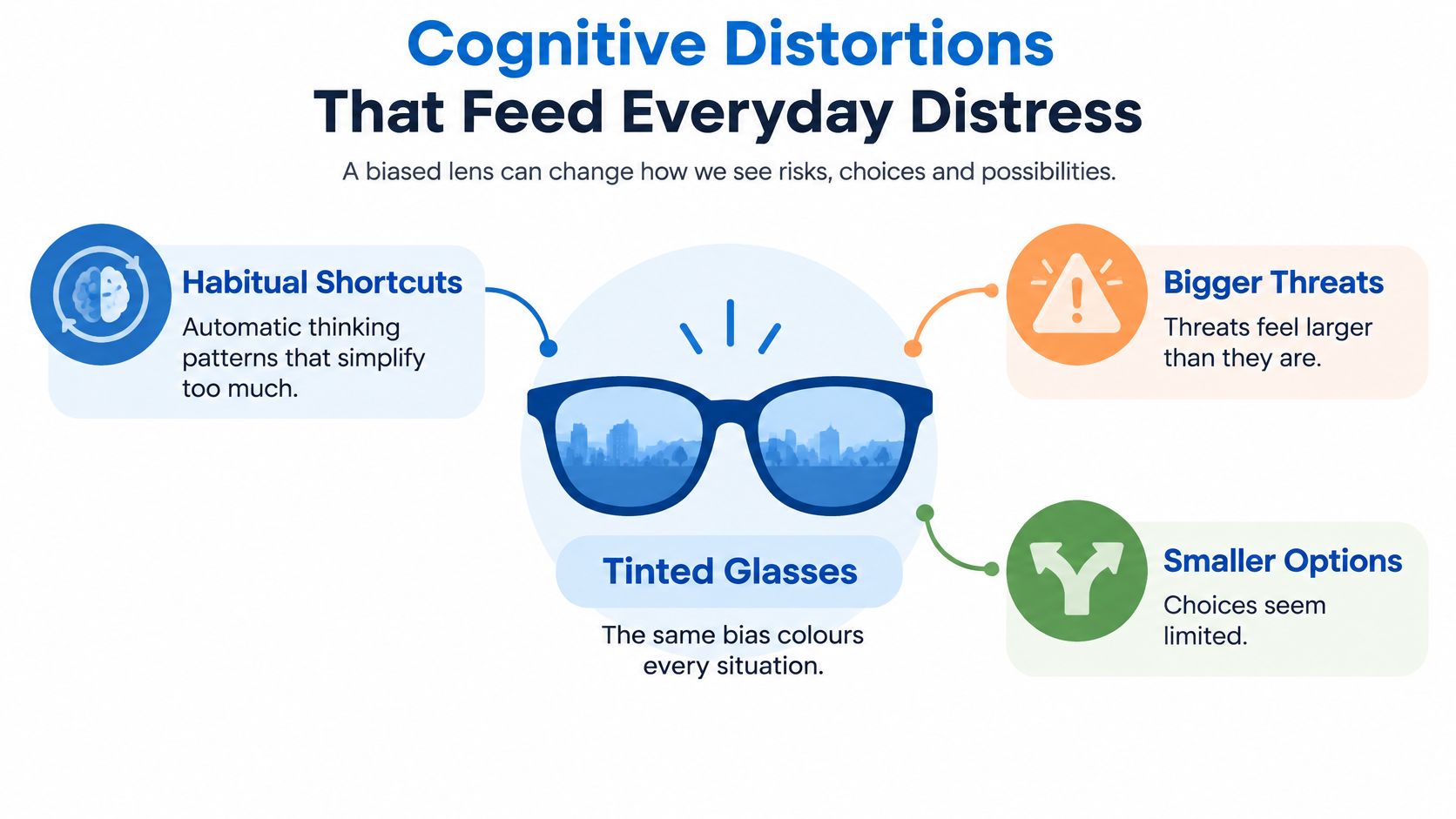
A cognitive distortion is a habitual shortcut in thinking. It makes threats feel bigger and choices feel smaller than they are. It's not a sign of low intelligence. It's what a tired, stressed brain does when it's trying to decide quickly.
Think of tinted glasses that colour every room the same shade. A neutral email looks hostile. A quiet friend looks angry. A mixed exam result looks like complete failure, even when parts went well.
Six patterns worth naming
All-or-nothing thinking sorts life into perfect or ruined. Catastrophising jumps to the worst outcome. Overgeneralisation turns one event into a permanent rule, while mind reading assumes you know what others think without checking.
Should statements turn feelings into strict rules, such as "I should never need rest." Personalisation places all blame on you for outcomes shaped by many people and conditions. Naming the pattern creates a small gap between you and the thought.
Common cognitive distortions with balanced alternatives
| Distortion | Example thought | Balanced alternative |
|---|---|---|
| All-or-nothing thinking | If I am not top of the class, I have failed | I did well in parts and can improve the rest |
| Catastrophising | My manager frowned, so I will lose my job | The frown has other explanations, and I can ask directly |
| Overgeneralisation | I was rejected once, so nobody will ever like me | One rejection does not define every relationship |
| Mind reading | My friend is quiet, so she must be angry with me | I can check with her instead of guessing |
| Should statements | I should never feel tired | Feelings are information, not rules to obey |
| Personalisation | The team project failed because of me | Several factors, including the timeline and resources, shaped the outcome |
A three-question test you can use
When a thought feels heavy, slow it down with three questions:
- What evidence supports it? Stick to facts you could show someone else.
- What evidence contradicts it? Include past coping, other explanations and partial successes.
- What action would help even if I'm not certain? Choose one small step you can take today.
This approach aims for accurate thinking, not forced positivity. Resources that help you turn harsh self-talk into balanced thoughts from Be Your Best Self & Thrive Counseling, PLLC show the same shift in everyday language. You're not pretending everything is fine. You're giving the full picture a fair hearing.
Say you receive a brief message from your manager and think, "I'm about to be fired." The evidence for it may be only the tone. The evidence against it may include recent good feedback and a busy day for the whole team. A useful action is to reply calmly or ask what she needs, instead of rehearsing the worst outcome all evening.
That small change matters because behaviour follows interpretation. You send the email, attend the class or call the friend. Each action gives your brain fresh evidence that the feared verdict wasn't the only possibility.
These questions fit automatic thoughts that feed worry and avoidance. They don't fit a thought that accurately describes real hardship, such as unsafe housing or an unpaid salary. In that case, practical help and safety planning come first.
Persistent hopelessness, thoughts of harming yourself, or being unable to work, study or care for yourself need professional evaluation. Self-help can support care, but it shouldn't replace it.
How Biology, Sleep and Trauma Shape Thoughts
Your thoughts don't arise in a vacuum. The body sets the volume. After poor sleep, you're more likely to feel irritable, notice threats and read neutral events as rejection.
The image below captures that late-night loop many people recognise, when the body is tired but the mind keeps scanning for danger.

When the body drives the mind
Chronic illness, hormonal changes, pain, substance use and some medicines can all affect mood and focus. So can neurodevelopmental differences that make planning, routines or social cues harder. A thought record won't correct a thyroid problem or undo the effects of alcohol withdrawal.
That's why a good assessment asks about sleep, appetite, energy, medical history and substance use. It also asks what's happening at home and work. You're not failing at mindset if a physical cause needs treatment first.
The stakes of missing that wider picture are serious. Based on NCRB data analysed by the Centre for Science and Environment, in 2024, 47% of illness-related suicides in India, 14,305 deaths, were attributed to mental illness. Professional care matters because some conditions need medical and psychological treatment together.
Trauma changes the alarm system
Trauma works through memory and the nervous system, not just opinion. After abuse, violence or a sudden loss, ordinary sounds, places or tones of voice can trigger a strong alarm. Your body may react before you've had time to form a clear thought.
Telling yourself "I'm safe now" may help a little, but the alarm often needs slower, guided work. Trauma-focused therapy helps you process memories at a pace that feels manageable. Sleep support, grounding skills and a safer daily environment often sit alongside that work.
The short video below offers another plain-language way to think about how stress responses live in the body, not only in beliefs.
None of this means your thoughts don't matter. It means care works best when it treats the whole system. Thought work, body care and personal history can support each other.
Family, Money and the Barriers to Getting Help
Many heavy thoughts grow inside heavy conditions. Family expectations, debt, unemployment, discrimination and unsafe homes shape what feels possible. A young adult who thinks "I've let everyone down" may be carrying real pressure from parents, fees and a narrow job market.
India's recurring stressors show up in national records. The National Crime Records Bureau chapter on suicides in 2023 recorded family problems in 31.9% of reported suicides and illness in 19.0%. Those categories describe contributing circumstances, not a single cause, and they underline why support must reach relationships and health, not only inner dialogue.
The treatment gap is part of the problem
Even when someone wants help, help can be hard to reach. A Press Information Bureau note on mental health in India reports that 70% to 92% of people with mental disorders do not receive proper treatment because of limited awareness, stigma and shortages of professionals. That's not a personal failure to think correctly. It's an access problem.
The gap also falls unevenly. A multisite Indian population study in BMJ Open found the treatment gap for current depression was 79.1%, higher among women at 80.1% and people in lower-income groups at 81.0%. In cities with fewer than one million residents, it reached 87.3%.
Practical rule: If advice asks you to reinterpret an objectively harmful situation but offers no way to change or leave it, the advice is incomplete.
Small steps around common barriers
- Talking to parents: Choose a calm moment and describe effects, not labels. "I'm not sleeping and I'm missing classes. I'd like to speak to a counsellor for a few sessions" is easier to hear than a long debate about beliefs.
- Faith and care: Spiritual practice can comfort you and still sit beside medical or psychological care. It becomes harmful delay when symptoms worsen, safety is at risk, or you're told to stop prescribed treatment.
- Cost limits: Ask about shorter sessions, community clinics, university counselling centres, group programmes or guided self-help. One assessment session can also help you prioritise what to do next.
- Family conflict: If home feels unsafe, focus first on a trusted adult, a safer place to stay, or local support services. Private reframing isn't enough where there's violence or control.
These pointers are informational, not a diagnosis. They can help you start a conversation, but a qualified professional should assess persistent symptoms, safety risk and treatment needs.
Workplace and Student Stress in the Numbers
Daily stress is common enough that it shouldn't be treated as a rare personal weakness. According to Ipsos's World Mental Health Day survey, in 2024, 53% of urban Indians reported experiencing stress severe enough to affect their daily life during the previous year. When stress reaches that level, burnout, poor sleep and harsh self-judgement often travel together.
For working professionals, the loop can look ordinary from outside. Long hours reduce sleep. Tiredness makes feedback feel like a threat. Worry then keeps you checking messages late at night, which steals more rest.
What students are reporting
School life carries its own pressures around exams, friendships, family hopes and future careers. The table below brings together recent Indian student indicators. They describe groups of students, not a diagnosis for any one child.
Student mental-health indicators in India
| Indicator | Reported share | Source |
|---|---|---|
| Students who felt anxious | 11% | NCERT survey, 2024 |
| Students who experienced extreme emotions | 14% | NCERT survey, 2024 |
| Students who reported mood swings | 43% | NCERT survey, 2024 |
| Students who did not know where to seek help at school | 40% | India-wide student report |
| Grade 12 students sleeping under 7-8 hours on school nights | Three-quarters | India-wide student report |
For context, a Press Information Bureau release citing the NCERT Mental Health and Well-being of School Students Survey reported in 2024 that 11% of school students felt anxious, 14% experienced extreme emotions, and 43% reported mood swings. A separate India-wide student report based on 8,542 responses found 40% of students did not know where to seek mental-health support at school, while three-quarters of Grade 12 students received less than the recommended 7 to 8 hours of sleep on school nights.
Those details change the advice you'd give. A student who thinks "I'll fail and ruin my future" may need thought testing. They may also need sleep, a realistic study plan, a named teacher to approach, and relief from constant comparison at home.
Three starting points for work or study
- Set one boundary: Protect a finish time for work or study on most days, even if it's not perfect every day.
- Name your support route: Identify one teacher, manager, HR contact or counsellor before a crisis, and save how to reach them.
- Track sleep for two weeks: Note bedtime, wake time and mood the next day before deciding a thought is distorted.
A counsellor can help you sort personal stress from symptoms that need assessment. Group figures can guide services and families, but they can't tell you what your own experience means.
Therapies That Work Alongside Changing Thoughts
Cognitive behavioural therapy, often called CBT, is the best-known structured approach for thought loops in anxiety and depression. In sessions, you learn to spot automatic thoughts, test them against evidence and try new behaviours. Between sessions, short practice tasks help those skills become habits.
CBT isn't positive thinking with a worksheet. A therapist may ask you to rate how strongly you believe a thought, run a small real-life experiment, then review what happened. If you avoid presentations because you expect humiliation, the experiment might be speaking for one minute in a low-risk meeting.
Where other approaches fit
Some difficulties need more than cognitive work, or need it later. Medication can reduce symptoms enough for sleep, concentration and therapy to become possible. Family work can change the pattern around you, not only the thoughts inside you.
Therapy and treatment options compared
| Approach | Best suited for | What it involves | Main limit |
|---|---|---|---|
| Cognitive behavioural therapy (CBT) | Anxiety, depression and repeating thought loops | Structured sessions to test thoughts and change behaviour | Works best with regular practice between sessions |
| Medication | Moderate to severe depression, anxiety or bipolar disorder | Prescribed by a psychiatrist or doctor | Needs medical supervision and monitoring for side effects |
| Systemic or family therapy | Family conflict, parenting stress and couples | Works with the whole relationship system | Depends on the willingness of family members to take part |
| Behavioural activation | Low motivation and withdrawal | Planning small, rewarding activities step by step | Less effective when money or work pressure is acute |
| Trauma-focused therapy | Trauma and PTSD | Processing traumatic memories in a safe, structured way | Requires a trained therapist and time |
| Counselling with self-help | Mild stress and exam worry | Guided reflection and coping skills | Not a substitute when symptoms are severe or persistent |
Behavioural activation deserves a plain explanation because it can sound too simple. When mood is low, you withdraw from friends, movement and tasks that once gave a sense of reward. A therapist helps you schedule small, specific actions, such as a ten-minute walk after lunch, so motivation has something to grow from.
Trauma-focused work follows a different pace. Safety, trust and stabilisation come before processing painful memories. Rushing into detailed recall without support can overwhelm you, which is why trained help and choice about pacing matter.
Systemic or family therapy looks at repeated interaction patterns. Say a teenager withdraws, a parent criticises, and the teenager withdraws further. Sessions can help each person hear the impact of the pattern and try a different response, instead of labelling one member as the problem.
Medication sits within medical care. A psychiatrist or doctor considers diagnosis, physical health, other medicines, benefits and side effects. You should have follow-up, a plan for what to watch for, and a chance to ask questions in language you understand.
Adapting care to Indian life
Indian clinicians often adapt approaches to family roles, language, faith, work patterns and who makes decisions at home. That adaptation isn't a soft extra. It affects whether homework is realistic, whether parents support attendance, and whether examples make sense in your daily setting.
Platforms such as DeTalks list psychologists and counsellors and offer informational screening tools that can point you towards self-help, counselling or psychiatric care. Screening is informational, not diagnostic. A qualified professional still needs to hear your history, check safety and agree a plan with you.
Good care doesn't ask, "Is it thoughts or circumstances?" It asks which parts need skills, which need treatment, and which need practical change.
Thought-focused work can be one strong part of care. It doesn't have to carry the whole burden alone.
Build Resilience and Take the Next Step
Well-being isn't only the absence of symptoms. It also grows through resilience, compassion, purpose, supportive relationships and moments of genuine rest. That wider view matters because recovery and a satisfying life aren't exactly the same goal.
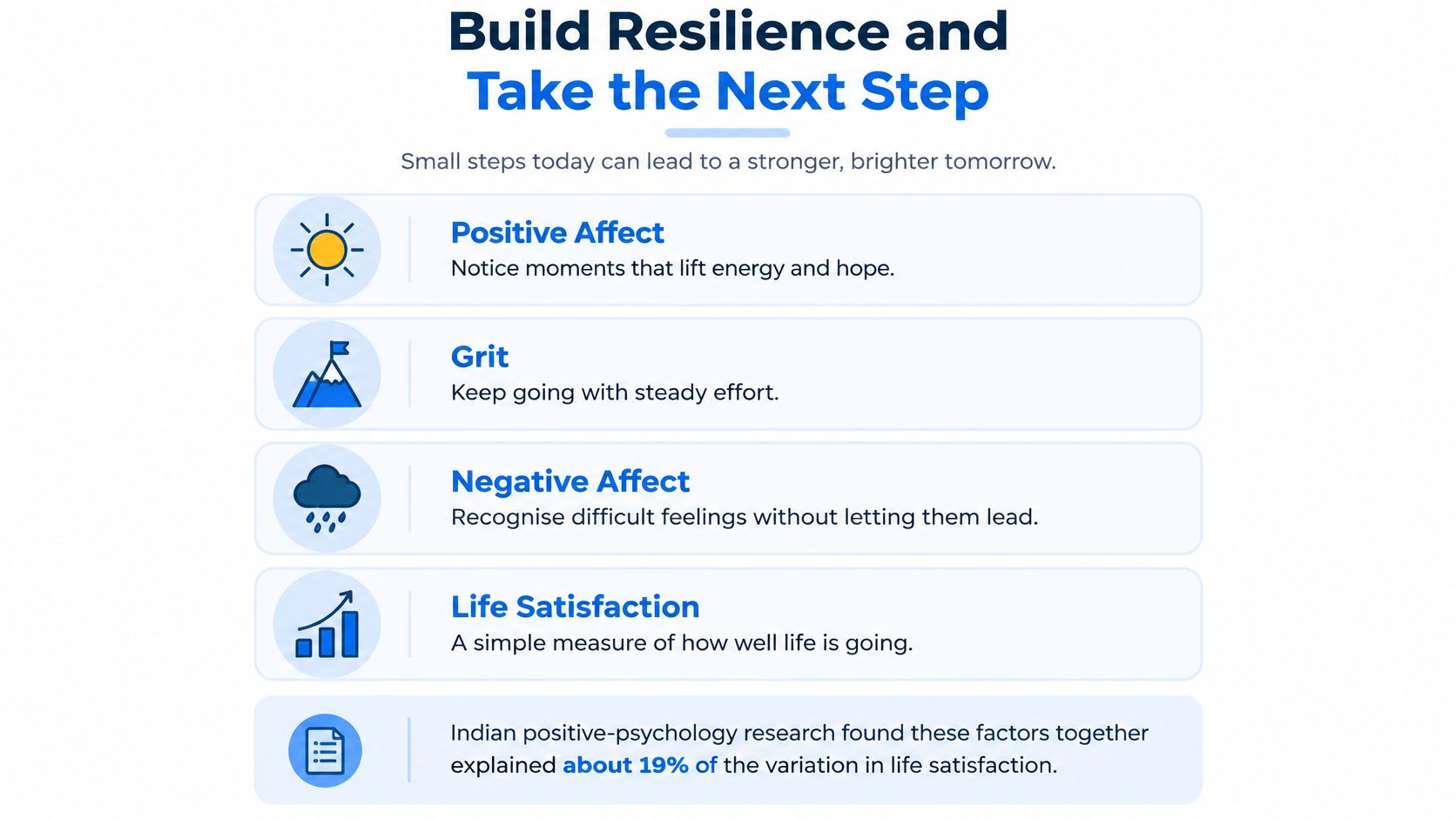
Indian positive psychology research gives a modest, useful clue. A review of Indian studies reported that among undergraduate college students, positive affect, grit and negative affect together explained 19% of the variation in life satisfaction. The same factors explained 11% of the variation in happiness, which leaves plenty of room for relationships, health, opportunity and chance.
Habits that support resilience
- Self-compassion: Speak to yourself as you would to a friend who's learning, not as a judge delivering a verdict.
- Gratitude journaling: Write two specific things that helped today, including small acts by other people.
- Mindfulness: Spend a few minutes noticing breath, sounds and body sensations without forcing calm.
- Connection and movement: Keep regular contact with trusted people and build physical activity into routines you can repeat.
- Sleep protection: Keep wake time steady where you can, dim screens late at night, and give worries a written parking place before bed.
These habits support resilience, but they aren't a promise of cure. Grit shouldn't mean enduring harm in silence. Sometimes the resilient step is asking for help, setting a boundary, changing a workload or leaving an unsafe situation.
A checklist for today
- Notice one repeating thought: Write it in the exact words your mind uses.
- Test it gently: Use evidence for, evidence against, and one helpful action.
- Protect sleep for a week: Track whether the thought feels louder after short nights.
- Speak to someone you trust: Tell them what support you'd like, such as listening, practical help or accompanying you to an appointment.
Any online screening for mood, stress, personality or happiness is informational, not diagnostic. It can help you reflect and choose a next step. It can't confirm depression, rule out risk or guarantee recovery.
Seek professional help without delay if you notice persistent hopelessness, thoughts of self-harm, hearing or seeing things others don't, unusually high energy with little need for sleep, panic that keeps returning, flashbacks, weeks of sleep loss, or increasing alcohol or drug use. If you might act on thoughts of harming yourself, contact local emergency services or a trusted person nearby now.
Thinking is one lever among many, and it's a lever you can learn to use with support. You deserve care that respects your body, your history, your family context and your real-world constraints, not blame for having a human mind under pressure.
If unhelpful thought patterns, stress, low mood or family pressure are weighing on you, DeTalks can help you find qualified therapists and counsellors across India and explore confidential, informational assessments to understand your next step. Visit the platform to browse professionals, book a session that fits your needs and language, and start building support around your thoughts, relationships and daily life.