
Ever feel like your attention is being pulled in a million different directions? It’s a feeling most of us know all too well. Improving your concentration isn't just about trying harder; it's about understanding what's causing the distraction and gently building habits that support your mental well-being.
The first step is simply realising that a scattered mind is usually a sign of being overwhelmed, not a personal failing. This journey is about self-compassion and finding what works for you.
Why Is It So Hard to Concentrate Today?
If you find yourself struggling to stay on task, you're definitely not alone. Our ability to concentrate is deeply tied to our overall mental and emotional health. Challenges like persistent workplace stress, anxiety, and burnout can drain our mental energy, making focus feel like an impossible task.

In high-pressure environments, the expectation to be constantly productive can use up our mental energy faster than we can restore it. This constant "on" mode prevents our brains from settling into deep, sustained attention. It becomes a cycle: stress hurts our focus, and the inability to focus creates more stress.
The Link Between Well-being and Attention
Think of your mental well-being as the foundation for your ability to concentrate. When you're managing feelings of anxiety or the low mood that can come with depression, your brain is working overtime just to cope. This naturally leaves fewer resources for tasks like paying attention and organising your thoughts.
This connection is particularly clear in India, where focus-related issues are often linked to high levels of stress. Recent data from Statista shows that about 74% of Indians experience significant stress, and a staggering 88% report anxiety.
Building resilience isn't about powering through exhaustion. It's about learning self-compassion and accepting that your ability to focus is directly linked to how you care for your mind.
Moving from Challenge to Clarity
Acknowledging these challenges without judging yourself is the real starting point. Instead of feeling frustrated about being distracted, try to see it as a signal—your mind telling you something needs attention.
This shift in perspective opens the door to effective strategies. It might mean exploring therapy or counselling, which can offer practical tools to manage stress and build emotional resilience. By understanding the root causes, you can move from a state of constant reaction to one of intentional action.
The goal isn't to achieve flawless, unbroken focus. It's about cultivating a more balanced and supportive internal environment where clarity and happiness have a chance to grow.
Build Your Foundation for Better Focus
Before diving into advanced techniques, it’s important to get back to basics. For your mind, the foundation is your physical well-being. Your ability to think clearly is deeply connected to how you care for your body every single day.

Sleep, nutrition, and exercise aren't just about feeling physically good; they are the bedrock of mental clarity and resilience. When these are out of balance, even the most effective focus strategies will feel like an uphill battle.
The Restorative Power of Quality Sleep
Sleep is when your brain does its nightly maintenance, recharging the circuits you need for attention and emotional control. When you don't get enough quality sleep, your cognitive performance can take an immediate hit, making it much harder to manage workplace stress and stay on task.
Post-pandemic surveys in India revealed a sharp increase in screen time and disrupted sleep patterns, both of which are strongly linked to poorer attention. It's not just a local trend; global research shows that cutting your sleep to just 5–6 hours a night for a week can impair your attention significantly.
Here are a few practical tips to improve your sleep:
- Create a Wind-Down Routine: An hour before bed, dim the lights and put away your phone. Try reading, listening to calm music, or doing some light stretching.
- Stick to a Schedule: Aim to go to bed and wake up around the same time daily, even on weekends, to regulate your body's internal clock.
- Optimise Your Environment: Make your bedroom cool, dark, and quiet. A comfortable space signals to your brain that it's time to rest.
Fuel Your Brain with Mindful Nutrition
The food you eat directly affects your brain function, energy levels, and mood. A diet with too many processed foods can lead to energy crashes and mental fog. A balanced diet full of whole foods, however, provides a steady, reliable stream of fuel for your brain.
Think of every meal as an opportunity to either support your focus or hinder it. Swapping a sugary biscuit for a handful of almonds might seem small, but it can make a real difference.
In the Indian context, this doesn't require a massive dietary overhaul, as many traditional foods are naturally brain-boosting.
- Complex Carbohydrates: Foods like whole-wheat roti, brown rice, and lentils (dal) provide slow-release energy.
- Healthy Fats: Nuts, seeds, and ghee are fantastic sources of omega-3 fatty acids, which are vital for brain health.
- Antioxidant-Rich Foods: Colourful vegetables and fruits, like spinach (palak) and mangoes, help protect your brain.
Energise Your Mind with Regular Movement
Physical activity is one of the quickest ways to sharpen your focus. Exercise boosts blood flow to the brain, delivering fresh oxygen and nutrients. It also releases chemicals that support attention, memory, and mood.
You don't need to commit to intense gym sessions. Short bursts of activity can have a surprisingly big impact on your mental clarity and help manage feelings of anxiety.
Why not try fitting one of these into your week?
- A brisk 20-minute walk during your lunch break.
- Starting your day with a few rounds of Surya Namaskar.
- Simply taking the stairs instead of the lift.
Sometimes, seeing the connection between daily habits and mental clarity can make all the difference. This table breaks down common challenges and simple first steps you can take.
Simple Lifestyle Tweaks for Better Focus
| Lifestyle Area | Challenge in Indian Context | Simple First Step to Improve Focus |
|---|---|---|
| Sleep | Late-night social obligations or high screen time. | Put your phone on charge across the room 30 minutes before your planned bedtime. |
| Nutrition | Easy access to fried snacks and sugary chai. | Pack a small box of nuts (almonds, walnuts) to eat as a mid-afternoon snack. |
| Exercise | Long commutes, humidity, and lack of public spaces. | Do 10 minutes of stretching or a few yoga poses right after waking up. |
This table is just a starting point. The goal is to build small, consistent habits that create a strong foundation for your mind. You can find more actionable strategies for improving focus and concentration that build on these fundamentals.
Train Your Brain to Pay Attention
Think of concentration as a muscle—it's a skill you can build and strengthen over time. With the right training, you can teach your brain to tune out noise and hold its attention for longer than you might think possible.
These aren't complex theories but simple, powerful strategies that fit into any routine. The aim is to give you a toolkit that puts you back in control of your attention, helping you feel less overwhelmed.
Give Your Time a Structure for Deep Work
One of the sneakiest thieves of focus is having too much unstructured time. By creating clear boundaries for your tasks, you give your brain a defined space to work in, which makes a world of difference in getting into a state of deep focus.
Two helpful methods for this are time-blocking and the Pomodoro Technique. Both are designed to prevent mental fatigue by breaking down intimidating tasks into something much more manageable.
Putting Time-Blocking to Work
Instead of a messy to-do list, picture your calendar neatly organised with specific blocks of time for each task.
- 9:00 AM – 10:30 AM: Draft the project report.
- 10:30 AM – 11:00 AM: Clear high-priority emails.
- 11:00 AM – 12:00 PM: Team strategy meeting.
This simple shift takes the guesswork out of your day and protects your focus from the temptation to multitask. If you want to explore this further, there are great strategies on how to improve focus at work without burning out.
Getting in the Zone with the Pomodoro Technique
The Pomodoro Technique is a fantastic way to manage workplace stress by creating a rhythm of intense focus followed by deliberate rest. This cycle is key to preventing mental burnout.
Here’s the breakdown:
- Pick one task. Just one.
- Set a timer for 25 minutes. For that time, it's just you and the task.
- Work until the timer goes off. Then, take a genuine 5-minute break.
- Repeat, then take a longer break. After four sessions, give yourself a proper rest of 15–30 minutes.
This method trains your brain to work in short, effective bursts. Those small breaks are essential for letting your mind reset.
Strengthen Your Mind with Cognitive Exercises
Beyond managing your schedule, you can train the "muscle" of your attention. Cognitive exercises, particularly mindfulness, have been shown to strengthen the parts of the brain that handle focus, emotional control, and resilience. It's about learning to notice your thoughts without getting swept away by them.
This isn't about achieving a blank mind. It's about learning to gently guide your focus back to where you want it to be. Just a few minutes a day can make a noticeable impact on how you handle distractions and feelings of anxiety.
Mindfulness is simply noticing where your attention is, without judging yourself for it. It creates the space you need to consciously decide where to place your focus next.
Five Minutes of Mindfulness for a Busy Day
A consistent practice of just five minutes a day can quieten a wandering mind and help you feel more in control. It helps build a stronger mind-body connection, which is a cornerstone of overall well-being.
Here’s a quick exercise you can try anywhere:
- Find a comfortable spot to sit and gently close your eyes.
- Turn your attention to your breath. Just notice the feeling of air moving in and out of your body.
- Your mind will wander. When you notice it has, just gently acknowledge where it went and guide it back to your breath.
That simple act of noticing and redirecting is the core of attention training. If you find it consistently difficult to maintain focus, counselling can also be a great resource for learning structured mindfulness techniques tailored to you.
Design an Environment That Supports Deep Work
Your surroundings play a huge role in your ability to concentrate. A cluttered desk or a phone buzzing nonstop can splinter our attention, making it nearly impossible to get into a state of deep focus.
Taking control of your environment isn't about perfection. It's about consciously shaping your space to protect your focus, whether it’s a corner of your home or a busy office.
Creating Your Physical Focus Zone
Your brain loves cues. When you dedicate a specific spot just for work, you're building a powerful mental link between that space and the act of concentrating.
Make this zone as distraction-free as you can. The goal is to eliminate the visual and auditory "noise" that competes for your attention.
Even tiny changes can make a massive difference:
- A Tidy Desk, A Tidy Mind: Spend five minutes at the end of your day clearing your workspace.
- Bring the Outside In: A small plant on your desk can help reduce workplace stress and sharpen concentration.
- Set Gentle Boundaries: Let family or colleagues know when you’re in a "focus block" with a simple sign or status update.
Taming Your Digital Environment
Our biggest distractions are often digital. That one little notification can completely derail a productive hour. Gaining control over your digital world is essential if you're serious about improving your focus.
This is all about good "digital hygiene." You want to curate your online experience so it serves your goals, not the other way around. This single shift can dramatically reduce the anxiety and overwhelm that comes from constant digital pings.
Your digital space is just like your physical desk—it can be a powerful tool for productivity or a black hole of distraction. You get to decide.
A great first step is turning off all non-essential notifications. Also, using website blockers or dedicated focus apps during work sessions creates a fantastic barrier against procrastination.
The infographic below shows how popular techniques like time-blocking and the Pomodoro method shine when your environment is set up for success.
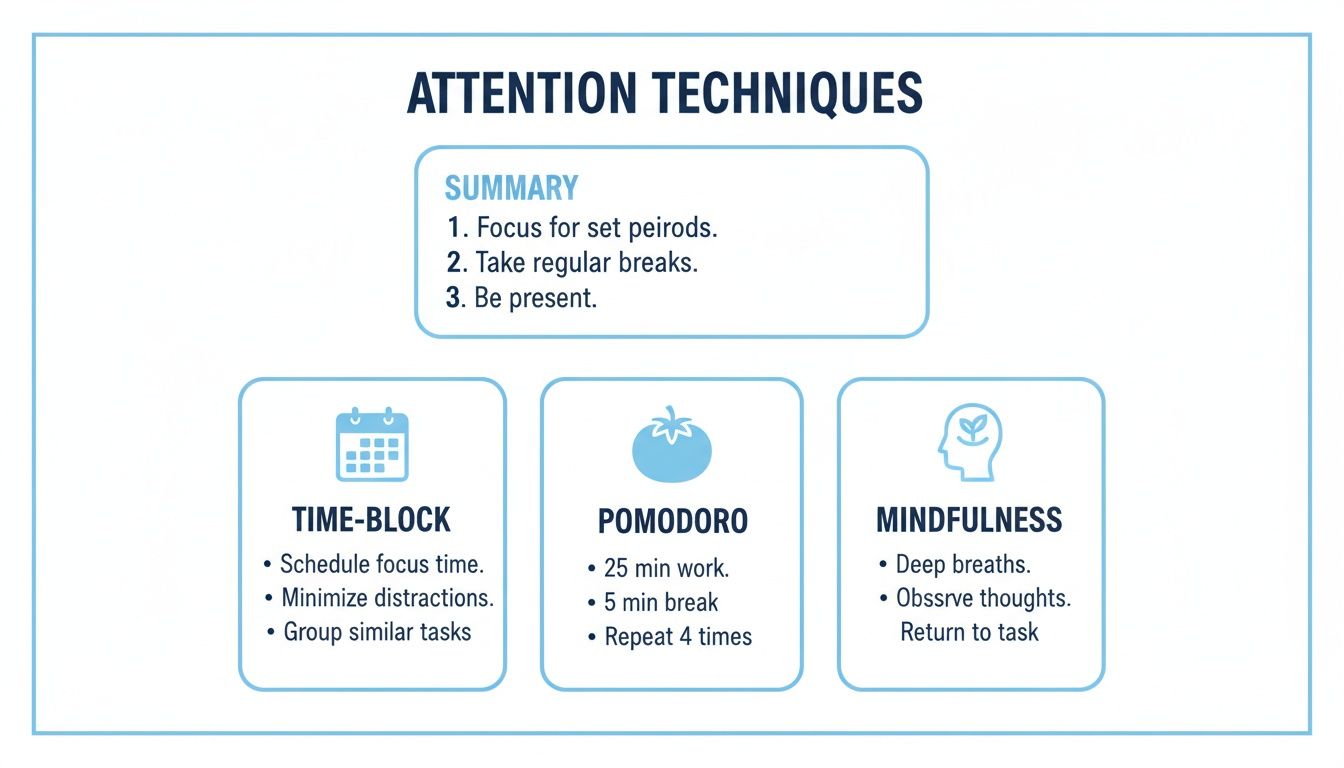
As you can see, these methods rely on creating uninterrupted blocks of time—something that’s only possible once you’ve tamed potential distractions.
Bridging The Physical and Digital Divide
Your physical and digital spaces are deeply interconnected. A messy desk might make you more likely to escape into your phone screen. Conversely, leaving your phone in another room can make your workspace feel dramatically calmer.
The table below offers a quick comparison of strategies for both realms.
Physical vs Digital Environment Optimization
| Focus Area | Physical Environment Strategy | Digital Environment Strategy |
|---|---|---|
| Space Definition | Designate a specific desk or area solely for focused work. | Customise your desktop with only essential apps; use different browser profiles for work and personal use. |
| Clutter Control | Tidy your desk daily. Keep only necessary items within arm's reach. | Turn off all non-critical notifications. Unsubscribe from noisy email lists. |
| Access & Barriers | Use noise-cancelling headphones. Close the door to your room. | Use website and app blockers (like Freedom) during work sessions. |
| Boundary Setting | Communicate your "focus hours" to family or colleagues. | Set "Do Not Disturb" or "Focus" modes on your devices. Use an auto-responder on your email. |
The goal is to create a unified system that builds your overall resilience against distraction. If environmental distractions consistently cause you distress, it might be worth exploring therapy or counselling to develop personalised strategies.
When It's Time to Look for Professional Support
While lifestyle shifts and focus techniques are powerful, there are times when a persistent struggle to concentrate is a sign of something deeper. It might be your mind gently telling you it needs a different kind of support to find its way back to clarity.
Getting to this point isn't a failure—it’s an act of self-awareness. If you’ve tried different strategies but still feel like you're fighting an uphill battle, it might be time to talk to a professional. This is especially true if focus issues are affecting your work, relationships, or general well-being.
Knowing When to Reach Out
It’s not always obvious when to ask for help. We are often our own harshest critics, telling ourselves to just "try harder." But sometimes, the problem isn’t a lack of effort.
Here are a few signs that professional guidance could make a real difference:
- You feel constantly overwhelmed, and even small tasks seem impossible to start.
- Your trouble concentrating is paired with ongoing feelings of sadness, irritability, or anxiety.
- It's affecting your relationships, with friends or family noticing you seem distant or forgetful.
- Your performance is slipping at work or in your studies, no matter how hard you try.
These struggles can sometimes be linked to challenges like depression, anxiety disorders, or ADHD. A professional can provide a safe, non-judgemental space to explore what's really going on.
Seeking help isn't admitting defeat. It’s a powerful step toward understanding your own mind and building the resilience needed to thrive.
What Does Professional Support Involve?
The thought of seeing a therapist can be daunting. Therapy and counselling are collaborative conversations where you work with a trained expert to understand your challenges and develop strategies that work for you.
A mental health professional can help you see the connections between your thoughts, feelings, and actions. They offer practical tools to manage things like workplace stress, regulate emotions, and get to the root of your focus issues.
A Note on Assessments and Diagnosis
If you seek support, a professional might suggest an assessment. It's crucial to understand these are informational tools, not labels. The goal is simply to get a clearer picture of your experience to guide you effectively. They provide insight, not a verdict, helping you and your therapist build a plan that truly fits.
The National Mental Health Survey revealed that while about 11 in every 100 adults in India have a mental health concern, the treatment gap is a staggering 70–92%. You can find more information about mental health resources in India from the Press Information Bureau.
Your Takeaway
Improving your focus is a journey, and it’s one that requires kindness toward yourself. There’s so much you can do on your own, and there's also incredible strength in knowing when to bring in a guide. Reaching out for support is a positive, proactive move toward a clearer, more balanced life.
Winding Up: Your Journey to a Sharper Mind
So, where do you go from here? Think of this guide not as a set of rigid rules, but as a toolkit. Improving your concentration is an ongoing practice of gently guiding your attention back home, time and time again.
Forget about perfection. Some days, you'll feel completely in the zone; on other days, your mind will feel scattered. On those tougher days, practice self-compassion and celebrate the small wins.
Supportive Takeaways for Lasting Focus
Ultimately, this isn't about becoming a productivity machine. It's about building a more intentional and balanced life. Every small change you make adds a brick to your foundation of mental resilience, creating an inner world where focus can arise naturally.
Part of this journey is knowing when you might need a helping hand. If you're constantly battling distraction, or if challenges like persistent anxiety or overwhelming workplace stress are getting in the way, reaching out for professional support is a sign of incredible strength. Seeing a therapist or counsellor is a proactive step towards taking charge of your well-being.
The path to a clearer mind is paved with patience and compassion. It's about progress, not perfection. Acknowledge your efforts, be gentle with yourself, and remember that you have the tools you need to begin.
You’ve already done the hardest part by seeking out this information. Now, just pick one small thing from this guide you can try today. That single, simple action is your next step forward.
Frequently Asked Questions
We’ve covered a lot of ground on how to sharpen your mind, but you might still have a few questions. Let’s tackle some of the most common ones.
How Long Does It Take to See Improvements in Concentration?
This is a really common question, and the honest answer is: it varies for everyone. There’s no magic timeline. You might feel a small shift in a few weeks with techniques like time-blocking, while foundational changes like sleep can take a couple of months to show their full benefit.
The most important thing is to be patient and kind to yourself through the process. Real, lasting mental resilience is built through steady effort over time, not from a quick fix.
Can Anxiety and Stress Really Affect My Focus That Much?
Absolutely, and it’s a bigger deal than most people realise. When you’re dealing with high levels of workplace stress or general anxiety, your brain kicks into a survival mode that pulls energy away from higher-level thinking, including sustained focus.
Getting a handle on your stress is often the most direct route to better concentration. Practices like mindfulness or talking to a professional through therapy or counselling directly free up the mental energy you need to concentrate.
Your ability to focus is a mirror of your overall well-being. If you’re constantly distracted, it might be your mind’s way of telling you it needs support.
Is My Phone the Biggest Problem for My Lack of Focus?
It’s easy to blame the phone, but more often than not, it's a symptom, not the root cause. We often use our devices to get a quick dopamine hit that helps us escape uncomfortable feelings like anxiety or burnout.
So, while setting digital boundaries is a smart move, it’s just as important to dig a little deeper. Ask yourself why you’re looking for that escape. Tackling underlying challenges, like depression or simple exhaustion, can dramatically weaken that compulsive urge to check your phone.
What If These Techniques Don't Work for Me?
First off, don't be discouraged. If you’ve given these strategies a consistent try and still feel like you’re struggling, it might signal something more is going on, such as an underlying condition like ADHD or persistent depression. This isn’t a failure; it’s simply a sign that you might need a different kind of support.
This is a great point to think about speaking with a professional. Therapy provides a safe, structured environment to uncover what's really going on and create a plan that's tailored specifically to you. Remember, seeking help is a sign of strength and a proactive step towards taking charge of your mental well-being.
At DeTalks, we believe everyone deserves access to the right support for their mental health journey. Whether you are looking for therapy, exploring confidential science-backed assessments, or simply seeking to understand yourself better, we are here to help. Find the right therapist for you at DeTalks.