
You've had a difficult day, and suddenly even a simple decision feels too much. You want someone familiar to take over, reassure you or tell you what to do, even though you'd usually manage comfortably.
That change can feel unsettling, especially if someone calls it childish. Understanding the regression defence mechanism offers a kinder starting point: notice what's changed, consider the pressure behind it, and decide whether comfort is enough or professional support would help.
What Regression Means as a Defence Mechanism
Regression is an unconscious return to earlier ways of coping when present-day distress feels overwhelming. It describes a change from someone's usual emotional functioning, not just feeling upset or needing help.
Consider a hypothetical 28-year-old project manager in Bengaluru. After a harsh performance review, she starts messaging her mother several times an hour and asks for help with tasks she normally handles easily.
Her mother's support isn't the problem. The noticeable shift from confident decision-making to feeling unable to manage familiar responsibilities is what makes regression a possible explanation.
This everyday scenario captures the search for reassurance after a difficult experience.

An older way of feeling safe
Think of regression as retreating to a familiar room when the rest of the house feels unsafe. The person reaches for an older, simpler way of coping, perhaps relying heavily on a parent or expressing distress through sulking rather than words.
The idea comes from psychoanalytic theory. Anna Freud and later writers described regression as a movement back towards earlier stages of emotional development; broader contemporary explanations include temporary dependence, comfort-seeking and childlike emotional expression under stress.
Psychological classifications usually place regression among immature or less flexible defences, compared with mature defences such as humour or sublimation. Sublimation means directing difficult feelings into a constructive activity, such as putting frustration into sport or creative work.
These terms describe coping patterns, not personal worth. An adult who struggles after criticism hasn't lost their intelligence, skills or right to respect.
What Indian evidence can tell us
A Coimbatore adolescent study involving 891 adolescents aged 17–19 found associations between defence mechanisms and personality traits, but it didn't isolate regression as an individual defence. Its regional, cross-sectional findings shouldn't be generalised to every Indian adolescent or interpreted as proof of cause and effect.
Regression is the mind reaching for an older, safer map when the current one feels too large.
The useful distinction is between a comforting retreat that helps someone regain balance and a persistent change that limits everyday life. Recognising that difference helps you choose support without turning a psychological label into a diagnosis.
Ordinary Regression or a Sign to Seek Help
Ordinary regression compared with signs that warrant assessment
| Signal | Usually a temporary stress response | Worth a professional assessment |
|---|---|---|
| Duration | Eases within days or a few weeks as stress settles | Persists beyond several weeks or keeps returning |
| Daily functioning | Work, study and self-care mostly continue | Missed work, school or self-care for long stretches |
| Where it appears | Mainly with a trusted person or during one stressor | Across most settings, including when alone |
| Awareness | Person notices it and can step back when reminded | Involuntary, with memory gaps or lost time |
| Safety | No self-harm or risk to others | Self-harm, substance misuse or thoughts of harming others |
| Accompanying signs | Tiredness or tearfulness linked to a clear event | Low mood, hopelessness, hallucinations or confusion |
This table is informational, not diagnostic. Its time descriptions are practical prompts, not clinical cut-offs, and you don't need to wait for a particular duration before asking for help.
A mental-health context document submitted to India's Parliament reinforces the importance of taking mental well-being seriously. However, no population-level figure can determine whether an individual's comfort-seeking is a disorder.
Read the pattern, not a single behaviour
Duration matters because a short-lived response after a clear stressor differs from a pattern that repeatedly interrupts life. Improvement is useful information, but distress doesn't have to become prolonged before it deserves attention.
Daily functioning asks what the person can still do. Needing company while preparing dinner differs from regularly being unable to eat, wash, attend classes or complete essential work.
Setting adds context. Someone who briefly feels dependent with a trusted partner may still manage elsewhere, while difficulties across home, work and private time suggest a broader problem.
Awareness helps distinguish an understandable retreat from experiences needing closer assessment. Memory gaps and lost time shouldn't be labelled regression, because a professional needs to consider other explanations.
Safety takes priority over every other row. Self-harm, dangerous substance use or thoughts of harming others call for prompt professional contact; immediate danger requires emergency help or the nearest emergency department.
Accompanying signs also change the response. Hallucinations, sudden confusion or severe hopelessness warrant assessment rather than reassurance alone, and sudden confusion may require urgent medical care.
Can regression be helpful?
Temporary dependence, reassurance, play, extra sleep, or familiar comforts can help someone settle after bereavement, a break-up, exam pressure, or a difficult appraisal. These activities are not regression by default, and choosing comfort consciously is not the same as an unconscious shift toward earlier coping.
The practical question is whether comfort helps the person return to life or increasingly replaces participation in it. Persistent, escalating or involuntary changes deserve closer attention.
Practical rule: Offer comfort without assuming illness, and seek assessment when safety, awareness or everyday functioning changes.
A family might sit together and identify what's different without debating whether someone is being immature. They could agree to help with meals during a difficult period while arranging counselling if missed classes, withdrawal or dependence continue.
How Regression Looks Across Ages and Settings
Regression across life stages and settings
| Age or setting | Typical regression-like behaviour | Common trigger | Supportive response |
|---|---|---|---|
| Young child (3 to 7 years) | Bedwetting, clinginess or baby talk | New sibling, school start or family move | Predictable routine, reassurance and gentle limits |
| Teenager (13 to 19 years) | Withdrawal, sulking or asking parents to do tasks they usually manage | Exam pressure, peer conflict or parental arguments | Listening, validation and firm but warm boundaries |
| University student | Avoiding deadlines, relying on family for decisions, reversed sleep | Exams, relocation or financial strain | Structured study plan and campus counselling |
| Working adult | Tantrum-like outbursts, avoiding responsibility, seeking constant reassurance | Workplace harassment, job insecurity or burnout | Rest, clear boundaries and counselling for workplace stress |
| Couples and families | Taking childlike roles or expecting rescue from a partner or parent | Marital discord, divorce or bereavement | Couples or family counselling and a shared coping plan |
| Older adults | Greater dependence after illness or loss | Bereavement, ill health or loss of independence | Compassionate support and medical review if confusion appears |
These are illustrative patterns, not diagnostic criteria or fixed developmental rules. The same behaviour can have different meanings depending on age, health, disability, circumstances and the person's usual abilities.
Familiar situations with different meanings
A young child might return to baby talk after a sibling arrives. Parents can offer predictable individual attention without teasing the child; new bedwetting also deserves consideration of physical causes rather than an automatic psychological explanation.
A teenager facing board-exam pressure might ask a parent to organise a schoolbag they normally manage. Sitting alongside them while they begin can be more useful than either scolding them or taking over completely.
A university student who has moved away from home might call family before every small decision and stop opening assignment emails. A manageable study plan and campus counselling can address the distress behind the avoidance.
A working adult might respond to criticism by withdrawing from decisions and repeatedly asking colleagues whether everything is all right. A private conversation about workload, harassment or fear of dismissal is more useful than public embarrassment.
A partner or family member might expect someone else to manage every practical task after grief or marital conflict. Shared planning can acknowledge pain while preventing an unspoken arrangement in which one person carries everything indefinitely.
An older adult might seek more assistance after illness or losing a spouse. Necessary care isn't regression, and new confusion, abrupt behavioural change or loss of established skills needs medical review.
Support within Indian family life
In Indian households, shared living, financial interdependence, obedience expectations and gender roles can influence what dependence looks like. Living with parents or consulting elders doesn't, by itself, indicate reduced emotional functioning.
The Week's reporting on young Indians' mental well-being describes difficulties involving stress recovery, focus and relationships. Those difficulties shouldn't be treated as evidence that young people are regressing or lack character.
Language, caste, disability and urban–rural differences can shape access to confidential, affordable support. Ask what help is realistic and welcome rather than assuming every household has the same resources.
Validation plus boundaries is a useful principle: recognise distress, preserve dignity and encourage achievable participation. Neither shaming nor total rescue helps you understand what the person needs.
What Triggers Regression and Why It Happens
When pressure exceeds someone's available coping resources, they may fall back on familiar responses that require less emotional effort. A person who usually explains their needs calmly might instead cling, withdraw or expect someone else to make decisions.
This isn't necessarily deliberate. Understanding the trigger helps distinguish a response to overload from a judgement about motivation or character.
Pressures to look for
- Prolonged isolation or uncertainty: Restricted contact and unpredictable circumstances can leave someone feeling less secure.
- Bereavement: Losing a person who provided stability may increase the need for reassurance.
- Relationship conflict or breakdown: Separation, arguments or fear of abandonment can make independent decisions feel harder.
- Workplace stress and burnout: Harassment, unrealistic demands and job insecurity can exhaust coping resources.
- Academic pressure: Exams, competitive admissions and fear of disappointing family may contribute to avoidance.
- Financial dependence: Limited choices can intensify helplessness, particularly during unemployment.
- Sleep loss or illness: Physical depletion can reduce patience and emotional flexibility.
- Substance use: Alcohol or other substances can complicate emotional regulation and require separate assessment.
For someone facing relocation, separation or another major change, life transition guidance from Nick Donahue LICSW offers an additional resource for thinking through adjustment. It complements, rather than replaces, individual assessment when functioning changes.
What stress and trauma studies suggest
A 2025 study of 200 Indian adults aged 18–45 found significantly stronger reliance on immature than mature defences during pandemic-induced isolation, and women reported higher COVID-related anxiety than men. The authors interpreted the defence pattern as consistent with emotional regression under prolonged uncertainty.
However, this was a cross-sectional study. It doesn't establish that isolation caused regression, that every immature defence was regression, or that these changes were permanent.
A study of 411 Indian adolescents exposed to childhood adversity found that immature defences statistically mediated associations between adverse childhood experiences and complex PTSD symptom clusters; immature and neurotic defences also mediated links with PTSD symptoms. This supports considering defence styles within a wider trauma assessment, not concluding that regression causes PTSD.
Longitudinal assessment is needed to clarify direction. A clinician should consider emotional regulation, trauma exposure, safety and functioning rather than interpreting a younger-seeming response in isolation.
Anxiety and depression may coexist with dependence, withdrawal or avoidance, making the picture harder to interpret. Identifying triggers helps you plan practical support and appropriate care instead of blaming yourself for struggling.
How Regression Affects Relationships, Work and Study
Relationships and the rescue pattern
A parent or partner may initially take over because they care. If that arrangement continues without discussion, they may become exhausted or resentful while the distressed person becomes less confident about managing independently.
Say a partner starts answering every difficult email after a relationship crisis. The immediate relief may be welcome, but gradually returning suitable tasks can protect both the relationship and the person's sense of capability.
Support doesn't require accepting shouting, intimidation or controlling behaviour. Compassion can sit alongside limits on how people treat one another.
Work and study under pressure
At work, regression-like coping may appear as repeated reassurance-seeking, avoiding decisions or missing deadlines. A manager should discuss observable difficulties privately rather than attaching a psychological label to an employee.
In the Aon Asia Mental Health Index report for India, 77% of workers surveyed faced a moderate-to-high risk of mental-health problems, 60% felt more sensitive to stress than the previous year, 45% found concentration more difficult, and 52% ended the workday mentally or physically exhausted. These figures describe workplace mental-health concerns, not the prevalence of regression.
A useful response might include written priorities, a manageable decision to own and a clear check-in arrangement. Counselling for workplace stress can complement changes to workload or working conditions; an employee shouldn't be expected to solve harassment through coping exercises alone.
In education, the consequences may include unopened assignments, disrupted sleep and asking family members to handle academic conversations. A student may need help contacting a tutor or counselling service while retaining responsibility for the next achievable action.
For supporters: Help someone do the task where possible, rather than automatically doing it for them.
Partners, parents and managers can name the pattern kindly, agree on small expectations and offer help accessing counselling. Punishment is unlikely to clarify whether the person is overwhelmed, unwell or facing an unsafe environment.
Watch for changes in functioning rather than arguing about maturity:
- Missed responsibilities: Work, classes or essential tasks remain unattended for more than two weeks, or sooner if the consequences are serious.
- Social withdrawal: The person stops responding to friends or avoids previously valued contact.
- Falling grades or output: Their usual performance declines alongside distress.
- Repeated conflict: The same rescue, withdrawal or outburst pattern keeps disrupting relationships.
These are practical reasons to seek support, not diagnostic thresholds.
Coping Strategies and Therapy Options That Help
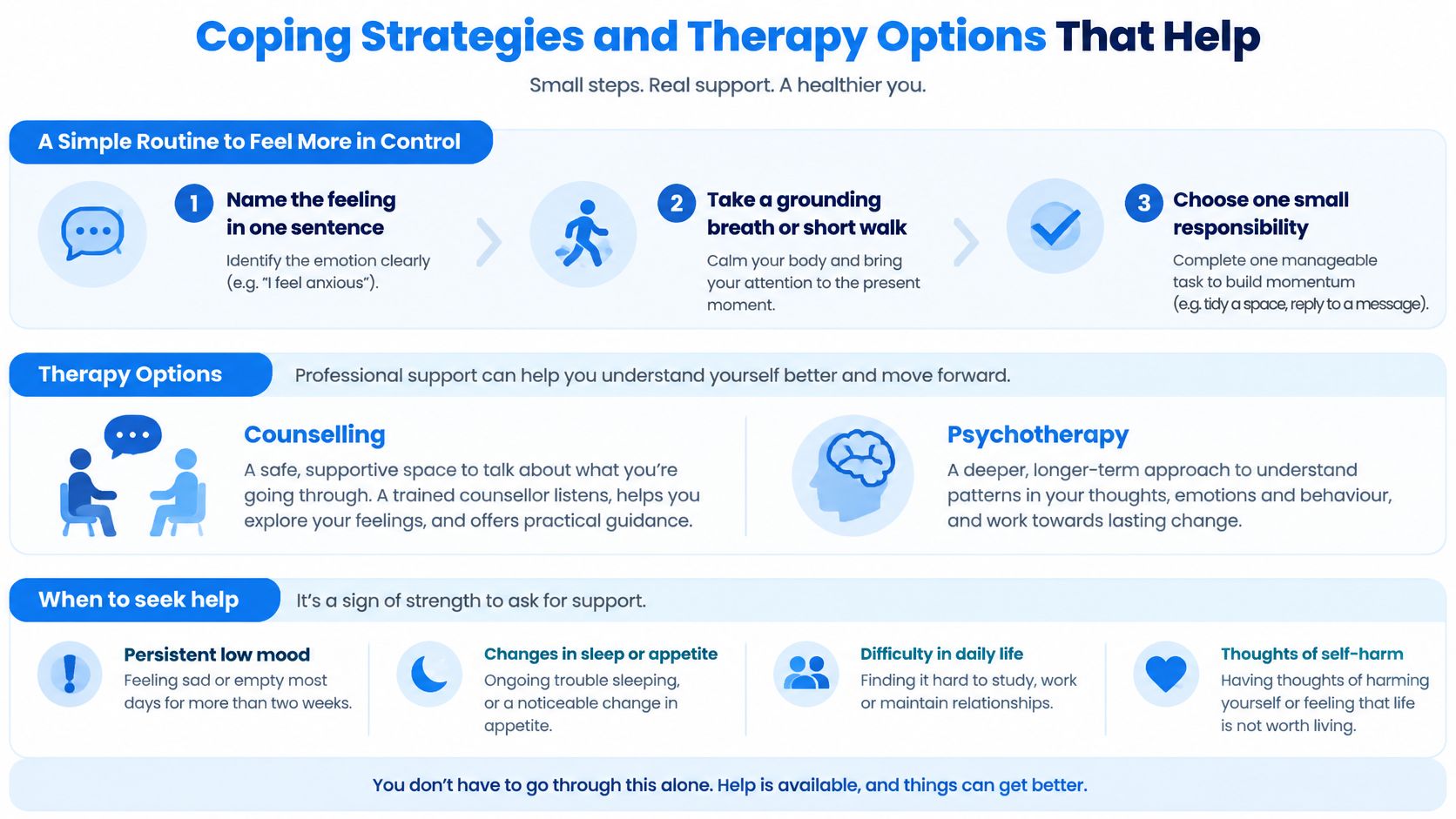
Name the feeling in one sentence. Try identifying fear, shame, loneliness or exhaustion before judging your reaction. A specific feeling gives you something clearer to respond to than a broad belief that you're failing.
Take a grounding breath or short walk. Feel your feet against the floor and breathe comfortably without forcing deep breaths. If concentrating on breathing feels uncomfortable, notice nearby colours, sounds or objects instead.
Choose one small responsibility to return to. Open the assignment file, prepare a meal or draft the first line of an email. Choose something manageable rather than testing yourself with the hardest task.
Protect sleep and meals. Keep a realistic waking routine and arrange accessible food during difficult periods. Persistent sleep disruption deserves attention rather than criticism about discipline.
Tell one trusted person what you need. Ask for a specific kind of support, such as company while you make a difficult call. Clear requests reduce guessing and make boundaries easier to agree on.
Practise self-compassion. Speak to yourself as you would to a struggling friend. Acknowledge the difficulty while choosing a constructive next step, rather than excusing harmful behaviour or demanding instant confidence.
Use this checklist as a reminder when choosing a manageable starting point.
Choosing a form of support
Therapy approaches for regression-related distress
| Approach | Best suited for | What sessions involve |
|---|---|---|
| Supportive counselling | Stress, grief and everyday overwhelm | Listening, validation and practical coping plans |
| Cognitive behavioural therapy | Anxiety, low mood and avoidance patterns | Structured sessions on thoughts, behaviours and small steps |
| Psychodynamic therapy | Recurring patterns and their origins | Exploring feelings, defences and past experiences over time |
| Family or couples therapy | Family conflict, marital discord or shared patterns | Joint sessions to improve communication and roles |
| Mindfulness and self-compassion practices | Rumination, self-criticism and emotional reactivity | Guided practices and skills practised between sessions |
These are starting points for discussion, not treatment prescriptions. Mindfulness and self-compassion may be integrated into therapy, and joint sessions require particular care if there's intimidation or abuse.
A first session usually includes questions about current difficulties, health, relationships, safety and what you hope will change. You and the professional can agree on goals and a plan, including whether medical or psychiatric assessment would be helpful.
Progress often involves work over weeks to months rather than a single conversation, but there's no fixed timetable or promised cure. Useful goals might include fewer reassurance loops, better attendance or greater confidence handling a familiar task.
Build strengths alongside coping skills
In an Indian undergraduate positive-psychology study, positive affect, grit and negative affect together explained 19% of variation in life satisfaction and 11% of variation in happiness. This supports paying attention to strengths alongside difficulties, without suggesting that gratitude or determination can replace care.
Resilience can mean trying again with support, compassion can soften self-criticism, and purpose can guide a small daily choice. Gratitude needn't deny hardship; positive assessment scores also don't rule out anxiety or depression, because assessments are informational, not diagnostic.
If you prefer a video format, this embedded resource offers another way to engage with the topic; it isn't a substitute for personalised care.
Getting an Assessment and Choosing Your Next Step
A screening assessment can help you organise concerns before a conversation. It can't determine whether you're experiencing regression or establish a mental-health diagnosis.
Tools people in India commonly encounter include the PHQ-9 for low mood, GAD-7 for anxiety and Perceived Stress Scale for everyday stress. Each provides an informational score that should be discussed with a qualified professional; the Defence Style Questionnaire-40 is a research instrument, not a self-diagnosis tool.
India's National Mental Health Survey 2015–16, conducted by NIMHANS and summarised by the Press Information Bureau, estimated that 10.6% of adults had a diagnosable mental disorder, with prevalence of 13.5% in urban areas versus 6.9% in rural areas. Accessible therapy and counselling need to account for different locations, languages and resources.
Turn concern into a conversation
- Start with a suitable screening tool: Use it to prepare questions, not attach a label.
- Record the pattern: Note duration, triggers, safety concerns and changes in daily functioning.
- Speak to a GP or therapist: Ask whether psychological, medical or psychiatric assessment is appropriate.
- Agree on a plan: Choose practical goals and discuss when to review them.
For readers supporting relatives in the United States, testing options for Ohio families from Providers for Healthy Living offer a location-specific resource for exploring professional assessment. Availability and suitability should be checked directly.
Further reading includes Anna Freud's The Ego and the Mechanisms of Defence (1936), Kristin Neff's Self-Compassion (2011) and Carol Dweck's Mindset (2006). These offer perspectives on defences, self-compassion and growth, rather than diagnostic guidance.
- Keep perspective: Regression can be a human response to overwhelming circumstances.
- Build strengths: Resilience, compassion and gratitude can develop alongside professional support.
- Ask early: Many people regain steadier functioning with support, and seeking help is strength rather than failure.
DeTalks offers a directory of psychologists and counsellors, bookable sessions and science-backed assessments that are informational, not diagnostic. If changes in dependence, reassurance-seeking or coping are troubling you, visit DeTalks to explore professionals and choose a supportive next step.