Tag: counselling for anxiety

  • Finding a Therapist for Stress: A Guide to Building Resilience and Well-being

    Finding a Therapist for Stress: A Guide to Building Resilience and Well-being

    Feeling overwhelmed, like you're constantly running on empty, is more than just a side effect of a busy life. It's a clear signal that your inner resources are stretched thin. Deciding to see a therapist for stress is a powerful, proactive step towards regaining your balance and investing in your long-term well-being.

    Why Talking to a Therapist for Stress Can Help

    A woman therapist consults with a male client in a bright, modern office with a model airplane.

    Navigating life’s pressures alone can feel challenging and isolating. A therapist acts as a skilled guide, helping you understand your emotional landscape and find a clearer path forward. This supportive partnership is what makes counselling for stress so effective.

    In places like India, where professional and personal pressures can be high, we often feel the need to appear strong all the time. Therapy offers a confidential space to lower that guard without judgment. It’s a place to explore the roots of your stress, whether it's workplace stress, family expectations, or personal anxieties.

    Building Your Mental Toolkit for Well-being

    A therapist does more than listen; they equip you with practical tools to enhance your mental well-being. This process helps you move from reacting to stress to responding with intention. It's about building lasting resilience and self-compassion.

    With their guidance, you can learn to:

    • Identify the specific thoughts and situations that trigger your stress.
    • Gently challenge and reframe unhelpful thought patterns that contribute to anxiety.
    • Develop practical coping skills for immediate relief when you feel overwhelmed.
    • Cultivate inner strengths like compassion and happiness to navigate future challenges.

    Therapy isn't about eliminating stress, but about changing your relationship with it. It’s learning to navigate life's challenges with greater confidence and calm, fostering a more positive and resilient mindset.

    This journey unfolds at your own pace, with a professional guide supporting you. Working with a therapist for stress helps you move from just surviving to truly thriving, creating a path to a more balanced and fulfilling life.

    Recognising the Signs You Might Need Support

    A distressed man sits on a bed, hiding his face in his hands, with a steaming mug nearby.

    It can be difficult to notice when everyday stress turns into something more serious. We all face pressure, but when it starts to feel like a constant weight on your shoulders, it's a sign to pay attention. These changes can be subtle, slowly becoming a new, exhausting normal.

    Recognising these shifts is an act of self-awareness and strength. If stress is consistently impacting your happiness, work, or relationships, considering professional counselling can be a helpful step. Finding a therapist for stress is a proactive choice for your overall well-being.

    When to Seek Help: Common Signs to Look For

    How do you know when it's time to reach out? Stress affects your mood, body, and behaviour. If you recognise several of the signs below in your own life, it may indicate that the load has become too heavy to carry alone.

    This is not a diagnostic checklist but an informational guide to help you reflect on your experiences.

    Signs It Might Be Time to Talk to a Therapist

    Area of Life Common Signs of Chronic Stress
    Emotional Well-being You feel constantly irritable, anxious, or overwhelmed. Things you used to enjoy no longer bring you pleasure. You might feel a persistent sense of dread or sadness that you can't shake off.
    Mental Clarity Concentration feels impossible. You struggle to make decisions, your memory feels foggy, or you have racing thoughts that keep you up at night. Minor tasks feel like huge hurdles.
    Physical Health Unexplained headaches, stomach problems, or frequent colds have become common. You feel exhausted all the time, even after a full night's sleep. Muscle tension and aches are your new norm.
    Work or School Procrastination has taken over, and your performance is slipping. You feel disengaged or cynical about your work, and the pressure feels unbearable.
    Relationships You find yourself snapping at loved ones or withdrawing from social activities. You feel isolated and disconnected, even when you're around people you care about.
    Behavioural Habits You're relying more on unhealthy coping mechanisms, like overeating, excessive drinking, or zoning out online. You've stopped taking care of yourself—skipping meals, exercise, or hygiene.

    If this list resonates with you, please know you are not alone. In India, workplace stress is a significant concern, with research indicating that a large portion of adults experience moderate stress from professional demands. You can read the full research about mental health trends in India for more context.

    These signs are not a sign of failure. They are your mind and body’s way of signalling that you are carrying too heavy a load and may benefit from support.

    Paying attention to these signals is an act of self-compassion. It's the first step toward building the resilience needed to navigate life’s challenges with greater ease and seeking help is a sign of strength.

    Therapeutic Approaches for Stress and Well-being

    Two individuals sit at a table during a counseling session with a notebook showing a 'Thought' diagram.

    When you begin working with a therapist for stress, you gain access to proven methods tailored to your needs. Therapy is a collaborative process where a skilled professional guides you using evidence-based techniques. The goal is to build practical, lifelong skills for managing your thoughts and feelings.

    Learning about these approaches can help demystify the process of counselling. Let's explore some of the most effective therapies used for stress, anxiety, and burnout, as well as for cultivating positive states like resilience and happiness.

    Cognitive Behavioural Therapy (CBT)

    Cognitive Behavioural Therapy (CBT) is a widely researched and effective approach for managing stress and anxiety. It is based on the idea that our thoughts, feelings, and actions are interconnected. Unhelpful thought patterns can trigger difficult emotions, which in turn lead to unhelpful behaviours.

    A CBT therapist helps you identify and understand these automatic thought patterns. You then learn to gently question them and shift towards more balanced perspectives. It's a practical, hands-on approach that gives you concrete tools to manage everything from workplace stress to personal worries.

    Acceptance and Commitment Therapy (ACT)

    Acceptance and Commitment Therapy (ACT) offers a different perspective: learning to change your relationship with your thoughts and feelings. It teaches that difficult emotions are a natural part of life, and fighting them can be exhausting. ACT helps you accept their presence without letting them control you.

    With an ACT therapist, you will focus on a few key areas. You'll learn to notice your feelings without being overwhelmed, clarify what truly matters to you (your values), and take meaningful action toward a life aligned with those values, even when stress is present. This fosters psychological flexibility and resilience.

    Mindfulness-Based Approaches

    When we are stressed, our minds often race between past regrets and future worries. Mindfulness-based approaches, like Mindfulness-Based Stress Reduction (MBSR), gently guide your attention back to the present moment. Through practices like guided meditation, you learn to observe your thoughts without judgment.

    Mindfulness is not about emptying your mind, but about observing your thoughts and feelings as they come and go, without getting carried away by them.

    This practice creates a vital pause between a stressful event and your reaction. In that space, you find the freedom to choose a more thoughtful response. Exploring related practices like therapeutic yoga can also be a wonderful way to connect mind and body, building a stronger foundation for well-being.

    How to Find a Therapist You Truly Connect With

    Finding the right therapist is a personal journey, and the connection you feel is key. This relationship, known as the therapeutic alliance, is one of the most important factors for successful therapy. You need to feel safe, seen, and understood to do the meaningful work of healing and growth.

    Taking the first step to find a professional is a hopeful act of self-care. It's worth taking the time to find someone who feels like a true partner in your corner. This person will help you navigate stress, build resilience, and learn to manage anxiety for the long term.

    Starting with the Essentials

    A few practical checks can help you create a shortlist of qualified and ethical professionals. In India, look for psychologists registered with a recognized body like the Rehabilitation Council of India (RCI). This registration ensures they have met specific training and ethical standards.

    Also, consider their area of focus. If you're dealing with challenges like workplace stress, anxiety, or depression, look for a therapist for stress who lists these as core areas of their practice. This ensures they have the right experience to support you.

    The Importance of the Right Fit

    The most qualified therapist may not be the right one for you if you don't feel a comfortable connection. That "fit" is the gut feeling of trust that allows you to be open and honest. It’s the difference between speaking with a clinical expert and a warm, empathetic human who truly understands.

    A good therapeutic fit means you feel respected, heard without judgment, and confident in your therapist's ability to guide you. This foundation of trust is where real growth and healing happen.

    This connection is built on empathy and a shared understanding of your goals. Trust your instincts; if an initial conversation doesn't feel right, it’s perfectly okay to continue your search.

    Questions to Ask a Potential Therapist

    Most therapists offer a brief initial consultation, often free of charge. This is your opportunity to ask questions and see if their style aligns with your needs. Having a few questions prepared can help you feel more confident in your choice.

    Here are a few helpful questions to consider:

    • What's your approach to helping people with stress and anxiety? This helps you understand their therapeutic style.
    • How do you help your clients build practical coping skills? This shows their focus on equipping you with real-world tools.
    • Can you describe what a typical session with you is like? This gives you a sense of their process and manages expectations.
    • How do you work with clients to track progress? This shows they are invested in your journey toward well-being.

    Finding the right therapist is a deeply personal process. By combining practical checks with a focus on human connection, you can find a professional who will be a powerful ally on your path to feeling better.

    Choosing Between Online and In-Person Therapy

    Today, finding the right therapist for stress means you have more options than ever. A key decision is whether to meet in a physical office or connect online. There is no single "best" choice—it all depends on what suits your life and makes you feel most comfortable.

    For some, traditional in-person therapy provides a dedicated, quiet space away from daily distractions. Going to an office can create a helpful mental separation, allowing you to focus entirely on yourself. This setting can make it easier to build rapport without technical interruptions.

    The Rise of Online Counselling

    Online counselling has made mental health support more accessible, especially in a country like India. It removes the stress of travel and makes it easier to fit a session into a busy schedule. This is a great benefit for people in smaller towns or anyone with mobility challenges.

    Many people also find it less intimidating to open up from the comfort of their own home. It can lower the initial barrier to starting therapy, helping you feel at ease from the very first call. This flowchart outlines the essential steps for finding a therapist, regardless of the format.

    A flowchart on finding a therapist, detailing steps like credentials, consultation, and rapport.

    The core steps—checking credentials and ensuring a good connection—remain the same for both options. To help you decide, here is a simple comparison.

    Comparing In-Person and Online Therapy

    Feature In-Person Therapy Online Therapy
    Environment A dedicated, neutral, professional office setting. Your own familiar, private space (home, office, etc.).
    Convenience Requires travel and scheduling around commute times. No travel needed; highly flexible and easy to fit in.
    Accessibility Limited to professionals in your local area. Access to a wide pool of therapists across the country.
    Connection Direct, face-to-face interaction without technology. Relies on a stable internet connection for video/audio.
    Comfort Level Can feel more structured and formal. May feel less intimidating and more relaxed for some.
    Anonymity Less anonymity due to visiting a physical location. Offers a greater sense of privacy and discretion.

    Ultimately, both paths can lead to the support you need for your well-being.

    What Is Right for You?

    The best choice is the one you will stick with. Whether you are dealing with anxiety, workplace stress, or want to build more resilience, a good therapist can support you in either setting.

    The goal is to find a supportive, professional partnership. Whether that happens in a physical room or through a video call, the quality of the connection is what matters most for your growth.

    Consider your lifestyle, comfort with technology, and the environment where you feel safest to open up. With trusted platforms offering secure sessions, you can build an effective, healing relationship no matter the distance.

    Taking Your First Step Toward a Calmer Life

    Deciding to find a therapist for stress is a sign of strength and a commitment to your own well-being. It’s a proactive choice to build a more fulfilling and balanced life. While the process might seem new, getting the right support is often more straightforward than you might imagine.

    Platforms like DeTalks are designed to simplify your search. You can browse profiles of qualified professionals who specialize in stress, anxiety, and burnout. This helps you find someone whose approach to counselling and expertise aligns with your needs.

    Using Self-Assessments for a Clearer Picture

    As you begin, you may come across self-assessment tools. These can be a helpful way to organize your thoughts and feelings, giving you a clearer starting point for your first conversation with a therapist. They are purely for your personal reflection and information.

    It is important to remember that these tools are informational and not a substitute for a professional diagnosis. They simply offer a private, structured way to map out what you have been experiencing.

    "Beginning therapy is not about admitting defeat; it is an act of profound self-love. It's giving yourself the space to heal, grow, and build the resilience needed to navigate life with greater peace and purpose."

    This journey is about more than just overcoming a difficult time; it’s about creating lasting positive change. The skills you learn in therapy—from managing workplace stress to practicing self-compassion—become a permanent part of your toolkit. You’ll be better equipped to handle life's challenges and build a life defined by calm and purpose.

    Your Questions About Stress Therapy, Answered

    Taking the first step into therapy is significant, and it's natural to have questions. Let's clarify some common queries people have when considering a therapist for stress. Our goal is to make the process feel clear and approachable.

    How Long Will I Need to Be in Therapy for Stress?

    There's no single answer, as the timeline is unique to you and your goals. For some, a few months is enough to build effective coping strategies. For others, particularly if stress is linked to deeper issues like trauma or ongoing anxiety, longer-term support may be more beneficial.

    Your therapist will work with you to set goals and will regularly check in to ensure you are moving in a helpful direction together. It is a collaborative process focused on your well-being.

    Is What I Say in Therapy Actually Private?

    Yes, confidentiality is a cornerstone of therapy. It is a strict ethical requirement for all professionals. This creates a safe space where you can speak openly without fear of your information being shared.

    The only exceptions are rare situations involving immediate risk of harm to yourself or others. Your therapist will explain these limits clearly at the beginning, so you feel fully informed.

    Think of the therapeutic relationship as a secure vault for your thoughts and feelings. This trust allows for genuine exploration and healing, freeing you from carrying your worries alone.

    What if I Don’t Click with the First Therapist I See?

    That is perfectly okay and quite common. Finding the right fit is crucial for a successful therapeutic experience. The connection you have with your therapist—the 'therapeutic alliance'—is one of the strongest predictors of positive outcomes in therapy.

    If the first person you meet doesn't feel right, don't be discouraged. View it as a step in the process of finding the right partner for your journey. Platforms are designed to help you find a professional who truly understands you.


    Seeking support is a courageous step towards managing stress and building your resilience. Exploring your options is the beginning of a path to a calmer, more balanced life. Book your first session today.


  • How to Deal with Social Anxiety: A Practical Guide

    How to Deal with Social Anxiety: A Practical Guide

    Living with social anxiety isn’t about becoming a different person overnight. It's a gentle journey of understanding yourself, learning to stay grounded, and slowly building your confidence over time. This is about nurturing your resilience and well-being with small, manageable steps.

    Understanding What Social Anxiety Really Feels Like

    A person sitting alone on a bench, looking thoughtful and slightly withdrawn, with a blurred background of a park.

    If you’re reading this, you probably know the feeling—that knot in your stomach, racing thoughts, or a wave of worry in social situations. The first thing to know is that what you’re experiencing is very real, and you are not alone in this.

    It's easy to dismiss it as shyness, but there's a difference. Shyness is often a temporary feeling in new situations, while social anxiety is a more persistent fear of being judged or embarrassed. This fear can be strong enough to make you avoid social events you might otherwise enjoy.

    Shyness vs. Social Anxiety: A Clear Distinction

    This simple comparison can help clarify the difference between occasional shyness and the patterns of social anxiety. Understanding where you are on this spectrum is a helpful first step.

    Characteristic Shyness Social Anxiety
    Intensity Mild to moderate discomfort. Intense, often overwhelming fear.
    Duration Usually temporary; fades as you warm up. Can start weeks before an event and linger long after.
    Impact Doesn't typically interfere with life goals. Often leads to avoidance of school, work, or relationships.
    Physical Symptoms Minimal; maybe some blushing. Significant; racing heart, sweating, shaking, nausea.
    Core Fear Fear of awkwardness or saying the wrong thing. Deep-seated fear of negative judgment and humiliation.

    Recognising these patterns is an important step toward understanding what you’re navigating and finding the right support.

    The Modern Pressures We Face

    Our always-on, connected world can amplify these feelings. The pressure to present a perfect image online while managing real-life social circles can lead to a draining cycle of anxiety and avoidance. This creates significant stress for many.

    This is particularly true in India, where a unique mix of traditional expectations and modern ambitions creates a high-pressure environment. From large family weddings to high-stakes work presentations, triggers for social unease are common. The resulting burnout is a growing concern.

    Research shows a rise in anxiety disorders across India, driven by socio-economic and cultural shifts. A global study highlighted that countries like India bear a large burden of these challenges. To learn more, you can explore the full research on this topic00412-2/fulltext) and see the data for yourself.

    What Does It Physically and Mentally Feel Like?

    Social anxiety is more than a feeling; it’s a full-body experience. When a trigger appears, your body’s "fight or flight" response can activate, even without any real danger. This can be an incredibly draining experience.

    You might notice physical and mental signs like a racing heart, sweating, or a whirlwind of "what if" thoughts. A powerful urge to escape can make it hard to focus on anything else. This response can contribute to feelings of depression over time.

    Acknowledging these feelings with compassion is the first step toward building resilience. It’s about recognising this as a manageable challenge, not a personal failing.

    Understanding what is happening can demystify the experience. This guide is here to walk you through that process with practical, gentle steps, helping you find more comfort and confidence.

    Pinpointing Your Personal Anxiety Triggers

    The first step in managing anxiety is not to fight it, but to understand it. Think of yourself as a gentle detective in your own life, looking for clues that show what sets off those feelings of unease. This process is about gaining clarity and compassion for yourself.

    Once you see the patterns, you are no longer in the dark. You have a map to start navigating your way forward with more awareness.

    Common Scenarios That Fuel Anxiety

    While everyone's experience is unique, social anxiety often appears in a few common situations. You might recognise yourself in these scenarios, whether it’s a large family gathering in India or the pressure of a presentation at work.

    • Performance Situations: This is a big one, including giving a speech or being put on the spot in a meeting. The underlying fear is often about being judged for how you come across.
    • Large Gatherings: A crowded party or a busy office social can feel overwhelming. It’s easy to feel like every move you make is being watched.
    • One-on-One Interactions: Sometimes, the most intense anxiety happens in smaller settings, like a chat with a boss. The pressure to be interesting can feel immense.
    • Anticipatory Anxiety: The dread often begins long before an event. You might worry for days or weeks, rehearsing all the ways things could go wrong.

    If this sounds familiar, you are far from alone. One study of nearly 7,000 young people found that 36% had symptoms of social anxiety disorder. Many feel this way for years before seeking help, which shows why open conversations are so important. You can read the full research about these findings to learn more.

    A Gentle Journaling Prompt for Self-Discovery

    To get a clearer picture of your triggers, try this simple journaling exercise. Think of this as an informational tool for awareness, not a test.

    Find a quiet moment and recall a recent social situation where you felt anxious. Use these questions to guide your thoughts without judging yourself.

    1. What was the situation? (e.g., A team lunch, a video call, a family function.)
    2. Who was there? (e.g., Colleagues, strangers, relatives, my manager.)
    3. What specific thoughts ran through my mind? (e.g., "I'm going to say something silly," "They think I'm awkward.")
    4. How did my body feel? (e.g., Heart pounding, sweaty palms, a knot in my stomach.)
    5. What did I do? (e.g., Stayed quiet, left early, looked at my phone.)

    Doing this helps you connect the dots and see patterns. This awareness is where your power lies and is the foundation for any effective therapy or counselling journey.

    By understanding what fuels your anxiety, you turn a vague feeling of dread into a specific challenge you can begin to address. This knowledge allows you to prepare for situations, be kinder to yourself, and take real steps toward feeling better.

    Practical Techniques to Calm Anxiety in the Moment

    When a wave of social anxiety hits, it can feel like your thoughts are spiralling. In those moments, you need simple, effective tools that work right away. You have the power to gently guide your nervous system back to a place of calm.

    These techniques are designed to be discreet and easy to use anywhere. They work by interrupting the anxiety cycle, pulling your focus away from racing thoughts and back to the present moment. This helps ease the physical symptoms of anxiety.

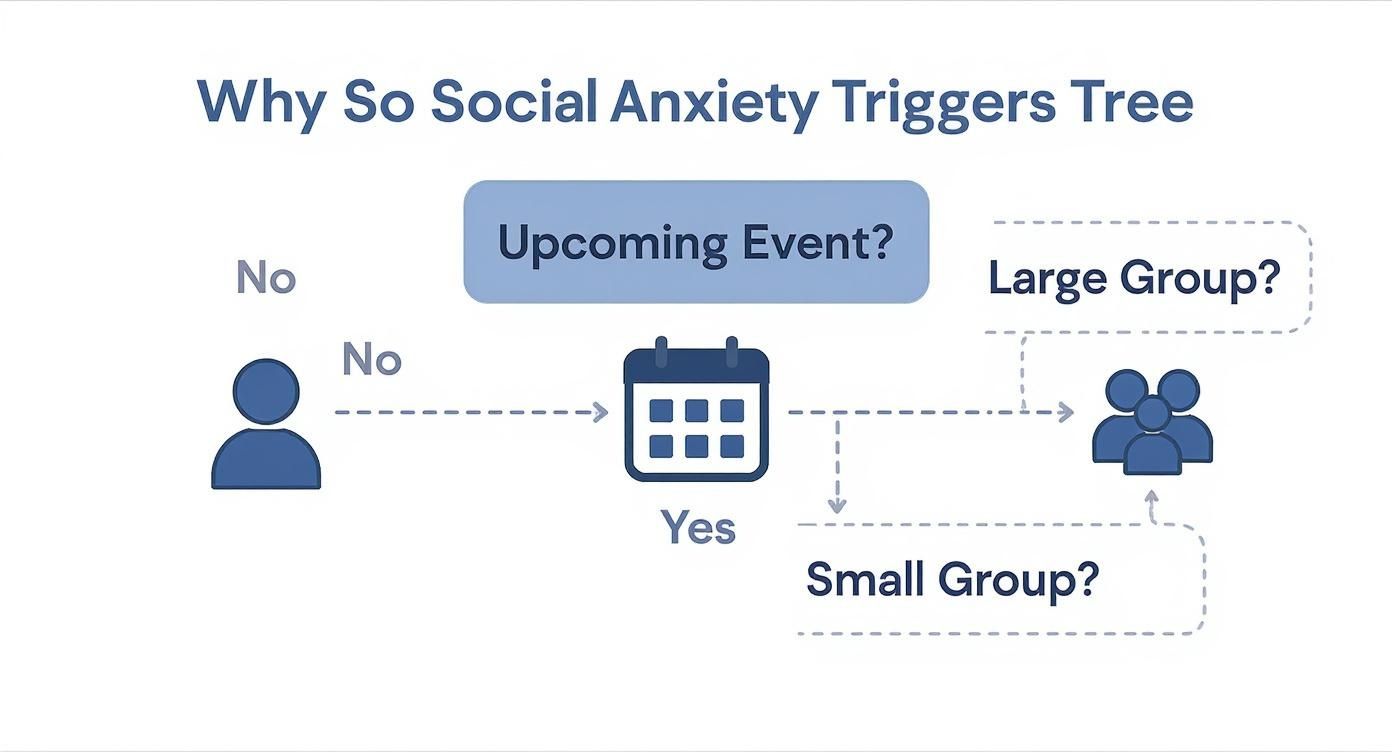
    First, it helps to understand what sets these feelings off. This decision tree shows a common thought process when facing a social event, pinpointing where anxiety might begin.

    Infographic showing a decision tree for social anxiety triggers, starting with 'Upcoming Event?' and branching into large vs. small groups.

    Sometimes the anxiety starts with just the thought of an event. Realising this pattern is a huge first step toward preparing yourself with calming strategies ahead of time.

    Ground Yourself with the 5-4-3-2-1 Method

    When anxiety pulls you into a whirlwind of worry, grounding techniques are your anchor. The 5-4-3-2-1 method is a sensory exercise that helps your brain focus on your immediate surroundings instead of internal fears. It's simple and can be done anywhere without anyone noticing.

    Here's how it works:

    • Look for 5 things you can see. Silently name five objects around you, like a pen, a pattern on the floor, or a leaf outside.
    • Notice 4 things you can feel. Tune into physical sensations, such as the texture of your clothes or the feeling of your feet on the ground.
    • Listen for 3 things you can hear. Pay attention to three distinct sounds, like the hum of a computer or distant traffic.
    • Identify 2 things you can smell. This may be subtle, but try to notice scents like coffee or the faint smell of rain.
    • Acknowledge 1 thing you can taste. Focus on one taste, such as a lingering flavour from a drink or just the neutral taste in your mouth.

    This exercise is a quiet, personal reset button you can press anytime you feel overwhelmed. It's a great tool for your mental well-being.

    Control Your Breath to Calm Your Body

    Your breath is one of the most powerful tools you have for managing anxiety. When you feel anxious, your breathing often becomes fast and shallow, which can worsen physical symptoms. By consciously slowing your breath, you can activate your body's natural relaxation response.

    A simple yet effective technique is box breathing. Picture a square and follow its sides with your breath.

    • Breathe in slowly for a count of four.
    • Hold your breath for a count of four.
    • Breathe out slowly for a count of four.
    • Hold your breath again for a count of four.

    Repeat this cycle a few times to help regulate your heart rate and bring a sense of stability. For those exploring other avenues of support, learning about the top supplements for stress and anxiety can also be a helpful resource.

    Quick Anxiety-Relief Techniques at a Glance

    This table summarises a few simple tricks you can use whenever you need them. Practice them in calm moments to build confidence in using them during times of stress.

    Technique How It Helps When to Use It
    5-4-3-2-1 Grounding Re-focuses your mind on your senses, pulling you out of anxious thoughts. When your thoughts are racing or you feel detached.
    Box Breathing Slows your heart rate and signals your nervous system to calm down. Before an event or when you feel physical symptoms.
    Progressive Muscle Relaxation Releases physical tension you may be holding onto. Discreetly tense and release your toes or fists.
    Mindful Observation Narrows your focus to a single object, giving your mind a break. When you feel overwhelmed in a crowded room.

    These are not magic cures, but they are powerful tools for navigating difficult moments. Having a few trusted strategies ready can help you face social situations with a greater sense of control and resilience.

    Building Lasting Confidence and Resilience

    A person gently tending to a small, thriving plant, symbolising growth and nurturing personal resilience.

    While in-the-moment techniques are helpful, building lasting confidence is key. This is where we move from managing anxiety to building genuine resilience. The goal is to learn to navigate social situations so that fear no longer controls your choices.

    This process involves gently and intentionally expanding your comfort zone. It's about taking small, manageable steps that prove to you, one interaction at a time, that you can handle this. This approach fosters happiness and a sense of accomplishment.

    Gently Expand Your Comfort Zone

    Think of this process as a series of low-stakes social experiments. The goal is to dip your toes into social situations where the pressure is minimal. This is a core part of professional therapy and counselling because it helps rewire the brain’s fear response.

    Start with things that feel just a little challenging, not overwhelming. Here are a few practical ideas:

    • Chat with the cashier: A simple "How's your day going?" is a structured interaction with a natural end.
    • Find a hobby-based group: Join a book club or a local class where the shared activity is the focus, taking pressure off conversation.
    • Give someone a compliment: Offer a genuine compliment to a colleague or someone in a shop. It's a positive, low-pressure interaction.

    Each time you do one of these things, you gather evidence that social interactions can be pleasant. This slow accumulation of positive experiences builds real confidence.

    Challenge and Reframe Your Thoughts

    Social anxiety is often fuelled by a relentless inner critic. Thoughts like "Everyone thinks I'm boring" can feel like truths, but they are often just assumptions. Learning to question them is a huge step toward better well-being.

    This practice is sometimes called cognitive reframing. It’s about becoming a curious detective of your own thoughts. When a negative thought appears, pause and ask yourself:

    • Where is the evidence for this thought? Is it based on facts or just a feeling?
    • What is a kinder way to see this? Instead of "I'm so awkward," try, "It's normal to feel nervous in new situations."
    • What would I tell a friend who was thinking this? We are often more compassionate with others than with ourselves.

    This is not about forced positivity. It's about introducing a more balanced and realistic viewpoint to counter the mind's tendency to focus on the negative.

    Mastering this internal dialogue is crucial for managing not just social anxiety, but also related challenges like workplace stress and feelings of depression. You’re building emotional resilience from the inside out.

    Embrace Progress Over Perfection

    One of the sneakiest traps of social anxiety is perfectionism. The fear of making one small mistake can be paralysing. Shifting your focus from perfection to progress is the way out.

    Celebrate the small wins, like staying at a party for 10 minutes longer than you planned. Acknowledge these moments to reinforce your courage and give you the motivation to keep going. This is about self-compassion and treating yourself with kindness.

    Setbacks will happen, and they are part of any meaningful journey. See them as learning opportunities, not failures. By taking these small, consistent steps, you are actively creating a more confident and fulfilling life.

    Knowing When and How to Get Professional Support

    Taking steps to manage social anxiety on your own shows real strength. But sometimes, even our best efforts aren't enough, and that’s completely okay. Reaching out for professional support is a smart, courageous move toward caring for your well-being.

    Making that decision can feel difficult, especially as conversations around mental health are still evolving in many cultures, including in India. Professional counselling provides a safe, confidential space to explore your feelings without judgment.

    Is It Time to Talk to a Professional?

    If social anxiety is consistently getting in the way of the life you want, it might be time to seek help. Therapy is about equipping you with tools and support to handle challenges more effectively. Consider reaching out if you notice your anxiety is affecting your life in these ways:

    • Affecting Your Work or Studies: Are you avoiding presentations or struggling to speak in meetings due to intense workplace stress?
    • Straining Your Relationships: Are you pulling away from friends and family, leading to feelings of isolation and depression?
    • Limiting Your Life: Are you saying "no" to things you want to do, like a friend's wedding or a trip you've been dreaming of?
    • Leading to Unhealthy Coping Habits: A professional can guide you toward healthier strategies if you are relying on avoidance or other unhelpful patterns.

    Think of these as signs pointing you toward extra support. Exploring resources on things like effective PTSD treatments can also show the wide range of support available for various mental health challenges.

    What Is Therapy Actually Like?

    The thought of starting therapy can be nerve-wracking if you don’t know what to expect. Your first appointment is really just a conversation to see if you and the therapist are a good fit. You can talk about what's been going on, and the therapist will listen and explain how they can help.

    Remember, you are in control. It's okay to ask about their experience, the methods they use, and what a typical session looks like.

    One of the most effective methods for social anxiety is Cognitive Behavioural Therapy (CBT). This practical approach helps you learn to spot, challenge, and change the negative thought patterns fuelling your anxiety. It gives you real-world skills to build your resilience.

    What to Expect from Getting Support

    Therapy is a partnership focused on your growth and happiness. It helps you build on your strengths, encourages self-compassion, and supports you as you work toward a life that feels authentic.

    Platforms like DeTalks can help you begin this process. They offer confidential assessments that can give you a better handle on your emotional state. It's important to remember these tools are informational, not diagnostic, but they can be a great first step toward a conversation with a professional.

    Ultimately, seeking support is an investment in your own well-being. It’s about giving yourself the chance to live a fuller, more connected life.

    Wrapping Up: Your Journey Forward

    Living with social anxiety is a journey, not a race. The goal is not a "perfect" social life, but to build your resilience and find more moments of ease and connection. Every small effort you make is a real win for your well-being.

    Understanding your anxiety is a huge first step. When you acknowledge your feelings without judgment, you are swapping fear for awareness. This self-compassion is the foundation for lasting change.

    It's the small, consistent actions that add up. Whether it's taking deep breaths before a meeting or gently questioning a negative thought, each act builds your confidence. These are the steps that help you loosen the grip of workplace stress and social fears.

    Your Path to Greater Well-Being

    Forget the idea of a quick cure; this is an ongoing process of growth. Embrace progress over perfection and celebrate the small victories—they matter more than you think.

    Here are a few supportive takeaways:

    • Be Kind to Yourself: Treat yourself with the same compassion you would offer a friend.
    • Progress Isn't a Straight Line: You will have good days and tough days. Both are part of the process.
    • Your Feelings Are Valid, Not Facts: Acknowledge your anxiety, but remember it is something you experience, not who you are.

    It is always okay to ask for help. Reaching out for therapy or counselling is a sign of incredible strength and a practical step toward more happiness and balance.

    This process is about equipping yourself with the right tools and insights to handle what comes your way. You have what it takes to build a life that feels more connected, authentic, and joyful.

    Frequently Asked Questions

    When you're figuring out how to handle social anxiety, many questions can come up. Here are answers to some of the most common ones.

    Can Social Anxiety Be Completely Cured?

    It is more helpful to think of social anxiety as highly manageable rather than something to "cure." Through consistent use of coping strategies, gentle exposure to feared situations, and professional support like therapy, you can significantly reduce its impact on your life. The goal is to build lasting resilience and feel good, even if you still get nervous sometimes.

    Should I Tell My Friends or Boss About My Social Anxiety?

    This is a personal decision, and there is no single right answer. Opening up to people you trust can build a strong support network and may lead to small adjustments that reduce workplace stress. However, you are never obligated to share. If you do decide to talk about it, being specific about what would be helpful can make the conversation more productive.

    Is Medication the Only Way to Treat Severe Social Anxiety?

    No, medication is just one of many tools. It often works best when combined with other approaches. Cognitive Behavioural Therapy (CBT), a key part of professional counselling, is a powerful, science-backed method for addressing the root causes of anxiety and depression. A good mental health professional will discuss all options with you to create a plan that feels right.


    Ready to feel more in control? DeTalks provides a confidential space with science-backed assessments to help you understand what's going on. You can also connect with qualified therapists who get it. Start your journey by exploring your options at https://detalks.com.