Tag: counselling india

  • Life Success Therapy: A Guide to Thriving in 2026

    Life Success Therapy: A Guide to Thriving in 2026

    Some people read about therapy after a hard week. Others land here after a good week that still feels oddly empty.

    You may be doing many things “right”. You work hard, meet deadlines, support family, keep going through traffic, pressure, and endless notifications. Yet your mind stays busy, your body stays tense, and even success can feel like a task you must maintain rather than a life you can enjoy.

    That doesn’t mean you’re ungrateful or failing. It often means your inner life needs as much care as your outer goals.

    Life success therapy is one way to bring those two sides together. It supports people dealing with anxiety, workplace stress, burnout, low mood, or depression, while also helping them build resilience, clarity, self-compassion, and a more grounded sense of purpose.

    Beyond Surviving Your Next Goal

    Rohan is 29, works in Bengaluru, and has the kind of life many people aim for. He has a stable salary, a decent flat, and parents who proudly tell relatives he’s doing well. Still, most evenings, he feels drained and restless.

    He keeps telling himself that the next promotion will settle him. Then maybe a better package. Then maybe a holiday. But every time he reaches one target, relief lasts only briefly, and the pressure returns.

    A professional man with long hair sits at a desk, deeply focused on his laptop screen during work.

    This pattern is common. A person can look successful from the outside and still struggle with anxiety, self-doubt, burnout, or a quiet sense that life has become too mechanical. In many Indian homes, there’s also another layer. You may carry family expectations, financial responsibility, social comparison, and the belief that resting means falling behind.

    When achievement stops feeling satisfying

    Sometimes people come to therapy because they’re in visible distress. Sometimes they come because life has become flat, rushed, or emotionally crowded.

    That second reason matters just as much.

    Life success therapy helps when you’re not only asking, “How do I stop feeling bad?” but also, “How do I build a life that feels meaningful?” It treats emotional pain seriously, but it doesn’t stop there. It also asks what helps you feel steady, connected, and alive.

    Wanting a fuller life isn’t selfish. It’s part of well-being.

    A student may want help with exam stress but also with confidence. A working professional may want support for workplace stress and also a healthier definition of success. A parent may need counselling for exhaustion while learning how to respond with more patience and compassion at home.

    A different starting point

    Many people assume therapy is only for crisis. It isn’t.

    You can seek therapy because you’re functioning, but not flourishing. You can seek it because your mind is always racing, because you’ve become harsh with yourself, or because you want your ambition and your well-being to stop pulling in opposite directions.

    Life success therapy starts from a simple idea. You deserve support not only for surviving difficult seasons, but for creating a more fulfilling life.

    What Is Life Success Therapy

    Think of your mind like a home garden.

    If weeds take over, the flowers struggle. If the soil is dry, even healthy seeds won’t grow well. And if you only cut the weeds without caring for the soil, the same problems often return.

    The garden analogy

    Traditional therapy often helps people remove the weeds. That may include addressing anxiety, depression, burnout, shame, or unhelpful patterns in relationships. This work matters because emotional distress can block everything else.

    Life coaching often focuses more on planting new seeds. It may centre on goals, habits, productivity, or motivation. That can be useful, but coaching usually isn’t designed to address psychological pain in a profound way.

    Life success therapy does both. It helps clear what’s getting in your way and strengthens what helps you grow.

    What that looks like in practice

    A therapist may help you notice how fear of failure shapes your choices. At the same time, they may help you build resilience, emotional awareness, gratitude, self-respect, and a clearer sense of purpose.

    That means the work can include both healing and growth:

    • For distress: support for anxiety, depression, low motivation, workplace stress, burnout, grief, or relationship strain
    • For thriving: support for confidence, values, boundaries, compassion, meaning, and sustainable ambition

    This is especially useful for people who feel stuck between two worlds. You may not feel “unwell enough” for therapy in the way people around you imagine it. But you may also know that pushing harder isn’t solving the deeper problem.

    Why it feels different from advice

    Advice tells you what to do. Therapy helps you understand why certain patterns keep repeating, what emotions sit underneath them, and how to respond differently.

    That distinction matters for professionals under pressure. If your work role carries leadership stress, a specialised perspective can help. Some readers may also find it useful to explore how support is customized for high-pressure roles in this guide to a therapist for executives.

    Practical rule: If your goals keep growing but your peace keeps shrinking, you may need more than motivation. You may need therapeutic support.

    Life success therapy is not about becoming positive all the time. It’s about building an inner life strong enough to hold difficulty, joy, effort, and rest together.

    Core Therapeutic Approaches You Will Encounter

    Therapy can seem mysterious until you see the tools clearly. In reality, many approaches are practical and understandable. Each one shines light on a different part of your life.

    An infographic titled Core Therapeutic Approaches outlining CBT, ACT, Psychodynamic Therapy, SFBT, and MBSR methods.

    A simple comparison

    Approach Main focus Helpful when
    CBT Thoughts, beliefs, and behaviour patterns You overthink, self-criticise, or spiral after setbacks
    ACT Values and action, even with uncomfortable feelings You feel stuck, avoid difficult tasks, or feel disconnected from what matters
    Psychodynamic therapy Past experiences and repeating emotional patterns The same conflicts keep showing up in work, family, or relationships
    SFBT Small, practical changes toward a preferred future You want clarity and momentum without getting lost in over-analysis
    MBSR Present-moment awareness and nervous system regulation Stress runs high and your mind rarely feels quiet

    CBT helps you question the story in your head

    Cognitive Behavioural Therapy, usually called CBT, asks a useful question. “What am I telling myself in this moment, and is it helping?”

    If your manager sends “Can we talk?”, your mind might jump to “I’ve messed up” or “I’m about to be judged”. CBT helps you slow that chain down. It teaches you to spot automatic thoughts, test them, and replace harsh or distorted thinking with something more balanced.

    That doesn’t mean fake positivity. It means accuracy and emotional steadiness.

    ACT helps you move with discomfort, not wait for its absence

    Acceptance and Commitment Therapy, or ACT, is helpful when people delay life until they feel confident, calm, or certain. The problem is that those feelings don’t always arrive on schedule.

    ACT teaches a different skill. You can feel nervous and still act according to your values.

    A young woman may feel afraid to speak up in meetings but strongly value growth and honesty. ACT would not ask her to erase fear first. It would help her carry that fear more lightly while taking the step that matches her values.

    You don’t need a perfect inner state to take a meaningful outer step.

    Psychodynamic work looks for old patterns in new places

    Some struggles are not just about the current week. They have history.

    If you always feel responsible for everyone, panic when someone is upset with you, or chase approval at work, a therapist may explore where those patterns began. Perhaps praise was linked to performance in childhood. Perhaps conflict felt unsafe. Understanding this can reduce shame and increase choice.

    SFBT and mindfulness make growth easier to practise

    Solution-Focused Brief Therapy, or SFBT, doesn’t ignore pain. It asks what’s already working, even a little. If a student feels overwhelmed, a therapist may ask, “When was the stress slightly less intense?” That tiny exception becomes a clue.

    Mindfulness-Based Stress Reduction, often called mindfulness work, helps you notice thoughts and feelings without getting pulled by each one. In daily Indian life, this may look like pausing before reacting during a family disagreement, noticing your breath before a difficult call, or eating a meal without scrolling and rushing.

    Different therapists combine these approaches in different ways. The best fit depends on your goals, your personality, and the kind of support your nervous system responds to.

    Defining and Achieving Your Personal Success

    A common Indian experience goes like this. You meet one goal, then another appears. A promotion brings pride, but also longer hours. Good marks bring relief, but not always confidence. From the outside, life seems to be improving. Inside, you may still feel tense, tired, or unsure why none of it feels like enough.

    That is why personal success needs a deeper definition than achievement alone.

    For one person, success means financial stability and leadership. For another, it means sleeping well, speaking to themselves with less criticism, and being present at home after work. For many people, it means both. Outer progress and inner steadiness.

    What therapy can change in real life

    Life success therapy turns a vague wish into something you can practise. Instead of chasing a general idea like “I want to do better,” you begin to name what better looks like in daily life.

    It may mean receiving feedback from your manager without spiralling into self-doubt. It may mean noticing anxiety early, before it takes over your whole day. It may mean finishing work and still having enough mental space to enjoy dinner, help your child with homework, or sit peacefully without replaying every conversation.

    Personal success often grows from three areas working together:

    • Achievement: doing meaningful work and following through on goals
    • Emotional balance: handling stress, disappointment, and self-criticism with more skill
    • Alignment: living in a way that matches your values, not only other people’s expectations

    A useful comparison is a house with strong walls but no foundation, or a foundation with no rooms built on it. Career progress without emotional steadiness can feel fragile. Self-awareness without action can leave you stuck. Therapy helps you build both.

    What India-based evidence suggests

    India-specific research on life success therapy is still developing, but some findings point in a useful direction. One set of CBT success rate statistics summarised findings linked to Indian adults and working professionals, including improvements in anxiety, motivation, stress, productivity, career resilience, and sense of purpose.

    These findings matter for a simple reason. Many people do not come to therapy with only one problem. An engineer may feel burned out and directionless. A student may struggle with anxiety and low confidence. A parent may be doing well at work while feeling constantly irritable at home. Relief and growth often need attention at the same time, especially in Indian settings where family duty, social comparison, and career pressure often overlap.

    Your version matters most

    Many people hear “success” and assume therapy is trying to make them more productive.

    Sometimes productivity improves. That is not the whole aim.

    A therapist may help you define success with questions like these:

    • What do I want more of? Calm, confidence, joy, clarity, better boundaries
    • What do I want less of? Panic, burnout, people-pleasing, constant comparison
    • What kind of life feels worth my effort? One guided by values, care, and direction

    A meaningful life is not measured only by output. It is also measured by how it feels to live it.

    For some people, success means staying ambitious without going emotionally numb. For others, it means healing enough from anxiety or depression to enjoy ordinary parts of life again. In the Indian context, it can also mean learning to respect family and community while still making room for your own voice.

    That balance is often where real growth begins.

    A Look Inside a Typical Therapy Session

    Most therapy sessions are quieter and more practical than people expect. They’re not lectures. They’re not interrogations. They’re structured conversations where you and the therapist make sense of what’s happening and decide what to try next.

    A professional therapist in a blazer sits in an armchair listening to a client on a sofa.

    How a session often begins

    A session usually starts with a check-in. You might talk about your week, a stressful event, a shift in mood, or something that went better than expected.

    A therapist may ask simple questions. “What’s been most present for you?” “When did you notice the stress rising?” “What are you hoping feels different by the end of today’s session?” These questions help narrow the focus.

    What the middle of the session can feel like

    Suppose a college student says, “I’m lazy. I can’t focus. Everyone else is coping better.” The therapist may slow that down and explore what sits underneath. Is it fear of failure? Exhaustion? Harsh self-talk? Family pressure? Anxiety?

    The work may then move into an exercise. For example:

    • Values compass: You identify what matters most right now, such as learning, health, family, honesty, or creativity
    • Thought check: You write down one painful thought and test whether it is fully true, partly true, or just familiar
    • Best possible self: You imagine a future version of your life that feels meaningful, then look for one realistic step toward it

    None of these exercises are about forcing optimism. They help you see your mind more clearly.

    How sessions usually end

    Good therapy often ends with one small step, not a dramatic breakthrough.

    A professional dealing with workplace stress might decide to pause before replying to late-night messages. A parent might practise noticing tension in their body before reacting to a child. A young adult feeling depressed may commit to one steady routine that supports sleep and structure.

    Therapy often moves forward through repeatable small actions, not one perfect insight.

    The next session builds from there. You review what helped, what didn’t, and what needs more care. Over time, this creates both self-understanding and practical change.

    Measuring Your Growth with Supportive Assessments

    A lot of people can feel that something is not working in their life, yet struggle to put it into words. They may say, “I’m stuck,” “I’ve lost drive,” or “I’m doing everything, but I still feel dissatisfied.” Supportive assessments can help put shape around that fog.

    In life success therapy, these tools work a bit like a health check for your inner life. Just as a blood test does not define your whole health, an assessment does not define your identity. It gives useful clues. Those clues can point to stress patterns, coping habits, self-belief, emotional regulation, motivation, values, or areas where you may be surviving well on the outside but feeling drained on the inside.

    That matters in the kind of therapy this article is describing. Clinical therapy often helps reduce distress such as anxiety, burnout, or low mood. Growth-focused work helps build resilience, purpose, confidence, and direction. Assessments can support both. They can show where pain needs care and where strengths need development.

    Why these tools can be helpful

    Consider a student in Kota preparing for exams, or a young professional in Bengaluru who keeps missing deadlines and calling themselves lazy. The problem may not be laziness at all. A supportive assessment may suggest high stress, poor recovery, perfectionism, harsh self-criticism, or difficulty naming emotions.

    Once the pattern becomes clearer, the conversation usually becomes more practical.

    1. You identify a pattern that was hard to describe on your own
    2. You discuss the result with a therapist or counsellor in simple, everyday language
    3. You use it to set goals and notice change over time

    This can make progress easier to recognise. Many people do not notice growth while they are living through it. They only notice it later, like realising a long commute feels easier because the road has slowly improved.

    What growth looks like in practice

    A person who begins therapy saying, “I just want to stop feeling overwhelmed,” may later notice more specific changes. They recover faster after criticism. They sleep with less mental noise. They say no with less guilt. They feel more connected to what they want, not only to what others expect.

    Those shifts are easy to miss if you rely only on mood from one difficult day. Supportive assessments create a steadier reference point. They help answer questions like, “Am I coping better than three months ago?” or “Has my sense of purpose improved, even if work is still stressful?”

    Why this matters in India

    In India, many people seek help only after distress becomes hard to hide. At the same time, there is growing interest in support that goes beyond symptom relief and includes confidence, direction, and a meaningful life. That wider need matters even more because access remains uneven. Rural areas face a 70% shortage of mental health professionals, with only 0.75 psychiatrists per 100,000 people, according to this discussion of working with underserved populations.

    That gap is one reason digital tools and guided assessments are getting attention. Used well, they can help people start with clearer self-observation before or alongside therapy. Used poorly, they can feel like labels or shortcuts.

    A good assessment should leave you with more clarity, not more confusion. The aim is simple. Better self-understanding, better conversations in therapy, and better decisions about how to build a life that feels stable, meaningful, and your own.

    How to Find the Right Therapist on DeTalks

    Choosing a therapist can feel like a big decision, especially if you’re already tired, confused, or hesitant. A good fit matters because therapy works best when you feel safe enough to be honest.

    A woman holding a smartphone displaying a mobile therapy app interface called DeTalks with various therapists.

    In India, access also shapes that decision. Rural areas face a 70% shortage of mental health professionals, with only 0.75 psychiatrists per 100,000 people, which is why telehealth has become such an important bridge for people seeking support for anxiety, resilience, and growth, as described in this discussion of working with underserved populations.

    What to look for in a profile

    Start with the therapist’s areas of focus. For life success therapy, it helps to look for words such as CBT, ACT, positive psychology, career counselling, stress management, burnout, anxiety, or depression.

    Then look at the tone of the profile. Does the therapist sound warm, practical, reflective, structured, or insight-oriented? A skilled therapist can use the right method, but the relationship still needs to feel workable for you.

    Here are useful things to scan for:

    • Relevant specialisation: workplace stress, exam stress, low motivation, relationship concerns, self-esteem, grief, or burnout
    • Approach to therapy: whether they work in a practical, goal-focused, exploratory, or blended way
    • Language and accessibility: whether you can speak in the language you’re most comfortable using
    • Session format: online options, timing, and availability that match real life

    Questions worth asking early

    An initial consultation doesn’t need to be impressive. It only needs to be honest.

    You might ask:

    • How do you help clients define success in a personal way?
    • How do you work with both anxiety and personal growth?
    • What happens if I’m not sure what my goal is yet?
    • Do you offer structured tools between sessions, or is the process more exploratory?

    These questions quickly show whether the therapist can hold both healing and growth.

    A short introduction can also make the process less intimidating:

    Signs of a strong fit

    You don’t need instant comfort. First sessions can feel awkward. But a good fit usually includes a few things.

    The therapist listens carefully. They don’t rush to label you. They help you feel understood without making empty promises. And they can translate emotional struggles into practical, compassionate next steps.

    If one therapist doesn’t feel right, that isn’t a failure. It’s part of finding the support that matches your needs and your well-being goals.

    Common Questions About Life Success Therapy

    Is this only for people with serious mental health concerns

    No. Life success therapy can support people facing anxiety, depression, burnout, or major distress, but it’s also for people who want to grow. You might seek counselling because you feel stuck, disconnected, self-critical, or unclear about what matters next.

    Is it the same as life coaching

    Not quite. Coaching often focuses on goals and performance. Therapy can also help with goals, but it is grounded in psychological understanding and can work with emotional pain, long-standing patterns, and mental health concerns at the same time.

    How long does life success therapy take

    There isn’t one standard timeline. Some people come for a focused issue and work briefly on one area, such as workplace stress or exam anxiety. Others stay longer because they want deeper change in relationships, self-worth, resilience, or life direction.

    What if I don’t know what I need yet

    That’s common. You don’t have to arrive with the perfect words.

    Many people begin with a vague feeling such as “I’m tired all the time”, “I’ve lost confidence”, or “I should be happy but I’m not”. A therapist helps turn that fog into something clearer and more workable. If you’re also curious about the profession itself, this guide on what career cluster a therapist is in gives a simple overview.

    Does starting therapy mean something is wrong with me

    No. It often means you’re paying attention.

    Seeking therapy can be an act of self-respect. It says your inner life matters, your well-being matters, and you don’t want to build success on top of untreated stress, anxiety, or emotional exhaustion.


    If you’re ready to explore therapy or supportive assessments in one place, DeTalks can help you find qualified mental health professionals, understand your needs more clearly, and take a steady first step toward greater resilience, clarity, and well-being.

  • A Guide to Online Therapy for Depression

    A Guide to Online Therapy for Depression

    Taking the first step toward managing depression is an act of courage. This guide offers a warm and clear look at how online therapy for depression is making professional support more accessible across India and globally. It’s a private, flexible way to connect with a qualified therapist who can help you navigate feelings of stress and find a way forward.

    Starting Your Path to Well-being

    Deciding to seek help for depression can feel overwhelming, but it is a hopeful and powerful choice. Online therapy, also known as online counselling, brings professional support directly to you, wherever you feel most comfortable. This allows for meaningful sessions with a therapist without leaving your home.

    Think of it as building a supportive bridge to better mental health. Online therapy connects you with the tools and guidance needed to manage challenges like workplace stress, anxiety, or depression. These platforms provide a safe, confidential space to explore your feelings and learn healthy coping skills.

    Woman relaxing peacefully in comfortable armchair by sunny window during mental health therapy session

    Embracing a New Way to Access Support

    The concept of therapy is evolving beyond the traditional clinic setting. This shift is particularly significant in places like India, where technology is transforming healthcare access. There is a growing demand for convenient mental health services, indicating a positive change in awareness and reduced stigma.

    This growing acceptance is reflected in market trends. In 2024, India's online mental health market was valued at USD 133.47 million, with projections reaching USD 451.73 million by 2033. This growth highlights how many people are finding value in online support, which you can read more about in this shift in mental health care in India.

    Online therapy for depression isn't a quick fix, but a journey of self-discovery and resilience with a trusted professional. It combines convenience with confidentiality, offering a powerful path toward well-being.

    Building Resilience and Well-being

    Therapy is not just about managing challenges; it's also about nurturing your strengths. It helps you build resilience, that inner capacity to bounce back from adversity. Through guided conversations, you can cultivate self-compassion, find more happiness, and enhance your overall emotional health.

    • Navigating Challenges: Learn effective strategies to manage stress, anxiety, burnout, and symptoms of depression.
    • Fostering Strengths: Discover and build on your inner resources like resilience, self-compassion, and emotional awareness.
    • Improving Relationships: Gain clarity on your relationships and develop healthier ways to communicate and connect with others.

    On some platforms, you may find assessments to better understand your current state of well-being. It is important to remember that these are informational tools, not a formal diagnosis. They serve as a helpful starting point for you and your therapist to understand your needs.

    How Online Therapy for Depression Actually Works

    So, what does online therapy for depression look like in practice? It involves having a supportive, professional conversation from a space where you feel completely at ease. You build a genuine connection with a therapist through secure video calls, phone chats, or messaging.

    The core goal is the same as in-person therapy: to create a safe, non-judgmental space. Here, you can explore your feelings, learn practical ways to cope with challenges like depression and anxiety, and work toward feeling more like yourself again.

    Professional woman therapist smiling during virtual video call session on laptop screen

    Different Ways to Connect with Your Therapist

    Online counselling offers several communication methods to suit your comfort level and schedule. Each format provides a unique way to engage in therapy.

    • Video Sessions: This format closely mirrors a traditional face-to-face meeting. Seeing your therapist allows for non-verbal cues to deepen understanding and connection.

    • Audio (Phone) Calls: If you prefer not to be on camera, audio sessions are a great alternative. Focusing solely on the conversation can make it easier for some people to open up.

    • Live Chat or Messaging: This involves real-time, text-based conversations. Typing out your thoughts can feel less intimidating than speaking, offering a discreet and comfortable option.

    • Asynchronous Messaging: This allows you to send messages to your therapist, who replies within a specific timeframe. It's incredibly flexible and gives you time to reflect on your thoughts before sharing them.

    What Happens in a Typical Session

    Regardless of the format, an online session is structured to support you. The first appointment is usually about getting to know each other, discussing what brought you to therapy, and exploring your goals.

    From there, your therapist will work with you to create a personalized plan. This might involve talking through difficult experiences, learning new skills to manage depression, or examining thought patterns related to workplace stress. The entire process is centered on your unique needs.

    The real power of online therapy lies in its ability to meet you where you are, both emotionally and physically. It removes barriers, making consistent, professional support a realistic part of modern life.

    Remember, therapy is a partnership. Your therapist is there as a guide, but your active participation is what drives meaningful progress.

    Building a Strong Therapeutic Bond Online

    A common question is whether you can truly connect with a therapist you've never met in person. The answer is a clear yes. Research and personal experiences show that the therapeutic alliance—the bond of trust between you and your counsellor—can be just as strong online.

    This connection is the foundation for real change. A skilled therapist knows how to create a sense of empathy, safety, and presence, even through a screen. Ultimately, consistency, active listening, and a shared commitment to your well-being build this powerful relationship.

    Finding the Therapeutic Approach That Fits You

    Starting online therapy is a significant step, and it's helpful to know that "therapy" includes various approaches. Each style has its own philosophy, and finding the right one is key to your progress. It's about finding a method that resonates with your personality and what you hope to achieve.

    This process empowers you to be an active participant in your own journey. Understanding the different types of therapy can help you make an informed choice.

    Cognitive Behavioural Therapy (CBT)

    Cognitive Behavioural Therapy (CBT) is a well-researched and widely used approach. It is based on the idea that your thoughts, feelings, and behaviours are interconnected. By changing unhelpful thought patterns, you can positively influence how you feel and act.

    A CBT therapist helps you identify and challenge negative thought patterns. They teach you practical, hands-on tools to replace these with more balanced and helpful thoughts. This approach focuses on making changes in the here and now.

    CBT helps you become more aware of your thought patterns. It provides skills to restructure thoughts in a way that supports your well-being, focusing on practical solutions for current challenges.

    Interpersonal Therapy (IPT)

    While CBT focuses inward, Interpersonal Therapy (IPT) looks outward at your relationships. This approach recognizes that our connections with others significantly impact our mental health. Difficulties in relationships can be a major source of stress and contribute to depression.

    IPT helps you identify and resolve issues within your key relationships. This could involve navigating conflict, processing grief, or adapting to major life changes. By improving communication and strengthening your social support system, you can lift your mood and build resilience.

    Psychodynamic Therapy

    Psychodynamic therapy explores how past experiences and unresolved conflicts may shape your current emotions and behaviours. It aims to uncover deeper, often unconscious, patterns that may be contributing to depression.

    This approach helps you connect the dots between your past and present, offering deep insights into why you feel the way you do. By addressing these underlying issues in a safe space, you can begin to heal and break free from old patterns.


    This table offers a quick comparison of common methods used in online therapy for depression.

    Comparing Online Therapy Approaches for Depression

    Therapy Type Primary Focus Best Suited For
    Cognitive Behavioural Therapy (CBT) Identifying and changing negative thought patterns and behaviours. People looking for practical, structured strategies to manage current symptoms of depression and anxiety.
    Interpersonal Therapy (IPT) Improving relationships and social functioning to relieve distress. Individuals whose depression seems linked to relationship conflicts, grief, or major life transitions.
    Psychodynamic Therapy Exploring past experiences and unconscious thoughts to understand current feelings. Those who want to gain deep insight into the root causes of their depression and recurring emotional patterns.
    Mindfulness-Based Therapies Using mindfulness and meditation to increase awareness and acceptance of the present moment. Anyone struggling with rumination or worry, looking to break free from cycles of negative thinking.

    It's good to know that many therapists use an integrative approach. They blend techniques from different models to create a plan tailored specifically to you.

    The most important factor for success isn't the specific type of therapy, but the connection you feel with your therapist. Finding someone you trust is the true foundation for growth.

    Is Online Counselling Right for You? A Look at the Real Benefits and Drawbacks

    Choosing how to support your mental health is a deeply personal decision. Online counselling has made therapy more accessible for many, but it's important to understand if it's the right fit for you. Let's have an honest look at its strengths and limitations.

    For many dealing with depression, online therapy can be transformative, especially in a country like India. It removes the barrier of distance, allowing you to connect with a skilled therapist from anywhere. This flexibility helps you find time for yourself, whether during a lunch break or late in the evening.

    There is also a sense of comfort in speaking from your own familiar space. For someone feeling nervous about starting therapy, this can make it much easier to open up. It offers a gentle way to begin the process of healing and self-discovery.

    The Upside: What Makes Digital Support So Powerful?

    The primary advantage of online therapy is accessibility. When you're managing workplace stress or the weight of depression, removing obstacles is key. Online platforms put professional help at your fingertips, making consistent care a real possibility.

    Here’s a breakdown of the key advantages:

    • No Commuting: Attend sessions from anywhere with an internet connection, saving time and travel costs.
    • Fits Your Schedule: Many online therapists offer flexible hours, including evenings and weekends.
    • Your Safe Space: Speaking from home can feel less intimidating and more private, promoting openness in counselling.
    • A Wider Pool of Experts: Access therapists with specific specializations, not just those in your local area.

    The shift to digital mental healthcare has already shown a positive impact. During the COVID-19 pandemic, online therapy became mainstream in India. One study noted that between 2020 and 2025, average depression scores showed a significant drop, with online support playing a key role. You can read the full study on pandemic-era mental health trends to learn more.

    The Other Side of the Coin: Practical Limitations to Consider

    While the benefits are clear, it's important to be realistic about the drawbacks. Online therapy may not be suitable for everyone or every situation. For instance, it relies entirely on technology, and a poor internet connection can disrupt a session.

    Building a strong therapeutic connection through a screen can also feel different for some. While many form deep bonds with their online therapists, others may miss the energy of an in-person meeting.

    It's absolutely critical to understand that online therapy is not suitable for severe mental health crises. If you are having thoughts of harming yourself or are in a psychiatric emergency, you need immediate, in-person help. A crisis helpline or the nearest hospital is your safest option.

    Finally, ensuring privacy in your home environment is crucial. It’s important to find a confidential space for your sessions. Taking these practical challenges into account will help you make an informed choice for your well-being and resilience.

    How to Find the Right Online Therapist for You

    Choosing a therapist is about finding a genuine connection with someone you trust. Think of it as seeking a skilled guide for your journey. You want someone who knows the terrain and helps you feel safe, heard, and understood.

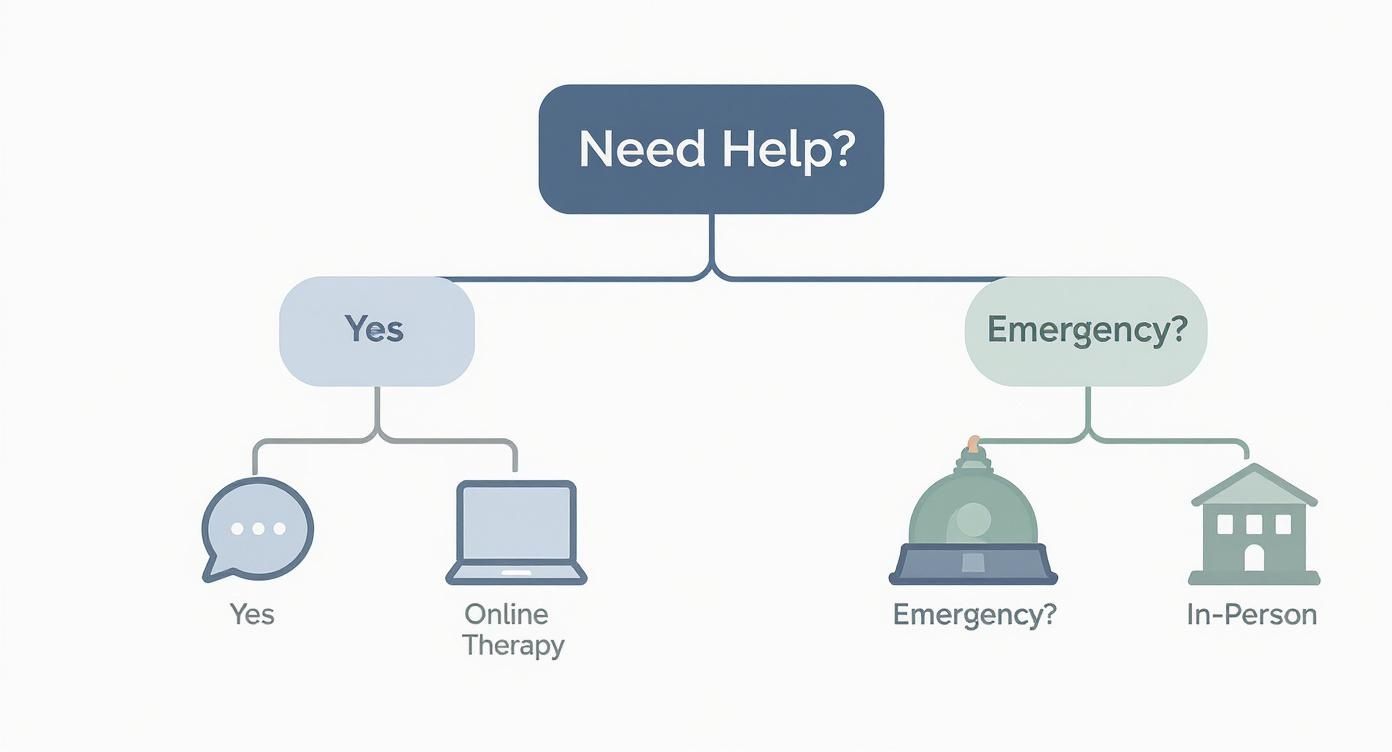
    The process of finding the right professional can feel daunting, but breaking it down into small steps helps. The goal is to find someone whose expertise and style align with your needs. This chart can help you think through your options.

    Mental health support flowchart showing options for online therapy, in-person care, and emergency services

    As you can see, online therapy is an excellent option for consistent, ongoing support. However, for crisis situations, immediate in-person help is essential.

    Verifying Qualifications and Specialisations

    First, ensure any therapist you consider has the right credentials. In India, look for professionals with degrees like an M.A., M.Sc., or M.Phil in Clinical Psychology. Registration with the Rehabilitation Council of India (RCI) is a strong indicator of professional standing.

    Beyond qualifications, look into their areas of expertise. Many therapists specialize in challenges like depression, anxiety, or workplace stress. Finding someone experienced in the areas you need help with can make a significant difference.

    The Importance of Cultural and Personal Fit

    A therapist who understands your cultural background can be incredibly helpful. When you don't need to explain cultural nuances, you can focus on the core issues more quickly. This shared context can build a bridge of understanding from the very first session.

    Beyond culture, a personal connection is vital. You need to feel comfortable being your authentic self without judgment. The right therapist creates an environment of validation and respect, which is the foundation for a strong therapeutic relationship.

    The right therapist doesn't just listen to your words; they hear the feelings behind them. Trust your intuition—the "chemistry check" during an initial consultation is often the most reliable guide to finding the right fit for your journey.

    Using Initial Consultations to Your Advantage

    Many online platforms offer introductory sessions, often at a reduced cost. Use this as a no-pressure opportunity to see if you connect with the therapist. It's a time to ask questions and notice how you feel during the conversation.

    Here are a few questions you might consider asking:

    • What is your approach to helping people with depression?
    • How do you help clients build resilience and improve their well-being?
    • What does a typical counselling session with you look like?
    • How will we track progress in therapy?

    Pay attention to both their answers and their energy. Do they seem empathetic and respectful? This initial interaction provides a valuable preview of what a long-term therapeutic relationship might feel like.

    Remember, it is perfectly okay if the first person isn't the right fit. Taking the time to choose thoughtfully is a powerful act of self-care.

    Your Journey Towards Lasting Resilience

    The path to feeling better is a gradual process of building inner strength and self-compassion. This journey is uniquely yours, and every step you take is a genuine victory.

    Remember that asking for help is a sign of strength, not weakness. Online therapy for depression is a valid and effective tool that can provide the supportive guidance you need to navigate feelings of depression, anxiety, or workplace stress.

    Supportive Takeaways for Your Path Forward

    As you move forward, keep these gentle reminders in mind. Think of them as anchors to hold onto during the natural ups and downs of your emotional health.

    • Your Feelings Are Valid: Whatever you are feeling is real and deserves to be heard. Therapy offers a safe, non-judgmental space to explore those feelings.
    • Progress Over Perfection: Healing is not a straight line. Focus on gradual progress rather than an impossible standard of perfection.
    • Kindness is Key: Be gentle with yourself throughout this process. Self-compassion is a powerful skill for building emotional resilience.

    A Brighter, More Balanced Future

    Despite the growing acceptance of online therapy for depression in India, a significant gap remains between those who need help and those who receive it. The National Mental Health Survey found that while many Indians could benefit from support, few access it. Online counselling is helping close this gap, though challenges like digital literacy and stigma persist, as noted in resources on mental wellness in India on youremotionalwellbeing.org.

    This highlights the importance of accessible, professional support. Online platforms are working to make quality care more widely available, connecting more people with qualified therapists.

    Every step you take towards understanding your mental well-being is a courageous move. Exploring your options with curiosity and kindness opens the door to a future where you feel more in control, understood, and hopeful.

    We encourage you to explore the possibilities that online therapy offers. Professional support is available to help you navigate challenges and build a life with greater happiness and meaning. Your journey matters, and you don’t have to walk it alone.

    Your Questions About Online Therapy, Answered

    Deciding to explore online therapy is a big step, and it's natural to have questions. This section provides clear, straightforward answers to common concerns. Our goal is to offer the clarity you need to feel confident moving forward.

    Everyone's path is different, and finding what works for you is what truly matters. We hope these answers help you on your journey.

    Is Online Therapy Actually as Good as Meeting in Person?

    For many people with mild to moderate depression, research shows that online therapy can be just as effective. The success of therapy depends on the connection you build with your therapist and your commitment to the process, not the format.

    The flexibility of online therapy is a major advantage. Connecting via video, audio, or chat from your own comfortable space can sometimes make it easier to open up.

    How Do I Know My Sessions Are Private?

    Reputable online therapy platforms use secure, encrypted technology to protect your conversations. This is similar to the security used for online banking, ensuring your information remains confidential.

    Therapists are also bound by the same strict professional ethics and confidentiality laws, whether online or in person. Always check a platform's privacy policy to ensure you feel secure.

    Your privacy isn't just a feature; it's a fundamental part of ethical therapy. A trustworthy platform will be upfront about how they protect your data, so you can focus on what matters—your well-being.

    What if I Don't Click With the First Therapist I Try?

    It’s completely normal and okay if you don’t connect with the first therapist you meet. The 'therapeutic alliance,' or your relationship with your therapist, is a key factor in successful therapy. You need to feel safe and understood.

    Most online services make it easy to switch to a new counsellor. Don't be discouraged by an initial mismatch; think of it as part of the process of finding the right fit for your journey toward resilience.

    What’s the Typical Cost for Online Therapy in India?

    The cost of online therapy can vary depending on the therapist's experience and the platform used. The good news is that online therapy is often more affordable than traditional in-person sessions.

    In India, session prices typically range from around ₹800 to over ₹2,500. Many platforms offer subscription plans or package deals that can make consistent support more budget-friendly.


    Taking the first step can feel challenging, but you don't have to do it alone. DeTalks offers a safe, supportive space to find qualified therapists who understand depression. You can explore our directory of professionals or take one of our confidential, science-backed assessments to get a clearer picture of your needs. See how we can help at https://detalks.com.

  • How to Stop Obsessing Over Someone and Reclaim Your Peace

    How to Stop Obsessing Over Someone and Reclaim Your Peace

    Feeling like you can't stop thinking about someone is a very human experience, and you are not alone in this. The path forward begins with understanding why it's happening, then taking gentle steps to create distance and refocus on your own well-being. This journey is about noticing your thoughts, identifying what might be missing in your life, and shifting your attention back to your personal growth.

    Understanding Why You Can't Stop Thinking About Them

    A person sitting alone on a windowsill, looking out thoughtfully, representing introspection and loneliness.

    It's common for our minds to become preoccupied with thoughts of another person. These intense feelings often come from a place of vulnerability. Understanding their origin is the first step toward finding balance and peace.

    Often, fixating on someone is a sign of deeper, unmet needs. It might be loneliness, the pain of a breakup, or a dip in self-esteem. These feelings can create an emotional gap that our minds try to fill with an idealised version of someone, which is a natural way we try to cope.

    Getting Trapped in a Thought Loop

    Have you ever felt like your thoughts are stuck on a repeating loop? This pattern, known as rumination, involves replaying conversations, memories, and "what-if" scenarios without reaching any conclusion. This mental cycle can fuel anxiety and create significant stress, making it difficult to focus on other areas of your life, like work.

    In the Indian context, societal and family pressures around relationships can add another layer of complexity. Expectations to meet certain milestones can intensify these obsessive thought patterns, making them harder to break.

    The link between obsessive thinking and mental health is well-documented. For instance, research on obsessive thoughts in India found that such symptoms can be more pronounced in urban settings, highlighting how our environment impacts our well-being.

    What Fuels the Fixation?

    Obsessive thinking often stems from a few common psychological triggers. Identifying these within yourself can help you approach your feelings with more compassion and less judgment.

    • Filling an Emotional Void: When you feel lonely or disconnected, fixating on someone can provide a temporary sense of connection.
    • Low Self-Esteem: We might put others on a pedestal when we feel we are lacking something ourselves, seeking their approval as a substitute for self-worth.
    • Past Wounds: Unresolved pain from previous relationships can lead us to subconsciously seek a "do-over," obsessing over a new person to try and fix what went wrong before.

    It's important to remember these thought patterns are not a reflection of your worth. They are signals from your mind, pointing to areas of your life that need kindness, attention, and healing. Acknowledging this is a powerful step toward regaining control.

    Practical Ways to Reframe Obsessive Thoughts

    A person calmly meditating, surrounded by gentle light, symbolising mental clarity and peace.

    Breaking free from an obsessive thought cycle is about taking small, deliberate steps. These techniques help interrupt the loop and reclaim your mental space. The goal is not to force the person out of your mind, but to gently redirect your focus and challenge the narrative you have built.

    One effective method is thought-stopping. When you notice yourself spiralling, consciously interrupt the thought. You can picture a stop sign or say "stop" to yourself, then immediately shift to a positive distraction, like calling a friend or listening to a song. This simple act helps weaken the neural pathways that fuel the obsession over time.

    Challenging Your Inner Story

    Another powerful approach is cognitive reframing, which involves questioning the story you tell yourself. Obsessive thoughts often create an unrealistic, idealised image of a person. By consciously challenging this image, you can bring yourself back to a more grounded reality.

    For example, instead of thinking, “My life would be perfect with them,” a reframe would be, “I admire certain things about them, but I know one person cannot solve all my problems or guarantee my happiness.” Practices like mindfulness can help you observe these thoughts without getting carried away. You can explore mindfulness exercises for anxiety to get started.

    Remember, reframing isn’t about denying your feelings but about introducing a dose of reality. This act can reduce the thought's emotional power and help you build resilience.

    A Practical Guide to Shifting Your Thoughts

    It's important to recognise that obsessive thinking can be connected to challenges like anxiety and depression, making it harder to break the cycle alone. Having a few planned responses can be very helpful when your mind starts to spiral. The table below offers a simple guide for replacing common obsessive thoughts with healthier alternatives.

    Challenging Obsessive Thoughts with Balanced Alternatives

    This guide helps you identify a common obsessive thought and consciously replace it with a more realistic perspective, which can help reduce the anxiety it creates.

    Common Obsessive Thought A Balanced, Realistic Alternative
    "I need to know what they're doing right now." "Their activities don't affect my well-being. I can focus on my own tasks and find peace in my day."
    "They are the only one who can make me happy." "My happiness comes from within. I am responsible for my own joy and fulfilment."
    "If I just try harder, they will see how perfect I am." "I am worthy of connection just as I am. I don't need to change myself to earn someone's affection."
    "Replaying our last conversation will give me clarity." "Going over it again and again causes more anxiety. I will let go and focus on the present moment."

    Using these reframing techniques consistently is like building a muscle. It requires patience and self-compassion, but with practice, you can regain control and find peace of mind.

    Grounding Exercises for Immediate Calm

    A person sitting in a calm, mindful pose with a serene natural background, representing grounding and presence.

    When your mind is caught in a spiral of obsessive thoughts, grounding exercises can offer immediate relief. These tools pull your attention out of the mental chaos and anchor you in the present moment. They are simple, discreet, and can be done anywhere to manage sudden waves of stress.

    The goal isn't to fight your thoughts, which can often make them stronger. Instead, these techniques create distance, giving you needed breathing room. This shift in focus helps calm your nervous system and puts you back in control.

    The 5-4-3-2-1 Sensory Method

    Reconnecting with your immediate surroundings is a practical way to halt a rumination spiral. The 5-4-3-2-1 technique directs your brain to the tangible world, away from the repeating loop of "what-ifs."

    Take a moment wherever you are and try this:

    • See 5 Things: Look around and name five objects, noticing details like the colour, shape, or texture.
    • Touch 4 Things: Shift your focus to physical sensations, like the feeling of your clothes or the surface of a table.
    • Hear 3 Things: Tune into the sounds around you, such as distant traffic, the hum of a fan, or your own breathing.
    • Smell 2 Things: Notice any scents in the air, whether it’s coffee, soap, or the smell of rain.
    • Taste 1 Thing: Finally, focus on what you can taste, like the lingering flavour of your last meal or drink.

    This exercise acts as a circuit-breaker, interrupting the obsessive pattern and demonstrating your ability to redirect your focus.

    A key part of improving your well-being is acknowledging thoughts without letting them define you. Grounding exercises are a first line of defence, helping you create a peaceful mental space.

    Mindful Breathing for Inner Stillness

    Mindful breathing is another powerful tool. When we experience stress, our breathing often becomes shallow, which can worsen anxiety. Deliberately slowing your breath sends a calming signal to your brain.

    Find a comfortable position and gently close your eyes if you wish. Place a hand on your stomach, and simply notice your breath. Then, slowly inhale through your nose for a count of four, and exhale slowly through your mouth for a count of six.

    Repeating this cycle for just a few minutes can have a significant calming effect. It cuts through mental chatter and helps you find a moment of peace, empowering you to regulate your emotions.

    Reclaiming Your Life with New Habits

    While shifting your mindset is crucial, taking tangible action is where you truly regain your freedom. These new habits are empowering choices that help you reconnect with yourself outside of this fixation. A great place to start is by managing your digital world, as constant social media access can fuel obsessive thoughts.

    Creating Healthy Digital Boundaries

    Setting digital boundaries is about giving your mind the space it needs to heal. You don't need a dramatic gesture; small, consistent steps are often more effective. A good first move is to mute their accounts, which stops their updates from appearing in your feed without the finality of blocking.

    Another practical technique is scheduling "worry time." Allot a specific, short period—perhaps 15 minutes each evening—to allow these thoughts. When the time is up, deliberately switch to a different, pre-planned activity. This trains your brain that these thoughts don't get to dominate your entire day.

    Taking control of your digital space and schedule sends a powerful message that your peace of mind comes first. This is about creating a calm, supportive environment for yourself.

    Reconnecting with Your World

    Obsessive thoughts can make your world feel very small, pushing out people and activities you once enjoyed. The antidote is to consciously rebuild those connections and rediscover your interests. Think about what you loved to do before this fixation began and put those activities back on your calendar.

    • Reconnect with friends: Reach out to a friend for a simple coffee or walk. The goal is to be present with someone who cares about you.
    • Explore new interests: Trying something new can create fresh neural pathways and build confidence. Consider a new class, hobby, or volunteer opportunity to invest your energy in positive experiences.

    Integrating meaningful self-care practices into your daily routine is also vital. Every step you take to reinvest in yourself, your friendships, and your passions helps loosen the obsession's grip.

    Building Resilience Through Self-Compassion

    A person gently holding their own hands in a gesture of self-comfort and compassion.

    Lasting healing often begins when you nurture your relationship with yourself. Obsessing over someone else can signal an unmet need for internal validation. Practising self-compassion helps you meet those needs and build a foundation of strength that doesn't depend on others.

    This journey is an opportunity to transform a painful experience into genuine personal growth and build lasting emotional resilience. Treating yourself with the same kindness you would offer a friend can soothe the inner turmoil that fuels the obsession.

    Cultivating a Kinder Inner Dialogue

    Your inner voice can be your harshest critic, especially when you're stuck in obsessive thoughts. The goal is to shift that internal conversation from judgment to compassion. This is crucial for managing the intense anxiety and stress that come with rumination.

    Journaling can be a powerful tool for this. It offers a safe space to untangle your thoughts and feelings without fear of judgment.

    Try these prompts to get started:

    • What might this obsession be telling me about what I truly need right now?
    • If my best friend were going through this, what supportive advice would I offer?
    • What are three things I appreciate about myself today?

    Please remember, any self-reflection or assessments are for informational purposes only and are not a substitute for a professional diagnosis. They are tools to guide your understanding on your path to well-being.

    Anchoring Yourself in Your Values

    When you're fixated on someone, it's easy to lose sight of who you are. Reconnecting with your core values provides a powerful anchor and a sense of purpose that is entirely your own. This internal compass helps guide your decisions and builds self-esteem from within.

    Take a moment to reflect on what is most important to you—perhaps it's creativity, honesty, or community. Once you have a clearer picture, start making small, intentional choices that align with those values. Every action reinforces your identity and proves you can create a fulfilling life on your own terms, which is a vital step in breaking free.

    When Professional Support Is the Next Best Step

    While self-help strategies are valuable, seeking professional guidance is a sign of strength. If obsessive thoughts are consistently disrupting your daily life, extra support can make a significant difference. Choosing therapy or counselling is a proactive step toward reclaiming your well-being.

    A trained professional offers a safe, non-judgmental space to explore these thought patterns. They can provide structured, personalised strategies to help you move forward.

    Knowing When It's Time for Help

    Consider how these obsessions are impacting your life. If you're constantly feeling overwhelmed by anxiety or a persistent sadness, those are important signals.

    It might be time to talk to someone if you notice:

    • Constant emotional distress: Your mood depends heavily on the other person's actions or perceived feelings.
    • A dip in daily functioning: You struggle to focus at work, neglect responsibilities, or withdraw from friends and hobbies.
    • Physical side effects: You experience sleep problems, appetite changes, or persistent fatigue from emotional burnout or workplace stress.

    It's important to clarify: any assessment checklist is for informational purposes, not for diagnosis. It can, however, be a useful guidepost to help you understand when professional support for your mental well-being may be beneficial.

    What Support Looks Like in India

    Seeking therapy is becoming more widely accepted across India, with many professionals offering sessions both in-person and online. A therapist can help you build emotional resilience and develop healthier coping mechanisms.

    In some cases, obsessive thoughts can be linked to conditions like depression or anxiety. We know from findings on mental health treatment accessibility in India that while effective therapies exist, access can sometimes be a challenge. A professional can provide clarity and equip you with the tools to break the cycle and move toward a more balanced state of mind.

    Supportive Takeaways and Next Steps

    As you move forward, it's natural to have questions. This journey is not about finding a quick cure, but about building lasting skills for your emotional well-being. Here are a few final thoughts to support you.

    How Long Does This Take?

    There is no set timeline for healing, as everyone's journey is unique. The duration depends on the depth of your feelings and how consistently you can apply new coping strategies. Instead of focusing on the calendar, celebrate small victories, like successfully redirecting a thought or enjoying an afternoon without rumination.

    Is It Normal to Feel Worse Before It Gets Better?

    Yes, this is a common part of the process. When you begin to consciously change long-held thought patterns, it can initially increase feelings of anxiety or sadness. This discomfort is often a sign that you are doing the difficult but necessary work of creating healthier neural pathways. Be gentle with yourself, and if the feelings become overwhelming, consider reaching out for professional counselling.

    What if I Have a Setback?

    Setbacks are a normal part of any learning process, not a sign of failure. If you find yourself slipping into old habits, approach the moment with compassion, not criticism. Gently guide yourself back to the tools you've learned, whether it's a mindfulness exercise or reaching out to a supportive friend. Each time you steer yourself back on course, you strengthen your resilience.


    If you feel that professional guidance could support you on this journey, help is available. DeTalks is a resource for finding qualified therapists and counsellors across India who specialise in managing challenges like obsessive thoughts, anxiety, and depression. You can find the right support for your well-being at https://detalks.com.