Tag: depression counselling

  • Psychologist Near Me for Depression and Anxiety Guide

    Psychologist Near Me for Depression and Anxiety Guide

    You're probably here because something has felt off for a while, and today you finally typed psychologist near me for depression and anxiety into your phone. Maybe you're tired, snappy, foggy, restless, or holding it together at work while falling apart in private. That's a common place to begin.

    In India, help-seeking often starts late, not because people don't care, but because life keeps moving. Family expectations, commute time, workplace stress, money worries, and plain uncertainty can make therapy feel like one more thing to figure out when you already feel stretched.

    Finding Support When You Search for Help Nearby

    A lot of first-time seekers think they need to be “bad enough” before they reach out. You don't. If anxiety is making your day smaller, if depression is draining your energy, or if burnout is flattening your sense of joy, that's enough reason to look for support.

    A young woman smiling while sitting at a desk with a laptop and a cup of coffee.

    India's need for support is large and visible. The National Mental Health Survey found that 10.6% of adults aged 18+ had a current mental morbidity, 13.7% had experienced a mental disorder at some point in life, and nearly 15% of adults required active intervention for one or more mental health issues, according to the Press Information Bureau summary of the National Mental Health Survey. That means your search isn't unusual. It reflects a real care gap.

    What this search usually means

    People aren't only asking, “Who is close to me?” They're really asking:

    • Can I talk to someone soon
    • Will this be affordable enough to continue
    • Will the person understand anxiety, depression, or workplace stress
    • Will I feel safe and not judged
    • Will this help my well-being and resilience

    That's why I don't think “near me” should be your first filter. Proximity matters, but access matters more.

    You don't need the closest psychologist. You need the fastest clinically appropriate support you can actually attend.

    If you're comparing local names online, don't confuse popularity with fit. Things like map pack visibility and reviews can explain why some clinics show up first, but search prominence doesn't tell you whether a therapist is right for your anxiety, depression, counselling needs, or schedule.

    A word on assessments

    Online assessments can help you put words to what you're feeling. They can organise confusion and point you towards therapy, counselling, self-help, or psychiatric care. But they are informational, not diagnostic.

    That distinction matters. A screening result can guide your next step. It shouldn't be treated as a final label.

    How to Build a Shortlist of Psychologists Near You

    Don't start with a giant list. Start with your actual problem.

    If your main issue is panic, persistent worry, low mood, hopelessness, irritability, sleep disruption, or workplace stress, say that clearly to yourself first. “I need help with anxiety after work calls” is more useful than “I need a therapist somehow.”

    Start with fit, not endless browsing

    A smart shortlist usually has 3-5 names. That's enough to compare without getting stuck.
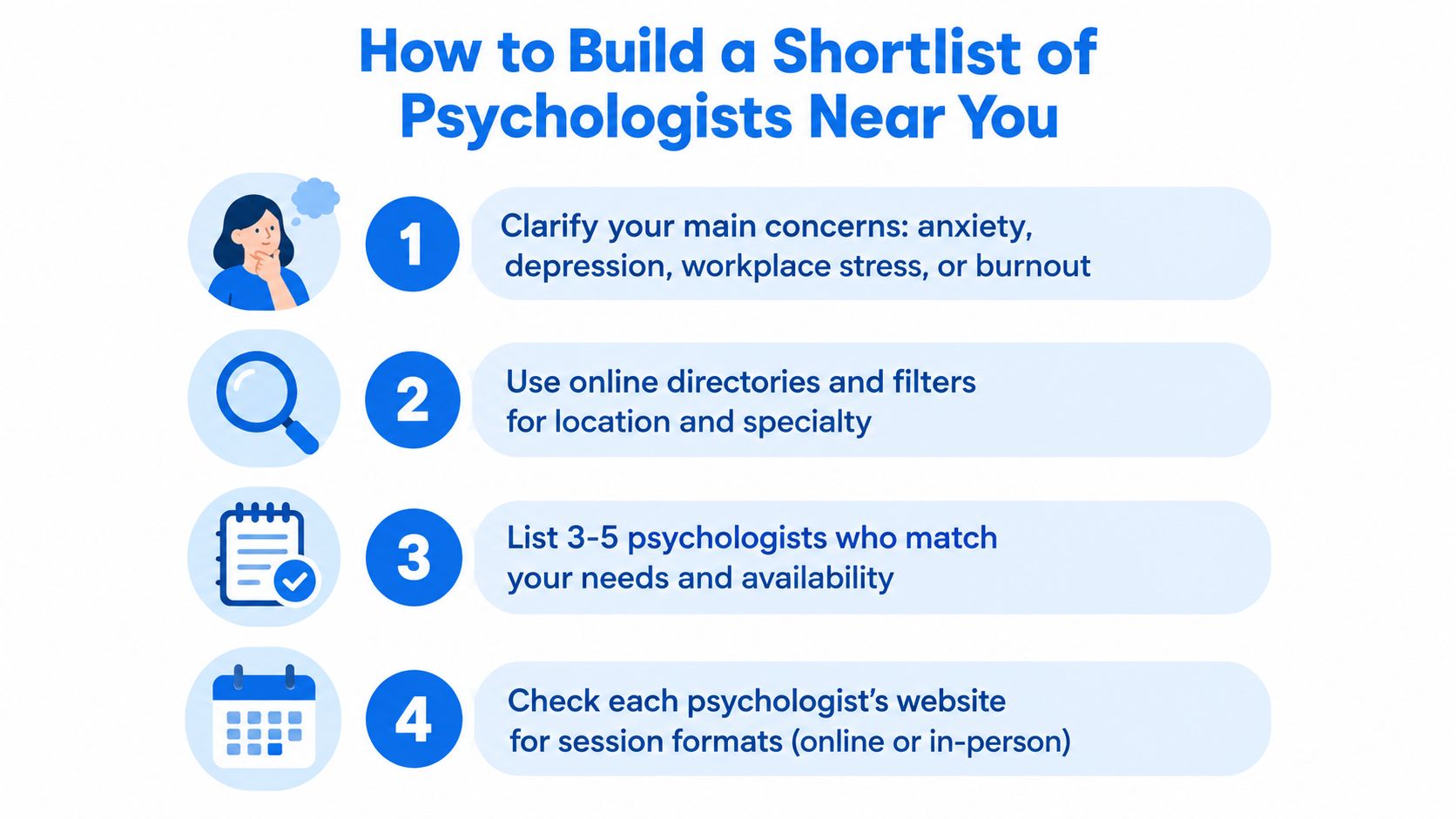
    An infographic titled How to Build a Shortlist of Psychologists Near You with four simple steps.

    Use a few channels, not just one:

    • Directories with filters: A platform such as DeTalks can help you browse psychologists, therapists, and counsellors by concern, format, and availability, which is useful when you want one place to compare options without random scrolling.
    • Doctor or therapist referrals: If you already trust a physician, counsellor, or HR well-being contact, ask for two or three names.
    • Personal referrals: A friend's recommendation can help, but only if the concern and style are similar. Good for them doesn't automatically mean good for you.

    What to note on each profile

    Look for clues that the psychologist works in a structured way. You want more than “good listener” or “safe space.”

    Pay attention to:

    • Main concerns treated: Anxiety, depression, burnout, stress, relationships, grief, or work pressure.
    • Session format: In-person, online, or hybrid.
    • Language comfort: Therapy works better when you don't have to translate your feelings.
    • Availability: If they have a long wait and you need support now, keep moving.
    • Approach: Read whether they mention clear methods, regular sessions, and progress tracking.

    India's treatment gap for common mental disorders was reported at 80.4%, and a Global Burden of Disease analysis estimated 45.7 million people with depressive disorders and 44.9 million with anxiety disorders in 2017, according to the ICMR summary of India's mental disorder burden. That's exactly why your shortlist should prioritise rapid triage, verified credentials, and low-friction follow-up.

    Build your notes like this

    Make a simple note on your phone for each option:

    • Why they match: “Works with workplace stress and anxiety.”
    • Why they may not: “Only weekday daytime sessions.”
    • Practical concern: “Too far to attend weekly.”
    • Next move: “Send enquiry” or “Book intake.”

    Practical rule: If a profile leaves you confused about what they treat, how they work, or how to book, don't chase clarity for too long. A good practice makes access simple.

    If you're searching “psychologist near me for depression and anxiety”, your goal isn't to find the perfect person on page one. Your goal is to create a short, workable list and start contact quickly.

    Choosing Between In Person Teletherapy and Hybrid Care

    Many people get stuck. They assume in-person therapy is automatically better because it feels more serious or more “real”. I don't agree.

    In India, the better question is often: which option can you attend consistently, afford without panic, and continue when life gets busy?

    The decision should match your life

    Private psychologist sessions in India commonly cost about ₹1,500–₹4,000 per session, while tele-mental-health and app-based support have expanded as lower-cost alternatives, according to India-focused reporting on current mental health statistics and care models. That price difference matters because therapy only helps when you can keep going.

    Tele-mental-health has also grown within the public system. Recent coverage notes that India's treatment gap for mental disorders is still estimated at 70–92%, that specialist shortages continue, and that Tele-MANAS has handled millions of calls and expanded across states, according to Observer Research Foundation analysis on India's mental healthcare access. So no, “near me” is not always the most sensible first filter.

    Which care pathway fits your needs best

    Decision Factor In Person Teletherapy Hybrid
    Comfort opening up Better if you feel grounded face to face Better if home feels safer Useful if you want both
    Travel and time Harder if commute is long Easiest for busy schedules Flexible
    Privacy at home Easier if home isn't private Hard if family is always around Can balance both
    Continuity Can drop when travel or work intensifies Easier to maintain weekly Strong if planned well
    Cost pressure Often higher overall once travel is added Often easier to sustain Moderate
    Best fit If you strongly prefer room-based support If access and convenience matter most If needs change over time

    When to choose which

    Choose in-person if being physically present helps you feel contained, focused, and less distracted.

    Choose teletherapy if the biggest barrier is time, distance, cost, or finding someone in your preferred language.

    Choose hybrid care if you want an in-person start and online follow-ups, or if your work schedule changes often.

    If you can only attend one format regularly, that format is usually the better option.

    Psychologist or psychiatrist

    A psychologist-led therapy path often makes sense for depression, anxiety, workplace stress, low motivation, emotional overwhelm, and resilience-building. A psychiatrist may be needed when symptoms feel severe, when sleep, appetite, panic, or daily functioning are sharply affected, or when medication assessment is needed.

    If you're waiting for an appointment, don't just wait passively. Fix your sleep window, reduce alcohol or other unhealthy coping, tell one trusted person what's going on, and book the earliest suitable session rather than the ideal future one.

    How to Vet Credentials and Ask the Right Questions

    Good therapy starts before session one. It starts with the quality of the person you choose.

    India's rights-based framework improved when the Mental Healthcare Act, 2017 came into effect in 2018, but access still sits inside a major workforce shortage. A nationally cited estimate from the National Mental Health Survey showed only 0.3 psychiatrists per 100,000 people, and later summaries noted psychologists were even scarcer, with Kerala at 0.63 clinical psychologists per 100,000 people and Rajasthan at 0.01 per 100,000 people, according to the Rajya Sabha committee report on mental healthcare resources and policy context. That shortage is exactly why you need to vet carefully instead of booking the first nearby name.
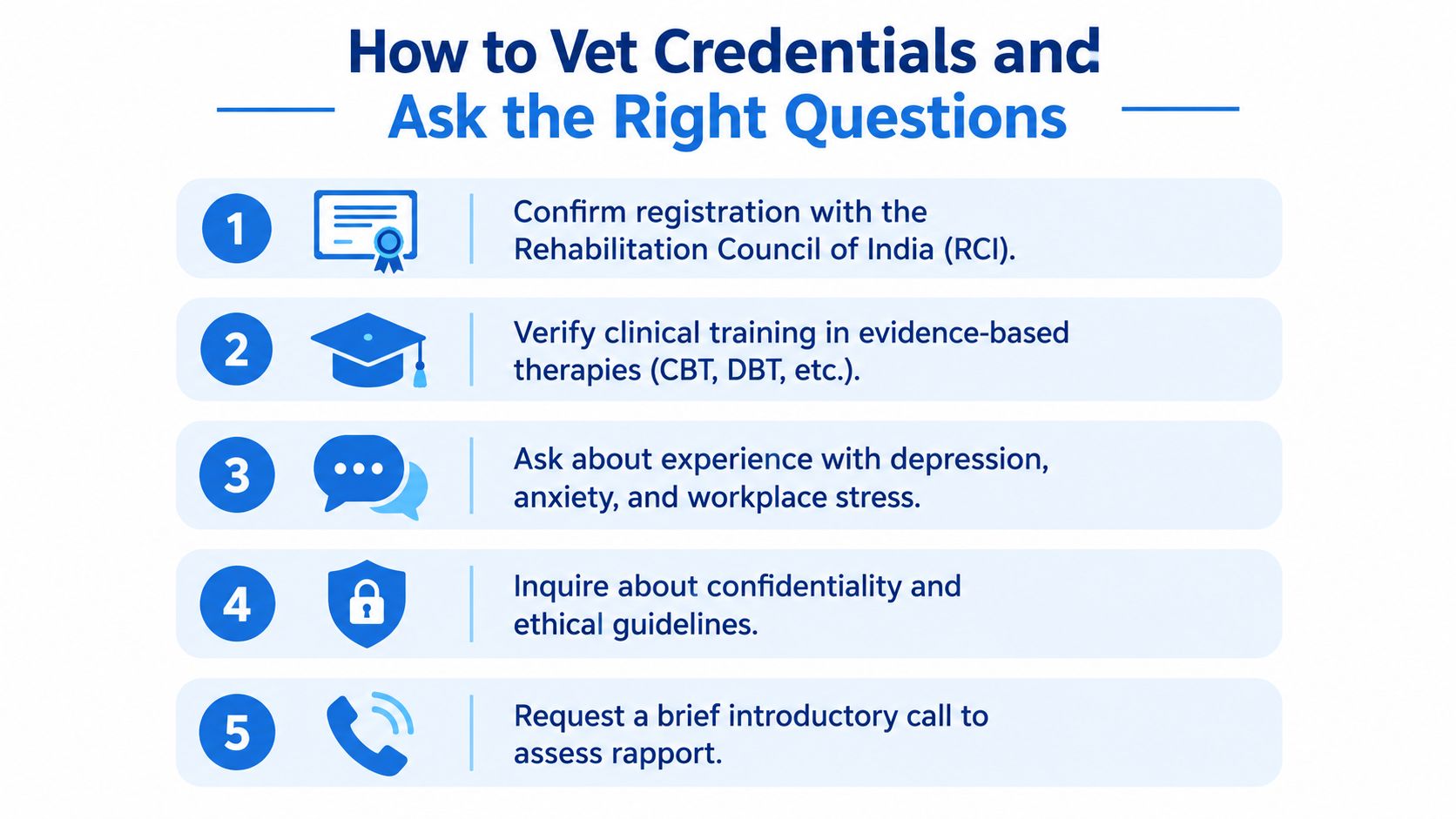
    An infographic outlining five steps to vet mental health credentials and choose the right therapist effectively.

    What to check before booking

    You don't need to interrogate anyone. You do need clear answers.

    Check for:

    • Registration and training: Ask whether they are registered with the Rehabilitation Council of India if they are practising as a clinical psychologist, and ask about formal training.
    • Experience with your concern: Depression, anxiety, counselling for burnout, or workplace stress are not interchangeable.
    • Structured intake: A solid first session includes history, current concerns, goals, and a plan.
    • Progress tracking: Good therapy isn't random. It should include regular review of what's improving and what isn't.
    • Boundaries and privacy: You should know how confidentiality works and when it has limits.

    Questions worth asking

    You can ask these directly by message or on a brief call:

    • “Do you regularly work with anxiety, depression, and work-related stress?”
    • “How do you usually structure the first few sessions?”
    • “How do you track progress if therapy is helping?”
    • “Do you offer online, in-person, or hybrid sessions?”
    • “If I need psychiatric support, do you refer out?”
    • “What does continuity usually look like in the early weeks?”

    Fit matters, but fit without structure often turns into endless venting.

    Red flags to take seriously

    A therapist should never guarantee a cure. They also shouldn't shame you, dismiss your symptoms, or talk vaguely about healing without explaining process.

    Watch for these warning signs:

    • Promises: “You'll be fixed quickly.”
    • No plan: No clear intake, no goals, no follow-up rhythm.
    • Stigma: Language that makes you feel weak, dramatic, or broken.
    • One-off mentality: Suggesting casual drop-ins for ongoing anxiety or depression without a proper care plan.

    A good psychologist helps you build resilience, self-understanding, and practical change. They don't sell certainty.

    Understanding Fees Insurance and Making Therapy Affordable

    Cost shapes care more than people admit. It's not enough to start therapy. You need a plan to continue it.

    A hand puts a coin into a glass jar labeled Therapy Fund next to a smartphone showing payment.

    What drives the fee

    A psychologist's fee usually reflects experience, city, session length, and format. In-person care may also carry hidden costs like travel, lost work time, or needing childcare.

    Don't be shy about asking practical questions. Financial clarity is part of ethical care.

    Ask:

    • What is the session fee
    • Do you offer any reduced-fee slots
    • Is there a cancellation policy
    • Are packages available
    • Can sessions be spaced or moved online if needed

    Plan for continuity, not a one-off start

    An important rule for depression and anxiety care is this: think beyond the first appointment. The practical workflow described in Indian evidence prioritises continuity over at least 8–12 weeks, because outcomes in Indian psychotherapy studies are often reported at 3 months and 1 year, while long-term follow-up evidence remains limited, as noted in the earlier ICMR-linked section.

    That means your budget should cover a period of regular support, not just one brave booking.

    Start with the most sustainable frequency you can honestly maintain. Consistent weekly or planned sessions beat an enthusiastic start followed by dropout.

    India-specific service delivery research also shows that structured, task-shifted psychotherapy can work when access is limited. A stepped-care intervention led by lay health counsellors in public primary care produced sustained benefits over 12 months across depression and anxiety outcomes, according to the British Journal of Psychiatry paper on lay health worker-led intervention in India. The lesson is simple. Structured care and follow-up matter more than polished branding.

    If you want a quick primer before booking, this short video can help you think through therapy budgeting and first steps.

    If private therapy feels out of reach

    Look into employer well-being benefits, EAP access, university counselling, hospital psychology departments, and tele-support pathways. If workplace stress is a major trigger, ask HR whether any counselling support exists. Many people never check.

    Keep a simple symptom note while you begin. Track sleep, appetite, worry level, mood, and work functioning in plain language. That record helps you use sessions better.

    Moving Forward With Confidence and Compassion

    If you searched for psychologist near me for depression and anxiety, you probably wanted an answer fast. Here's the direct one. Don't choose based on distance alone. Choose the path you can access soon, afford steadily, and stay with long enough to see whether it helps.

    Therapy and counselling are not only for crisis. They can also support resilience, self-compassion, better boundaries, stronger relationships, and a healthier sense of well-being. That matters whether you're dealing with anxiety, low mood, burnout, or feeling unlike yourself.

    What to remember now

    Keep these points close:

    • Assessments can guide you: They are useful for insight, but they are informational, not diagnostic.
    • Consistency beats perfection: The right format is the one you'll attend.
    • Structure matters: Look for a clear intake, regular review, and thoughtful follow-up.
    • Kindness matters too: Good care should help you feel respected, not judged.

    India's mental health reality makes this search harder than it should be. But hard doesn't mean impossible.

    A small next step is enough for today. Shortlist three names. Ask two clear questions. Book one first session. That's how many people begin moving from distress towards steadier ground, more resilience, and a little more hope.


    If you want one place to begin, DeTalks lets you explore mental health professionals, book support, and use science-backed assessments that can help you decide whether therapy, counselling, or psychiatric care may be the right next step. If you're trying to make sense of anxiety, depression, workplace stress, or burnout, it gives you a practical starting point without forcing you to figure everything out alone.

  • Finding a Therapist for Depression: Your Guide to Support

    Finding a Therapist for Depression: Your Guide to Support

    Deciding to look for a therapist is a brave first step toward healing. If you're searching for a "therapist near me for depression," you are already on a path of self-care. This guide is here to walk with you and make the process feel less overwhelming.

    Your First Step Toward Well-Being

    A young man sitting on a park bench at sunset, looking at his phone, with a city skyline in the background.

    Simply searching for support is a powerful act of kindness to yourself. It's normal to feel a mix of hope and nervousness about what comes next. Many people in India and around the world feel this way when they begin their journey toward better mental well-being.

    Think of therapy as a safe, dedicated space created just for you. It is an opportunity to understand the weight you've been carrying, whether it's persistent sadness, workplace stress, or anxiety. The goal is to find a professional who partners with you to navigate these feelings without judgment.

    What to Expect from Counselling

    Counselling is a collaborative process aimed at improving your well-being. A good therapist works with you to explore your thoughts, identify unhelpful patterns, and build practical skills to handle life's challenges. This support can help with feelings of depression and anxiety.

    During your sessions, you can expect to:

    • Explore your feelings: Gently understand where feelings of depression may come from and how they affect your daily life.
    • Develop coping skills: Learn new strategies to manage stress and anxiety, helping you feel more in control.
    • Build resilience: Focus on your strengths and learn how to bounce back from difficulties with greater self-compassion and confidence.

    The purpose of therapy is to empower you with insights and tools for lifelong well-being. It’s about building a future where you feel more connected to yourself and better equipped to find happiness.

    A Path to Lasting Well-Being

    This process is not just about reducing difficult feelings; it’s about cultivating positive mental health. A therapist can guide you in building habits that foster resilience, gratitude, and self-compassion. For instance, small changes like practicing good sleep hygiene can significantly improve your mood.

    Remember, the hardest part is often taking that first step, and you have already done it. The path ahead is one of support, discovery, and building a more meaningful life.

    How to Begin Your Search for the Right Therapist

    Taking that first step to find a therapist can feel like the biggest hurdle, and it's okay to feel overwhelmed. You can break the process down into smaller, manageable actions. It's not just about searching for a "therapist near me for depression," but about finding the right person you feel safe with.

    A trusted online directory like DeTalks is a great place to start. These platforms simplify your search, allowing you to filter by location, the issues you're facing like depression or workplace stress, and language. In a diverse country like India, finding a professional who speaks your language can make therapy feel more comfortable.

    Personal recommendations can also be valuable. Your family doctor may have a network of mental health professionals they can refer you to. Sometimes, a referral from a friend who has had a positive experience with therapy can make the process feel less intimidating.

    Understanding Different Professionals

    As you search, you will encounter titles like counsellor, psychologist, and psychiatrist. Understanding the differences helps you find the right support for your needs.

    • Psychologists and Counsellors: These professionals are your guides in talk therapy. They help you navigate thoughts and feelings, develop coping mechanisms for challenges like anxiety and depression, and build inner resilience. Their focus is on improving your mental well-being through conversation.

    • Psychiatrists: A psychiatrist is a medical doctor who specializes in mental health. They can diagnose conditions and prescribe medication if needed. They often work with a counsellor to create a comprehensive plan that combines therapy with medication.

    What to Look For in a Therapist's Profile

    Once you have a shortlist, take time to explore their online profiles. A good profile gives you a sense of who they are and how they work, beyond just their qualifications.

    Look at their specializations, such as experience with depression, grief, or workplace stress. Also, review their qualifications and the therapeutic approaches they use to see if their style feels right for you. Their approach should support your journey toward greater well-being and resilience.

    Remember, the goal is to find someone you can build a trusting relationship with. A profile is just a glimpse, but it should give you a feeling of hope and connection.

    When you begin looking for a therapist to help with depression, you'll discover that "therapy" isn't a one-size-fits-all solution. There are many different approaches, and finding one that clicks with you is a key part of the journey.

    Think of different therapies as different paths to the same goal: feeling better. Some are structured and practical, while others explore the deeper roots of your feelings. Neither is better; it's about what feels right for you at this moment.

    Common and Effective Therapy Methods

    Let's break down some of the most common types of counselling you might encounter. This is a starting point for understanding your options.

    • Cognitive Behavioural Therapy (CBT): CBT is a hands-on approach focused on the present. It helps you identify and change negative thought patterns and behaviors that contribute to depression. If you want practical strategies for managing workplace stress or anxiety, CBT is a great choice.

    • Psychodynamic Therapy: This approach explores how past experiences and unconscious feelings influence your present emotions. It is less about quick fixes and more about fostering deep self-understanding for lasting change and emotional healing.

    • Mindfulness-Based Therapies: These approaches blend CBT with mindfulness practices like meditation. The goal is to observe your thoughts and feelings without being carried away by them. This can be very effective for breaking negative thought cycles common in depression and building resilience.

    To help you visualize what these different paths might look like, here’s a simple comparison of these therapeutic methods.

    Comparing Common Therapy Approaches for Depression

    This table provides a simple comparison of different therapeutic methods to help you understand what might work best for you.

    Therapy Approach Focus Area Best Suited For
    Cognitive Behavioural Therapy (CBT) Identifying and changing negative thought patterns and behaviours. Individuals seeking practical, goal-oriented strategies and skills to manage current symptoms.
    Psychodynamic Therapy Exploring how past experiences and unconscious thoughts affect current feelings. People interested in deep self-exploration to understand the root causes of their emotional patterns.
    Mindfulness-Based Therapies (MBCT) Combining CBT with mindfulness to change one's relationship with negative thoughts. Those who want to learn how to observe their thoughts without judgement and prevent depressive relapse.

    Ultimately, choosing an approach is about finding a good match for your personality and goals. Feel free to ask a potential therapist what methods they use and why they think it would be a good fit for you.

    This flowchart maps out the initial steps of a good therapist search, from checking directories and asking for referrals to carefully reviewing individual profiles.

    Flowchart outlining the process of finding a therapist, detailing options like directories, referrals, and profiles.

    The main takeaway here is that finding the right person is a process. It involves gathering information from different places to make a decision you feel confident about.

    Why Credentials and Safety Matter

    A therapist's qualifications are just as important as their therapy style. A qualified professional has completed rigorous training and follows strict ethical standards to ensure your safety. In India, for example, a psychologist registered with the Rehabilitation Council of India (RCI) meets professional benchmarks.

    Your therapist is a partner in your healing. While their qualifications provide expertise, the most critical ingredient is the safe, respectful connection you build with them.

    Some platforms, including DeTalks, offer screening questionnaires. These tools can be useful for clarifying what you are experiencing. However, it is important to remember that these assessments are informational and not a medical diagnosis. They are a starting point for a conversation with a professional.

    Preparing for Your First Therapy Session

    Cozy armchair with blanket, wooden table with notepad and water, and framed ocean art in a sunlit room.

    It is normal to feel nervous before your first therapy appointment. Remember, it is not a test, but a conversation to see if you and the therapist are a good fit. Finding the right connection is a key part of the process when searching for a "therapist near me for depression."

    A good therapist creates a safe, welcoming space for you to open up at your own pace. You don't need to have everything figured out. The main goal of this first meeting is to connect and see if you feel heard and comfortable.

    Questions to Ask a Potential Therapist

    Preparing a few questions can help you feel more in control of the process. Think of it as a conversation where you are both seeing if it is a good match. This is your chance to take an active role in your own well-being.

    It can be helpful to group questions into their professional style and practical details.

    First, get a sense of their experience and approach:

    • What is your experience helping people with depression and anxiety?
    • Which therapeutic methods do you use, and why might they be a good fit for me?
    • How do you view the therapy process? What can I expect in our sessions?

    Next, you will want to clarify the practical details of counselling.

    • What are your session fees? Do you offer a sliding scale or payment plans?
    • How long is a session, and how often do you suggest we meet?
    • What is your policy for cancelling or rescheduling an appointment?

    Asking questions shows you are invested in your healing. A good therapist will appreciate your engagement and answer honestly, which helps build trust from the beginning.

    How to Talk About What You Are Going Through

    Starting that first conversation can feel difficult, especially if you are not used to talking about your feelings. You do not have to share your entire life story in the first hour.

    Sometimes, the simplest start is best. You could say, “I’ve been feeling really low lately,” or “Things have felt overwhelming, and I realized it was time to talk to someone.” Your therapist will then gently guide the conversation with questions, helping you find words for your experiences, whether it's workplace stress or a loss of joy.

    Using Pre-Session Tools for Insight

    Some therapy platforms, like DeTalks, offer confidential questionnaires you can complete before your first appointment. These assessments can be helpful, offering a snapshot of what you're experiencing, from your emotional state to your resilience.

    It's vital to remember these tools are for informational purposes only; they are not a diagnosis. They can help you organize your thoughts and provide context for your therapist. This can make your first conversation more focused from the start.

    Choosing Between In-Person and Online Counselling

    A big question you might have is whether to choose in-person or online therapy. There is no wrong answer; the best choice is what feels right and fits your life.

    Let's break down what each option looks like.

    Modern office with a waiting area and a laptop on a table, ideal for hybrid therapy sessions.

    Traditional in-person therapy has a unique power. Going to a separate space can help you mentally switch gears and focus. Being in the same room also allows you and your therapist to notice non-verbal cues, which can deepen your connection.

    Online counselling has made therapy much more accessible. If you have a demanding job, family commitments, or live in a remote area, its flexibility is a great advantage. It removes travel time and makes it easier to prioritize your well-being.

    The Rise of Online Therapy in India

    In India, online therapy has been a major breakthrough, especially for those outside major cities. Platforms like DeTalks connect people with qualified therapists anywhere, making it easier to get help for issues like depression, anxiety, and workplace stress. This has made professional support more achievable for many.

    When considering online therapy, ask yourself a few practical questions:

    • Convenience: Do I have a private, quiet space at home for sessions?
    • Access: Are there good local therapists specializing in what I need, or is my best match online?
    • Comfort: Would I feel more relaxed and open talking from my own space?

    Finding Your Personal Fit

    Ultimately, the choice is deeply personal. Some people thrive with the structure of in-person sessions. Others find the privacy and convenience of online therapy helps them stay consistent.

    The most important factor isn't the format but your ability to build a trusting relationship with your therapist. This foundation can be built both in-person and online.

    Think about what feels more sustainable for you right now. Do you need the ritual of a physical appointment, or the flexibility of online counselling? Answering that will guide you toward starting your therapy journey and building lasting resilience.

    Navigating Costs and Finding Sustainable Support

    One of the first questions you may have when looking for a "therapist near me for depression" is about cost. This is a normal and important question. Your therapy plan must be financially sustainable for you to commit to it long-term.

    Starting therapy is a huge step toward caring for your well-being, but it must be affordable. In India, session costs vary based on the therapist's experience and location. It's important to be clear about your financial situation from the start.

    Having the Conversation About Fees

    It can feel awkward to talk about money, but therapists are used to this conversation. They understand that for counselling to be effective, you can't be stressed about the cost. Don't hesitate to ask about fees when you first reach out.

    Many professionals offer ways to make their services more manageable. You can ask about:

    • Sliding Scale Fees: Some therapists adjust their prices based on your income.
    • Payment Plans: You may be able to spread the cost over several payments.
    • Session Frequency: Your therapist might suggest meeting bi-weekly instead of weekly to fit your budget.

    Clarifying costs from day one allows you to focus on your healing. This helps you find a rhythm of support that doesn't add financial pressure while you are dealing with depression or anxiety.

    Supportive Takeaways

    It can be helpful to view therapy as an investment in your long-term happiness and health. You are learning skills for managing workplace stress, improving relationships, and developing resilience. These tools will support your well-being for a lifetime.

    Therapy is not a quick fix; it is a dedicated space where you partner with a professional. They guide you as you build strength to handle life’s challenges and find your capacity for growth and happiness. This is your journey, and it happens one step at a time. Be kind to yourself as you find the support that feels right.


    Finding the right therapist is a personal journey, and DeTalks is here to make it easier. Browse our directory of qualified professionals, explore confidential assessments to gain clarity, and book your first session to begin your path toward healing. Take your first step today at https://detalks.com.