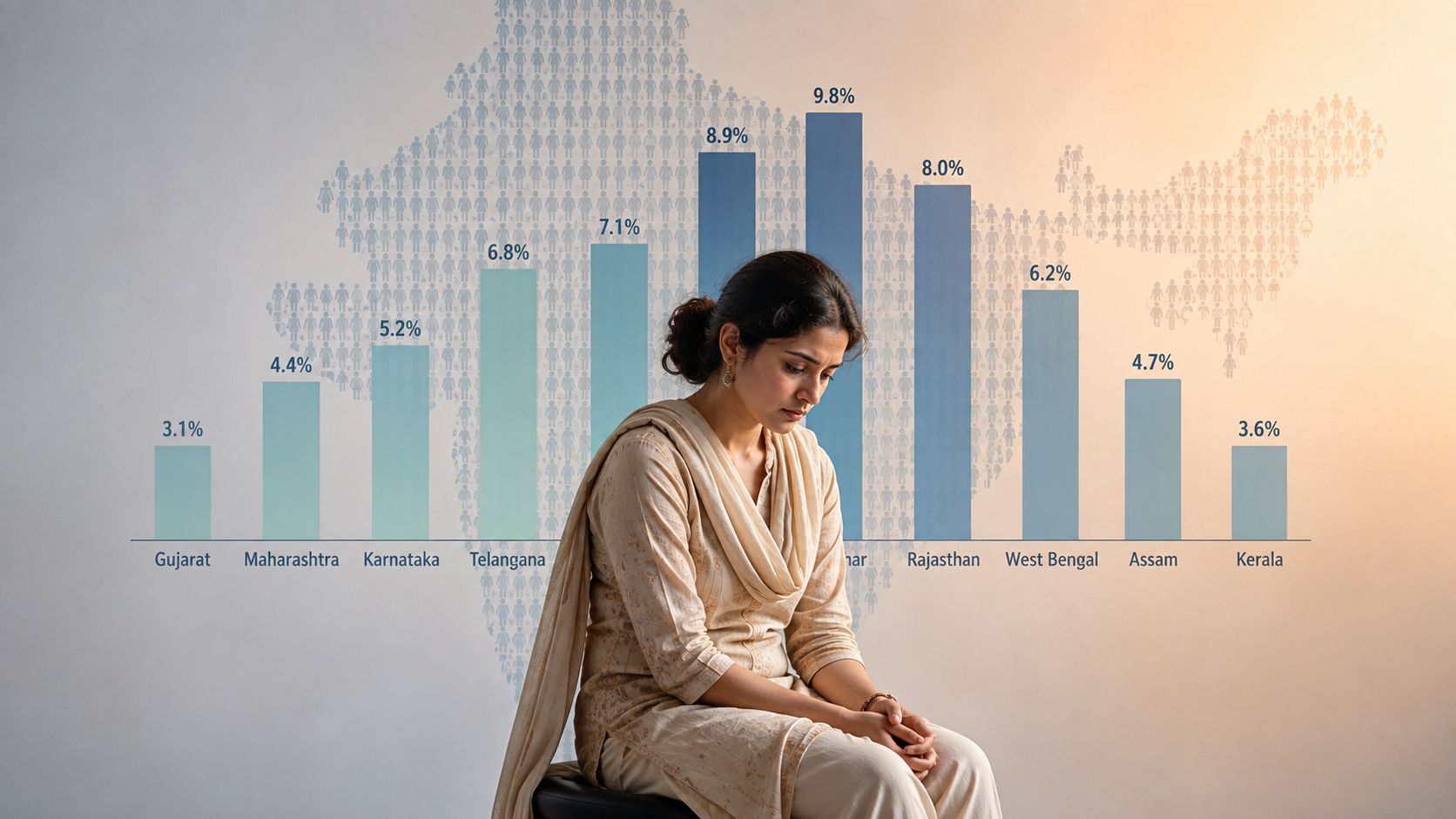
2.68% of people in India had current depression in the National Mental Health Survey, which is about 1 in 40. 5.25% had experienced depression at some point in their lives, about 1 in 20.
That sounds like a national average, but the story is more complicated. The most important question isn't only how many people are affected, it's also why so many cases stay invisible, even when help exists.
Understanding the Baseline Depression Rate in India
The clearest national baseline comes from India's National Mental Health Survey 2015–16. It found a current prevalence of depressive disorders of 2.68% and a lifetime prevalence of 5.25% across the surveyed states, which is why people often describe the picture as roughly 1 in 40 living with depression now and 1 in 20 having experienced it at some point NMHS baseline study.
That distinction matters. Current prevalence means people who are living with depression at the time of the survey, while lifetime prevalence means people who have ever had it. A person can move in and out of these categories over time, so the two numbers answer different questions.
The same survey estimated that around 23 million adults in India would need care for depressive disorders at any given time NMHS baseline study. It also found that current prevalence was higher in the 40–59 age group, 3.6%, than in the overall population NMHS baseline study.

A useful way to read these numbers is to see them as a population signal, not a personal label. A survey can tell us how common depression is, but it can't tell any one person what they are feeling or whether they need support.
Practical rule: a prevalence figure is a public health measure, not a diagnosis. If someone is struggling, the right next step is a conversation with a qualified professional, not self-labelling from a statistic.
India also uses these figures as a baseline because they come from a large, state-based national survey. That makes them more useful than scattered estimates, especially when the goal is to understand the depression rate in India in a way that policymakers, clinicians, and families can all interpret clearly.
The Invisible Crisis Why Most Cases Go Undiagnosed
The hard part isn't just how depression is counted, it's how often it is missed. In recent India evidence among adults aged 45+ with depression, 97% were undiagnosed, only 3% had been diagnosed, and 2% received treatment JAMA Psychiatry study.
That gap changes the meaning of every headline number. If the majority of people with depression are not being recognised in routine care, then the visible rate is only a slice of the actual burden. For many families, the problem shows up first as fatigue, irritability, sleep trouble, low motivation, or withdrawal, not as a formal diagnosis.
Why the gap stays so wide
The same evidence points to a much larger untreated burden, with about 29.1 million untreated adults and 22.4 million of them living in rural areas JAMA Psychiatry study. That helps explain why access matters so much, because care often breaks down before anyone gets to therapy, counselling, or even a first screening.
A striking part of the picture is the difference between self-reported diagnosis and modelled prevalence. In that study, self-reported diagnosis among older adults was only 0.5%, while modelled prevalence was 5.7% JAMA Psychiatry study. That is a clear sign that a lot of depression never reaches a clinical label.
Depression can be present long before it is named. If people wait until daily life has already become unmanageable, the system has usually failed them twice, first by missing the symptoms, then by making access too late.
This is why the depression conversation in India is partly an ascertainment problem. The issue is not only how many people are affected, it's how many are seen, asked the right questions, and connected to care.
The scale of this treatment gap also matches broader India reporting, which has cited an 80.4% treatment gap for common mental disorders in the 2016 survey JAMA Psychiatry study. For readers, that means a diagnosis rate can look small not because need is rare, but because recognition is still weak.
Who Is Most Affected Age, Gender, and Regional Trends
Depression doesn't fall evenly across India. The NMHS-linked reporting shows that the 40–59 age group had a current depression prevalence of 3.6%, which is higher than the overall national figure NMHS baseline study.
That age pattern makes sense in human terms. Midlife often carries work pressure, caregiving duties, financial strain, and health worries at the same time, so emotional strain can accumulate gradually rather than arrive as one obvious crisis.
| Demographic/Region | Current Prevalence |
|---|---|
| Overall adults in NMHS | 2.68% |
| Adults aged 40–59 | 3.6% |
| Gujarat | 1.2% |
| Jharkhand | 4.7% |
State variation matters too. A BMJ Open study reported current depression ranging from 1.2% in Gujarat to 4.7% in Jharkhand BMJ Open study. That spread is a reminder that India is not one uniform mental health situation.
The point is not to treat one state as “good” and another as “bad”. It is to recognise that regional healthcare access, local stressors, and social conditions shape the chance that a person gets help when they need it.
Older community studies also linked higher risk with low education, poor housing, recent debt, and marginalised caste groups, which is why depression in India often tracks disadvantage rather than appearing randomly. In practice, that means a person's environment can be part of the clinical picture, even before any formal assessment.
The most helpful conclusion is simple. If people ask whether the depression rate in India is rising, the more precise answer is that the burden is uneven, and the burden is often hidden. A single national average cannot show who is carrying the heaviest load.
Beyond Biology Socioeconomic Drivers and Workplace Stress
Depression often grows in the middle of pressure, not in a vacuum. Debt, poor housing, caregiving load, job insecurity, and family conflict can all wear down emotional reserves, and people may begin to feel exhausted, hopeless, or numb long before they seek help.
That's why workplace stress deserves a central place in India's mental health conversation. Long hours, constant availability, and fear of falling behind can feed anxiety, burnout, and depression together, especially when someone has little room to recover between demands.
A simple way to think about it is this. Some distress is a response to difficult conditions, not a personal weakness. Naming that does not minimise suffering, it reduces shame and makes support more reachable.
Compassion matters here. When a person is carrying financial strain, family responsibility, and job pressure at the same time, asking them to “just stay positive” misses the point.
This is also where well-being and positive psychology belong in the same conversation as illness. Resilience, gratitude, and compassion don't erase hardship, but they can help people protect energy, make clearer decisions, and stay connected to others while life is difficult.
The broader lesson is that depression in India isn't only about biology. It is also about social reality, and social reality changes what recovery can look like.
Bridging the Gap How to Seek Support and Build Resilience
If low mood, persistent anxiety, sleep problems, loss of interest, or burnout are getting in the way of daily life, start with a screening or a conversation. Online assessments can be a useful first step, but they are informational, not diagnostic, so they should guide action rather than replace professional judgement.
A practical path is to match the level of support to the problem. Counselling can help with stress, coping, grief, relationships, and everyday overload. Therapy is often used for structured psychological support, while psychiatric care is more relevant when symptoms are severe, persistent, or need medical evaluation.
You can also use evidence-based tools to clarify what kind of help may fit. For teams and organisations, resources such as assessing employee resilience methods can help identify where strain is showing up before it becomes a crisis.
The important thing is not to wait for a perfect moment. A first appointment, a screening questionnaire, or a confidential chat with a psychologist can all be reasonable entry points, especially when someone is feeling stuck.
Resilience grows through small supports, not dramatic fixes. Regular sleep, reaching out to one trusted person, reducing isolation, and making space for rest can all support emotional balance while a person looks for further care.
If you want a structured place to start, DeTalks offers a directory of mental health professionals and confidential assessments that can help people sort through depression, anxiety, stress, and burnout without feeling rushed. For many people, that kind of guided first step makes support feel less distant and more practical.
A Future of Emotional Well-being and Positive Psychology
The healthiest way to read the depression rate in India is not as a verdict, but as a call to build stronger support systems. Numbers show where need exists, while resilience, compassion, and emotional intelligence show how people can keep moving through hard seasons with more steadiness.
Positive psychology fits here because it asks a better question than “What is wrong?”. It asks what helps people stay connected, hopeful, and functional even when they are carrying stress, anxiety, or grief.
That mindset matters for families, workplaces, and communities. When people feel safe enough to ask for help early, they are more likely to use counselling, therapy, and supportive routines before problems become overwhelming.
Well-being is not the absence of struggle. It's the presence of support, skills, and relationships that make struggle more bearable.
For India, and for any country facing a large treatment gap, the goal is not to chase perfection. It is to make support normal, compassionate, and easy to reach, so more people can move from surviving to living with greater balance.
If you're worried about your own mood or someone else's, take the next step today. DeTalks helps people find psychologists, counsellors, and confidential assessments in one place, so it's easier to move from confusion to support. Visit DeTalks to explore a private, practical starting point for therapy, counselling, and emotional well-being.