Tag: DeTalks India

  • Conversion Disorder Icd 10

    Conversion Disorder Icd 10

    You may be reading this after a confusing appointment, a stack of test reports, or a moment that frightened your family. Perhaps your arm felt weak, your voice changed, or you had seizure-like episodes, and the scans or blood tests didn't fully explain what was happening.

    That kind of uncertainty can feel exhausting. It can also stir up anxiety, low mood, workplace stress, and a painful fear that others won't believe you.

    If you've seen the phrase conversion disorder ICD-10 on a report, this article is here to make it clearer. The code matters, but the human experience behind it matters more. Your symptoms are real, your distress is real, and there are practical next steps that can support your well-being, resilience, and recovery.

    When Your Body Speaks Your Stress

    A person may wake up and find their leg feels heavy and unreliable. Another may collapse during a stressful period and later hear that the episode looked like a seizure, yet the usual neurological explanation wasn't found. These situations are extremely unsettling, especially when friends or relatives start asking whether it is “just stress”.

    A man in a doctor's office holding his wrist, showing symptoms of discomfort or pain.

    Conversion disorder, often also discussed as Functional Neurological Disorder, describes a condition in which a person has genuine physical symptoms that affect movement, sensation, or episodes that resemble neurological events. The symptoms are not pretend, and they are not a sign of weak character.

    Why this feels so confusing

    Most of us are taught to separate the body from the mind. If a symptom is physical, we expect a scan, a blood test, or a visible injury to explain it. When that explanation doesn't appear, people can feel dismissed, ashamed, or afraid.

    Stress can influence the body in many ways, even outside this diagnosis. If you want a simple example of how emotional strain can affect physical health, this article on anxiety and blood pressure shows how closely body systems and emotional states can interact.

    Your body can carry distress in visible, physical ways. That does not make the symptom less real.

    A more compassionate way to understand it

    Think of this as a problem in function, not a judgement about whether the problem exists. A person may be dealing with pressure, trauma, burnout, depression, or intense anxiety, and the nervous system can begin expressing that overload through the body.

    That doesn't mean every person with this diagnosis has one obvious cause. Some people can identify a trigger. Others can't. What matters first is validation, safety, and finding the right support through medical care, therapy, counselling, and practical rehabilitation.

    Understanding the F44 Codes in ICD-10

    Medical codes can look cold on paper. In practice, they're a shared language that helps doctors, therapists, hospitals, and insurers describe a condition in a standard way.

    In ICD-10, conversion disorder sits in the F44 group for dissociative and conversion disorders, with different subcodes based on the main symptom pattern, including F44.4, F44.5, F44.6, and F44.7. The coding system also includes F44.9 for unspecified presentations, which shows that this isn't treated as one vague label but as a structured category based on symptom type, as outlined in the ICD-10 F44 coding listing.

    Think of F44 like labelled folders

    A simple way to picture it is a records shelf. The F44 shelf holds related conditions. Inside it, each folder reflects the kind of symptom a clinician is documenting.

    That matters because weakness, seizure-like events, and sensory changes may all affect daily life in different ways. A more specific code helps describe what the person is experiencing.

    Common ICD-10 codes for conversion disorder F44

    Code Symptom Type Simple Explanation
    F44.4 Motor symptom or deficit Used when the main problem involves movement, such as weakness or trouble using part of the body
    F44.5 Seizures or convulsions Used when the main episodes look like seizures or convulsions
    F44.6 Sensory symptom or deficit Used when the main difficulty involves sensation, such as numbness or altered sensory experience
    F44.7 Mixed symptom presentation Used when more than one type of symptom is present
    F44.9 Unspecified Used when the record does not yet clearly specify the presentation

    Why diagnostic coding became more detailed

    The move to ICD-10-CM brought far more specificity into healthcare coding. One health-policy analysis noted that ICD-10-CM includes more than 70,000 unique codes compared with about 14,000 in ICD-9-CM, and that coding detail for some conditions expanded sharply, such as hip and pelvic fractures moving from 39 codes to 423 codes in ICD-10-CM, according to this analysis of the ICD-9 to ICD-10-CM transition.

    That detail can feel bureaucratic, but it has a practical purpose. It gives clinicians a way to describe symptoms more precisely, which can support clearer records and better coordination across care settings.

    Practical rule: The code describes the symptom pattern. It doesn't tell the whole story of your life, your stress, or your potential for healing.

    The Diagnostic Journey What to Expect

    People often fear that this diagnosis means, “We found nothing, so it must be psychological.” That isn't the right way to think about it.

    A careful diagnosis looks for positive clinical signs that the symptom pattern doesn't fit recognised neurological disease in the usual way. In DSM-5-aligned guidance, clinicians look for one or more altered voluntary motor or sensory symptoms, signs that are incompatible with recognised neurological disease, and distress or functional impairment, while also excluding malingering and other better explanations, as described in this DSM-5-aligned overview of conversion disorder criteria-dsm–5-300.11-(icd–10–cm-multiple-codes)).

    A diagram outlining the five-step diagnostic journey for identifying conversion disorder in a patient.

    What usually happens in assessment

    A person may first see a general physician, neurologist, or emergency doctor. The team may review symptoms, examine movement or sensation, and order tests when needed to check for other medical conditions.

    After that, the picture often becomes broader. A clinician may ask about recent stress, trauma, burnout, depression, panic, family pressures, sleep, and how symptoms affect work or home life.

    Questions you may be asked

    The questions can feel personal, but they help build a fuller picture.

    • About symptoms: When did they start, what do they look like, and what makes them better or worse?
    • About daily life: Are you able to work, study, travel, cook, or manage social situations as before?
    • About emotional strain: Have there been recent changes, losses, conflict, workplace stress, or periods of intense anxiety or depression?
    • About past care: What tests, scans, or specialist visits have already happened?

    If you want to prepare thoughtfully for appointments, resources on designing effective digital medical forms can be useful because they show the kind of organised health history that helps clinicians understand symptoms more clearly.

    A good assessment should leave you feeling heard, not blamed.

    What diagnosis is not

    It is not a shortcut. It is not an accusation. And it should never be delivered as if the symptoms are imaginary.

    The most helpful clinicians explain the pattern clearly, answer questions, and give a path forward. That path may involve neurology, psychiatry, psychology, physiotherapy, or a combination, depending on the person's needs.

    Your Mind and Body in Conversation

    A useful analogy is software and hardware. In some conditions, the hardware is damaged. In this condition, the brain and nervous system may be functioning in a disrupted way even when there isn't visible structural damage explaining the symptom.

    That can still produce very real weakness, shaking, numbness, speech changes, or seizure-like episodes. The experience isn't fake. The system is struggling to send, organise, or regulate signals in the usual way.

    Stress doesn't stay neatly in the mind

    When people live with chronic worry, trauma, relationship strain, grief, burnout, or workplace stress, the nervous system can remain on high alert. Over time, that can affect concentration, sleep, pain, digestion, breathing, and bodily awareness.

    For some people, the body becomes the loudest place distress shows up. The symptom may begin during an emotionally intense period, but not always. Some people only realise later that they had been carrying tension for months.

    Why shame gets in the way

    Many patients hear words like “psychological” and feel accused. Families may also misunderstand, especially if they expected a purely neurological explanation.

    A kinder frame is this: the brain, emotions, and body are constantly in conversation. Therapy or counselling can help a person notice that conversation without self-blame. It can also help them develop steadier ways to respond to anxiety, depression, fear, and physical symptoms.

    • Emotional awareness: Learning to spot stress signals earlier can reduce the sense of helplessness.
    • Resilience skills: Grounding, pacing, and self-compassion can help the nervous system feel safer.
    • Support for mood: If depression or anxiety is also present, addressing it can improve overall well-being.
    • Family understanding: When relatives understand that symptoms are genuine, recovery often feels less lonely.

    Healing often begins when a person stops fighting to prove the symptom is real and starts getting support for the whole picture.

    Positive psychology also has a place here. Building resilience isn't about pretending everything is fine. It means strengthening the inner and outer supports that help you cope, adapt, and keep moving toward a meaningful life.

    Building Resilience and Finding Relief

    Improvement usually comes from a team approach, not a single magic fix. The aim is often to reduce distress, improve functioning, and help the person feel safer in their own body.

    A diagram illustrating a holistic treatment plan for managing conversion disorder, including psychotherapy, physical therapies, and support systems.

    What helpful care can include

    Some people benefit most from therapy that explains the condition in plain language and teaches ways to respond to symptoms without panic. Others also need support for trauma, depression, or persistent anxiety that has been weighing down their nervous system.

    Physical rehabilitation can matter just as much. If movement, walking, speech, or daily activities have been affected, physiotherapy or occupational support may help retrain function and rebuild confidence.

    A balanced plan often looks like this

    • Psychological support: Counselling or structured therapy can help with symptom understanding, stress regulation, trauma, and mood.
    • Body-based rehabilitation: Physiotherapy may focus on movement patterns, strength, confidence, and gradual return to activity.
    • Stress management: Relaxation practice, breath work, mindfulness, and routine-building can reduce overload.
    • Family education: When loved ones learn how to respond calmly and supportively, home becomes less tense.
    • Workplace adjustments: For people facing workplace stress or burnout, a gradual return or reduced pressure can be part of healing.

    Progress rarely moves in a straight line

    Some weeks feel encouraging. Other weeks feel messy, and symptoms may flare during stress, conflict, poor sleep, or major life changes. That doesn't mean treatment has failed.

    A more realistic goal is functional improvement. Can you manage more of your day, feel less frightened by symptoms, and recover more quickly after setbacks? Those changes matter.

    Recovery is often about regaining trust in your body, one small step at a time.

    Compassion matters here. People often push themselves harshly or feel guilty for not “snapping out of it”. A steadier approach combines practical skills, patience, and support. That is where resilience grows.

    Your Practical Guide to Getting Help

    In India, many people first seek care in non-psychiatric settings when symptoms affect movement, sensation, or seizure-like episodes. That makes sense. The symptoms feel neurological, and they deserve proper medical attention.

    Modern guidance also stresses that symptoms should be validated rather than framed as purely psychological, which is especially important in India, where stigma can make mental-health help-seeking harder and where patients often begin outside psychiatric care, as noted in this overview of F44 and the need for validating care.

    A woman holds a smartphone displaying the MindSupport app inside a community health and wellness center.

    A sensible next-step checklist

    If you or someone you love has received this diagnosis, try to keep the next steps simple.

    1. Ask for a clear explanation. Request that the clinician explain why this diagnosis fits and what findings support it.
    2. Follow through with medical review. If neurology follow-up is advised, attend it.
    3. Add psychological care. Therapy or counselling can help with stress, trauma, anxiety, depression, and coping.
    4. Consider rehabilitation. If function has changed, ask whether physiotherapy or occupational support would help.
    5. Bring family into the conversation. A short, calm explanation often reduces blame and confusion.

    A note on practical barriers

    Some families worry about cost, paperwork, or claim rejections. If that becomes part of the stress, a resource like this guide to resolving behavioral health denials can help people understand common billing problems in behavioural health systems.

    If you're exploring online mental health platforms or screening tools, remember this point clearly: assessments are informational, not diagnostic. They can help you organise your concerns and decide what kind of support to seek, but they don't replace a qualified clinician.

    You don't need to choose between “it's physical” and “it's mental”. The most helpful care usually respects both. A person can need neurological review and mental health support at the same time.


    If you're looking for a gentle first step, DeTalks can help you explore therapists, counsellors, and informational mental health assessments in one place. Whether you're dealing with anxiety, depression, burnout, trauma, workplace stress, or the confusion that can follow a conversion disorder diagnosis, it's a practical way to find support that fits your needs and strengthens long-term well-being and resilience.

  • Anxiety Therapist Near Me: Find Your Support

    Anxiety Therapist Near Me: Find Your Support

    Typing “anxiety therapist near me” often happens in a hard moment. Maybe your mind won't slow down at night, work feels heavier than it should, or you've become so used to holding everything together that asking for help feels unfamiliar.

    That search still matters. It means some part of you knows your well-being deserves care, not just endurance. The process can feel confusing at first, but it becomes much more manageable when you know what to look for, what to ask, and how to notice whether a therapist feels right for you.

    Taking the First Step to Find an Anxiety Therapist

    If you're searching while feeling stressed, burnt out, or emotionally tired, you're not doing it wrong. It is common to begin this process without perfect clarity. People often start because something in daily life no longer feels sustainable.

    Therapy can help with anxiety, workplace stress, depression, burnout, and the quiet pressure of always being “fine”. It can also support resilience, self-compassion, emotional balance, and happiness, which are just as important as symptom relief.

    A person holding a smartphone showing a search query for an anxiety therapist near me while relaxing.

    One reason this search matters so much is that many people who need care still don't receive it. Only about 43% of those affected receive care, which highlights a real treatment gap and the need for accessible support, as noted in this Psychology Today overview of therapists in Cheyenne.

    What this step really means

    Searching for a therapist isn't a commitment to tell your whole life story tomorrow. It's a decision to explore support. That's a gentler and more realistic way to think about it.

    A good search usually begins with three simple questions:

    1. What's bothering me most right now?
      Is it panic, constant worry, overthinking, irritability, sleep issues, relationship stress, or work pressure?

    2. What kind of support feels possible?
      Online therapy may feel easier if privacy, travel, or time are concerns. In-person counselling may feel steadier if you want a dedicated space outside home.

    3. What matters to me personally?
      Language, cultural understanding, gender preference, faith sensitivity, LGBTQ+ affirming care, and a therapist's communication style all matter.

    Practical rule: Don't wait until your distress feels “serious enough.” If anxiety is affecting your sleep, focus, relationships, or sense of peace, that's enough reason to seek support.

    If you want a calm companion resource while you sort through your options, this guide to choosing your ideal therapist can help you reflect on fit, preferences, and what to prioritise.

    How to Start Your Search for Local Anxiety Therapy

    A useful search starts with a longlist, not a perfect final choice. You're gathering options first. That takes pressure off and helps you compare people more clearly.

    An online therapist directory is the easiest starting point for many individuals. It lets you scan profiles, compare areas of focus, and notice practical details quickly.

    A laptop showing a therapist directory website next to a physical planner on a desk.

    Use search filters that reflect your real life

    Many people type “anxiety therapist near me” and then freeze when dozens of names appear. Filters help if you use them in a practical order.

    Start with:

    • Primary concern such as anxiety, workplace stress, depression, panic, burnout, or relationship strain
    • Session format such as online, in-person, or both
    • Language if you want to speak in English, Hindi, or another language you feel emotionally natural in
    • Client focus such as students, working professionals, couples, parents, or young adults

    Then narrow further by what affects your daily comfort:

    • Timing for evening or weekend availability
    • Gender preference if that helps you feel safer
    • Approach if you already know you prefer CBT, ACT, or trauma-informed care

    Build a shortlist that includes more than credentials

    A strong profile doesn't just list degrees. It tells you how the therapist works, what concerns they commonly support, and whether their style feels grounded and relatable.

    When reading profiles, notice:

    • Clarity: Do they explain their work in simple language, or does the profile feel full of jargon?
    • Specificity: Do they mention anxiety, stress, depression, and the kinds of life situations they treat?
    • Tone: Do you feel judged, impressed, confused, or reassured while reading?

    That last point matters more than people realise. The human response you have while reading a profile often predicts whether you'll feel comfortable reaching out.

    Don't rely on directories alone

    Directories are useful, but they shouldn't be your only route. You can also ask:

    • a trusted GP or physician
    • your company's employee assistance channel, if one exists
    • a college counsellor or student support office
    • local hospitals or community mental health services

    Sometimes a referral is especially helpful if you're unsure whether you need therapy, psychiatric support, or both.

    The best shortlist usually mixes practicality and instinct. A therapist can look excellent on paper and still not feel like the right person for you.

    If you're curious about how trust is built online before someone even books an appointment, this piece on improving a medical clinic's digital presence offers a useful lens on why profiles, reviews, and clarity matter.

    A simple shortlist method

    Use a notes app or planner and track each therapist under four headings:

    What to note Why it helps
    Speciality Confirms whether anxiety is a genuine focus, not just one item in a long list
    Format Helps you compare online and in-person fit
    Practical match Availability, fees, language, and location affect follow-through
    Gut response A brief note like “seems warm” or “too clinical for me” is surprisingly useful

    Aim for a shortlist of three to five names. More than that often creates decision fatigue.

    Understanding Therapist Credentials and Therapy Types

    Once you have a few names, the next challenge is making sense of the words attached to them. Many people assume they need to understand every qualification before they can choose well. You don't.

    You only need a basic grasp of two things. Who the therapist is professionally, and how they're likely to work with your anxiety.

    An infographic explaining the difference between therapist credentials and therapy types for choosing a mental health professional.

    Understanding titles in an India-first context

    In India, the words psychologist, counselling psychologist, psychotherapist, and counsellor may be used differently across platforms and settings. What matters most is whether the person is transparent about their training, supervised experience, and scope of work.

    As a general rule:

    • Counsellors often help with emotional support, stress, relationships, adjustment issues, and coping skills
    • Psychologists may have deeper training in assessment, formulation, and structured therapy approaches
    • Psychiatrists are medical doctors who can evaluate whether medication is needed alongside therapy

    If a profile feels vague, ask directly about training and experience with anxiety. A qualified therapist should be able to answer without becoming defensive.

    Which therapy styles are commonly used for anxiety

    Different therapy approaches don't mean one person is “better” than another. They mean the therapist may guide change in different ways.

    Here's a simple comparison:

    Therapy type What it often focuses on May suit you if
    CBT Thoughts, behaviours, patterns, practical skills You want structured tools and clear exercises
    ACT Accepting feelings, reducing struggle, living by values You feel stuck fighting your thoughts all day
    Psychodynamic therapy Emotional patterns, relationships, past influences You want to understand deeper recurring themes
    Mindfulness-based work Grounding, awareness, nervous system regulation You need help slowing down and feeling present

    Among these, Cognitive Behavioural Therapy or CBT has especially strong relevance in the India context. CBT for anxiety disorders has shown a post-treatment response rate of 55-65% in urban populations in India, according to this systematic review on CBT for anxiety disorders in India.

    That doesn't mean CBT is the only good option. It does mean it's a very reasonable place to start if you want an evidence-based approach.

    A therapy method should make sense to you. If a therapist can't explain their approach in plain language, ask again.

    What a good profile should tell you

    A therapist profile doesn't need to sound impressive. It needs to sound useful.

    Look for signs like:

    • Real focus areas such as anxiety, stress, burnout, depression, grief, or trauma
    • A clear method such as CBT or ACT, explained clearly
    • Client fit like adolescents, adults, couples, or professionals
    • Session style whether they are structured, reflective, collaborative, or skills-based

    You don't need to pick the “best” therapy type in the abstract. You need one that matches how you learn, speak, and cope.

    If you'd like plain-language educational material before contacting someone, these anxiety learning resources can help you recognise common patterns and questions to bring into counselling.

    The Crucial Screening Call What to Ask a Therapist

    A profile tells you what a therapist says about themselves. A short call tells you how they make you feel.

    That difference matters. Many people choose based on degrees, availability, and fees, then realise after two sessions that they still feel guarded. A screening call helps you catch that earlier.

    A serene woman talking on a smartphone while sitting near a window with a checklist nearby.

    What to listen for beyond the words

    Suppose you say, “I've been anxious for months and work has become overwhelming.” One therapist replies with polished language but sounds rushed. Another says, “That sounds exhausting. Tell me a little about what your days have been like lately.” The second response often gives you more useful information than any profile line.

    You're listening for:

    • whether they interrupt or let you finish
    • whether they speak in a way you can understand
    • whether they sound present, warm, and steady
    • whether they seem curious about you, not just your symptoms

    If you leave a screening call feeling smaller, more confused, or subtly judged, pay attention to that.

    Questions worth asking

    You don't need a long script. A few open questions can reveal a lot.

    • “What kind of anxiety concerns do you usually work with?”
      This shows whether they regularly help with the issues you're facing, such as panic, overthinking, social anxiety, workplace stress, or mixed anxiety and depression.

    • “How do you usually work with someone in the first few sessions?”
      Their answer tells you whether therapy will be structured, exploratory, skills-based, or a blend.

    • “How will we know if therapy is helping?”
      A good therapist should be able to talk about progress in practical terms, not only vague reassurance.

    • “What do you suggest if I'm nervous about opening up?”
      This helps you see whether they respect pacing and emotional safety.

    • “Do you give strategies or reflections between sessions?”
      Some people prefer tools and exercises. Others prefer deeper processing. Neither is wrong.

    Notice your own body's response

    People often ask, “How do I know if there's a connection?” Usually, your body tells you before your mind explains it.

    You might notice:

    • your shoulders drop a little
    • you don't feel the need to impress them
    • their tone feels grounding
    • you can imagine speaking openly, even if it would take time

    This short video may help you think about fit and what support can look like in practice.

    Red flags that deserve attention

    A screening call doesn't need to be perfect, but a few concerns shouldn't be brushed aside:

    • Pressure: They push you to book immediately without answering basic questions.
    • Vagueness: They can't explain how they approach anxiety.
    • Dismissiveness: They minimise your stress, workplace strain, or cultural realities.
    • Poor boundaries: They overshare about their own life or speak casually about other clients.

    A good therapist doesn't need to charm you. They need to help you feel safe enough to begin.

    Practical Matters Cost Insurance and Session Format

    Even when a therapist seems like a strong fit, the practical side can decide whether therapy remains sustainable. That isn't shallow. If the logistics don't work, even good counselling becomes harder to continue.

    Many people feel awkward asking about fees, insurance, or online options. It's better to ask early than to build hope around an arrangement you can't maintain.

    Cost and affordability

    Affordability is a real barrier in many places. It's also common for therapists to offer sliding scale fees based on income to make care more accessible, as noted in this Greensboro therapy directory overview.

    Ask plainly:

    • What is your current session fee?
    • Do you offer a sliding scale?
    • Do you have lower-frequency options if weekly sessions aren't possible?
    • Are there shorter-term formats for specific goals like anxiety management or workplace stress?

    Some therapists can adjust fees. Others can't, but may refer you to someone who can. Both responses are useful.

    Insurance and reimbursement

    Insurance processes vary widely, especially in India, where mental health coverage can be inconsistent across plans. Don't assume therapy is covered just because your policy includes hospital care.

    Check these points:

    • Outpatient mental health cover: Ask whether counselling or psychotherapy is included
    • Provider requirements: Some insurers reimburse only if the professional has a specific designation
    • Documentation: Confirm whether invoices, diagnosis codes, or referral letters are needed
    • Session limits: Some plans cap the number of reimbursable consultations

    A therapist may not manage your insurance claim for you, but their clinic should usually be able to explain billing documents.

    Ask about money before the first session, not after the third. Financial stress can quietly disrupt good therapy.

    Online, in-person, or hybrid

    There isn't one universally better format. The right choice depends on privacy, energy, routine, and how you feel most able to engage.

    Format Often works well when Possible drawback
    Online therapy Travel is difficult, schedules are tight, or you want access beyond your area Home may not feel private enough
    In-person therapy You focus better in a dedicated setting and want stronger separation from daily life Commute time can become a burden
    Hybrid therapy Your needs change week to week and flexibility matters Availability can depend on the therapist's system

    For working professionals, online therapy can be easier to keep up with. For some students or people in shared homes, online sessions are harder because privacy is limited. A technically convenient option isn't always emotionally convenient.

    Choose the format you're most likely to continue, not the one that sounds ideal in theory.

    Your First Session and Building a Path to Resilience

    The first session is usually less dramatic than people fear. You don't have to explain everything neatly. You don't need a powerful opening sentence. You only need to arrive as you are.

    Most first appointments involve a gentle review of what brings you in, how long things have been difficult, what support you've tried before, and what you hope might feel different. You can share at your own pace.

    What typically happens in the room

    A therapist may ask about:

    • your main concerns right now
    • sleep, appetite, focus, and stress levels
    • family, relationships, or work strain
    • any history of therapy, medication, or major life events

    This isn't a test. It's a way of understanding context.

    If you've used an online screening tool before booking, remember this clearly. Assessments are informational, not diagnostic. They can point to patterns worth discussing, but your first session is where a proper clinical conversation begins.

    What a helpful first session feels like

    A good first session doesn't always feel instantly comfortable. Anxiety can make any new conversation feel exposed. But there's a difference between natural nervousness and a poor fit.

    Signs the session is moving in a useful direction include:

    • you feel listened to rather than analysed too quickly
    • the therapist helps organise your concerns without taking over
    • there's some early sense of direction
    • you leave with a little more clarity than you had when you entered

    Sometimes the biggest early relief is simple. Someone understands the weight you've been carrying and doesn't treat it as a weakness.

    Therapy isn't about becoming cheerful all the time. It's about building enough steadiness to meet life with more choice, less fear, and greater self-understanding.

    Building resilience, not chasing perfection

    People often start therapy hoping to “stop feeling anxious”. That makes sense, but the deeper work is usually broader. Therapy helps you recognise triggers earlier, respond to stress with more care, set healthier boundaries, and build daily habits that support well-being.

    That may include:

    • learning how anxiety shows up in your body
    • noticing self-criticism before it becomes your inner voice for the day
    • responding differently to workplace stress
    • creating more room for compassion, rest, connection, and meaning

    Resilience doesn't mean you never struggle again. It means struggle stops running your entire life.

    If the first therapist isn't the right match, that doesn't mean therapy has failed. It means you're refining the search with more self-knowledge. Trust that process. The goal isn't to force a connection. It's to find support that helps you feel safe enough to grow.


    If you're ready to move from searching to speaking with someone, DeTalks offers a practical place to explore therapists, counselling support, and informational mental health assessments that can help you understand your needs more clearly. You don't have to have everything figured out before you begin. Sometimes the next kind step is choosing a place to start.

  • Top-Rated Marriage Counselling Kolkata: Expert Support 2026

    Top-Rated Marriage Counselling Kolkata: Expert Support 2026

    Some couples in Kolkata sit across the dinner table and talk only about groceries, school timings, office calls, or bills. The deeper conversation has gone quiet. They're living together, functioning well enough from the outside, yet feeling lonely in the same home.

    If that feels familiar, you're not failing. Many couples reach this point after months of stress, anxiety, workplace stress, caregiving pressure, or repeated misunderstandings. Marriage counselling can help you slow things down, understand what's happening between you, and rebuild connection with dignity.

    Starting the Conversation About Your Relationship

    A couple often comes in with a simple sentence. “We keep having the same fight.” Under that sentence, there may be hurt, burnout, resentment, fear of loss, or just deep tiredness from trying and not getting anywhere.

    In Kolkata, I often see partners who still care for each other but have lost the way they speak, listen, and repair after conflict. One person feels unheard. The other feels criticised. Both feel alone.

    Marriage counselling kolkata services are not only for relationships on the edge. They can also support couples who want help before things harden into silence, contempt, or emotional distance. That matters because early support is usually easier on the heart than waiting until every conversation feels heavy.

    When hesitation is really fear

    Many couples delay therapy because they worry it means something is seriously wrong. Others fear blame. Some worry that a counsellor will “take sides” or push them towards separation.

    A good counselling space doesn't work like a courtroom. It works more like a calm room where both people finally get enough time, structure, and safety to say what they mean and hear what the other person has been trying to say.

    Practical rule: If you're repeating the same painful pattern, support isn't a sign of weakness. It's a sign that the relationship matters enough to work on.

    Sometimes the first relief comes from naming the problem clearly. “We aren't bad people. We're stuck in a bad cycle.” That shift can reduce shame and open the door to resilience, compassion, and better well-being for both partners.

    What counselling can make possible

    Marriage therapy can help with communication, trust, emotional closeness, parenting disagreements, sexual concerns, and pressure from work or extended family. It can also support individual struggles that affect the relationship, such as anxiety, depression, stress, or exhaustion.

    You don't need to arrive with perfect words. You only need some willingness. Hope doesn't have to feel big at the beginning. Sometimes it starts as a small thought. “Maybe we can do this differently.”

    What Marriage Counselling Is and Who It Helps

    Marriage counselling is a guided conversation with a trained professional who helps two people understand their patterns and respond to each other in healthier ways. If your relationship feels like a car stuck in Kolkata traffic, the counsellor isn't driving for you. They help you see the road, reduce confusion, and choose the next turn together.

    A couple sits on sofas in a cozy living room, engaged in a calm and serious conversation.

    It isn't only for married couples in crisis. It can help engaged partners, newlyweds, long-married couples, separated partners trying to co-parent, and even couples who say, “We're mostly okay, but we want to stay strong.” In that sense, therapy is both supportive and preventive.

    It helps with more than fighting

    In Indian families, relationship strain often isn't limited to one issue. A couple may be managing in-law tensions, money worries, career transfers, fertility questions, parenting styles, sleep loss, or pressure to “adjust” without complaint.

    Counselling gives these issues a place to be discussed without shouting, shutting down, or pretending everything is fine. It also helps couples notice strengths they've forgotten, such as loyalty, humour, care during illness, or shared values.

    Common reasons couples seek support include:

    • Communication breakdown: Conversations quickly become blame, defence, or silence.
    • Emotional distance: You feel more like flatmates than partners.
    • Trust strain: This may follow secrecy, repeated disappointment, or betrayal.
    • Life transitions: Marriage, parenthood, relocation, job loss, and caregiving can unsettle even a loving bond.
    • Personal mental health pressures: Anxiety, depression, and burnout can change how partners relate to each other.

    Pre-marital support is growing

    Younger couples are increasingly seeking guidance before marriage, not only after problems grow. Economic Times reporting on relationship therapy demand notes a 20-fold increase in sessions for unmarried couples between FY2023-2025, with strong growth in metro areas like Kolkata as people seek help around finances, in-law boundaries, and career expectations.

    That trend makes sense. Learning how to disagree well is often more useful than hoping you'll never disagree. If you're already trying to make sense of trust concerns, digital boundaries, or uncertainty before commitment, resources on navigating relationship doubts and red flags can also help you frame better questions before you enter therapy.

    Counselling doesn't tell you what kind of couple to become. It helps you become a more honest, more aware version of the couple you want to be.

    Recognising the Signs You Might Need Support

    Some signs are loud. Frequent arguments. Threats of leaving. Long silences. Other signs are quieter and easier to dismiss. You stop sharing small updates. Affection feels forced. One of you stays busy all the time because slowing down would bring up too much pain.

    A young couple sits across from each other at a wooden table with a wilted flower.

    In Kolkata, relationship strain hasn't been invisible. Telegraph India's report on rising marital discord described a 50% increase in matrimonial disputes filed in South 24 Parganas, rising to 2,000 cases in a single year, and also noted a surge of over 50% in extra-marital affair cases among educated urban people seeking help. If you're struggling, you're not alone, and your concerns are valid.

    Signs that often get missed

    Couples don't always recognise distress because they expect it to look dramatic. Sometimes it looks ordinary, repeated, and draining.

    You might need support if:

    • Every discussion turns practical: You coordinate life well, but emotional warmth is missing.
    • Old arguments return in new clothes: Today it's dishes, tomorrow it's money, but the deeper wound is the same.
    • One partner pursues and the other withdraws: The more one pushes to talk, the more the other shuts down.
    • Trust feels brittle: You keep checking, doubting, or bracing for disappointment.
    • Stress spills into the relationship: Workplace stress, caregiving, anxiety, or low mood leaves little patience at home.

    When the relationship starts affecting health

    A struggling relationship can shape sleep, appetite, concentration, and energy. It can also increase irritability, emotional numbness, or hopelessness. Some partners start wondering if the problem is only the marriage, when in reality there may also be anxiety, depression, or burnout in the background.

    That's why counselling often looks at the wider picture of well-being. Not to label anyone harshly, but to understand what the relationship is carrying.

    If your home feels tense more often than safe, that's reason enough to seek support.

    A simple self-check

    Ask yourselves these questions:

    Question If the answer is often yes
    Do we avoid important topics because they always go badly? The relationship may need structure and support
    Do we feel more irritated than connected most days? Emotional strain may be building
    Have we stopped repairing after conflict? Hurt may be staying unresolved
    Are outside pressures swallowing our patience? Individual stress may be affecting the couple bond

    This kind of reflection is informational, not diagnostic. It doesn't decide your future. It helps you notice whether extra care might help.

    Common Approaches in Marriage Counselling

    Many couples feel calmer once they realise therapy isn't random chatting. Good marriage counselling uses structured approaches that help people move from blame and confusion towards clarity, empathy, and practical change.

    A diagram outlining three common approaches to marriage counselling, including the Gottman Method, EFT, and CBT.

    One broad finding matters here. TherapyRoute's overview of couples counselling in Kolkata notes that a meta-analysis of 58 studies involving over 2,000 couples found a large effect size of 1.12 on relationship satisfaction, and that 70% of couples completing Emotionally Focused Therapy become symptom-free by treatment's end. That's encouraging because it shows that change is not just wishful thinking.

    EFT for rebuilding emotional safety

    Emotionally Focused Therapy, often called EFT, helps couples understand the emotional dance underneath conflict. One partner may protest loudly because they fear being unimportant. The other may pull away because they fear failure or attack.

    EFT helps couples slow that dance down. Instead of “You never care,” the conversation becomes, “When I feel ignored, I panic and reach for you in ways that sound harsh.” That shift can rebuild tenderness, trust, and closeness.

    The Gottman Method for practical skills

    Some couples need concrete communication tools. The Gottman Method focuses on habits that strengthen friendship, respect, and conflict management.

    This can include learning how to start difficult conversations more gently, how to listen without instantly rebutting, and how to repair a tense moment before it becomes a full fight. It's useful for couples who say, “We love each other, but we don't know how to talk anymore.”

    CBT for changing unhelpful patterns

    Cognitive Behavioural Therapy, or CBT, looks at the link between thoughts, emotions, and behaviour. In couples work, it can help partners notice patterns such as mind-reading, worst-case assumptions, or all-or-nothing thinking.

    For example, “You forgot this one thing, so I must not matter to you” can be explored more carefully. CBT doesn't erase pain. It helps couples respond to pain with more accuracy and less escalation.

    Different approaches can work together

    A counsellor may blend methods depending on what the relationship needs. That's normal. If there's infidelity, emotional disconnection, and practical conflict about family roles, one style alone may not be enough.

    A few examples:

    • Trust injury and distance: EFT may be central because emotional repair is urgent.
    • Frequent arguments about routines: Gottman-style skills can bring immediate structure.
    • Strong anxiety or negative assumptions: CBT tools can reduce misinterpretation and reactivity.

    The method matters, but the purpose is simple. Help two people stop fighting the same painful cycle and start understanding it.

    How to Choose a Qualified Counsellor in Kolkata

    Finding the right therapist can feel harder than deciding to seek help. Many couples search “marriage counselling kolkata” and get a long list of profiles, fees, claims, and platforms. The best choice usually comes from combining professional credibility with personal fit.

    Start with qualifications and experience

    Look for a counsellor, psychologist, psychotherapist, or mental health professional who has clear experience with couples work. General mental health knowledge is valuable, but marriage therapy has its own skills. A person may be excellent in individual counselling and still not be the best fit for couple dynamics.

    When you read a profile or speak on a first call, consider asking:

    • What kind of couples do you often work with? This helps you know if they understand your concerns, such as infidelity, in-law conflict, parenting stress, or emotional distance.
    • How do you structure sessions? You want someone who can explain the process plainly.
    • Do you see one partner individually as well? Some do this carefully within a clear framework.
    • How do you handle confidentiality within couple work? This is especially important where trust is fragile.

    Fit matters as much as credentials

    A counsellor can be well-trained and still not feel right for you. You need someone both partners can speak to without feeling shamed, rushed, or dismissed.

    Good fit often sounds like this:

    • We felt heard, not judged
    • They helped us slow down
    • They didn't pick sides
    • They explained things clearly
    • We left with something practical to try

    If one session feels uncomfortable because difficult truths came up, that doesn't always mean poor fit. But if you repeatedly feel misunderstood or unsafe, it's reasonable to consider another professional.

    A good therapist doesn't become the “third person” in your marriage. They help the two of you hear each other more clearly.

    Cost is real and deserves honest discussion

    For many couples, cost is the biggest barrier. Arpan Sarma's discussion of affordable relationship counselling options in Kolkata points to a serious gap in lower-cost access and highlights organisations such as Anjali Mental Health Rights Organization and Mental Health Foundation Kolkata, while also noting that information about accessibility remains limited.

    That matters because financial stress itself often strains marriages. If therapy feels financially out of reach, ask directly about online formats, shorter check-in sessions after initial work, or whether the provider can guide you towards lower-cost organisations. Some couples also begin with one partner attending first to understand patterns and prepare for joint work later.

    The table below is qualitative on purpose. Fees vary widely across experience level, format, and location, and many public guides focus on premium care rather than affordable pathways.

    Typical marriage counselling costs in Kolkata 2026

    Counsellor Experience In-Person Session per hour Online Session per hour
    Early-career practitioner Often lower than premium city-centre rates, but availability varies Often slightly more accessible than in-person
    Mid-experience couples therapist Usually moderate to premium depending on specialisation Moderate, with some flexibility
    Senior specialist or highly sought-after therapist Often premium Often premium, though sometimes easier to schedule

    If you're trying to understand how mental health support is assessed and chosen more broadly, this overview of Haven Medical mental health support is a useful example of how people evaluate care options, what questions to ask, and why clarity matters before beginning.

    A practical shortlist method

    Don't try to compare everyone. Shortlist three options and look for:

    1. Clear couples experience
    2. A style that feels warm and structured
    3. Transparent discussion of fees and format
    4. Respect for cultural realities like joint family pressure, work schedules, and privacy needs

    That balance is often what turns hesitation into a workable first step.

    What to Expect in Your First Counselling Sessions

    The first sessions are usually less dramatic than people fear. They are mostly about understanding, slowing things down, and setting a direction. You don't need to arrive with polished language or a final decision about your future.

    A cozy, sunlit room set up for marriage counselling with comfortable chairs and soft warm lighting.

    Many counsellors begin by hearing the story from both sides. They may ask what brought you in now, what has already been tried, what each of you hopes will improve, and what tends to happen during conflict. This isn't an interrogation. It's more like drawing a map of the relationship.

    The early sessions often include

    • History gathering: How you met, major stress points, turning points, and current concerns.
    • Pattern tracking: What starts the argument, how it escalates, and how it ends.
    • Goal setting: You might choose goals such as better communication, rebuilding trust, reducing hostility, or deciding next steps with respect.
    • Practical planning: Session frequency, online or in-person format, and any brief exercises between sessions.

    It's common to feel emotional afterwards. You may also feel relieved. Naming the pattern out loud often lowers confusion.

    Assessments can be part of the process

    Some therapists use questionnaires or structured reflection tools to understand stress, communication style, or emotional patterns. These are informational, not diagnostic. They don't define your relationship. They provide you and the counsellor with a clearer starting point.

    If one partner is also struggling with anxiety, depression, sleep problems, or workplace stress, the therapist may recommend individual support alongside couples work. That doesn't mean the marriage is being ignored. It means the relationship may improve more effectively when both the bond and the person are supported.

    For a simple visual overview of how counselling conversations can unfold, this short clip may help:

    Online or in-person

    Both formats can work. In Kolkata, online sessions often help couples manage long commutes, work schedules, and privacy concerns. In-person sessions may feel more grounded for some partners, especially when conflict becomes intense and being physically present with the therapist helps contain the conversation.

    Many couples begin weekly and later reduce frequency as things stabilise. What matters most is not choosing the “perfect” format. It's choosing one you can realistically continue.

    The first session isn't a test you can fail. It's the beginning of a clearer conversation.

    Your Questions Answered and How to Get Started

    A few questions come up in almost every first enquiry. They're sensible questions, and asking them usually means you're taking the relationship seriously.

    What if my partner refuses to come

    You can still begin alone. Individual therapy can help you understand the pattern, improve how you respond, and decide what boundaries or invitations make sense. Sometimes one partner's change creates enough safety for the other to join later.

    Will the therapist blame one of us

    A skilled couples therapist looks at the interaction, not just the individual. Harmful behaviour should never be minimised, but ordinary relationship conflict is usually understood as a cycle both people are caught in. The aim is accountability with fairness.

    Is what we say confidential

    Confidentiality is a core part of counselling, but couples work has its own rules. Ask the therapist to explain clearly how they handle privacy, note-keeping, and any individual disclosures. It's better to understand this early than to make assumptions.

    Can counselling help if there has been infidelity

    It can, if both people are willing to be honest and the process feels emotionally safe enough to continue. Recovery usually takes time. The work often includes truth-telling, emotional regulation, boundaries, grief, and the slow rebuilding of trust.

    What if we're not sure whether to stay together

    That uncertainty itself can be part of the work. Counselling doesn't have to force a quick answer. It can help you speak with sincerity, reduce chaos, and make decisions with more clarity and less damage.

    How do we prepare for the first appointment

    Keep it simple:

    • Write down the main issues: Not every detail. Just the themes.
    • Notice your hopes: Even if your hope is only “I want less fighting,” that's enough.
    • Agree on basic respect: No interrupting, mocking, or using the session to attack.
    • Be open to learning: Therapy often works best when both people are willing to hear something new.

    A final word for hesitant couples

    Relationships aren't sustained only by love. They're also sustained by skills, repair, resilience, and everyday kindness. When stress, anxiety, depression, burnout, or family pressure enter the picture, even caring couples can lose their footing.

    Seeking support doesn't guarantee a specific outcome, and no ethical therapist should promise a cure. What it can offer is a steadier place to think, feel, speak, and choose. Sometimes that leads to renewed closeness. Sometimes it leads to clearer boundaries. Often, it leads to more compassion and better well-being, whatever the next chapter becomes.


    If you're ready to take a gentle first step, DeTalks can help you browse verified mental health professionals, explore informational assessments, and find therapy support that fits your relationship needs, comfort level, and practical realities in Kolkata.

  • What is family therapy? Learn how it heals relationships

    What is family therapy? Learn how it heals relationships

    When a family faces a tough spot, it’s easy to feel like you're all pulling in different directions. Family therapy offers a unique way forward, bringing everyone together to find solutions as a team. It’s not about singling one person out; it looks at the family as a whole, interconnected unit.

    Understanding the Family as a System

    Think of your family like a mobile hanging from the ceiling. If you gently touch one piece, the whole structure sways. That's the core idea behind family therapy: a supportive space designed to help you see and adjust these interconnected dynamics.

    A wooden mobile of five interconnected human figures, suspended from a white ceiling, symbolizing family.

    The goal isn't to find a "problem person" or to assign blame. It's about uncovering patterns of communication and relating to each other that might be causing friction, so you can build healthier ways to connect.

    To put it simply, here’s a quick overview of what family therapy truly entails.

    Family Therapy At a Glance

    Core Aspect What It Means for Your Family
    Systemic View We look at the family as a whole. One person’s stress affects everyone, and healing happens together.
    No Blame Game The focus is on patterns and interactions, not on fault. It's about what is happening, not who is to blame.
    Guided Communication A therapist helps you talk and listen to each other in new, more constructive ways.
    Building Skills You learn practical tools for resolving conflicts, managing stress, and supporting one another better.

    This table shows how therapy moves beyond individual issues to strengthen the entire family foundation.

    A Safe Space to Reconnect and Heal

    A qualified therapist acts as a neutral guide, creating a safe and respectful environment where every voice can be heard. This helps untangle complex issues, from communication breakdowns to the challenge of adapting to a major life event. The process equips your family with tools to build a stronger, more resilient foundation for well-being.

    In India, family therapy is becoming an important resource for navigating conflicts that arise from our evolving social norms. Yet, stigma can stand in the way. Research highlights a significant treatment gap, where many with mental health concerns don't receive care due to social judgment or lack of awareness. You can explore more about these public health findings to understand why accessible support is so crucial.

    This type of counselling can help with a wide range of common challenges, including:

    • The ripple effect of workplace stress on home life.
    • When one member's anxiety or depression impacts the entire family dynamic.
    • Navigating major life transitions like a marriage, the arrival of a new baby, or grieving a loss.
    • Developing collective resilience to face unexpected hardships together.

    More Than Just Fixing Problems

    Family therapy isn't solely about crisis management; it’s a proactive step towards fostering positive growth. It champions concepts from positive psychology, like compassion and shared happiness, to strengthen family bonds. The sessions are always collaborative, and any assessments used are informational, not for diagnosis or labelling.

    By taking part, families discover their hidden strengths and learn healthier, more supportive ways of interacting. It’s a journey that can turn difficult challenges into opportunities for deeper connection and genuine improvement in everyone's well-being.

    What Are the Real Goals and Benefits of Family Counselling?

    Deciding to start family therapy is a positive step toward a healthier home. But it's normal to ask, "What are we actually trying to accomplish?" The point isn't just to put out immediate fires; it's about giving your family a new toolkit for the long haul.

    At its heart, a key goal is to improve communication. A therapist creates a safe space where everyone feels heard, from the quietest teen to the most outspoken parent. This means learning to listen differently and express your needs without starting a fight.

    Building a Stronger Family Foundation

    Another major goal is learning how to solve problems together. Many families get stuck in the same arguments because they lack better strategies. Therapy provides new ways to work through conflict that build you up, turning friction into an opportunity for teamwork.

    When you start doing this, the whole atmosphere at home begins to change. Sorting out unspoken tensions and making daily interactions smoother can significantly lower background anxiety and stress. The result is a home that feels more like a sanctuary and less like a battleground.

    "The aim of family therapy is to interrupt dysfunctional patterns and create new, healthier ways of relating. It’s about building a team that can face anything together, strengthening the emotional fabric that holds a family in place."

    By working through things in a guided setting, family members start to see each other's perspectives. This builds deeper empathy and connection, which is vital for getting through life's challenges. It helps you navigate everything from daily workplace stress to major family changes.

    Fostering Resilience and Well-being for Everyone

    One of the most powerful benefits of family therapy is that it builds collective resilience. Life is full of challenges, and resilient families have the skills to bounce back from tough times. They support each other and come out stronger on the other side.

    A good therapist helps your family see its own strengths, focusing not just on what's wrong but also on what's already working. This shift in perspective can be a massive help in tackling feelings of depression by making home a true source of support.

    When therapy is working well, you'll start to see real changes:

    • Reduced Conflict: Disagreements still happen, but they don't spiral into destructive fights anymore.
    • Deeper Empathy: Family members get much better at understanding and validating how others are feeling.
    • Clearer Roles and Boundaries: Everyone has a clearer sense of their role, which leads to less confusion and more respect.
    • Improved Overall Well-being: A healthier family dynamic boosts the mental health of every single person, creating a more secure and happy environment.

    If you're interested in practical ways to improve communication, you might find some useful ideas in marriage counseling exercises, as many of these techniques can be adapted for the whole family.

    Ultimately, family therapy is an investment in your shared future. It’s a process that helps you rewrite your family’s story with connection and understanding at the center.

    Exploring Different Approaches to Family Therapy

    Family therapy isn't a one-size-fits-all solution. It's a collection of thoughtful approaches, and a good therapist will select one that best suits your family’s unique needs and goals.

    This flexibility is one of the greatest strengths of family counselling. The aim is always to find the most effective path toward better communication, stronger bonds, and lasting resilience. Getting to know these different styles can make the process feel less mysterious.

    Structural Family Therapy

    Every family has an invisible structure that shapes how everyone interacts. Structural therapy works to examine and adjust this blueprint. The therapist helps the family see where the structure might be causing stress, like when boundaries are blurry or roles are rigid.

    For example, a therapist can help re-establish a healthier structure when parent-child roles become confused. The focus is practical, creating supportive and well-defined roles for everyone.

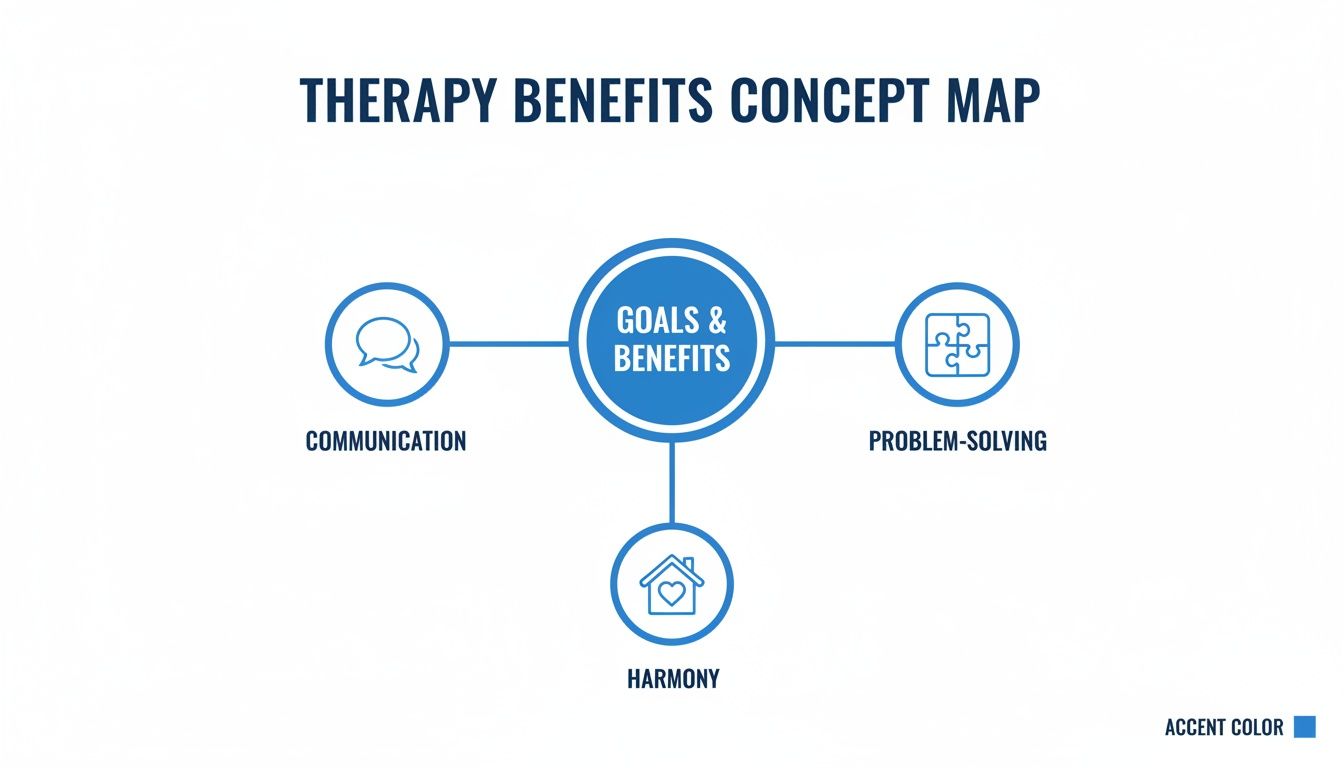
    A clear concept map illustrates the key benefits of therapy: communication, problem-solving, and harmony.

    As this shows, the goal across different models is to create a balanced family system where every member can thrive.

    Narrative Therapy

    Every family has a story it tells about itself. Sometimes, these stories become focused on problems, like past hurts or ongoing struggles with anxiety or depression.

    Narrative therapy helps families rewrite that story. Instead of seeing a person as the problem, this approach separates the person from the issue. The therapist guides your family to uncover strengths and past successes, co-authoring a new, more hopeful story for your future.

    Bowenian Family Therapy

    This approach looks at the family system across generations. It’s based on the idea that many of our relationship patterns are handed down through our family history.

    The main goal is to help each family member develop a stronger sense of self. This means learning to stay emotionally connected to the family while also being your own independent person.

    Bowenian therapy teaches us that understanding our family's emotional history can free us from repeating unhealthy patterns. It’s about achieving a balance between belonging and being an individual, which is key to reducing conflict and anxiety.

    A Bowenian therapist helps you see these inherited patterns. Then, you can consciously choose a healthier, more intentional response, breaking the cycle for yourself and for generations to come.

    Systemic Family Therapy

    The systemic model views the family as a deeply interconnected emotional unit. It focuses on the unspoken rules and communication loops that keep certain behaviours going. A therapist using this model carefully observes how everyone interacts to uncover the underlying dynamics.

    The focus isn't on who started the problem, but on how it’s being maintained now. Changing just one small part of the system can create positive ripple effects, improving everyone's well-being.

    Comparing Common Family Therapy Models

    Here is a simple breakdown of these different models to help you get a clearer picture.

    Therapy Model Main Focus Best Suited For
    Structural Therapy Family hierarchy, boundaries, and roles. Families dealing with conflict around roles and authority, such as parenting challenges.
    Narrative Therapy The stories a family tells about itself. Families who feel stuck in a negative cycle or defined by a particular problem.
    Bowenian Therapy Generational patterns and self-awareness. Families wanting to understand deep-rooted patterns and improve emotional maturity.
    Systemic Therapy Current communication and interaction loops. Families needing to address ongoing conflicts and the unspoken rules driving them.

    While each approach has a different lens, they all share a common goal: to help your family function in a healthier way.

    It’s important to remember that any assessments used during therapy are informational, not diagnostic. A therapist’s role is to understand your family's unique situation and apply the most suitable methods to help you move forward.

    What to Expect During a Family Therapy Session

    Walking into a therapist's office for the first time can feel like a big step. Knowing what to expect can calm your nerves. The therapist’s main job is to create a safe space where every family member feels heard and respected.

    A diverse family, two men and a young girl, engaged in a therapy session with a female counselor.

    Things usually begin with an initial consultation. The therapist will get to know your family, listen to your concerns, and understand your goals for counselling. This is also your chance to see if the therapist is the right fit.

    The First Few Sessions

    The first session or two is all about discovery. Your therapist will act as a neutral guide, listening to everyone’s perspective without taking sides. Their role is to help you talk to each other, not to play judge.

    You’ll likely be asked about your family’s history and the issues that brought you in. It's important to know that any assessments a therapist might use are informational. They are not diagnostic tools and are never used to label anyone.

    Who comes to each session can change. Sometimes the whole family will be there; other times, the therapist might suggest smaller groups. This flexible approach allows the therapist to focus on different relationships.

    What Happens During a Typical Session

    After the initial phase, sessions become more interactive. A therapist will guide the conversation to help you spot hidden patterns causing friction or stress. You might also do specific exercises to improve how you interact.

    These activities could include:

    • Role-playing: A safe way to practise new communication skills for when disagreements pop up.
    • Mapping your family system: Literally drawing out your family tree and relationships to get a clearer picture of connections and boundaries.
    • Setting shared goals: Working as a team to decide what a happier, healthier family life looks like for all of you.

    The point of a session isn’t to dig up old arguments and have another fight. It's about finding new ways forward, together. It’s a collaborative effort to build understanding, foster resilience, and learn practical skills.

    This process shifts the focus from individual blame to shared solutions. It creates a space where tough subjects, like workplace stress or feelings of anxiety and depression, can be discussed openly.

    The Role of Therapy in Broader Contexts

    Family therapy is also expanding to meet families where they are. In India, school-based family counselling is becoming a critical resource for helping students handle academic pressure. This approach gets families involved in solving problems like exam stress, bridging the gap between home and school. You can read more about these school-based initiatives and see their impact.

    Duration and Realistic Expectations

    One common question is, "How long will this take?" There's no set timeline. The duration depends on your family's unique situation and goals. Some families see improvement in a few months, while others with more complex issues may need longer-term support.

    Your therapist will discuss a potential plan with you, but it’s always flexible. The goal is to empower your family with the tools to navigate challenges on your own, long after therapy has ended.

    Signs Your Family Might Benefit from Therapy

    Every family has its rough patches. But what happens when those patches start to feel like a permanent, rocky road? Recognizing that you could use a guide is a sign of strength, not defeat.

    Thinking about counselling is a proactive step toward getting your family’s well-being back on track. It's often wise to address small issues before they grow into larger ones.

    Communication Breakdowns

    One of the first red flags is when communication stops working. Maybe every chat explodes into an argument, or an uncomfortable silence hangs in the air. When people feel they can't speak up or aren't being heard, resentment builds.

    This communication gap can show up in a few ways:

    • Constant Arguing: If every discussion feels like a battle and nothing gets resolved, you're stuck in a negative loop.
    • Avoiding Each Other: Family members might retreat to their rooms or make excuses to stay out of the house to avoid conflict.
    • Holding Grudges: When old wounds never heal, the lingering anger can poison the home atmosphere.

    Therapy creates a safe, neutral ground to learn how to talk and listen to one another again. A therapist acts as a coach, helping your family break old habits and start having real conversations.

    Overwhelming Life Transitions or Events

    Life has a way of throwing curveballs that can shake even the strongest families. Big events—like a new baby, a move, a job loss, or illness—can pile on stress. These moments bring up huge emotions that are hard to handle as a group.

    Family therapy provides a space to work through these changes together. It helps everyone find their footing and build resilience as a team.

    Persistent Behavioural or Emotional Issues

    When a child or teen is having a hard time, the ripple effects are felt by everyone. If you're dealing with ongoing behavioural problems, signs of anxiety or depression, or sudden mood swings, it's a source of worry. Often, these struggles are a symptom of a dynamic within the family.

    Seeking help is about understanding the root cause of the behaviour, not just managing the symptoms. It’s an opportunity to create a more supportive home environment where every member can thrive.

    Therapy can uncover underlying stressors and give your family practical tools to support the person who's struggling. When it comes to adolescents, a guide to therapy for teens can be a great resource.

    Takeaways for Your Family

    Seeing your family in these descriptions is the first, most important step. Remember, the goal of therapy isn’t about pointing fingers. It’s about giving your family the tools and understanding needed to face challenges together, reconnect, and build a stronger future.

    Finding the Right Family Therapist with DeTalks

    Deciding to start family therapy is a big step. But finding the right professional for your family is what truly sets the stage for meaningful change. The relationship you build with your therapist is key, so you need someone whose style resonates with your family.

    A good fit is when everyone feels safe, genuinely heard, and understood.

    A smiling family engaging in a virtual video call with a professional on a laptop.

    Look for a qualified professional with experience in the kinds of issues your family is facing. Ask if they have a background in areas like managing workplace stress, parenting hurdles, or dealing with anxiety.

    Your Path to Finding Support

    The thought of searching for a therapist can feel overwhelming, which is why platforms like DeTalks exist. We offer a clear way to connect with vetted therapists across India, bringing professional counselling within reach. Whether you're looking for face-to-face or online therapy, the right support is out there.

    Online therapy has become a game-changer in India, helping to bridge a huge gap in mental health access. For families in remote areas or those still navigating post-pandemic life, digital platforms are a necessity. This shift is helping countless people find support, a trend highlighted in this report on mental health awareness trends.

    Taking that first step is an act of courage and a commitment to your family's well-being. Finding a therapist you can all trust builds the foundation for healing and allows your family to grow.

    How DeTalks Can Help You Begin

    At DeTalks, we believe you should feel empowered with information from the start. Our platform offers confidential, science-backed assessments that can provide a valuable glimpse into your family's dynamics. It’s crucial to remember that these assessments are informational tools, not diagnostic ones.

    Here's how easy it is to get started with us:

    • Explore Profiles: Take your time browsing our directory of experienced therapists to find a good match for your family.
    • Book with Ease: Once you've found a potential fit, schedule an appointment directly on the platform at a time that works for everyone.
    • Gain Insights: Consider taking one of our informational assessments to get a better handle on your family’s strengths.

    Starting this journey is a sign of hope. It’s an investment in building lasting resilience and nurturing deeper connections. With the right support, the path forward is just a click away.

    Got Questions About Family Therapy? We've Got Answers.

    It's completely normal to have questions when you're thinking about starting family therapy. It means you're taking this step seriously. Let's walk through some common concerns to help you feel more comfortable.

    Will the Therapist Pick a Side?

    This is a fair question. A professional family therapist acts as a neutral facilitator, not a referee. Their job isn't to figure out who's "right" or "wrong" or to place blame.

    Instead, they look at the family as a whole system. The focus is on untangling communication patterns and creating a safe space where everyone feels understood. It's about shifting from "you vs. me" to an "us vs. the problem" approach.

    What if Someone in the Family Won't Go?

    This happens all the time, so don't worry. It’s not uncommon for one person to be hesitant about counselling. The good news is that family therapy can still be very effective even if not everyone is in the room.

    Think of it like a ripple effect. When even one or two family members learn new ways of communicating, those positive changes spread. A therapist can also give you tools to gently encourage others to join.

    "Therapy's purpose is not to prove who was right, but to create a shared understanding that allows the family to move forward together. It fosters compassion and builds the resilience needed to face life's challenges as a unified team."

    Is This Only for Big, Dramatic Problems?

    Absolutely not. While therapy is crucial during a crisis, it’s just as valuable for everyday tune-ups. Many families use therapy proactively to strengthen their bonds and get ahead of small issues before they grow.

    Think of it as preventative care for your family's emotional health. It’s a great way to handle life transitions, manage ongoing workplace stress, or simply learn to connect on a deeper level.

    How Long Will We Need to Be in Therapy?

    There's no magic number here. The length of therapy depends on your family's unique situation and goals. For some, a specific issue might be resolved in a handful of sessions.

    For others, untangling more complex patterns might take longer. Your therapist will be open about this and discuss a likely timeline with you. The goal is to give you the skills to thrive on your own long after therapy ends.


    At DeTalks, we know that reaching out is an act of hope and strength. We make it simple to find experienced, compassionate professionals ready to support your family's journey. You can browse therapist profiles and book a session to start building a more connected and resilient future. Find the right guide for your family at https://detalks.com.