
Most popular advice says counselling is light support for everyday problems and therapy is the deeper, more serious option, so you should pick a therapist if things feel bad. That shortcut can mislead you in India. It can also make a good counsellor sound second best.
The difference between counsellor and therapist isn't a simple ranking. Counselling usually supports present-life stress and coping, while therapy is a wider word that can include structured psychological treatment. What matters more is the person's verified training, stated scope, supervision, and registration where that applies.
That distinction protects your well-being. A warm, well-trained counsellor may be the right support for grief, a relationship difficulty, or building resilience. An unverified person using the title therapist may not be the right support for severe depression, trauma symptoms, or thoughts of self-harm.
This guide uses an India-first lens, and the everyday examples will feel familiar elsewhere too. It covers stress, anxiety, burnout and workplace stress, and also growth, compassion, emotional balance, and happiness. Any assessment mentioned here is informational, not diagnostic, and it can't replace a qualified professional.
Why the Job Title Is a Weak Signal
Counselling usually supports situational stress and everyday coping, therapy is the broader term that can include structured treatment, and verified training and scope decide the right fit more than the title. Keep that line in mind when profiles look similar. The comparison table in the next section turns it into a booking decision.
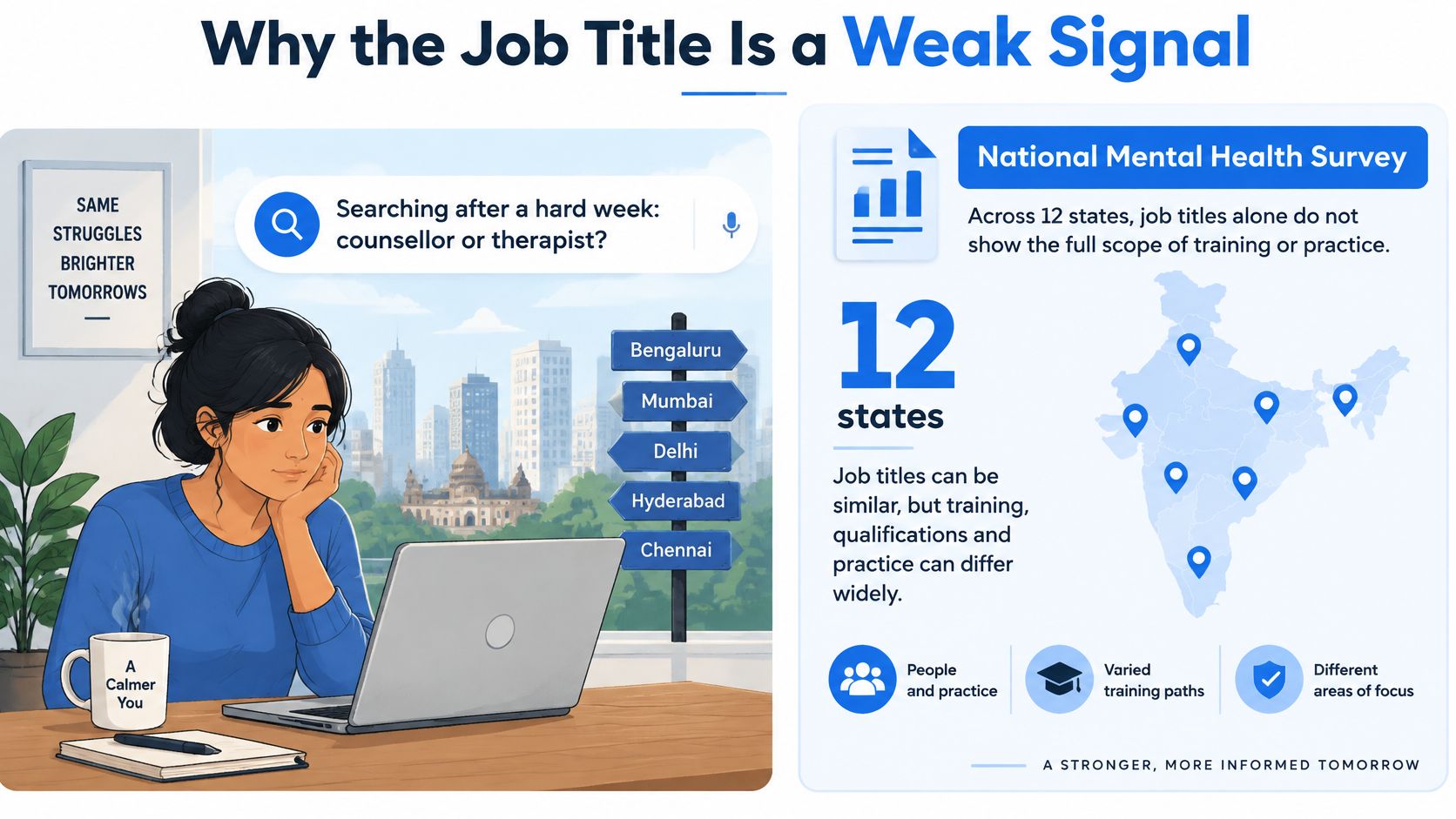
Say you're in Pune after a hard week, searching late at night. One profile says counsellor, another says therapist, and both mention anxiety and stress. It's natural to wonder if one word means more skill.
A Common Search in a Country With Unmet Need
You're not alone in that search, and needing help isn't a personal failure. Many people delay support because of stigma, cost worries, family concerns, or not knowing where to start.
The National Mental Health Survey 2015 to 2016 was conducted across 12 states with 34,802 participants, and it found that 10.6% of adults had a current mental-health condition and 13.7% had experienced a condition during their lifetime. It estimated a treatment gap of 70% to 92% across different disorders, including an 85.0% gap for common mental disorders.
Those numbers describe access problems across India, not a label for you. They show why a clear first step matters for concerns such as anxiety, depression, workplace stress, and burnout. They also show why a title alone can't tell you if someone can help safely.
What Most Simple Explainers Miss
In India, counsellor and therapist are often functional descriptions, not consistently protected titles. That means therapist isn't automatically more qualified than counsellor. You need to look at training, registration, and the kind of concerns the person is prepared to support.
- Focus: Is the work about a current situation, or a pattern that keeps returning?
- Training: What's the exact qualification and specialisation?
- Registration: Does clinical work need a formal register entry?
- Risk: What happens if your needs become urgent or complex?
For example, counselling may help you reset sleep and boundaries during a demanding work project. Therapy may help when anxiety keeps returning after the project ends. Either path can also build resilience, compassion for yourself and others, and a steadier sense of happiness.
A job title tells you how someone describes their work. It doesn't prove what they're trained and authorised to do.
Use any online assessment only as a prompt for reflection. It's informational, not diagnostic, and it can't decide whether you're facing burnout, depression, or another concern.
Counsellor and Therapist Compared at a Glance
Counselling usually focuses on present-life challenges, such as adjustment, relationships, stress, and decisions. Therapy is broader: it can include counselling, and it can also involve structured psychological treatment when the practitioner is trained for that work. Neither word, on its own, ranks one above the other.
Read the table row by row before you pay for a session. Find the row closest to your concern, then check whether the practitioner's profile matches that row.
| Criterion | Counsellor | Therapist |
|---|---|---|
| Main focus | Present-life adjustment, decisions, relationships and coping | Broader support that may include counselling plus structured treatment of recurring difficulties |
| Typical concerns | Exam pressure, workplace stress, grief, parenting, self-esteem and personal growth | Recurrent anxiety, depression, trauma-related symptoms, OCD or complex patterns, when within training |
| Training signal in India | Often postgraduate psychology with a counselling specialisation; a degree alone is not proof of competence | Clinical-level work tied to a recognised clinical psychology qualification, including supervised practice where required |
| Registration | Counsellor is not a single protected nationwide title | A clinical psychologist practising as a rehabilitation professional needs recognised training and Central Rehabilitation Register enrolment |
| When the booking should change | Suitable first step when distress is mild and safety risk is low | Prefer verified clinical care for persistent symptoms, major impairment or high-risk presentations |
The Legal Detail in Plain Words
Under the Mental Healthcare Act, 2017, a clinical psychologist must hold a recognised clinical-psychology qualification approved by the Rehabilitation Council of India (RCI), or a relevant postgraduate degree followed by a two-year, full-time MPhil-level qualification that includes supervised clinical training. In practice, the law ties clinical psychological work to named qualifications and supervised hours, so the word therapist gains meaning only when that training sits behind it.
Counsellor, by contrast, is used more broadly across schools, workplaces, relationship services, and mental-health settings. It has had less consistent nationwide regulation, and the rules around the title are still evolving. That gap is why the qualification behind the word matters more than the word itself.
How to Read the Table for Your Booking
If your main concern is a recent breakup, a job change, or exam pressure, the counselling column may fit well. Look for clear postgraduate counselling training and experience with people like you. A psychology degree on its own doesn't prove someone can counsel or provide psychotherapy.
If low mood, panic, trauma symptoms, or obsessive thoughts keep disrupting daily life, don't rely on the word therapist. Ask whether the person has verifiable training for structured treatment and whether a clinical psychologist or psychiatrist should assess you first. Credentials and scope matter more than the title.
Title confusion shows up in other helping roles too. A comparison such as recovery mentor versus addiction counselor is a useful reminder to check what a support role covers, since peer support and formal treatment are not interchangeable.
A counsellor with clear training can be the right person for mild, situational needs. A therapist title without clear training is a weaker signal, especially when symptoms are severe. In India, let severity, verified training, and registration guide the booking rather than the job title on the profile.
What Counselling and Therapy Sessions Involve
A counselling session usually starts with what's happening now and what would feel more manageable. You might talk through exam pressure, grief, parenting stress, loneliness, low self-esteem, or a habit you want to change. The work often feels practical and supportive.
Common methods include psychoeducation, which means learning in plain language how stress or mood can affect you. You may also practise skills for sleep, communication, problem-solving, or calming your body. Sessions are often weekly at first, for a short to medium period.
Where Therapy Widens the Work
Therapy can include that same supportive conversation. It may also involve formal psychotherapy for recurrent depression, anxiety disorders, trauma-related symptoms, OCD, personality difficulties, or stuck relationship patterns. The pace and method should match the practitioner's training and your needs.
Say a professional is facing burnout after months of long hours. Counselling could help them notice early signs of overload, set limits on late messages, rebuild rest, and regain motivation. If exhaustion turns into persistent low mood and loss of interest, a more structured therapy and clinical assessment may be needed.
Someone else may not be in crisis at all. They may want greater resilience, more compassion in close relationships, or a clearer sense of purpose. Counselling or therapy can support strengths and emotional balance, not only symptoms.
The real difference is treatment intensity and risk, not a rank of job titles.
Safety, Privacy, and Referral
Good practice starts with informed consent. The practitioner explains what sessions involve, what confidentiality covers, and where its limits are. They also maintain clear boundaries and work only within their training.
The Counselling Code of Ethics guidance supports this focus on competence, consent, confidentiality, boundaries, continuing development, and referral when needs exceed expertise. A referral isn't rejection. It's a sign the practitioner is taking your safety seriously.
Some presentations shouldn't stay in routine counsellor matching. They need prompt clinical or psychiatric evaluation.
- Immediate safety concerns: Thoughts or plans to harm yourself or someone else.
- Psychosis or mania: Losing touch with reality, or unusually high energy and reduced need for sleep.
- Severe impairment: You're unable to work, study, care for yourself, or manage daily tasks.
- Substance dependence: Use that feels hard to control and affects health or safety.
- Suspected clinical conditions: Concerns that need formal assessment, including neurodevelopmental conditions.
If any of these fit, the next step is a qualified clinical professional, and psychiatric care where needed. That pathway protects you better than trying to choose between two profile labels.
Which Concern Fits Counselling or Therapy
Workplace stress is a common starting point, and it doesn't by itself prove an illness. Gallup's India country data reports that 28% of employees experienced a lot of stress on the previous day. Many people first seek help for pressure at work, low motivation, or anxiety before meetings.
Use this table to choose a sensible first conversation. Then watch for the signs in the third column, because they change the level of care you need.
| Concern | Often a sound first step | Move to specialist care when |
|---|---|---|
| Workplace stress or burnout | Counselling on coping, boundaries, sleep and motivation | Low mood, exhaustion or anxiety persists or work functioning collapses |
| Exam or academic pressure | A counselling psychologist or college counselling | Panic, self-harm thoughts or an inability to study or attend |
| Relationship or family conflict | Relationship-focused counselling | Fear, violence, severe distress or a suspected clinical condition |
| Grief or loneliness | Supportive counselling and social reconnection | Prolonged inability to function or suicidal thoughts |
| Mild anxiety | Skills-based counselling or therapy | Avoidance or panic stops daily life |
| Growth, resilience and happiness | Counselling or therapy aimed at strengths and emotional balance | Distress is the main issue, or screening raises concern that needs professional evaluation |
Two Everyday Examples
Say a Bengaluru professional feels tense every Sunday evening and struggles to switch off. They're still working, sleeping fairly well, and meeting friends. Counselling could be a sound first step for boundaries, recovery time, and calmer routines.
If that person later can't concentrate, avoids work, and feels low most days, the picture has changed. They should move toward a practitioner with verifiable psychotherapy training, a clinical psychologist, or a psychiatrist. Persistence and loss of functioning matter.
Say a college student feels nervous before exams and procrastinates. College counselling may help with study routines, self-talk, and support from friends. Panic that stops attendance, or thoughts of self-harm, need specialist assessment without delay.
Growth Counts as a Reason to Seek Support
You don't need to wait for a crisis to ask for help. You may want to build resilience, respond with more compassion, or feel more balanced and engaged in daily life. Support can strengthen those positive outcomes while also helping you notice early signs of strain.
For grief and loneliness, small connections can sit alongside counselling, such as time with trusted people or gentle community activities. If the loss involves a much-loved animal and you're later considering a new companion, you could explore pet adoption only when you feel ready and supported. Companionship can comfort, but it doesn't replace professional care when distress is severe.
A brief assessment can suggest what kind of support to explore. It can't tell burnout from depression or an anxiety disorder, because those need professional evaluation. If difficulty persists or worsens, please don't rely on a score alone.
Checks to Make Before You Book Help
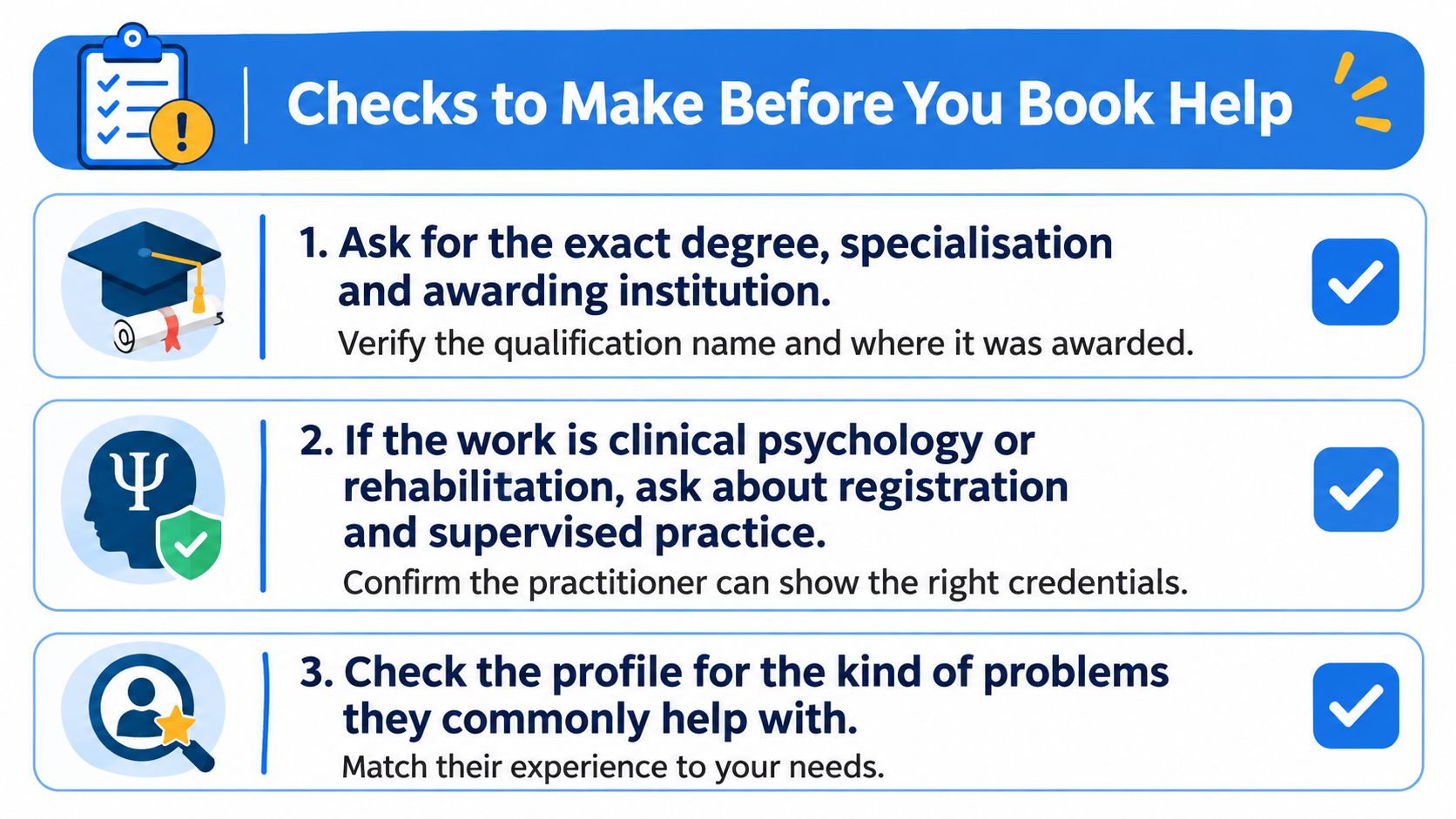
Use these checks on any profile, whether it says counsellor, therapist, or psychologist. Clear answers should be easy to find. If key fields are missing, pause before booking.
Seven Questions That Protect You
- Ask for the exact qualification: What's the degree, specialisation, and awarding institution?
- Ask about registration: If the work is clinical psychology or rehabilitation, what's the RCI and Central Rehabilitation Register status?
- Ask about supervised practice: How much supervised training did they complete, and who do they usually serve?
- Ask about scope: Which concerns do they treat, and which do they refer, including depression, trauma, OCD, and risk of self-harm?
- Ask about the method: Which modality do they use, how long are sessions, and what do consent and confidentiality cover?
- Ask about emergencies: They should state clearly that they aren't a crisis service and explain referral to a clinical psychologist or psychiatrist.
- Treat screening with care: Any online assessment is informational only, never a diagnosis.
A simple safeguard: A well-trained counsellor can be appropriate for many needs, while an unverified therapist isn't automatically safe for high-risk care.
Practical Details Decide if Support Fits Your Life
After the safety checks, ask three booking questions. What's the fee per session? Are sessions online or in person? Which language will you use together?
Those details affect whether you can attend regularly and speak freely. A session in a language you're comfortable in can make it easier to describe feelings clearly. Regular attendance also gives counselling or therapy a fair chance to help.
On our directory, we aim to make degree, registration, supervised training, and stated scope visible rather than treating titles as interchangeable. That helps you compare the difference between counsellor and therapist in a practical way. If a profile elsewhere doesn't show those fields, ask before you commit.
Choose the Lowest Safe Level of Support
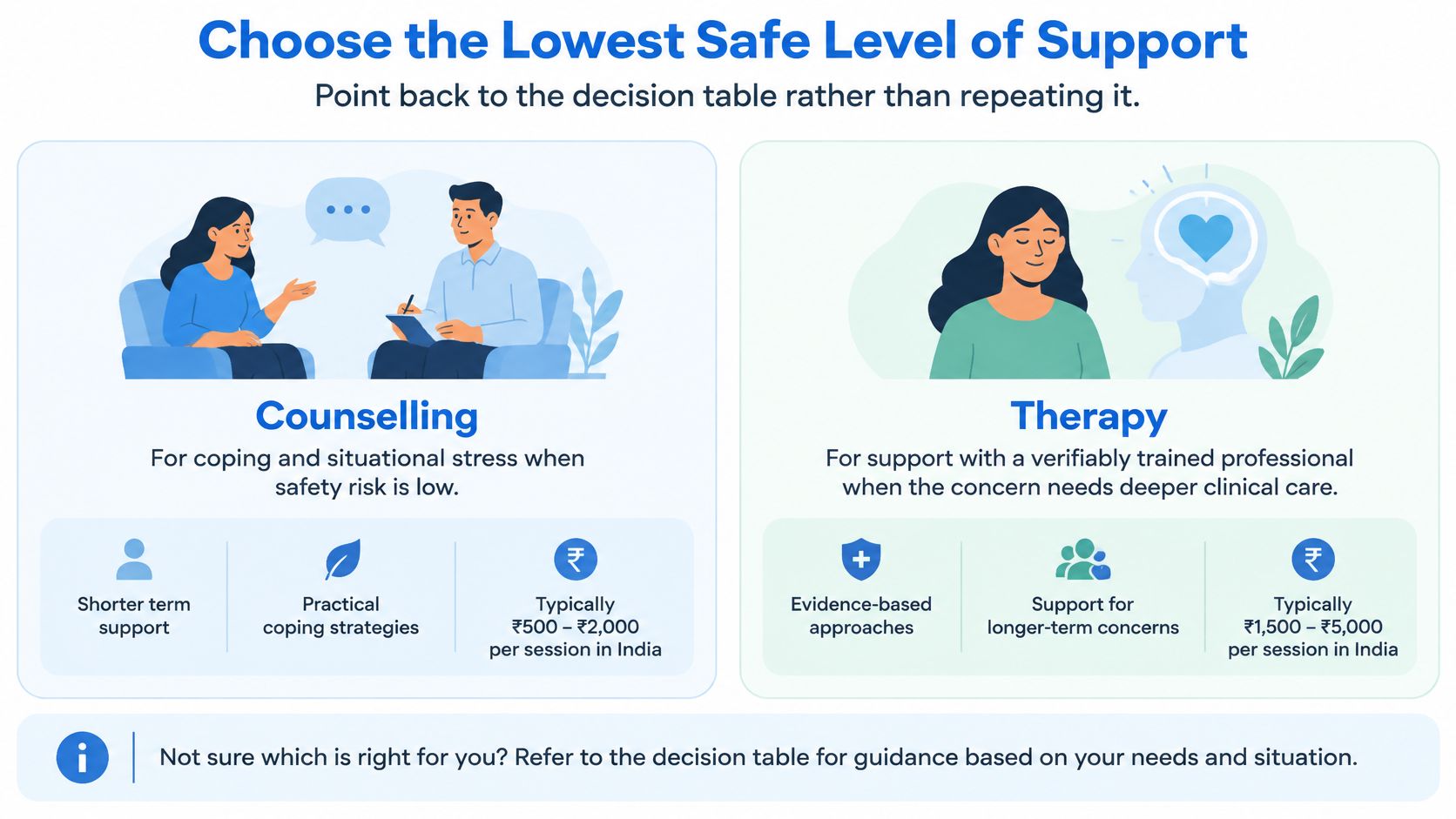
The safest choice is the least intensive support that still fits your symptoms. In India, that decision turns on severity, verified training, registration, and stated scope rather than whether someone is called a counsellor or a therapist.
A Calm Way to Decide
Mild, recent distress tied to a situation often fits counselling first: a breakup, exam pressure, a move, conflict at home, or strain at work. In that space you practise coping skills, adjust routines, and test whether a few focused conversations steady you. Review after a handful of sessions; if the same pattern keeps returning, ask whether a different level of care would help.
When anxiety, low mood, panic, sleep disruption, or relationship patterns repeat across months, look for therapy with a verifiably trained practitioner. A useful answer sounds specific: what method they use, what sessions will work on, and what change you should both watch for. Clear goals make slow progress easier to judge.
Seek a clinical psychologist or psychiatrist promptly when symptoms are severe or persistent, when daily functioning drops sharply, or when there is psychosis, mania, substance dependence, or any danger to yourself. Routine counselling should not be asked to carry a high-risk situation.
The label matters less than the risk in front of you.
Why Checking Scope Matters in India
Government information citing Indian research reports approximately 0.75 psychiatrists per 100,000 people, compared with the World Health Organization's referenced recommendation of at least 3 per 100,000.
That gap makes triage practical. Counsellors may support coping and everyday concerns, therapists may provide structured treatment for recurring difficulties, and psychiatrists address medical assessment and medication when indicated. Training can overlap, so the person's verified education, registration where applicable, supervised experience, and stated scope deserve more weight than the title on a profile.
A clear scope also protects timing. It helps a practitioner refer upward early, and it helps you avoid spending months in the wrong level of care while symptoms deepen.
Supportive Takeaways for Your Next Step
An early conversation can protect your well-being and make the next step clearer. It can build skills for stress, strengthen resilience, and help you respond to yourself and others with more compassion. Those gains matter, even when life remains demanding.
Progress usually comes from a good fit, steady practice, honest review, and timely escalation. No single session or screening settles a condition by itself.
Visit DeTalks to browse psychologists, counsellors, and therapists, review their profiles, and book a session when you're ready to talk. You can also explore confidential, science-backed assessments as a gentle starting point for reflection.
Book the lowest safe level of help that fits today. If symptoms worsen, functioning drops, or safety becomes a concern, escalate promptly. You deserve support that is both warm and properly qualified.