
A psychologist is trained in the science of mind and behaviour, while a psychotherapist provides structured talking therapy; in India, only some of these roles are tightly regulated. The practical difference is between a professional background and a treatment activity, so the title on a profile isn't enough to choose care.
You might be searching after another difficult workday, wondering whether your anxiety, exhaustion or low mood needs attention. Then a booking page offers psychologists, psychotherapists, counsellors and psychiatrists, sometimes with descriptions that sound almost identical.
You don't need to understand every qualification before asking for help. You do need a way to check whether someone's training matches what you're experiencing.
Psychologist and Psychotherapist Side by Side
A search result may call someone a psychologist, psychotherapist or counsellor, while their profile gives little detail about training. Compare the titles as starting points, then look at the person's qualifications and the work they offer.
| Title | What it usually means | Training signal in India | Assessment scope | Often a first fit for |
|---|---|---|---|---|
| Psychologist | Broad professional trained in psychology | Psychology degree; check the area of specialisation | Clinical assessment requires further relevant training | Understanding patterns, counselling, workplace or education work |
| Clinical psychologist | Regulated clinical role within psychology | RCI-recognised clinical qualification | Formal psychological assessment within scope | Complex anxiety, depression, trauma, diagnostic uncertainty |
| Counselling psychologist | Applied psychology focused on counselling and growth | Postgraduate counselling or applied psychology training | Psychological formulation and screening within training, not medical assessment | Relationship strain, adjustment, resilience, mild distress |
| Psychotherapist | Someone who provides psychotherapy, not one statutory title | Therapy-method training alongside an underlying professional qualification | Therapy training doesn't automatically confer diagnostic authority | Ongoing therapy for anxiety, low mood, stress or relationships |
| Counsellor | Supportive talking help | Counselling diploma or degree; check supervised practice | Supportive exploration and screening, not automatic diagnostic authority | Everyday stress, grief, exam or family strain |
| Psychiatrist | Medical doctor specialising in mental health | MBBS plus psychiatry specialisation | Medical diagnosis and medication | Severe depression, psychosis, bipolar disorder, safety risk |
The psychologist row covers a broad field. A psychologist may work in research, schools or organisations rather than provide individual treatment. A psychology degree alone does not show whether someone has training for clinical assessment.
Clinical and counselling psychology can involve different areas of work. A counselling psychologist may support adjustment or relationship concerns, while a clinical psychologist may offer formal assessment within their training and scope. The person's actual experience matters more than the title alone.
Psychotherapist describes a treatment role, so check the practitioner's underlying qualification and therapy training. A counsellor may provide supportive conversations, but that title alone does not establish authority to diagnose. A psychiatrist is a medical doctor who can assess mental-health concerns medically and prescribe medication.
Use the table to narrow your search
India's National Mental Health Survey found large treatment gaps for depression and anxiety. Those gaps point to unmet need across the country; they do not indicate whether any one person has a mental-health condition.
You can seek support for distress, emotional skills or healthier coping without first assigning yourself a diagnosis. Use a title to shortlist someone, then check their qualifications, supervised experience and scope of practice.
Website quizzes and directory labels can help organise questions, but they are not diagnoses. An assessment can identify patterns and guide a conversation; diagnosis calls for a suitably qualified clinician's broader evaluation.
Profession, Method and Common Myths
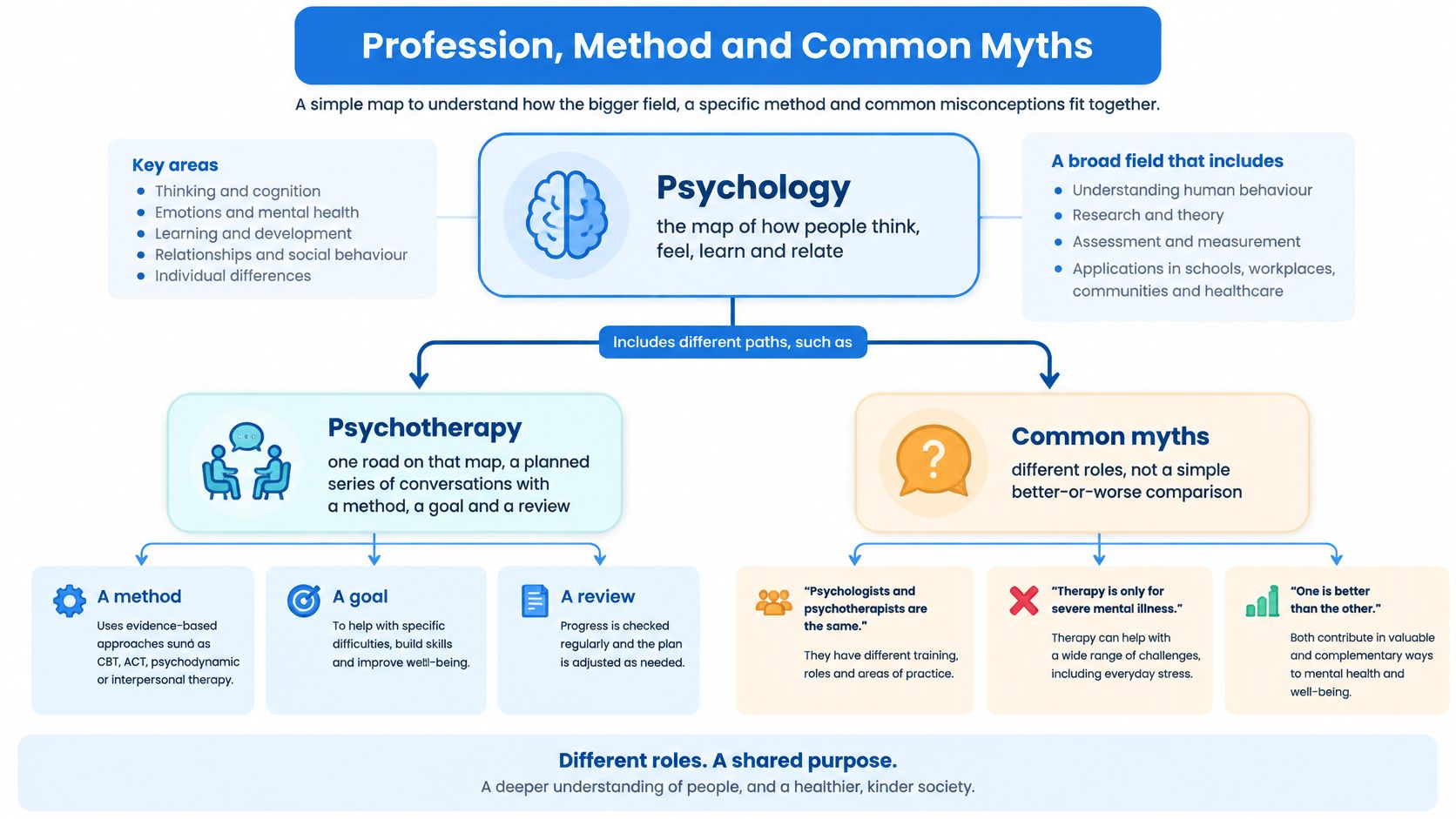
Think of psychology as a map of how people think, feel, learn and relate. Psychotherapy is one road on that map: planned conversations using a method, a goal and a way to review progress.
A clinic makes the distinction easier to picture. Several professionals may work in the same building, but the therapy conversation is a treatment activity, not the name of the degree hanging on the wall.
This diagram separates the broader field from the treatment activity.
What happens in the therapy room
Say you're struggling with worry before meetings. A clinical psychologist might provide psychotherapy, while another appropriately trained mental-health professional might offer therapy for the same concern within their scope.
Meanwhile, someone with a psychology background may spend their working life studying learning or improving workplace systems. They may never provide therapy at all.
Therapy methods also aren't job titles. Cognitive behavioural therapy explores links between thoughts, feelings and actions; psychodynamic work explores recurring emotional and relationship patterns; couple or family therapy examines interaction between people.
A general psychology degree doesn't establish competence in all these methods. Equally, training in a therapy method doesn't automatically establish competence in formal clinical assessment.
Myths that can make choosing harder
- The titles are interchangeable. They overlap, but one describes a professional field and the other a treatment function.
- One title always means greater seniority. Relevant training, supervised experience and fit matter more than a simple hierarchy.
- Any psychologist can diagnose depression. A broad psychology qualification isn't enough to establish clinical diagnostic competence.
- A quiz score is a diagnosis. Screening results, including depression questionnaires, are informational starting points rather than clinical conclusions.
- You must be ill to attend therapy. People also seek help with self-compassion, resilience, happiness, relationships and purpose.
There's another misconception: your first conversation must be with a specialist. A listening service or counsellor can help you explain what's happening and decide whether ongoing or more specialised care would be useful.
According to the Press Information Bureau's Tele-MANAS update, the service had handled more than 20.05 lakh calls by 1 April 2025, with services across 36 States and Union Territories in 20 languages. These are service-access figures, not evidence that a call replaces ongoing treatment.
Low-barrier support can be a sensible entry point when you aren't sure how to describe your concern. It can also help you find language for a later appointment.
When reading a profile, move beyond whether someone sounds reassuring. Ask what they studied, which methods they use and what working together would involve.
Training, Legal Scope and What to Verify
For clinical psychology in India, recognised training and registration matter more than a website headline. Under the Mental Healthcare Act, 2017, the qualification requirements include recognised clinical-psychology training approved by the Rehabilitation Council of India, or a relevant postgraduate degree with a two-year, full-time M.Phil.-level clinical programme incorporating supervised training.
Recognised routes have included the M.Phil., with newer pathways including an RCI-approved M.A. in Clinical Psychology and a four-year Psy.D. programme, as discussed in The BMJ's account of India's psychology regulation. Clinical-psychology registration is linked to the RCI's Central Rehabilitation Register, so verify the specific qualification and registration rather than assuming every similarly named course qualifies.
What the title doesn't establish
Psychotherapist describes the delivery of structured psychological therapy; it isn't a single nationally standardised qualification title under the Act. A counsellor or therapist can have valuable training without holding clinical-psychologist registration, but they shouldn't imply that they have it.
A general psychology degree alone isn't proof of competence in formal clinical assessment, diagnosis-related work or complex treatment. The useful question is what this practitioner is trained and authorised to do for your concern.
Checks before booking
Read the exact degree. Look beyond a headline such as mental-health expert. The subject and clinical specialisation give you a more useful starting point.
Verify clinical registration. For someone advertising as a clinical psychologist, check the relevant RCI recognition and their entry on the Central Rehabilitation Register.
Ask about supervised practice. Find out which client groups they worked with and what supervised clinical training they completed. Experience with adults doesn't automatically establish competence with children or couples.
Check the therapy method. Ask how their approach fits anxiety, depression, trauma, couples work or workplace stress. A clear answer should connect the method to your goals.
Ask about limits and referrals. Find out what they don't treat and when they involve a clinical psychologist, psychiatrist or another specialist. Clear boundaries are a useful sign of responsible practice.
Confirm practical arrangements. Discuss language, online or in-person sessions, fees, cancellation terms and confidentiality limits. For online therapy, consider who could overhear at home.
Ask how assessments are used. A responsible explanation distinguishes informational scores from diagnosis and describes how findings inform counselling or further evaluation.
Put immediate safety first. If there's suicide risk or you can't stay safe, use local emergency services rather than waiting for a routine booking.
The Ministry of Health's operational guidance distinguishes screening from confirmation and identifies the Patient Health Questionnaire-9 as a tool that can support assessment. A clinician still needs to consider symptoms, duration, functioning, history, context and safety.
Directory filters should separate academic background, regulated credentials, therapy specialisation and scope of practice. Combining those into a single badge can hide the distinctions you need to make an informed choice.
Which Concern Fits Which Professional
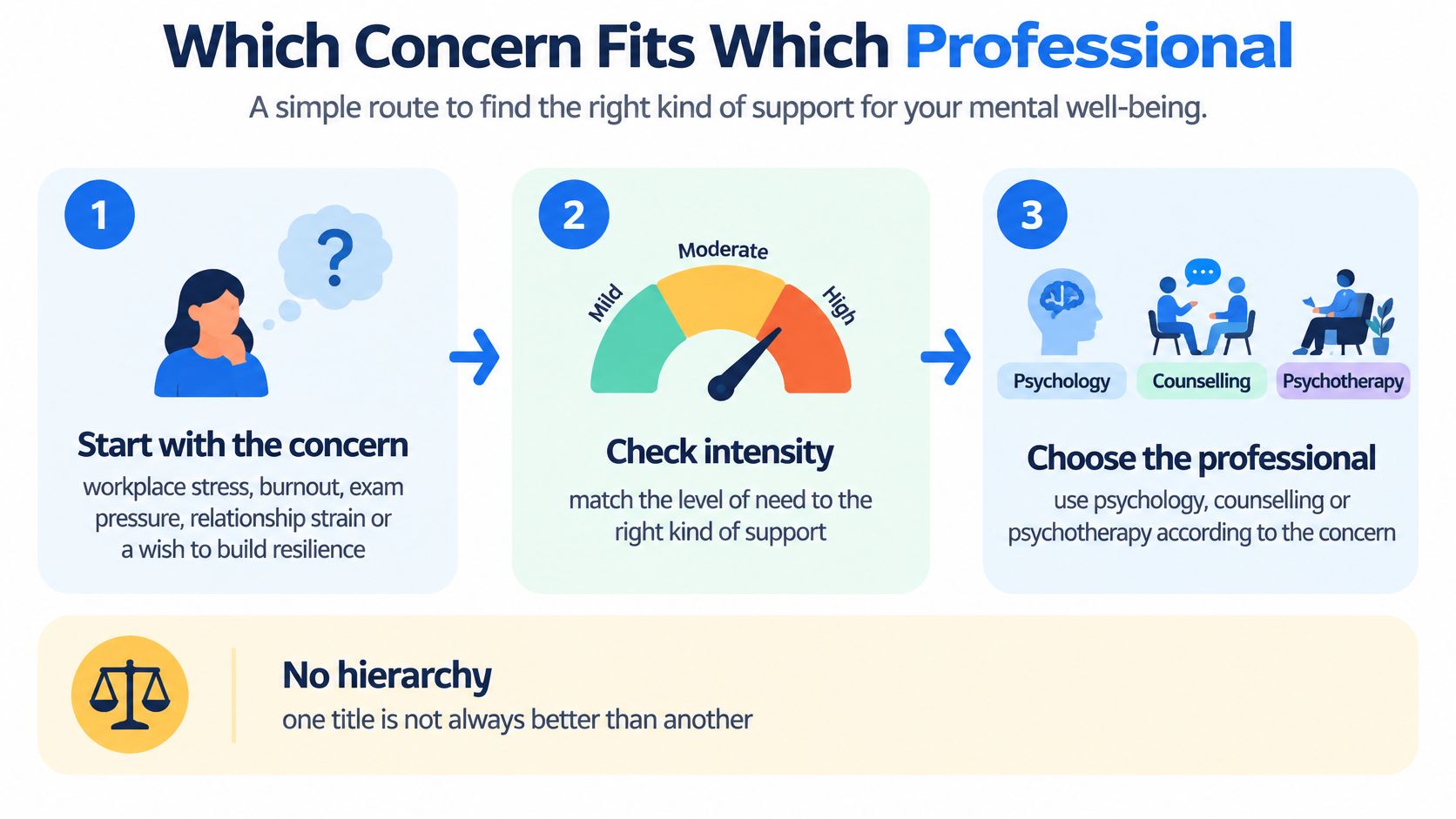
Start with the concern and its intensity, not with the idea that one professional is always better. The question is what support you need now and what would signal that care should widen.
This route keeps everyday concerns and higher-risk needs in the same picture without treating them as equivalent.
Where to start by concern
| Concern | Start with | Why this fit | Widen care when |
|---|---|---|---|
| Workplace stress or burnout | Counsellor, counselling psychologist or psychotherapist | Therapy for boundaries, focus and recovery without assuming illness | Low mood, hopelessness or inability to function persists |
| Mild anxiety or adjustment strain | Trained therapist or counselling psychologist | Structured counselling or therapy for worry and coping | Panic, avoidance or daily life keeps shrinking |
| Relationship or family conflict | Couple, family or individual therapist | Work on communication and roles | Abuse, safety fears or severe depression appears |
| Wish for resilience or well-being | Counselling psychologist, coach-style therapist or positive-psychology-informed clinician | Growth work on compassion, purpose and emotional skills | Distress is the main driver, rather than only a growth goal |
| Persistent depression or anxiety | Therapist plus clinical psychologist if assessment is needed | Therapy alongside a fuller review of duration, functioning and history | Self-harm thoughts, psychosis or lack of improvement requires review |
| Severe, unclear or high-risk symptoms | Clinical psychologist and psychiatrist | Psychological assessment, medical review and possible medication | Seek immediate help for suicide risk, mania or loss of contact with reality |
A coach-style description isn't a clinical credential. For significant distress, check the practitioner's mental-health training rather than relying on a growth-focused label.
How the route works in everyday life
A manager who feels drained after constant late-night messages may need boundaries, recovery time and practical workload changes. The Aon Asia Mental Health Index report for India found 77% of workers in India had moderate-to-high risk of experiencing mental-health issues, while 45% found concentration more difficult than the previous year.
These findings don't mean every stressed employee has an illness. Counselling can help the manager practise boundaries and problem-solving, but an employer must also address unreasonable demands.
A student whose anxiety now prevents class attendance needs more than reassurance about exam nerves. An appropriately trained therapist can address avoidance, while a clinical psychologist can help when symptoms, functioning or diagnostic uncertainty need fuller assessment.
A family member with severe mood swings, little sleep and unusually risky decisions needs prompt medical review, not just general stress support. A clinical psychologist and psychiatrist may need to coordinate care rather than leaving the family to arrange disconnected appointments.
For another perspective on choosing support, this video may be useful.
Life stage also matters: someone distressed after childbirth may need a practitioner with relevant trauma experience. Bornbir's guide to therapy options for birth trauma offers a starting point for understanding that specific concern.
Language, cost, online access and home privacy can determine whether support is workable. Screening scores can open a conversation, but they're informational, not diagnostic, and either professional may need to coordinate wider care.
Moving Safely Between Support Levels
You don't have to identify the perfect service before your first conversation. You need a manageable starting point and a clear plan for what happens if your needs change.
A helpline or counsellor can offer a listening space, coping ideas and help putting your experience into words. Speaking in your preferred language may make it easier to explain feelings you usually minimise or struggle to translate.
When ongoing support makes sense
Consider ongoing psychotherapy when a concern persists over several weeks, repeats across settings or increasingly restricts work, sleep, study or relationships. You don't need to wait until every part of life is affected.
For example, someone may initially call for help after a difficult breakup, then notice that panic and avoidance keep returning. Regular therapy offers room to work on those patterns rather than repeatedly managing each difficult evening in isolation.
A referral isn't a rejection. A responsible practitioner recognises when another professional can contribute something you need.
Add a clinical psychologist when you need formal psychological assessment, a fuller understanding of your history and functioning, or help resolving uncertainty about what's happening. Bring previous reports and a description of what has changed, including sleep, work, relationships and coping.
A psychiatrist can help when medication may be needed, a medical explanation needs consideration, or symptoms raise concern about depression, mania or psychosis. Psychiatric care and psychotherapy can happen alongside each other rather than being competing choices.
Routine referrals and urgent help are different
- Routine coordination. Ask who will arrange the referral, what information will be shared with your consent and who will remain your main point of contact.
- Prompt clinical review. Marked deterioration, substance dependence or new severe symptoms need timely assessment rather than an open-ended continuation of general support.
- Same-day emergency help. Thoughts of self-harm or suicide, loss of contact with reality, sudden confusion or inability to stay safe call for local crisis or emergency services, not a routine appointment.
If danger is immediate, go to the nearest emergency department or contact local emergency services. If it's safe to do so, involve a trusted person who can stay with you and help you access care.
Stepping down can also be appropriate
Care doesn't always move towards greater intensity. After stabilisation, someone may continue with therapy, space appointments further apart or agree on a plan for returning if warning signs reappear.
Ask what improvement would look like in everyday terms, such as attending classes, sleeping more consistently or managing conflict without withdrawing. Review these goals together instead of treating a lower questionnaire score as the whole story.
Any screening result remains a starting point, not a diagnosis. Good coordination combines what you report, professional judgment and a shared understanding of your next step.
Choose Support That Matches Your Need
The difference between psychologist and psychotherapist becomes useful when it helps you choose care, not when it becomes another test you feel you must pass. You can make a sensible decision without having a perfect explanation for everything you're feeling.
Choose by your immediate goal
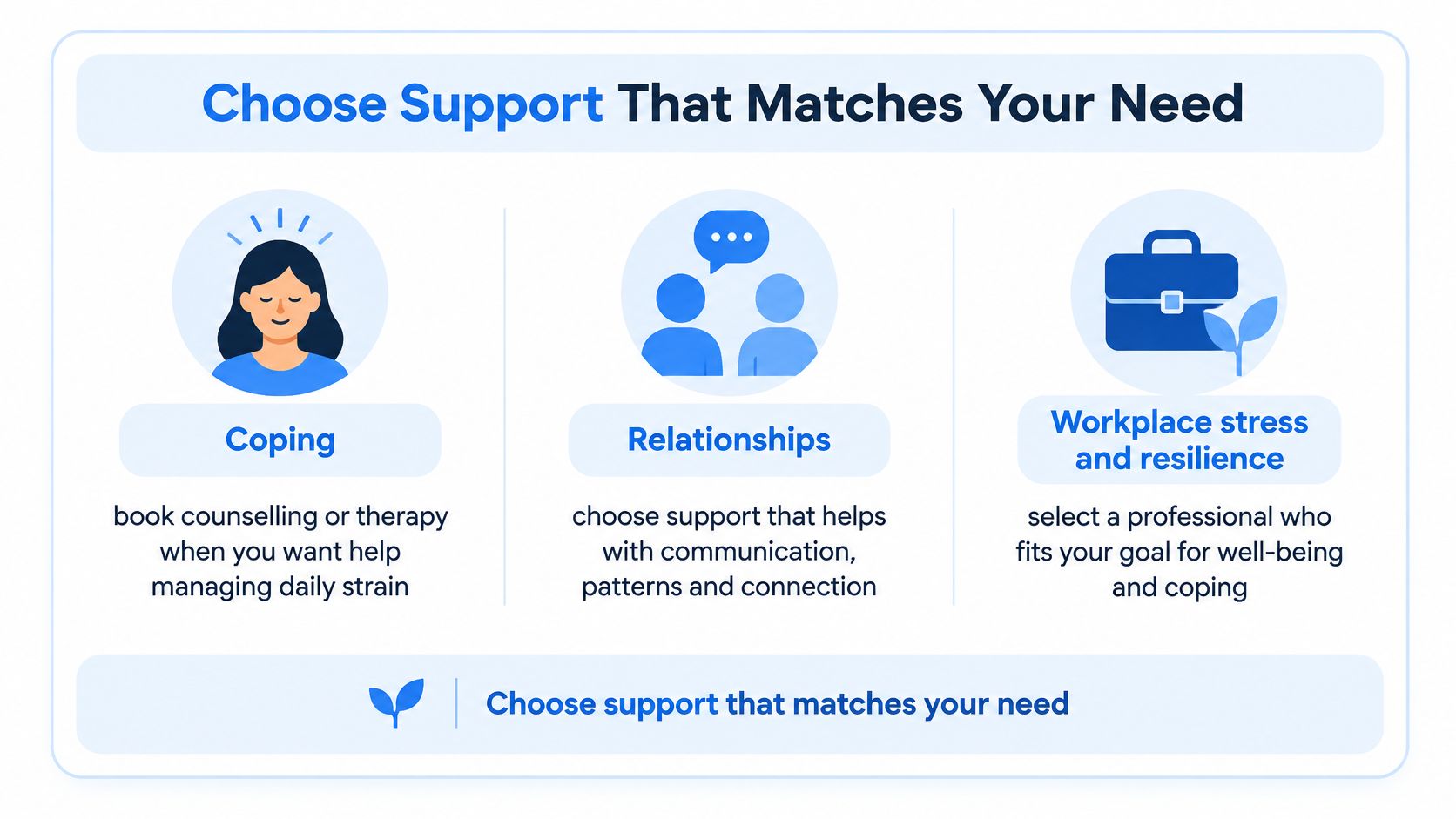
- For coping and growth. Book counselling or therapy for relationships, workplace stress, resilience or well-being with someone whose method and language fit.
- For clinical clarity. Look for a clinical psychologist when you need testing, a careful understanding of patterns or support for a diagnosable condition, and ask about psychiatric coordination.
- For safety. Seek urgent clinical care the same day if safety is in doubt rather than waiting to compare more profiles.
These everyday goals can help you recognise what you're hoping to change.
DeTalks is an India-based place to compare psychologists, therapists and counsellors, read qualifications and explore science-backed assessments. Those website assessments are informational and don't diagnose depression, anxiety or any other condition; use them as a starting point before counselling, therapy or referral.
Make the next step manageable
Shortlist two practitioners, check registration where it applies and choose the person whose scope matches your concern. You're allowed to ask questions, and a first session is a fit check, not a lifelong contract.
Progress can mean useful skills, some relief and clearer next steps. It isn't a guaranteed cure or a requirement to feel better immediately.
The right title is the one backed by qualifications that fit this stage of need. Asking for help is already a strong step towards emotional balance.
DeTalks offers a directory of mental-health professionals and informational assessments to help you explore suitable support. Visit DeTalks to compare qualifications, therapeutic approaches and areas of practice, then choose a next step that matches your needs.