Tag: emotional abuse

  • Trauma Bond Meaning: Signs, Cycles, & Healing

    Trauma Bond Meaning: Signs, Cycles, & Healing

    Some people are reading this because they know something is wrong, yet they still miss the person who hurts them. You may feel pulled in two directions at once. Part of you wants peace, and another part still waits for the next apology, the next kind message, or the next brief moment when everything feels normal again.

    That confusion can affect every part of life. It can raise anxiety, disturb sleep, increase workplace stress, and leave you feeling emotionally exhausted in ways that look a lot like burnout. It can also make you doubt your own judgement, even when your body is already telling you that something feels unsafe.

    The good news is that this pattern has a name. Understanding trauma bond meaning can bring relief, because it helps explain why leaving or emotionally detaching can feel so much harder than other people assume. This isn't a sign of weakness. It's a painful psychological pattern that can be understood, worked through, and healed with support, therapy, and compassionate counselling.

    Why Is It So Hard to Leave

    You might know someone like this, or this might be your story. They say, “I know the relationship is harming me, but I still love them,” and they mean both parts. They aren't pretending, and they aren't confused in a simple way. They are living inside a profoundly mixed emotional reality.

    One day, the person criticises, controls, threatens, or humiliates them. The next day, that same person apologises, becomes affectionate, promises change, or acts protective. The mind starts holding on to those softer moments because they offer relief from fear. Relief can feel like love when you've been under stress for a long time.

    A pensive person with short hair looks out of a window during a rainy day.

    In plain language, a trauma bond is a strong emotional attachment to someone who is also causing harm. It often develops in abusive relationships where fear, hope, affection, and pain keep repeating in a cycle. The person being harmed may feel loyal, protective, or intensely attached, even while suffering.

    Why mixed feelings are so common

    People often ask themselves, “If it hurts this much, why can't I just walk away?” That question usually comes with shame. Shame makes healing harder.

    You can care about someone and still be harmed by them. Those two truths can exist together.

    In many Indian homes, leaving a relationship isn't only an emotional decision. Family expectations, fear of judgement, pressure to keep the relationship intact, concern for children, and financial dependence can all make the situation more complicated. Readers outside India may recognise similar pressures in different forms, such as religion, community reputation, or immigration concerns.

    What this means for your well-being

    Living in this kind of push-pull dynamic can drain emotional energy. People often describe racing thoughts, low confidence, sadness, and constant alertness. Over time, that strain can spill into concentration, appetite, daily functioning, and even happiness in parts of life that once felt steady.

    If this sounds familiar, understanding the trauma bond meaning isn't about putting a label on you. It's about giving language to an experience that can otherwise feel impossible to explain.

    The Psychology Behind This Powerful Bond

    A trauma bond doesn't appear out of nowhere. It develops through repeated experiences that train the nervous system to stay attached in the middle of harm. Once you see the pattern, the attachment starts to make psychological sense.

    A useful analogy is a lottery ticket. If a reward came every single time, your brain would know what to expect. But when the reward comes unpredictably, people often keep waiting, hoping, and trying again. In an abusive relationship, affection arrives unpredictably, and that inconsistency can make the attachment feel even stronger.

    A diagram illustrating the cycle of abuse, showing four stages: tension building, incident, reconciliation, and calm.

    As explained in this description of the four-stage cycle of abuse, trauma bonds develop through a specific pattern: tension building, where anxiety and fear accumulate; the incident of abuse, which can be physical or emotional; the reconciliation phase, where the abuser offers apologies or affection; and the calm phase, where the relationship temporarily stabilises.

    The four stages in everyday language

    Tension building

    This is the part where the atmosphere changes. You may feel yourself becoming extra careful. You watch your tone, your face, your timing, and your words because you sense that something bad could happen.

    Many people describe this stage as walking on eggshells. Even when nothing obvious has happened yet, the body is already carrying stress.

    Incident or abuse

    Then the harm happens. It may be shouting, insults, threats, sexual coercion, control, intimidation, physical violence, or a cold emotional shutdown meant to punish.

    This is the stage people often focus on, but it isn't the whole picture. If abuse happened without the other stages, the bond might not become so confusing.

    Reconciliation

    After the incident, the person who caused harm may apologise, cry, become tender, buy gifts, make promises, or say they didn't mean it. They may talk about stress, childhood pain, alcohol, family problems, or work pressure.

    Practical rule: An apology matters only when behaviour changes consistently over time.

    This stage can create intense relief. The nervous system finally gets a break, and that break can feel powerful enough to keep the relationship going.

    Calm

    For a while, things may seem stable. There may even be warmth, closeness, or hope. You might tell yourself that the worst is over and that this time things will stay better.

    Then the cycle begins again.

    Why the bond feels so strong

    The attachment isn't a sign that you enjoy pain. It's a sign that your mind and body have adapted to survive an unstable environment. When fear and relief keep alternating, the brain starts linking safety with the very person who caused the danger.

    This can affect mental health in broad ways. People may notice anxiety, emotional dependency, difficulty concentrating, low mood, and stress reactions that follow them into friendships, parenting, and work. For professionals already carrying heavy workloads, this can blend with workplace stress and make it harder to tell where one pressure ends and another begins.

    A gentle reminder

    Understanding this psychology can reduce self-blame. It shows that the bond is not evidence that you are foolish, broken, or weak. It is a human response to repeated manipulation, fear, and intermittent comfort.

    Common Signs of a Trauma Bond

    The trauma bond meaning becomes clearer when you look at how it shows up in daily life. The signs are often emotional as much as behavioural. You may not see all of them, but even recognising a few can be illuminating.

    An infographic listing five common signs of a trauma bond, including emotional dependency and difficulty leaving.

    A useful starting point is this: trauma bonding is a psychological response where a victim develops a strong emotional attachment to the perpetrator, reinforced by cycles of violence and intermittent rewards. In India, 37% of women experience intimate partner violence, and this bond is described as a primary reason many remain in abusive relationships in this overview of trauma bonding in abusive relationships.

    What you might notice in yourself

    • You defend the person who hurts you. You may explain away cruel behaviour by focusing on their stress, childhood, job pressure, or “good heart”.
    • You feel unusually responsible for keeping the peace. Their anger starts to feel like your job to prevent.
    • You keep waiting for the good version of them to return. The hope for change stays alive, even after repeated disappointment.
    • You feel pulled away from other people. Friends, siblings, colleagues, or neighbours may start seeing less of you, either because you've withdrawn or because the relationship makes outside contact difficult.
    • You feel trapped even when part of you wants to leave. The thought of separation can bring panic, guilt, loneliness, or a sense that you won't cope alone.

    Internal signs that often get missed

    Some signs are quieter. You might feel your self-esteem shrinking. You may stop trusting your own memory or reactions. You may feel sad, numb, or emotionally flat, then suddenly desperate for the person's approval.

    If you're trying to understand the wider mental health impact of toxic relationships, it can help to look at patterns like emotional confusion, isolation, fear, and dependency together rather than as separate problems.

    If the relationship keeps hurting you, but you still feel compelled to protect it at any cost, that's worth taking seriously.

    This is informational, not diagnostic

    A checklist can guide reflection, but it can't diagnose your situation. Assessments and articles are informational, not diagnostic. A trained mental health professional can help you sort out whether you're experiencing a trauma bond, another form of unhealthy attachment, or a different relationship dynamic altogether.

    Trauma Bonds vs Healthy Attachments

    Many people recognise that something feels off, but they don't have a clear comparison point. If unhealthy behaviour has become normal over time, a safer relationship can even seem unfamiliar at first. Looking at the differences side by side can help restore perspective.

    One important India-first reality also belongs here. Economic pressure can keep a trauma bond in place. A reported 2026 NFHS-6 finding says 54% of women in abusive relationships in rural India cite financial inability to leave as the primary barrier, highlighted in this discussion of economic dependence and trauma bonds. That doesn't mean money is the only barrier, but it does mean practical realities matter.

    Trauma Bond vs Healthy Bond

    Characteristic In a Trauma Bond In a Healthy Bond
    Emotional safety You feel tense, watchful, or afraid of the other person's reactions You feel safe enough to speak honestly without fear
    Conflict Arguments may involve intimidation, blame, cruelty, or punishment Conflict is handled with respect, repair, and accountability
    Affection Kindness appears unpredictably and may follow harm Care is steady, not used as a reward after mistreatment
    Power One person dominates, controls, or manipulates Both people matter, and power is shared more fairly
    Autonomy Independence may be discouraged Personal space, friendships, and individuality are respected
    Financial reality Dependence can be used to keep the relationship in place Practical support strengthens freedom, not control
    Emotional effect You feel drained, confused, anxious, or low You feel supported, steadier, and more able to grow

    A simple way to tell the difference

    Healthy attachment doesn't require fear to keep closeness alive. It doesn't ask you to shrink yourself, silence your intuition, or accept repeated harm in exchange for brief tenderness. In a healthier bond, care and respect don't disappear whenever conflict appears.

    A trauma bond often feels intense. Healthy attachment often feels steadier. Intensity can be mistaken for love, especially when your nervous system has become used to emotional highs and lows.

    What healthy love supports

    A healthier relationship usually makes room for these experiences:

    • Your voice counts. You can disagree without being punished.
    • Your world stays open. Friends, work, family, and personal interests remain part of your life.
    • Support builds resilience. The relationship helps your well-being rather than steadily eroding it.
    • Care doesn't depend on compliance. You don't have to earn basic kindness by staying silent or pleasing the other person.

    This comparison isn't meant to make you judge yourself. It's meant to offer a clearer benchmark, especially if stress, depression, or long-term emotional strain has made it hard to trust your own instincts.

    Unpacking Myths and Misunderstandings

    One of the biggest sources of confusion is social media. People often use “trauma bond” to mean a close friendship built through shared pain, late-night conversations, or mutual vulnerability. That usage has become common, but it isn't the clinical meaning.

    A trauma bond is not two people bonding over hard experiences. It describes an attachment between a person being abused and the person causing the abuse. When that distinction gets blurred, people may miss the seriousness of what they're living through.

    Why the confusion matters

    If someone says, “We're trauma-bonded besties,” it can make the term sound casual or even affectionate. That can distract from the fact that trauma bonding involves coercion, harm, and a power imbalance.

    A reported 2025 NIMHANS digital mental health survey found that 68% of social media users in India aged 18 to 34 confuse these terms, as discussed in this article on how trauma bond is often misused online. That confusion helps explain why many readers feel uncertain about what the term means.

    A clearer distinction

    Here is a simple way to separate the ideas:

    • Shared suffering or mutual vulnerability means two people connect by talking openly about difficult experiences.
    • Trauma bonding means one person becomes strongly attached to someone who repeatedly harms them and then provides intermittent relief or affection.

    Naming the pattern accurately matters because accurate language points people toward the right kind of help.

    If you've been using the term loosely

    There's no need for embarrassment. Many people learned the phrase from short videos, memes, or casual posts. The important part is correcting the meaning now so you can better understand your relationships and support others with more care.

    This clarity can also protect your mental health. If you're dealing with ongoing fear, isolation, or manipulation, you don't need a trendy label. You need language that reflects reality and opens the door to the right support.

    First Steps Toward Breaking the Bond

    Breaking a trauma bond rarely feels neat or emotionally clean. Even when someone knows the relationship is harmful, they may still feel longing, guilt, fear, or a strong urge to go back. That doesn't mean they're failing. It means the bond is being challenged.

    One of the most important things to know is that leaving or creating distance can bring reactions that feel like withdrawal. As described in this piece on withdrawal symptoms when breaking a trauma bond, people may experience emotional cravings, intrusive thoughts, and loneliness. Those responses are normal, and compassionate self-care such as mindfulness and journaling can help.

    Start with very small acts of truth

    Try naming the behaviour clearly, at least in private. “They shouted at me for hours.” “They threatened me.” “They controlled who I spoke to.” Clear language interrupts the habit of minimising harm.

    If writing feels easier than speaking, keep a private journal. Record what happened, how you felt, and what was said. This can help when your mind starts doubting your own memory after a calmer phase.

    Reach for support, but keep it simple

    You don't need to tell everyone your story at once. Start with one person who is steady, trustworthy, and unlikely to pressure you.

    Some people choose a sibling. Others choose a friend, neighbour, colleague, mentor, or counsellor. The first goal isn't to explain everything perfectly. It's to break isolation.

    “I don't need to solve my whole life today. I need one safe next step.”

    Protect your nervous system

    Trauma bonds often keep the body in a state of alarm. Small routines can make a difference, especially when emotions are intense.

    • Mindfulness: A short grounding practice can help when you feel pulled to contact the person impulsively.
    • Journaling: Putting thoughts on paper can reduce mental looping and help you notice patterns.
    • Rest and food: Stress can make basic care feel unimportant, but your body needs regular support.
    • Reduced exposure: If possible, limit triggers that pull you back into the cycle, including repeated checking of messages or social media.

    Plan for practical barriers

    Emotional healing matters, but practical planning matters too. If financial dependence, housing, children, or family pressure are part of your situation, try thinking in stages rather than all at once. Quiet preparation is still progress.

    This might include saving documents, identifying a trusted contact, setting aside essentials, or learning about local options for legal and emotional support. None of these steps means you're overreacting. They mean you're taking your safety seriously.

    Be gentle with setbacks

    Many people return emotionally or physically before they fully leave. That can happen because of fear, love, hope, or exhaustion. Shame after a setback can deepen the bond, so try to respond with compassion rather than self-attack.

    Healing often begins with repeated small choices, not one dramatic moment. Each truthful thought, boundary, note in a journal, or supportive conversation helps rebuild resilience.

    Finding Professional Support and Building Resilience

    At some point, insight alone may not feel like enough. Understanding the trauma bond meaning can bring clarity, but healing usually asks for more than understanding. It asks for support that helps you process the trauma underneath the attachment.

    A young man sits comfortably in an armchair, engaging in a supportive conversation with his female therapist.

    According to the Indian Journal of Psychological Medicine discussion of trauma bonding and treatment approaches, healing requires attention to both the emotional addiction and the underlying trauma. The same source notes that EMDR, attachment-informed therapy, and DBT are recommended approaches to help rebuild autonomy, especially because trauma bonds are linked with high rates of anxiety, depression, and PTSD.

    What professional support can help with

    A good therapist or counsellor doesn't tell you to “move on”. They help you understand why the bond formed, how your body responds to fear and relief, and what makes separation feel so painful. They can also support safety planning, boundary work, emotional regulation, and recovery from low self-worth.

    Different approaches can help in different ways:

    • EMDR: Often used to process distressing memories that keep the nervous system stuck.
    • Attachment-informed therapy: Helps explore why harmful closeness can feel familiar or hard to leave.
    • DBT: Builds practical skills for emotional regulation, distress tolerance, and steadier decision-making.
    • Supportive counselling: Offers a consistent space to speak openly, reduce shame, and strengthen self-trust.

    If you're outside India, local services may differ, but the principle is the same. Trauma-informed care matters. If you're looking for region-specific information elsewhere, this guide to UK mental health support may be a helpful starting point.

    Assessments can guide reflection

    Self-assessments can sometimes help people name patterns they have struggled to describe. They can support reflection on stress, mood, trauma responses, and relationship strain. Still, it's important to remember that assessments are informational, not diagnostic.

    A qualified professional adds the context that a checklist cannot. They can help you distinguish trauma bonding from grief, conflict, attachment insecurity, or another mental health concern.

    A short educational video can also make these patterns easier to recognise.

    Building resilience after the bond

    Recovery is not only about leaving harm. It's also about learning what steadiness feels like. That may include rebuilding daily routine, restoring friendships, caring for sleep, reducing workplace stress, and making room for positive psychology practices such as compassion, gratitude, and meaningful pleasure.

    Healing doesn't ask you to become fearless. It asks you to become more supported, more truthful with yourself, and more able to choose what protects your well-being.

    With time, people often reconnect with parts of themselves that had gone quiet. Confidence returns slowly. So can a sense of peace, happiness, and possibility.


    If you're looking for a place to begin, DeTalks can help you explore qualified therapists and counsellors, along with science-backed assessments that offer useful insight into your emotional health. These tools are designed to support understanding, not diagnosis, and they can be a thoughtful first step toward therapy, counselling, stronger resilience, and better well-being.

  • Navigating Relationships with a Narcissistic Partner: Signs and Healing

    Navigating Relationships with a Narcissistic Partner: Signs and Healing

    Being in a relationship with a person who has narcissistic traits can be a confusing and draining experience. It often leaves you questioning your reality and self-worth. This dynamic can create an imbalance where their needs consistently overshadow yours, pulling you into a cycle of highs and lows.

    What a Relationship with a Narcissist Can Feel Like

    A distressed woman in the passenger seat of a car, as a man drives on a highway.

    If you constantly feel on edge or exhausted by your partnership, please know those feelings are valid. Being with a partner with narcissistic traits can feel like being a passenger in a car where the driver keeps changing the destination without telling you. It can leave you feeling disoriented and powerless.

    At its core, this kind of relationship often involves a significant power imbalance where your partner's need for admiration sets the rules. This dynamic can lead to serious emotional distress, contributing to anxiety, chronic stress, and eventually, burnout.

    The Emotional Rollercoaster

    Many of these relationships start with an intense and exciting "idealisation" phase, where they shower you with affection. You might feel like you've found your soulmate. This initial connection can feel incredibly strong and validating.

    Then, the dynamic can shift, and the person who once praised you may begin to criticise or devalue you. This sudden change is jarring and can leave you scrambling to regain their approval. It's a difficult cycle that can impact your mental health.

    "The end of a relationship with a narcissistic partner is unlike any other breakup. It involves shattering an entire reality. Yet, in that shattering, there is a profound opportunity for healing and rediscovering yourself."

    This cycle of idealisation and devaluation is a common pattern in a narcissist in relationships. It is an emotional rollercoaster designed to keep you seeking their approval, often at a great cost to your own well-being.

    Building Resilience and Finding Clarity

    Understanding these patterns is a crucial first step toward reclaiming your sense of self. It's not about diagnosing your partner but about recognising how the dynamic is affecting you. This awareness is where you can begin to build resilience and practice self-compassion.

    What you are experiencing is real, and your feelings are normal reactions to a challenging situation. Acknowledging this truth is your first move toward healing, often with the support of professional counselling or therapy.

    Recognising the Red Flags of a Narcissistic Partner

    Identifying the specific behaviours of a narcissistic partner can be difficult. You might have a nagging feeling that something is wrong but struggle to pinpoint it. Let's break down some common red flags to help you connect the dots.

    These patterns often start in a way that feels wonderful, which makes them hard to spot. Over time, however, these behaviours can reveal a cycle designed to control rather than connect. Recognising them is the first step toward protecting your emotional health.

    The Dazzling Start: Love Bombing

    At the beginning, you may be swept off your feet by an overwhelming display of affection known as love bombing. You are placed on a pedestal and celebrated as the perfect partner. This intense idealisation is meant to forge a powerful bond very quickly.

    You might receive extravagant gifts or hear declarations of love much sooner than feels natural. While it can seem like a fairy tale, this phase often lays the groundwork for future manipulation. It’s the "too good to be true" stage that can make it so painful to leave later.

    The Mind Game: Gaslighting

    After the initial high, you may notice a disturbing shift where your reality is questioned. Gaslighting is a manipulation tactic that can make you doubt your own perceptions, memories, and sanity. It is a slow erosion of your self-confidence.

    For example, your partner might deny saying something you clearly remember, using phrases like, "You're just being too sensitive." Over time, this constant invalidation can lead to significant anxiety and a sense that you can no longer trust your own judgment.

    This tactic is particularly damaging because it isolates you from your own intuition. When you can no longer trust what you know to be true, you may become more dependent on the person causing the confusion.

    Understanding what a healthy emotional connection looks like can highlight the lack of emotional availability common in these dynamics. Learning how to be more emotionally available can offer a helpful contrast.

    The Slow Erosion: Devaluation and Criticism

    Once the love-bombing phase has you emotionally invested, a pattern of devaluation often begins. The same person who once adored you may now find fault in everything you do. It can start subtly with backhanded compliments or small jabs disguised as jokes.

    This often escalates to overt criticism about your appearance, intelligence, or choices. A partner might praise you in public but dismiss your feelings or tear down your achievements in private. This behaviour can chip away at your self-esteem, leading to feelings of anxiety and depression.

    The Three-Phase Cycle

    The dynamic with a narcissist in relationships often follows a predictable cycle. Understanding these stages can help you see the bigger picture and realise the shifts in behaviour are part of a pattern, not a reflection of your worth.

    The Narcissistic Relationship Cycle Explained

    This table breaks down the three main phases of a relationship with a person with narcissistic traits to help identify recurring patterns.

    Phase Their Behaviour (What You See) Your Feeling (How It Impacts You)
    Idealisation Intense praise, over-the-top affection, and constant attention. They present themselves as your perfect match. Euphoric, seen, and deeply loved. You feel an incredibly strong, almost magical connection.
    Devaluation Non-stop criticism, dismissal of your feelings, and gaslighting. The praise vanishes, replaced by fault-finding. Confused, anxious, and inadequate. You're always on edge, trying to win back their approval.
    Discard Abruptly ending things, often with shocking cruelty and blame. They might just disappear without a word. Shocked, heartbroken, and worthless. You are left feeling completely abandoned and disposable.

    This cycle rarely ends with the discard and can repeat, reinforcing an unhealthy attachment. Understanding this cycle is a crucial step toward finding support to build your resilience and protect your well-being.

    The Toll on Your Mental and Emotional Well-Being

    Being in a relationship with a narcissistic partner can slowly erode your sense of self. It takes a profound toll on your mental health, leaving an emotional weight that feels heavy to carry alone. Recognising this impact is a compassionate first step toward healing.

    The constant cycle of being put on a pedestal only to be torn down can create chronic unease. This emotional rollercoaster often leads to persistent anxiety, as your nervous system remains on high alert. It is an exhausting way to live.

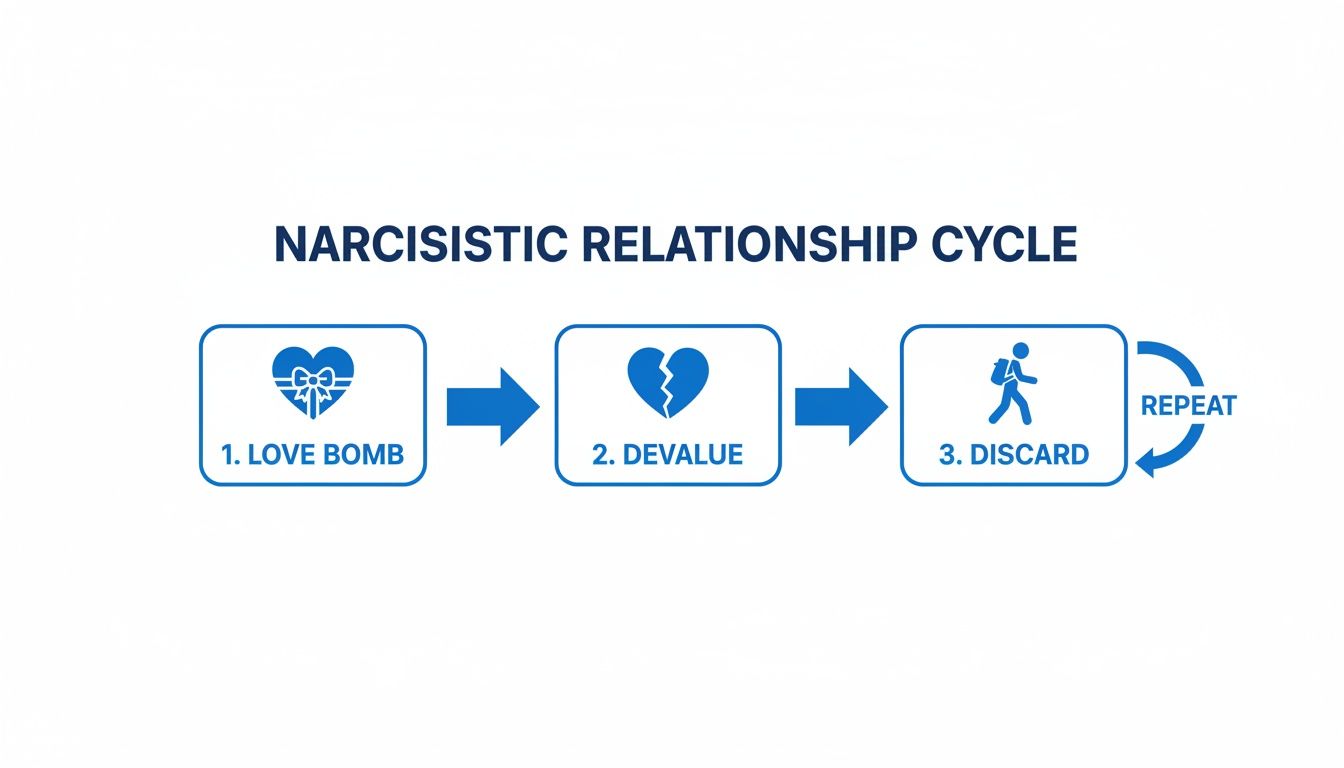
    This destructive pattern is often visualised as a cycle of love bombing, devaluing, and discarding.

    A diagram illustrating the narcissistic relationship cycle: love bomb, devalue, discard, and repeat.

    Seeing this laid out can help you realise that these behavioural shifts are part of a predictable pattern—they are not a reflection of your worth.

    From Anxiety to Burnout

    Over time, living in this heightened state of stress can lead to something deeper than just worry. Many people experience symptoms of depression, like a persistent low mood and a loss of interest in things they once loved. Your world can start to feel smaller.

    This prolonged emotional strain can eventually lead to complete burnout, a state of emotional, physical, and mental exhaustion. It might feel like you have nothing left to give—not to your partner, your work, or even yourself.

    In a relationship with a narcissist, your emotional needs may be consistently dismissed. This invalidation can chip away at your self-esteem and make you question your own perceptions of reality.

    This erosion of confidence is a significant blow to your overall well-being. It can even spill over into your professional life, increasing workplace stress and feeding a sense of inadequacy.

    Understanding the Impact as Trauma

    It can be helpful to view the effects of such a relationship through the lens of trauma. This is not about assigning a diagnosis but acknowledging that prolonged emotional distress is a genuinely traumatic experience. Your body and mind are having a normal reaction to an abnormal situation.

    Complex trauma can develop from the repeated emotional harm common in these relationships. Recognising these responses as trauma-related can be incredibly validating. It helps shift your perspective from, "What's wrong with me?" to, "What happened to me?" which is a powerful step toward self-compassion.

    Cultivating Resilience and Happiness

    Despite the immense challenges, remember your capacity for healing and resilience. Resilience is about integrating your experiences and growing stronger because of them. You can learn to rebuild your self-worth and find happiness again.

    This journey starts with small, intentional acts of self-care. It involves reconnecting with hobbies, friends, and activities that bring you joy. Every step you take to prioritise your own well-being is an act of reclaiming your life.

    Understanding Narcissistic Traits Versus NPD

    It's helpful to distinguish between someone showing narcissistic traits and someone who has Narcissistic Personality Disorder (NPD). The difference is like feeling sad versus experiencing clinical depression. This distinction helps in navigating the situation with clarity and empathy.

    Most of us can be selfish or crave attention at times, especially under stress, but these moments don't define a personality disorder. Human behaviour exists on a spectrum. This helps us avoid labels while still acknowledging the pain that a narcissist in relationships can cause.

    The Spectrum of Narcissism

    Think of narcissism as a continuum, with healthy self-esteem at one end and NPD at the other. NPD is a mental health condition defined by a pervasive pattern of grandiosity, a need for admiration, and a lack of empathy. Most people fall somewhere in the middle, occasionally showing traits like self-absorption.

    For example, a colleague under intense workplace stress might become unusually self-centred for a short period. While their behaviour might be hurtful, it is different from the destructive patterns of NPD that affect all aspects of a person's life.

    Disclaimer: It is important to remember that only a qualified mental health professional can make a formal diagnosis. This guide is informational and intended to empower you, not to serve as a diagnostic tool.

    Why the Distinction Matters for Your Healing

    Understanding this distinction is not about excusing hurtful behaviour but about protecting your mental health from anxiety and burnout. When you understand what you are dealing with, you can set realistic expectations. This clarity helps you focus on what you can control: your responses, boundaries, and path to resilience.

    This knowledge is the first step toward getting the right kind of help. Whether you are dealing with someone with strong narcissistic traits or someone who may have NPD, professional counselling can provide you with valuable tools. A therapist can help you develop coping mechanisms and rebuild your self-worth.

    Practical Strategies for Setting Boundaries and Coping

    A woman stands by an open door, bathed in warm morning sunlight, looking outside.

    Moving from understanding to action is a major step in reclaiming your life. Setting boundaries with a narcissist in relationships can feel intimidating but is essential for your well-being. The key is to start with small, manageable steps.

    These strategies are not about changing your partner but about changing how you interact with them. By creating emotional distance and setting clear limits, you can shield yourself from the constant impact of their behaviour. This process helps you manage the anxiety and stress these dynamics often create.

    Establishing Clear and Firm Boundaries

    The first step in setting a boundary is defining your limit and communicating it calmly and firmly. Using "I" statements helps you express your needs without starting a conflict. This approach focuses on what you will do, which is within your control.

    For instance, instead of saying, "You can't yell at me," try framing it as, "I am not willing to continue this conversation if you're yelling." Sticking to your boundary is crucial. Each time you enforce it, you reinforce its importance to both them and yourself.

    The Grey Rock Method

    When dealing with manipulation, the "Grey Rock Method" can be an effective technique. The goal is to become as uninteresting as a plain grey rock. This means keeping conversations short, factual, and emotionally neutral.

    A person with narcissistic traits often thrives on emotional reactions. By not providing that reaction, you become a less satisfying target. The Grey Rock Method is a powerful tool for disengaging and reducing the daily stress of the interactions.

    "Your healing cannot and should not be rushed. The depth of your pain reflects what you endured. Honour that by giving yourself permission to take all the time you need."

    This approach protects your inner peace by allowing you to opt out of their emotional chaos. It is a quiet act of resilience that conserves your energy for your own healing.

    Rebuilding Your Support System and Self-Worth

    Relationships with narcissistic partners can be isolating, which makes reconnecting with your support system vital. Reach out to trusted friends and family who see and value you. Rebuilding these connections is a powerful reminder of who you are outside the relationship.

    At the same time, consciously invest in things that bring you joy. This could be joining a class, reviving a hobby, or spending time in nature. These activities are concrete steps toward rebuilding the self-esteem that may have been eroded.

    Creating a Safety Plan

    If you ever feel emotionally or physically unsafe, creating a safety plan is the top priority. This is a practical and empowering step to ensure you are protected. A therapist or a domestic violence support service can be invaluable in this process.

    A safety plan might include identifying a safe person to call or a safe place to go. It could also involve keeping a small bag with essentials in a secure location. Taking these steps can help you regain a sense of control in a chaotic environment.

    How to Find the Right Professional Support

    Choosing to seek professional help is a profound act of self-care and strength. If you are constantly on edge, battling anxiety, or feel you’ve lost yourself, it may be time to talk to someone. These feelings are valid signals that you need support.

    In India, conversations around mental health are becoming more open, making it easier to seek help. Choosing therapy or counselling is a courageous move toward healing. It offers a safe space to process your experiences and develop tools for lasting resilience.

    When Is It Time to Seek Help?

    Knowing when to reach out is a personal decision, but some common signs include persistent self-doubt or a feeling of sadness you can't shake. If stress from your relationship is affecting other areas of your life, such as your work or friendships, that is another key indicator. Professional guidance may be helpful if you feel alone, anxious, or have lost touch with your own needs.

    Finding a therapist is not about admitting defeat; it’s about investing in your well-being and future happiness. A good counsellor can act as a guide, helping you find your way back to yourself.

    Finding a Therapist Who Understands

    When dealing with a narcissist in relationships, finding the right therapist is key. It is important to find someone experienced in narcissistic abuse, complex trauma, and difficult relationship dynamics. Not all therapists have this specialised training, so feel empowered to be selective.

    As you search, look for professionals who list these areas as specialities. Platforms like DeTalks can simplify this process by allowing you to filter therapists by their expertise. This helps ensure you connect with someone who understands the nuances of what you are facing.

    Disclaimer: Online psychological assessments are informational, not diagnostic. A formal diagnosis can only be provided by a qualified mental health professional, but these tools can offer valuable insights for your first therapy session.

    Questions to Ask a Potential Counsellor

    Before committing to sessions, it is a good idea to have an initial chat with a potential therapist. This is your chance to see if their approach feels right for you. You deserve to feel heard, respected, and comfortable.

    Here are a few questions you could ask:

    1. What is your experience working with clients who have been in relationships with narcissistic individuals?
    2. Which therapeutic approaches do you use for issues like complex trauma, anxiety, and rebuilding self-esteem?
    3. How do you create a safe and non-judgmental space for your clients?
    4. Can you explain how you help someone learn to set boundaries and build resilience?

    Healing is a journey, not a race, focused on rediscovering your strength and practicing self-compassion. The right professional support can provide a roadmap, guiding you toward a healthier, more peaceful life.

    Frequently Asked Questions

    When you are dealing with the effects of a narcissistic relationship, it is normal to have many questions. It's common for the same doubts and fears to surface repeatedly. Let’s walk through some of them to help you find more clarity.

    Can a Narcissist Change for Someone They Love?

    In theory, anyone can change, but for someone with deep-seated narcissistic patterns, it is a very difficult and rare process. Real, lasting change requires significant self-awareness and a strong commitment to long-term therapy. The desire for change must come from within them, not from external pressure.

    Am I to Blame for What Happened?

    No, you are not to blame. After experiencing gaslighting, it is natural to feel guilt or wonder if you could have done something differently. However, the manipulation and control tactics used by a narcissist are about their needs, not your worth or actions.

    Your reactions were normal for someone in a confusing and challenging situation. Feeling hurt, trying to fix things, or getting angry does not make you the problem. Practicing self-compassion is an important first step in healing.

    How Do I Heal After Leaving a Narcissistic Relationship?

    Healing is a gradual journey of returning to yourself and rebuilding your emotional well-being. The path often includes giving yourself permission to grieve, reconnecting with your support system, and creating emotional safety through boundaries. Working with a professional counsellor can help you process the experience and build resilience.

    This process is about rediscovering who you are and learning to trust yourself again. It is about moving toward a future where you can experience genuine happiness and peace.


    If you are struggling and need someone to talk to, DeTalks can connect you with therapists who understand narcissistic abuse. Start your healing journey by visiting https://detalks.com today.