
Tag: emotional maturity

  • Growing Up Meaning: Emotional Maturity Guide

    Growing Up Meaning: Emotional Maturity Guide

    You're replying to a family WhatsApp message about your future while switching between a job portal, an unfinished application, and a chat you haven't had the energy to answer. Everyone around you seems to know what growing up should look like, yet you're still wondering whether confusion means you're immature or whether adulthood has become harder to recognise.

    That question matters in India, where education, work, family expectations, relationships, and independence often arrive together. Growing up isn't a verdict on your character. It's a gradual process of learning how to understand yourself, handle responsibility, relate to others, and ask for support without losing your compassion.

    A Moment Most Young Adults in India Will Recognise

    At 24, you may have a degree, a salary, and a growing list of responsibilities, but still feel uncertain about your direction. Perhaps you're living in Bengaluru, Pune, Delhi, or another busy city because your work requires it, while your family expects regular updates about marriage, savings, promotions, or moving back home.

    One message asks when you'll visit. Another asks whether you've considered a more “stable” career. Your manager wants the presentation revised, your friends are sharing engagement photographs, and you're comparing your life with everyone else's. You can make sensible decisions at work and still feel like a child during a difficult call with a parent.

    That contradiction doesn't mean you haven't grown up. It means adult life contains several kinds of maturity, and they don't develop at the same pace. You might be financially responsible but struggle to name your feelings. You might be emotionally thoughtful but unsure how to choose a career. You might support everyone else while avoiding your own need for therapy or counselling.

    India's youth population makes this personal question a major social reality. A UNFPA India profile using Census 2011 data reports 253.2 million adolescents aged 10–19, representing 20.9% of the population. The same source reports that the youth population aged 15–24 grew by 22.1% over the preceding decade.

    So, when people ask about the growing up meaning, they may be asking much more than a dictionary question. They may be asking how to become independent without rejecting family, ambitious without burning out, and emotionally strong without becoming numb.

    This guide treats growing up as a process, not a finish line. You don't need to have every answer to be moving forward.

    What Growing Up Really Means Beyond Age

    Growing up means moving through a layered transition. Your body changes, your emotional world becomes more complex, your sense of identity develops, and your social roles expand. These layers overlap, but they don't always progress together.

    In Indian educational and academic contexts, adolescence is generally understood as the period from roughly 10 to 19 years, a time of rapid physical, emotional, and behavioural change. The NCERT-related course material on childhood and growing up presents this period as a movement from childhood dependence towards greater autonomy.

    A diagram illustrating the four dimensions of growing up: biology, emotion, identity, and social roles.

    Four layers of the transition

    Biology includes puberty, energy changes, sleep patterns, and physical development. These changes can affect confidence, concentration, and comfort in your own body.

    Emotion involves learning to recognise feelings, tolerate disappointment, and recover after conflict. A mature person still feels anger, fear, jealousy, and sadness. They gradually learn what those emotions are communicating and how to respond without harming themselves or someone else.

    Identity concerns the questions beneath everyday choices. What matters to you? Which beliefs are yours, and which have you inherited? What kind of work, relationship, or life feels meaningful?

    Social roles change as you become a student, employee, partner, caregiver, friend, or family decision-maker. In India, these roles can be closely connected to family duty and community expectations, which may make independence feel emotionally complicated.

    A useful definition is this: growing up is learning to make increasingly conscious choices while accepting that uncertainty remains. It's less like reaching the final floor of a building and more like learning to move through a building whose layout keeps changing.

    That's why a 19-year-old and a 29-year-old can both be growing up. Age provides context, but maturity shows in how you handle responsibility, relationships, emotions, and change.

    The Three Pillars of Emotional Maturity

    A young professional in Bengaluru ends a call with her parents after hearing questions about salary, marriage, and “settling down.” She feels shame, anger, and fear together, then notices the urge to withdraw. Emotional maturity gives her a pause before that urge becomes a decision. It also recognises the mental-health cost of carrying career pressure, family expectations, and delayed independence while appearing capable.

    A focused young woman writing in a journal at a desk while others chat in the background.

    Self-awareness

    Self-awareness means noticing what is happening inside you before a feeling turns into an automatic reaction. She might pause and say, “I'm feeling overwhelmed. I'll talk about this after I've had time to think.” Naming the feeling can make the next choice clearer.

    That pause creates space between an emotional trigger and a decision. It may also show that exhaustion, fear of disappointing family, or uncertainty about work is shaping the reaction.

    Responsibility

    Responsibility means accepting your part without turning one mistake into a judgement about your entire personality. A college student who misses a deadline can acknowledge it, communicate with the teacher, and make a plan to repair the situation.

    It includes recognising limits. You can care about your family without keeping every member happy, preventing every conflict, or carrying every task at work. Asking for support can be part of responsible problem-solving.

    Healthy relationships

    Healthy relationships make room for honesty, disagreement, and repair. A couple may argue about money, relocation, or family involvement. Maturity helps them stay engaged, speak without humiliation, and return to the conversation after emotions settle.

    Emotional maturity involves understanding your feelings and choosing actions that reflect your values, even when strong emotions are present.

    Look for small behaviours rather than dramatic proof. You listen before defending yourself, apologise without adding excuses, keep agreements, communicate when plans change, and ask for help before a problem becomes unmanageable. You also allow other adults to feel disappointed or uncomfortable without treating those feelings as your personal failure.

    Key Stages from Adolescence to Emerging Adulthood

    Growing up rarely follows the neat sequence that families track. A student may perform well academically but feel unsure of their identity. A working adult may manage rent and deadlines yet still be learning how to communicate in close relationships.

    The broad developmental stages below offer orientation, not a test.

    Early adolescence from 10 to 14

    A class 8 student may be navigating exam pressure, changing friendships, body-related self-consciousness, and a stronger wish for privacy. Parents may still see a child, while the young person feels increasingly aware of peer approval and personal choice.

    At this stage, emotional reactions can feel immediate and intense. Support often works best when adults offer structure without dismissing the young person's experience.

    Middle adolescence from 15 to 17

    A class 11 student may begin negotiating subjects, friendships, appearance, technology use, and future plans. Questions about identity become more visible, especially when family expectations seem to point in one direction and personal interests point in another.

    Maturity here doesn't mean making a final career decision. It may mean learning how to discuss uncertainty respectfully and gather information before choosing.

    Late adolescence from 18 to 19

    College, entrance exams, relocation, and new social freedom can arrive together. A young person may be legally closer to adulthood while still relying on family for money, housing, transport, or emotional security.

    This period often involves learning to tolerate ambiguity. You may not know whether a course, city, friendship, or relationship will suit you, and that uncertainty can be part of healthy development.

    Emerging adulthood from 20 to 29

    A working professional may be changing jobs, building skills, managing unstable plans, or deciding what commitment means in relationships. Families may focus on graduation, the first job, or marriage, while the person is trying to form a stable identity and a sustainable life.

    A diagram outlining the developmental stages from early adolescence to emerging adulthood with descriptive milestones for each age.

    These stages aren't rigid boxes. Someone can be confident at work and uncertain in love, independent financially and dependent emotionally, or highly reflective while still learning practical skills. Being “behind” in one area doesn't mean you've failed to grow up.

    Myths That Keep Young Indians Stuck

    Myth one, grown-ups never feel lost. Many young Indians move from school to higher education, employment, relocation, and family decisions without much space to process the changes. Feeling uncertain doesn't prove immaturity. It may show that you're taking a meaningful decision seriously.

    Myth two, financial independence is the only proof of maturity. Earning money matters, but it's only one part of adult functioning. A person can have a salary and still avoid accountability, mistreat a partner, or ignore their health. Another person may be temporarily dependent on family while showing honesty, responsibility, and emotional awareness.

    Myth three, asking for help is weakness. The National Mental Health Survey of India reported adolescent morbidity at 7.3%, with higher prevalence in urban metro areas. That finding supports an India-first approach in which school environment, social connection, academic pressure, and access to support deserve attention.

    Myth four, grown-ups shouldn't cry. Emotional control doesn't require emotional silence. The 2025 well-being study reported that 43% of Indian young adults aged 18–34 were in the “Distressed” or “Struggling” categories, compared with 12% among those aged 55 and above, as reported by the Times of India.

    Maturity doesn't mean carrying everything alone. It means knowing what you can carry, what you can change, and when support is sensible.

    For a wider discussion of assumptions that can prevent people from seeking care, explore this practical guide to dispelling mental health myths. Replacing shame with accurate information is itself a form of growing up.

    Practical Strategies to Support Healthy Growth

    Healthy growth doesn't require an expensive routine or a complete life overhaul. Small, repeatable actions can strengthen resilience, emotional clarity, and everyday well-being.

    Name what you feel

    Use ordinary language. “I'm disappointed,” “I'm anxious about the meeting,” or “I feel pressured by this conversation” is more useful than saying you're “bad at coping.”

    A college student in Delhi might write down the emotion, the situation that triggered it, and the response they're considering. This creates a little distance from the feeling without denying it.

    Model responsibility

    If a younger sibling forgets an assignment, help them think through the next step instead of calling them lazy. If you miss a task at work, acknowledge it, explain the repair plan, and avoid a long self-attack.

    Responsibility grows when people see accountability paired with compassion.

    Practise reflection

    A short journal entry can help you notice patterns. Ask yourself what drained you, what restored you, what boundary you avoided, and what one action would make tomorrow easier.

    Reflection isn't endless analysis. It's a way to turn experience into learning.

    Set boundaries

    A boundary might sound like, “I can discuss this after dinner,” or “I need a minute before I respond to that feedback.” In a demanding workplace, it may mean clarifying priorities with a manager instead of accepting every urgent request.

    Boundaries can feel uncomfortable in close families, but clear communication is kinder than repeated resentment.

    Celebrate small wins

    Notice evidence of progress that no one else sees. You replied to a difficult email, attended class after a poor night's sleep, took a break before reacting, or asked a friend for support.

    For additional ideas on self-help and emotional support, you can browse mental health resources from Wald Behavioral Health. Choose suggestions that fit your circumstances rather than treating every routine as a rule.

    A graphic titled Practical Strategies to Support Healthy Growth listing five key points for personal development.

    Try three actions this week: name one difficult emotion, have one honest conversation, and protect one period of rest. Friends, mentors, teachers, and trusted colleagues can also provide perspective, especially during adolescence, when peer support can protect well-being.

    When Growing Up Starts to Feel Like Burnout

    A young professional returns to Bengaluru after college, spends hours commuting, answers messages late into the evening, and hears repeated questions about promotions, marriage, or financial independence. By bedtime, sleep feels difficult, yet exhaustion is treated as proof of responsibility.

    Relocation, new workplace cultures, money worries, family expectations, and uncertainty about a career direction can arrive together. Anxiety, poor sleep, irritability, or emotional numbness may signal that the way you are working needs attention.

    Healthy challenge usually includes effort, recovery, learning, and some sense of meaning. Burnout-like depletion can bring persistent cynicism, poor concentration, detachment, and the feeling that rest never restores you. A person may still attend meetings and meet family obligations while running on empty.

    Workplace findings show why this strain deserves attention. A Deloitte survey of corporate India found that 47% identified workplace-related stress as a main stressor, while 55% reported emotional exhaustion or burnout, 49% reported anxiety, and 59% reported depression. A 2024 Aon report on India reported that 43% of employees felt unsettled and nervous, while 60% felt more sensitive to stress than the previous year.

    Workplace stress signals among Indian employees

    Indicator Reported share Source
    Workplace-related stress as a main stressor 47% Deloitte corporate India survey
    Emotional exhaustion or burnout 55% Deloitte corporate India survey
    Feeling more sensitive to stress than the previous year 60% Aon India report

    A separate Indian Journal of Psychiatry report involving urban white-collar employees found nearly 29% with moderate-to-severe signs of depression, 55% with moderate-to-severe signs of anxiety, and 78% with moderate-to-high stress. Around 99% still reported moderate-to-high psychological well-being, showing that distress and resilience can exist together.

    Start with practical changes rather than blaming your personality. Discuss workload priorities, take genuine breaks, protect sleep where possible, and seek counselling if anxiety or depression interferes with daily functioning. This guide to evidence-backed burnout prevention strategies offers structured ways to examine work patterns without treating burnout as a personal failure.

    When to Seek Support and How DeTalks Can Help

    Transition stress often appears during exams, relocation, career decisions, relationship changes, or family conflict. Support becomes important when low mood, disrupted sleep, intense anxiety, loss of interest, hopelessness, or trouble functioning lasts for more than two weeks, worsens, or affects work, study, relationships, or safety.

    You do not have to wait for a crisis. Therapy or counselling can help you recognise recurring patterns, practise emotional regulation, process grief or conflict, and build resilience. Seeking help is a responsible way to respond to strain.

    Mental-health assessments can provide information about symptoms, personality, coping, or resilience, but they are informational and not diagnostic. The National Mental Health Survey 2 covers adults aged 18 and above and adolescents aged 13–17 across India, including screening areas such as anxiety disorders, mood disorders, and substance use disorders. A result should begin a conversation with a qualified professional, rather than become a label or self-diagnosis.

    Practical compassion matters too. Cost, stigma, family concerns, and limited local services may make support difficult. Confidential online options, trusted adults, college services, employee assistance programmes, or a gradual conversation with someone safe can make help more accessible. Resilience and support can exist together.

    The clearest growing up meaning combines self-care with accountability. You learn to care for yourself while considering how your choices affect others. Rest, honesty, friendship, joy, therapy when needed, and patience all belong in that process. Maturity develops at different speeds, especially when career pressure, family expectations, and delayed independence weigh heavily.

    DeTalks can help you explore confidential assessments, find qualified therapists and counsellors across India, and access resources for anxiety, depression, workplace stress, relationships, resilience, and well-being. Visit DeTalks to understand yourself and choose support that fits your journey.

  • What is Maturity in Life? Signs, Growth, and Practical Steps

    What is Maturity in Life? Signs, Growth, and Practical Steps

    What is maturity in life, really? At its heart, maturity is the ability to respond to life's challenges with wisdom and self-control, rather than just reacting on impulse. It’s far less about your age and much more about your capacity for understanding, resilience, and compassion.

    Moving Beyond Age to Understand True Maturity

    In many cultures, including in India, we often link age with maturity. While life experience certainly helps build wisdom, your chronological age doesn't automatically grant you emotional or psychological maturity.

    You might know a young person who handles pressure with incredible calm, and you may also know someone older who struggles with impulsive reactions. True maturity is a continuous journey of personal growth, not a destination you reach on a specific birthday.

    "Maturity is a life increasingly shaped by the Holy Spirit, increasingly surrendered to Jesus, increasingly aligned with the Scriptures, and increasingly oriented toward love for God and neighbour. It is not perfection. It is not personality. And it is certainly not self-proclaimed. It is grace made visible."

    It’s easy to confuse the two, but age and maturity are fundamentally different concepts. Let's explore some of these common misconceptions.

    Maturity vs Age: A Quick Comparison

    Characteristic Sign of Age (Chronological) Sign of Maturity (Psychological)
    Response to Conflict Blames others, avoids responsibility. Takes accountability, seeks resolution.
    Decision-Making Acts on impulse or peer pressure. Thinks critically, considers consequences.
    Emotional Regulation Has frequent, uncontrolled outbursts. Acknowledges feelings, manages them constructively.
    View of Learning Believes they know everything already. Remains curious and open to new ideas.
    Relationships Depends on others for happiness. Builds interdependent, mutually supportive bonds.

    As you can see, simply getting older doesn't guarantee the development of these mature traits. It requires conscious effort and a commitment to your own personal well-being.

    The Journey of Personal Growth

    Understanding what maturity is in life involves seeing it as an ongoing process. It’s about building a stronger internal foundation to handle external pressures, from managing workplace stress to navigating complex family dynamics.

    This journey helps you view challenges like anxiety or burnout not as personal failings, but as opportunities to grow. A key part of this is becoming a self-directed learner—someone who actively takes charge of their own development and well-being.

    Core Areas of Mature Development

    To make this journey feel more approachable, we can break maturity down into a few core areas. Each one builds on the others, creating a solid foundation for your overall well-being.

    • Emotional Growth: Learning to understand and manage your feelings without letting them control you.
    • Cognitive Growth: Developing your ability to think critically and see things from different perspectives.
    • Social Growth: Building healthy, supportive, and meaningful relationships with others.

    Focusing on these areas helps you shift from simply reacting to life to responding with intention and grace. This process is central to improving your well-being and is often a focus in supportive settings like therapy and counselling.

    The Four Pillars of Personal Maturity

    So, what does maturity look like in practice? It helps to think of it as a sturdy structure built on four interconnected pillars. These aren't separate skills but different facets of a balanced self, creating a solid foundation for your resilience and overall well-being.

    Framing it this way helps us move beyond vague ideas and into the real world. These pillars guide us in building healthier relationships, so we can navigate life’s ups and downs with more confidence and grace.

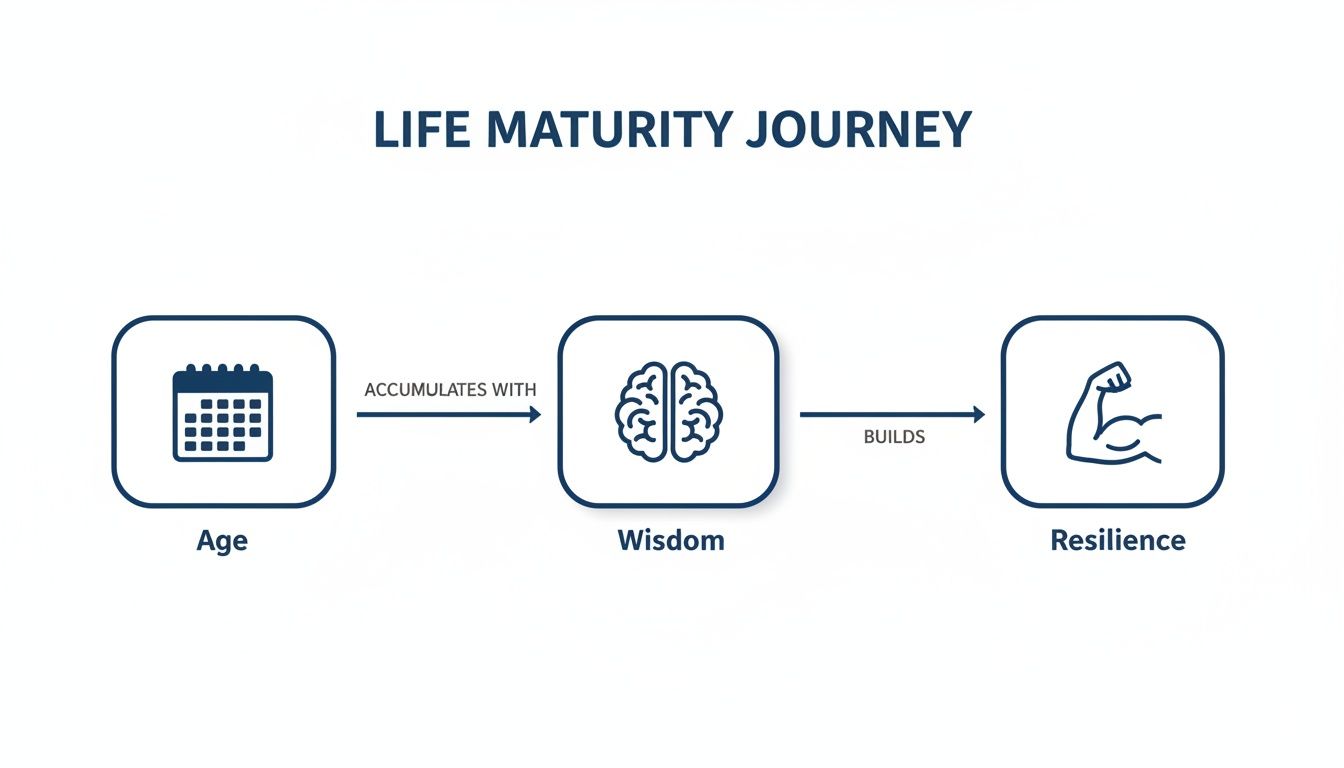
    This visual map shows how age provides experience. When we reflect on that experience, it transforms into wisdom, and wisdom is what builds true resilience.

    A diagram illustrating the Life Maturity Journey: Age accumulates with Wisdom, which builds Resilience.

    It’s a powerful reminder that maturity isn’t automatic. It’s a deliberate process of turning life’s lessons into inner strength.

    Emotional Maturity: Managing Feelings with Grace

    Emotional maturity is your ability to understand and manage feelings constructively. It isn't about suppressing what you feel, but acknowledging your emotions without letting them hijack your behaviour. You can feel anger without lashing out, or experience sadness without getting lost in despair.

    Think about workplace stress. An emotionally mature person might feel overwhelmed but will take practical steps to address the cause, building resilience and managing feelings of anxiety.

    Cognitive Maturity: Thinking Critically and Flexibly

    Cognitive maturity is about how you think. It’s marked by your capacity for critical thought, your willingness to consider different perspectives, and your ability to adapt your mindset when you learn something new.

    Someone with cognitive maturity can hear an opposing viewpoint without getting defensive. In a family disagreement, for example, they can appreciate a relative’s traditional values even if they don't share them, contributing to better well-being.

    A key sign of maturity is recognising that you don’t have all the answers. It’s the humility to listen, the curiosity to learn, and the wisdom to understand that every person you meet knows something you don’t.

    This openness to learning and seeing beyond your own perspective is a true cornerstone of growth.

    Social Maturity: Building Healthy Relationships

    This pillar governs how you connect with others. Social maturity is the art of building meaningful, interdependent relationships based on empathy, clear communication, and healthy boundaries.

    A socially mature person invests in relationships built on mutual trust and respect. Developing these skills is often a major focus in counselling because they are essential for a fulfilling social life and deep compassion for others.

    Key ingredients of social maturity include:

    • Active Listening: Truly hearing what someone is saying, not just waiting for your turn to talk.
    • Empathy: The ability to step into someone else's shoes and understand their feelings.
    • Boundary Setting: Respectfully communicating your limits to protect your own energy and well-being.

    Mastering these skills helps you avoid the burnout that can come from unhealthy relationship dynamics.

    Moral Maturity: Acting with Integrity

    The final pillar, moral maturity, is your internal compass. It's about living in alignment with your personal values and principles, guiding your decisions with honesty and compassion.

    A simple example is admitting a mistake at work and taking responsibility, instead of letting a colleague take the blame. This integrity builds self-respect and earns the trust of others, helping to steer clear of the internal conflict that can fuel challenges like depression and anxiety.

    Ultimately, mastering these four pillars isn't about reaching perfection. It's about committing to a lifelong journey of self-awareness and growth, a journey that therapy can wonderfully support.

    Recognising the Signs of Maturity in Daily Life

    How do these qualities show up in the real world? Maturity isn't a single event but the sum of countless small, conscious choices we make every day.

    You see it in the way someone handles a tense conversation, reacts to a setback, or owns up to a mistake. Let's look at a few concrete examples of what maturity looks like in action.

    A man and woman sit on opposite sides of a coffee table, having a thoughtful conversation.

    Taking Ownership Instead of Placing Blame

    Imagine making a mistake on a team project at work. An immature reaction is to point fingers, blaming a confusing email or a colleague.

    A mature person takes a different route. They acknowledge their part in the error and pivot to finding a solution, which helps reduce workplace stress and builds trust.

    Maturity is the ability to reap without apology and not complain when things don't go well. It's the wisdom to know that while you can't control every outcome, you can always control your response.

    This shift from blame to responsibility is a powerful sign of growth and strengthens your resilience.

    Setting Boundaries with Compassion

    In many Indian families, managing the expectations of loved ones can be a common challenge. Quietly agreeing to things you're not comfortable with can lead to anxiety or burnout.

    Social maturity shines here. It’s the skill of setting a firm but respectful boundary, like saying, “I appreciate you caring, but this is a decision I need to make for myself.” You honour their feelings while protecting your own peace.

    Delaying Gratification for Long-Term Goals

    Think about receiving a yearly bonus. The temptation is to splurge, but the mature choice might be to invest it toward a bigger, long-term goal.

    This skill, known as delaying gratification, is essential for building the life you want. It involves:

    • Future-Oriented Thinking: Picturing a future goal that outweighs immediate pleasure.
    • Impulse Control: Managing the urge to act on a whim.
    • Discipline: Making choices that align with your long-term goals.

    This ability to prioritise your future well-being over a fleeting moment is a cornerstone of a stable, purposeful life. Professional counselling can offer valuable strategies to help you navigate this, an important consideration when you discover more insights about mental wellness in India and understand the broader picture.

    Practical Steps to Cultivate Greater Maturity

    Knowing what maturity is in theory is one thing, but living it is a lifelong journey. It's about weaving small, intentional practices into your daily life that build emotional strength and self-awareness.

    Think of these strategies as sustainable habits that support your long-term well-being. They are foundational skills you might build with the support of good therapy or counselling.

    A bright desk scene featuring an open notebook, pen, plant, headphones, and a 'mindfulness' card.

    Practice Mindfulness and Self-Regulation

    Mindfulness is the simple act of paying attention to the present moment without judgment. When you feel workplace stress or a wave of anxiety, this practice creates a crucial gap between feeling an emotion and reacting to it.

    You can start with just five minutes a day. Focus on your breath or notice the sounds around you. This simple act trains your brain to stay steady under pressure, giving you space to choose a thoughtful response.

    The greatest weapon against stress is our ability to choose one thought over another. By practising mindfulness, you are not stopping your thoughts, but rather learning to observe them without letting them take control.

    This technique is a cornerstone for building genuine emotional resilience.

    Embrace Journaling for Self-Discovery

    A journal can be a powerful tool for getting to know your own mind. It’s a safe space to untangle thoughts, process feelings, and see patterns in your behaviour.

    To get started, try these simple prompts:

    • What situation today triggered a strong emotional reaction in me?
    • When did I act in a way I was proud of?
    • What is one thing I am worried about, and what is one small step I can take?

    Journaling helps you start breaking the cycle of self-defeating behaviors that might be holding you back. It is often the first step in identifying patterns and tackling challenges like depression.

    Develop Your Active Listening Skills

    A huge part of maturity shows up in how we connect with others. Active listening is about truly understanding the emotion and intention behind someone's words, which can transform your relationships.

    To practice, focus entirely on the person speaking and resist planning your reply. When they finish, summarize what you heard. This simple act can make others feel genuinely seen and understood.

    This skill is invaluable everywhere, strengthening your social maturity and contributing to your overall well-being.

    When to Seek Support on Your Growth Journey

    The path to maturity is personal, but you never have to walk it alone. Deciding to get support is a sign of strength, showing you have the self-awareness and courage to invest in your well-being.

    Sometimes, challenges like persistent sadness, overwhelming anxiety, or chronic workplace stress feel too heavy to carry on your own. When these feelings interfere with your daily life, reaching out is a powerful, proactive step.

    Making Professional Guidance Normal

    In India, conversations around mental health are opening up, but some hesitation remains. It's important to reframe therapy and counselling not as a last resort, but as a vital partnership in your personal growth.

    A therapist provides a safe, confidential, and non-judgmental space to equip you with practical tools. This professional support helps you build resilience, navigate tough emotions, and create healthier ways of coping.

    Acknowledging you need support is a profound act of self-compassion. It's the moment you decide your well-being is a priority worth investing in, a decision that paves the way for genuine, lasting growth.

    Seeking help is a conscious choice for a better future, a key part of the journey to happiness.

    How Assessments Can Help Light the Way

    To get a clearer sense of where you stand, psychological assessments can offer valuable insights. Scientifically validated assessments can give you a snapshot of your emotional and psychological landscape, highlighting strengths and patterns.

    It is critical to clarify: assessments are informational, not diagnostic. They are a starting point for self-discovery and can point you toward the right support, but they are not a substitute for a professional evaluation.

    • For Self-Understanding: Get clarity on your emotional patterns and resilience.
    • To Guide Your Search: Help you find a therapist who specializes in areas like anxiety or depression.
    • To Track Progress: Offer a way to measure your growth over time.

    Supportive Takeaways for Your Journey

    Deciding to seek support is a significant step, so be kind to yourself. The goal isn't a quick fix but a sustainable path toward greater self-awareness and emotional balance.

    Remember, building maturity is a lifelong process of learning and evolving. Professional support can offer the structure and guidance to make that journey feel less overwhelming, as recognized in government reports on mental healthcare initiatives in India.

    Got Questions About Maturity? Let's Talk.

    When you start digging into what maturity means, it’s natural for questions to pop up. Seeking clarity is a huge part of the process. We’ve pulled together some of the most common questions to give you straightforward, supportive answers.

    This is a quick guide to some of the trickier spots on the map of personal growth. It is framed with an India-first context but is globally relatable.

    Can a Person Be Mature at a Young Age?

    Absolutely. Maturity isn't tied to your birthday but to your emotional and psychological development. A young person who can manage their emotions, own their mistakes, and empathize with others is showing a high level of maturity.

    Everyone's path is unique. Some people develop a strong sense of self and emotional control earlier in life, reminding us that wisdom isn't tied to age.

    Is Being Emotional a Sign of Immaturity?

    Not at all; it's the other way around. Being emotional is part of being human, and recognizing your feelings is a sign of self-awareness and a cornerstone of maturity.

    Emotional maturity is not about bottling up feelings. It's about understanding why you feel a certain way, expressing those feelings healthily, and building resilience.

    How Can Therapy Help Me Become More Mature?

    Therapy creates a confidential, judgment-free space to explore your patterns of thought and behaviour. A good counsellor helps you build self-awareness and find better ways to handle life’s challenges, from workplace stress to anxiety.

    Through this supportive relationship, you can learn to manage emotions and see old problems in a new light. This guided self-discovery boosts your overall well-being and helps you move through life with more confidence.

    Maturity isn't about having all the answers. It's about having the courage to ask the right questions and the wisdom to seek support when you need it. Professional counselling can be a powerful space for this exploration.

    What Is the Difference Between Maturity and Independence?

    This is a great question. Independence is about being self-sufficient—paying your bills and solving your own problems. Maturity, however, is a much bigger picture.

    Maturity includes the wisdom to know when you shouldn't go it alone. A mature person understands that we all rely on each other and that asking for help is a sign of strength, not weakness.


    At DeTalks, we believe everyone deserves support on their journey toward personal growth and well-being. Whether you're navigating challenges like anxiety or depression, or simply seeking to build greater resilience and self-awareness, our platform connects you with qualified professionals who can help. Explore our directory of therapists and our science-backed assessments to take the next step in your journey today. Learn more and find the right support for you at DeTalks.