
Tag: family therapy

  • Relationship Issues Therapy: What to Expect

    Relationship Issues Therapy: What to Expect

    You care about your partner, yet conversations that once felt easy now become tense, brief, or strangely practical. You may discuss meals, bills, and schedules while avoiding the hurt underneath. Perhaps you're both tired, anxious, or burned out, and neither of you knows how to reconnect without starting another argument.

    Relationship issues therapy offers a structured place to understand these patterns. It isn't only for couples facing separation. It can also support emotional well-being, communication, resilience, and mutual understanding before resentment takes firm root.

    Understanding the Need for Relationship Support

    A couple might sit on the same sofa every evening but feel miles apart. One partner asks, “What's wrong?” The other says, “Nothing,” because explaining the hurt feels harder than staying silent. Both may still care, but repeated misunderstandings have made closeness feel unsafe or exhausting.

    A couple sitting on a couch, experiencing relationship issues while sitting apart and looking distressed.

    This doesn't automatically mean the relationship is failing. Relationships are living connections. They need attention, repair, and adjustment as people manage work, family expectations, health concerns, money, parenting, and major life decisions. A disagreement can be normal, while a repeated cycle of criticism, defensiveness, withdrawal, and loneliness may need guided support.

    Therapy creates a bridge between intention and action. You may both want to listen better, but good intentions often disappear when one person feels rejected and the other feels blamed. A therapist slows the conversation down, helps each partner name the underlying emotion, and supports a safer response.

    Counselling is not an admission of failure

    Many people in India still associate counselling with severe crisis or personal weakness. That view is changing. An analysis of more than 100,000 calls to the Mpower helpline found that relationship issues were the leading concern, accounting for 33% of calls, ahead of anxiety at 23%, depression at 20%, stress at 16%, and psychiatric disorders at 8%. The same analysis found that 74% of callers were aged 18–40, a period often shaped by dating, marriage decisions, family planning, and changing responsibilities. India-specific helpline analysis of relationship concerns

    Seeking help early can be a thoughtful act of care. If you're looking for a geographically specific service, a directory such as find couples therapy in Arizona may help you explore local options and understand what couples support can involve.

    Therapy doesn't decide who's right. It helps people understand what happens between them, take responsibility for their part, and decide what kind of relationship they want to build.

    The Shift Toward Preventive Counselling

    Relationship counselling is increasingly moving beyond the idea that couples should wait until a crisis forces them into a therapist's room. Many people now seek support while they're still deciding whether to marry, adjusting to a new stage of commitment, or trying to strengthen communication before conflict becomes entrenched.

    India offers a clear example of this shift. In a 2025 report, the emotional-wellness platform YourDOST said sessions booked by unmarried couples rose 20-fold between FY2023 and FY2025. Bookings by unmarried or pre-marital couples grew by 1,034% in FY2023–24 and by another 103% in FY2024–25, with the 19–25 age group leading the trend. Indian relationship support trend report
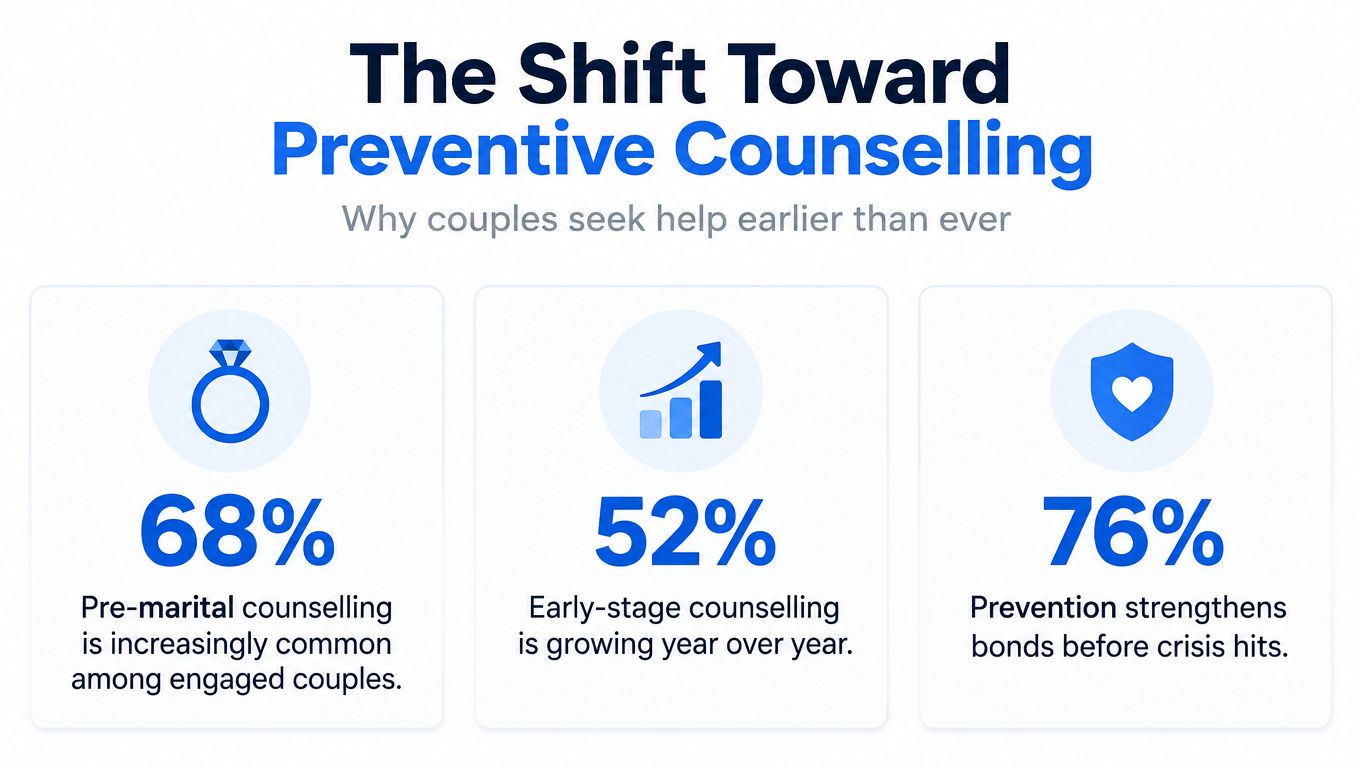
    An infographic titled The Shift Toward Preventive Counselling showing statistics on why couples seek therapy early.

    Independent reporting has also noted that more than 40% of Indian couples in therapy used it preventively, seeking to improve communication and intimacy before serious problems developed. The coverage of changing relationship therapy patterns in India also reported that the National Commission for Women announced 21 pre-marital counselling centres across nine states.

    What preventive work can look like

    Pre-marital counselling isn't a test that determines whether two people should marry. It's a guided conversation about expectations that couples may otherwise avoid until pressure builds.

    A therapist might help partners discuss:

    • Conflict habits: Do you pursue a conversation while your partner needs space, or do you both avoid difficult topics?
    • Family boundaries: How will you respond to expectations from parents, relatives, or wider community networks?
    • Money and responsibilities: What does fairness mean when incomes, work hours, or household duties differ?
    • Intimacy and affection: How do you express closeness, and how do you respond when needs don't match?
    • Future decisions: How will you approach children, relocation, careers, faith, or caring for ageing family members?

    Preventive counselling builds emotional intelligence, because partners learn to recognise feelings before those feelings become accusations. It also strengthens resilience. A couple that can repair after disagreement is better prepared for stress, grief, illness, or unexpected change.

    The aim isn't to create a conflict-free relationship. It's to help both people develop enough honesty, compassion, and practical skill to handle conflict without losing respect.

    Recognizing When to Seek Professional Help

    You don't have to wait for a dramatic event before seeking support. Relationship distress often appears in quieter ways first. You may notice that you're lonely despite being together, that small misunderstandings repeat, or that you're carefully choosing words to avoid another argument.
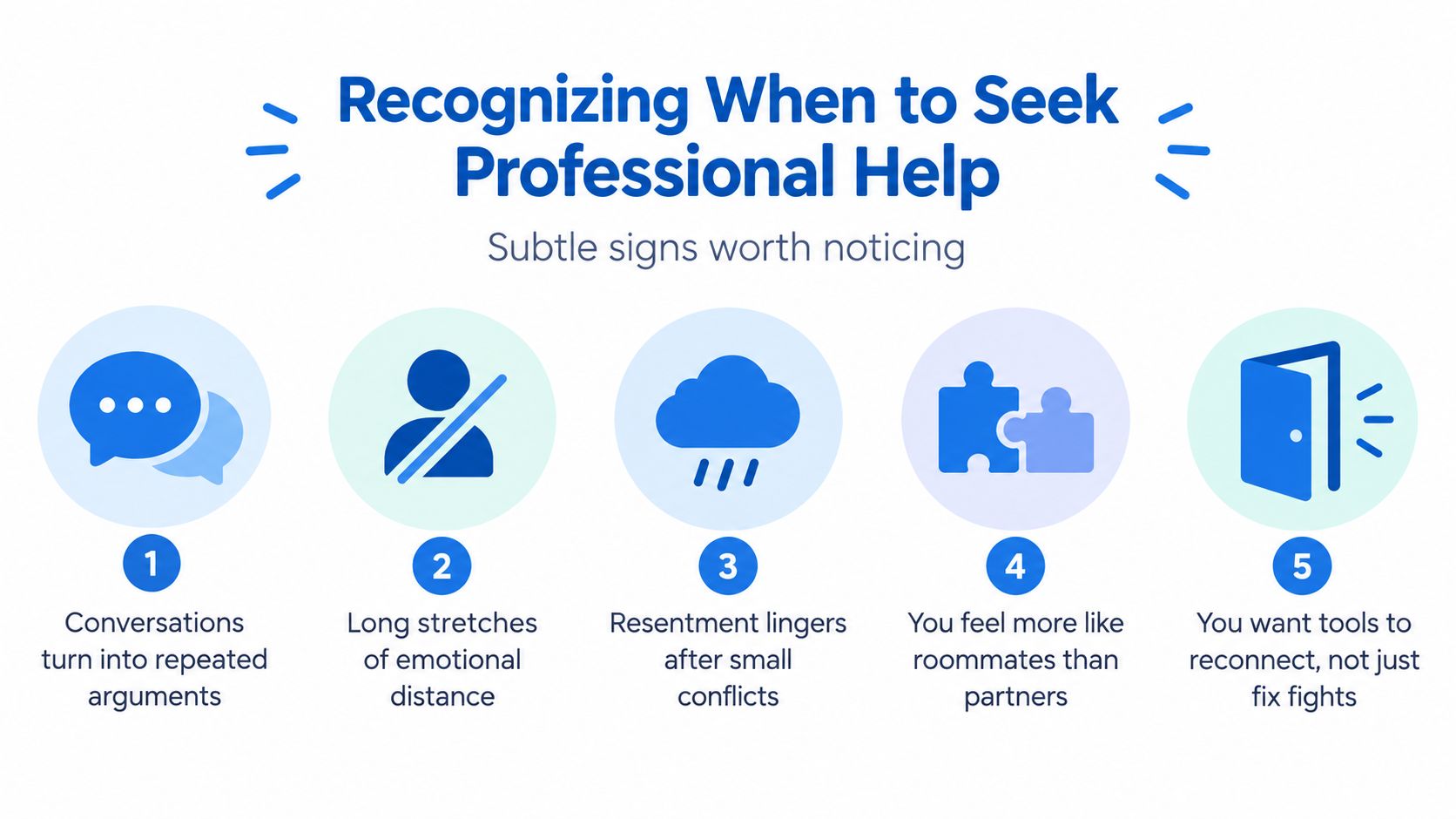
    An infographic showing five signs of relationship issues that indicate it is time to seek professional therapy.

    Notice the pattern, not just the latest argument

    One difficult week doesn't necessarily indicate a serious problem. Look instead at what keeps happening and whether you can repair it without outside help.

    Consider professional support when:

    • Conversations become predictable battles: You have the same disagreement repeatedly, but neither person feels heard or understood.
    • Silence replaces connection: One or both partners withdraw for long periods, share little emotionally, or avoid meaningful time together.
    • Resentment survives every apology: You may say sorry, yet the original wound remains active and influences future conflicts.
    • The partnership feels more practical than personal: You coordinate tasks successfully but no longer feel like companions.
    • You want tools, not blame: You're tired of proving who caused the problem and want to learn how to respond differently.

    Individual well-being also affects relational well-being. Anxiety can make reassurance feel urgent, while depression may reduce energy for affection, communication, or shared activities. Workplace stress and burnout can make a normally patient person irritable or emotionally unavailable. These experiences deserve support in their own right, and they shouldn't be used to label either partner as the problem.

    Look beneath repeated conflict

    Some arguments are really about an older injury. A partner may react strongly to a delayed reply because it awakens a fear of abandonment. Another may shut down after criticism because earlier experiences taught them that emotional openness leads to rejection.

    Indian therapists have described attachment injuries linked to betrayal, chronic invalidation, and emotionally unavailable responses. These injuries can keep conflict active even when a couple learns basic problem-solving skills. Clinical discussion of attachment injuries and marital distress in India

    An assessment can help organise what you're experiencing, but it's informational, not diagnostic. If you want a private starting point for understanding your mental-health needs, you might explore a private assessment with XO clinicians. A qualified professional can explain what the results mean and whether counselling, therapy, coaching, or another form of care is appropriate.

    If there is violence, coercion, intimidation, or fear for your safety, joint therapy may not be suitable. Prioritise individual support and safety planning with a qualified professional.

    Choosing the Right Therapy Format

    The right format depends on the relationship, the concern, and each person's readiness. Couples therapy isn't automatically better than individual therapy, and individual therapy isn't a substitute for joint work in every situation. A therapist may recommend one approach, or combine formats over time.

    Comparing Therapy Formats

    Therapy Format Primary Focus Best Suited For
    Couples therapy The interaction between partners, including communication, trust, conflict, and repair Couples who both want to understand their pattern and practise new ways of relating
    Individual therapy Personal emotions, history, boundaries, coping, and recurring relationship patterns Someone whose anxiety, depression, trauma, attachment wounds, or uncertainty affects the relationship
    Family counselling Relationships and communication across a wider family system Conflict involving parents, children, siblings, caregiving, or household expectations

    In couples therapy, the relationship becomes the focus. The therapist gives both partners space, avoids taking sides, and observes how they communicate in real time. Sessions may include identifying a repeated cycle, slowing down a difficult conversation, practising emotional expression, and agreeing on a small change to try between sessions.

    Individual therapy can be useful when your partner won't attend, when you're not sure whether you want to remain in the relationship, or when your personal history is strongly shaping your reactions. You can explore boundaries, emotional regulation, grief, self-esteem, or patterns that have appeared across relationships. You can change your own behaviour, but you can't control your partner's choices.

    Family counselling makes sense when the tension extends beyond the couple. For example, newly married partners may need help setting boundaries with relatives, or parents and adult children may need support around caregiving and independence.

    When formats overlap

    A couple may begin with individual sessions to build emotional stability, then move into joint work. Another couple may start together and discover that one partner needs separate support for anxiety, depression, trauma, or substance use. Parallel therapy can work when each therapist has a clear role and the necessary consent for communication.

    Safety matters. Couples therapy shouldn't be used to pressure someone into disclosing information or to create false equality where one person is controlling or abusive. Ask a therapist how they assess safety, confidentiality, and suitability before beginning.

    For practical information about joint support, relationship counselling for couples can help you compare what couples counselling may address and what to expect from the process.

    How External Stress Impacts Connection

    A partner who comes home quiet and impatient may not have stopped caring. They may be carrying workplace stress, financial anxiety, professional uncertainty, or the effects of burnout into the home. That context doesn't excuse hurtful behaviour, but understanding it can help couples respond to the underlying issue instead of arguing only about the latest sharp comment.

    A caring woman offers a cup of coffee to her exhausted husband sitting at a wooden table.

    India's National Mental Health Survey reported that 10.6% of adults were living with a diagnosable mental health disorder, lifetime prevalence was 13.7%, and about 15% of adults required active intervention for one or more mental-health issues. The reported prevalence was higher in urban areas, at 13.5%, compared with 6.9% in rural areas. National Mental Health Survey information from the Press Information Bureau

    Work can intensify that pressure. A 2022 India workplace mental-health report based on 1,500 people found that 77% of workers had a moderate-to-high risk of mental-health issues, while 43% felt unsettled and nervous, 60% felt more sensitive to stress than the previous year, and 45% found it difficult to concentrate. India workplace mental-health report

    Make stress visible before it becomes personal

    A simple check-in can prevent assumptions. Instead of asking, “Why are you behaving like this?” try, “Are you looking for comfort, practical help, or quiet time tonight?” That question separates the person from the pressure they're carrying.

    Useful boundaries might include:

    • Create a transition ritual: Take a short walk, change clothes, or sit for a moment before discussing difficult topics.
    • Name capacity plainly: Say, "I want to talk, but I'm too depleted to do this well right now."
    • Protect basic care: Sleep, food, movement, and time away from screens support emotional regulation.
    • Share the load clearly: Decide which tasks can wait and which need attention today.
    • Keep compassion balanced with accountability: Stress explains a reaction, but repair still matters after someone has been hurt.

    An Indian Journal of Psychiatry review cited a 2022 urban white-collar study of 1,764 employees in which 78% showed moderate-to-high stress, 55% had moderate-to-severe anxiety, and nearly 29% had moderate-to-severe depressive signs. Workplace mental health review in the Indian Journal of Psychiatry

    For a broader view of well-being, a 2025 Ipsos report found that 73% of respondents in India thought about their mental well-being often, 29% said stress had affected daily life, and 30% had felt stressed to the point that they couldn't cope. These figures support informational and supportive care, while an assessment remains non-diagnostic and shouldn't replace professional evaluation. Ipsos report on daily overwhelm in India

    Finding a Therapist and Setting Expectations

    Choosing a therapist can feel difficult when you're already overwhelmed. Start by looking for someone who clearly works with couples, relationship concerns, family conflict, or the individual issues affecting your connection. If you're in India, consider whether the professional understands the cultural context of marriage, family involvement, gender expectations, privacy, and the pressures faced by urban and tier-two city couples.

    Questions to ask before booking

    A short consultation can help you understand whether the therapist's approach fits your needs. Ask:

    1. Do you offer couples therapy, individual therapy, or both?
    2. How do you handle confidentiality when two partners attend?
    3. How do you assess safety and power differences in a relationship?
    4. What happens if one partner needs individual support?
    5. How do you work with communication, trust, intimacy, or family pressures?
    6. What language and session format are available?

    A good fit doesn't mean every session feels comfortable. It means both people feel respected, neither partner feels automatically blamed, and the therapist can explain the purpose of each exercise in plain language. If one person is expected to “fix” everything, or the therapist repeatedly takes sides, raise the concern or seek another opinion.

    The first session may involve each person describing their experience, identifying the main pattern, discussing goals, and agreeing on how sessions will work. You may not solve the central conflict immediately. Early progress often means learning to describe the problem more accurately and listening without interrupting.

    Use assessments with care

    Psychological assessments and screening tools can help you reflect on anxiety, depression, relationship patterns, stress, or resilience. They're informational rather than diagnostic. A score can suggest an area worth discussing, but only a qualified professional can interpret it alongside your history, current circumstances, and functioning.

    A structured approach can be useful. A randomized controlled trial in Maharashtra found that a five-week Emotion-Focused Couples' Communication Program produced significant gains in marital communication and satisfaction among urban couples. Report of the Maharashtra couples communication trial

    This doesn't mean every couple needs the same number of sessions or that therapy follows a fixed timetable. It does show why clear goals, emotion-focused work, and practical communication exercises can be more helpful than general advice alone.

    Building Resilience and Moving Forward

    The purpose of relationship issues therapy isn't just to stop arguments. A healthier relationship gives both people more room to experience happiness, gratitude, compassion, confidence, and emotional safety. It helps partners respond to difficulty without allowing every stressful event to define the connection.

    Resilience doesn't mean never feeling hurt. It means recovering with greater awareness. A resilient couple can say, “We're having the same pattern again,” rather than, “You always ruin everything.” That change in language creates space for curiosity, accountability, and repair.

    Practise the skills outside sessions

    Small actions carry the work into everyday life:

    • Reflect before reacting: Notice the feeling beneath anger, such as fear, disappointment, shame, or loneliness.
    • Ask for a specific behaviour: “Could you listen for five minutes before offering advice?” is easier to respond to than “You never support me.”
    • Repair promptly: Acknowledge the impact of your words without adding a defence.
    • Protect moments of warmth: Shared meals, humour, affection, and appreciation help the relationship contain more than its problems.
    • Review what is changing: Discuss which conversations feel easier and where you still need support.

    Positive psychology adds an important dimension to therapy. Couples can learn from difficulty while also noticing strengths, values, acts of kindness, and moments when they handled pressure well. Emotional intelligence grows when people can hold two truths together: “We're struggling,” and “There is still care worth protecting.”

    Individual support may also remain valuable. Anxiety, depression, workplace burnout, grief, or low self-esteem can affect closeness, and caring for your own well-being is part of caring for the relationship. Counselling doesn't promise a perfect partnership or a particular outcome. It can offer clearer choices, better boundaries, stronger communication, and a more compassionate understanding of yourself and the person beside you.

    Start with one honest conversation, one qualified consultation, or one carefully considered step toward support. DeTalks offers access to psychologists, therapists, and counsellors for relationship difficulties, marital discord, family conflict, anxiety, depression, workplace stress, and personal growth. Visit DeTalks to explore support options and take a practical step towards greater resilience and emotional well-being.

  • Family Conflict Resolution That Actually Works

    Family Conflict Resolution That Actually Works

    On a Sunday afternoon in a joint family home, a small disagreement can become a full household shutdown. A parent questions a career choice, an in-law comments on marriage, a sibling objects to money arrangements, or a child asks for more screen time. Voices rise, someone leaves the room, and dinner is served in silence.

    Family conflict resolution isn't about creating a home where nobody disagrees. It's about stopping familiar arguments from damaging trust, sleep, work, school, and mental health. The most useful approach combines emotional regulation, clear boundaries, age-appropriate communication, counselling when needed, and honest screening for situations where mediation may be unsafe.

    When the Living Room Becomes a Battleground

    Family arguments rarely have a single villain. A parent may sound controlling because they're frightened about security. An adult child may appear disrespectful while trying to protect autonomy. An in-law may bring a different expectation of responsibility, while a tired caregiver reacts from resentment rather than cruelty.

    The first practical shift is to separate the person from the pattern. Instead of deciding that “my brother is selfish” or “my mother always interferes”, describe what happens: money is discussed during meals, criticism begins in front of children, or one person carries most of the household work without acknowledgement.

    A more useful definition of resolution

    Resolution doesn't always mean agreement. Sometimes it means agreeing on a process, such as discussing eldercare privately, reviewing finances with a neutral professional, or setting a predictable time for parenting decisions. In other situations, it means accepting that contact must be limited because continued interaction is harmful.

    A simple starting plan looks like this:

    1. Pause the recurring scene. Don't attempt a major conversation while people are shouting, drinking, driving, or rushing to work.
    2. Name the topic precisely. “We disagree about my university choice” is more workable than “You never support me.”
    3. Identify the people affected. Include children and dependent adults in planning, without making them responsible for adult decisions.
    4. Choose the lightest effective support. Try a structured family conversation first, then counselling or therapy if the pattern repeats.
    5. Protect safety before harmony. No communication technique can make coercion or abuse safe.

    Practical rule: The aim isn't to eliminate conflict. It's to prevent conflict from becoming the family's main way of relating.

    That matters beyond one uncomfortable evening. Repeated household tension can shape how people sleep, study, work, parent, care for elders, and understand their own worth. The next step is to take that impact seriously without treating every disagreement as a crisis.

    Why Family Conflict Matters More Than We Admit

    India's family justice system shows how family disputes have become part of public institutions. A National Judicial Academy presentation on counselling, conciliation, and mediation reported 69,209 cases settled through mediation in Delhi from 22 August 2005 to 15 January 2022, estimating 138,418 benefiting litigants because each case involved at least two parties. The same presentation reported 51,147 family dispute settlements in Delhi from 2005 to 2021, combining direct and connected cases.

    These figures don't prove that mediation suits every household. They do show that divorce, maintenance, custody, and related family disputes have moved through organised court-linked counselling, conciliation, and mediation for years. A Vidhi Centre for Legal Policy report on strengthening mediation in India found that more than 25,000 family law cases were referred to mediation from 2011 to 2015, representing almost 80% of all mediation referrals during that period. One major high-court mediation centre recorded a 66% settlement rate, while another reported a rate around 56% over the same five-year span.

    The mental health cost of constant tension

    Family conflict can keep the body in a state of alertness. People may struggle with sleep, concentration, appetite, emotional control, school participation, or workplace performance. Children often absorb arguments, and a teenager may show distress through withdrawal, irritability, missed work, or sudden changes in friendships rather than through a direct explanation.

    The public health context is stark. Family problems were the largest reported cause of suicide in India in 2024, accounting for 55,175 of 170,746 reported suicides, or 33.5%, while marriage-related issues were cited in 8,524 cases and dowry-related disputes in 1,693 cases, according to the Indian Journal of Individual Psychology report discussing family mental health and suicide data.

    Family Member Common Impact Why It Matters
    Children Fear, distraction, sleep difficulty, or self-blame They may assume adult conflict is their responsibility
    Teenagers Withdrawal, anger, secrecy, or loss of concentration Shame can make them avoid seeking support
    Parents Irritability, exhaustion, anxiety, or emotional numbness Stress can reduce patience and consistent caregiving
    Adult siblings Resentment around money, care, or unequal duties Unspoken assumptions can harden into long-term distance
    Older adults Loss of voice, insecurity, or dependence on competing relatives Decisions made around them can undermine dignity

    Saying “all families fight” can normalise harm. A calmer household doesn't require perfect happiness, but it does require compassion, accountability, and timely support when stress becomes persistent.

    Spotting the Triggers Before They Spot You

    Most families try to solve a fight at the loudest point. A better method is to study the few minutes before it begins. The words that trigger an argument are often only the visible surface of a pattern involving fatigue, unmet expectations, fear, embarrassment, or a sense of unfairness.

    Use these three questions after a conflict, preferably when everyone has settled.

    What happens just before the fight

    Record the time, topic, people present, and what was said first. Does the argument begin after someone returns from work? Does it happen during meals, school preparation, bedtime, or conversations about marriage and money? Does one relative raise a sensitive subject in front of guests?

    Then ask what the repeated pattern is. A household may discover that arguments about chores happen when one parent returns from work and finds the kitchen untidy. That points to a workload and scheduling problem, not necessarily a character flaw.

    What emotion arrives first

    Anger is often the second emotion. The first may be resentment, fear, embarrassment, helplessness, rejection, or shame. Notice physical signals as well, such as a tight chest, a flushed face, a clenched jaw, or the urge to interrupt.

    What does each person need

    Common needs include respect, autonomy, reassurance, fairness, privacy, appreciation, or a clear role. Ask, “What would help this person feel less threatened right now?” That question doesn't excuse hurtful behaviour. It helps you choose a response that addresses the pressure instead of arguing about the last sentence.

    Keep a one-week conflict journal with four simple entries:

    • Time and setting: Note where the conflict started.
    • Topic: Write the specific issue, not a global label.
    • Intensity: Describe whether it was a tense discussion, shouting, withdrawal, or threat.
    • Outcome: Record what happened next and whether anything was repaired.

    Parents carrying invisible planning and caregiving work may find a practical guide for busy parenting coordinators useful for identifying how mental load enters daily disagreements. The journal is informational, not diagnostic. It won't tell you who is right, but it can reveal which household arrangement needs to change.

    Communication Skills That Lower the Temperature

    Good communication begins before the first sentence. If your heart is racing, your voice is sharp, and you're preparing a rebuttal while the other person speaks, a carefully worded script won't create safety. Regulation, listening, and boundaries work as one loop: settle your body, understand the issue, then state what you can and can't accept.

    Calm your nervous system first

    Take a brief pause, drink water, lower your voice, or move to a quieter room. Don't use the pause to punish someone with silence. Say, “I'm too activated to discuss this fairly. I want to continue after I've calmed down.”

    Run this self-check mid-argument:

    • Am I trying to understand, or am I collecting evidence against them?
    • Am I describing one problem, or listing every past failure?
    • Am I asking for a change, or trying to make the other person feel small?

    If you're retaliating, stop. A pause is a repair tool when you give a clear return point.

    Use structured turns

    One person speaks for a short, agreed period while the other listens without interrupting. The listener then reflects the message: “I heard that you feel left out of decisions about Papa's care, and you want a clear role.” Reflection doesn't mean agreement. It tells the speaker that their meaning was received.

    Useful sentence frames include:

    • “I feel overwhelmed when household decisions are made without me. I need us to discuss them privately.”
    • “I'm concerned about safety, but I also want to hear what independence means to you.”
    • “I spoke harshly. I'm sorry for the words I used. I still want to discuss the issue calmly.”
    • “I can discuss the budget, but I won't continue while we're insulting each other.”

    A family dealing with school choices can also use age-appropriate educational resources, such as the StudyHQ Class 10 subject guide, to move from vague anxiety about a child's future to a concrete discussion of interests, options, and practical constraints.

    Boundaries should describe your action

    A boundary isn't “You must never disagree with me.” It's “If shouting starts, I'll end the conversation and return to it tomorrow.” In a joint household, boundaries work best when they're specific, visible, and applied consistently rather than announced only during a crisis.

    A graphic showing three communication skills to help lower the temperature during heated interactions between people.

    A short demonstration of listening and emotional regulation can reinforce the ideas above.

    Age-Specific Approaches for Children, Teens, and Adults

    The same disagreement can require different handling at different ages. A child arguing about screen time needs structure and emotional naming. A teenager needs limits with room for agency. An adult sibling needs direct negotiation about responsibility, money, or respect.

    Age-appropriate doesn't mean permissive. It means matching the explanation, consequence, and repair process to the person's developmental needs.

    Children

    Keep the conversation brief and concrete. Say, “You're angry because screen time ended. It's okay to be angry. It isn't okay to hit or insult.” After the child settles, use play, drawing, or a short calm-down ritual to repair connection.

    If parents disagree about rules, don't debate in front of the child. Agree privately on the routine, explain it clearly, and offer limited choices, such as choosing homework before or after a snack. Children need predictable boundaries more than long explanations.

    Adolescents

    Teenagers often experience rules as a question of identity and autonomy. A parent can hold a firm limit while inviting participation: “The phone stays outside the bedroom at night. You can help decide where it charges and how we handle urgent messages.”

    Avoid shaming comments about friends, clothes, marks, or marriage expectations. Ask what the teenager is trying to protect, then discuss safety and responsibility without treating disagreement as disloyalty. Counselling may help when conversations repeatedly collapse into silence or explosive anger.

    Adults

    Adult family conflict often involves in-laws, sibling comparison, eldercare, property, or business succession. Replace moral labels with defined responsibilities: who pays, who visits, who makes which decision, and how disagreements will be reviewed.

    Age Group Common Trigger What Lowers the Temperature What Usually Backfires
    Children Rules, bedtime, or screen time Simple emotion words, predictable limits, quick repair Long lectures, threats, public humiliation
    Adolescents Autonomy, peers, marks, or future choices Choice within boundaries, privacy, respectful questions Sarcasm, comparisons, monitoring without dialogue
    Adults Money, marriage, eldercare, or in-law roles Written agreements, private discussion, neutral facilitation Recruiting relatives, old scorekeeping, vague expectations

    For parent and adult-child friction, try: “I respect that this is your decision. I'm willing to discuss the practical risks, but I won't pressure you in front of relatives.” For sibling care disagreements, ask each person to state their available time, financial limits, and essential requirements before proposing a plan.

    When Mediation Helps and When It Hurts

    Mediation can be valuable when people are able to participate freely and negotiate in good faith. It may help with divorce arrangements, inheritance, family-business succession, eldercare responsibilities, or recurring sibling deadlocks. Indian mediation practice has handled substantial family-law volume, and a national policy review reported that about 52% of mediated referrals involved divorce proceedings, with early framing and skilled de-escalation especially important for these cases, as described in Supreme Court-linked mediation reporting.

    The mistake is treating mediation as automatically safe because it is calmer than court. A person who fears retaliation may agree to terms they don't want. An economically dependent spouse may be unable to negotiate freely. A community elder may restore dialogue in one family, but in another may increase pressure, shame, or family surveillance.

    Screen for safety before scheduling

    Ask privately:

    • Is there active domestic abuse, stalking, intimidation, or threats?
    • Can each person say no without punishment?
    • Is one person controlling money, documents, movement, phones, or access to children?
    • Is substance use affecting safety or reliable participation?
    • Does anyone fear being alone with the other participant?
    • Are children being pressured to carry messages or take sides?
    • Can each party obtain independent legal or emotional support?

    If the answer raises concern, prioritise safety planning, individual therapy or counselling, legal advice, and specialist support. Do not place a vulnerable person in a joint session because the family wants quick closure.

    An infographic titled When Mediation Helps and When It Hurts outlining situations where mediation is beneficial or caution is advised.

    A useful readiness checklist asks whether everyone understands the process, can access relevant information, accepts basic ground rules, and has enough emotional and practical freedom to decide. Families managing domestic staff or caregiving arrangements may also find practical ideas in this resource on workplace harmony for nannies, especially where household roles and expectations overlap.

    Start with self-led repair when the issue is ordinary and safety is intact. Move to therapy when the same pattern keeps returning. Consider formal mediation only when participation is voluntary, informed, and sufficiently balanced.

    Finding the Right Support Without Losing Hope

    Support should match the problem's seriousness. A useful four-tier path prevents families from either overreacting to a manageable disagreement or waiting too long while distress grows.

    Start with skills practice

    For a recurring but safe argument, use the trigger journal, a pause agreement, structured turns, and one clearly defined household change. Review what happened after the conversation rather than demanding immediate emotional closeness.

    Add trusted support

    A relative, community elder, or faith-based counsellor can help when the person is neutral and respects privacy. Choose someone who can listen to more than one side, avoids public shaming, and won't turn a private dispute into a family campaign.

    Choose professional therapy or counselling

    A qualified family therapist, RCI-registered psychologist, or accredited family counsellor can help separate emotional injury from practical negotiation. Ask about their training, experience with family conflict, confidentiality rules, fees, and how they handle safety concerns. Individual therapy may be more appropriate than joint sessions when one person feels afraid or controlled.

    Mental health assessments can help people reflect on stress, anxiety, depression, resilience, or workplace stress, but they're informational, not diagnostic. A screening result should guide a conversation with a qualified professional, not become a label used against a family member.

    Workplace pressure often intensifies household conflict. A 2024 Indian Journal of Psychiatry review reported that among 1,764 urban Indian white-collar employees, nearly 29% showed moderate-to-severe signs of depression, 55% showed moderate-to-severe signs of anxiety, and 78% had moderate-to-high stress. These findings support early attention to well-being, compassion, resilience, and rest, without turning a screening result into a diagnosis.

    Use formal options when needed

    Formal mediation, family courts, Lok Adalats, or legal aid may be appropriate where rights, custody, maintenance, inheritance, or safety require clear documentation and enforceable decisions. Counselling and legal advice can work alongside each other. One doesn't replace the other.

    An infographic showing four steps for finding support, including building foundations, leaning on family, seeking professional guidance, and formal options.

    Progress is usually uneven. A family may communicate well for a week and then return to an old pattern under pressure. That isn't proof that therapy or counselling failed, and seeking help isn't a failure of effort. This week, write down one recurring conflict, identify the first emotion beneath it, and invite one safe person to discuss a specific change.


    DeTalks offers a way to explore therapists, counsellors, and mental health professionals in India for concerns including family conflict, relationship difficulties, anxiety, depression, burnout, and workplace stress. Visit DeTalks to compare support options, explore confidential informational assessments, and take one practical step towards better well-being, resilience, and compassion at home.