
It's Sunday evening, and another conversation about money and in-laws has ended in silence. You want to explain why you're hurt, but you're already bracing for the next argument, and neither of you knows how to begin differently.
Searching for counseling for marriage doesn't mean you've failed. It can mean you're ready for help understanding what keeps happening, provided you can both speak freely and safely.
What Couples Bring to Marriage Counselling
Marriage counselling is a structured conversation with a trained professional who helps partners understand their patterns, communicate with less harm, and decide what they want next. The counsellor isn't there to award points or persuade someone to stay.
Say a couple keeps arguing about spending. One sees questions about purchases as criticism; the other sees unanswered questions as secrecy, so each response makes the next exchange harder.
A counsellor helps them separate the practical decision from its emotional meaning. They might need both an agreed spending plan and a way to discuss money without accusations.
Common issues couples bring to counselling
| Issue | What it often looks like | What counselling works on |
|---|---|---|
| Repeated arguments | Same fight returns every week without resolution | Identifying the trigger pattern and changing the response |
| Communication breakdown | Silent treatment, interrupting, or sarcasm | Speaking so the other person can hear, and listening to understand |
| Emotional distance | Living together as housemates, little affection | Rebuilding small daily connections and shared routines |
| Work stress at home | Irritability after long shifts, withdrawal on weekends | Separating job strain from relationship concerns |
| In-law or family interference | Decisions made by relatives, unclear loyalties | Agreeing boundaries and presenting a united front |
| Trust injury after infidelity | Suspicion, checking phones, repeated questions | Structured honesty, repair steps, and rebuilding safety |
| Decision to stay or separate | Doubt about the future, one or both partners considering exit | Clarifying values and options, with or without reconciliation |
Support before a crisis
You don't need to wait until separation feels inevitable. Counselling can also help you practise compassion and resilience while disagreements are still manageable.
For practical money conversations, couples' budgeting with Peaceful Mindful Pocket, from Peaceful Mindful Pocket LLC, offers a resource to explore alongside relationship work. A budget can organise financial decisions, but it doesn't replace addressing fear, secrecy, or control.
Counselling is a recognised part of India's family-justice system under the Family Courts Act, 1984, making help-seeking a normal and responsible step, as described in this account of Indian family-court practice. Participation should be voluntary, with confidentiality protected where the law allows and its limits explained before you begin.
Gottman, EFT and Others
No single model fits every couple. Many counsellors draw on several approaches, choosing tools that match your concerns rather than expecting you to fit a particular method.
Major couple therapy models at a glance
| Model | Core idea | Typical focus | Often suits |
|---|---|---|---|
| Gottman Method | Couples manage conflict and maintain connection through friendship and daily habits | Conflict style, shared meaning, turning towards each other | Couples wanting practical tools for recurring fights |
| Emotionally Focused Therapy (EFT) | Distress can involve attachment fears and unmet emotional needs | Emotional cues, calming the negative cycle, secure bonding | Couples stuck in a pursue-withdraw pattern |
| Cognitive Behavioural Couple Therapy (CBCT) | Unhelpful thoughts and behaviours keep conflict going | Assumptions, communication habits, shared activities | Couples who like clear goals and homework |
| Imago Relationship Therapy | Partners may repeat patterns learned in childhood | Structured dialogue and understanding each partner's history | Couples wanting to understand their reactions |
| Solution-Focused Brief Therapy | Small changes already happening can be built on | Specific, achievable goals in a brief course | Couples wanting focused work on a defined concern |
What the approaches feel like
With the Gottman Method, a counsellor pays attention to everyday interactions. Do you respond when your partner tries to connect, and can you disagree without contempt? Work might include making a complaint without attacking character or learning how to repair an argument.
EFT looks beneath the argument to what feels emotionally threatening. One partner may press for answers because distance feels frightening, while the other withdraws because criticism feels overwhelming. The work helps both recognise that loop and express the need underneath it.
CBCT examines assumptions alongside behaviour. If you interpret a late reply as proof your partner doesn't care, the counsellor may help you test that conclusion and agree on a realistic communication habit. Home practice gives you something concrete to try.
Imago Relationship Therapy uses structured listening to explore how earlier experiences influence present reactions. A partner might repeat back what they heard before responding, making room for understanding without requiring agreement or excusing harmful behaviour.
Solution-focused brief therapy asks when the problem is less intense and what's different then. If evenings go better when household tasks are agreed beforehand, you might build on that exception rather than analyse every past disagreement.
Choose the map that fits
Think of these models as different maps of the same city. One highlights habits, another emotional fears, and another the assumptions behind an argument; a good counsellor explains why a particular map suits your situation.
Don't choose solely by an impressive label. Ask the counsellor:
- Progress: How will we know the approach is helping?
- Duration: What determines how long a course runs, and when will we review it?
- Engagement: What happens if one partner is hesitant or stops participating?
A clear answer should connect the approach to your goals, not promise that a named method will save your marriage.
When Joint Sessions Are Not Safe
Saving the marriage should not be the default goal. Safety, autonomy, and informed consent come first. If you're afraid of what your partner will do after a session, improving communication isn't the immediate task.
The Press Information Bureau's account of NFHS-5 findings states that 29.3% of ever-married women aged 18–49 in India experienced physical and/or sexual spousal violence in 2019–2021. Controlling behaviour can also be normalised as concern, family duty, or a private marital matter.
Warning signs and the first step to take
| Warning sign | Why it changes the plan | First step |
|---|---|---|
| Threats or intimidation | Fear shapes what either partner can say in a joint session | Talk to the counsellor privately and pause joint work |
| Physical violence or fear of it | Joint sessions can increase risk after disclosure | Create a safety plan and contact emergency or women's helplines |
| Financial control | One partner cannot access money or documents | Arrange individual support and legal or financial advice |
| Sexual coercion | Consent isn't freely given, making joint discussion unsafe | Seek individual counselling and medical care |
| Monitoring or isolation | Phone checks, movement tracking, or cutting off family and friends restrict freedom | Speak to a specialist; keep records only if safe |
| Retaliation risk | Raising concerns may trigger punishment at home | Plan safe access to shelter, legal support, or a way to leave |
Conflict is not the same as coercion
Raised voices and hurt feelings need attention, but they aren't automatically the same as coercive control. The key questions are whether you can disagree, refuse sex, access money, and seek support without fear of punishment.
A responsible counsellor should speak with each partner privately before joint work. Where threats, violence, or coercive control are present, joint sessions should be paused while specialist assessment and independent support take priority.
Safety rule: You don't need to disclose abuse in front of the person you fear to justify getting help.
Make a practical safety plan
If it's safe, identify a trusted person you can contact, a way to reach them, and somewhere you could go. Consider access to money, copies of important documents, essential medicines, and a known exit route.
Don't store a plan or incident records on a device your partner monitors. A domestic-violence specialist can help you adapt these steps without increasing your exposure to harm.
In India, call 112 for an emergency or 181 for the women's helpline; men and LGBTQ+ people can also seek local crisis, medical, legal, and specialist community support. If any warning sign is present, tell the counsellor privately and start with individual support rather than a joint appointment.
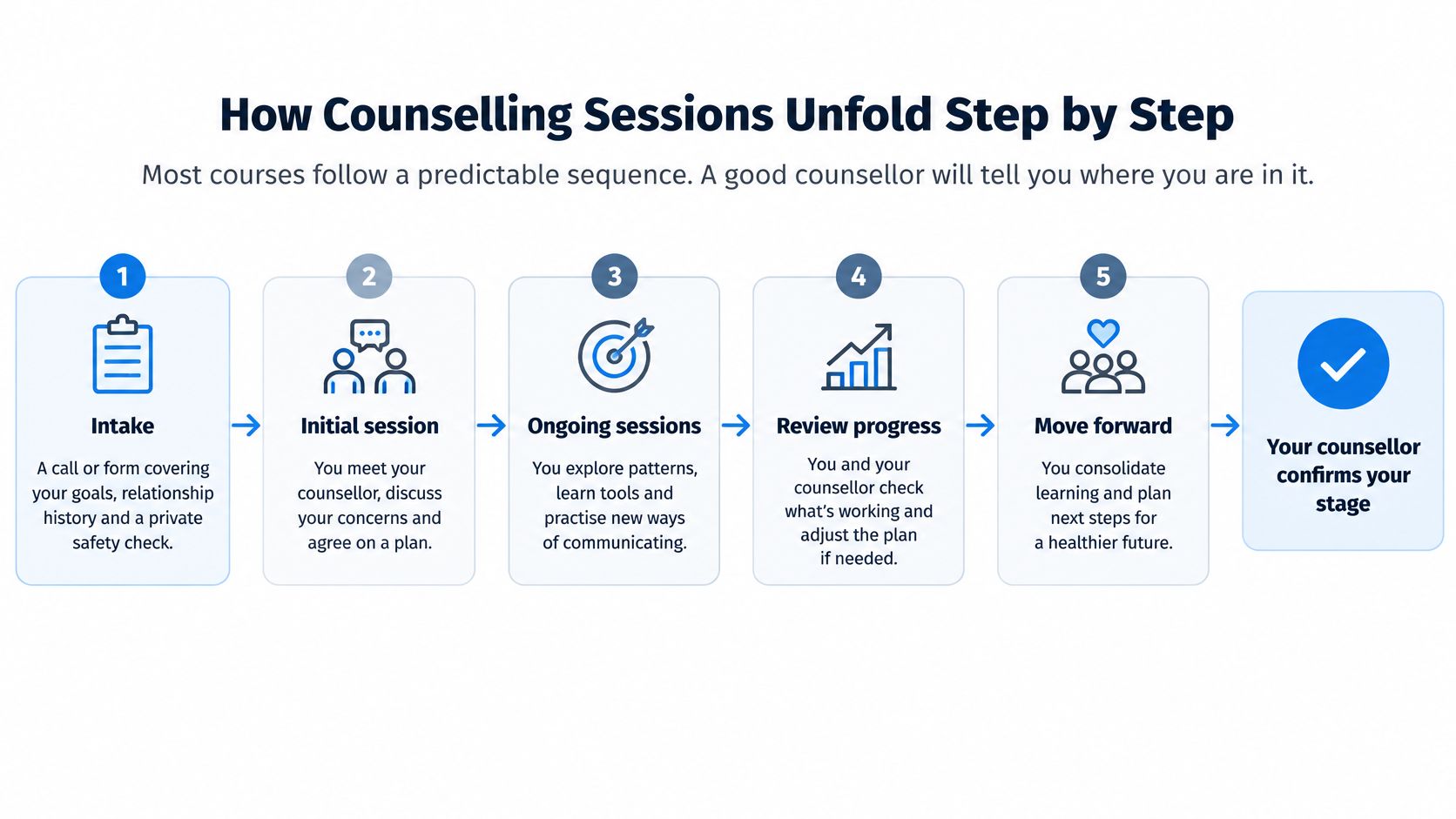
How Counselling Sessions Unfold Step by Step
A course of counselling should have an understandable structure, not feel like an endless series of arguments in another room. Your counsellor should explain what you're working on, why it matters, and when you'll review it.
This flowchart gives a starting picture of the process.
A practical sequence
- Intake. Complete a call or form about your goals, relationship history, and current concerns. Each partner should have a private safety check.
- Individual conversations. Separate appointments let each person explain their perspective. Ask beforehand how private disclosures will be handled within couples work.
- Optional questionnaires. You may reflect on stress, communication, and relationship satisfaction. Assessments are informational, not diagnostic, and shouldn't be used to label or blame a partner.
- Joint sessions. Agree on ground rules such as taking turns, avoiding interruptions, and pausing when either person becomes overwhelmed.
- Home practice. For example, try a ten-minute daily check-in and a planned shared activity each week, if both agree and feel safe.
- Progress review. A possible plan is to review every four to six sessions, considering arguments, feeling heard, attendance, and safety rather than relying on a vague sense of improvement.
- Closing or another phase. Ask for a written summary of useful skills, remaining concerns, and what to do if difficulties return.
For scheduling, you could ask whether 50–60-minute appointments, weekly or fortnightly, would suit the proposed work. Confirm the actual length and frequency with the provider rather than assuming every service follows that format.
Making online appointments workable
In Indian homes, relatives may influence decisions about attending, or expect to join. Agree beforehand who participates; family involvement should require both partners' consent, not merely whoever is available at home.
For privacy, choose a quiet room or, if genuinely private and safe, a parked car. Don't attend while driving, and tell the counsellor if someone can overhear rather than trying to discuss sensitive matters anyway.
If work schedules clash, request a fixed appointment slot. If willingness differs, ask about separate introductory calls; if language or connectivity is a barrier, discuss language-matched support or an appropriate audio option.
Counselling and mediation have different purposes. Counselling addresses emotional and behavioural patterns, while mediation focuses on resolving disputes; an Indian family-dispute mediation review also illustrates why settlement shouldn't be treated as a universal reconciliation outcome. Combining the processes requires clear roles, informed consent, and safety.
What Counselling Can Realistically Achieve
Counselling is most workable when both partners participate, even if one starts more hesitantly. Engagement means trying something different and discussing what happens, not agreeing on everything.
A systematic review and meta-analysis by CHRIST (Deemed to be University), published in 2025, identified 12 empirical studies of couple interventions for marital distress and reported Cohen's d = 0.85, with a 95% confidence interval of 0.56–1.14. That represents a large average benefit, not a guaranteed outcome or proof that every couple improves equally.
A session can provide space to practise a different conversation.

What meaningful progress looks like
Useful goals are specific enough to recognise at home:
- Less harmful conflict: Disagreements don't routinely become insults, threats, or prolonged punishment.
- Clearer requests: You can ask for help directly instead of expecting your partner to guess.
- Trust repair: Honest answers and agreed boundaries replace pressure to forgive quickly; rebuilding may take months.
- Shared routines: You make room for affection, rest, and practical cooperation.
- Everyday compassion: You notice effort and express gratitude without pretending painful issues have disappeared.
Counselling aims to change the pattern between two people, not to decide who is right.
That doesn't mean responsibility is always equal. Someone who has betrayed trust or caused harm needs to take responsibility for their actions; understanding the relationship pattern mustn't erase accountability.
Success needn't mean staying together
Some couples reconnect. Others decide to separate, with more clarity and, where children are involved, a more workable approach to co-parenting.
Look for calmer disagreement, feeling heard more often, and decisions reached without fear. Happiness may include renewed closeness, but it can also mean greater stability and freedom to make an honest choice.
This video offers another way to engage with the topic.
If progress stalls after several sessions, bring that into the conversation. Review the goals and approach, consider individual work, or seek a second opinion rather than continuing indefinitely without a clear purpose.
Signs It Is Time to Seek Help
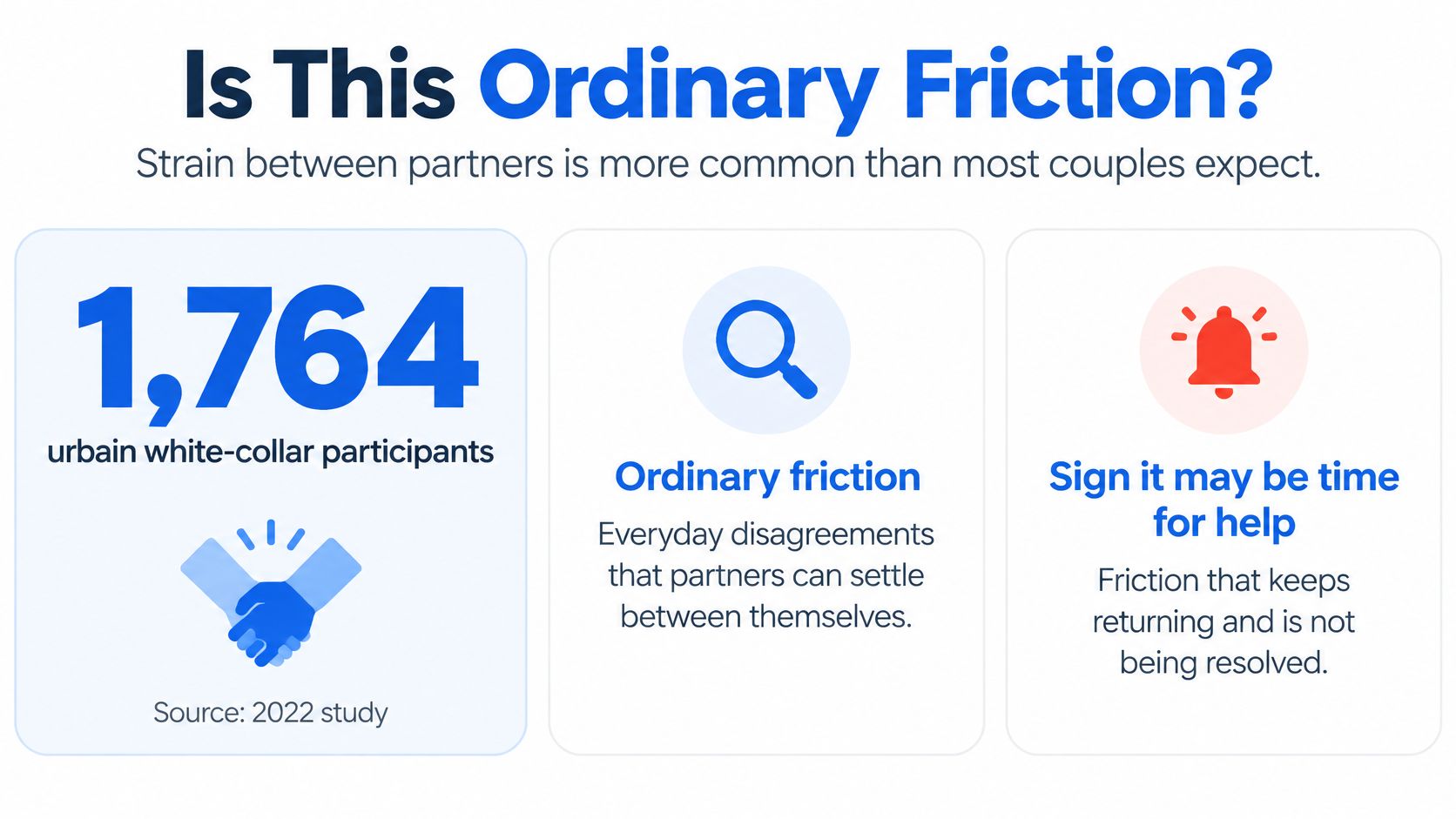
Is this ordinary friction, or do we need help? An India-focused workplace mental-health review reported that, in a 2022 study of 1,764 urban white-collar employees, 29% showed moderate-to-severe signs of depression, 55% moderate-to-severe anxiety, and 78% moderate-to-high stress, using an emotional check-in tool.
Those findings describe that employee group, not every couple, and they aren't diagnoses. They do offer a reason to respond to distress with curiosity rather than dismissing someone as difficult or uncaring.
This distinction can help you consider what's happening at home.
Notice persistence and impact
An occasional disagreement doesn't automatically require therapy. Consider support when you recognise patterns such as these:
- Repeating arguments: The same disagreement continues for months without a workable resolution.
- Withdrawal: A partner regularly avoids conversation or involvement in home life.
- Physical changes: Sleep or appetite changes alongside emotional distress.
- Harmful coping: Alcohol or other behaviours become a way to escape and create further problems.
- Lost interest: Shared plans and activities no longer feel appealing.
- Hopelessness: You feel stuck, with no believable way forward.
- Workplace stress: Job pressure repeatedly disrupts your relationship and recovery time.
Make room for both kinds of support
Depression, anxiety, and burnout can affect energy, concentration, and closeness. A partner may need individual mental-health care alongside relationship counselling, rather than being expected to resolve everything through better communication.
Early help also creates room for positive habits. Resilience can mean recognising overload and asking for support; compassion can mean listening before offering solutions, while gratitude means noticing genuine effort rather than overlooking harm.
Screening tools can help organise what you're noticing, but a qualified professional makes any diagnosis. Don't use a questionnaire score as evidence that your partner is the problem.
If you're having thoughts of self-harm, seek urgent professional or crisis support; if there's immediate danger, contact 112 or a local crisis line straight away. You don't need to wait for a couples appointment.
Choosing a Couples Counsellor and Taking the First Step
| Professional | Typical training | Prescribes medication | Typical role in couples work |
|---|---|---|---|
| Clinical psychologist | Postgraduate clinical psychology training; check registration with the Rehabilitation Council of India | No | Talk therapy, psychological assessment, and couples work |
| Psychiatrist | MBBS followed by MD or DNB in psychiatry | Yes | Diagnosis, medication, and therapy alongside couples work |
| Counselling psychologist | Postgraduate psychology or counselling training; check listed qualifications | No | Structured counselling for relationship and life concerns |
| Family therapist or marriage counsellor | Training routes differ; check specialist certification and supervised experience | No | Couples and family work, often focused on communication and conflict |
A psychiatrist can prescribe medication when appropriate, while the other professionals listed focus on talk-based support and assessment within their training. A professional title alone doesn't establish expertise in couples therapy.
An analysis of counselling within India's family-justice system identifies inadequate training, inconsistent appointments, and weak institutional support as constraints. Ask for clear qualifications, supervised experience, and relevant high-conflict or family-court experience when those issues apply.
Questions before booking
- Specialist preparation: What couples-therapy training and supervised experience do you have?
- Relevant experience: How do you work with concerns like ours, including parenting, infidelity, or family boundaries?
- Safety procedures: How do you screen privately for domestic violence and coercive control, and when would you decline joint work?
- Practical arrangements: What are the fees, cancellation terms, and session length?
- Access: Which languages and online or in-person formats are available?
- Privacy: How do you manage records, separate conversations, and appointments when a partner is at home?
A counsellor should answer without making you feel troublesome for asking. You're checking whether the arrangement is suitable, not auditioning to be accepted.
Turn uncertainty into a first step
- Write down goals. If safe, each partner can identify their top three hopes for counselling.
- Shortlist three counsellors. Compare training, approach, language, availability, and cost.
- Start individually if safety is a concern. Request a confidential intake through a safe contact method.
- Book jointly when appropriate. Both partners should understand the arrangement and feel ready to participate freely.
- Set a review point. For example, agree to review progress after four sessions and adjust the plan together.
You don't need certainty about the marriage's future before seeking help. A reasonable first goal is understanding your options and protecting your well-being.
DeTalks offers a directory of psychologists, therapists, and counsellors where you can browse professionals, book sessions, and explore informational, non-diagnostic assessments. Visit DeTalks to compare relationship-support options and ask about a suitable intake, starting individually if safety or privacy is a concern.