Tag: how to help someone with anxiety

  • How to Help Someone with Anxiety: A Practical Guide

    How to Help Someone with Anxiety: A Practical Guide

    Your First Steps in Offering Support

    Two women having a quiet, supportive conversation in a bright room with a cup of tea.

    Watching someone you care about struggle with anxiety is difficult. You might feel unsure of what to do or say, especially as conversations around mental health are still growing in India.

    Your response can make a real difference. It’s not about "fixing" them, but about creating a safe, judgment-free space. Being a steady, compassionate presence is the most powerful support you can offer.

    Recognising the Signs of Anxiety

    Anxiety doesn't always look like a panic attack; it can be much quieter. Learning to spot these subtle signs is the first step toward offering meaningful help.

    Keep an eye out for common indicators:

    • Persistent Worry: They seem stuck in a loop of worry over daily things like work, health, or family.
    • Irritability: You might notice a shorter fuse or big emotional reactions to small frustrations.
    • Physical Symptoms: They may complain of headaches, stomach issues, or constant tiredness without a clear physical cause.
    • Changes in Behaviour: They might start avoiding social events, procrastinate on tasks, or have trouble sleeping.

    Seeing these as signs of a struggle rather than character traits shifts your approach toward empathy and compassion.

    How to Start the Conversation

    Starting the conversation is often the biggest hurdle. Aim to be gentle and simply show you care, inviting them to share what's on their mind.

    Instead of saying, "Why are you so stressed?" try something softer. For instance, "I've noticed you seem to have a lot on your plate lately. I just wanted to check in." This turns a potential confrontation into a warm invitation.

    You don't need to be a therapist to help; you just need to be a good listener. If you'd like to build more formal skills, an online certificate in mental health can provide a solid foundation.

    Remember, the most powerful thing you can offer is your presence. Letting someone know they are not alone can significantly lighten their emotional load and is a critical part of supporting their well-being.

    Building that initial trust is key. Here’s a quick guide to help you navigate that first delicate conversation.

    Immediate Actions: Do's and Don'ts

    Do Say or Do This Don't Say or Do This
    Listen patiently. Let them speak without interrupting. Dismiss their feelings. Avoid saying things like "You're overreacting" or "It's not a big deal."
    Validate their experience. Use phrases like "That sounds really tough" or "I can see why you'd feel that way." Offer unsolicited advice. Don't jump in with "You should just…" or "Why don't you try…"
    Ask open-ended questions. "How has this been affecting you?" or "What's on your mind?" Make it about you. Steer clear of "I know exactly how you feel, one time I…"
    Offer specific, practical help. "Can I help you with groceries this week?" or "Want to go for a quiet walk?" Pressure them to "snap out of it." Phrases like "Just be positive" or "Calm down" are not helpful.

    Getting this first interaction right helps build a strong foundation of trust, making it easier for them to lean on you.

    Understanding Anxiety in the Indian Context

    To truly help someone, it helps to understand their world. While conversations about mental health are opening up in India, many people still battle their feelings in private. Knowing the cultural context can help you offer more grounded and meaningful support.

    Anxiety is often tangled up with the pressures of daily life. From academic competition to demanding jobs and workplace stress, these external factors play a big role.

    The Pressures They Might Be Facing

    In India, a unique set of expectations can add to stress and anxiety. The intense pressure to excel in exams and careers can create a deep-seated fear of failure.

    There is also a strong cultural tendency to keep personal problems "within the family." While well-intentioned, this can make it difficult for someone to seek professional help. Understanding this can help you be more patient if they seem hesitant to open up.

    Long hours and "hustle culture" can also contribute to burnout and chronic anxiety. Your friend is navigating these external pressures every day.

    Remember, you're their ally, not their therapist. Your role is to be a supportive presence and gently point them towards professional help, but their journey is their own. Think of it as a partnership, not a rescue mission.

    What Anxiety Looks Like and How Help Works

    Anxiety shows up in many ways, from constant worry to sudden panic attacks. You don't need to be an expert, but a little knowledge helps you listen better.

    This is where professional support can be a game-changer. Therapies like Cognitive Behavioural Therapy (CBT) give people practical tools to challenge negative thought cycles. This helps them build lasting resilience.

    The numbers show how common this is. According to India's National Mental Health Survey (NMHS) 2015-16, 9.54% of adults are affected by common mental disorders. Suggesting therapy isn't a shot in the dark; studies show it's effective. Reading about the success rates of anxiety therapy can give you confidence in the conversation.

    Using a Simple Tool to Start the Conversation

    Starting this conversation can feel awkward. A simple, structured tool can sometimes break the ice and ease the tension.

    Assessments like the GAD-7 (Generalised Anxiety Disorder 7-item scale) are straightforward questionnaires. Crucially, these tools are for information, not diagnosis. They are a low-pressure way to start a conversation about feelings.

    You could say, "I found this simple quiz that helps people make sense of their feelings. We could look at it together if you like, no pressure." This approach gives them space to reflect and may provide the confidence they need to seek professional therapy or counselling.

    Practical Ways to Help During Anxious Moments

    When someone is in the grip of anxiety, your calm presence is your greatest tool. It’s not about fixing them but about being a steady anchor while the storm passes.

    Having a few simple techniques can make a difference. These aren't complex interventions, but human ways to show support and well-being.
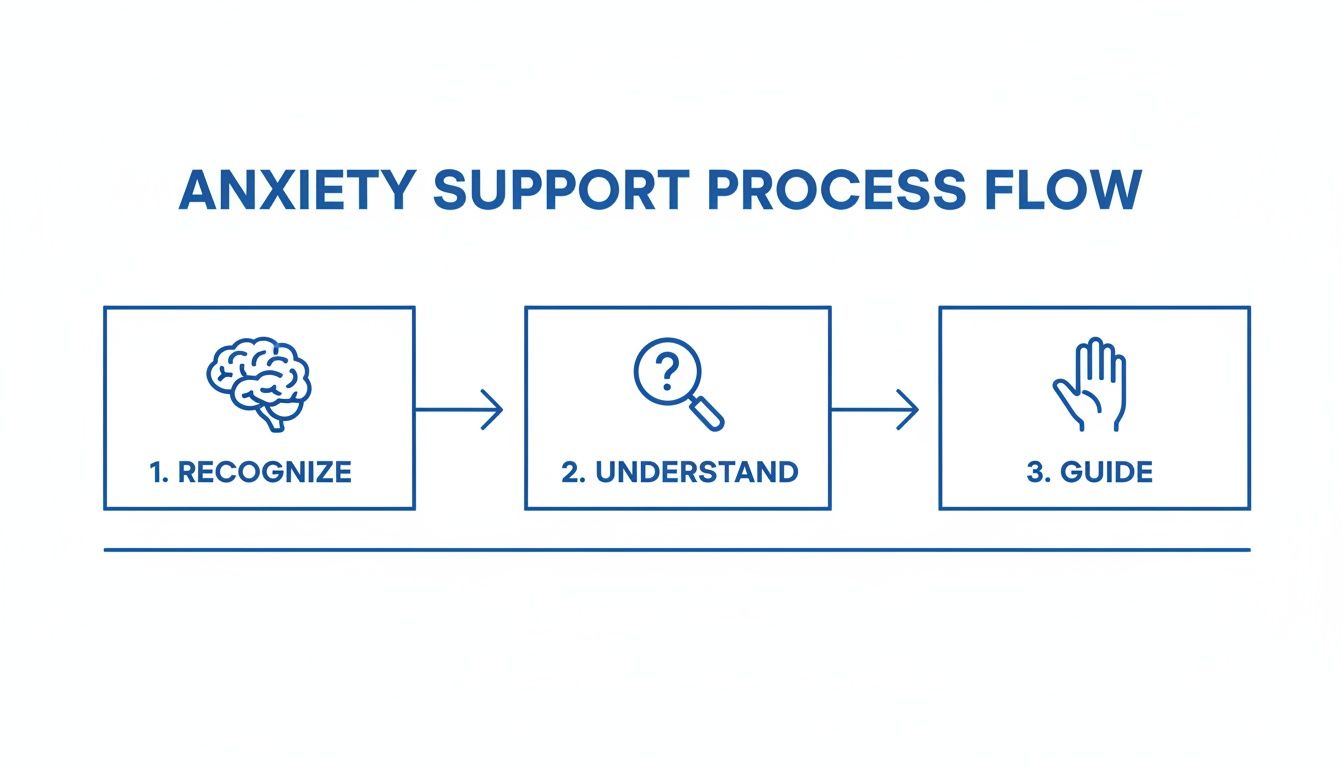
    A flowchart outlining the anxiety support process: Recognize, Understand, and Guide, with corresponding icons.

    Real support starts with empathy before action. This ensures your help is genuinely helpful.

    Use Grounding to Bring Them Back to the Present

    During intense anxiety, the mind gets lost in "what-ifs." Grounding techniques use the five senses to pull their focus back to the present moment.

    A simple method is the 5-4-3-2-1 technique. You can guide them through it in a quiet voice.

    • 5 Things You Can See: Ask them to name five things around them, like a lamp or a book.
    • 4 Things You Can Feel: Guide them to notice four physical sensations, like the texture of their jeans or their feet on the ground.
    • 3 Things You Can Hear: Have them tune into three distinct sounds, like birds outside or the hum of a fan.
    • 2 Things You Can Smell: Encourage them to find two scents, such as coffee or fresh air.
    • 1 Thing You Can Taste: Lastly, ask them to name one thing they can taste.

    This exercise shifts the brain's attention from internal chaos to the neutral details of the outside world, helping them find their footing.

    Guide Them with Calming Breathing

    When anxiety takes over, breathing becomes fast and shallow, which can increase panic. Guiding someone to slow their breathing sends a calming signal to their nervous system.

    The 4-7-8 breathing technique is very effective. Guide them with a calm voice.

    1. Ask them to exhale completely.
    2. Have them close their mouth and inhale through their nose for a count of four.
    3. Then, ask them to hold that breath for a count of seven.
    4. Finally, guide them to exhale slowly through their mouth for a count of eight.

    Repeat this cycle with them a few times. The long exhale triggers the body's relaxation response.

    The goal isn’t to stop the anxiety. It's to help them ride the wave without being swept away. Offering these tools shows you're right there with them in the struggle, not just waiting on the sidelines for it to be over. That’s what builds trust and resilience.

    Ultimately, your presence is what matters most. By staying calm, listening, and using these practical tools, you can be a profoundly reassuring presence.

    How to Talk About Getting Professional Help

    Talking about professional help can feel daunting. But approaching the conversation with care can be one of the most loving things you do.

    The goal isn't to push them into therapy. It's about gently opening a door to building mental strength and resilience.

    Normalising the Conversation

    In India, mental health can still carry a stigma, causing many to suffer in silence. Your first task is to gently dismantle that outdated idea.

    A huge treatment gap exists; data shows that only a small fraction of people with anxiety get formal help. You can learn more about these important mental health findings. By talking about mental well-being openly, you help break the silence.

    Here are a few ways to start:

    • Share your own story. If you've benefited from counselling, talking about it makes the idea more human and relatable.
    • Keep it casual. Mention an article you read about workplace stress or a podcast on managing anxiety.
    • Frame it as skill-building. Pitch therapy not as a "cure," but as a way to learn practical skills for life's challenges.

    This approach positions professional support as a proactive, positive step towards happiness and well-being.

    Choosing the Right Time and Place

    Timing is crucial. Avoid bringing this up during an argument or in a crowded, stressful environment.

    Wait for a calm moment when you both have privacy and won't be interrupted. A quiet evening at home or during a peaceful walk can create a safe atmosphere.

    Your approach matters just as much as your words. Lead with "I care about you" rather than "You need to fix this." A compassionate tone makes it clear that your suggestion comes from a place of love and concern, not criticism.

    How to Phrase Your Suggestion

    The words you choose can make all the difference. Keep your language gentle, collaborative, and free of demands.

    Here are a few supportive conversation starters:

    • "I’ve noticed you’ve been under so much pressure, and it seems really tough. Would you ever be open to talking to someone trained to help with this kind of stress?"
    • "I care about you, and it's hard to see you struggling. Some friends found that talking to a therapist gave them new tools. I'm here to help you look into it if you're ever curious."
    • "We've been talking about how overwhelming things feel. I came across a platform called DeTalks that helps people find support for things like anxiety and depression. We could look at it together, no pressure."

    These phrases are invitations, not instructions. They respect their autonomy and make it clear you are a supportive partner in their journey.

    Building Sustainable Support and Self Care

    Two smiling friends walk in a sunny park at sunset, one with an arm around the other's shoulder, both wearing backpacks.

    Helping someone with anxiety is a marathon, not a sprint. Your consistent, patient presence is powerful, but it requires a long-term view.

    Recovery is not a straight line; there will be good days and tough ones. The goal is to build a foundation of sustainable support for both of you.

    Fostering Resilience Through Healthy Routines

    Gently encouraging small, positive daily habits can make a huge difference. These routines bring structure and can be incredibly grounding.

    Suggest activities you can do together, turning it into a shared effort. Physical activity is a brilliant tool; even a daily walk can regulate the nervous system. There's a strong the surprising link between exercise and anxiety and its benefits.

    Other simple routines could include:

    • Mindfulness Moments: Suggesting a five-minute guided meditation you can try together.
    • Consistent Sleep: Encouraging a regular bedtime to support their body's natural rhythms.
    • Shared Hobbies: Finding a low-stress activity to enjoy together, like listening to music.

    These small, consistent actions build stability and a sense of control, which are vital for long-term well-being.

    The Importance of Celebrating Small Wins

    When anxiety has a tight grip, even small tasks can feel monumental. It’s essential to notice and celebrate these small victories.

    A "win" might be making a phone call they were dreading or trying a breathing exercise. Acknowledging their courage helps them build self-compassion and recognise their own strength.

    Your role is to be a consistent source of encouragement, not a critic. Celebrating progress, no matter how minor it seems, validates their journey and reminds them they are moving forward. This positive reinforcement is a cornerstone of building lasting resilience.

    Protecting Your Own Wellbeing to Avoid Burnout

    It's easy to get so wrapped up in helping that you forget to care for yourself. But you can't pour from an empty cup. If you experience burnout, you won't be able to offer the steady support they need.

    Taking care of yourself isn’t selfish—it’s a necessary part of being an effective ally. It means knowing your limits and actively protecting your own well-being.

    Setting Healthy Boundaries for Yourself

    Boundaries create a healthy dynamic where you can give support without becoming drained. This is crucial for preventing burnout, especially when managing your own challenges like workplace stress.

    Here are a few practical ways to set boundaries:

    • Define Your Availability: It's okay to say, "I'm here to listen for the next 20 minutes, but then I have another commitment."
    • Encourage Self-Reliance: Instead of solving their problems, ask, "What are some things you think might help right now?"
    • Schedule 'You' Time: Block out and protect time in your calendar for your own rest and hobbies.

    Setting these limits protects you and models healthy self-care. This balanced approach ensures you have the emotional resources to be a pillar of support for the long haul.

    Common Questions About Supporting Someone with Anxiety

    Even with the best intentions, tricky situations can arise. It's normal to feel unsure. This guide can help you navigate tough spots with confidence.

    The goal isn't to be perfect but to be present and supportive. Let's walk through some common concerns.

    What If They Refuse Professional Help?

    This is a common and difficult situation. If they’re not ready for therapy or counselling, pushing them will likely cause them to shut down.

    Instead, continue to be a safe person they can talk to without judgment. You can still offer incredible support by listening and helping with small, everyday tasks.

    Gently normalise the idea of professional help over time. You might share an article or resource without pressure. The goal is to keep the door open for when they feel ready.

    How to Help During a Panic Attack Without Making It Worse

    Your calm presence is the most powerful tool during a panic attack. Stay grounded, speak softly, and ask what they need.

    Avoid saying things like "just calm down," which can sound dismissive when their body is in fight-or-flight mode.

    A better approach is to gently guide them through a grounding or breathing exercise. Quietly remind them that the feeling will pass and you are there with them. Your steady support is more helpful than trying to "fix" it.

    Your role is to be a supportive ally, not to be responsible for their recovery. True healing is their personal journey, and trying to carry that weight can lead to your own burnout. Offer compassion, encourage professional help, and protect your own mental health.

    Am I Responsible for Their Recovery?

    It's natural to feel responsible, but it is vital to draw a line. You are not responsible for their recovery from anxiety or depression.

    This is a deeply personal journey they must navigate, ideally with professional help. Your role is to offer compassion and encouragement.

    Be their cheerleader, point them towards support, and set healthy boundaries to protect your own energy. This allows you to be a consistent, positive presence as they build their own resilience.


    Taking the first step toward getting help is a sign of strength. At DeTalks, we make finding the right support less overwhelming. Explore our directory of qualified therapists and our library of science-backed assessments to help your loved one start their journey. Find out more at https://detalks.com.


  • How to Help Someone with Anxiety: A Practical Guide

    How to Help Someone with Anxiety: A Practical Guide

    When someone you care about is struggling with anxiety, the best thing you can do is offer patience, empathy, and a willingness to listen without judgment. It’s not about finding a quick fix, but creating a safe space where they feel understood. Your presence alone can be one of the most powerful tools for their well-being.

    What Anxiety Actually Feels Like

    A distressed young man sits on the floor, receiving a comforting touch on his shoulder.

    To genuinely help, it’s useful to understand what they're going through. Anxiety is more than just feeling worried; it's like a constant alarm bell inside their head they can't switch off. In India, this can be amplified by pressure from work, academics, and family, creating a stressful environment.

    Imagine trying to get through your day while your mind constantly jumps to the worst-case scenario. A simple task can spiral into overwhelming thoughts of failure, which is mentally draining. This constant state of alert makes it hard to focus on anything else.

    It's Not "All in Their Head"

    Anxiety is a deeply physical experience as well as a mental one. It can show up as a racing heart, tense muscles that ache, or a persistent knot in the stomach. These physical symptoms are real and can be frightening.

    Someone experiencing intense anxiety might even worry they are having a medical emergency, which feeds the cycle of fear. Recognizing this strong mind-body connection is a key part of offering compassionate support and building resilience.

    Anxiety can also take on different forms depending on life circumstances. For example, knowing the warning signs of postpartum depression and anxiety can help you provide timely and effective assistance to a new parent.

    The Scale of the Challenge in India

    This need for empathy is especially critical given the numbers. In India, anxiety disorders affect a significant portion of the population. A large percentage of people may never get the support they need due to a treatment gap widened by social stigma.

    Mental health challenges are sometimes viewed as a personal weakness rather than a health condition. Encouraging the use of informational assessments can be a helpful first step, as they can identify symptoms with high accuracy. You can read the full research about these mental health challenges to learn more. Please remember, these assessments are for informational purposes only and are not a substitute for a professional diagnosis.

    By seeing the world from their perspective—acknowledging the mental and physical weight they carry—you can offer support that truly matters. This foundation of empathy is where genuine connection and healing begin.

    Ultimately, your role isn't to diagnose or fix them. It's to build a bridge of understanding that helps them feel less alone in their struggle. This compassionate approach is the first and most vital step in helping someone navigate the journey of managing anxiety.

    What to Say and Do During an Anxiety Attack

    When someone is having an anxiety attack, your calm presence can be a lifeline. The key is not to try and stop the attack but to be a steady anchor while it passes. This is about grounding them, not problem-solving.

    The most powerful thing you can do is often just to be there, but it’s always best to ask first. A simple, "I'm here. Do you want me to stay with you?" gives them a sense of control. Speak softly, move slowly, and your quiet, non-judgmental presence can make all the difference.

    First, Create a Sense of Safety

    Anxiety can make the brain feel like there's an immediate threat. Your first job is to help their nervous system feel safe. You can do this by speaking in a low, reassuring voice and reminding them that the feeling, though terrifying, is temporary and will pass.

    Keep your language simple and avoid asking why this is happening, as that can make things worse. Right now, it's about the present moment and letting them know they are physically safe. This is the foundation they need to start feeling grounded again.

    Managing your own reaction is also a huge part of this. It’s natural to feel distressed, but if you look scared, it can confirm their brain's fears. Take a deep breath yourself; your calm can be contagious and help them feel secure.

    Guide Them Back to the Present with Grounding

    Grounding techniques are brilliant because they pull focus away from internal chaos and onto the tangible, outside world. One of the simplest and most effective is the 5-4-3-2-1 technique.

    You can gently guide them through it without any pressure.

    • "Let's find 5 things you can see around us. I see the blue lamp. What do you see?"
    • "Okay, now what are 4 things you can feel? Maybe your feet on the floor, or the texture of the sofa."
    • "Let's listen for 3 things you can hear. I can hear a car outside. What can you hear?"
    • "Can you smell 2 different things? Maybe my coffee, or the soap on your hands."
    • "And finally, what's 1 thing you can taste? Even if it's just the taste in your mouth."

    This simple exercise gives their racing mind a concrete task to focus on. It helps break the cycle of panic and regain a small but vital sense of control.

    You’re not expected to be their therapist. Think of yourself as a compassionate anchor. By staying calm and offering gentle guidance, you help them navigate the storm and remind them of their own strength.

    Choose Your Words Carefully

    What you say—and don't say—matters immensely. Common reactions like "just calm down" or "it's not that bad" can feel dismissive and make them feel more isolated.

    The goal is always empathy and validation. Your words should show that you see their struggle, believe them, and you're not going anywhere. This is what builds trust and helps them feel safe.

    Navigating these conversations can be tricky. Here’s a quick guide on what to say and what to avoid to foster connection and happiness.

    Helpful vs Unhelpful Phrases When Supporting Someone with Anxiety

    Communication can either build a bridge or a wall. The right words can make someone feel seen and understood, while the wrong ones can deepen their sense of isolation.

    Instead of Saying This… Try Saying This Instead…
    "Just calm down." "I'm here with you. Take your time."
    "There's nothing to be scared of." "I know this feels really scary right now."
    "You're overreacting." "This must feel so overwhelming. It will pass."
    "Why are you feeling this way?" "You don't need to explain. Just focus on your breathing."
    "It's all in your head." "I can see you're in distress. Let's get through this together."

    Choosing validation over dismissal is one of the most powerful ways to offer support. It communicates that you're on their team, ready to sit with them in their discomfort without judgment. This is the heart of learning how to help someone with anxiety.

    Gently Encouraging Professional Support

    Suggesting professional help is one of the most loving things you can do. The key is to approach the conversation with care and patience, so your loved one feels supported, not judged. Think of it as opening a door, not pushing them through it.

    Timing is everything. Find a quiet, private moment when you’re both calm. Bringing it up during an argument or a moment of high anxiety will likely not be helpful. The goal is to create a safe space where your genuine concern can be felt.

    Framing the Conversation with Care

    How you say it matters just as much as what you say. It's crucial to speak from a place of compassion, focusing on your own feelings and concerns rather than placing blame.

    Using "I" statements is a fantastic way to do this. Instead of saying, "You need therapy," which can sound like an accusation, try a softer approach.

    You could say, "I've noticed you've been having a hard time, and it worries me because I care about you. I was wondering if you’ve ever considered talking to someone who might have tools to help?" This reframes the conversation, positioning therapy or counselling as a proactive step toward building resilience.

    Highlighting the Power of Evidence-Based Support

    Sometimes, explaining that therapy is a practical, science-backed tool can make a huge difference. You don't need to be an expert, but mentioning that there are proven methods can normalise the idea.

    For example, you could mention Cognitive Behavioural Therapy (CBT), an effective approach for anxiety that teaches skills to manage difficult thoughts. Pointing them toward a resource like DeTalks, which connects them with professionals, makes it feel more concrete. It's a tangible next step, especially since untreated anxiety can sometimes be linked with depression. You can discover more insights about these findings to feel more informed.

    Remember, the goal isn't to push them into a decision. It's about planting a seed of possibility and letting them know that effective, compassionate help is available whenever they are ready.

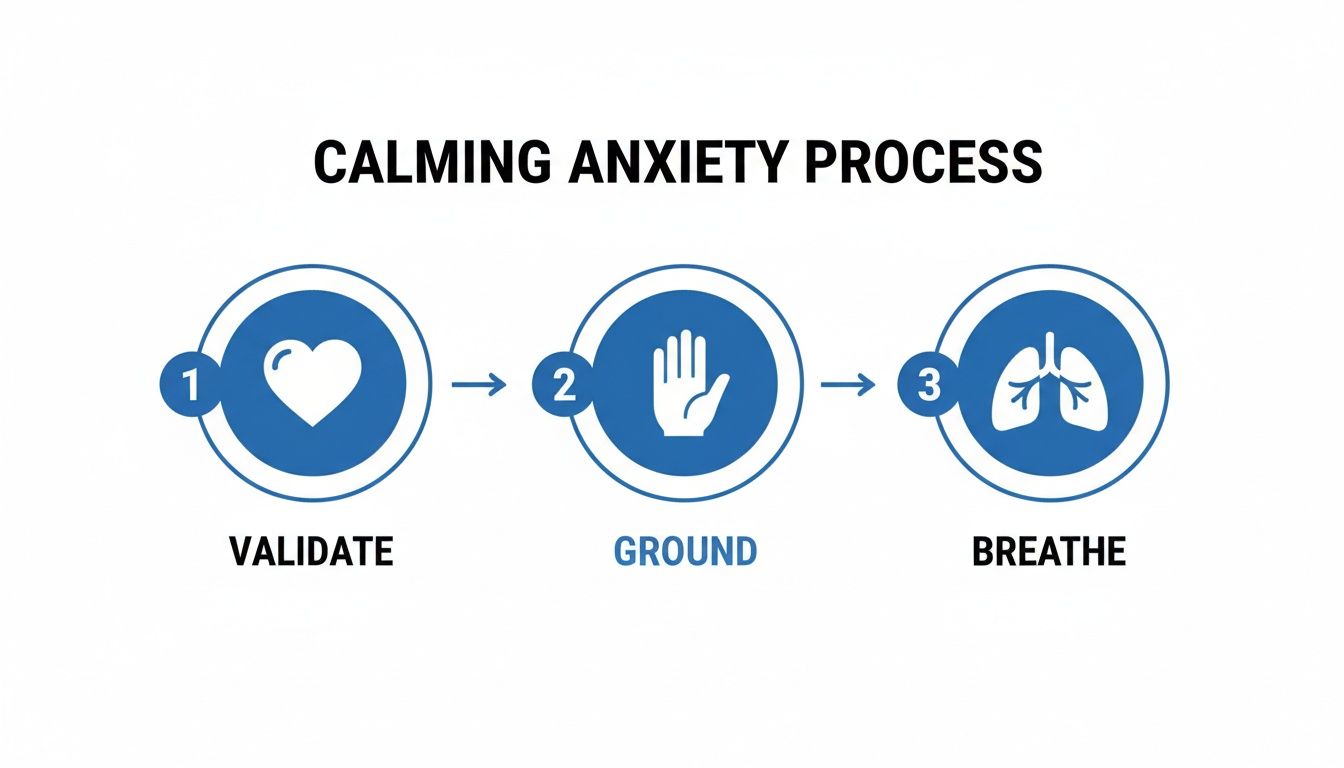
    The visual below breaks down a simple process to help someone calm down in an anxious moment. It focuses on validation, grounding, and breathing.

    Diagram illustrating the three-step calming anxiety process: Validate, Ground, and Breathe.

    This simple flow shows that in-the-moment support is about connection, not correction.

    Offering Practical, Hands-On Help

    Anxiety and depression can be exhausting, making it hard to find a therapist and make an appointment. This is where you can step in with practical support. Offering this kind of help shows you're truly in their corner.

    Here are a few ways to lighten their load:

    • Do the legwork. Offer to research therapists or counsellors who specialise in anxiety. You could say, "If you'd like, I can help look up a few people who might be a good fit."
    • Help make the call. The first phone call can feel intimidating. Offering to make it for them, or just sitting with them while they do it, can provide a boost of courage.
    • Go with them. Simply offering to drive them to their first appointment can make the experience feel far less daunting.

    Your role here is to remove logistical and emotional friction, making it as easy as possible for them to take that brave first step. It’s a powerful way to show you are not facing this alone.

    Providing Long-Term Support Without Burning Out

    Two young men walk and talk on a misty park path during a golden sunrise.

    Learning how to help someone with anxiety is a marathon, not a sprint. It’s about showing up with patience, but it’s just as important to protect your own well-being to avoid burnout. You can only give your best support when you’re not running on empty.

    Long-term support means shifting your mindset from finding a "cure" to celebrating small wins. Recovery isn’t a straight line; there will be good and bad days. Your steady presence through it all makes a real difference.

    Embracing the Ebb and Flow of Recovery

    It’s normal to feel frustrated when someone has a setback after doing well. Remember, these ups and downs are a standard part of managing a mental health condition like anxiety or depression. This is where your compassion and resilience truly count.

    Your job isn't to fix them but to be a consistent, stable presence. Simply listen, offer encouragement, and gently remind them of how far they've come. This steady support helps them build their own strength over time.

    While geared towards classrooms, this article on how to help students with anxiety has some great universal strategies. The core ideas of patience and validation are just as relevant when supporting an adult.

    Setting Boundaries to Prevent Burnout

    Setting healthy boundaries is essential for being there for the long haul. This isn't selfish; it prevents compassion fatigue or burnout, which doesn't help anyone. Boundaries are kind limits that protect your mental and emotional energy.

    Here’s what healthy boundaries can look like:

    • Defining Your Availability: "I'm always here for you, but I need to switch off after 10 PM. Can we catch up tomorrow morning?"
    • Protecting Your Emotional Energy: "I want to support you, but I don't have the headspace to talk about this right now. Can we check back in this afternoon?"
    • Encouraging Self-Reliance: "I can see this decision is weighing on you. I can't make it for you, but I'm happy to listen while you think it through."

    These are respectful ways of communicating your own needs, allowing you to continue showing up for them in a meaningful way and promoting their own resilience.

    Supporting someone with anxiety means being a lighthouse, not a lifeboat. Your job is to be a steady, guiding light—you cannot carry them to shore. You can only show them the way.

    Prioritising Your Own Well-Being

    You can't pour from an empty cup. Looking after yourself is a non-negotiable part of being a good support person, especially if you're juggling your own workplace stress.

    Make time for things that recharge you, whether it’s a walk, a hobby, or five minutes of peace. These moments build your own resilience and stop resentment from creeping in. If you feel overwhelmed, consider getting support for yourself through therapy or counselling.

    How Digital Tools Can Open Doors to Recovery

    Close-up of hands holding a smartphone displaying a voice recorder app with sound waves in a home setting.

    Technology can be an accessible ally in the journey towards better well-being. For someone with anxiety, the thought of finding help can feel overwhelming. Digital tools offer a gentle, private first step, empowering them to explore support on their own terms.

    It’s important to remember these tools are a support for, not a replacement of, professional counselling. By knowing what's out there, you can gently suggest resources that might resonate with your loved one.

    Making That First Step Feel Less Scary

    One of the biggest hurdles is not knowing where to begin. Online platforms like DeTalks help by offering directories of qualified therapists. This lets someone browse profiles and find a professional who feels like the right fit from home.

    Many platforms also offer confidential, informational assessments. It's crucial to clarify these are for insight, not diagnosis. But they can provide a language for what someone is feeling, which makes future conversations with a therapist more focused.

    Digital tools can act as a bridge, connecting a person's private struggle with the world of professional support. They lower the barrier to entry, making that first step toward healing feel more manageable and less frightening.

    Evidence-Based Strategies Right at Their Fingertips

    Technology also puts a library of self-help strategies directly into their hands. Suggesting these tools is a brilliant way to encourage proactive steps in managing anxiety without being pushy.

    Here are a few ideas you could suggest:

    • Mindfulness and Meditation Apps: Apps like Calm or Headspace offer guided meditations that teach mindfulness techniques to help quiet a racing mind and build resilience.
    • Digital Journaling: A journaling app can be a private space to untangle thoughts and spot anxiety triggers, promoting positive psychology.
    • Mood Trackers: These apps help people connect the dots between their lifestyle and how they feel. Seeing how sleep or exercise impacts their anxiety can be eye-opening.

    While these tools are best used alongside professional support, they are a fantastic way to build healthy habits for long-term well-being and manage challenges like workplace stress.

    Breaking Down Barriers in the Indian Context

    In India, geography and stigma can make getting mental health care tough. This is where teletherapy, or online counselling, shines, bringing quality care to people in smaller cities and rural areas.

    The impact has been significant, especially as post-COVID data shows a rise in anxiety. Online platforms cut through the hesitation to seek help, making support accessible and consistent. You can learn more about these mental health trends from the CDC.

    By encouraging your loved one to explore these digital avenues, you're not just pointing them to a resource. You’re offering hope and a modern, accessible path toward well-being.

    Your Questions Answered: Navigating Anxiety Support

    When you’re trying to help someone, it’s natural to have questions. Feeling unsure of what to do is part of the process. Let’s walk through some common concerns to help you feel more confident.

    What if They Refuse to Get Help?

    This is a tough situation. You can see they’re struggling, but you can’t force someone into therapy or counselling. Pushing too hard can often cause them to shut down.

    Instead, keep the lines of communication open and let your support be unconditional. You can gently say, "I'm always here to listen, and if you ever want to talk to someone else, I can help." Focus on what you can do: be a patient, non-judgmental presence in their life.

    How Can I Support Someone from Far Away?

    Living at a distance adds complexity, but your support can still be a powerful anchor. Consistency is key. Regular check-ins, even a simple text, can bridge the physical gap and make them feel seen.

    Schedule regular video calls to make the connection feel more real. You can also encourage them to look into local support or online therapy, which is widely accessible. Offering to help research options shows that even from miles away, you’re there with them.

    Your consistent presence, even from afar, is a powerful reminder that someone cares. It's about showing up emotionally, even when you can't be there physically.

    Is It Anxiety or Just Normal Stress?

    This is a great question, as stress and anxiety can feel similar. The main difference is the trigger and duration. Stress is usually tied to a specific external cause, like a work deadline, and eases up when the situation resolves.

    Anxiety, however, often lingers long after a trigger is gone or appears for no clear reason. It’s a more persistent feeling of dread that impacts daily life. While everyone experiences workplace stress, chronic anxiety is a deeper challenge affecting a person’s well-being.

    What Do I Do if I Say the Wrong Thing?

    It’s bound to happen. If you say something that comes out wrong, the most important thing is how you handle it. Simply own it with a sincere apology.

    Something like, "I'm sorry, that didn't come out right. What I meant was that I care," can make all the difference. It shows humility and that your intention is to help. Your willingness to listen and learn builds trust and strengthens your ability to build resilience together.

    Can Someone Ever Fully Recover from Anxiety?

    Recovery looks different for everyone. For most, it isn't about a "cure" that makes anxiety and depression disappear. Instead, it’s about learning to manage symptoms so they no longer run your life. With tools from counselling and self-care, people can and do live rich, happy, and fulfilling lives.

    The goal is building resilience and having coping strategies for tough times. Remember to celebrate small wins and understand there will be ups and downs. Your steady, patient support is a vital part of this journey toward lasting well-being.


    Navigating mental health support can feel overwhelming, but you're not in this alone. If you're looking for professional, compassionate guidance for yourself or someone you love, DeTalks provides a directory of qualified therapists. Our confidential, science-backed assessments can help you find the right path forward. Explore your options at https://detalks.com.