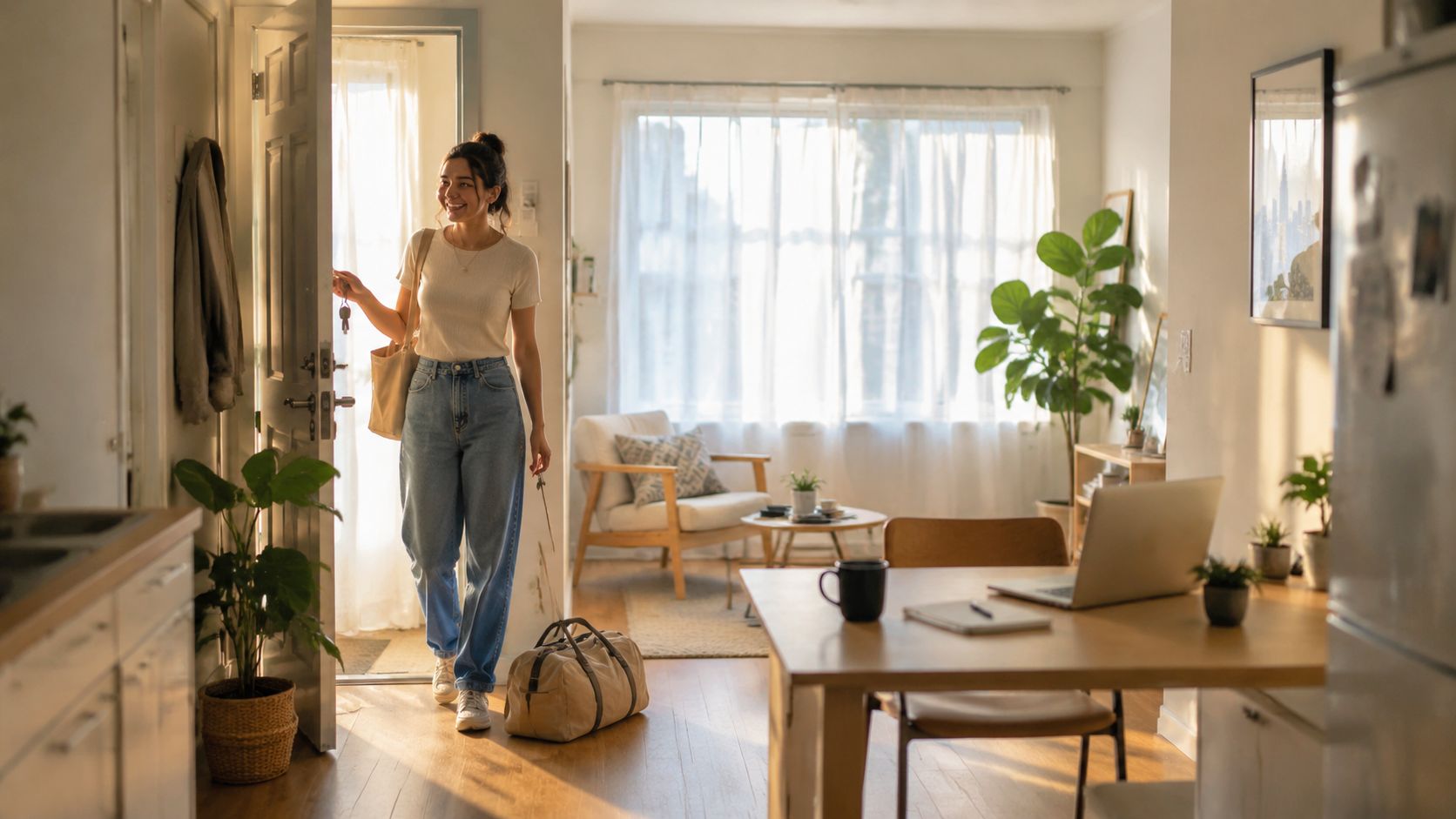
The key turns, the door opens, and the flat sounds bigger than you expected. There's no background noise from family, no flatmate asking where the charger is, no familiar movement in the next room. For many people, that first quiet moment feels exciting and unsettling at the same time.
If you're trying to learn how to live alone, you probably don't need dramatic advice. You need calm, usable guidance. You need help making a space feel safe, handling the wave of anxiety that can come at night, and building a life that supports your well-being instead of draining it.
Embracing the Journey of Living Alone
A new home often begins with tiny decisions. Where to keep your keys. Which mug becomes your evening tea mug. Whether the silence feels peaceful or too loud. Those details matter because living alone isn't only a housing arrangement. It's an emotional transition.

In India, this shift is becoming more common. One-person households in cities such as Mumbai, Delhi, and Bangalore have more than doubled since 1990 to over 12% in 2020, a change linked to both greater independence and tougher mental health adjustments, as noted in this report on the rise of living alone.
The first week often feels mixed
Some people feel relief first. They enjoy the privacy, the control, and the freedom from constant negotiation. Others feel strong anxiety at night, especially after work, when the mind finally slows down and the emptiness becomes noticeable.
Both reactions are normal.
Practical rule: If your emotions feel inconsistent, that doesn't mean you made the wrong decision. It usually means your mind is adjusting to a major life change.
Living alone can be restorative when your previous environment was chaotic, critical, or crowded. It can also expose habits that stayed hidden when other people were always around. Mess looks different when nobody else will clean it. Sadness feels sharper when nobody interrupts it.
What changes when a home becomes fully yours
The trade-off is real. You gain autonomy, but you lose built-in company. You gain peace, but you also become responsible for the practical and emotional structure of daily life.
A few early shifts tend to matter most:
- Choice expands: You decide your routine, meals, music, visitors, and boundaries.
- Responsibility sharpens: Bills, repairs, groceries, and emotional regulation don't get shared by default.
- Silence becomes meaningful: It can feel soothing on one day and heavy on another.
- Self-awareness grows: You start noticing what calms you, what triggers you, and what kind of life suits you.
Many people assume they'll feel either lonely or liberated. In practice, they feel both. That's why learning how to live alone isn't about becoming emotionless or hyper-independent. It's about building a life that can hold freedom and vulnerability at the same time.
A kinder way to frame this chapter
You don't need to prove that you “love being alone” from day one. You don't need to romanticise every quiet evening either. A more grounded goal is to become someone who can care for herself or himself well in solitude.
That includes practical skills, but it also includes compassion. If you've been dealing with workplace stress, anxiety, burnout, or the aftereffects of a breakup, living alone may bring those feelings closer to the surface. That doesn't mean solitude is harming you. It may be making your needs easier to hear.
Preparing Your Mind for Solo Living
The strongest preparation happens before the home feels settled. Furniture can wait a little. Your mindset can't.
Global evidence on solo living is sobering. Living alone is associated with a 39% increased mortality risk for males and a 15% increased risk for females, and in India the share of people reporting no friends rose from 3% in 1990 to 12% in 2020, according to this evidence brief on living alone and social connection. That doesn't mean living alone is always unhealthy. It means passive isolation is risky.
Solitude and isolation aren't the same
Healthy solitude gives you room to think, rest, and recover. Isolation cuts you off from regulation, support, and perspective. The difference isn't whether you live by yourself. The difference is whether your life still includes connection, rhythm, and care.
Start by asking yourself a few direct questions:
- When I get stressed, do I reach for support or disappear?
- Do I want privacy, or am I withdrawing because I'm hurt?
- What time of day feels hardest for me?
- What usually keeps my mood steady?
These questions help you spot patterns early. That matters because people often confuse emotional overload with personal weakness, when it's often just a sign that their internal systems need more support.
Build expectations that are honest
Living alone doesn't automatically make you stronger, wiser, or calmer. It gives you the chance to practise those qualities. Some days you'll use that chance well. Some days you'll order dinner, ignore the laundry, and feel low for no obvious reason.
That's still part of the process.
A simple mental framework helps:
| Experience | What it usually means | Better response |
|---|---|---|
| Quiet feels uncomfortable | Your nervous system is used to constant input | Add gentle structure, not constant distraction |
| Evenings feel heavy | Transition time is emotionally exposed | Create a repeatable evening ritual |
| You miss people intensely | Connection matters to you | Reach out early, not after a crisis |
| You feel guilty for enjoying solitude | Old social expectations are speaking | Let peace be valid |
If work is already draining you, solo living can magnify that fatigue. A practical way to reduce pressure is to set firmer boundaries around work hours, recovery time, and digital overflow. If that's a struggle, these strategies to avoid burnout offer useful prompts that fit well with solo routines.
Positive psychology works best when it's concrete
Resilience isn't built by repeating positive thoughts you don't believe. It grows through repeated acts of self-respect. Making breakfast before your first call. Going for a short walk instead of doom-scrolling. Texting a friend before the spiral deepens.
You don't need to enjoy every moment alone. You need enough emotional steadiness to stay present in your own life.
Try these internal habits in the first month:
- Name the feeling: “I'm anxious tonight” is clearer and kinder than “I'm a mess.”
- Lower the standard: Aim for functional, not perfect. A simple meal and a clean bed are a solid win.
- Create one anchor: Keep one routine fixed, such as morning tea, prayer, stretching, or journalling.
- Use support early: Therapy or counselling is often more helpful at the beginning of a difficult transition than after months of exhaustion.
If you use a mental health assessment, treat it properly. It's informational, not diagnostic. It can point you towards patterns in anxiety, depression, or stress, but it can't replace a therapist, counsellor, or doctor.
Building Your Independent and Secure Home
A stable home lowers mental noise. When basic systems work, your brain doesn't have to stay on alert all day. That matters more than décor.

A practical framework works well here. A three-phase protocol recommends 2 to 3 months of expense tracking, then building self-reliance skills, and then strengthening community ties. It also notes that people who establish routines within the first six months report a 40% reduction in loneliness-related anxiety, and that a useful benchmark is learning to handle 90% of home maintenance independently.
Start with money before aesthetics
People often spend heavily in the first few weeks because an empty flat feels emotionally urgent. That's understandable, but it can create stress that lingers for months. Buy for function first.
Begin with these categories:
- Must-have now: Bed or mattress, lighting, locks, curtains, basic cookware, cleaning supplies.
- Useful soon: Storage, chair, table, laundry basket, drying rack, simple first-aid items.
- Can wait: Decorative extras, duplicate appliances, trend-driven furniture, guest items you rarely use.
Track spending for the first 2 to 3 months. That window shows where money leaks. Delivery fees, cabs taken out of tiredness, convenience groceries, and repeat purchases add up quickly when you're managing a home alone.
If you're furnishing your first place, a grounded starting point is to look at Woodstock Outlet's apartment furniture tips. The most useful advice in this stage is usually about scale, priority, and avoiding bulky purchases that make a small space feel cramped.
Learn the small skills that reduce panic
Independence feels better when small problems don't become emergencies. You don't need to become a technician, but you do need basic competence.
Focus on tasks like these:
Utility basics
Know where the main switches, water controls, and building contact numbers are. Save them in your phone and keep a written copy at home.Everyday fixes
Learn how to reset a tripped switch, replace a bulb, unclog a simple drain, and use basic tools safely.Kitchen self-reliance
Keep three easy meals you can cook when tired. This protects your budget and reduces the stress that comes from decision fatigue.Paperwork order
Store rent papers, ID copies, emergency contacts, and medical information in one clearly marked folder.
Home truth: Competence reduces fear faster than motivation does.
Build a home that supports your mind
A secure home isn't only about locks. It's also about cues that tell your nervous system you can rest here.
Try this checklist:
- Entry routine: One tray or hook for keys, wallet, ID, and pepper spray if you carry it.
- Night comfort: Working bedside light, charged phone, water bottle, and emergency numbers nearby.
- Visual order: One tidy corner matters more than an entire “perfect” home.
- Food stability: Keep basic staples that help on low-energy days.
- Repair list: Write down small issues early instead of waiting until several pile up.
A well-run home won't solve anxiety or depression on its own. But it removes avoidable friction. That's often the difference between “I can handle this week” and “everything feels too much”.
Your Routine for Safety and Well-being
For many women in India, living alone isn't only about freedom. It's also about vigilance. The door may be locked, yet the body may still refuse to relax.

That's the safety paradox. You finally have your own space, but you don't always feel psychologically safe inside it. In major Indian cities, 62% of women living alone experience persistent safety anxiety, which can stop them from enjoying solitude or even resting properly. Generic advice like “change the lock” doesn't go far enough.
Safety confidence matters more than safety theatre
Some habits create real protection. Others only create the feeling of doing something. What helps most is a system you are able to follow when tired, upset, or rushed.
A stronger approach combines physical safety with mental steadiness:
| What people often do | Why it falls short | What works better |
|---|---|---|
| Rely on one safety gadget | Devices can fail or be forgotten | Layer habits, contacts, and building awareness |
| Stay hyper-alert all evening | It increases exhaustion | Use a short, repeatable safety check, then disengage |
| Avoid everyone nearby | It can increase isolation | Build selective familiarity with neighbours and staff |
| Read endless crime updates | It raises fear without improving response | Keep practical local information only |
Build a short evening safety ritual
This works better than constant scanning. A routine gives your mind a clear message that checks are complete.
Use a sequence like this:
- Secure the entry: Check the main door, windows, and any secondary latch once.
- Set communication: Share your location or a simple “home now” message with one trusted person if that helps you relax.
- Prepare essentials: Keep your phone charged, emergency contacts visible, and needed medicines accessible.
- Lower stimulation: Once checks are done, step away from alarming news and repetitive fear loops.
After that, switch into rest mode on purpose. Tea. Shower. Music. Prayer. Reading. Stretching. Safety confidence grows when your body learns that protection and calm can exist together.
Routine protects mental health too
When people live alone, unstructured time can feed anxiety, low mood, and workplace stress. A routine doesn't need to be strict. It needs to be reliable.
Keep three daily anchors:
- Sleep anchor: A roughly consistent time to dim lights and stop work.
- Food anchor: Regular meals, even simple ones, so hunger doesn't worsen irritability.
- Movement anchor: Some form of physical activity each day, even indoors.
Sleep quality often shapes everything else. If you're trying to reset your evening habits, SleepHabits wellness insights can be a helpful companion for thinking through sleep, stress, and recovery in practical terms.
Safety isn't only the absence of danger. It's the presence of enough calm for your body to unclench.
If fear stays intense, especially after harassment, stalking, or a frightening incident, self-help may not be enough. Therapy or counselling can help you rebuild psychological safety, work with trauma triggers, and reduce the exhausting cycle of checking, bracing, and overthinking.
Navigating Loneliness and Building Support
Loneliness often emerges subtly. It can look like irritation after work, endless scrolling at night, or a sudden urge to call someone you don't even want to speak to. Living alone doesn't cause loneliness by itself, but it removes the distractions that sometimes hide it.

Within the first six months of living alone, 18.4% of urban Indians report severe anxiety symptoms, yet fewer than 12% seek professional therapy. Early clinical intervention for transition-induced loneliness can reduce long-term risks by 35%. That gap matters because generic advice often tells people to “stay busy” when they may need real care.
The first loneliness crisis needs a plan
The earliest stage is often the hardest. This is when people think, “I should be coping better than this.” They try to outwork the feeling, over-socialise, or numb it with content, food, or alcohol. Those responses may distract for a few hours, but they rarely build stability.
A better response is to create layers of support:
- One daily connection: A call, voice note, walk with a friend, or brief conversation with someone safe.
- One weekly in-person contact: Class, faith space, neighbour chat, coworking, hobby group, or family visit.
- One emotional outlet: Journal, therapy, counselling, support group, or reflective conversation.
- One practical support line: A person who can help if you feel overwhelmed late at night or during illness.
Know when loneliness is becoming a clinical concern
Not all loneliness needs therapy. Some of it softens when routine, connection, and rest improve. But some signs suggest it's moving into anxiety or depression and deserves professional attention.
Look out for patterns such as:
Your body stays activated
You feel dread, panic, racing thoughts, or constant unease when you're at home alone.Function starts slipping
You stop eating properly, miss work tasks, neglect hygiene, or struggle to leave bed.You withdraw from support
You want connection, but you avoid replying, cancel plans, or feel too depleted to speak.Hopeless thoughts appear
The future feels blank, heavy, or pointless.
This is a good point to pause and watch something grounding before deciding what kind of help you need next.
Use self-help, but don't stop there if you're struggling
Self-compassion is useful. So are hobbies, walking, mindfulness, and reconnecting with friends. But they aren't always enough when your nervous system is in distress.
If loneliness starts changing your sleep, appetite, concentration, or wish to keep going, treat it as a mental health issue, not a personality flaw.
If you take an online assessment for anxiety, depression, or burnout, keep the result in perspective. It's informational, not diagnostic. It can help you notice patterns and decide whether to seek therapy or counselling, but it shouldn't be used to label yourself.
Support doesn't have to mean crisis. Sometimes it means not waiting until things get worse.
Thriving in Your Own Company
The deepest shift happens when living alone stops feeling like a test you must pass. It becomes a relationship with yourself that you practise day by day. That's where confidence gets quieter and more solid.
Thriving doesn't mean you never feel lonely, anxious, or tired. It means those feelings no longer run the whole house. You know how to steady yourself, how to reach out, and how to make your space support your well-being instead of fighting it.
What growth often looks like in real life
It usually isn't dramatic. It's small, visible changes in how you live.
You might notice that:
- Your evenings feel less chaotic: You know what helps you settle.
- You recover faster from hard days: Workplace stress still hits, but it doesn't swallow the entire week.
- Your choices become cleaner: You say no more easily, rest earlier, spend more carefully, and keep better boundaries.
- Your self-talk softens: You stop treating every difficult day as proof that you're failing.
These changes build resilience. They also create more room for happiness, gratitude, and compassion. Not the performative kind. The ordinary kind that shows up in a peaceful cup of chai, a made bed, a safe friendship, or a Sunday afternoon that no longer feels threatening.
Living alone can teach emotional strength
A person who learns how to live alone well often becomes more grounded in every other area of life. Relationships improve because need and choice become easier to separate. Work improves because stress has fewer hidden leaks at home. Health improves because routine stops depending on someone else's presence.
That doesn't mean you must do everything alone forever. It means solitude can become a training ground for emotional intelligence.
A few principles stay useful long-term:
- Protect rhythm over perfection
- Choose support before collapse
- Treat therapy and counselling as strength, not failure
- Respect signs of anxiety, depression, and burnout early
- Let your home reflect safety, not pressure
If you've had a rough start, don't use that as evidence that you're not built for solo living. Many people struggle at first, especially after family homes, hostels, marriage, or shared flats. Learning this skill takes repetition.
You don't need to become fearless. You need to become familiar with your own needs, limits, and strengths. That's a more reliable kind of confidence.
If you want thoughtful support while learning to live alone, DeTalks can help you explore therapy, counselling, and informational mental health assessments in one place. It's a practical way to understand what you're feeling, find the right professional support, and strengthen your resilience without guessing your way through stress, anxiety, depression, or loneliness on your own.