
Feeling like you've lost interest in everything you once loved can be a confusing and lonely experience. It's a feeling known as anhedonia, which is a formal way of saying you've lost the ability to feel pleasure. You are not alone in feeling this way.
Think of it as a signal, like a warning light on your car's dashboard. It’s your mind and body’s way of telling you that something needs your attention and care.
When the Colour Fades from Your World

Imagine your life is like a radio, usually tuned to your favourite music. Suddenly, the signal fades to static. The music is still playing, but your connection to it has become muted.
This emotional numbness is not a sign of weakness; it's often a protective response to being overwhelmed. When you're dealing with prolonged challenges like workplace stress or emotional burnout, your system may enter an energy-saving mode.
It's surprisingly common, especially among high-achievers who find themselves understanding why the life you wanted feels like a cage, even when they have everything they thought they wanted.
A Shared Experience Across India
Losing the ability to feel pleasure is a key sign of conditions like depression, affecting millions in India from all walks of life. The National Mental Health Survey found that a significant portion of the adult population experiences these challenges.
Unfortunately, many people who could benefit from support don't receive it. This is why having open conversations about mental well-being is so important. Acknowledging that the music has faded is the first step toward finding the frequency again.
Anhedonia isn't about not caring. It's often the result of caring too much, for too long, until your emotional battery is completely drained. It's a sign that you need to gently recharge.
Boredom vs Anhedonia Understanding the Difference
It is easy to confuse a persistent loss of interest with simple boredom, but they are very different feelings. Boredom is a temporary state of being understimulated that you can often fix by changing activities. Anhedonia is a deeper, more lasting feeling that affects everything.
This table highlights the key differences to help you understand what you might be feeling. Please remember, this is for informational purposes and not a diagnostic tool.
| Feeling | What It Is | What You Might Say | Next Step |
|---|---|---|---|
| Boredom | A fleeting dissatisfaction with your current activity. It’s temporary and specific. | "I'm so bored of this show." or "There's nothing to do right now." | Find a new activity, call a friend, or go for a walk. The feeling usually passes. |
| Anhedonia | A persistent inability to feel pleasure from activities you once enjoyed. It’s general and long-lasting. | "I just don't care about anything anymore." or "Even my favourite hobbies feel like a chore." | Acknowledge the feeling and consider speaking with a trusted friend, family member, or mental health professional. |
Recognising this distinction is an act of self-awareness. It helps you notice when a passing mood might be shifting into something that needs more attention and compassion.
Common Reasons for Feeling Disconnected and Apathetic
Losing interest in everything is a human response to the pressures of modern life, not a personal failing. It can feel like your mind has hit an emergency brake to protect you from becoming overwhelmed. Understanding the potential causes is a kind and compassionate first step toward feeling more engaged.
This feeling of being unplugged can come from many sources, such as the constant pressure of a demanding job or the weight of unaddressed emotions. Recognising these patterns is not about blame, but about gently connecting the dots to better understand your experience.
The Heavy Toll of Workplace Stress and Burnout
In our fast-paced world, workplace stress is a major factor that can drain your energy. Constantly facing long hours and high expectations can lead to chronic stress, which may turn into burnout. Burnout is a state of complete emotional, physical, and mental exhaustion.
Burnout is more than just feeling tired; it can create a sense of cynicism and detachment that spreads beyond your job. Hobbies may start to feel like chores, and seeing friends can feel draining. It’s as if the demands of work have extinguished the spark that once fueled your passions.
Your mind and body have a finite amount of energy. When one area, like work, consistently drains your resources, other parts of your life naturally start to power down. This isn't a flaw; it's a feature of your internal energy management system.
The Quiet Drain of Anxiety and Depression
Often, a persistent loss of interest is a quiet signal of an underlying mental health condition like anxiety or depression. Anxiety can trap you in a cycle of worry, making it difficult to be present and enjoy the moment. When your mind is busy with "what ifs," there is little room left for pleasure.
Depression can change how you perceive the world, placing a grey filter over everything. It is a common reason people find themselves losing interest in everything, as it can directly affect the brain's pleasure and reward systems. This is why effective therapy and counselling focus on gently rebuilding those connections.
Here’s a glimpse of how these conditions might show up:
- Anxiety: You might decline social invitations, not because you don't care about your friends, but because the thought of conversation feels overwhelming. The mental effort seems too great.
- Depression: You may find yourself skipping favourite songs or movies you once loved. The things that used to bring comfort can feel empty and stir no emotion.
Navigating Grief and Major Life Changes
Grief is a powerful process that can extend beyond losing a loved one. We can also grieve the end of a relationship, the loss of a job, or a significant change in our health or identity. Grieving requires a tremendous amount of emotional energy, leaving little for anything else.
Major life transitions—even positive ones like moving to a new city or becoming a parent—can also lead to feeling disconnected. These events disrupt routines and your sense of self, forcing a period of adjustment. It is normal to pull back and feel detached while your mind processes the change, and acknowledging this is a step toward building resilience and improving your well-being.
Recognising the Subtle Signs in Your Daily Life

When the colour starts to drain from your world, it often happens slowly. The signs can appear in small, everyday choices you make without much thought. Spotting these subtle shifts is an important step toward supporting your well-being.
Think of these signs not as failures, but as gentle clues from your inner self asking for attention. Viewing them with curiosity instead of criticism can help you understand what's really going on.
Emotional and Social Shifts
Often, the first hint that something is off appears in how you feel and connect with others. You might notice an emotional flatness where there used to be bright highs and comforting lows. A celebration or a friend's good news may not bring the same warmth it once did.
This emotional quietness can naturally begin to affect your social life.
- Declining Invitations: You find yourself saying "no" more often to social plans. It's not that you're upset with anyone; the idea of socialising just feels too draining.
- Avoiding Conversations: Small talk can feel like a huge effort. You might withdraw from conversations or offer only short replies.
- Feeling Detached: Even when you are with people you care about, you might feel like you are watching your life from a distance instead of truly living it.
This experience is increasingly common. For instance, post-pandemic studies in India showed a rise in these feelings, with a significant number of students reporting "little interest or pleasure in doing things." You can explore more mental health trends for a broader perspective.
Remember, these observations are for your information only and are not a substitute for a professional diagnosis. They are simply starting points for self-awareness and compassion.
Changes in Your Daily Routine
This feeling of disinterest often spills over into your daily habits. Things that used to be easy or enjoyable can suddenly feel like overwhelming tasks. How you engage with your hobbies, food, and sleep can change noticeably.
You might see shifts in a few key areas:
- Neglected Hobbies: The guitar gathers dust, the sketchbook stays blank, and your running shoes remain by the door. Your passions begin to feel like chores.
- Changes in Appetite: You might eat much more or much less, often out of boredom or a lack of energy rather than hunger.
- Altered Sleep Patterns: Sleep might become an escape, causing you to oversleep. Or, it could become elusive, with your mind racing at night despite feeling exhausted.
- Reduced Motivation for Self-Care: Basic tasks like showering, making a meal, or tidying your space can feel incredibly difficult.
Simply noticing these patterns is a powerful act of self-care and compassion. It is an acknowledgement that something feels different, which is the first, most crucial step toward rebuilding your resilience and finding your way back to yourself.
Gentle Steps You Can Take to Reconnect Today
When you feel disconnected, the last thing you need is more pressure. The idea of "getting better" can feel like another big task. Instead, the kindest approach is to focus on small, gentle actions that can slowly build positive momentum.
This is not about forcing happiness or pretending to feel something you don't. It is about creating a supportive foundation for your well-being. Think of it as gently coaxing a shy animal out of hiding by creating a safe space for it to emerge in its own time.
The Power of Tiny, Mindful Actions
When you're losing interest in everything, even simple things can feel huge. The key is to make your goals so small they seem easy to achieve. The point is not a grand accomplishment, but taking one tiny step to reconnect with the present moment.
These small actions can help interrupt the cycle of numbness without draining your energy.
Here are a few gentle ideas to get you started:
- Listen to one song. Don't commit to a whole album. Just play one song you used to love and notice how it feels in your body, without judgement.
- Take a five-minute walk. This isn't about exercise. It’s about feeling the sun or a cool breeze on your skin. Just step outside and breathe for a few minutes.
- Try a simple breathing exercise. Inhale slowly for four counts, hold for four, and exhale slowly for six. Repeating this just three times can gently calm your nervous system.
Strengthening the mind-body connection is another powerful way to counter apathy. You can find many practical mind-body connection exercises that guide you in re-engaging with your physical self in a supportive way.
Re-Engaging Your Senses
Apathy can feel like living behind a thick pane of glass, where you can see the world but can't quite touch or feel it. Gently tuning into your senses is a kind way to start thinning that glass. This mindfulness practice helps pull you out of your head and back into the physical world.
This is not about forcing yourself to feel joy; it's simply about noticing.
A core part of building resilience is learning to be present with what is, without judgment. When you focus on a single sensation, you give your mind a break from the heavy thoughts of anxiety or depression.
Here’s a simple sensory exercise you can try right now:
- Look: Find five different things in the room. Notice their colour, shape, and texture.
- Listen: Close your eyes. What are four distinct sounds you can hear? It might be the hum of a computer, birds outside, or your own breathing.
- Feel: Bring your awareness to three things you can physically feel, like the texture of your shirt, the solidness of your chair, or the temperature of the air.
Each small act of noticing is a quiet victory. They won’t fix everything at once, but they create tiny cracks of light, reminding you that a world of sensation is still available.
Practising Self-Compassion
Perhaps the most crucial step is to be kind to yourself. When dealing with challenges like workplace stress or emotional exhaustion, it's easy to fall into a cycle of self-criticism. This only increases feelings of isolation.
Self-compassion means offering yourself the same grace you would a good friend. It is acknowledging that it's okay not to be okay. This isn't about making excuses but about creating an inner environment where healing can begin, a foundational skill in both self-help and professional therapy and counselling.
Knowing When to Seek Professional Support
Deciding to talk to a professional is a sign of strength, not weakness. It can feel like a big step, but knowing when it's the right time can make the process less daunting. Seeking help puts you back in control of your well-being.
If this feeling of flatness has lasted for more than a few weeks, it may be a good time to reach out. When losing interest in everything starts to impact your work, relationships, or daily life, that's your cue. Therapy or counselling provides a safe, confidential space to explore these feelings without judgment.
Why Professional Guidance Matters
Self-help strategies are valuable tools, but sometimes they are not enough. When the roots of the problem run deep, a trained professional can offer a perspective and tools that are difficult to find on your own. They can help you connect your thoughts, feelings, and behaviours, paving the way for lasting change and building your resilience.
This is especially important in environments where these feelings are often dismissed. In India, for example, lack of interest is an undertreated symptom of depression. One study showed that while many adults visiting their GP had depressive signs, most left without a mental health diagnosis. You can read more about these mental health findings to get a clearer picture.
This simple decision tree offers a way to take a small step forward, even when you feel drained.
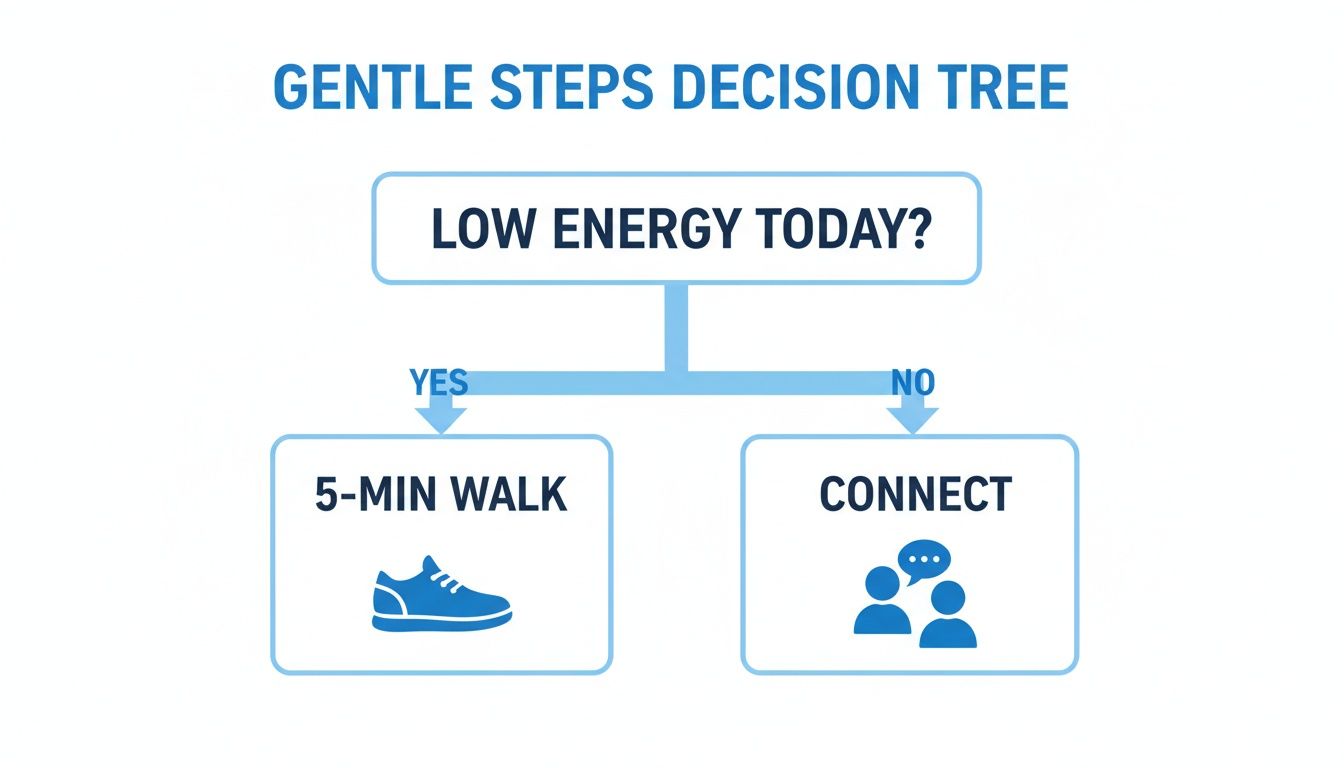
The key takeaway is that you don't need a grand plan. Just focus on the smallest, most manageable step you can take right now.
What to Expect from Therapy
Starting therapy can feel intimidating, but it's not about being "fixed." It is a partnership where you work with someone to explore the reasons behind your feelings, whether it's burnout from workplace stress, underlying anxiety, depression, or something else.
A good therapist will help you:
- Identify Patterns: Recognise hidden thought and behaviour loops that keep you feeling stuck.
- Develop Coping Skills: Learn practical strategies to manage difficult emotions and slowly re-engage with your life.
- Build Self-Awareness: Understand yourself on a deeper level—your needs, values, and strengths.
Important Clarification: Any assessments or screening tools you find online, including those on platforms like DeTalks, are for informational purposes only. They are designed to offer insights and guide you toward support, not to provide a medical diagnosis.
Ultimately, seeking professional help is a proactive choice to reclaim your sense of purpose and joy. It is an investment in yourself and a commitment to living a life that feels more connected and fulfilling.
Your Path Forward to Reconnecting with Life
Finding your way back to feeling engaged is a gradual process of rediscovery. The most important thing you can do is be patient and kind to yourself along the way.
If you’re losing interest in everything, please know this is a human experience, not a personal failing. It is a signal from your mind and body that something needs your attention. Identifying the root cause—be it workplace stress, anxiety, or depression—is the first step toward improving your well-being.
Embracing the Journey with Hope
Rediscovering what brings you joy often happens through small, intentional moments that bring you back to the present. It could be as simple as noticing the warmth of your morning coffee or taking five minutes for deep breaths.
Every tiny step forward matters. These small actions help rebuild the pathways to pleasure and cultivate your inner resilience. Aim for gentle progress, not perfection.
Acknowledging how you feel without judging yourself is the foundation of healing. It’s okay to feel disconnected; this self-awareness is precisely what gives you the power to move forward.
Supportive Takeaways for Your Path Ahead
As you navigate this, keep these gentle reminders in mind. Think of them as supportive guideposts to help you find your footing again.
- Be Patient with Yourself: Healing is not a straight line. There will be good days and tough days, and that is a normal part of the process.
- Explore Small Connections: Focus on tiny, manageable actions that re-engage your senses. A short walk or a brief chat with a trusted friend can make a real difference.
- Professional Support Is Strength: Reaching out for therapy or counselling is a brave act of self-care. It provides a safe space to explore your feelings with an expert guide.
Remember, you have the capacity to move through this. The path to reconnecting with your life is walked one gentle step at a time, and each one is a testament to your strength.
Frequently Asked Questions
It is normal to have questions when you are trying to understand why you're losing interest in things. Here are some straightforward, supportive answers to common questions to provide clarity.
Is Losing Interest in Everything Always a Sign of Depression?
Not always. While a loss of interest is a core feature of depression, it can also arise from other challenges. Intense workplace stress, burnout, high-level anxiety, grief, and even some physical health issues can lead to similar feelings.
The key is to consider the full picture. If this feeling of emptiness persists for more than a couple of weeks and impacts your daily life, it's a good idea to speak with a professional. They can help you understand what might be going on.
How Long Is It Normal to Feel This Way?
There is no exact timeline, as everyone's experience is unique. A helpful guideline is to seek support if you have felt a significant loss of interest or pleasure on most days for two weeks or more.
More importantly, pay attention to how this feeling is affecting your life. If it's causing you distress or making it hard to manage work, relationships, or self-care, that's a clear signal. Reaching out for professional counselling or therapy can be a supportive next step.
What Is the Difference Between Therapy and Counselling?
The terms therapy and counselling are often used interchangeably because they both provide valuable support. However, there are subtle differences in their approach.
- Counselling often focuses on specific, immediate issues like workplace stress or navigating a difficult life change. It tends to be solution-focused and may be shorter-term.
- Therapy may explore deeper, more ingrained patterns of thought and feeling to get to the root of something like persistent apathy. This can sometimes be a longer-term journey.
A good professional will help you determine which approach best fits your needs and supports your well-being.
Remember, both therapy and counselling provide a safe, confidential, and non-judgemental space. The most important factor is finding a professional you feel comfortable with and trust.
Can I Overcome This Feeling on My Own?
Sometimes, yes. If your lack of interest is tied to a temporary period of stress, gentle self-help strategies can be very effective. Practices like mindfulness, light exercise, or re-engaging your senses can help bring the colour back into your world.
However, if the feeling is deep, persistent, or connected to conditions like anxiety or depression, going it alone can be very difficult. Therapy provides a dedicated space to heal and equips you with tools that are hard to find on your own. Realising you might need support and asking for it is a sign of strength and a key step in building resilience.
Your journey back to joy and connection is deeply personal, but you don’t have to do it alone. If you feel ready to take that next step, DeTalks is here to provide a compassionate, confidential starting point. You can explore our directory of qualified therapists or take a free, science-backed assessment to get a clearer picture of what you’re experiencing.
Find your path forward at https://detalks.com.