
Tag: marriage counseling

  • What Is Marriage Counseling and How It Helps Couples

    What Is Marriage Counseling and How It Helps Couples

    Marriage counseling is structured, voluntary work with a trained clinician that helps partners change recurring conflict patterns and improve communication. It offers support and clearer choices, not a guarantee of reconciliation, and any assessment used is informational rather than diagnostic.

    Perhaps you've had another argument about money, a late arrival home, or a relative's expectations. You still care about each other, but you're tired of explaining yourself and unsure whether talking will help or start another fight.

    You don't need a polished explanation before seeking help. In India, where marital concerns may involve extended family, work demands, and privacy worries, finding room for an honest conversation can itself feel difficult.

    Understanding What Marriage Counseling Really Is

    Consider a familiar situation: a partner raises a concern about household responsibilities, and the other hears criticism. They defend themselves, the first partner pushes harder, and eventually someone stops speaking.

    The disagreement may concern chores, but the recurring interaction pattern deserves attention too. A clinician helps partners notice how criticism, withdrawal, defensiveness, and pursuit can reinforce each other, rather than deciding who won the argument.

    A guided process rather than family advice

    If you're asking, “What is marriage counseling?”, the important distinction is structure. Also called couples therapy, it involves identifying concerns, agreeing on goals, practising different responses, and reviewing what happens between appointments.

    Friends or relatives may offer reassurance or opinions. A trained clinician instead helps you examine the relationship without assuming that their personal expectations should determine your choices.

    This visual outlines the main elements of professional relationship work.
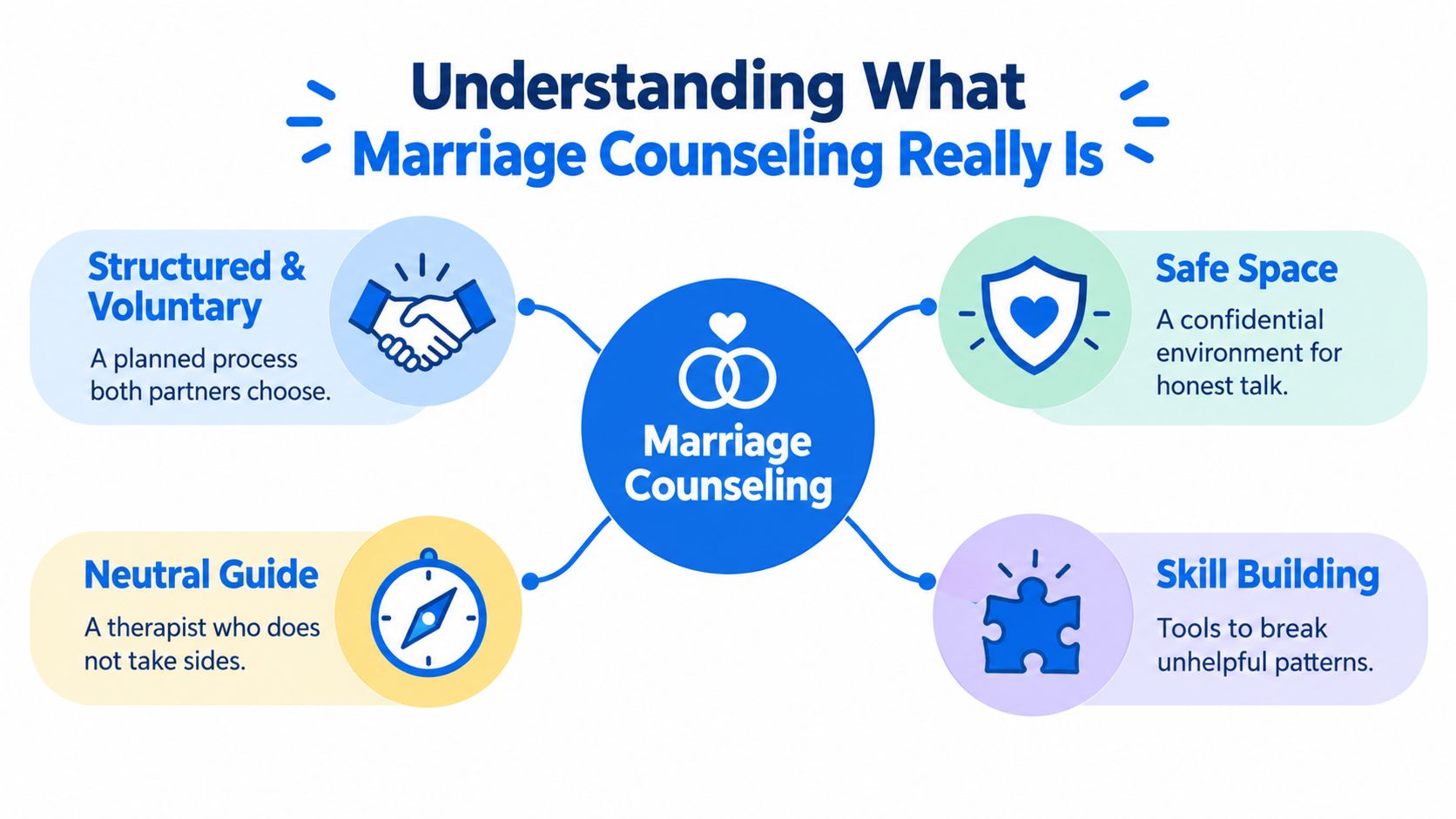
    An infographic titled Understanding What Marriage Counseling Really Is, illustrating four key elements of professional relationship therapy.

    • A clear purpose: You identify what needs attention instead of revisiting every disappointment at once.
    • Room for both perspectives: Understanding someone's feelings doesn't require agreeing with every interpretation.
    • Practical learning: Partners try different ways to speak, listen, and handle decisions outside the counselling room.

    What the evidence can and cannot tell you

    A meta-analysis of 58 studies involving more than 2,000 couples found a large improvement in relationship satisfaction, with an effect size of 1.12, and gains that persisted at short- and long-term follow-up, as summarised in this couples-therapy evidence overview. An effect size describes the magnitude of change in research; it isn't a personal success probability.

    If you're also navigating a court-related process abroad, Goodhand's explanation of what to expect at family guidance offers a separate resource about the Dubai court context. Don't assume that court guidance and voluntary psychological therapy serve identical purposes.

    Professional neutrality also has limits: treating both partners respectfully must never mean treating harmful behaviour as acceptable.

    Goals and Benefits Couples Typically Work Toward

    Better communication becomes useful when you can recognise it at home. A goal such as feeling understood needs a practical expression: finishing a thought without interruption, asking a clarifying question, or returning to a difficult discussion after a pause.

    In a session, a counsellor might ask each partner to describe a recent disagreement without guessing the other person's intentions. The listener then checks whether they understood before offering their own perspective.

    Turning broad hopes into everyday actions

    Different concerns need different goals. Financial tension may require clearer responsibility for expenses, while extended-family pressure may require an agreement about which decisions belong to the couple.

    • Calmer turn-taking: Let the speaker finish, then respond to the concern rather than collecting counterarguments.
    • Clearer financial conversations: Separate practical questions about spending from fears about security, fairness, or independence.
    • Shared family boundaries: Discuss how you'll respond to relatives without requiring either partner to reject their family.
    • A kinder pace: Choose a time when both people can engage, rather than demanding resolution during exhaustion.

    These are practice targets, not tests of whether you're a good spouse. A difficult attempt can still reveal what needs adjusting.

    Supporting the person as well as the partnership

    India's National Mental Health Survey 2015–16, covering 34,802 people across 12 states, estimated that 10.6% of adults had a current mental disorder and nearly 15% needed mental-health intervention, according to the national survey findings. These findings provide wider context, not evidence that relationship difficulties automatically indicate a mental-health condition.

    A counsellor should make room for anxiety, depression, and distress without reducing everything to marital conflict. Sometimes a partner needs individual support alongside relationship work.

    Counselling can also include resilience, compassion, and happiness as personally meaningful goals. Suggested practices might include acknowledging a partner's effort, restoring a shared enjoyable activity, or discussing what makes your life together feel worthwhile.

    A useful goal: Aim for a conversation you can recover from, not a relationship in which nobody ever disagrees.

    The point isn't to remove every uncomfortable feeling. It's to develop responses that make room for difficulty without repeatedly hurting each other.

    Common Approaches and Techniques Explained

    Different therapy approaches offer different ways of understanding the same relationship. Ask a clinician to explain their method in ordinary language and connect it to the concerns you've brought.

    For example, an argument about unanswered messages could involve fear of disconnection, an unclear practical agreement, or expectations learned in earlier family life. Each perspective suggests a different place to begin.

    Different lenses on the same difficulty

    Approach What you might explore or practise
    Emotionally focused work Naming the hurt or fear beneath an argument and recognising the cycle you both enter.
    Behavioural skills work Rehearsing a clear request, checking understanding, or agreeing how to pause and resume a discussion.
    Insight-oriented work Exploring how earlier family experiences shape expectations about closeness, money, or disagreement.
    Positive-psychology and mindfulness-informed work Noticing strengths, acknowledging care, and pausing to recognise emotions before responding.

    These examples describe possible session activities, not a prescription for every couple. A useful question is whether the clinician can explain why an approach fits your situation.

    A therapist may draw the interaction pattern so both partners can examine it together.

    A professional therapist explains a circular diagram to a couple during a marriage counseling session.

    Making the work culturally responsive

    Indian relationship work should consider language preference, religious expectations, family involvement, and whether meetings are individual, joint, or sequential. Respecting culture doesn't mean accepting unequal treatment without discussion.

    Indian research includes a Mumbai community intervention using four single-gender and two mixed-gender sessions, with participating couples describing improvements in family relations, sexual-health knowledge, and emotional well-being; recruiting men remained a challenge, as discussed in this Indian counselling research. These local findings shouldn't be treated as a universal outcome.

    Progress can be reviewed through relationship satisfaction, conflict behaviour, distress, and safety, rather than marital status alone. Repeated assessments remain informational and need professional interpretation.

    If your questions concern negotiated agreements rather than therapeutic work, the Badesha Law mediation guide is a separate legal-context resource. Clarify which service you need, and seek India-specific legal advice when applicable.

    What Happens in a Typical Session

    You might arrive wondering whether you'll have to reveal everything immediately. A thoughtful opening can begin more easily: what brought you here, what feels hardest, and what you hope might become different.

    The clinician should explain consent, confidentiality boundaries, and how information from separate conversations will be handled. Ask these questions before sharing something you're concerned could place you at risk.

    The session process may look broadly like this, although the order can change according to your needs.
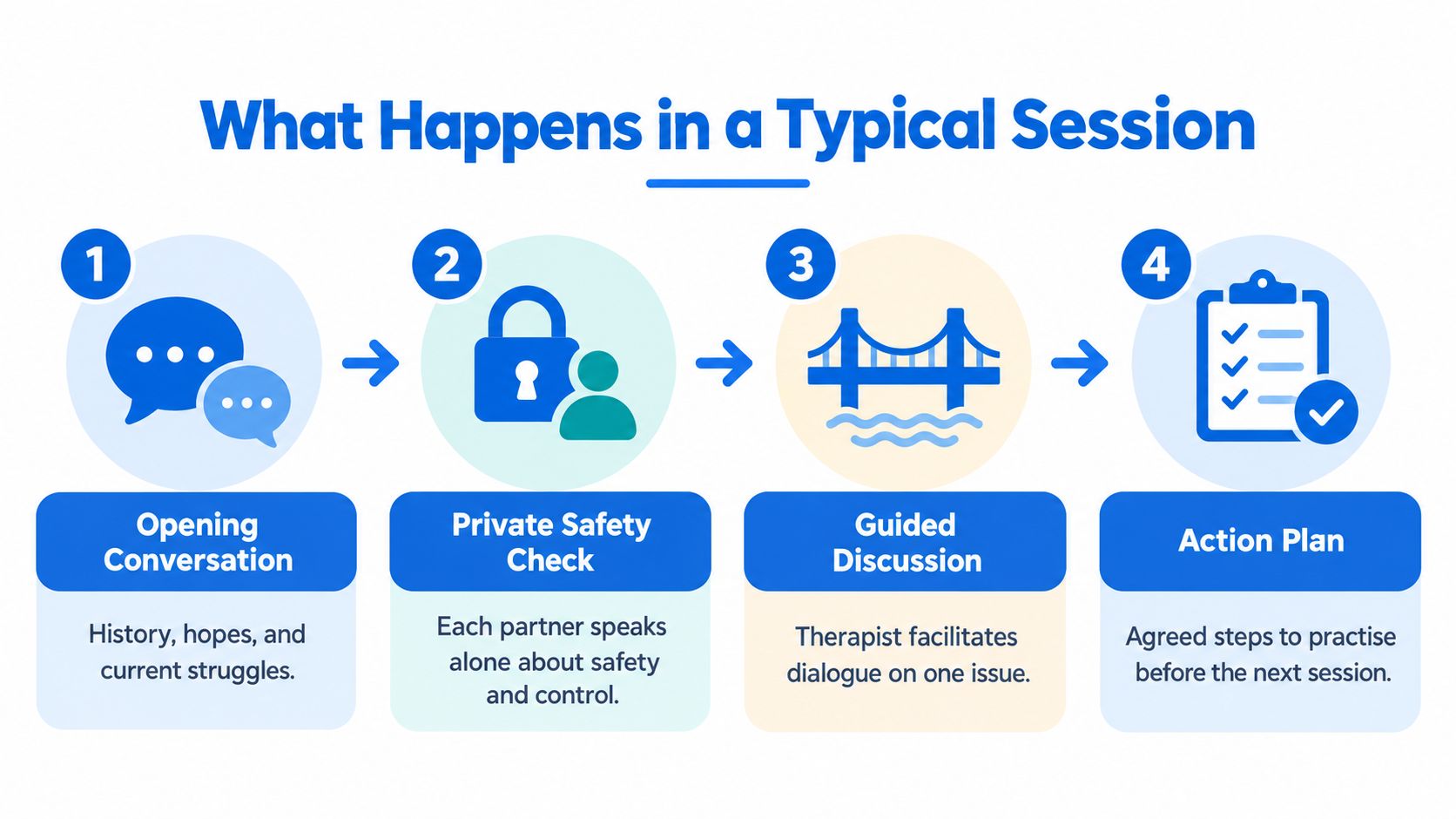
    A four-step infographic showing the process of a typical marriage counseling session, from initial conversation to action plan.

    Listening before attempting solutions

    An intake should include private safety screening for coercive control, physical or sexual violence, severe substance misuse, and acute mental-health risk. Joint discussion shouldn't begin with an assumption that both partners can speak freely and safely.

    If joint work is appropriate, you may examine a recent disagreement. The therapist might slow the conversation, ask what each person heard, and help distinguish the original concern from the responses that followed.

    A take-home practice should be specific and manageable. For example, you might agree to check an interpretation before replying, then discuss what happened at the next appointment.

    • Format: Ask whether in-person or online sessions suit your privacy and circumstances.
    • Length and frequency: Confirm these directly with the provider; there's no single schedule to assume.
    • Pace: Ask how the plan changes if individual attention is needed before further joint work.

    Voluntary and court-connected counselling in India

    The Family Courts Act of 1984 established a framework emphasising conciliation and specialised family-dispute handling; a convention marking 25 years of Mumbai's Family Court brought together 98 counsellors from 14 states, who reported similar case types but differing implementation, according to this account of Indian family-court counselling.

    A legally referred appointment may therefore feel different from choosing private therapy. Clarify the purpose of the service and what information may be reported.

    If you prefer a video alongside the written explanation, you can view the following resource.

    Signs Counseling May Help and When to Pause

    You don't have to wait until separation feels imminent. Relationship concerns are worth discussing when your usual attempts to resolve them leave you repeatedly stuck, disconnected, or uncertain.

    The reason for seeking help might be co-parenting, financial disagreement, intimacy concerns, caring for children or elders, or rebuilding trust after an incident. The practical question is whether professional support could help you understand and respond to the difficulty.

    Signs worth bringing to an appointment

    • Repeated arguments: You revisit the same issue without reaching a workable agreement.
    • Emotional distance: You manage household tasks together but struggle to share your inner lives.
    • Trust strain: A lie, betrayal, or broken agreement has left unresolved questions.
    • Competing responsibilities: Parenting, elder care, or work leaves little room for connection.

    Work deserves attention too. A 2022 study of 1,764 urban white-collar employees found moderate-to-severe anxiety symptoms in 55%, moderate-to-severe depression symptoms in 29%, and moderate-to-high stress in 78%, as reported in this Indian workplace mental-health research.

    These figures concern that study population, not every Indian worker. They support asking about workplace stress, burnout, sleep, and the transition from work to home; screening scores are informational, not diagnostic.

    The following chart offers prompts for deciding what kind of help to seek.
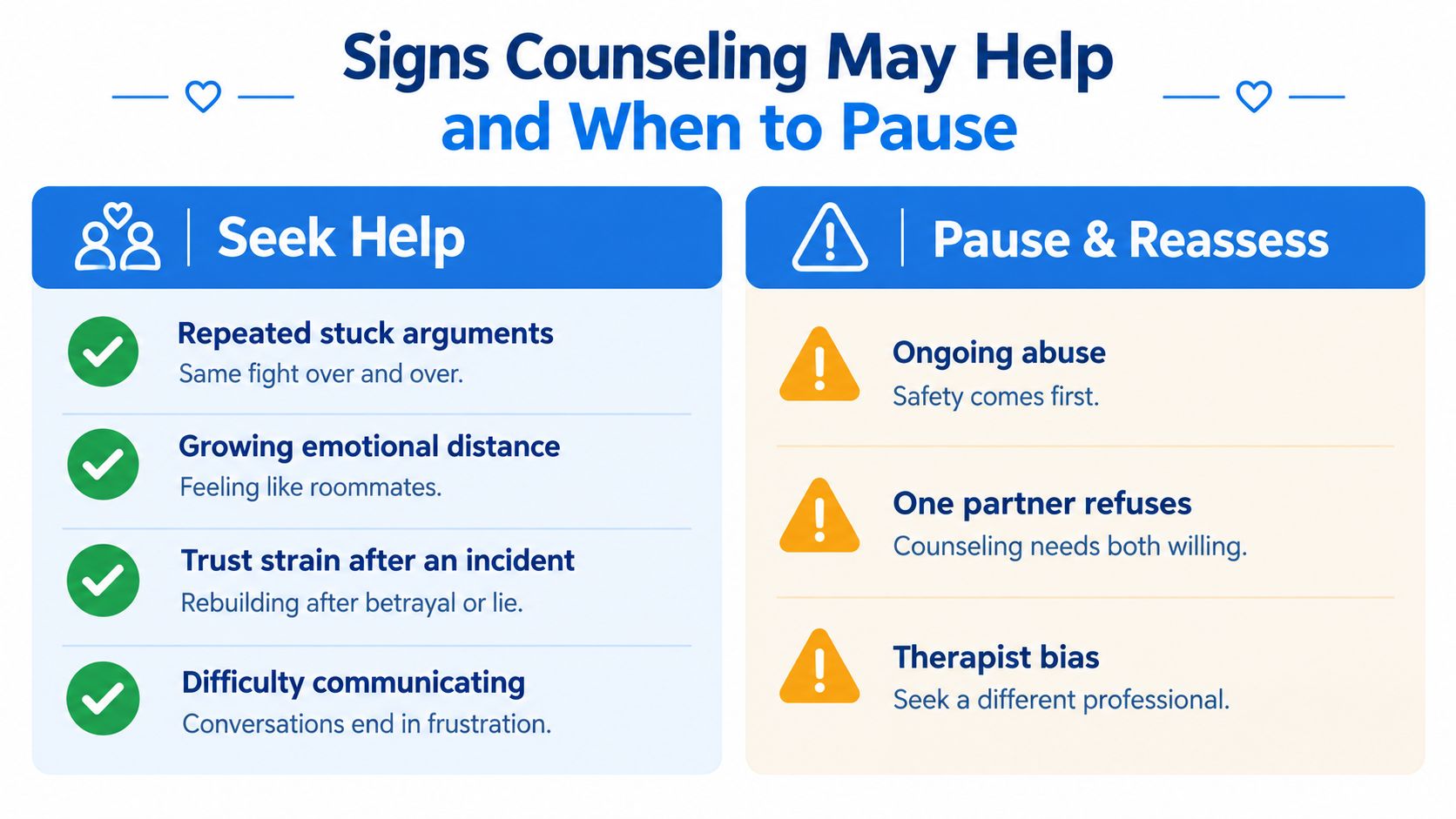
    A chart comparing signs when marriage counseling might help versus when to pause and reassess the situation.

    When the plan needs to change

    Coercive control, threats, violence, severe substance misuse, or an active mental-health crisis may make conventional joint sessions inappropriate. Individual safety planning, specialist services, or psychiatric care may need to come first.

    Safety comes first: Being frightened of what will happen after an honest disclosure is different from feeling nervous about a difficult conversation.

    A reluctant partner means pausing the joint plan, not abandoning your own access to support. Likewise, if a therapist minimises harm or pressures you to accept mistreatment, seek another professional opinion.

    When Only One Partner Is Ready to Start

    You may be ready for counselling while your partner says the problem is private, doubts therapy, or refuses to attend. That doesn't mean you must wait indefinitely before seeking help for yourself.

    Indian evidence identifies stigma, family influence, and limited access to qualified counsellors as participation barriers, making the usual requirement that both partners attend incomplete, as discussed in this Indian study of counselling barriers. Reluctance deserves exploration, but it doesn't justify pressure or coercion.

    Begin with what you can decide

    Individual, relationship-focused counselling can help you clarify your goals and choices. It isn't a way to diagnose an absent partner or recruit a therapist to prove that you're right.

    • Name your own concern: Explain what you're experiencing and what you want help deciding.
    • Identify workable boundaries: Discuss what you can accept, what needs to change, and what you'll do if an agreement isn't respected.
    • Explore an invitation: Offer information about counselling and leave your partner room to decide.
    • Check feasibility: Consider privacy, cost, language, scheduling, and whether participation would be safe.

    You might say that you're seeking help to understand your own responses and would welcome their participation if they become willing. Avoid turning attendance into evidence of love or loyalty.

    Separate hesitation from intimidation

    A partner's uncertainty about therapy is different from preventing you from obtaining support. Financial dependence, family pressure, and fears about privacy can make that distinction difficult to assess alone.

    A counsellor can help you examine the circumstances without assuming that every marital disagreement has equal responsibility on both sides. Where intimidation or harm is present, referrals to domestic-violence, legal, or psychiatric services may be more appropriate than another invitation to attend together.

    You can take responsibility for your choices without taking responsibility for another person's harmful behaviour.

    Ask how your individual confidentiality will work if joint sessions become possible later. The clinician should explain whether they can change roles and what consent would be needed.

    Your first useful outcome may be clearer thinking rather than a partner's immediate participation. That clarity can help you choose a next step without rushing or surrendering your autonomy.

    How to Find a Qualified Couples Therapist

    Look for evidence of relevant qualifications and relationship-specific training, not just a reassuring profile photograph. In India, ask about recognised university education in counselling psychology or clinical psychology, supervised practice, and ongoing professional development.

    Professional-body membership may be useful background information, but it shouldn't replace checking the clinician's actual training and experience. Ask whether they regularly work with couples facing concerns similar to yours.

    Questions that reveal a useful fit

    A short introductory conversation can help you understand the clinician's working style. You're not asking them to resolve the marriage during that call; you're checking whether the service fits.

    • Training and experience: What preparation have you had for couples work and safety screening?
    • Cultural fit: Can we work in our preferred language, and how do you approach religious or family expectations?
    • Privacy: How are records, online sessions, and separate disclosures handled?
    • Practical arrangements: What are the fees, cancellation terms, proposed frequency, and review points?

    Among directory options, DeTalks allows users to browse professional profiles, book therapy sessions, and explore informational assessments and self-help resources. You can also approach a clinic directly or ask an existing healthcare professional for referral options.

    Look beyond reducing conflict

    Ask whether the clinician makes room for strengths and growth as well as distress. India's positive-psychology context supports goals involving resilience, compassion, emotional understanding, and shared well-being, while assessments should be interpreted with a qualified professional rather than treated as definitive, as outlined in this mental-health and well-being resource.

    During early appointments, expect an explanation of the proposed work and an opportunity to ask questions. You should understand the goals, the clinician's role, and how you'll review whether continuing is useful.

    If you don't feel heard, raise that concern when it's safe to do so. You can ask for a different approach, request a referral, or choose another professional without treating the mismatch as a personal failure.

    Supportive Takeaways for Your Next Step

    Marriage counselling is a form of support, not a verdict on your relationship. Seeking it doesn't prove that you've failed, and declining a particular service doesn't mean you've rejected every possible way forward.

    The most helpful next step depends on your circumstances. Joint therapy, individual counselling, practical self-help, peer support, or coaching may address different needs, but informal or growth-focused support shouldn't replace specialist care when safety or significant clinical concerns require it.

    Make the first step manageable

    You don't need to agree on the future of the marriage before asking what support is appropriate. You can begin by finding a qualified professional, checking privacy arrangements, and explaining the concern you most want help understanding.

    • Choose a starting concern: Write down what happens, how it affects you, and what you'd like to discuss.
    • Identify practical needs: Note language preferences, availability, affordability, and whether you have somewhere private to speak.
    • Keep your choices open: An introductory conversation is an opportunity to learn about the service, not a promise to continue indefinitely.

    In India, access and family circumstances can complicate help-seeking. Start with an option that is realistically available to you rather than waiting for an ideal arrangement.

    Hold hope alongside honest limits

    A relationship can deserve care without being guaranteed repair. Growth-oriented practices such as gratitude, shared meaning, and calmer communication belong alongside honest attention to distress, not in place of it.

    Any self-assessment should remain a conversation aid, not a diagnosis or an instruction about whether to stay married. Your lived experience and a qualified professional's judgement matter more than a score considered in isolation.

    You're allowed to seek understanding before you know what decision you'll make.

    Try to approach yourself with the same compassion you hope to bring into the relationship. A small, considered step towards support is enough for today.


    DeTalks offers a directory of psychologists, therapists, and counsellors, alongside informational assessments and self-help resources for relationship concerns and personal well-being. Visit DeTalks to explore relationship-focused support, check a professional's suitability, and book an appointment that fits your needs.

  • Online Couples Counseling to Rebuild Your Connection

    Online Couples Counseling to Rebuild Your Connection

    Every relationship, like a garden, needs care and attention to flourish. Online couples counselling offers a warm, practical way for partners to nurture their connection, providing expert guidance from the comfort and privacy of your home. Taking this step is a positive move toward building a stronger, more resilient partnership.

    Why Modern Couples Are Turning to Online Therapy

    Life today is often busy and demanding. Juggling work, family, and personal time can create stress in a relationship, leading to communication gaps that leave partners feeling disconnected. Seeking support is a healthy, proactive way to keep your bond strong.

    Online therapy provides a convenient and private space for couples to work through challenges together. It removes common barriers like travel and scheduling conflicts, making it easier to prioritize your relationship. This allows you to connect with a qualified professional in a calm, focused headspace for important conversations.

    A Space to Grow and Understand Each Other

    At its heart, couples counselling helps foster deeper understanding and emotional closeness. A neutral professional guides you both to explore communication patterns, identify difficult areas, and find new ways to support one another. The goal is not just to fix problems, but to build lasting skills for a happier future, helping you solve communication breakdowns in a relationship.

    Digital support is becoming increasingly common, especially for busy couples in places like India and around the world. As we grow more comfortable with virtual interactions, online therapy is seen as both effective and practical. It fits naturally into our modern lives.

    Taking Proactive Steps for a Healthier Bond

    Deciding to start therapy is a powerful sign of your commitment to each other and your future. It's a true investment in your shared well-being, helping you navigate current challenges and face future ones as a stronger team.

    Think of online couples counselling as a dedicated workshop for your relationship. It is a space to build stronger foundations and learn new tools for growth, guided by an expert who supports your shared goals.

    By addressing issues like lingering anxiety or unresolved arguments, you can prevent them from becoming bigger problems. This supportive process helps partners develop greater empathy, strengthen their emotional connection, and rediscover joy. It's all about building a future where you both feel heard, valued, and understood.

    Understanding How Online Couples Counselling Works

    Taking the first step into couples counselling can feel uncertain. It helps to understand what happens in a session. Online couples counselling is professional relationship therapy delivered through a secure video call, offering expert support with greater flexibility.

    Your therapist acts as a skilled guide and neutral third party, not a judge. Their role is to help you both hear each other's perspectives in a safe and respectful environment. This allows for open and honest conversations.

    The main goals are to improve communication skills, find healthier ways to manage disagreements, and rekindle your emotional connection. It is a collaborative effort between you, your partner, and your therapist to strengthen your relationship's foundation.

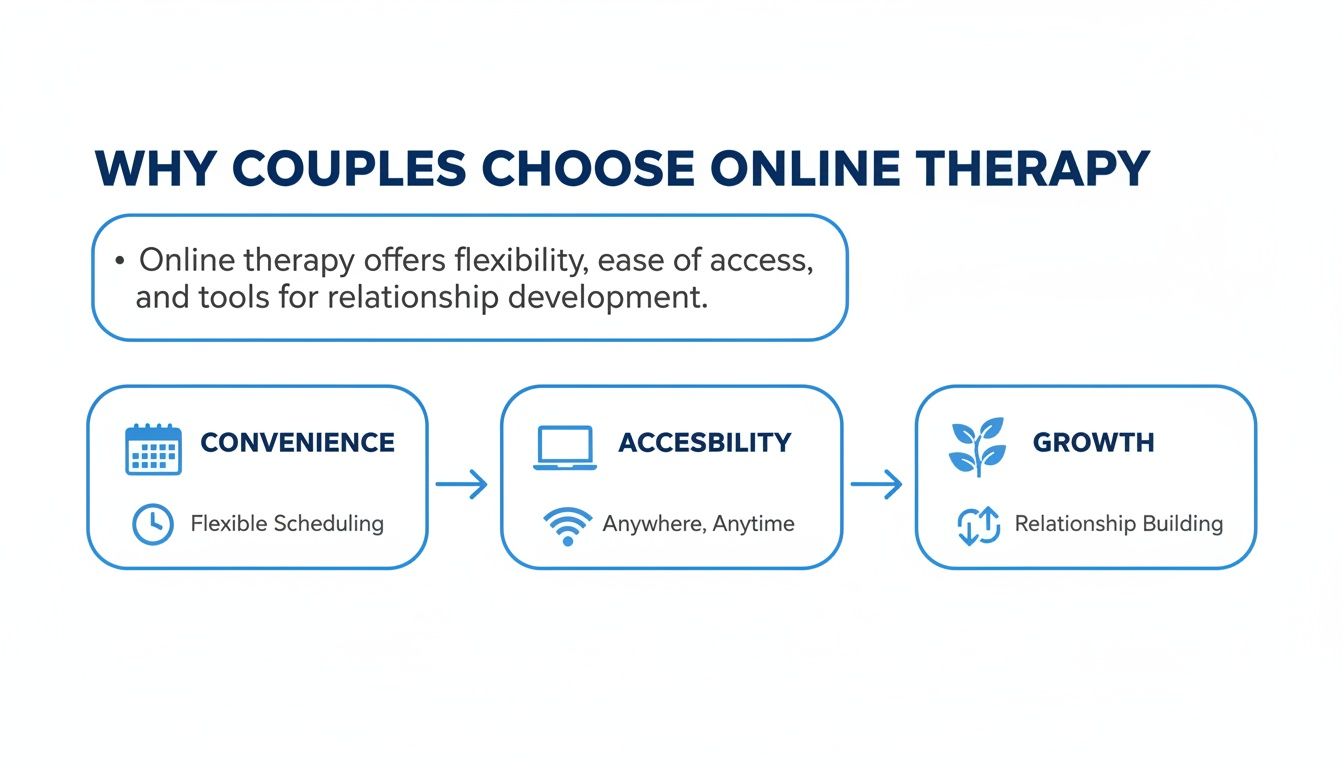
    This visual captures some of the core reasons why so many couples are finding this approach helpful.

    Diagram explaining why couples choose online therapy, detailing convenience, accessibility, and relationship growth benefits.

    This blend of convenience, accessibility, and a genuine focus on growth makes online therapy a practical choice for investing in your partnership.

    What Kinds of Issues Can Be Addressed?

    Couples seek therapy for many reasons, from daily friction to major life events. Online counselling provides a structured space to work through a wide range of issues that can create distance and stress in a relationship.

    Some common areas of focus include:

    • Communication Breakdowns: Feeling like you're talking past each other is a common challenge. Therapy teaches you how to listen actively and express yourselves clearly.
    • Conflict Resolution: If you're stuck in the same arguments, a counsellor can provide tools to break the cycle and find resolutions.
    • Trust and Infidelity: Rebuilding trust is a difficult emotional journey. A therapist can guide you through the necessary conversations to heal and move forward.
    • Life Transitions: Major changes like marriage, a new baby, or a job change can strain a relationship. Therapy helps you navigate these shifts as a team.

    How a Typical Session Is Structured

    While each therapist has their own style, most online sessions follow a similar flow. You and your partner will join a secure video call from a quiet, private space, either together or from different locations.

    Your counsellor will begin by creating a calm and safe atmosphere. The first few sessions focus on getting to know your relationship's history, understanding your perspectives, and clarifying your shared goals for counselling.

    "The goal of therapy is not to assign blame. Instead, it is about identifying unhelpful patterns and building new, healthier ways of relating to each other. It’s a journey toward greater resilience and well-being, both as individuals and as a couple."

    As you progress, your therapist will introduce practical exercises and communication strategies. These tools can help manage challenges like workplace stress and anxiety, building a deeper connection. The process is designed to be supportive, fostering empathy and guiding you toward a happier partnership.

    Is Online Relationship Support Right for You?

    Taking the first step toward relationship support is a positive and hopeful move. Counselling is not just a last resort; it's a valuable resource for any couple looking to deepen their bond and build a more satisfying life together. It’s about being proactive, not just reactive.

    Many couples find themselves in a routine that feels more like roommates than partners. Online therapy creates a dedicated time to unpack these feelings, understand the disconnect, and learn practical skills to bring back intimacy and affection.

    Scenarios Where Online Counselling Can Help

    Every relationship is unique, but many of the challenges couples face are common. Online counselling is particularly helpful when traditional in-person therapy is difficult to access. If any of these situations sound familiar, online support could be a great fit.

    Consider online support if you're:

    • Stuck in the Same Old Fights: A therapist can act as a neutral guide, helping you break negative patterns and learn healthier ways to communicate.
    • Recovering from a Betrayal: Guided therapy provides a safe, structured path to work through the hurt, explore forgiveness, and decide how to move forward together.
    • Making a Long-Distance Relationship Work: Online counselling bridges the physical gap, offering a dedicated space to strengthen your connection across any distance.
    • Wrangling Hectic Schedules: The flexibility of online sessions makes it possible to prioritize your relationship, even with demanding jobs or family commitments.

    A Proactive Approach to a Healthier Partnership

    You don’t have to wait for a crisis to seek support. Proactive counselling can help a good relationship become even stronger, like preventative care for your partnership. It helps you maintain your emotional and relational health.

    This approach is all about building resilience. You'll learn tools to handle life's challenges, from workplace stress to unexpected changes, as a unified team. This focus on positive psychology helps you create more joy, compassion, and happiness in your life together.

    How to Find the Right Online Couples Therapist

    Finding a therapist who makes you both feel safe and understood is the most important step. Think of them as a guide who can help you navigate difficult conversations with skill and compassion. Taking the time to find the right fit is an investment in your relationship's future.

    The goal is to find the right person for your unique partnership. The connection you build with your counsellor, known as the therapeutic alliance, is a strong predictor of a positive outcome. It is vital that you both feel comfortable with their approach.

    A couple sits at a table, looking at a tablet displaying a professional profile, with coffee mugs nearby.

    Understanding Credentials and Specialisations

    As you search, you will find therapists with various qualifications. Look for professionals with specific training in relationship dynamics. Specialised certifications in couples work are a significant advantage.

    Two highly respected, evidence-based approaches you might see are:

    • The Gottman Method: This practical approach is based on decades of research. It focuses on skills for managing conflict, deepening friendship, and creating shared meaning.
    • Emotionally Focused Therapy (EFT): This model helps couples understand and change negative cycles. It aims to create a more secure emotional bond by helping you express deeper needs and feelings.

    A therapist trained in these methods will have a clear framework to help you address challenges and grow together.

    Using Platforms Like DeTalks to Your Advantage

    Modern platforms like DeTalks make it much easier to find a qualified professional. You can filter your search based on specific needs and browse detailed profiles that outline their experience and therapeutic philosophy.

    Reading these profiles carefully is key. Does their approach resonate with you? Do they have experience with challenges like workplace stress, managing anxiety as a couple, or navigating feelings of depression? This helps you create a shortlist of potential therapists.

    Remember, the initial consultation is a two-way interview. It's your opportunity to assess the therapist, just as much as they are getting to know you. Feeling a sense of connection and trust from that very first conversation is a fantastic sign.

    Many platforms offer introductory calls, which are valuable for getting a feel for the therapist. This is your chance to ask questions and see how they interact with both of you. Pay attention to how you feel during and after the call.

    Key Questions to Ask in a Consultation

    An initial consultation is the perfect time to ensure the therapist's approach aligns with your goals. Having a few questions ready can help you make a confident decision. This is a conversation to see if your communication styles connect.

    Here’s a quick checklist to guide your discussion:

    1. What is your approach to couples counselling? This helps you understand their philosophy and the methods they use.
    2. What’s your experience with issues like ours? You want someone who has navigated similar territory before.
    3. How do you structure your sessions? This gives you a practical idea of what to expect.
    4. How do you ensure both of us feel equally heard? A skilled therapist is neutral and balances the conversation.
    5. How do you view setting goals for therapy? This clarifies how you'll work together to define a successful outcome.

    Choosing a therapist is a personal decision. The goal is to find a culturally sensitive professional who helps you both feel seen and hopeful. A thoughtful search sets the stage for a positive experience with online couples counselling and a stronger partnership.

    What to Expect in Your First Few Sessions

    It is completely normal to feel a mix of hope and nervousness before your first therapy session. Starting online couples counselling is a big step. The first few meetings are about building a foundation of trust and helping you get comfortable with the process and your therapist.

    Your therapist will likely begin by getting to know you and your relationship’s history. They will listen as you describe your challenges and, just as importantly, what you hope to achieve together. This helps the therapist gain a complete picture of your connection.

    Smiling couple attends an online counseling session on a laptop in their cozy living room.

    Setting the Stage for Open Conversation

    The goal of early meetings is not to determine who is right or wrong. It's a team effort to identify recurring patterns that may be creating distance between you. Your therapist acts as a guide, helping you see these cycles from a fresh, more compassionate perspective.

    To get the most out of your sessions, prepare your physical space beforehand. Find a quiet, private spot where you won't be interrupted. A stable internet connection and comfortable seating will help you focus on the conversation and each other.

    Understanding the Role of Assessments

    Sometimes, a therapist might use questionnaires to gather more information. These are not tests. They are simply tools to offer insights into things like communication styles, sources of workplace stress, or individual well-being.

    It’s important to remember that these assessments are not diagnostic. They are informational guides that provide a clearer starting point for your therapy journey, highlighting both strengths and areas for growth.

    This information helps your therapist tailor the counselling specifically to you, ensuring the process is relevant and effective.

    Establishing Collaborative Goals

    By the end of the first few sessions, you, your partner, and your therapist will work together to set clear, achievable goals. This is a critical step that ensures everyone is on the same page and working toward a shared vision. This process turns a vague hope for change into a concrete plan for building a stronger connection.

    These initial meetings are a guided exploration focused on building resilience and fostering compassion. The supportive takeaways should leave you feeling hopeful and better equipped for the journey ahead, focusing on your shared well-being rather than promises of a cure for challenges like anxiety or depression.

    Making the Most of Your Therapy Journey

    Starting online couples counselling shows you are both invested in building a stronger future together. Getting the most out of it requires patience, practice, and a commitment from both of you to apply what you learn in your daily lives.

    It's normal for challenges to arise during therapy; in fact, they are often opportunities for growth. For instance, one partner may feel hesitant at first. Approaching this with empathy and framing therapy as something you are doing for the relationship can help.

    Navigating Common Hurdles Together

    If your partner is unsure, focus the conversation on shared goals, like wanting more laughter or less tension. This shifts the dynamic from blame to collaboration, making therapy feel like a positive investment in your future happiness.

    Talking about sensitive subjects can also feel uncomfortable, but this discomfort is often a sign of progress. A good therapist creates a safe, non-judgmental space for these conversations. Remembering this can help you move through the difficult moments.

    Overcoming these small challenges together can become a powerful part of the therapeutic process itself. It’s in these moments—showing patience with a skeptical partner or offering support during a tough conversation—that you begin to build new patterns of compassion and resilience.

    Here are a few practical tips to help you navigate this:

    • Create a "We" Frame: Talk about therapy as something "we" are doing for "us" to reinforce that you are a team.
    • Practice Patience: Lasting change takes time. Celebrate small wins and acknowledge the effort you are both making.
    • Schedule Practice Time: Set aside 15-20 minutes a few times a week to practice the communication exercises your therapist provides.

    From Insights to Action

    A key challenge is applying what you learn in therapy to real life. It takes consistent practice to use new skills when you are feeling stressed or frustrated. This is where the real work of building a stronger relationship happens.

    This journey also helps rebuild your emotional bond and address feelings of isolation. To deepen your connection and learn more about overcoming distance, you may find it helpful to explore resources on how to deal with loneliness and build real connections.

    Ultimately, making the most of your online couples counseling comes down to showing up for your sessions, your partner, and yourself. It is an active process of turning moments of anxiety and friction into opportunities for a much deeper connection.

    Frequently Asked Questions

    It's completely normal to have a few questions before diving into online couples counselling. Let's walk through some of the most common ones to help you get a clearer picture of what to expect and feel confident about taking this step for your relationship.

    Is Online Couples Counselling as Effective as In-Person Therapy?

    Absolutely. For most couples, online therapy can be just as powerful as sitting in a therapist's office. A growing body of research, along with countless real-world success stories, shows that video sessions deliver fantastic results in improving communication, navigating conflict, and boosting overall relationship happiness.

    Ultimately, what makes therapy work isn't the room you're in—it's your commitment to the process and the connection you build with your therapist. The best format is simply the one that works for your life and allows you both to show up fully and engage.

    What If My Partner Is Hesitant to Try Counselling?

    This is a big one, and it's something many couples face. The key is to approach the conversation with empathy, not pressure. Try framing it as a project you can tackle together to make your team stronger, rather than something meant to "fix" your partner or place blame.

    Often, suggesting just one initial consultation can feel like a much smaller, less intimidating step. Many partners who are initially on the fence find that the privacy and comfort of being at home for online couples counselling takes a lot of the pressure off. Once they see it's a supportive space, that hesitation usually melts away.

    How Much Does Online Couples Counselling Typically Cost?

    Costs can range quite a bit, and they usually depend on the therapist's level of experience, their specific qualifications, and the platform you choose. The good news is that many online services offer access to professionals at various price points, so you can often find great support that aligns with your budget.

    It can be helpful to reframe the cost. Instead of viewing it as just another weekly bill, think of it as a meaningful investment in the long-term health, happiness, and resilience of your partnership.

    How Will We Know If the Therapy Is Working?

    Progress in therapy isn't always a dramatic, overnight change. More often, it reveals itself in small but significant shifts in your daily interactions. You might suddenly realise you're able to talk about a touchy subject without it blowing up, or you catch yourself truly listening to your partner's side of things instead of just waiting for your turn to talk.

    Here are a few signs you're on the right track:

    • You start feeling more like partners and less like roommates.
    • You notice disagreements de-escalate much faster than they used to.
    • You feel a renewed sense of hope and optimism about your future together.

    A good therapist will also make a point of checking in with you both regularly. They'll help you reflect on the goals you set at the beginning and see how you’re progressing, ensuring the counselling stays on track and genuinely helps you both.


    Ready to take that first step towards a stronger, happier relationship? The right support can make all the difference. On DeTalks, you can find experienced therapists who specialise in working with couples. Take a look and book a confidential session today. You can explore your options and find a therapist on DeTalks.