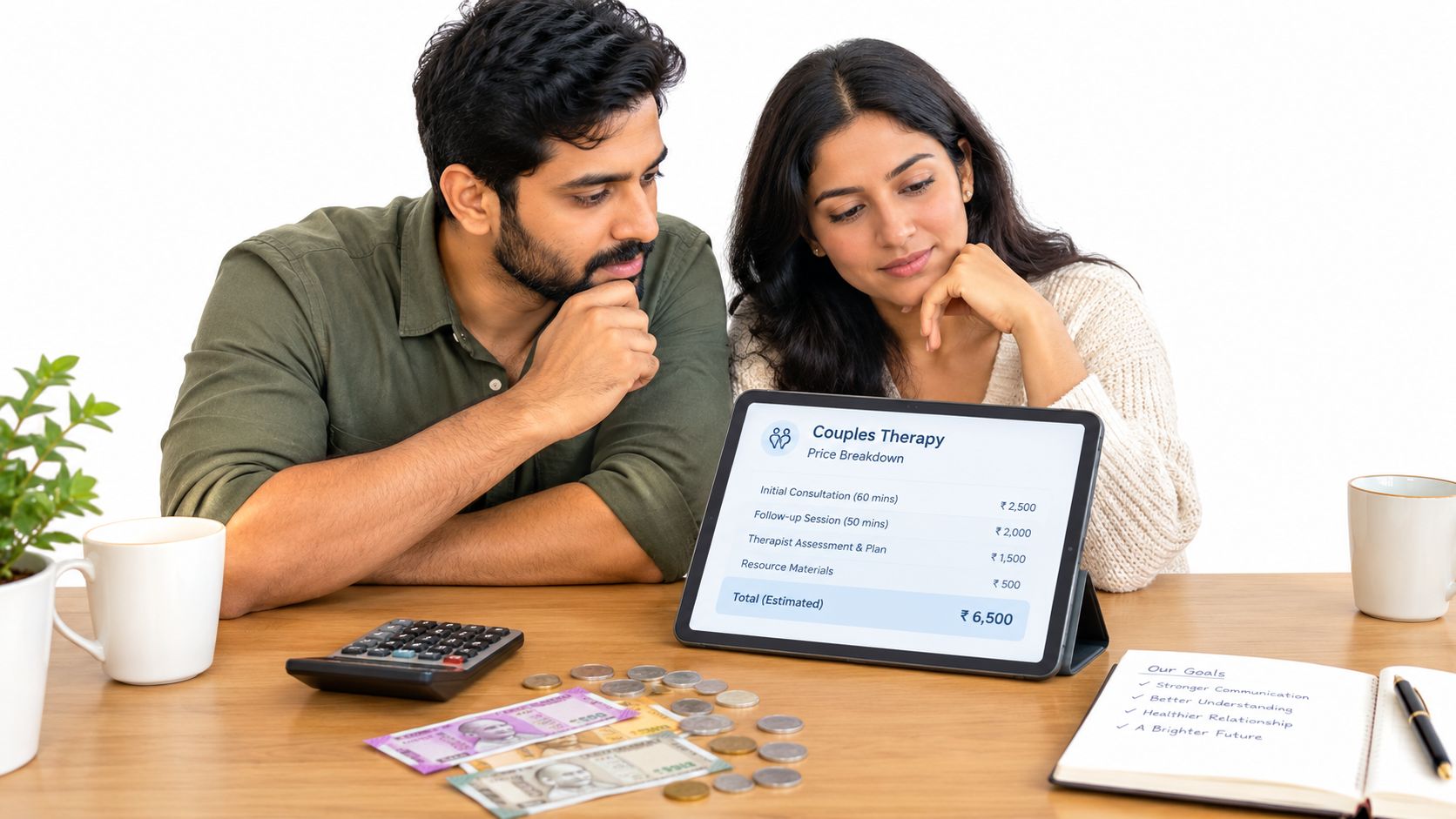
Couples therapy in India typically costs about ₹500 to ₹7,000 per session, although the wider market can run from free or subsidised services to ₹15,000 or more for top metro specialists. The amount depends mainly on the city, therapist experience, session format, and whether you meet online or in person.
You may be searching for help after the same argument has returned for the tenth time, or while stress, anxiety, workplace pressure, and money worries are making every conversation harder. You're not only asking whether therapy could help. You're asking whether you can afford to begin, continue, and choose a therapist who understands both partners.
Why Couples Therapy Feels Like a Big Financial Question
An Indian couple in their thirties might sit with a laptop open to therapy directories, a list of monthly bills beside it, and two very different opinions about spending money on counselling. One partner may say, “We should start now.” The other may worry that a few sessions will become an open-ended expense.
That concern is reasonable. The couples therapy cost in India isn't one fixed market rate. A guide from Mentis on couples therapy pricing places private metro sessions around ₹2,000–₹5,000, smaller-city sessions around ₹1,000–₹2,500, online couples therapy around ₹1,200–₹3,000, subsidised NGO services at free to ₹500, and government hospitals at roughly ₹50–₹200 per session.
| Setting | Indicative cost per session | What usually shapes the fee |
|---|---|---|
| Government hospital services | About ₹50–₹200 | Subsidy, availability, and waiting time |
| NGO or subsidised services | Free to ₹500 | Funding, eligibility, and capacity |
| Smaller-city private therapy | ₹1,000–₹2,500 | Local demand and therapist experience |
| Online couples therapy | ₹1,200–₹3,000 | Platform, therapist tier, and format |
| Metro private therapy | ₹2,000–₹5,000 | City, training, and practice costs |
Money can become part of the relationship conflict itself. One partner may see therapy as an essential investment in well-being, while the other sees it as another bill arriving during an already difficult month. Discussing the budget calmly is therefore part of the work, not an administrative detail.
A second India marriage counselling cost guide places the broader typical range at ₹500–₹7,000 per session, with low-cost services at ₹0–₹500, newer online or early-career counsellors at ₹500–₹2,000, mid-level therapists at ₹2,000–₹3,500, senior clinical psychologists at ₹3,500–₹7,000, and top metro specialists at ₹6,000–₹15,000 or more.
Practical rule: Decide what you can pay consistently, not what you can manage for one unusually motivated month.
The right question isn't “What's the cheapest therapist?” It's “Which level of support fits our needs, safety, schedule, and budget?” Couples comparing financial consequences across different countries may also find this guide to divorce lawyer costs in Austin useful for understanding how relationship decisions can involve wider professional costs.
What Actually Drives the Price of Couples Therapy
The fee usually reflects several choices made together. A therapist's training matters, but so do the city, the length of the appointment, and the kind of support you're seeking.
Therapist experience and training
A therapist with general counselling experience may charge differently from a senior clinician who has specialised training in couples work. Approaches such as Emotionally Focused Therapy, the Gottman Method, Imago, or couples-focused cognitive behavioural therapy may involve additional training and structured assessment.
That doesn't mean a higher fee automatically means better care. A more expensive therapist may be a good fit for complex relationship patterns, while a newer practitioner under appropriate supervision may offer thoughtful support at a lower rate. Ask what training the therapist has completed and how often they work with couples.
City and practice setting
Location affects the fee because private practice costs and local demand differ across India. Metro couples may encounter higher rates, while smaller cities and online services can offer more accessible options. The Ellomind guide to therapy costs in India similarly describes a broad standard therapy range of ₹800–₹3,500 for a 50–60 minute appointment, while listing couples therapy by setting, including metro private therapists at ₹2,000–₹5,000 and smaller-city therapists at ₹1,000–₹2,500.
Session length and format
A standard appointment may last 50–60 minutes, but some couples need a longer first meeting, a structured assessment, or an extended session. The Mentis guide notes that metro couples sessions are often 60–90 minutes, which helps explain why the per-session cost can exceed that of standard individual counselling.
Online sessions may reduce travel and make it easier to consult someone outside your city. In-person sessions may suit couples who need a more contained environment, have limited privacy at home, or find emotionally difficult conversations harder through a screen.
Modality and specialisation
General relationship counselling and specialist couples therapy aren't always priced alike. A therapist working with infidelity, trauma, repeated separation threats, family boundaries, or high-conflict communication may use a more structured process and charge accordingly.
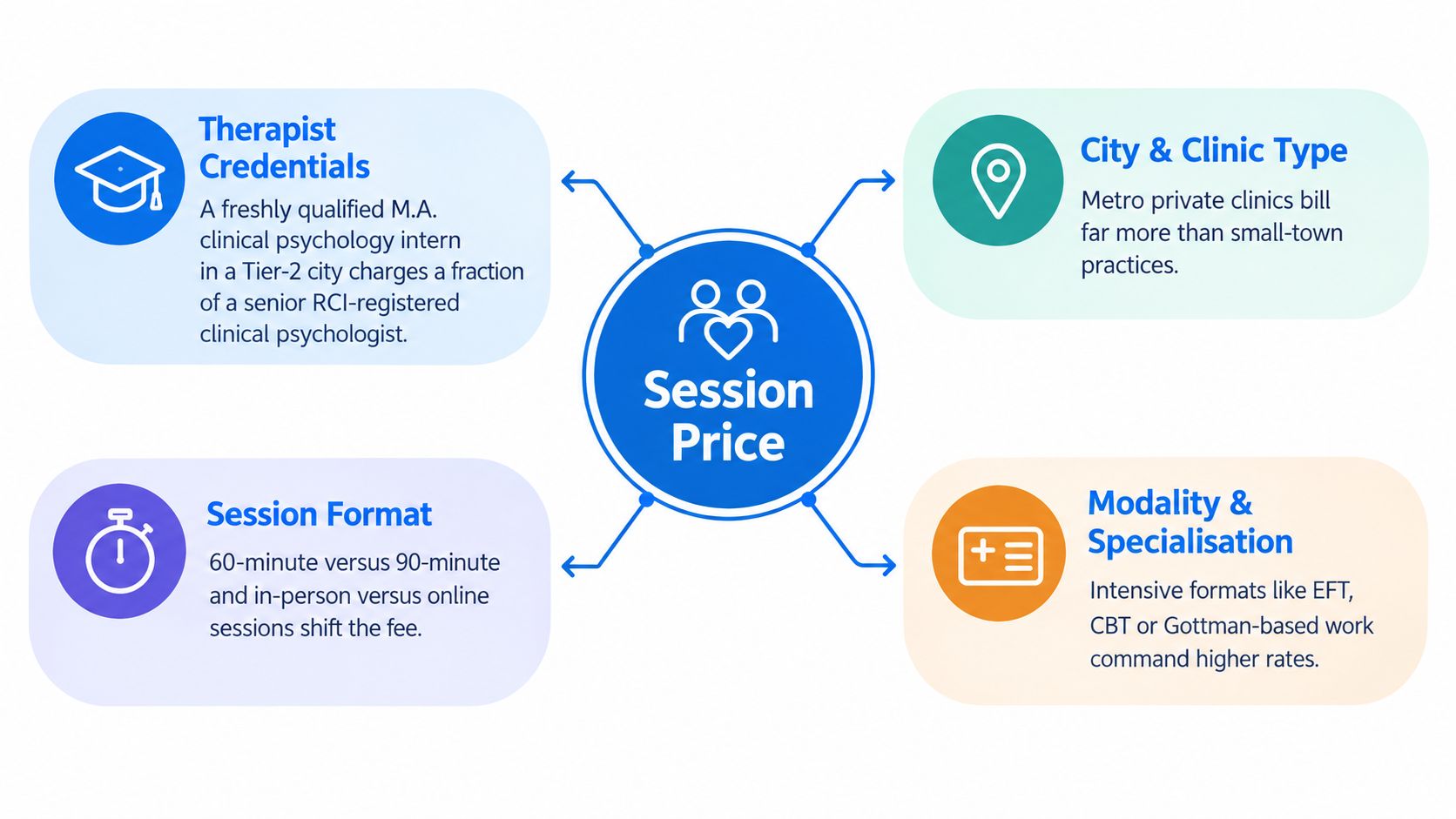
The final bill is rarely about one variable. A senior specialist in a metro city, offering longer in-person sessions and a specialised modality, will usually sit at the premium end. An online therapist in a smaller city, offering standard appointments, may fall much lower without providing careless or inferior support.
Online Versus In-Person Couples Therapy Cost
Online counselling is often the practical choice for couples with demanding work schedules, children at home, or different locations. It can also give people outside major cities access to therapists who specialise in relationship concerns.
For online couples therapy, the India-specific range cited by Mentis is ₹1,200–₹3,000 per session. In-person private therapy commonly varies from about ₹1,000–₹2,500 in smaller cities to ₹2,000–₹5,000 in metro cities, with senior specialists potentially charging more. These are guide ranges, not guaranteed quotes.
| Factor | Online Sessions | In-Person Sessions |
|---|---|---|
| Cost | Often more accessible, depending on therapist and platform | Can be higher in metro private practices |
| Convenience | No commute, easier cross-city access | Requires travel and coordinated schedules |
| Privacy | Needs a quiet, confidential space at home | The clinic may provide a more controlled setting |
| Best fit | Busy couples, long-distance partners, and non-metro clients | Couples who prefer physical presence or lack home privacy |
| Main limitation | Screen fatigue, interruptions, or unstable internet | Travel time, availability, and local therapist choice |
Online therapy isn't automatically less serious. It's a format, and the quality depends on the therapist's competence, the couple's engagement, and whether both partners can speak privately. A useful international perspective on choosing between formats appears in this St. Petersburg holistic therapy comparison, although Indian prices and access conditions are different.
Choose in-person care if one or both partners can't speak freely at home, if sessions repeatedly become chaotic online, or if the therapist believes a more structured setting is appropriate. Choose online care if travel, work, geography, or childcare would otherwise stop you from attending consistently.
Realistic India Price Tiers From Free to Premium
India's couples therapy market has several affordability bands. You don't need to begin at the premium end to receive useful support, but you should still check qualifications, confidentiality, experience, and the therapist's approach.
| Tier | Per-session range | Typical provider | Setting |
|---|---|---|---|
| Subsidised access | Free to ₹500 | NGO or community service | NGO centre or supported programme |
| Public service | About ₹50–₹200 | Government hospital service | Hospital or family counselling setting |
| Accessible private care | ₹1,000–₹2,500 | Private therapist or counsellor | Smaller city or tier-2 practice |
| Online private care | ₹1,200–₹3,000 | Online couples therapist | Video counselling platform |
| Established metro practice | ₹2,000–₹5,000 | Experienced private therapist | Metro clinic or private practice |
| Senior specialist | ₹3,500–₹7,000 and beyond | Senior clinical psychologist or specialist | Premium private practice |
The lowest-cost options can be important for couples who would otherwise receive no support. They may involve limited appointment availability, shorter continuity, or fewer choices about therapist language and modality. Ask what happens if you need follow-up sessions and whether both partners can attend.
The accessible private tier may suit couples who want regular support without paying metro specialist rates. Smaller-city fees commonly fall around ₹1,000–₹2,500, according to the Mentis and Ellomind pricing guides. Online sessions can sit in a similar affordability range, depending on the platform and provider.
Established metro practices often charge more because the therapist may have deeper experience, specialised training, or a high-demand schedule. That price can be justified when the therapist is a strong fit for a complex concern, but reputation alone shouldn't decide your choice.
Senior clinicians may charge ₹3,500–₹7,000, while the marriage counselling cost guide identifies top metro specialists at ₹6,000–₹15,000 or more. Couples should ask what this premium includes. Does the therapist offer structured assessment, specialist experience, longer sessions, or a clear treatment plan?
A lower fee is acceptable when the therapist is qualified, transparent, and suitable. A high fee deserves an equally clear explanation.
Assessments and screening tools can help organise concerns around stress, anxiety, depression, communication, or well-being, but they're informational, not diagnostic. Only a qualified professional can assess a mental health condition properly, and relationship distress may require both couples counselling and individual therapy.
How Packages and Bundles Change the Real Cost
A single-session fee can hide the financial commitment. Ask whether the therapist bills per appointment, offers a package, charges separately for assessments, or adds a fee when both partners attend.
One India couples-therapy service lists sessions starting at ₹650 for 60 minutes and adds a 30% couples-therapy charge to the base session cost. It also lists packages of 5 sessions from ₹5,599, 10 sessions from ₹9,999, and 15 sessions from ₹14,999, as shown on the MindPeers couple therapy pricing page. This illustrates why the advertised base rate isn't always the final amount.
A package can make budgeting easier, but it can also create pressure if the couple isn't sure the therapist is a good fit. Don't prepay a large bundle only because the per-session figure looks lower. Start with the number of sessions the therapist recommends initially, then review progress and affordability together.
Ask these questions before paying:
- What's included: Does the fee cover both partners, assessment, written feedback, or follow-up communication?
- What changes the price: Are longer appointments, individual check-ins, or family-inclusive sessions charged separately?
- What happens if we cancel: Request the cancellation and rescheduling policy in writing.
- When is payment due: Clarify whether you pay before each session or at the start of a package.
- What if we stop early: Ask whether unused package sessions are refundable or transferable.
The most useful comparison is the total expected cost, not the attractive first-session price. Request a written quote that states the session length, number of participants, package terms, add-ons, payment schedule, and cancellation policy.
Insurance, EAPs, and Sliding Scale Options in India
Funding couples therapy in India can be confusing because policies and employer benefits don't all treat relationship counselling in the same way. Don't assume that a health insurance plan will reimburse a couples session because it includes some mental health benefits.
Ask the insurer a direct question: “Is couples or marriage counselling covered when there is no individual diagnosis?” Also ask whether reimbursement depends on the clinician's registration, a referral, a diagnosis, or a specific billing code. Get the response in writing before booking a costly course.
If one partner is experiencing anxiety, depression, burnout, or another mental health concern, individual therapy may be assessed separately from relationship counselling. The Aon India mental health index report reported that 43% of employees surveyed in India said they felt unsettled and nervous, based on an online survey of 1,500 people living in India in November 2022. That finding supports taking workplace stress and emotional strain seriously, but it doesn't determine whether an insurer will fund couples therapy.
Employee Assistance Programmes can be worth checking, especially if either partner works for a large employer. Benefits may be limited to individual counselling, may have a capped number of sessions, and may not include relationship work. The benefits team or confidential EAP provider can explain the actual terms.
Sliding-scale fees are often the most practical route. Some therapists reserve lower-cost appointments for people with limited income, while supervised training clinics and community organisations may have more accessible rates.
Questions to ask about reduced fees
- Availability: Do you offer a reduced-fee slot for couples with financial constraints?
- Eligibility: Do you need income documents, or can we explain our circumstances privately?
- Continuity: Can the reduced rate continue for the expected course of support?
- Supervision: If a trainee provides counselling, who supervises the work?
- Referral: Can you refer us to a lower-cost service if your fee isn't manageable?
You can also ask recognised training institutions, university psychology clinics, NIMHANS, Amity, Christ, and community mental-health NGOs about current services. Availability changes, so contact each organisation directly rather than relying on an old directory listing.
Practical Ways to Find Affordable Couples Therapy
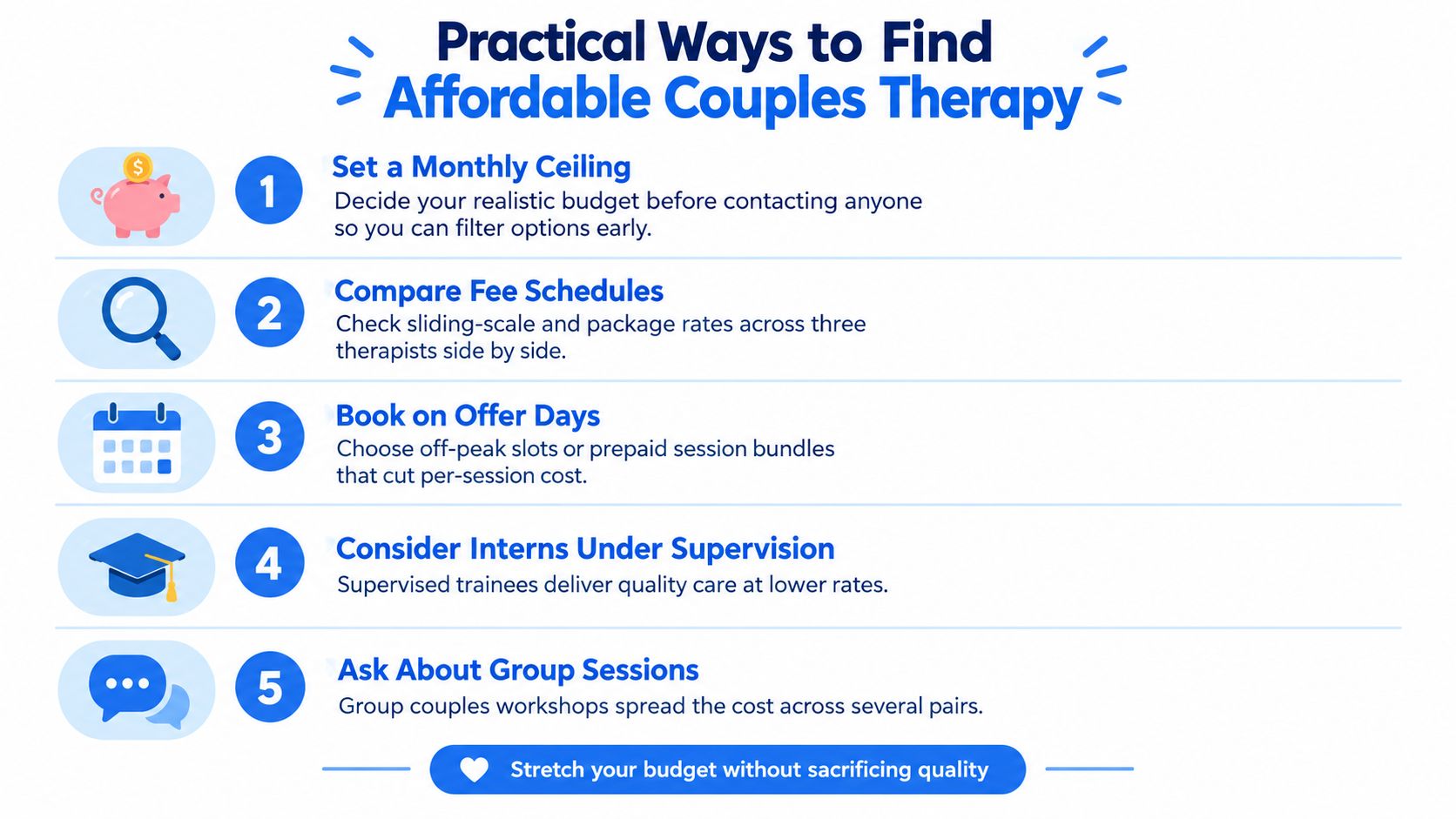
Start with a monthly ceiling. If your realistic budget is unclear, every therapist's fee will feel either frightening or unexpectedly tempting. Decide what you can sustain after rent, food, transport, debt, and essential care, then search within that range.
Check credentials and couples experience, not just reviews. If a therapist mentions RCI or APSI registration, verify the relevant details through the appropriate professional registry. Ask whether they regularly work with relationship conflict, infidelity, family pressure, intimacy concerns, workplace stress, anxiety, depression, or burnout.
Use the first conversation to assess fit. Ask about the therapist's modality, how they handle unequal participation, whether they meet partners individually, how confidentiality works, and what they do if one partner wants to separate. A good counsellor should answer clearly without making either partner feel blamed.
A directory such as Practo can help you begin a broad search, while a dedicated mental-health platform such as DeTalks can help users browse psychologists, therapists, counsellors, assessments, and support for relationship concerns. Compare the actual session fee, appointment length, therapist credentials, cancellation rules, and reduced-fee availability rather than choosing only by profile ranking.
Biweekly sessions can lower the monthly pressure for some couples, especially when the therapist agrees that the couple can practise skills between appointments. That isn't suitable for every situation. Severe conflict, safety concerns, active addiction, or significant depression may require more frequent or individual support.
Supervised university clinics, community programmes, NGO services, and telephonic helplines can offer alternatives when private therapy isn't affordable. Group couples workshops may also reduce the cost, though they provide less privacy and individual attention than couples counselling.
Before booking, use this short check:
- Fee transparency: Avoid therapists who won't state the full price before the first appointment.
- No pressure: Be cautious if someone pushes a large prepaid package before assessing your needs.
- Clear boundaries: Ask how private information is handled when partners disagree.
- Relevant experience: Confirm that the therapist works with couples, not only individual clients.
- Safety awareness: If there is violence, coercion, or fear at home, request an individual safety discussion before joint sessions.
Therapy supports more than conflict repair. It can help couples build resilience, compassion, emotional awareness, happiness, and shared well-being, while also addressing anxiety, depression, burnout, and workplace stress that enter the relationship. Assessments can offer useful information, but they're not diagnostic and shouldn't replace a professional evaluation.
DeTalks brings together access to psychologists, therapists, counsellors, confidential assessments, and self-help resources for relationship concerns and wider well-being needs. Compare support options, ask about the full couples therapy cost and payment terms, and visit DeTalks when you're ready to take a practical next step.