Tag: marriage counsellor India

  • Counselling for Marriage: A Practical Guide for Couples

    Counselling for Marriage: A Practical Guide for Couples

    It's Sunday evening, and another conversation about money and in-laws has ended in silence. You want to explain why you're hurt, but you're already bracing for the next argument, and neither of you knows how to begin differently.

    Searching for counseling for marriage doesn't mean you've failed. It can mean you're ready for help understanding what keeps happening, provided you can both speak freely and safely.

    What Couples Bring to Marriage Counselling

    Marriage counselling is a structured conversation with a trained professional who helps partners understand their patterns, communicate with less harm, and decide what they want next. The counsellor isn't there to award points or persuade someone to stay.

    Say a couple keeps arguing about spending. One sees questions about purchases as criticism; the other sees unanswered questions as secrecy, so each response makes the next exchange harder.

    A counsellor helps them separate the practical decision from its emotional meaning. They might need both an agreed spending plan and a way to discuss money without accusations.

    Common issues couples bring to counselling

    Issue What it often looks like What counselling works on
    Repeated arguments Same fight returns every week without resolution Identifying the trigger pattern and changing the response
    Communication breakdown Silent treatment, interrupting, or sarcasm Speaking so the other person can hear, and listening to understand
    Emotional distance Living together as housemates, little affection Rebuilding small daily connections and shared routines
    Work stress at home Irritability after long shifts, withdrawal on weekends Separating job strain from relationship concerns
    In-law or family interference Decisions made by relatives, unclear loyalties Agreeing boundaries and presenting a united front
    Trust injury after infidelity Suspicion, checking phones, repeated questions Structured honesty, repair steps, and rebuilding safety
    Decision to stay or separate Doubt about the future, one or both partners considering exit Clarifying values and options, with or without reconciliation

    Support before a crisis

    You don't need to wait until separation feels inevitable. Counselling can also help you practise compassion and resilience while disagreements are still manageable.

    For practical money conversations, couples' budgeting with Peaceful Mindful Pocket, from Peaceful Mindful Pocket LLC, offers a resource to explore alongside relationship work. A budget can organise financial decisions, but it doesn't replace addressing fear, secrecy, or control.

    Counselling is a recognised part of India's family-justice system under the Family Courts Act, 1984, making help-seeking a normal and responsible step, as described in this account of Indian family-court practice. Participation should be voluntary, with confidentiality protected where the law allows and its limits explained before you begin.

    Gottman, EFT and Others

    No single model fits every couple. Many counsellors draw on several approaches, choosing tools that match your concerns rather than expecting you to fit a particular method.

    Major couple therapy models at a glance

    Model Core idea Typical focus Often suits
    Gottman Method Couples manage conflict and maintain connection through friendship and daily habits Conflict style, shared meaning, turning towards each other Couples wanting practical tools for recurring fights
    Emotionally Focused Therapy (EFT) Distress can involve attachment fears and unmet emotional needs Emotional cues, calming the negative cycle, secure bonding Couples stuck in a pursue-withdraw pattern
    Cognitive Behavioural Couple Therapy (CBCT) Unhelpful thoughts and behaviours keep conflict going Assumptions, communication habits, shared activities Couples who like clear goals and homework
    Imago Relationship Therapy Partners may repeat patterns learned in childhood Structured dialogue and understanding each partner's history Couples wanting to understand their reactions
    Solution-Focused Brief Therapy Small changes already happening can be built on Specific, achievable goals in a brief course Couples wanting focused work on a defined concern

    What the approaches feel like

    With the Gottman Method, a counsellor pays attention to everyday interactions. Do you respond when your partner tries to connect, and can you disagree without contempt? Work might include making a complaint without attacking character or learning how to repair an argument.

    EFT looks beneath the argument to what feels emotionally threatening. One partner may press for answers because distance feels frightening, while the other withdraws because criticism feels overwhelming. The work helps both recognise that loop and express the need underneath it.

    CBCT examines assumptions alongside behaviour. If you interpret a late reply as proof your partner doesn't care, the counsellor may help you test that conclusion and agree on a realistic communication habit. Home practice gives you something concrete to try.

    Imago Relationship Therapy uses structured listening to explore how earlier experiences influence present reactions. A partner might repeat back what they heard before responding, making room for understanding without requiring agreement or excusing harmful behaviour.

    Solution-focused brief therapy asks when the problem is less intense and what's different then. If evenings go better when household tasks are agreed beforehand, you might build on that exception rather than analyse every past disagreement.

    Choose the map that fits

    Think of these models as different maps of the same city. One highlights habits, another emotional fears, and another the assumptions behind an argument; a good counsellor explains why a particular map suits your situation.

    Don't choose solely by an impressive label. Ask the counsellor:

    • Progress: How will we know the approach is helping?
    • Duration: What determines how long a course runs, and when will we review it?
    • Engagement: What happens if one partner is hesitant or stops participating?

    A clear answer should connect the approach to your goals, not promise that a named method will save your marriage.

    When Joint Sessions Are Not Safe

    Saving the marriage should not be the default goal. Safety, autonomy, and informed consent come first. If you're afraid of what your partner will do after a session, improving communication isn't the immediate task.

    The Press Information Bureau's account of NFHS-5 findings states that 29.3% of ever-married women aged 18–49 in India experienced physical and/or sexual spousal violence in 2019–2021. Controlling behaviour can also be normalised as concern, family duty, or a private marital matter.

    Warning signs and the first step to take

    Warning sign Why it changes the plan First step
    Threats or intimidation Fear shapes what either partner can say in a joint session Talk to the counsellor privately and pause joint work
    Physical violence or fear of it Joint sessions can increase risk after disclosure Create a safety plan and contact emergency or women's helplines
    Financial control One partner cannot access money or documents Arrange individual support and legal or financial advice
    Sexual coercion Consent isn't freely given, making joint discussion unsafe Seek individual counselling and medical care
    Monitoring or isolation Phone checks, movement tracking, or cutting off family and friends restrict freedom Speak to a specialist; keep records only if safe
    Retaliation risk Raising concerns may trigger punishment at home Plan safe access to shelter, legal support, or a way to leave

    Conflict is not the same as coercion

    Raised voices and hurt feelings need attention, but they aren't automatically the same as coercive control. The key questions are whether you can disagree, refuse sex, access money, and seek support without fear of punishment.

    A responsible counsellor should speak with each partner privately before joint work. Where threats, violence, or coercive control are present, joint sessions should be paused while specialist assessment and independent support take priority.

    Safety rule: You don't need to disclose abuse in front of the person you fear to justify getting help.

    Make a practical safety plan

    If it's safe, identify a trusted person you can contact, a way to reach them, and somewhere you could go. Consider access to money, copies of important documents, essential medicines, and a known exit route.

    Don't store a plan or incident records on a device your partner monitors. A domestic-violence specialist can help you adapt these steps without increasing your exposure to harm.

    In India, call 112 for an emergency or 181 for the women's helpline; men and LGBTQ+ people can also seek local crisis, medical, legal, and specialist community support. If any warning sign is present, tell the counsellor privately and start with individual support rather than a joint appointment.

    How Counselling Sessions Unfold Step by Step

    A course of counselling should have an understandable structure, not feel like an endless series of arguments in another room. Your counsellor should explain what you're working on, why it matters, and when you'll review it.

    This flowchart gives a starting picture of the process.
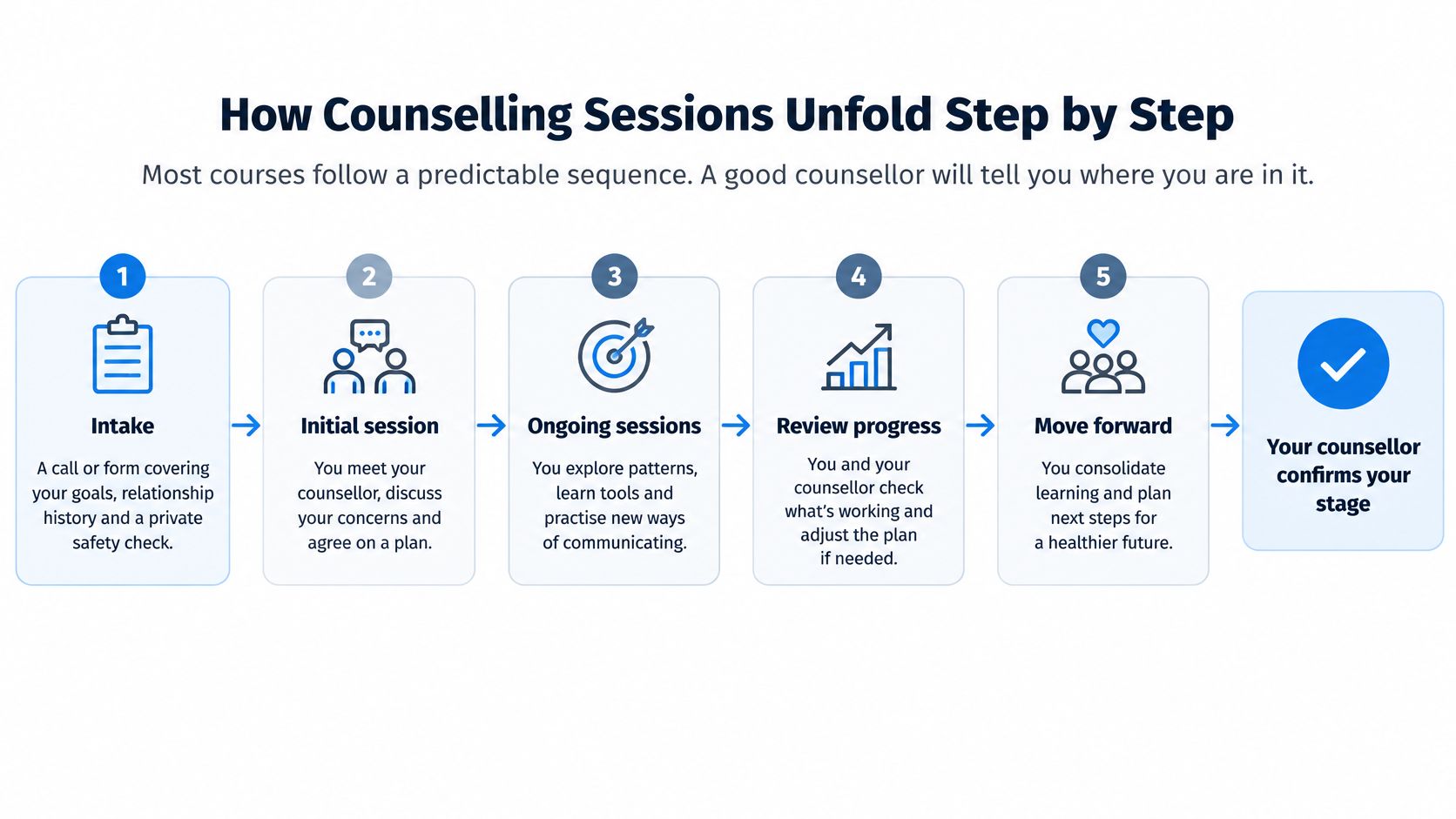
    A step-by-step flowchart infographic illustrating the process of counseling sessions from intake to moving forward.

    A practical sequence

    1. Intake. Complete a call or form about your goals, relationship history, and current concerns. Each partner should have a private safety check.
    2. Individual conversations. Separate appointments let each person explain their perspective. Ask beforehand how private disclosures will be handled within couples work.
    3. Optional questionnaires. You may reflect on stress, communication, and relationship satisfaction. Assessments are informational, not diagnostic, and shouldn't be used to label or blame a partner.
    4. Joint sessions. Agree on ground rules such as taking turns, avoiding interruptions, and pausing when either person becomes overwhelmed.
    5. Home practice. For example, try a ten-minute daily check-in and a planned shared activity each week, if both agree and feel safe.
    6. Progress review. A possible plan is to review every four to six sessions, considering arguments, feeling heard, attendance, and safety rather than relying on a vague sense of improvement.
    7. Closing or another phase. Ask for a written summary of useful skills, remaining concerns, and what to do if difficulties return.

    For scheduling, you could ask whether 50–60-minute appointments, weekly or fortnightly, would suit the proposed work. Confirm the actual length and frequency with the provider rather than assuming every service follows that format.

    Making online appointments workable

    In Indian homes, relatives may influence decisions about attending, or expect to join. Agree beforehand who participates; family involvement should require both partners' consent, not merely whoever is available at home.

    For privacy, choose a quiet room or, if genuinely private and safe, a parked car. Don't attend while driving, and tell the counsellor if someone can overhear rather than trying to discuss sensitive matters anyway.

    If work schedules clash, request a fixed appointment slot. If willingness differs, ask about separate introductory calls; if language or connectivity is a barrier, discuss language-matched support or an appropriate audio option.

    Counselling and mediation have different purposes. Counselling addresses emotional and behavioural patterns, while mediation focuses on resolving disputes; an Indian family-dispute mediation review also illustrates why settlement shouldn't be treated as a universal reconciliation outcome. Combining the processes requires clear roles, informed consent, and safety.

    What Counselling Can Realistically Achieve

    Counselling is most workable when both partners participate, even if one starts more hesitantly. Engagement means trying something different and discussing what happens, not agreeing on everything.

    A systematic review and meta-analysis by CHRIST (Deemed to be University), published in 2025, identified 12 empirical studies of couple interventions for marital distress and reported Cohen's d = 0.85, with a 95% confidence interval of 0.56–1.14. That represents a large average benefit, not a guaranteed outcome or proof that every couple improves equally.

    A session can provide space to practise a different conversation.

    A couple sits on a sofa talking to their therapist during a professional marriage counseling session.

    What meaningful progress looks like

    Useful goals are specific enough to recognise at home:

    • Less harmful conflict: Disagreements don't routinely become insults, threats, or prolonged punishment.
    • Clearer requests: You can ask for help directly instead of expecting your partner to guess.
    • Trust repair: Honest answers and agreed boundaries replace pressure to forgive quickly; rebuilding may take months.
    • Shared routines: You make room for affection, rest, and practical cooperation.
    • Everyday compassion: You notice effort and express gratitude without pretending painful issues have disappeared.

    Counselling aims to change the pattern between two people, not to decide who is right.

    That doesn't mean responsibility is always equal. Someone who has betrayed trust or caused harm needs to take responsibility for their actions; understanding the relationship pattern mustn't erase accountability.

    Success needn't mean staying together

    Some couples reconnect. Others decide to separate, with more clarity and, where children are involved, a more workable approach to co-parenting.

    Look for calmer disagreement, feeling heard more often, and decisions reached without fear. Happiness may include renewed closeness, but it can also mean greater stability and freedom to make an honest choice.

    This video offers another way to engage with the topic.

    If progress stalls after several sessions, bring that into the conversation. Review the goals and approach, consider individual work, or seek a second opinion rather than continuing indefinitely without a clear purpose.

    Signs It Is Time to Seek Help

    Is this ordinary friction, or do we need help? An India-focused workplace mental-health review reported that, in a 2022 study of 1,764 urban white-collar employees, 29% showed moderate-to-severe signs of depression, 55% moderate-to-severe anxiety, and 78% moderate-to-high stress, using an emotional check-in tool.

    Those findings describe that employee group, not every couple, and they aren't diagnoses. They do offer a reason to respond to distress with curiosity rather than dismissing someone as difficult or uncaring.

    This distinction can help you consider what's happening at home.
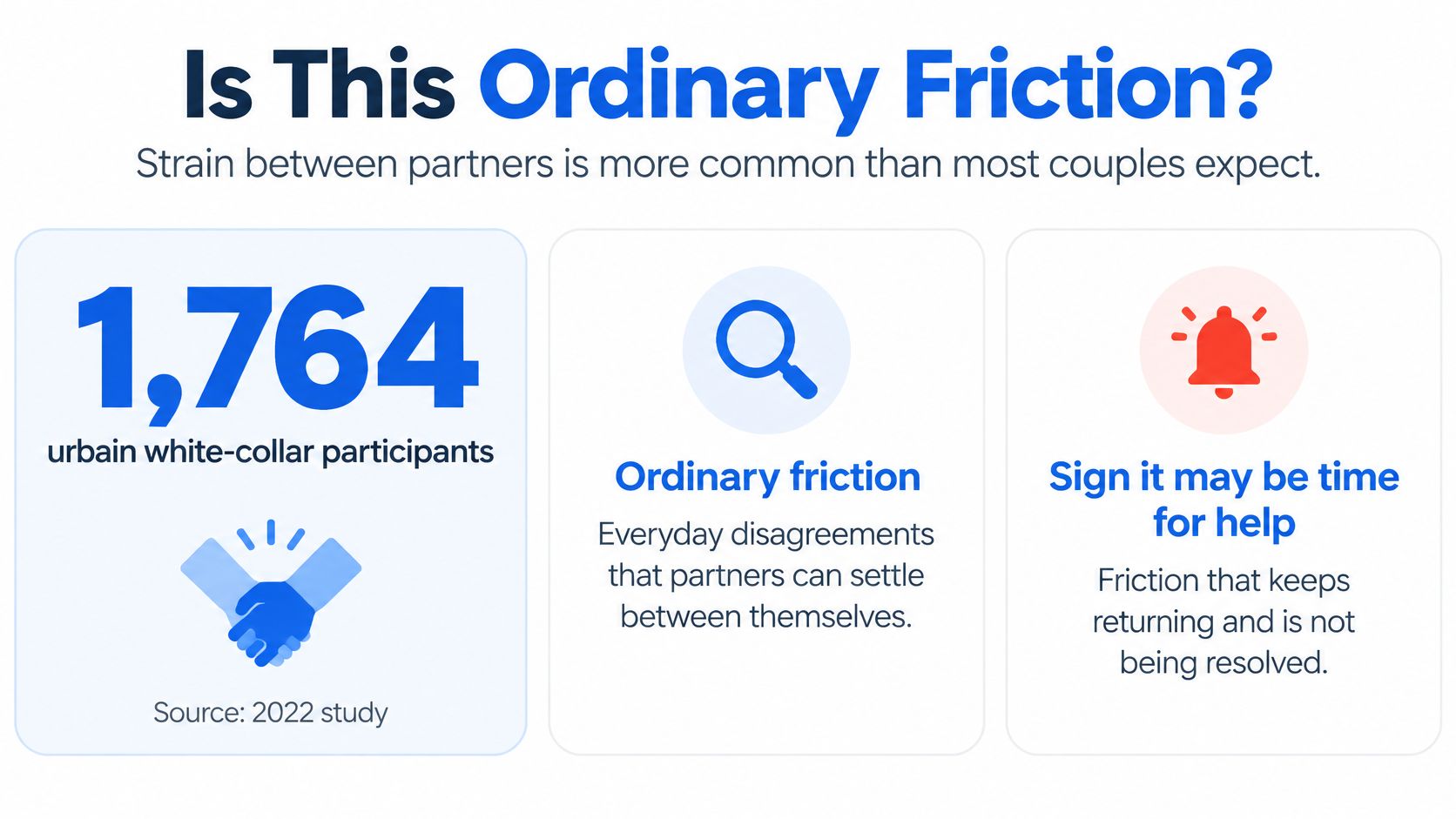
    An infographic defining the difference between ordinary relationship friction and issues requiring professional help for couples.

    Notice persistence and impact

    An occasional disagreement doesn't automatically require therapy. Consider support when you recognise patterns such as these:

    • Repeating arguments: The same disagreement continues for months without a workable resolution.
    • Withdrawal: A partner regularly avoids conversation or involvement in home life.
    • Physical changes: Sleep or appetite changes alongside emotional distress.
    • Harmful coping: Alcohol or other behaviours become a way to escape and create further problems.
    • Lost interest: Shared plans and activities no longer feel appealing.
    • Hopelessness: You feel stuck, with no believable way forward.
    • Workplace stress: Job pressure repeatedly disrupts your relationship and recovery time.

    Make room for both kinds of support

    Depression, anxiety, and burnout can affect energy, concentration, and closeness. A partner may need individual mental-health care alongside relationship counselling, rather than being expected to resolve everything through better communication.

    Early help also creates room for positive habits. Resilience can mean recognising overload and asking for support; compassion can mean listening before offering solutions, while gratitude means noticing genuine effort rather than overlooking harm.

    Screening tools can help organise what you're noticing, but a qualified professional makes any diagnosis. Don't use a questionnaire score as evidence that your partner is the problem.

    If you're having thoughts of self-harm, seek urgent professional or crisis support; if there's immediate danger, contact 112 or a local crisis line straight away. You don't need to wait for a couples appointment.

    Choosing a Couples Counsellor and Taking the First Step

    Professional Typical training Prescribes medication Typical role in couples work
    Clinical psychologist Postgraduate clinical psychology training; check registration with the Rehabilitation Council of India No Talk therapy, psychological assessment, and couples work
    Psychiatrist MBBS followed by MD or DNB in psychiatry Yes Diagnosis, medication, and therapy alongside couples work
    Counselling psychologist Postgraduate psychology or counselling training; check listed qualifications No Structured counselling for relationship and life concerns
    Family therapist or marriage counsellor Training routes differ; check specialist certification and supervised experience No Couples and family work, often focused on communication and conflict

    A psychiatrist can prescribe medication when appropriate, while the other professionals listed focus on talk-based support and assessment within their training. A professional title alone doesn't establish expertise in couples therapy.

    An analysis of counselling within India's family-justice system identifies inadequate training, inconsistent appointments, and weak institutional support as constraints. Ask for clear qualifications, supervised experience, and relevant high-conflict or family-court experience when those issues apply.

    Questions before booking

    • Specialist preparation: What couples-therapy training and supervised experience do you have?
    • Relevant experience: How do you work with concerns like ours, including parenting, infidelity, or family boundaries?
    • Safety procedures: How do you screen privately for domestic violence and coercive control, and when would you decline joint work?
    • Practical arrangements: What are the fees, cancellation terms, and session length?
    • Access: Which languages and online or in-person formats are available?
    • Privacy: How do you manage records, separate conversations, and appointments when a partner is at home?

    A counsellor should answer without making you feel troublesome for asking. You're checking whether the arrangement is suitable, not auditioning to be accepted.

    Turn uncertainty into a first step

    1. Write down goals. If safe, each partner can identify their top three hopes for counselling.
    2. Shortlist three counsellors. Compare training, approach, language, availability, and cost.
    3. Start individually if safety is a concern. Request a confidential intake through a safe contact method.
    4. Book jointly when appropriate. Both partners should understand the arrangement and feel ready to participate freely.
    5. Set a review point. For example, agree to review progress after four sessions and adjust the plan together.

    You don't need certainty about the marriage's future before seeking help. A reasonable first goal is understanding your options and protecting your well-being.


    DeTalks offers a directory of psychologists, therapists, and counsellors where you can browse professionals, book sessions, and explore informational, non-diagnostic assessments. Visit DeTalks to compare relationship-support options and ask about a suitable intake, starting individually if safety or privacy is a concern.

  • What Is Marriage Counseling and How It Helps Couples

    What Is Marriage Counseling and How It Helps Couples

    Marriage counseling is structured, voluntary work with a trained clinician that helps partners change recurring conflict patterns and improve communication. It offers support and clearer choices, not a guarantee of reconciliation, and any assessment used is informational rather than diagnostic.

    Perhaps you've had another argument about money, a late arrival home, or a relative's expectations. You still care about each other, but you're tired of explaining yourself and unsure whether talking will help or start another fight.

    You don't need a polished explanation before seeking help. In India, where marital concerns may involve extended family, work demands, and privacy worries, finding room for an honest conversation can itself feel difficult.

    Understanding What Marriage Counseling Really Is

    Consider a familiar situation: a partner raises a concern about household responsibilities, and the other hears criticism. They defend themselves, the first partner pushes harder, and eventually someone stops speaking.

    The disagreement may concern chores, but the recurring interaction pattern deserves attention too. A clinician helps partners notice how criticism, withdrawal, defensiveness, and pursuit can reinforce each other, rather than deciding who won the argument.

    A guided process rather than family advice

    If you're asking, “What is marriage counseling?”, the important distinction is structure. Also called couples therapy, it involves identifying concerns, agreeing on goals, practising different responses, and reviewing what happens between appointments.

    Friends or relatives may offer reassurance or opinions. A trained clinician instead helps you examine the relationship without assuming that their personal expectations should determine your choices.

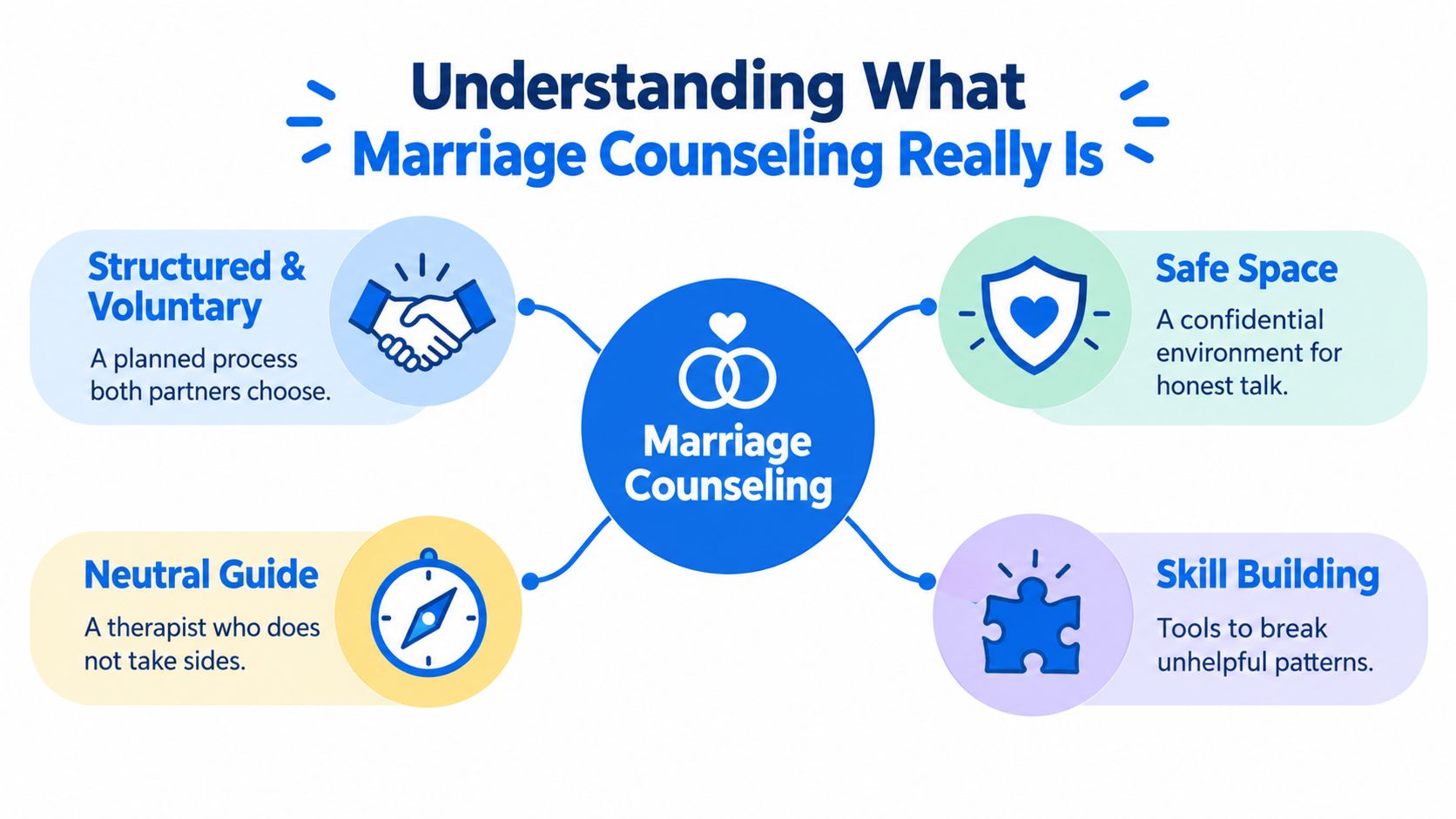
    This visual outlines the main elements of professional relationship work.

    An infographic titled Understanding What Marriage Counseling Really Is, illustrating four key elements of professional relationship therapy.

    • A clear purpose: You identify what needs attention instead of revisiting every disappointment at once.
    • Room for both perspectives: Understanding someone's feelings doesn't require agreeing with every interpretation.
    • Practical learning: Partners try different ways to speak, listen, and handle decisions outside the counselling room.

    What the evidence can and cannot tell you

    A meta-analysis of 58 studies involving more than 2,000 couples found a large improvement in relationship satisfaction, with an effect size of 1.12, and gains that persisted at short- and long-term follow-up, as summarised in this couples-therapy evidence overview. An effect size describes the magnitude of change in research; it isn't a personal success probability.

    If you're also navigating a court-related process abroad, Goodhand's explanation of what to expect at family guidance offers a separate resource about the Dubai court context. Don't assume that court guidance and voluntary psychological therapy serve identical purposes.

    Professional neutrality also has limits: treating both partners respectfully must never mean treating harmful behaviour as acceptable.

    Goals and Benefits Couples Typically Work Toward

    Better communication becomes useful when you can recognise it at home. A goal such as feeling understood needs a practical expression: finishing a thought without interruption, asking a clarifying question, or returning to a difficult discussion after a pause.

    In a session, a counsellor might ask each partner to describe a recent disagreement without guessing the other person's intentions. The listener then checks whether they understood before offering their own perspective.

    Turning broad hopes into everyday actions

    Different concerns need different goals. Financial tension may require clearer responsibility for expenses, while extended-family pressure may require an agreement about which decisions belong to the couple.

    • Calmer turn-taking: Let the speaker finish, then respond to the concern rather than collecting counterarguments.
    • Clearer financial conversations: Separate practical questions about spending from fears about security, fairness, or independence.
    • Shared family boundaries: Discuss how you'll respond to relatives without requiring either partner to reject their family.
    • A kinder pace: Choose a time when both people can engage, rather than demanding resolution during exhaustion.

    These are practice targets, not tests of whether you're a good spouse. A difficult attempt can still reveal what needs adjusting.

    Supporting the person as well as the partnership

    India's National Mental Health Survey 2015–16, covering 34,802 people across 12 states, estimated that 10.6% of adults had a current mental disorder and nearly 15% needed mental-health intervention, according to the national survey findings. These findings provide wider context, not evidence that relationship difficulties automatically indicate a mental-health condition.

    A counsellor should make room for anxiety, depression, and distress without reducing everything to marital conflict. Sometimes a partner needs individual support alongside relationship work.

    Counselling can also include resilience, compassion, and happiness as personally meaningful goals. Suggested practices might include acknowledging a partner's effort, restoring a shared enjoyable activity, or discussing what makes your life together feel worthwhile.

    A useful goal: Aim for a conversation you can recover from, not a relationship in which nobody ever disagrees.

    The point isn't to remove every uncomfortable feeling. It's to develop responses that make room for difficulty without repeatedly hurting each other.

    Common Approaches and Techniques Explained

    Different therapy approaches offer different ways of understanding the same relationship. Ask a clinician to explain their method in ordinary language and connect it to the concerns you've brought.

    For example, an argument about unanswered messages could involve fear of disconnection, an unclear practical agreement, or expectations learned in earlier family life. Each perspective suggests a different place to begin.

    Different lenses on the same difficulty

    Approach What you might explore or practise
    Emotionally focused work Naming the hurt or fear beneath an argument and recognising the cycle you both enter.
    Behavioural skills work Rehearsing a clear request, checking understanding, or agreeing how to pause and resume a discussion.
    Insight-oriented work Exploring how earlier family experiences shape expectations about closeness, money, or disagreement.
    Positive-psychology and mindfulness-informed work Noticing strengths, acknowledging care, and pausing to recognise emotions before responding.

    These examples describe possible session activities, not a prescription for every couple. A useful question is whether the clinician can explain why an approach fits your situation.

    A therapist may draw the interaction pattern so both partners can examine it together.

    A professional therapist explains a circular diagram to a couple during a marriage counseling session.

    Making the work culturally responsive

    Indian relationship work should consider language preference, religious expectations, family involvement, and whether meetings are individual, joint, or sequential. Respecting culture doesn't mean accepting unequal treatment without discussion.

    Indian research includes a Mumbai community intervention using four single-gender and two mixed-gender sessions, with participating couples describing improvements in family relations, sexual-health knowledge, and emotional well-being; recruiting men remained a challenge, as discussed in this Indian counselling research. These local findings shouldn't be treated as a universal outcome.

    Progress can be reviewed through relationship satisfaction, conflict behaviour, distress, and safety, rather than marital status alone. Repeated assessments remain informational and need professional interpretation.

    If your questions concern negotiated agreements rather than therapeutic work, the Badesha Law mediation guide is a separate legal-context resource. Clarify which service you need, and seek India-specific legal advice when applicable.

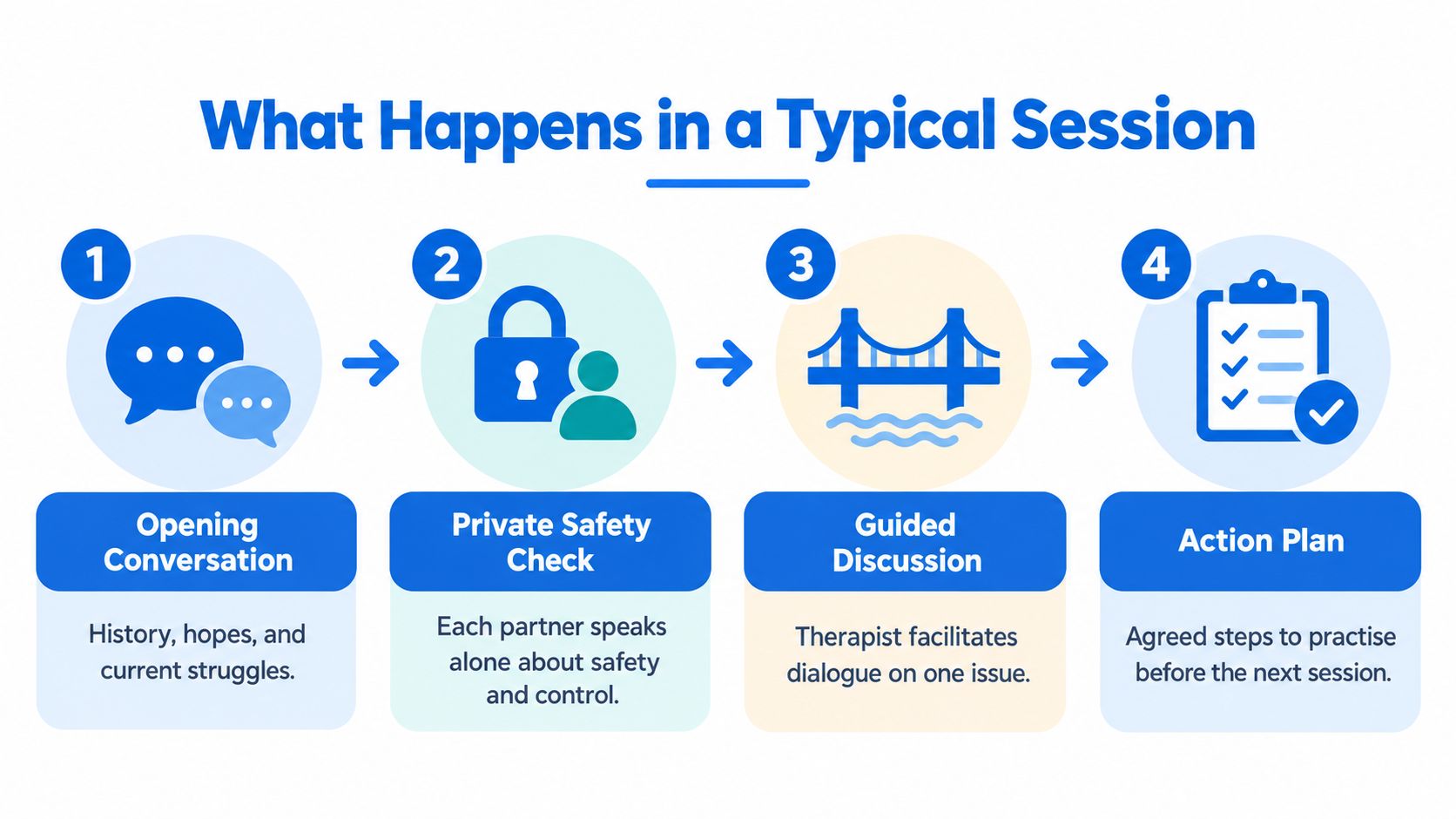
    What Happens in a Typical Session

    You might arrive wondering whether you'll have to reveal everything immediately. A thoughtful opening can begin more easily: what brought you here, what feels hardest, and what you hope might become different.

    The clinician should explain consent, confidentiality boundaries, and how information from separate conversations will be handled. Ask these questions before sharing something you're concerned could place you at risk.

    The session process may look broadly like this, although the order can change according to your needs.

    A four-step infographic showing the process of a typical marriage counseling session, from initial conversation to action plan.

    Listening before attempting solutions

    An intake should include private safety screening for coercive control, physical or sexual violence, severe substance misuse, and acute mental-health risk. Joint discussion shouldn't begin with an assumption that both partners can speak freely and safely.

    If joint work is appropriate, you may examine a recent disagreement. The therapist might slow the conversation, ask what each person heard, and help distinguish the original concern from the responses that followed.

    A take-home practice should be specific and manageable. For example, you might agree to check an interpretation before replying, then discuss what happened at the next appointment.

    • Format: Ask whether in-person or online sessions suit your privacy and circumstances.
    • Length and frequency: Confirm these directly with the provider; there's no single schedule to assume.
    • Pace: Ask how the plan changes if individual attention is needed before further joint work.

    Voluntary and court-connected counselling in India

    The Family Courts Act of 1984 established a framework emphasising conciliation and specialised family-dispute handling; a convention marking 25 years of Mumbai's Family Court brought together 98 counsellors from 14 states, who reported similar case types but differing implementation, according to this account of Indian family-court counselling.

    A legally referred appointment may therefore feel different from choosing private therapy. Clarify the purpose of the service and what information may be reported.

    If you prefer a video alongside the written explanation, you can view the following resource.

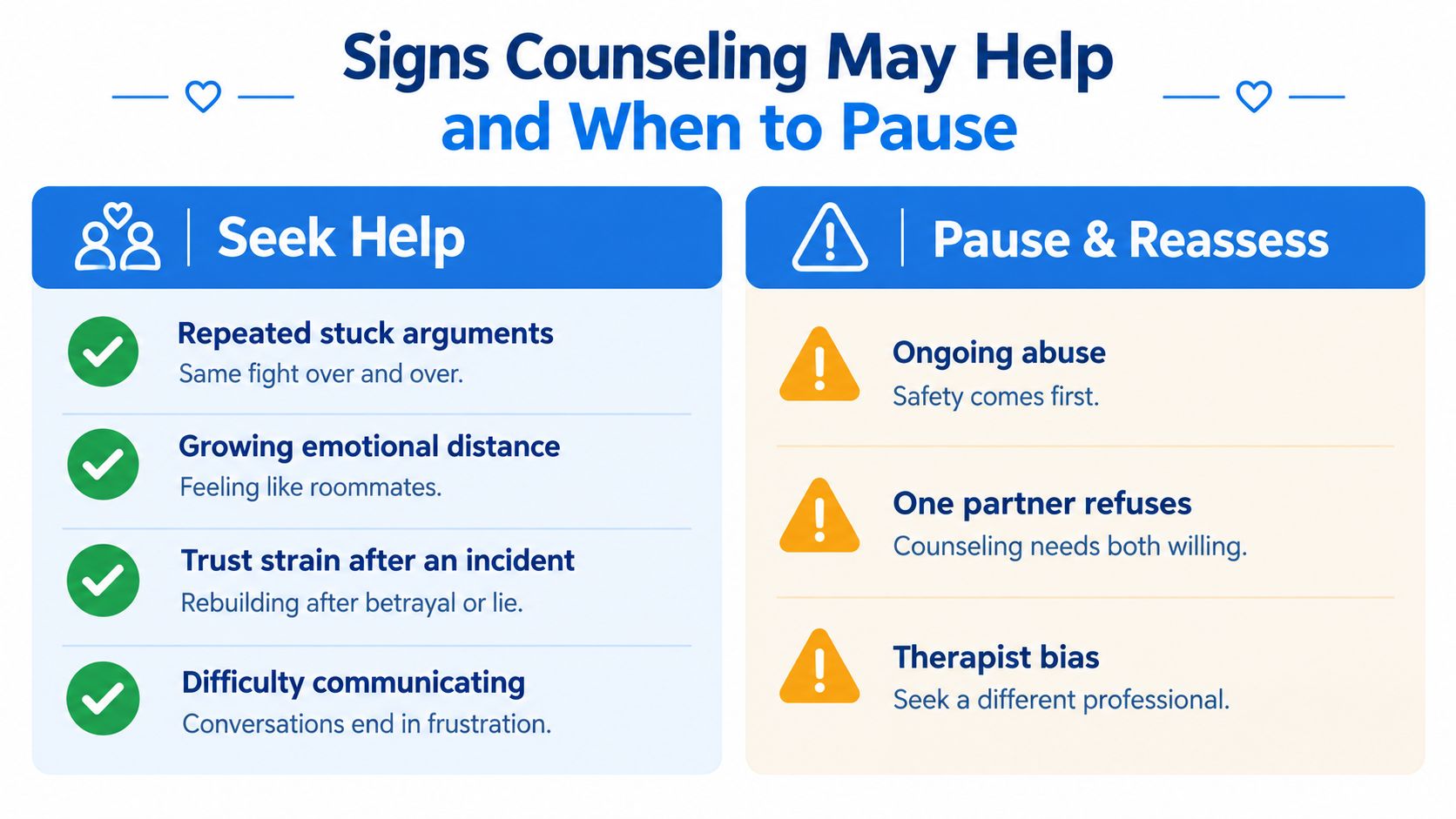
    Signs Counseling May Help and When to Pause

    You don't have to wait until separation feels imminent. Relationship concerns are worth discussing when your usual attempts to resolve them leave you repeatedly stuck, disconnected, or uncertain.

    The reason for seeking help might be co-parenting, financial disagreement, intimacy concerns, caring for children or elders, or rebuilding trust after an incident. The practical question is whether professional support could help you understand and respond to the difficulty.

    Signs worth bringing to an appointment

    • Repeated arguments: You revisit the same issue without reaching a workable agreement.
    • Emotional distance: You manage household tasks together but struggle to share your inner lives.
    • Trust strain: A lie, betrayal, or broken agreement has left unresolved questions.
    • Competing responsibilities: Parenting, elder care, or work leaves little room for connection.

    Work deserves attention too. A 2022 study of 1,764 urban white-collar employees found moderate-to-severe anxiety symptoms in 55%, moderate-to-severe depression symptoms in 29%, and moderate-to-high stress in 78%, as reported in this Indian workplace mental-health research.

    These figures concern that study population, not every Indian worker. They support asking about workplace stress, burnout, sleep, and the transition from work to home; screening scores are informational, not diagnostic.

    The following chart offers prompts for deciding what kind of help to seek.

    A chart comparing signs when marriage counseling might help versus when to pause and reassess the situation.

    When the plan needs to change

    Coercive control, threats, violence, severe substance misuse, or an active mental-health crisis may make conventional joint sessions inappropriate. Individual safety planning, specialist services, or psychiatric care may need to come first.

    Safety comes first: Being frightened of what will happen after an honest disclosure is different from feeling nervous about a difficult conversation.

    A reluctant partner means pausing the joint plan, not abandoning your own access to support. Likewise, if a therapist minimises harm or pressures you to accept mistreatment, seek another professional opinion.

    When Only One Partner Is Ready to Start

    You may be ready for counselling while your partner says the problem is private, doubts therapy, or refuses to attend. That doesn't mean you must wait indefinitely before seeking help for yourself.

    Indian evidence identifies stigma, family influence, and limited access to qualified counsellors as participation barriers, making the usual requirement that both partners attend incomplete, as discussed in this Indian study of counselling barriers. Reluctance deserves exploration, but it doesn't justify pressure or coercion.

    Begin with what you can decide

    Individual, relationship-focused counselling can help you clarify your goals and choices. It isn't a way to diagnose an absent partner or recruit a therapist to prove that you're right.

    • Name your own concern: Explain what you're experiencing and what you want help deciding.
    • Identify workable boundaries: Discuss what you can accept, what needs to change, and what you'll do if an agreement isn't respected.
    • Explore an invitation: Offer information about counselling and leave your partner room to decide.
    • Check feasibility: Consider privacy, cost, language, scheduling, and whether participation would be safe.

    You might say that you're seeking help to understand your own responses and would welcome their participation if they become willing. Avoid turning attendance into evidence of love or loyalty.

    Separate hesitation from intimidation

    A partner's uncertainty about therapy is different from preventing you from obtaining support. Financial dependence, family pressure, and fears about privacy can make that distinction difficult to assess alone.

    A counsellor can help you examine the circumstances without assuming that every marital disagreement has equal responsibility on both sides. Where intimidation or harm is present, referrals to domestic-violence, legal, or psychiatric services may be more appropriate than another invitation to attend together.

    You can take responsibility for your choices without taking responsibility for another person's harmful behaviour.

    Ask how your individual confidentiality will work if joint sessions become possible later. The clinician should explain whether they can change roles and what consent would be needed.

    Your first useful outcome may be clearer thinking rather than a partner's immediate participation. That clarity can help you choose a next step without rushing or surrendering your autonomy.

    How to Find a Qualified Couples Therapist

    Look for evidence of relevant qualifications and relationship-specific training, not just a reassuring profile photograph. In India, ask about recognised university education in counselling psychology or clinical psychology, supervised practice, and ongoing professional development.

    Professional-body membership may be useful background information, but it shouldn't replace checking the clinician's actual training and experience. Ask whether they regularly work with couples facing concerns similar to yours.

    Questions that reveal a useful fit

    A short introductory conversation can help you understand the clinician's working style. You're not asking them to resolve the marriage during that call; you're checking whether the service fits.

    • Training and experience: What preparation have you had for couples work and safety screening?
    • Cultural fit: Can we work in our preferred language, and how do you approach religious or family expectations?
    • Privacy: How are records, online sessions, and separate disclosures handled?
    • Practical arrangements: What are the fees, cancellation terms, proposed frequency, and review points?

    Among directory options, DeTalks allows users to browse professional profiles, book therapy sessions, and explore informational assessments and self-help resources. You can also approach a clinic directly or ask an existing healthcare professional for referral options.

    Look beyond reducing conflict

    Ask whether the clinician makes room for strengths and growth as well as distress. India's positive-psychology context supports goals involving resilience, compassion, emotional understanding, and shared well-being, while assessments should be interpreted with a qualified professional rather than treated as definitive, as outlined in this mental-health and well-being resource.

    During early appointments, expect an explanation of the proposed work and an opportunity to ask questions. You should understand the goals, the clinician's role, and how you'll review whether continuing is useful.

    If you don't feel heard, raise that concern when it's safe to do so. You can ask for a different approach, request a referral, or choose another professional without treating the mismatch as a personal failure.

    Supportive Takeaways for Your Next Step

    Marriage counselling is a form of support, not a verdict on your relationship. Seeking it doesn't prove that you've failed, and declining a particular service doesn't mean you've rejected every possible way forward.

    The most helpful next step depends on your circumstances. Joint therapy, individual counselling, practical self-help, peer support, or coaching may address different needs, but informal or growth-focused support shouldn't replace specialist care when safety or significant clinical concerns require it.

    Make the first step manageable

    You don't need to agree on the future of the marriage before asking what support is appropriate. You can begin by finding a qualified professional, checking privacy arrangements, and explaining the concern you most want help understanding.

    • Choose a starting concern: Write down what happens, how it affects you, and what you'd like to discuss.
    • Identify practical needs: Note language preferences, availability, affordability, and whether you have somewhere private to speak.
    • Keep your choices open: An introductory conversation is an opportunity to learn about the service, not a promise to continue indefinitely.

    In India, access and family circumstances can complicate help-seeking. Start with an option that is realistically available to you rather than waiting for an ideal arrangement.

    Hold hope alongside honest limits

    A relationship can deserve care without being guaranteed repair. Growth-oriented practices such as gratitude, shared meaning, and calmer communication belong alongside honest attention to distress, not in place of it.

    Any self-assessment should remain a conversation aid, not a diagnosis or an instruction about whether to stay married. Your lived experience and a qualified professional's judgement matter more than a score considered in isolation.

    You're allowed to seek understanding before you know what decision you'll make.

    Try to approach yourself with the same compassion you hope to bring into the relationship. A small, considered step towards support is enough for today.


    DeTalks offers a directory of psychologists, therapists, and counsellors, alongside informational assessments and self-help resources for relationship concerns and personal well-being. Visit DeTalks to explore relationship-focused support, check a professional's suitability, and book an appointment that fits your needs.