You open a report, discharge summary, or insurance paper and see something like F31.1 or F31.32. Your stomach drops. You may wonder if this code changes your future, your job, your relationships, or the way other people will see you.
It helps to pause here. A clinical code is not your identity. It’s a shorthand that helps doctors, psychiatrists, therapists, and insurers describe what kind of support may be needed.
If you or someone you love has been told they may have bipolar 1 disorder icd 10 coding on their records, confusion is common. So is anxiety. Many people feel overwhelmed by the mix of medical language, treatment decisions, family concerns, workplace stress, and practical questions about counselling, therapy, and day-to-day well-being.
Your Guide to Understanding a Bipolar I Diagnosis
A common situation looks like this. A person goes to hospital during a period of very high energy, little sleep, racing thoughts, or unusually risky choices. Later, when they read the paperwork, they find a code instead of a plain-English explanation.
That can feel cold. It can also feel frightening, especially when the person is already coping with stress, depression, anxiety, family worries, or burnout from trying to hold life together.
Why the code matters
The code matters because it affects how clinicians describe symptoms, choose treatment, and communicate with each other. It may also affect insurance paperwork and the type of follow-up care someone is offered.
But the code does not capture the whole person. It doesn’t describe your kindness, your strengths, your resilience, or your capacity for recovery and well-being.
Practical rule: Read the code as a care tool, not a character judgement.
Research suggests that the life prevalence of Bipolar I disorder in the general population ranges from 0.4 to 1.6%, and 1.7% of respondents in clinical registry research were identified with bipolar affective disorder according to clinical findings on bipolar affective disorder prevalence and classification. For many readers, that won’t remove the shock, but it can reduce the sense of being alone.
What people usually want to know first
Most families want answers to practical questions:
- What does the code mean: Is it describing mania, depression, remission, or something mixed?
- Does this affect treatment: Could it change medication, therapy, or follow-up plans?
- Is improvement possible: Can someone work, study, parent, and build a meaningful life?
- What help is available: Should you look into psychiatry, counselling, routine support, or a more intensive setting?
Some people also want a broader overview of bipolar disorder treatments because treatment often involves more than one layer of care. That may include medication, psychological therapy, sleep and routine support, family education, and safety planning.
A more human way to read a diagnosis
When clinicians write a diagnosis, they’re trying to organise a pattern. They’re not trying to reduce a person to a label.
That distinction matters. A diagnosis can open doors to therapy, counselling, workplace accommodations, family understanding, and better planning around stress, sleep, and emotional well-being.
What is Bipolar I Disorder
Bipolar I disorder is a mood condition marked by major shifts in energy, mood, activity, and thinking. These shifts are not the ordinary ups and downs typically encountered during a stressful week or a difficult month.
For some people, the most visible part is mania. For others, it’s the crash that follows, including depression, exhaustion, hopelessness, or loss of interest in daily life.

The core feature clinicians look for
A Bipolar I Disorder diagnosis requires at least one manic episode lasting a minimum of one week, or any duration if hospitalisation occurs, with three or more manic symptoms such as heightened mood or increased goal-directed activity. That distinction from Bipolar II is outlined in diagnostic criteria for bipolar disorder ICD-10 coding.
In plain language, clinicians are looking for a period when someone’s mood and energy become distinctly heightened or unusually irritable, and their behaviour changes in a significant way.
What mania can look like
Mania doesn’t always look like happiness. Sometimes it looks like speed.
A person may sleep very little and still feel full of energy. They may talk faster, start many projects, spend money impulsively, take risks, become more argumentative, or feel unusually powerful and certain.
At first, this can be misunderstood as confidence, productivity, or relief after depression. But over time, it often disrupts work, studies, relationships, finances, and safety.
What depression can look like
The depressive side can feel heavy and disorienting. Someone may lose interest in things they usually care about, struggle to concentrate, feel slowed down, or carry deep sadness and fatigue.
This can affect attendance at college or work, social connection, parenting, self-care, and hope. It can also make people question themselves harshly, especially if others only noticed the earlier high-energy phase.
Bipolar I is not just about mood. It affects sleep, judgement, relationships, routine, and the ability to feel steady in your own mind.
How it differs from Bipolar II
Readers often get stuck here. The key difference is that Bipolar I includes mania, while Bipolar II involves hypomania, which is a less intense state of heightened mood.
That difference matters in diagnosis, treatment planning, and safety decisions. It also helps explain why one person may need urgent psychiatric support while another may first come to care through therapy or counselling for depression and anxiety.
A compassionate view
People with Bipolar I are often dealing with more than symptoms alone. They may also be carrying shame, confusion, family tension, workplace stress, or burnout from trying to function while their mood is unstable.
That’s why support should include both symptom care and strengths-based care. Resilience, routine, connection, compassion, and realistic hope all matter.
Demystifying the ICD-10 Coding System
ICD-10 is a medical classification system. Clinicians use it to describe diagnoses in a standard way so that records, referrals, and billing are more organised.
A simple way to think about it is a library system. The code helps place a condition in the right section so different professionals can understand the same page of the story.
What the code does
An ICD-10 code can help with:
- Clinical communication: A psychiatrist, therapist, and hospital team can refer to the same diagnostic category.
- Documentation: Notes become more consistent across settings.
- Insurance and administration: Claims and records often rely on formal coding language.
- Care planning: The code can point to the current episode type, such as manic, depressed, mixed, or remission.
What the code does not do
A code does not tell someone’s whole history. It doesn’t measure values, intelligence, personality, or potential.
It also doesn’t replace a full assessment. Good mental health care still depends on conversation, observation, history, family context, and the person’s daily functioning.
Why people feel intimidated by codes
Individuals weren’t taught how to read mental health documentation. So when they see letters and numbers, they assume the meaning is more ominous than it really is.
That reaction is understandable. Medical shorthand can feel excluding.
If a code increases your anxiety, ask your clinician to translate it into everyday language. That’s a reasonable request, not a difficult one.
For families, this translation can reduce conflict. Instead of arguing over labels, everyone can focus on what support is needed right now, whether that means medication review, therapy, counselling, stress management, or changes to routine.
Quick Reference for Bipolar I Disorder ICD-10 Codes
When people search for bipolar 1 disorder icd 10, they usually want a quick answer first. The code family most often associated with bipolar affective presentations is F31.
The pattern is easier to follow when you read it in two parts. F31 points to the broader bipolar category, and the number after it points to the current episode or state being documented.

How to read the F31 family
Some codes focus on a manic phase. Others focus on a depressive phase, a mixed phase, or remission.
You don’t need to memorise them. You only need enough familiarity to ask informed questions and understand why a clinician chose one code over another.
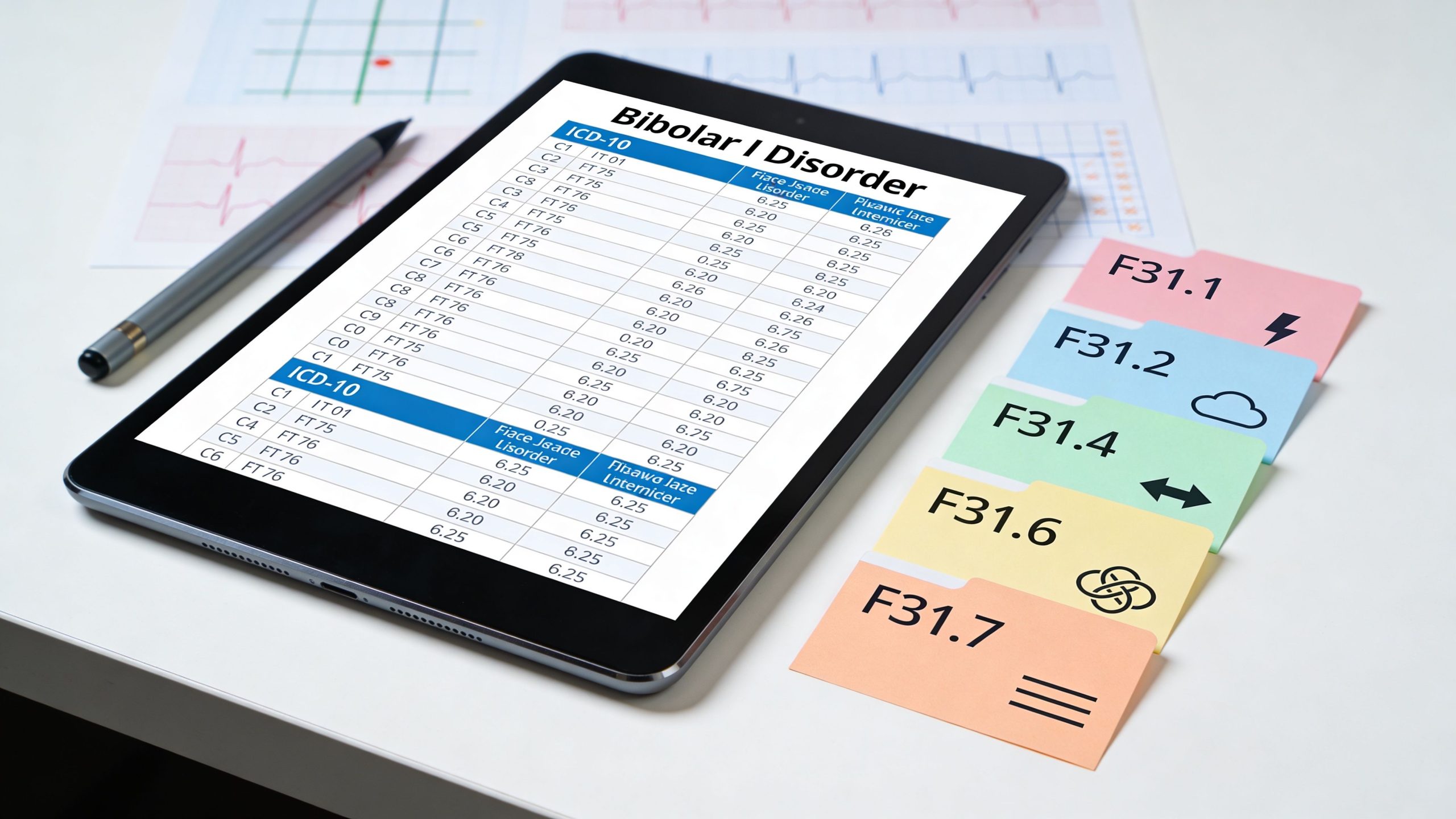
Bipolar I Disorder ICD-10 Codes F31
| Code | Description |
|---|---|
| F31.0 | Bipolar disorder, current episode hypomanic |
| F31.1 | Bipolar disorder, current episode manic without psychotic symptoms |
| F31.2 | Bipolar disorder, current episode manic with psychotic symptoms |
| F31.3 | Bipolar disorder, current episode depressed |
| F31.4 | Bipolar disorder, current episode depressed, severe without psychotic symptoms |
| F31.5 | Bipolar disorder, current episode depressed, severe with psychotic symptoms |
| F31.6 | Bipolar disorder, current episode mixed |
| F31.7 | Bipolar disorder, currently in remission |
| F31.8 | Other bipolar disorder |
| F31.9 | Bipolar disorder, unspecified |
What this table can and can’t tell you
This table is useful for orientation. It can help you understand what the code is pointing to right now.
It is not enough for self-diagnosis. A person’s notes, symptom history, daily functioning, and clinical interview still matter more than the code alone.
For concerned family members, one practical takeaway is this. If the code changes over time, that doesn’t always mean the earlier diagnosis was wrong. It may mean the current episode has changed and the record is being updated to match.
A Detailed Breakdown of Current Episode Codes
The most confusing part of bipolar coding is usually the phrase current episode. People often assume the diagnosis itself has changed, when the clinician is often documenting the person’s present state.
That distinction matters because treatment decisions may differ during mania, depression, or mixed symptoms. The same person can move through different coded states over time.
When the current episode is manic
A code such as F31.1 points to a manic episode without psychotic features. In everyday terms, the person may be sleeping very little, talking rapidly, feeling unusually energised, making impulsive decisions, or becoming highly agitated.
In this state, the main concern is often safety and judgement. The care plan may place more weight on psychiatric review, family monitoring, reducing overstimulation, and protecting sleep.
When the current episode is depressed
A depressive episode in bipolar disorder can look very similar to what people call depression in everyday conversation. The difference is that the depressive phase sits within a bipolar pattern rather than standing alone.
That’s why accurate coding matters. A clinician isn’t just saying “this person is depressed.” They’re saying “this depression is happening in the context of Bipolar I.”
A closer look at F31.32
F31.32 is used for Bipolar I disorder, current episode depressed, moderate. According to clinical guidance on F31.32 moderate depressed bipolar episode coding, it requires a history of at least one manic episode, plus five or more depressive symptoms for at least two weeks, with impairment that falls between mild and severe.
That wording can sound abstract, so it helps to make it concrete. A person might still be getting out of bed and attending some responsibilities, but with clear strain. They may show slowed thinking, reduced concentration, low motivation, sadness, or loss of pleasure that meaningfully affects work, family life, or studies.
Clinical clue: “Moderate” doesn’t mean “not serious.” It means the person is impaired, but the presentation doesn’t fit the most severe end of the range.
Why severity matters
Severity language helps clinicians decide how much support is needed. Someone with a moderate depressive episode may need close follow-up, medication management, structured therapy, and support with routine, sleep, and stress.
A person in a severe episode may need a more intensive response. That could include urgent psychiatric care or hospital-based support.
When the current episode is mixed
A mixed episode is especially hard for patients and families to recognise. The person may have features that look both energised and depressed at the same time, which can feel confusing, frightening, and emotionally exhausting.
Families often say, “We can’t tell what’s happening.” That confusion makes sense. Mixed states don’t fit neat assumptions about either “high mood” or “low mood.”
Questions worth asking your clinician
If you see one of these current-episode codes, these questions can help:
- What symptoms led to this code: Ask for examples from daily life.
- What level of impairment are you seeing: Work, relationships, self-care, sleep, or safety?
- Has the episode changed over time: If yes, what signs should the family watch for?
- What support fits this stage: Therapy, counselling, medication review, routine changes, or emergency planning?
These conversations often reduce fear. Clear language is part of good care.
Coding for Remission Psychosis and Other Specifiers
Some bipolar presentations are harder to capture in one tidy line. People often run into terms like remission, psychotic features, or mixed episodes, and the paperwork starts to feel even more distant from real life.
These specifiers add detail. They don’t change the person’s humanity, and they shouldn’t increase stigma.
What remission means
A code such as F31.7 refers to bipolar disorder that is currently in remission. For many families, this can be one of the most hopeful parts of the coding system.
Remission means the person isn’t currently meeting the full criteria for an active mood episode. It doesn’t mean they should stop all support. It means the focus may shift toward maintenance, relapse prevention, therapy, sleep stability, and long-term well-being.
What psychotic features mean
When clinicians document psychotic features, they’re referring to experiences such as delusions, hallucinations, or major disturbances in reality testing during a mood episode. This can happen in some manic or depressive states.
This language can sound alarming, and many families fear it means the person is permanently changed. That isn’t what the code means. It describes what is happening during the episode and helps guide treatment intensity and safety planning.
People deserve careful, non-judgemental care when symptoms include psychosis. Fear and shame make help-seeking harder.
Why mixed and rapid changes cause confusion
One of the known gaps in bipolar coding is that mixed episode coding such as F31.6x is often poorly understood by patients, and there is little guidance on how billing or treatment planning changes when someone cycles rapidly between manic and depressive states according to discussion of mixed bipolar coding and rapid shifts in clinical documentation.
That gap matters in daily life. A person may feel that their mood state changes too quickly to match one stable code, while the record still has to choose something at a given point in time.
Why your code may change
A changing code can reflect real changes in the current presentation. It may also reflect a clinician gathering more information over time.
For patients, this can feel unsettling. Some worry that changing codes mean uncertainty or inconsistency. Often, it means the clinician is documenting the episode more precisely as the picture becomes clearer.
How to make this easier in practice
If rapid mood shifts are part of the story, it helps to keep clear notes for appointments. These might include:
- Sleep pattern changes: Reduced sleep often matters clinically.
- Energy swings: Very high activation followed by collapse can be important.
- Risky behaviour or impulsivity: Spending, driving, conflict, or abrupt decisions.
- Depressive symptoms: Loss of interest, slowed thinking, hopelessness, or withdrawal.
That record can help therapy and psychiatric follow-up feel more connected to lived experience. It also supports more accurate documentation.
Understanding Comorbidities and Related Codes
Bipolar I rarely exists in a vacuum. Many people also struggle with anxiety, poor sleep, relationship strain, substance use, trauma responses, or physical health stress.
That doesn’t mean the diagnosis is “too complicated.” It means the care plan has to treat the whole person, not just one line in the chart.

Why more than one code may appear
A psychiatrist or therapist may document bipolar disorder and also document another condition or concern. That can happen when a person has persistent anxiety, depressive symptoms outside the immediate episode picture, unhealthy coping patterns, or stress-related problems that need their own attention.
This can improve care. Multiple codes can help explain why someone needs broader support, such as therapy for anxiety, counselling for family stress, or help reducing harmful coping behaviours.
Common real-life combinations
Some of the most common patterns include:
- Anxiety alongside bipolar symptoms: A person may feel both mood instability and ongoing worry, tension, or panic.
- Workplace stress and burnout: Job pressure can worsen sleep disruption, which can then affect mood stability.
- Substance use as coping: Some people use alcohol or other substances to manage energy swings, anxiety, or depression.
- Relationship strain: Partners and families may become distressed by confusion, conflict, or unpredictability.
If you’re trying to understand how these overlapping issues are treated together, resources on co-occurring disorders can help frame why one person may need integrated support rather than isolated treatment.
Why holistic care matters
A narrow approach can miss what keeps the cycle going. If a clinician only looks at mood episodes but ignores chronic anxiety, grief, trauma, sleep loss, or workplace stress, the person may continue to struggle even with the correct bipolar code on file.
Good care often includes several moving parts:
- Psychiatric support for diagnosis review and medication planning
- Therapy or counselling for coping skills, thought patterns, relationships, and resilience
- Routine building around sleep, meals, activity, and social rhythm
- Family education so loved ones know what changes to watch for
A reassuring point
Seeing more than one diagnosis on a record can feel heavy. But sometimes it’s a sign that the clinician is paying attention to the full picture.
That can support better well-being, not worse. It can also make treatment feel more validating, because it reflects the fact that people don’t experience life in tidy diagnostic boxes.
Navigating Healthcare in India with a Bipolar I Diagnosis
It is a point where paperwork meets real life. In India, families often have to juggle clinical advice, insurance rules, hospital systems, and uneven access to mental health specialists.
The challenge is that much online coding guidance is written for a very different healthcare environment. That can leave Indian patients and practitioners trying to translate foreign billing language into local realities.
Why the Indian context feels confusing
There is a recognised gap here. ICD-10 coding guidance is often primarily applicable to North American billing systems, with limited information for Indian practitioners and patients using local insurance schemes, cross-border telehealth, or resource-limited public health settings, as noted in discussion of ICD coding gaps for India-focused practice.
That gap affects everyday questions. People want to know whether the code on their file matters for reimbursement, whether a private psychiatrist will write the same diagnosis as a public hospital, and what happens if one provider uses older terminology while another refers to newer classification systems.
What patients and families can do
If you’re navigating care in India, a few habits can make the process easier:
- Ask for the diagnosis in plain language: Don’t leave with only a code.
- Keep copies of records: Prescriptions, discharge notes, assessments, and follow-up plans matter.
- Check insurance wording early: Ask what diagnosis language is accepted before assuming coverage.
- Clarify telehealth documentation: This matters if your clinician is outside your home state or outside India.
Public and private settings may differ
Public systems may use shorter documentation and focus on urgent care needs. Private settings may provide more detailed reports, especially if families request them for work leave, academic accommodations, or insurance claims.
Neither format automatically means the care is better or worse. But the difference can surprise patients who expect all mental health records to look the same.
Bring a notebook or phone note to appointments. Write down the code, the plain-English explanation, the current episode, and the next-step plan.
Why this matters for access to care
A diagnosis code can shape how easily someone gets medicine, therapy referrals, or leave documentation. It can also affect whether a family understands the seriousness of symptoms, especially when the person looks “fine” during brief periods of stability.
The best approach is practical, not perfectionistic. Ask questions, keep records, and seek clarification early. That can reduce delays and make treatment decisions feel less mysterious.
How to Seek a Professional Assessment
If this article sounds familiar, it may be time to speak with a qualified mental health professional. That could be a psychiatrist, clinical psychologist, therapist, or counsellor, depending on the symptoms and the urgency.
Assessments are informational, not diagnostic unless they’re conducted as part of a formal professional evaluation. Online reading can help you recognise patterns, but it can’t replace clinical judgement.

When to reach out
Consider professional help if you’ve noticed major changes in mood, sleep, energy, impulsivity, concentration, or functioning. The same applies if a loved one has become unusually activated, withdrawn, hopeless, or hard to recognise.
Signs that deserve prompt attention include:
- Marked sleep reduction with high energy
- Unusual risk-taking or agitation
- Periods of depression that affect work, study, or self-care
- Confusion, frightening beliefs, or loss of touch with reality
What a proper assessment usually includes
A careful assessment often covers current symptoms, past mood episodes, sleep, family observations, medical history, substance use, and daily functioning. The clinician may also ask about work stress, anxiety, relationship conflict, and previous treatment.
That depth matters because bipolar symptoms can overlap with other concerns. A good evaluation doesn’t rush.
For readers who feel unsure where to begin, guidance on finding mental health support can be reassuring because it normalises the process of asking for help and choosing a provider who feels safe and competent.
Questions to bring to your first appointment
These can help the conversation feel less overwhelming:
- What diagnosis are you considering, and why?
- What symptoms suggest bipolar disorder rather than only depression or anxiety?
- Do I need therapy, psychiatry, or both?
- What signs mean I should seek urgent help?
A short explainer can also help some families feel less alone:
What support may look like afterwards
Treatment may include medication, psychotherapy, counselling, family education, sleep support, and lifestyle work that protects resilience and well-being. Some people also benefit from tracking mood changes, stress triggers, and early warning signs.
Asking for help is not weakness. It’s a practical step toward steadier care, clearer understanding, and more compassionate self-management.
Frequently Asked Questions About Bipolar I
Is Bipolar I the same as Bipolar II
No. The key difference is the presence of mania in Bipolar I. Bipolar II involves hypomania, which is less intense than full mania.
This difference affects diagnosis, safety planning, and treatment choices. It’s one reason a professional assessment matters.
Can someone live a full life with Bipolar I
Yes, many people build meaningful lives with work, study, relationships, and purpose while managing Bipolar I. The path usually involves ongoing support, self-awareness, and practical care around sleep, stress, therapy, and medication.
A full life doesn’t mean a symptom-free life every day. It means learning how to protect well-being and respond early when warning signs appear.
What if I disagree with the diagnosis
Ask for a clear explanation of the clinician’s reasoning. You can also seek a second opinion, especially if the diagnosis was made in an emergency setting or during a short consultation.
Bring records if you can. A fuller history often helps clarify things.
Does a code mean I’ll always have the same symptoms
No. Codes can change as the current episode changes. Someone may move from a manic or depressive state into remission, and the documentation may change to reflect that.
That doesn’t mean the clinicians are guessing. It often means they’re updating the record to match the current picture.
Should I tell my employer or college
That depends on your needs, privacy preferences, and whether you require accommodations or leave documentation. If workplace stress or study pressure is affecting your well-being, it can help to discuss options with a clinician before deciding what to disclose.
You don’t have to share every detail to ask for support.
Can therapy help if medication is also needed
Yes. Therapy and medication often play different roles. Medication may support mood stability, while therapy can help with coping skills, routine, relationships, anxiety, depression, resilience, and rebuilding confidence after difficult episodes.
Both can matter. Neither replaces the other in every case.
If you're looking for a trusted next step, DeTalks can help you connect with therapists, psychologists, and mental health professionals, while also offering confidential assessments for insight and guidance. These tools are designed to support understanding, not to replace diagnosis, and they can be a helpful first step toward therapy, counselling, resilience, and better overall well-being.