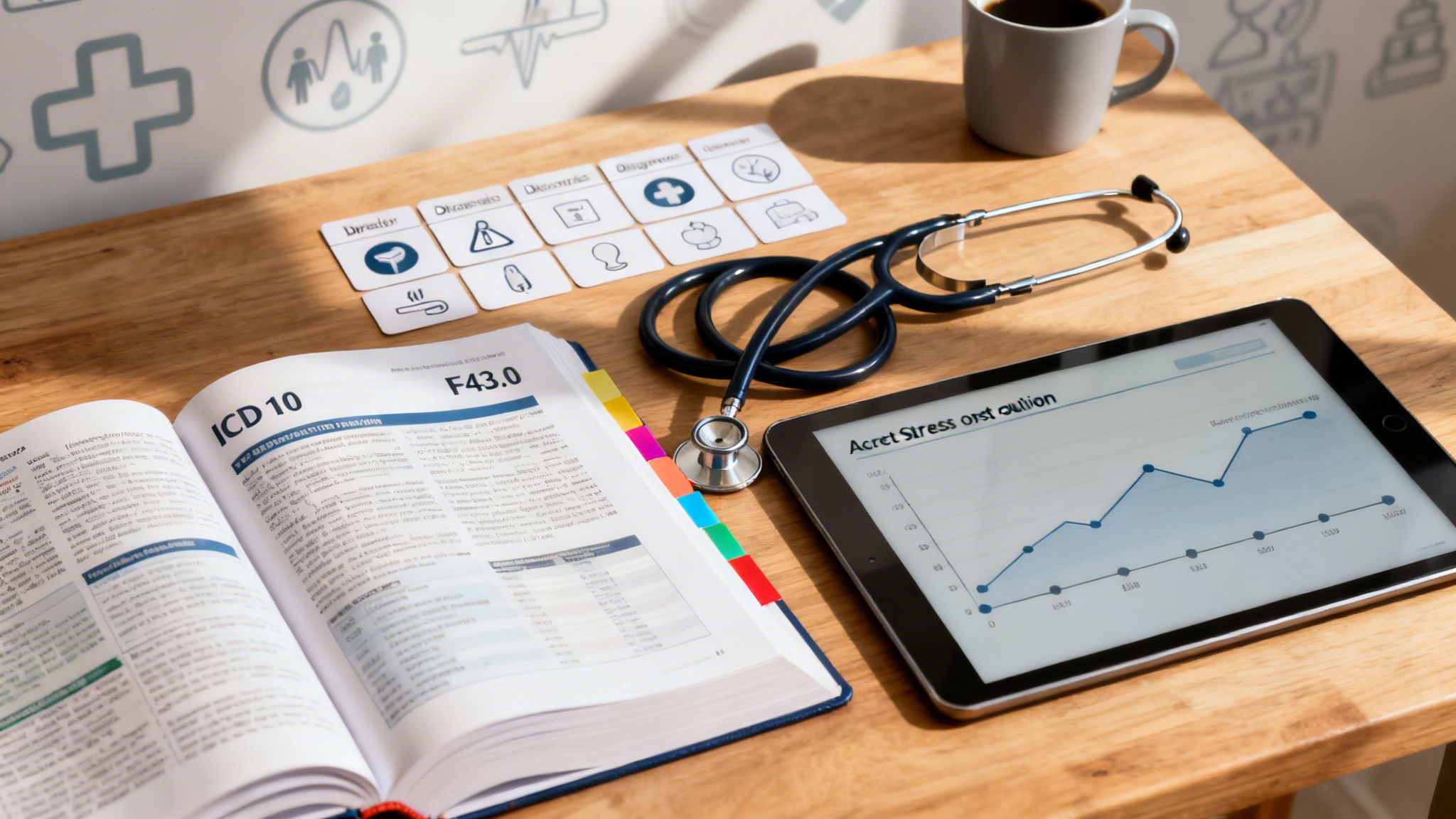
When you experience an immediate and intense reaction to a major stressor, mental health professionals have a way to understand it. In the ICD-10 system, used in India and globally, this is known as an Acute Stress Reaction under code F43.0. This code helps describe symptoms that appear quickly after a deeply stressful event and usually fade within a few days.
What Does the F43.0 Code Mean?

After an overwhelming event, like a personal crisis or an extreme incident, it's natural for your mind and body to have a powerful reaction. The acute stress reaction ICD-10 code helps professionals classify these responses in a structured way. Specifically, F43.0 describes immediate, short-term reactions that arise right after a major stressor.
It is important to remember that this kind of reaction is not a sign of weakness; it is a normal human response to an abnormal situation. Understanding this fosters self-compassion, which is a key step toward building resilience and protecting your long-term well-being. This guide offers clear insights for anyone trying to make sense of this experience.
Key Aspects of an Acute Stress Reaction
An acute stress reaction has a few clear features, and recognizing them can be the first step toward getting the right support through counselling or therapy.
- Immediate Onset: The symptoms almost always begin within an hour of the triggering event.
- Transient Nature: A key feature is that the reaction is temporary, typically subsiding within 8 to 48 hours.
- Variable Symptoms: The experience can look different for everyone, from feeling dazed and confused to experiencing overwhelming anxiety.
Assessments using codes like F43.0 are informational, not a life-long label. They provide a shared language for individuals and professionals to discuss mental health, navigate challenges like anxiety or depression, and find a positive path forward.
Understanding Acute Stress Reaction vs. Acute Stress Disorder
In the moments after a deeply unsettling event, you may hear two terms: Acute Stress Reaction (ASR) and Acute Stress Disorder (ASD). They sound similar, but in mental health, they describe different experiences. Understanding the distinction is important for finding the right kind of support.
Acute Stress Reaction is a term from the ICD-10, the manual used across India and much of the world. It refers to a very brief response to an overwhelming stressor, with symptoms appearing almost immediately and resolving within a couple of days.
On the other hand, Acute Stress Disorder is a term from the DSM-5. This describes a more persistent pattern of symptoms that last for at least three days and up to a month following a traumatic event.
Key Differences in a Nutshell
You can think of an Acute Stress Reaction as the mind's initial, brief shock absorber—a powerful but fleeting response. Acute Stress Disorder involves a more complex set of symptoms that do not fade as quickly. This distinction helps guide next steps, from brief counselling to build immediate resilience to more structured therapy for lasting effects.
Understanding which term applies can also help address related challenges, like overwhelming workplace stress, persistent anxiety, or the risk of developing depression.
- Timeline is Crucial: The biggest difference is timing. ASR lasts for hours or a few days, while ASD spans from three days to one month.
- Diagnostic Manual: Remember, ASR is an ICD-10 term (F43.0), while ASD is from the DSM-5.
- Symptom Complexity: ASD has a more detailed list of symptoms, including intrusive memories, negative mood, dissociation, avoidance, and hyper-arousal.
It's helpful to view any assessment as a tool for understanding, not a rigid label. It creates a shared language for a conversation about healing and finding your footing again after a difficult experience.
Knowing the difference helps everyone involved—from professionals to individuals seeking help—to approach recovery with more precision and empathy. It ensures the support offered matches the person's unique experience and timeline.
Key Diagnostic Criteria and Symptom Timeline for F43.0

The ICD-10 code F43.0, or Acute Stress Reaction, is based on specific guidelines that help make sense of an overwhelming experience. For this code to apply, there must be a clear link between a person's symptoms and a recent, exceptionally stressful event.
Timing is a critical factor, as symptoms must appear almost immediately—typically within one hour of the traumatic event. Often, the first sign is a 'daze-like' state where the person seems bewildered or unable to process what is happening. This can be seen as the mind's way of creating a temporary shield for protection.
The Symptom Experience
After the initial shock, a person might experience a range of intense emotional and physical responses that feel out of their control. It's important to remember these are normal human reactions to an abnormal situation, not signs of weakness.
- Emotional Fluctuation: A person may swing from feeling numb to experiencing sudden agitation, overwhelming anxiety, or deep despair.
- Autonomic Signs: The body often goes into high alert, showing signs of panic like a racing heart (tachycardia), sweating, and flushed skin.
- Social Withdrawal: In some cases, the individual might pull away, becoming unresponsive or seeming disconnected from their surroundings.
- Disorientation: Mild and brief confusion about time, place, or identity is also common.
These symptoms are a direct result of the body's 'fight or flight' response being activated. Understanding this can foster self-compassion, which is a vital step toward building resilience and restoring emotional well-being.
The Critical Timing for Resolution
The most defining feature of an F43.0 Acute Stress Reaction is how short-lived it is. The clinical guidelines are clear about how quickly these symptoms should fade once the person is out of the stressful situation.
The main takeaway is that an Acute Stress Reaction is temporary. This is a hopeful and powerful piece of information, as it frames the experience as a passing state, not a permanent condition.
If the stressor was a single event, symptoms should start to ease within 8 hours. If the stressful situation continues, symptoms should begin to resolve within 48 hours. This rapid recovery separates it from other conditions like PTSD or chronic workplace stress, where symptoms last much longer.
Professional support through therapy or counselling can be very helpful for navigating this period and may prevent longer-term issues like depression. It's important to view any assessment as a starting point for getting support, not an unchangeable label.
How Indian Psychiatric Research Shaped the ICD-10
The ICD-10 is used worldwide, but its strength lies in adapting to insights from across the globe. Research from India has been particularly important in refining how we understand acute stress, making the system more relevant to people's experiences here.
Pioneering work from research centres in India highlighted a gap in the diagnostic framework. Clinicians often saw acute psychotic episodes that did not fit classic definitions of schizophrenia or major depression.
Building a More Culturally Relevant System
This research had a significant impact on clinical practice, showing a clear need for a separate classification for these short-lived, stress-related conditions. This work directly contributed to the creation of codes for acute and transient psychotic disorders, the same family that includes F43.0 for acute stress reaction ICD 10.
One powerful statistic showed that around 52% of patients with acute psychosis could not be classified using the major diagnoses available at the time. Indian studies were essential in advocating for new categories in the ICD-10. For those interested, you can read the full research about these findings to learn more.
Why does this backstory matter?
- Validation: It confirms that mental health experiences seen in India are recognized and respected on a global stage.
- Accuracy: It provides clinicians with sharper, more precise tools, which often leads to more effective therapy and counselling.
- Resilience: It highlights the importance of cultural context in mental health, paving the way for a more understanding approach to promoting well-being.
Knowing this history helps demystify mental health struggles like workplace stress, anxiety, and depression. It reminds us that our understanding of the human mind is always evolving, thanks to researchers who listen to diverse experiences.
Navigating Differential Diagnoses and Similar Conditions
In mental health, telling apart conditions with similar symptoms is a crucial first step toward compassionate support. For an acute stress reaction, which can resemble other responses to trauma, getting this right is essential for guiding someone toward healing.
This involves looking closely at the timing, duration, and specific nature of the symptoms. For example, the acute stress disorder ICD 10 code F43.0 refers to an immediate and brief reaction. Other conditions unfold on different timelines, and sorting this out prevents misdiagnosis.
The flowchart below shows how psychiatric research in India has helped refine diagnostic tools like the ICD-10, leading to more precise and effective patient care.

This process of research and data analysis continuously strengthens frameworks like the ICD-10, which translates directly into better outcomes in clinical settings.
Distinguishing Acute Stress Reaction from Similar Conditions
It's helpful to remember that a clinical assessment provides clarity, not a permanent label. An acute stress reaction might be mistaken for PTSD, adjustment disorders, or panic disorder at first glance, but each has key features that set it apart.
The table below provides a side-by-side comparison to help clarify these distinctions.
Distinguishing Acute Stress Reaction from Similar Conditions
| Condition | Onset | Duration | Core Symptoms |
|---|---|---|---|
| Acute Stress Reaction (F43.0) | Immediate (within minutes/hours of trauma) | Begins to diminish within hours; resolves within 3 days | Initial daze, disorientation, anxiety, anger, despair, over-activity or withdrawal. |
| Post-Traumatic Stress Disorder (PTSD) (F43.1) | Can be delayed; diagnosis requires symptoms for >1 month | Can be long-term or chronic if untreated | Re-experiencing (flashbacks, nightmares), avoidance of reminders, negative mood, hyperarousal. |
| Adjustment Disorder (F43.2) | Within 1 month of a specific stressor | Resolves within 6 months after the stressor ends | Emotional/behavioural symptoms (e.g., low mood, anxiety) in response to a non-life-threatening event. |
This table is a quick reference, and a full clinical picture always requires a deeper conversation. Let's look at some of these conditions in more detail.
Post-Traumatic Stress Disorder (PTSD): Both conditions are rooted in trauma, but PTSD is diagnosed only when symptoms last for more than one month. The experience involves a lasting pattern of re-experiencing the event, avoiding reminders, and feeling constantly on edge. To understand long-term trauma care, exploring the best PTSD treatments can be insightful.
Adjustment Disorder (F43.2): This is more fitting when someone has a strong emotional or behavioral response to a significant but not necessarily life-threatening stressor, like a job loss. Symptoms typically appear within one month and resolve within six months after the stressor ends.
Panic Disorder (F41.0): While panic attacks can be part of an acute stress reaction, they are the central feature of Panic Disorder. Here, the attacks are recurrent and often unexpected, leading to a persistent fear of having another one, which is different from the direct trauma response of F43.0.
Identifying Common Comorbidities with F43.0
An acute stress reaction rarely happens in isolation. It is a natural human response to an overwhelming event, and it is common for other mental health challenges to surface at the same time or as coping mechanisms.
Recognizing this overlap is key to providing truly effective and compassionate care. When someone goes through a traumatic experience, it can amplify existing struggles or trigger new ones. This means a diagnosis of acute stress disorder ICD 10 often needs to consider related conditions for a complete picture.
Common Co-occurring Conditions
Think of these co-occurring conditions as interconnected parts of the same experience. An integrated care plan, often blending different therapeutic approaches, can address these challenges together, building resilience and supporting a more complete recovery.
Here are some of the most common overlaps:
- Anxiety Disorders (F41): It is common for generalized anxiety or panic attacks to appear alongside an acute stress reaction as the mind struggles to feel safe again.
- Depressive Episodes (F32): Deep feelings of hopelessness or a low mood can follow a major stressor and may sometimes evolve into a depressive episode.
- Substance-Related Disorders (F10-F19): Some people may turn to alcohol or other substances to numb intense emotional pain, which can unfortunately lead to dependence.
- Adjustment Disorders (F43.2): When symptoms last longer than a few days but do not meet the full criteria for PTSD, a diagnosis of an adjustment disorder may be considered.
Acknowledging these related conditions is a critical step. It allows for a support plan that addresses not just the immediate crisis but also the broader impact on a person's life and well-being.
For anyone seeking practical next steps, exploring a guide to Trauma-Informed CBT Healing can offer a compassionate path forward. Remember, assessments are informational tools designed to guide supportive conversations.
Next Steps: Guiding Patients and Seeking Support

An assessment using an acute stress disorder ICD-10 code is the start of a conversation, not a final verdict. The focus should be on helping the person move from shock and anxiety toward stability and a renewed sense of control. A good first step is gently explaining that their intense reaction is a normal response to an abnormal event.
Framing the experience this way helps build resilience by shifting the focus from distress to the inherent strength it takes to seek help. It's crucial to clarify that an assessment is an informational tool, not a permanent label.
Connecting Patients with Supportive Care
Once someone feels heard, the next step is connecting them with the right support. Presenting options for therapy and counselling provides a safe space to process the event. These are proactive tools for managing stress and preventing longer-term issues like depression or burnout.
By focusing on compassion and providing practical tools, we empower people to see their response not as a disorder, but as a temporary state they have the strength to navigate. This perspective is central to fostering genuine healing and happiness.
Working together to create a simple, manageable plan can make the path forward feel less overwhelming. This could involve setting small, achievable goals to build momentum and restore a sense of agency.
Building a Practical Support Plan
A helpful support plan is built around the individual, respecting their pace and unique situation. The plan should be holistic, addressing everything from workplace stress to pre-existing anxiety.
Here are a few practical elements to include:
- Immediate Grounding Techniques: Simple mindfulness or breathing exercises can be invaluable for managing sudden moments of panic.
- Connecting with Social Support: Gently encourage reaching out to trusted friends or family, as social connection is a powerful buffer against stress.
- Professional Counselling Options: Offer clear information on therapists who specialize in trauma, explaining how counselling provides tools for processing difficult emotions.
The goal is to offer a supportive partnership, not a quick fix. By equipping people with knowledge and resources, we help them move forward with confidence, knowing they can rebuild their sense of safety and well-being.
Your Questions Answered: Acute Stress and the ICD-10
Making sense of mental health codes can feel complex, but understanding the terms professionals use is a great first step. Let's clarify some common questions about acute stress reactions and their place in the ICD-10 system.
What Is the ICD-10 Code for an Acute Stress Reaction?
The specific code for an acute stress reaction is F43.0. This code is used for an immediate, intense, but very brief response to an exceptionally stressful event. Think of it as the mind's initial shock response, which is temporary, not a chronic condition.
How Is an Acute Stress Reaction Different From PTSD?
The main difference is timing. An Acute Stress Reaction (F43.0) is diagnosed when symptoms appear almost immediately and fade within a few hours to three days. In contrast, Post-Traumatic Stress Disorder (PTSD), coded as F43.1, is only considered when symptoms last for more than one month.
Can Severe Workplace Stress Result in an F43.0 Diagnosis?
It is possible, but only in specific situations. If the workplace stress comes from a single, overwhelming event like a serious accident, it could trigger an acute stress reaction. However, long-term stress leading to burnout, anxiety, or depression would fall under different codes.
It's helpful to see any diagnosis as information, not a label. These codes are tools that help professionals understand your experience and map out the most effective support, like therapy or counselling.
What if My Symptoms Don't Go Away After Three Days?
If feelings of distress and anxiety continue for more than three days, it is a strong signal to reach out for professional help. A mental health expert can conduct a more thorough assessment to understand what is happening. Persistent symptoms might point toward a different condition, and getting support early is a powerful step toward building resilience.
Do I Need a Professional Assessment for an Official Diagnosis?
Yes, a formal diagnosis of F43.0 or any mental health condition can only be made by a qualified healthcare professional. While self-assessment tools offer useful insights, they are not a substitute for a clinical evaluation. This professional assessment ensures you receive care that is right for your situation, putting you on a path toward recovery and well-being.
At DeTalks, we're here to help you connect with the right support for your mental health journey. Whether you need therapy, counselling, or science-backed assessments, our platform connects you with trusted professionals across India. Take the first step towards clarity and resilience by visiting us at https://detalks.com.