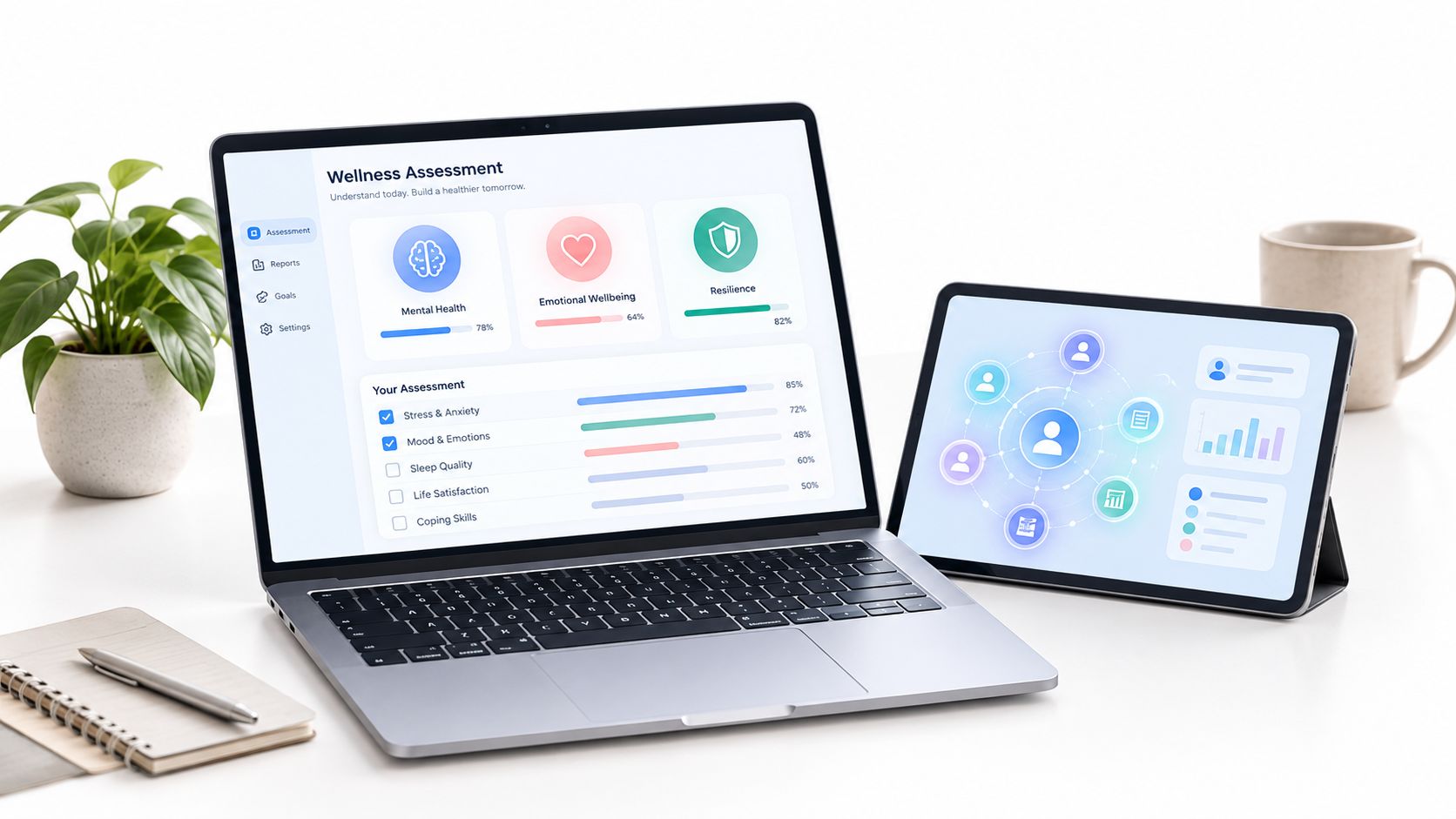
You've had a demanding week. Your sleep feels lighter, small tasks require more effort, and conversations that once felt easy now leave you tense. You may not know whether you're experiencing ordinary pressure, workplace stress, anxiety, low mood, or the early signs of burnout. An online assessment tool can offer a calm place to organise those feelings instead of leaving you alone with uncertainty.
These tools work like a helpful check-in. They ask focused questions about recent experiences, turn your answers into a structured snapshot, and suggest what kind of support may fit next. They don't provide a medical diagnosis, and a result shouldn't become a label or a judgement about your character.
For people in India, this kind of early insight matters because access to specialist mental-health care isn't equal across every community. India's National Mental Health Survey 2 results, led by NIMHANS and covering adults aged 18+ and adolescents aged 13–17 across all States and Union Territories, reports mental-disorder prevalence across rural and urban areas. That national picture helps explain why accessible screening can support earlier identification and triage, particularly beyond specialist-heavy urban centres.
A useful assessment also looks beyond distress. Resilience, compassion, happiness, mindfulness, and overall well-being can be explored alongside depression, anxiety, stress, and relationship difficulties. The aim isn't to find fault. It's to understand what's happening and identify a practical route towards self-help, counselling, therapy, coaching, or psychiatric care when appropriate.
Introduction to Online Assessment Tools and Why They Matter Today
Many people begin searching for an assessment after a quiet moment of concern. A student might notice that exam stress is affecting concentration. A working professional may feel constantly exhausted despite taking time off. A parent may wonder whether family conflict is creating more emotional strain than they can manage alone.
An online assessment tool gives these experiences a structure. Instead of asking, “What's wrong with me?”, you can ask gentler questions: What am I feeling? How often is it happening? How much is it affecting daily life? What support could help?
That change in language matters. Stress, anxiety, depression, burnout, grief, loneliness, and low motivation aren't signs of personal failure. They're experiences that deserve attention, just as positive qualities such as resilience and compassion deserve opportunities to grow.
A starting point, not a verdict
A screener is closer to a thermometer than a full medical examination. It can indicate that something needs a closer look, but it can't explain every cause or decide what treatment you need.
For example, a high anxiety score might reflect workload, sleep problems, grief, a health concern, relationship strain, or several factors together. A low score also doesn't prove that everything is fine, especially if you're struggling in ways the questions didn't capture.
Remember: An online assessment is informational. It can guide a conversation with a qualified professional, but it doesn't replace clinical evaluation.
India's online public-service experience also offers a useful historical comparison. The NeSDA 2021 report describes an online system created to help the Department of Administrative Reforms and Public Grievances assess services. It reports 78% average compliance for Punjab's services portals, 62% for the Local Governance and Utility Services sector, 98% for Odisha's State Portal, and 86% for Uttar Pradesh's State Portal. These results show how online systems can apply common criteria, generate scores, and compare performance at scale.
Mental-health assessments use a similar broad logic, but the subject is personal experience rather than public-service delivery. Good design still depends on clear questions, consistent scoring, responsible interpretation, and a pathway to meaningful action.
What this guide can help you do
You'll learn how these tools work, which type may suit your concern, how to judge scientific quality and cultural relevance, and what to check before sharing sensitive answers. You'll also see why a score is most useful when it connects to counselling, therapy, well-being practices, or professional referral, rather than ending on a results screen.
How Online Assessment Tools Work in Simple Terms
Think of an online mental-health assessment as a structured health check. A health check doesn't claim to explain your whole body from one measurement. It gathers selected information so you and a professional can decide whether further attention would be useful.
The first step is deciding what you want to understand. A depression screener asks about mood, interest, energy, sleep, appetite, concentration, and related experiences. A resilience measure asks about how you respond to pressure, recover from setbacks, and access support. Different tools answer different questions.
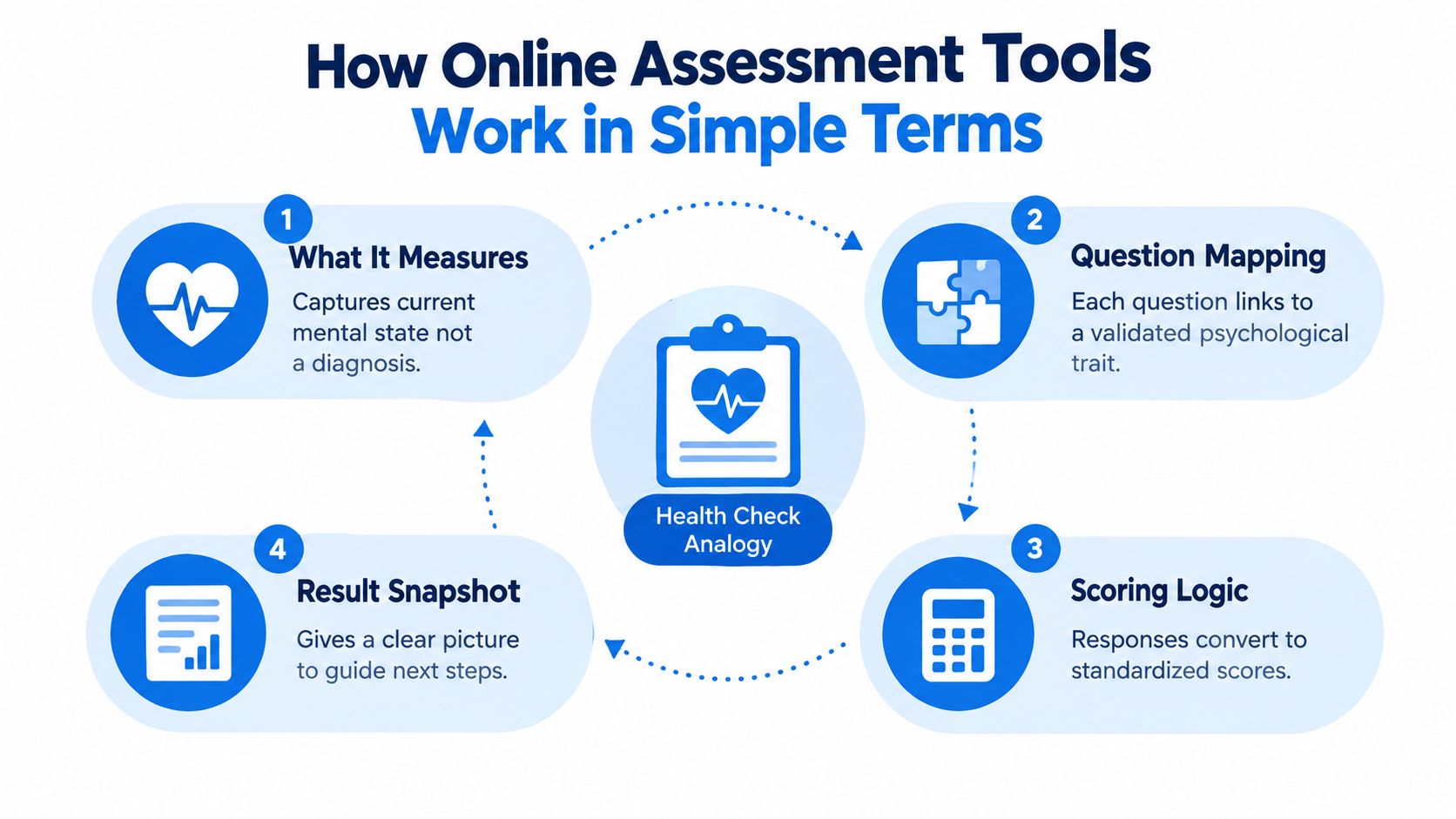
Step one involves focused questions
Most useful screeners refer to a defined period. For example, the India-based assessment guide from TheraSoft explains that PHQ-9 screens depression symptoms over the last 2 weeks, while GAD-7 screens anxiety symptoms over the last 2 weeks using 7 validated questions. It also describes K10 as a measure of general psychological distress.
This time window helps you answer from a specific experience rather than from your entire life story. Try to respond based on what has generally been true during that period, not only on your best or worst day.
Step two turns answers into a pattern
Each response contributes to a score. The score doesn't measure your worth, intelligence, or ability to cope. It summarises the pattern represented by that particular tool.
Some tools screen for possible symptoms. Others help track severity over time, explore personality tendencies, or identify strengths such as compassion and resilience. A progress check can be useful because you may not notice gradual changes in sleep, mood, or confidence without comparing your experiences across time.
Step three requires thoughtful interpretation
A results page may place your responses into a range, such as lower, moderate, or higher concern. Treat that range as a prompt for reflection, not a final answer.
A score can be influenced by current circumstances, language, fatigue, privacy while completing the assessment, and how well the questions match your life. It can't observe your relationships, cultural context, physical health, or the meaning behind your answers.
A result should open a useful conversation, not close one.
If a result suggests concern, consider speaking with a counsellor, therapist, psychologist, or doctor. If the assessment includes a risk question and you indicate immediate danger, follow the platform's crisis guidance and contact local emergency or crisis services without waiting for a later interpretation.
Types of Online Assessment Tools You Will Encounter
The right tool depends on the question you're trying to answer. Someone facing workplace stress needs a different starting point from a student exploring resilience, and a person wondering about depression needs a different measure from a couple reflecting on communication.
Symptom screeners
Depression and anxiety screeners focus on recent symptoms and their effect on daily functioning. PHQ-9 is commonly used to screen depression symptoms over a recent time window, while GAD-7 focuses on anxiety symptoms. They can help a student recognise that exam stress has become persistent, or help a professional name patterns that feel like constant worry and exhaustion.
These tools are particularly useful when you're unsure whether your experience deserves support. They don't determine a diagnosis, and they shouldn't be used to dismiss concerns when your score appears low.
Tracking and broader distress
A severity tracker can help you notice change. You might complete the same validated measure at suitable intervals and discuss the pattern with a professional. The purpose isn't to chase a perfect score. It's to see whether sleep, motivation, concentration, or emotional strain is shifting after counselling, therapy, lifestyle changes, or a change in circumstances.
A broader distress tool, such as K10, may be useful when your feelings don't fit neatly into one category. It can provide a wider view of psychological strain, while a clinician helps explore what may be contributing to it.
Personality and positive psychology
Personality tools explore tendencies such as communication style, emotional responses, or preferences. They can support self-awareness, but they shouldn't be used to box you into a fixed identity.
Positive-psychology assessments focus on resources as well as difficulties. Measures related to resilience, compassion, happiness, gratitude, mindfulness, emotional intelligence, self-esteem, and purpose can reveal areas to strengthen. A resilience score isn't a judgement about how strong you are. It can suggest where support, rest, connection, or skill-building may make daily life easier.
For health concerns that overlap with emotional well-being, a broader resource such as this full assessment for perimenopause symptoms may help someone organise questions about changing physical and emotional experiences before speaking with a clinician.
| Tool Type | What It Measures | Typical Time Frame | Best For |
|---|---|---|---|
| Depression screener | Mood, interest, energy, and related symptoms | Recent defined period | People concerned about low mood or loss of interest |
| Anxiety screener | Worry, tension, restlessness, and related symptoms | Recent defined period | Anxiety, exam stress, and workplace pressure |
| Distress measure | General psychological strain | Recent defined period | Experiences that don't fit one clear category |
| Severity tracker | Change in symptoms or functioning | Repeated check-ins | Monitoring progress with professional guidance |
| Personality measure | Patterns of preferences and responses | Usually broader and less time-bound | Self-awareness and communication |
| Positive-psychology measure | Resilience, compassion, happiness, or well-being | Current strengths or recent experience | Growth, prevention, and everyday well-being |
Are Online Assessments Scientifically Valid and Culturally Relevant
A polished design doesn't make an assessment trustworthy. Scientific quality depends on whether the tool measures what it claims to measure, does so consistently, and works appropriately for the people using it.
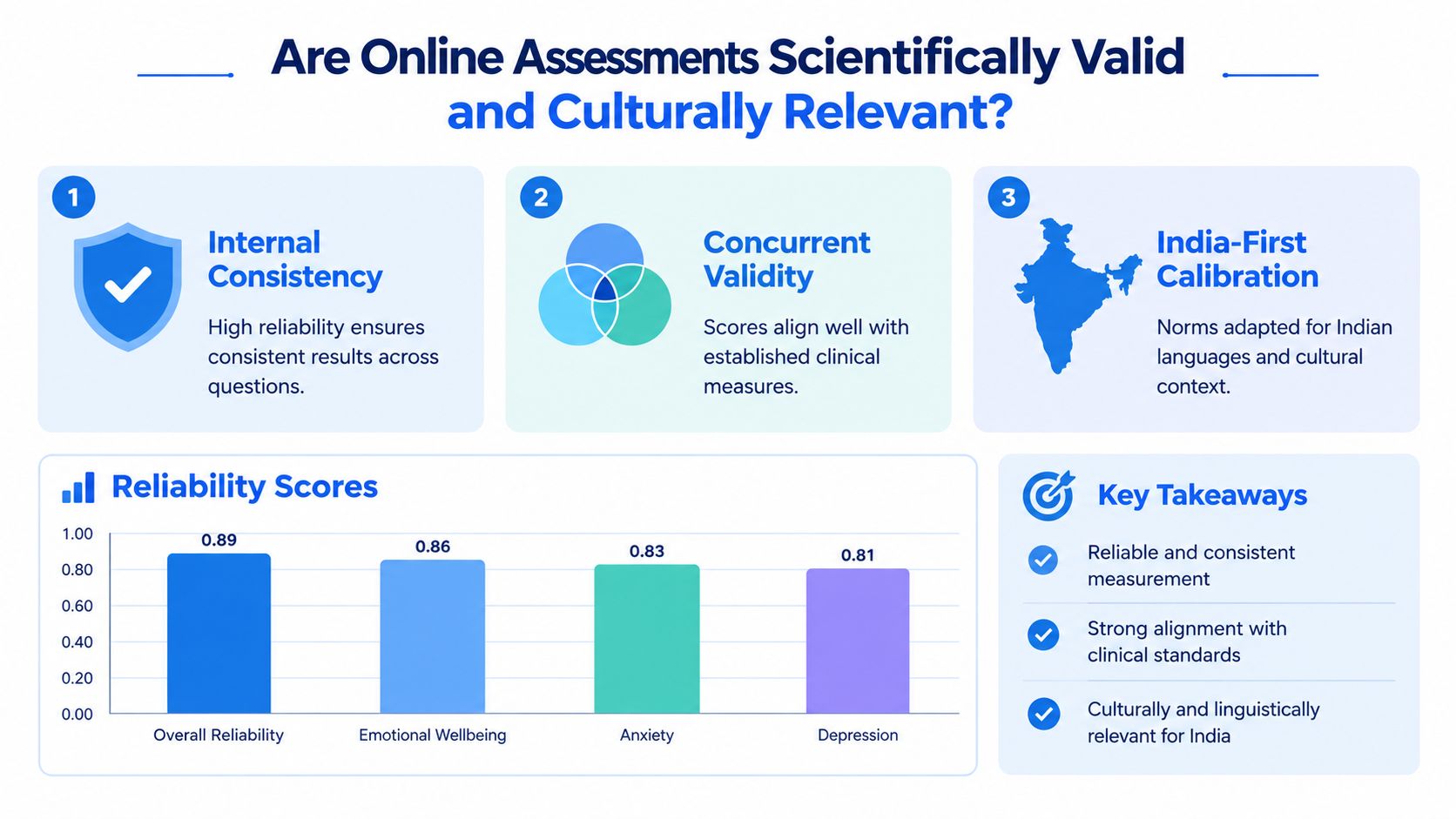
Reliability asks whether the questions work together consistently. If several questions explore a related experience, people's responses should form a coherent pattern. Validity asks whether the score has a meaningful relationship with the concern being assessed. Concurrent validity checks whether an online result aligns with an established measure or professional assessment.
The language and setting matter too. A tool developed for another population may use assumptions that don't fit Indian family structures, work environments, access to care, or everyday expressions of distress. Translation alone isn't always enough. Researchers need to examine how local participants understand the questions and whether the scoring remains meaningful.
What Indian validation can show
An internet-use assessment developed for Indian participants reported Cronbach's alpha of 0.893 across 25 items, concurrent validity of 0.800, and a statistically significant correlation with the Internet Addiction Test at p<0.001 in the published Indian-context validation study. In plain language, the questions showed strong internal consistency and a meaningful relationship with an established comparator.
The authors also noted that there had previously been no empirically validated tool in the Indian context for that purpose. That point matters beyond internet-use assessment. It shows why platforms should validate tools locally instead of merely placing an overseas questionnaire on a website.
A co-designed screening app for Indian university students reported validity correlations of r=0.819, r=0.887, and r=0.972 when app scores were compared with clinical assessments in the Indian student screening research. The study also emphasised clinician-supported and student-centred implementation. Strong correlation helps, but safe referral and local usability remain essential.
For readers who want a plain-language explanation of reliability and validity, this practical guide to psychometric metrics can make technical terms easier to understand.
A trust checklist
Look for the name of the instrument, its purpose, the population for which it was evaluated, and a clear explanation of scoring. A responsible platform should also say that results are informational and not diagnostic.
Be cautious when a tool makes sweeping claims, hides its evidence, or presents a result as an identity. DeTalks brings validated assessments together with access to psychologists, therapists, and other mental-health professionals, allowing a screening result to sit within a wider support pathway rather than standing alone.
Privacy Ethics and Safety Before You Share Your Answers
Mental-health answers can reveal intimate details about mood, relationships, work, health, and safety. Before starting an online assessment, pause long enough to understand what happens to that information.
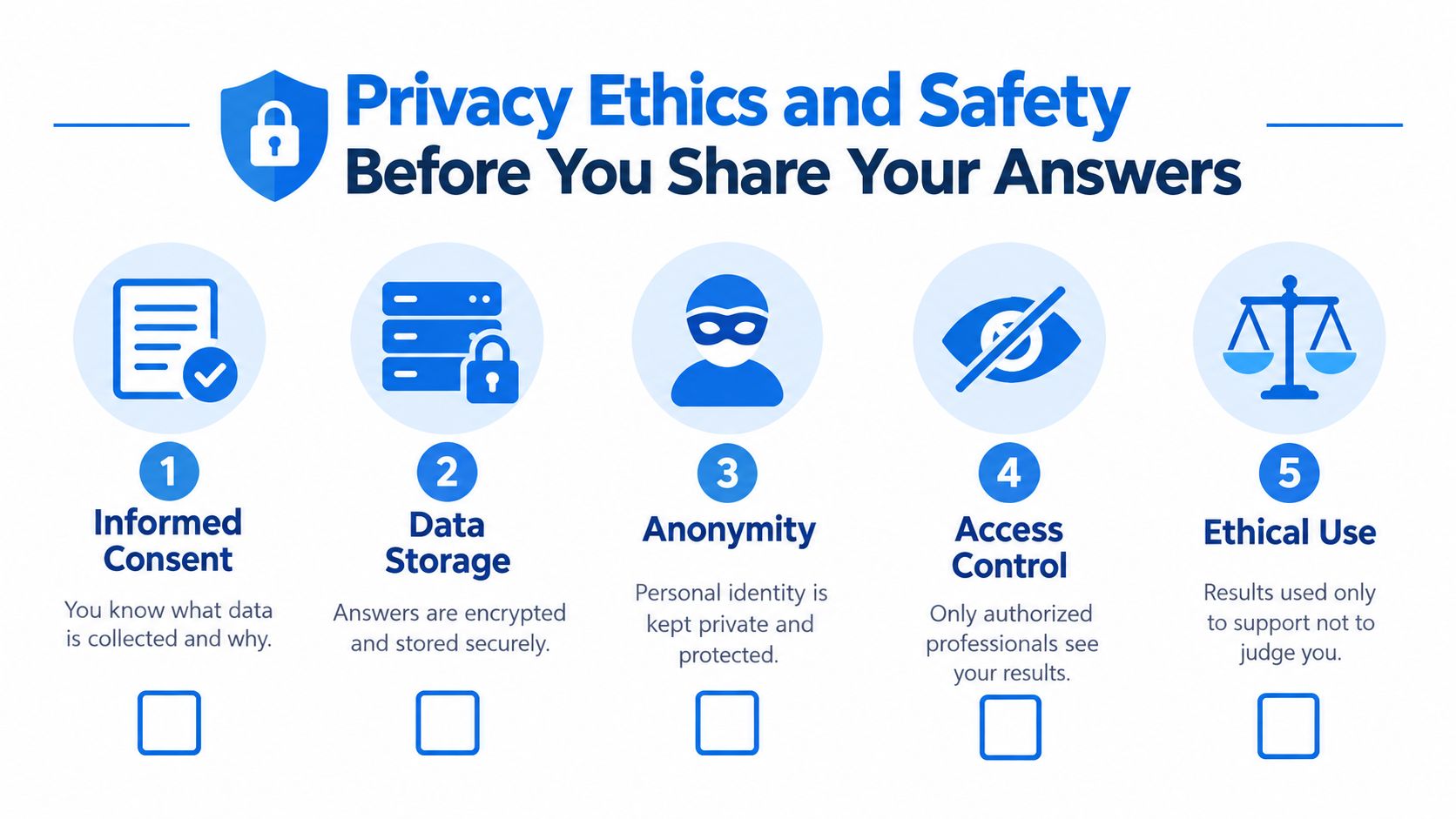
A trustworthy platform should explain what it collects, why it collects it, how it stores it, and who can access it. If those details are difficult to find, unclear, or written in language you can't understand, you're entitled to delay sharing personal information.
Five questions to ask first
- Consent: Do you know what you're agreeing to, and can you choose not to continue?
- Purpose: Is the information used to provide your requested assessment and support, or for another purpose?
- Storage: Does the platform explain how answers are protected and how long they may be retained?
- Access: Can you see who will receive the result, such as you alone, a clinician, an employer, or an institution?
- Safety: Does the platform explain what happens if your answers suggest urgent risk?
Safety matters more than convenience
An assessment should never be presented as a diagnosis, and a score shouldn't be used to judge whether you're a good employee, parent, partner, or student. Employers and institutions need especially careful consent and access boundaries because people may feel pressured to participate.
Risk questions can feel direct, but they serve an important purpose when handled respectfully. If you're thinking about harming yourself, feel unable to stay safe, or face immediate danger, don't rely on an online score. Contact local emergency services, a crisis service, or a trusted person who can stay with you while you seek urgent help.
A safe platform should provide clear next steps after a concerning result. That may include information about counselling, therapy, medical care, or crisis support. Screening without a route to care leaves the person with information but little help.
The video below offers another accessible way to think about privacy, ethics, and responsible use.
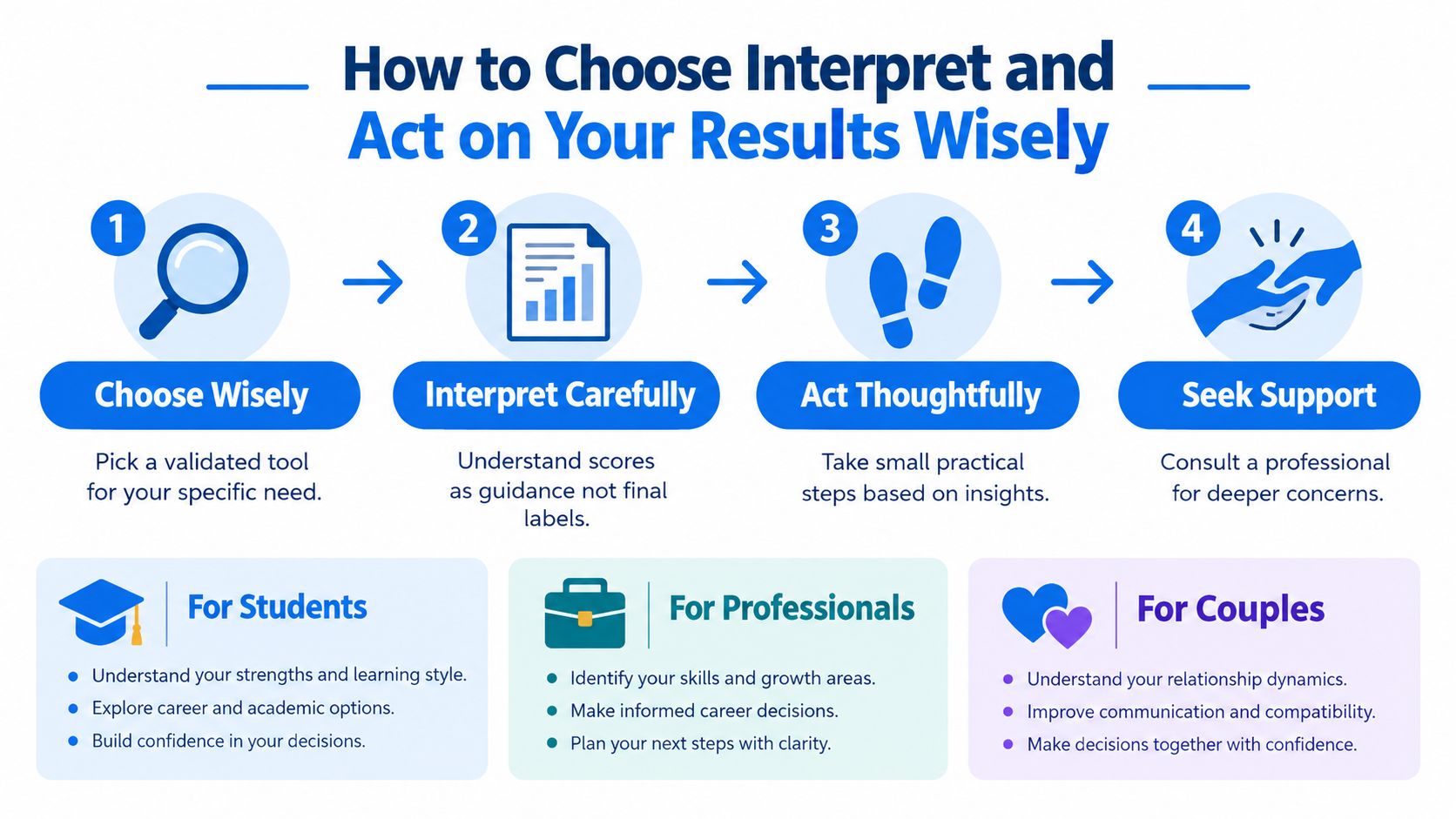
How to Choose Interpret and Act on Your Results Wisely
Start with the situation, not the score. A student facing exam stress may choose an anxiety or general-distress screener, then discuss sleep, concentration, and study pressure with a counsellor. A professional experiencing workplace stress may combine a stress-focused check-in with reflection on workload, boundaries, rest, and burnout.
A couple may use an assessment to identify communication patterns, but each person's score should support a respectful conversation rather than become evidence against the other. Parents dealing with family conflict can use a well-being or stress measure as a prompt to seek family counselling, especially when arguments, withdrawal, or worry are affecting daily routines.
Read the result in context
Check the tool's explanation of its ranges. Don't compare your score with a friend's, and don't treat a change as meaningful without considering sleep, illness, recent events, work demands, or the way you answered.
Tracking can be useful when it's done consistently and discussed with a professional. One result may offer a snapshot. A pattern across time can provide richer information, but neither replaces a clinical conversation.
A score can describe a pattern. Only a fuller conversation can explore its meaning.
Turn insight into a next step
Use the result to choose a proportionate response:
- Lower concern: Consider self-help, mindfulness, gratitude, movement, rest, social connection, or resilience-building practices, while staying attentive to how you feel.
- Persistent concern: Book counselling or therapy to explore causes, coping strategies, relationships, workplace stress, or recurring anxiety and depression symptoms.
- Complex or worsening concern: Speak with a psychologist, psychiatrist, or doctor who can assess your wider mental and physical health.
- Immediate safety concern: Seek urgent crisis or emergency support rather than waiting for an online follow-up.
The connection between screening and referral is important in India. An implementation study reported that technology-enabled screening and referral increased use of primary-care services for mental-health problems from 3.3% to 81.2%, as described in the Indian implementation research. The same source reports 96% screening completion among logged-in users in an Indian college-based digital brief intervention. These figures support a practical lesson: an assessment becomes more useful when the platform makes the next step visible and reachable.
DeTalks offers validated assessments alongside a directory of therapists, counsellors, psychologists, and other mental-health professionals. That arrangement can help users move from reflection towards a suitable conversation instead of interpreting a result in isolation.
Supportive Next Steps for Your Well Being Journey
An online assessment can help you name an experience, notice a strength, or prepare for a conversation. It can't tell your whole story, predict your future, or replace therapy, counselling, medical advice, or a supportive relationship.
Use results with curiosity. If anxiety, depression, burnout, grief, or workplace stress keeps affecting sleep, relationships, work, study, or daily functioning, reaching out is a sensible act of care. Seeking help doesn't mean you've failed. It can reflect resilience, self-awareness, and compassion towards yourself.
Positive well-being deserves attention too. Small practices such as mindful breathing, gratitude, supportive connection, meaningful activity, and kinder self-talk can complement professional support. They won't erase every difficulty, but they can help you recognise what restores energy and strengthens your ability to cope.
For readers who want to look beyond symptoms and consider everyday functioning, relationships, and satisfaction, this guide explains how to apply quality of life metrics with MicroTrack. Whatever tool you choose, check its evidence, protect your privacy, and treat the result as information rather than a verdict.
If you're in India or elsewhere and feel unsure about what kind of support fits, you don't have to decide everything at once. Begin with one honest check-in, share your concerns with someone trustworthy, and seek professional guidance when the burden feels persistent, confusing, or unsafe.
DeTalks offers confidential, scientifically validated assessments and access to psychologists, therapists, counsellors, and other mental-health professionals who can help you understand what comes next. Visit DeTalks to explore an assessment, find suitable support, and take a thoughtful first step towards better well-being.