Tag: mental health support

  • Psychiatrist Near Me for Depression and Anxiety: Psychiatris

    Psychiatrist Near Me for Depression and Anxiety: Psychiatris

    You open your phone, type “psychiatrist near me for depression and anxiety”, and then freeze.

    One tab shows a doctor listing. Another says therapy. A third mentions counselling. You may be dealing with low mood, panic, poor sleep, workplace stress, burnout, or that heavy sense that daily life has become harder than it should be. When you already feel drained, even searching for help can feel like work.

    If that's where you are, you're not failing. You're doing something brave. Looking for support is often the first act of resilience.

    In India, this need is far from rare. The National Mental Health Survey found that about 10.6% of adults had a current mental morbidity, and nearly 150 million people needed active mental health care, with a very wide treatment gap, according to this summary of the survey context. That matters because many people searching for help aren't overreacting. They're responding to real distress that has often gone unsupported for too long.

    This guide is for that moment. Not to label you, and not to replace professional care, but to help you make calmer, clearer decisions about therapy, counselling, medication support, and your next step towards well-being.

    Taking the First Step When You Feel Overwhelmed

    A lot of people wait until things feel unbearable before they search for a psychiatrist. They tell themselves it's just stress, just a rough patch, just lack of sleep. Sometimes that's partly true. But sometimes anxiety and depression subtly start shaping your days, your relationships, your work, and your sense of self.

    You might notice that your mornings feel heavy. You may still be functioning, replying to messages, attending meetings, finishing chores, but inside you feel flat, tense, irritable, or exhausted. Some people feel constant worry. Others feel numb. Many feel both.

    What people often get wrong

    People often assume they must be in a severe crisis before reaching out. That isn't true. If anxiety, depression, burnout, or emotional pain is making life harder to manage, support is worth considering.

    Another common worry is, “What if I'm making too much of this?” In practice, asking for help is not a diagnosis. It's an information-gathering step. A mental health assessment is meant to understand what's happening. It doesn't define your whole identity.

    Practical rule: If your distress is affecting sleep, concentration, relationships, work, or hope, it's reasonable to seek support.

    For many readers, the hardest part is not finding a name in a directory. It's accepting that they deserve care. If that sounds familiar, a simple primer on signs it's time for psychiatric help can make that decision feel less frightening and more grounded.

    A gentle way to begin today

    If you feel overwhelmed, don't try to solve everything at once. Start with one small action:

    1. Write down your main concern. It could be “I cry often”, “I feel anxious all day”, or “I can't switch off after work”.
    2. Note how long it's been going on. Even a rough sense helps.
    3. List what's getting harder. Sleep, appetite, motivation, focus, family life, studies, or workplace stress.
    4. Tell one trusted person. You don't need a long explanation. A simple “I'm struggling and looking for support” is enough.

    That kind of clarity helps when you begin therapy, counselling, or a psychiatric consultation. It also helps you feel less lost.

    You don't need to be certain about what's wrong before you ask for help. You only need to notice that something isn't feeling manageable.

    Depression and anxiety can shrink your world. Reaching out starts to widen it again. Not instantly, and not perfectly, but meaningfully.

    Understanding Who Can Help With Your Well-being

    Looking for a psychiatrist near me for depression and anxiety often involves trying to answer two questions at once. Who can help me? And what kind of help do I need?

    That confusion is understandable. In India, the treatment gap for common mental disorders is substantial. The National Mental Health Survey reported that 76.5% of people with depression and 85.2% with anxiety disorders had not received treatment, making the first step to find any qualified professional clinically important, as noted in this summary of Indian treatment-gap data.

    An infographic comparing the roles of psychiatrists, psychologists, and therapists in mental health and well-being.

    The simple difference

    A psychiatrist is a medical doctor who specialises in mental health. A psychiatrist can diagnose conditions, prescribe medication, and may also provide therapy.

    A psychologist focuses on assessment and therapy. A counsellor or therapist typically provides talk-based support for emotional, behavioural, and relationship concerns. In general use, neither psychologists nor counsellors prescribe medication.

    Psychiatrist vs psychologist vs counsellor in India

    Professional Primary Role Can Prescribe Medication? Typical Focus
    Psychiatrist Medical evaluation, diagnosis, treatment planning Yes Depression, anxiety, medication management, combined care
    Psychologist Psychological assessment and therapy No Therapy, coping skills, behaviour patterns, emotional insight
    Counsellor Talk support and practical emotional guidance No Stress, relationships, workplace stress, adjustment, well-being

    Which one makes sense for you

    If your anxiety or depression feels intense, persistent, or physically disruptive, a psychiatrist may be the right starting point. This is especially true if you're wondering whether medication might help, or if symptoms are affecting basic functioning.

    If you mainly want structured talk therapy, emotional processing, or skills for resilience, a psychologist or counsellor may be a strong fit. Many people do best with both. One professional helps with medication decisions if needed, while another supports regular therapy and counselling.

    A few examples make this easier:

    • Frequent panic and poor sleep: A psychiatrist can assess symptoms and discuss medication if appropriate.
    • Low mood after a breakup or job stress: A psychologist or counsellor may help you process emotions and rebuild coping.
    • Long-term anxiety plus difficulty functioning: A combined approach can make sense, with psychiatric review and ongoing therapy.

    A better question than “Who is nearest?”

    Instead of asking only who is close by, ask who matches your current needs.

    You may need:

    • Diagnostic clarity if you don't understand what's happening
    • Medication support if symptoms feel moderate to severe
    • Therapy and counselling if you want practical and emotional tools
    • A combined plan if you want relief now and resilience over time

    The right professional is not always the first name you see in search results. It's the one whose role matches your needs.

    Many people click a listing, book quickly, and only later realise they chose the wrong kind of care. Understanding the roles first can save time, money, and frustration.

    How to Find and Evaluate a Psychiatrist

    Search results can be misleading. Many “psychiatrist near me” pages are built for provider discovery, but they don't help you decide what kind of care fits your situation. That gap matters because many users still need guidance on choosing between self-help, psychotherapy, and psychiatric medication, as discussed in this analysis of the content gap around care pathways.

    A woman looks at mental health professional listings on a laptop computer screen while working at home.

    Start with your symptoms, not the directory

    Before you compare profiles, write down what you want help with. Be specific. “Anxiety” is useful, but “constant worry, racing thoughts, chest tightness, and poor sleep” is much more helpful.

    Also note whether your symptoms seem mild, moderate, or severe. If there are suicidal thoughts, self-harm risk, or a sudden sharp decline in functioning, don't wait for a routine search process. Seek urgent help from local emergency services, a nearby hospital, or immediate support from family and trusted people.

    A practical search method

    Use a simple filter process rather than scrolling endlessly.

    1. Search by need
      Look for psychiatrists who mention depression, anxiety, panic, sleep issues, stress, or burnout.

    2. Check qualifications
      Confirm that the professional is licensed and clearly identified as a psychiatrist if you want medical evaluation or medication support.

    3. Look at care style
      Some psychiatrists focus mainly on medication management. Others also offer therapy-informed care. Neither is automatically better. The question is what you need.

    4. Review access details
      Check whether they offer online sessions, in-person sessions, or both. Also see how follow-up works.

    5. Shortlist two or three options
      Too many choices can increase anxiety. A small shortlist is easier to act on.

    Questions worth asking before booking

    Some people feel awkward asking questions. You don't need to. A good clinician should expect them.

    • Do you work often with depression and anxiety?
    • How do you usually assess symptoms in the first session?
    • Do you provide medication management, therapy, or both?
    • If I also need therapy, do you coordinate with a psychologist or counsellor?
    • Are online follow-ups available?
    • What should I prepare before the first appointment?

    These questions help you judge fit, not just credentials.

    A good first appointment isn't about impressing the psychiatrist. It's about seeing whether the care feels safe, clear, and organised.

    Here is a short explainer that can make the process feel less abstract:

    Signs of a good fit

    Notice how you feel after the first interaction, even if it's only a call or booking exchange.

    A promising sign is when the psychiatrist or clinic:

    • Answers practical questions clearly
    • Explains next steps in plain language
    • Doesn't shame you for waiting or struggling
    • Takes your symptoms seriously
    • Talks about follow-up, not only the first visit

    A less helpful sign is when everything feels rushed, vague, or dismissive.

    Finding the right psychiatrist near you for depression and anxiety is partly about credentials, but it's also about whether the care is usable in real life. If you can't access follow-up, don't understand the plan, or feel too intimidated to return, the match may not be right.

    What to Expect from Your Treatment Journey

    Starting psychiatric care can feel intimidating because people often imagine the unknown. In reality, the first steps are usually conversational, practical, and more ordinary than people expect.

    For depression and anxiety, a practical workflow is to verify symptom severity, then choose a psychiatrist for diagnosis and medication management. Benchmark timelines are often 2–4 weeks for initial antidepressant benefit and 5–20 weekly sessions for psychotherapy response, according to this clinical overview of common treatment timelines.

    A four-step infographic illustrating the psychiatrist treatment journey for mental health concerns, including consultation and therapy.

    What happens in the first appointment

    A psychiatrist will usually ask about your symptoms, how long they've been present, what makes them worse or better, and how they affect sleep, work, relationships, and daily life. They may also ask about medical history, current medicines, and family history.

    This can feel personal, but it serves a purpose. The goal is to understand patterns, not to judge you.

    If the psychiatrist uses questionnaires or screening tools, treat them as informational, not diagnostic. They help organise the conversation. They don't reduce your whole life to a score.

    What treatment may look like

    Not everyone needs the same plan. A psychiatrist may suggest one of several paths:

    • Medication management if symptoms are moderate to severe, or if anxiety and depression are making it hard to function
    • Therapy or counselling if you need support with thoughts, emotions, relationships, coping, or workplace stress
    • Combined care if both symptom relief and deeper emotional work are important

    Combined care often makes practical sense. Medication may help reduce symptom intensity, while therapy helps you build insight, resilience, self-compassion, and habits that support long-term well-being.

    Recovery isn't only about symptom reduction. It's also about rebuilding trust in yourself, daily stability, and the ability to feel engaged with life again.

    Why patience matters

    People often stop too early because they expect immediate change. That's understandable, especially when you're hurting. But treatment often unfolds in stages.

    You might first notice better sleep, a little less panic, or fewer crying spells. Larger changes in mood, motivation, and confidence may take longer. Therapy also builds gradually. Skills such as boundary-setting, emotional regulation, and healthier self-talk become stronger with repetition.

    If your situation is more layered, such as anxiety or depression alongside another mental health or substance-related concern, reading about treatment for co-occurring disorders can help you understand why a broader support plan may be needed.

    What follow-up is for

    Follow-up appointments aren't just prescription check-ins. They're where treatment gets refined.

    A psychiatrist may review:

    • Side effects or concerns
    • Changes in mood, sleep, and anxiety
    • Whether therapy should be added or adjusted
    • What's happening at home or work
    • How to support long-term resilience

    This is also your space to say what's working and what isn't. Good care is collaborative. You're not expected to be passive.

    Considering Online vs In-Person Psychiatry

    “Near me” used to mean distance on a map. Today, it often means something more useful. Can I get seen, continue care, and stay consistent?

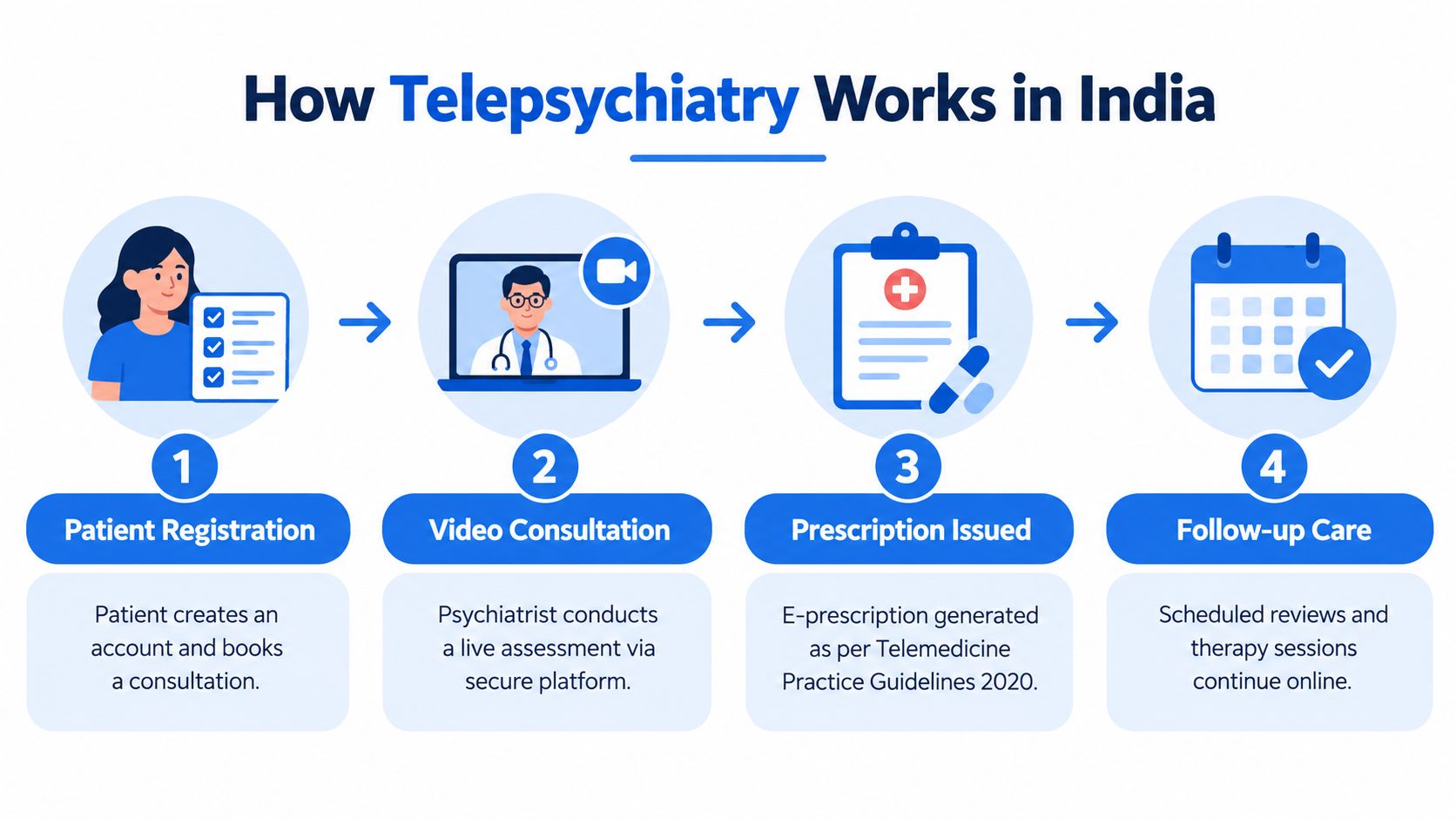
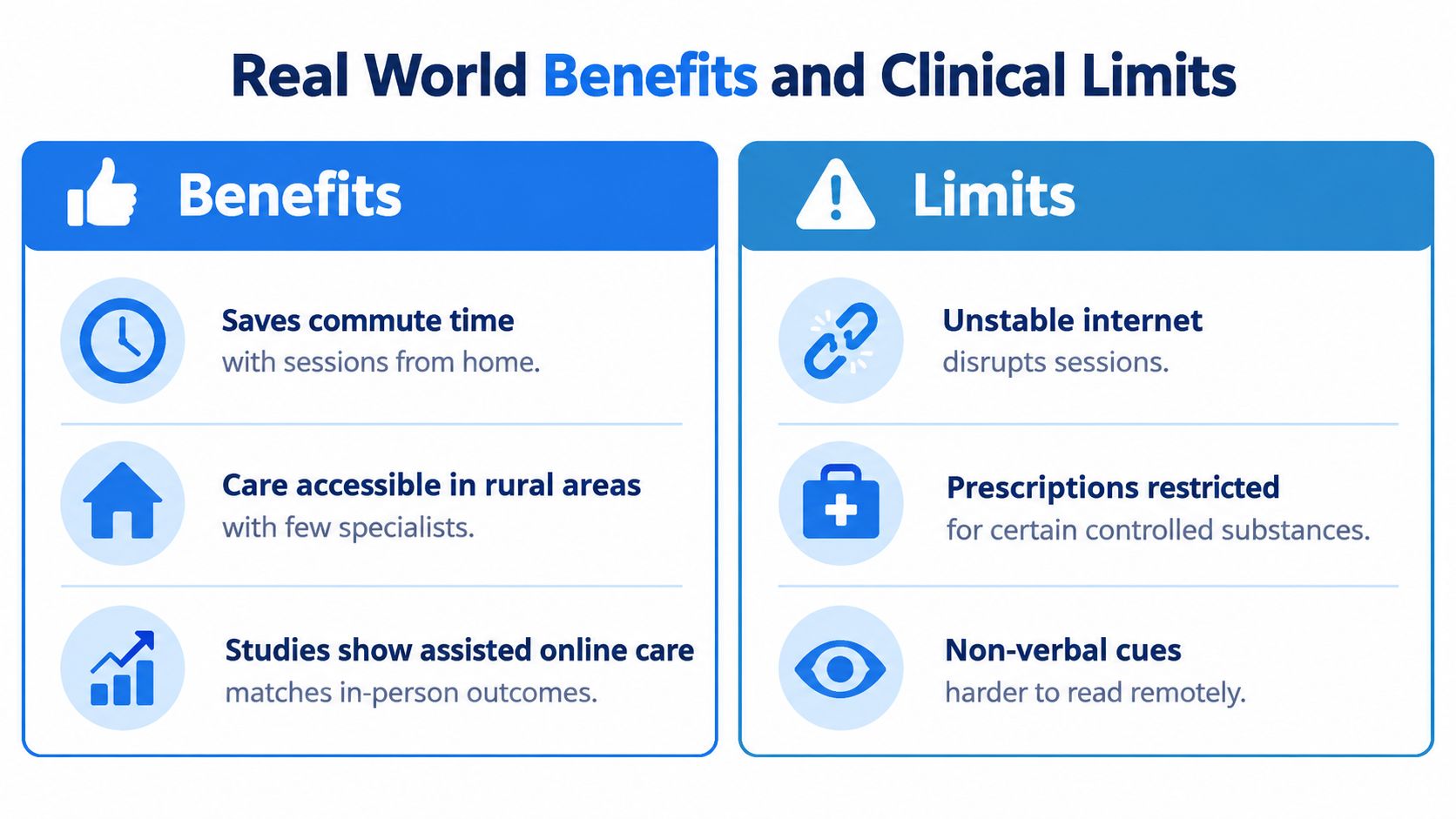
    That question matters in India because the best “nearby” psychiatrist may be online. India's National Tele-Mental Health Programme, Tele-MANAS, crossed 1.5 million calls by 2025, showing strong demand for remote support that can bypass access inequities and psychiatrist shortages, as described in this overview of tele-mental health demand in India.

    A split-screen view shows a patient in a video therapy session and in-person psychotherapy session.

    When online psychiatry makes sense

    Online care can work well if travel is difficult, your schedule is packed, or specialist access in your area is limited. It can also feel easier for people who are anxious about walking into a clinic.

    For many working professionals, online appointments reduce friction. You don't have to lose half a day to commuting. That can make a real difference when you're already carrying workplace stress, family responsibilities, or academic pressure.

    Online care may be especially helpful if you need:

    • Continuity through regular follow-ups
    • Privacy from a familiar environment
    • Access to a specialist outside your immediate city
    • Flexibility for therapy and medication reviews

    When in-person care may feel better

    Some people feel more comfortable meeting face to face. That preference matters. In-person sessions can also feel grounding if home doesn't offer privacy, or if you find it easier to open up in a structured clinic setting.

    A local clinic may also feel more reassuring if you want a medical environment, physical presence, or easier coordination with other healthcare services.

    The real decision is accessibility

    A psychiatrist can be geographically close and still hard to access. Maybe appointments are scarce. Maybe follow-ups are irregular. Maybe the clinic feels too rushed. In that case, “near me” doesn't really mean available to me.

    That's why it helps to compare formats on practical terms:

    Format Best for Watch for
    Online psychiatry Busy schedules, smaller towns, follow-up continuity, privacy Need for stable internet and a private space
    In-person psychiatry Face-to-face comfort, clinic setting, local medical coordination Travel time, scheduling strain, fewer local options

    The most helpful psychiatrist is the one you can realistically keep seeing, not just the one whose address is closest.

    If you're unsure which format fits your life, this guide to holistic therapy options offers a thoughtful way to compare comfort, convenience, and personal preference.

    A useful middle path

    You don't always have to choose only one format. Some people begin online because it gets them started quickly, then shift to in-person later. Others do the reverse.

    A hybrid model can be practical for depression and anxiety. You might use online follow-ups for consistency and choose occasional in-person reviews when that feels helpful. The most important thing is not loyalty to a format. It's staying connected to care that supports your well-being.

    Your Path Forward to Resilience and Well-being

    By the time someone searches for a psychiatrist near me for depression and anxiety, they're usually not looking for abstract advice. They want relief, clarity, and a path that feels manageable.

    A helpful path is often simple. Know what you're feeling. Understand who can help. Choose care based on fit, not just proximity. Stay long enough to let support work. That's the framework.

    What to remember when things feel foggy

    If you're unsure what kind of support to seek, begin with the level of need in front of you. Severe or fast-worsening symptoms call for urgent attention. Ongoing distress that affects work, sleep, relationships, or hope deserves professional care even if you're still “functioning”.

    If you use assessments or screening tools, keep one thing in mind. They are informational, not diagnostic. They can help you notice patterns in anxiety, depression, stress, burnout, resilience, or emotional well-being, but they don't replace a qualified clinician's judgement.

    Small actions that build resilience

    Resilience isn't pretending you're fine. It's what grows when you respond to pain with honesty, support, and practice.

    A few steady habits can support treatment:

    • Keep one follow-up promise to yourself even if motivation is low
    • Reduce isolation by updating one trusted person
    • Protect sleep and routine as much as your circumstances allow
    • Use therapy or counselling to build skills, not just vent
    • Speak to yourself with compassion rather than constant self-criticism

    Happiness may not be the first goal when you're in distress. Safety, steadiness, and breathing room often come first. But over time, many people find something deeper than symptom relief. They start rebuilding confidence, emotional balance, meaning, and a more sustainable sense of well-being.

    Asking for help is not the opposite of strength. It's one of the clearest forms of it.

    If you or someone around you is in immediate danger, having suicidal thoughts, or unable to stay safe, seek urgent local emergency help right away and involve trusted family or friends immediately. In that moment, speed matters more than finding the perfect provider.

    You don't need to have the whole journey figured out today. You only need the next right step.


    If you're ready to explore support, DeTalks can help you find mental health professionals, browse therapy and counselling options, and use science-backed assessments for clearer self-understanding. These tools are designed to support informed next steps in anxiety, depression, workplace stress, resilience, and overall well-being.

  • Anxiety Therapist Near Me: Find Your Support

    Anxiety Therapist Near Me: Find Your Support

    Typing “anxiety therapist near me” often happens in a hard moment. Maybe your mind won't slow down at night, work feels heavier than it should, or you've become so used to holding everything together that asking for help feels unfamiliar.

    That search still matters. It means some part of you knows your well-being deserves care, not just endurance. The process can feel confusing at first, but it becomes much more manageable when you know what to look for, what to ask, and how to notice whether a therapist feels right for you.

    Taking the First Step to Find an Anxiety Therapist

    If you're searching while feeling stressed, burnt out, or emotionally tired, you're not doing it wrong. It is common to begin this process without perfect clarity. People often start because something in daily life no longer feels sustainable.

    Therapy can help with anxiety, workplace stress, depression, burnout, and the quiet pressure of always being “fine”. It can also support resilience, self-compassion, emotional balance, and happiness, which are just as important as symptom relief.

    A person holding a smartphone showing a search query for an anxiety therapist near me while relaxing.

    One reason this search matters so much is that many people who need care still don't receive it. Only about 43% of those affected receive care, which highlights a real treatment gap and the need for accessible support, as noted in this Psychology Today overview of therapists in Cheyenne.

    What this step really means

    Searching for a therapist isn't a commitment to tell your whole life story tomorrow. It's a decision to explore support. That's a gentler and more realistic way to think about it.

    A good search usually begins with three simple questions:

    1. What's bothering me most right now?
      Is it panic, constant worry, overthinking, irritability, sleep issues, relationship stress, or work pressure?

    2. What kind of support feels possible?
      Online therapy may feel easier if privacy, travel, or time are concerns. In-person counselling may feel steadier if you want a dedicated space outside home.

    3. What matters to me personally?
      Language, cultural understanding, gender preference, faith sensitivity, LGBTQ+ affirming care, and a therapist's communication style all matter.

    Practical rule: Don't wait until your distress feels “serious enough.” If anxiety is affecting your sleep, focus, relationships, or sense of peace, that's enough reason to seek support.

    If you want a calm companion resource while you sort through your options, this guide to choosing your ideal therapist can help you reflect on fit, preferences, and what to prioritise.

    How to Start Your Search for Local Anxiety Therapy

    A useful search starts with a longlist, not a perfect final choice. You're gathering options first. That takes pressure off and helps you compare people more clearly.

    An online therapist directory is the easiest starting point for many individuals. It lets you scan profiles, compare areas of focus, and notice practical details quickly.

    A laptop showing a therapist directory website next to a physical planner on a desk.

    Use search filters that reflect your real life

    Many people type “anxiety therapist near me” and then freeze when dozens of names appear. Filters help if you use them in a practical order.

    Start with:

    • Primary concern such as anxiety, workplace stress, depression, panic, burnout, or relationship strain
    • Session format such as online, in-person, or both
    • Language if you want to speak in English, Hindi, or another language you feel emotionally natural in
    • Client focus such as students, working professionals, couples, parents, or young adults

    Then narrow further by what affects your daily comfort:

    • Timing for evening or weekend availability
    • Gender preference if that helps you feel safer
    • Approach if you already know you prefer CBT, ACT, or trauma-informed care

    Build a shortlist that includes more than credentials

    A strong profile doesn't just list degrees. It tells you how the therapist works, what concerns they commonly support, and whether their style feels grounded and relatable.

    When reading profiles, notice:

    • Clarity: Do they explain their work in simple language, or does the profile feel full of jargon?
    • Specificity: Do they mention anxiety, stress, depression, and the kinds of life situations they treat?
    • Tone: Do you feel judged, impressed, confused, or reassured while reading?

    That last point matters more than people realise. The human response you have while reading a profile often predicts whether you'll feel comfortable reaching out.

    Don't rely on directories alone

    Directories are useful, but they shouldn't be your only route. You can also ask:

    • a trusted GP or physician
    • your company's employee assistance channel, if one exists
    • a college counsellor or student support office
    • local hospitals or community mental health services

    Sometimes a referral is especially helpful if you're unsure whether you need therapy, psychiatric support, or both.

    The best shortlist usually mixes practicality and instinct. A therapist can look excellent on paper and still not feel like the right person for you.

    If you're curious about how trust is built online before someone even books an appointment, this piece on improving a medical clinic's digital presence offers a useful lens on why profiles, reviews, and clarity matter.

    A simple shortlist method

    Use a notes app or planner and track each therapist under four headings:

    What to note Why it helps
    Speciality Confirms whether anxiety is a genuine focus, not just one item in a long list
    Format Helps you compare online and in-person fit
    Practical match Availability, fees, language, and location affect follow-through
    Gut response A brief note like “seems warm” or “too clinical for me” is surprisingly useful

    Aim for a shortlist of three to five names. More than that often creates decision fatigue.

    Understanding Therapist Credentials and Therapy Types

    Once you have a few names, the next challenge is making sense of the words attached to them. Many people assume they need to understand every qualification before they can choose well. You don't.

    You only need a basic grasp of two things. Who the therapist is professionally, and how they're likely to work with your anxiety.

    An infographic explaining the difference between therapist credentials and therapy types for choosing a mental health professional.

    Understanding titles in an India-first context

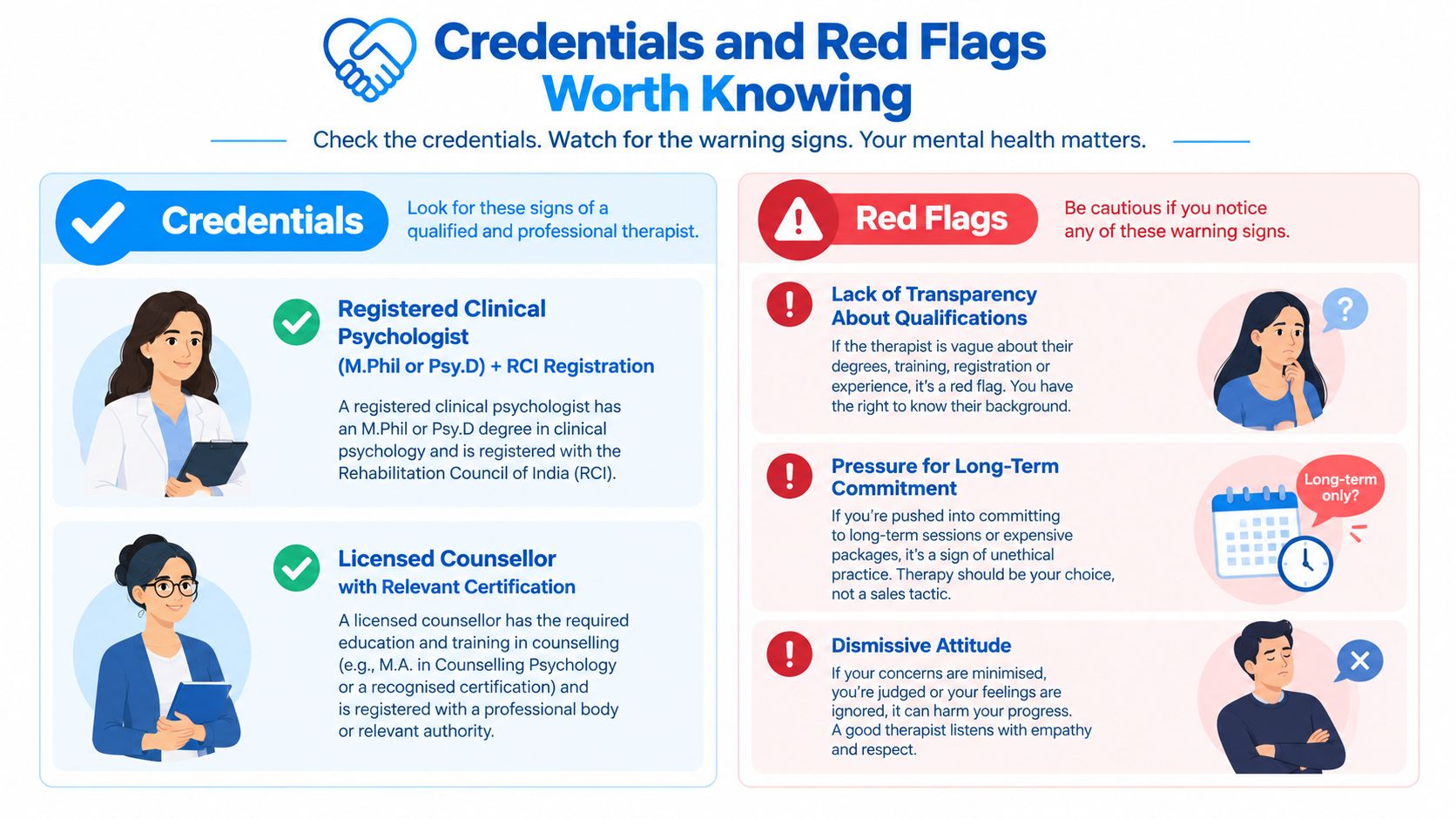
    In India, the words psychologist, counselling psychologist, psychotherapist, and counsellor may be used differently across platforms and settings. What matters most is whether the person is transparent about their training, supervised experience, and scope of work.

    As a general rule:

    • Counsellors often help with emotional support, stress, relationships, adjustment issues, and coping skills
    • Psychologists may have deeper training in assessment, formulation, and structured therapy approaches
    • Psychiatrists are medical doctors who can evaluate whether medication is needed alongside therapy

    If a profile feels vague, ask directly about training and experience with anxiety. A qualified therapist should be able to answer without becoming defensive.

    Which therapy styles are commonly used for anxiety

    Different therapy approaches don't mean one person is “better” than another. They mean the therapist may guide change in different ways.

    Here's a simple comparison:

    Therapy type What it often focuses on May suit you if
    CBT Thoughts, behaviours, patterns, practical skills You want structured tools and clear exercises
    ACT Accepting feelings, reducing struggle, living by values You feel stuck fighting your thoughts all day
    Psychodynamic therapy Emotional patterns, relationships, past influences You want to understand deeper recurring themes
    Mindfulness-based work Grounding, awareness, nervous system regulation You need help slowing down and feeling present

    Among these, Cognitive Behavioural Therapy or CBT has especially strong relevance in the India context. CBT for anxiety disorders has shown a post-treatment response rate of 55-65% in urban populations in India, according to this systematic review on CBT for anxiety disorders in India.

    That doesn't mean CBT is the only good option. It does mean it's a very reasonable place to start if you want an evidence-based approach.

    A therapy method should make sense to you. If a therapist can't explain their approach in plain language, ask again.

    What a good profile should tell you

    A therapist profile doesn't need to sound impressive. It needs to sound useful.

    Look for signs like:

    • Real focus areas such as anxiety, stress, burnout, depression, grief, or trauma
    • A clear method such as CBT or ACT, explained clearly
    • Client fit like adolescents, adults, couples, or professionals
    • Session style whether they are structured, reflective, collaborative, or skills-based

    You don't need to pick the “best” therapy type in the abstract. You need one that matches how you learn, speak, and cope.

    If you'd like plain-language educational material before contacting someone, these anxiety learning resources can help you recognise common patterns and questions to bring into counselling.

    The Crucial Screening Call What to Ask a Therapist

    A profile tells you what a therapist says about themselves. A short call tells you how they make you feel.

    That difference matters. Many people choose based on degrees, availability, and fees, then realise after two sessions that they still feel guarded. A screening call helps you catch that earlier.

    A serene woman talking on a smartphone while sitting near a window with a checklist nearby.

    What to listen for beyond the words

    Suppose you say, “I've been anxious for months and work has become overwhelming.” One therapist replies with polished language but sounds rushed. Another says, “That sounds exhausting. Tell me a little about what your days have been like lately.” The second response often gives you more useful information than any profile line.

    You're listening for:

    • whether they interrupt or let you finish
    • whether they speak in a way you can understand
    • whether they sound present, warm, and steady
    • whether they seem curious about you, not just your symptoms

    If you leave a screening call feeling smaller, more confused, or subtly judged, pay attention to that.

    Questions worth asking

    You don't need a long script. A few open questions can reveal a lot.

    • “What kind of anxiety concerns do you usually work with?”
      This shows whether they regularly help with the issues you're facing, such as panic, overthinking, social anxiety, workplace stress, or mixed anxiety and depression.

    • “How do you usually work with someone in the first few sessions?”
      Their answer tells you whether therapy will be structured, exploratory, skills-based, or a blend.

    • “How will we know if therapy is helping?”
      A good therapist should be able to talk about progress in practical terms, not only vague reassurance.

    • “What do you suggest if I'm nervous about opening up?”
      This helps you see whether they respect pacing and emotional safety.

    • “Do you give strategies or reflections between sessions?”
      Some people prefer tools and exercises. Others prefer deeper processing. Neither is wrong.

    Notice your own body's response

    People often ask, “How do I know if there's a connection?” Usually, your body tells you before your mind explains it.

    You might notice:

    • your shoulders drop a little
    • you don't feel the need to impress them
    • their tone feels grounding
    • you can imagine speaking openly, even if it would take time

    This short video may help you think about fit and what support can look like in practice.

    Red flags that deserve attention

    A screening call doesn't need to be perfect, but a few concerns shouldn't be brushed aside:

    • Pressure: They push you to book immediately without answering basic questions.
    • Vagueness: They can't explain how they approach anxiety.
    • Dismissiveness: They minimise your stress, workplace strain, or cultural realities.
    • Poor boundaries: They overshare about their own life or speak casually about other clients.

    A good therapist doesn't need to charm you. They need to help you feel safe enough to begin.

    Practical Matters Cost Insurance and Session Format

    Even when a therapist seems like a strong fit, the practical side can decide whether therapy remains sustainable. That isn't shallow. If the logistics don't work, even good counselling becomes harder to continue.

    Many people feel awkward asking about fees, insurance, or online options. It's better to ask early than to build hope around an arrangement you can't maintain.

    Cost and affordability

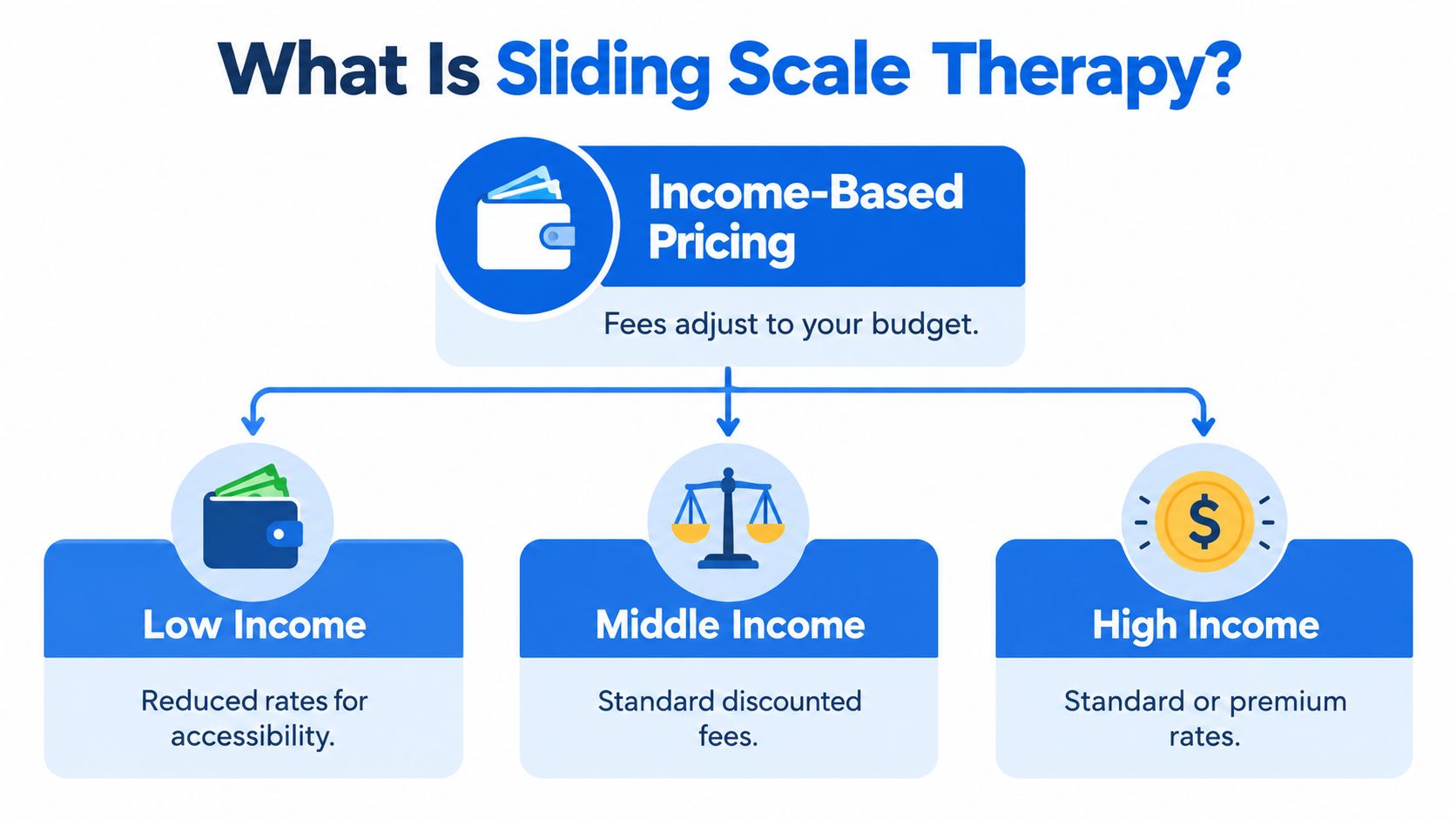
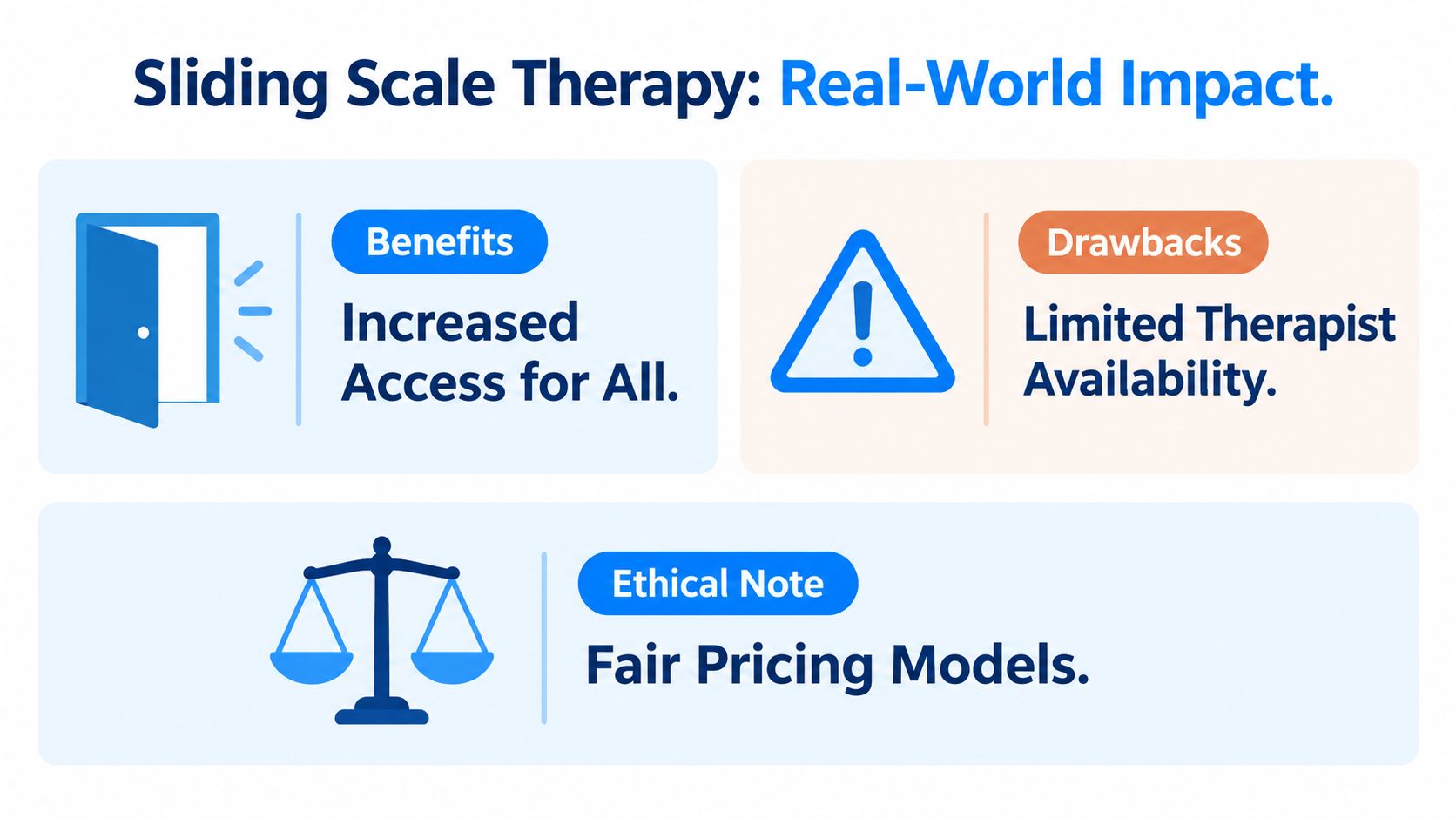
    Affordability is a real barrier in many places. It's also common for therapists to offer sliding scale fees based on income to make care more accessible, as noted in this Greensboro therapy directory overview.

    Ask plainly:

    • What is your current session fee?
    • Do you offer a sliding scale?
    • Do you have lower-frequency options if weekly sessions aren't possible?
    • Are there shorter-term formats for specific goals like anxiety management or workplace stress?

    Some therapists can adjust fees. Others can't, but may refer you to someone who can. Both responses are useful.

    Insurance and reimbursement

    Insurance processes vary widely, especially in India, where mental health coverage can be inconsistent across plans. Don't assume therapy is covered just because your policy includes hospital care.

    Check these points:

    • Outpatient mental health cover: Ask whether counselling or psychotherapy is included
    • Provider requirements: Some insurers reimburse only if the professional has a specific designation
    • Documentation: Confirm whether invoices, diagnosis codes, or referral letters are needed
    • Session limits: Some plans cap the number of reimbursable consultations

    A therapist may not manage your insurance claim for you, but their clinic should usually be able to explain billing documents.

    Ask about money before the first session, not after the third. Financial stress can quietly disrupt good therapy.

    Online, in-person, or hybrid

    There isn't one universally better format. The right choice depends on privacy, energy, routine, and how you feel most able to engage.

    Format Often works well when Possible drawback
    Online therapy Travel is difficult, schedules are tight, or you want access beyond your area Home may not feel private enough
    In-person therapy You focus better in a dedicated setting and want stronger separation from daily life Commute time can become a burden
    Hybrid therapy Your needs change week to week and flexibility matters Availability can depend on the therapist's system

    For working professionals, online therapy can be easier to keep up with. For some students or people in shared homes, online sessions are harder because privacy is limited. A technically convenient option isn't always emotionally convenient.

    Choose the format you're most likely to continue, not the one that sounds ideal in theory.

    Your First Session and Building a Path to Resilience

    The first session is usually less dramatic than people fear. You don't have to explain everything neatly. You don't need a powerful opening sentence. You only need to arrive as you are.

    Most first appointments involve a gentle review of what brings you in, how long things have been difficult, what support you've tried before, and what you hope might feel different. You can share at your own pace.

    What typically happens in the room

    A therapist may ask about:

    • your main concerns right now
    • sleep, appetite, focus, and stress levels
    • family, relationships, or work strain
    • any history of therapy, medication, or major life events

    This isn't a test. It's a way of understanding context.

    If you've used an online screening tool before booking, remember this clearly. Assessments are informational, not diagnostic. They can point to patterns worth discussing, but your first session is where a proper clinical conversation begins.

    What a helpful first session feels like

    A good first session doesn't always feel instantly comfortable. Anxiety can make any new conversation feel exposed. But there's a difference between natural nervousness and a poor fit.

    Signs the session is moving in a useful direction include:

    • you feel listened to rather than analysed too quickly
    • the therapist helps organise your concerns without taking over
    • there's some early sense of direction
    • you leave with a little more clarity than you had when you entered

    Sometimes the biggest early relief is simple. Someone understands the weight you've been carrying and doesn't treat it as a weakness.

    Therapy isn't about becoming cheerful all the time. It's about building enough steadiness to meet life with more choice, less fear, and greater self-understanding.

    Building resilience, not chasing perfection

    People often start therapy hoping to “stop feeling anxious”. That makes sense, but the deeper work is usually broader. Therapy helps you recognise triggers earlier, respond to stress with more care, set healthier boundaries, and build daily habits that support well-being.

    That may include:

    • learning how anxiety shows up in your body
    • noticing self-criticism before it becomes your inner voice for the day
    • responding differently to workplace stress
    • creating more room for compassion, rest, connection, and meaning

    Resilience doesn't mean you never struggle again. It means struggle stops running your entire life.

    If the first therapist isn't the right match, that doesn't mean therapy has failed. It means you're refining the search with more self-knowledge. Trust that process. The goal isn't to force a connection. It's to find support that helps you feel safe enough to grow.


    If you're ready to move from searching to speaking with someone, DeTalks offers a practical place to explore therapists, counselling support, and informational mental health assessments that can help you understand your needs more clearly. You don't have to have everything figured out before you begin. Sometimes the next kind step is choosing a place to start.

  • 7 Top Behavioural Therapist Near Me Options (2026 Guide)

    7 Top Behavioural Therapist Near Me Options (2026 Guide)

    You finish dinner, open your phone, and type “behavioural therapist near me” into a search bar. That search often comes after weeks of poor sleep, repeated arguments, exam stress, work pressure, or the quiet feeling that coping is taking too much effort.

    That moment can feel private, even heavy. It is also common, and it does not mean you have failed. Reaching out for therapy is a practical health decision, much like seeing a doctor when pain keeps returning instead of hoping it will fade on its own.

    Behavioural therapy helps by focusing on patterns you can observe and change. A simple way to understand it is to picture daily life as a set of loops. A stressful thought leads to avoidance, avoidance brings short relief, and the problem grows. Therapy helps you notice those loops, test new responses, and build skills that make everyday life feel more manageable.

    That matters in the Indian context, where people often balance family expectations, academic pressure, demanding work cultures, long commutes, and concerns about privacy. Finding the right support is not only about locating the nearest clinic. It is also about choosing a therapist whose style, language, availability, fees, and mode of care fit your life.

    This guide is built for that real-world decision. You will find seven therapy providers in India, along with practical help on what behavioural therapy usually involves, how to compare options, what first sessions may feel like, and how to book care through platforms such as DeTalks if you want a more direct way to filter by need, format, and budget.

    Therapy is not only for moments of crisis. It can also help you build steadiness, clearer habits, and healthier ways to respond to stress, anxiety, low mood, and relationship strain.

    1. Amaha formerly InnerHour

    Amaha (formerly InnerHour)

    Amaha is one of the better-known names for people who want a combination of therapy, psychiatry, and a structured care pathway in one place. If your search for a behavioural therapist near me is really a search for “someone who can help me figure out what kind of support I need”, Amaha is a practical place to start.

    It works well for adults dealing with anxiety, depression, OCD-like concerns, workplace stress, addictions, and mood difficulties. It also has a stronger youth and family angle than many general platforms because of its integration with Children First.

    Why it stands out

    Amaha offers care through centres in Bengaluru, Mumbai, and New Delhi, along with online support. That matters if you want the option to begin online and shift to in-person care later, or if you want therapy with access to psychiatry when needed.

    The service also presents itself as a multidisciplinary ecosystem rather than a single-clinician practice. For some people, that reduces the friction of searching separately for a therapist, a psychiatrist, and developmental support for a child or teenager.

    • Integrated support: You can move from assessment to therapy and, if needed, psychiatric care without starting from scratch elsewhere.
    • Useful for families: The Children First tie-in makes it easier for parents seeking behavioural support for children, adolescents, and young adults.
    • Good for mixed needs: It suits people who may need counselling now but want a broader support network available later.

    Amaha can also feel reassuring if you’re unsure whether your difficulty is “serious enough” for therapy. You don't need to arrive with a fixed label. A good intake process should help match you with the right kind of care.

    Best fit and limits

    Amaha is a strong fit if you value continuity. Maybe you’re a working professional with burnout and anxiety, or a parent juggling school stress, behaviour concerns, and family conflict. In those cases, a system that can coordinate different professionals may feel easier than managing separate clinics on your own.

    One thing to know is that pricing isn’t clearly posted in a central public format, so you may need to enquire before deciding. The physical centres are also limited to three cities, which means many people across India will rely on online therapy rather than nearby in-person care.

    Practical rule: Ask the intake team who will actually work with you, what their training is, and whether the first session is assessment-focused or therapy-focused. That small question can make expectations much clearer.

    If you want structured, mainstream, urban mental healthcare with online reach, Amaha is one of the easiest names to shortlist.

    2. Mpower

    You search for a behavioural therapist near you because the problem does not sit neatly in one box. Maybe your child is struggling at school and also needs speech support. Maybe you want couples counselling, but one partner may also need individual therapy or a psychiatry referral. In those cases, Mpower can make sense because it offers more than standard counselling.

    Mpower works like a multi-room clinic rather than a single-doctor setup. Alongside therapy and psychiatry, it also offers services such as occupational therapy, speech support, dance movement therapy, and remedial interventions. That mix can reduce the back-and-forth that families often face when they have to contact separate providers on their own.

    Its metro presence also matters. Mpower has centres across cities such as Mumbai, Bengaluru, Kolkata, Pune, and New Delhi, so it is easier to tell whether in-person care is a realistic option before you spend time enquiring.

    Where Mpower can be especially useful

    Mpower is often a practical fit when support needs overlap across roles, settings, or age groups. A parent may be looking for behavioural help for a child, while also needing guidance on routines, school stress, and communication at home. A college student may want therapy, but may also benefit from structured skill-building. A couple may need joint sessions within a setting that can also point them toward individual care if the therapist feels that would help.

    A useful way to compare options is this. An independent therapist can feel like a focused one-to-one room. A centre like Mpower can feel more like a clinic with several doors, where different kinds of support sit in the same place. Neither is automatically better. The better choice depends on whether your concerns are straightforward or layered.

    Here is where Mpower stands out:

    • Several services in one centre: Therapy, psychiatry, and allied supports are available within the same system.
    • Clear metro footprint: You can quickly check whether face-to-face sessions are possible in your city.
    • Public-facing mental health work: Its outreach and campus programmes suggest a stronger focus on awareness and access, not only appointments inside the clinic.

    That matters in India, where mental healthcare access can still vary sharply by city and region. As noted earlier in this guide, specialist care is often easier to find in large urban centres than in smaller towns or rural areas. For some families, a centre that brings multiple services together can save time, confusion, and repeated assessments.

    What to ask before booking

    Mpower may suit you well if you want care in a formal clinical setting and like the idea of related services being available in one place. That can feel reassuring if you are not fully sure what kind of help you need yet.

    Before you book, ask simple questions. Who will conduct the first session. Is it mainly an assessment, or will therapy begin in that meeting. If your child may need speech or occupational support, can the team coordinate referrals internally. If you are comparing online platforms such as DeTalks with clinic-based care, this is a good checkpoint. DeTalks can help you filter therapists by issue, language, format, and availability. Mpower may fit better if you already know you want a centre-based setup with possible add-on services.

    Fees may require a direct enquiry, and busy metro clinics can have waiting periods for specific clinicians. If speed matters more than seeing one named professional, ask for the earliest suitable appointment and confirm the therapist’s qualifications before you finalise.

    Some people do best with one steady therapist. Others benefit from a centre where therapy, psychiatry, and developmental services can be coordinated. The right choice is the one that matches the shape of your need.

    3. Fortis Healthcare Department of Mental Health and Behavioural Sciences

    You may already be seeing one doctor for migraines, another for thyroid issues, and still be wondering whether anxiety or low mood is part of the same story. In that situation, a hospital-based mental health department can feel easier to trust because your care sits within one recognised medical system.

    Fortis Mental Health and Behavioural Sciences offers therapy and psychiatry within the wider Fortis network. That matters when emotional concerns do not sit neatly in one box. Sleep problems, chronic illness, medication questions, stress, panic, hormonal changes, and depression often overlap. A hospital setting can help connect those dots.

    Why some people choose a hospital setting

    A private therapist’s practice can feel like a quiet studio. A hospital mental health department works more like a connected hub. If your therapist needs input from a psychiatrist, physician, neurologist, or another specialist, that coordination may be simpler inside the same system.

    This can be reassuring for families too. If you are booking for a parent, spouse, or teenager and you are not sure whether they need behavioural therapy, a psychiatric opinion, or both, a hospital department gives you more than one path forward without starting your search from scratch.

    The wider India context matters here. The Mental Healthcare Act, 2017 strengthened the legal framework around mental healthcare access and patient rights. For someone searching behavioural therapist near me, that shift matters because it has helped make formal mental healthcare feel more visible and legitimate, especially in larger health systems.

    Who may find Fortis a good fit

    Fortis may suit you if your situation feels medically layered rather than straightforward. That includes people managing chronic conditions alongside anxiety, those who may need both therapy and medication review, and families who feel safer in a hospital environment with established processes.

    Its multi-city presence can also help if you prefer in-person care and want a recognised provider rather than a single-clinic option. In practical terms, this means your search can start with location and department availability, then narrow down to the right clinician.

    If you are comparing Fortis with a platform such as DeTalks, the difference is simple. DeTalks helps you filter by concern, language, session format, and availability so you can book quickly. Fortis may be the stronger choice when you expect therapy to sit alongside medical care or psychiatric review.

    • Connected care: Useful if therapy may need coordination with doctors or psychiatry.
    • Formal clinical setup: Can feel reassuring if you want clear systems and hospital processes.
    • Wider network presence: Increases the chance of finding support in cities where Fortis operates.

    There are trade-offs. Fees may vary by city and clinician, and hospital departments can feel less personal than a smaller private practice. Before booking, ask who conducts the first appointment, whether therapy starts in session one or after an assessment, and whether you can review the clinician’s profile in advance.

    Fortis works well for people who want mental healthcare in the same place they handle the rest of their health. For many first-time therapy seekers, that familiarity lowers the barrier to starting.

    4. Cadabams Group MindTalk

    You have been putting off therapy because one question keeps coming up. What exactly happens after I book? If that uncertainty is the main barrier, Cadabams MindTalk stands out because it answers the practical questions early. Its website presents a defined CBT programme with 12 live sessions across 90 days, daily exercises, progress tracking, guided breathwork, and a listed package price of ₹7,799.

    That kind of structure can make therapy feel less mysterious.

    MindTalk may suit people who do better with a plan, especially those dealing with stress, anxiety, burnout, or recurring patterns in relationships and daily behaviour. CBT often works best when you can spot a pattern, test a new response, and repeat that practice between sessions. A fixed programme supports that process well. It works a bit like following a guided fitness plan instead of walking into a gym and guessing what to do first.

    This can be especially appealing for working professionals in India who want support they can fit around job demands, family responsibilities, and commute-heavy routines. If your search for a behavioural therapist near me is really a search for something practical, time-bound, and clear on cost, MindTalk is easier to evaluate than a clinic that asks you to begin with no sense of length or budget.

    Why this format helps some first-time therapy seekers

    A common fear about therapy is that it will become endless or too vague. MindTalk reduces that fear by showing the broad shape of care upfront. You know the session count, the time frame, and the fact that there is work between appointments.

    That matters because behavioural therapy is usually active. You are not only talking about problems. You are learning to notice triggers, question unhelpful thought loops, practise new habits, and track what changes. For someone who likes goals and routine, that can feel reassuring rather than restrictive.

    It also gives you a simple screening question for yourself. Do I want a therapist-led process with a clear track, or do I need a more open space to explore several overlapping concerns at my own pace?

    Where it fits well, and where it may not

    MindTalk is a good fit if you want clarity from day one.

    • Visible pricing: You can judge affordability before booking.
    • Defined timeline: The programme has a clear beginning, middle, and end point.
    • Between-session practice: Daily exercises can help lessons carry into real life.

    The trade-off is that fixed programmes do not suit everyone. If your schedule changes often, if you want a slower pace, or if your concerns are layered across trauma, family conflict, substance use, or severe mood symptoms, you may need a more personalised format. In those cases, ask whether the therapist can adapt the plan or whether another provider would be a better match.

    This is also where comparison becomes useful. A structured provider like MindTalk gives you a ready-made path. A platform such as DeTalks helps you filter therapists by concern, language, format, and availability, which can be useful if you are still figuring out what kind of care fits you best. One offers a clearer programme. The other helps you choose among clinicians.

    Before booking, ask three simple questions. Will the first session start therapy right away or mainly assess fit? How much homework is expected between sessions? If the programme does not suit me after the first few sessions, what are the next options?

    Progress tracking can be helpful, but it is still only one part of the picture. Self-ratings and app-based check-ins can support the conversation. They should not be treated as a diagnosis or as a substitute for a clinician's judgement.

    5. Sukoon Health

    A common situation looks like this. Someone begins by searching behavioural therapist near me because sleep has fallen apart, work is slipping, or family members are worried. Then a practical question follows. Is weekly talk therapy enough, or do they need a centre that can offer closer monitoring if symptoms get heavier?

    Sukoon Health is designed for the second kind of situation. It offers outpatient behavioural therapies and psychiatric care, while also giving patients a path into day care, inpatient treatment, and other higher-support services when clinicians believe that level of care is appropriate. For people in Delhi NCR, that makes it a useful option when the need is more than short-term counselling.

    What makes Sukoon different

    Sukoon brings several forms of care into one setting. Alongside CBT, it lists services such as art therapy, remediation, occupational therapy, and psychoanalytic work. It also offers advanced interventions including rTMS, ECT, and ketamine treatment in selected clinical contexts.

    That range matters because mental health care is not always linear. Some people improve with regular therapy sessions and home practice. Others need a setup that works more like a hospital-linked support system, where therapy, psychiatry, medication review, and higher-intensity care can be coordinated without sending the family to three or four different places.

    In India, depression and other serious mental health conditions create a large treatment need, especially when symptoms begin to affect functioning, safety, appetite, or the ability to get through a normal day. In those cases, Sukoon sits on the higher-support end of the spectrum.

    Who may find it a better fit

    Sukoon is often better suited to moderate or severe cases than to mild, situational stress. It can also make sense for someone who has already tried standard therapy and now needs more structure, more supervision, or a team that can review several treatment options together.

    A few practical signs can help you judge fit before booking:

    • Symptoms are disrupting daily life: Work, sleep, eating, or self-care have become hard to maintain.
    • You may need psychiatry and therapy together: A combined setup can save time and reduce confusion.
    • Your family wants one centre to coordinate care: This is often easier than piecing support together across separate clinics.
    • You want escalation options available: If weekly sessions are not enough, the next level of care is already in the same system.

    This is also where a platform such as DeTalks can help if you are still comparing options. You can filter for concerns, therapy style, language, and appointment format, then decide whether you need an individual behavioural therapist or a centre like Sukoon that can offer more intensive support.

    There are trade-offs. Sukoon’s in-person access is concentrated in Gurgaon and the wider Delhi NCR area, so it is less convenient for people elsewhere in India. Public pricing is also not presented as one simple list, which means you may need to ask directly about session fees, psychiatric consultations, and how costs change if a higher level of care is recommended.

    If you are considering Sukoon, ask clear questions in the first call. Will treatment begin with an assessment only, or with therapy as well? Which services are needed now, and which are only backup options? If progress is slow, how does the team decide whether to adjust therapy, add psychiatry, or suggest a more supervised setting?

    For someone seeking basic stress counselling, this may be more infrastructure than they need. For someone whose symptoms feel bigger, more persistent, or harder to contain, Sukoon can offer a safer and more coordinated starting point.

    6. Children First Delhi and Gurgaon

    A parent notices that school complaints are increasing, homework ends in tears, and simple routines at home are turning into daily battles. At that point, searching behavioural therapist near me is rarely about one neat problem. It is often a search for clarity.

    Children First stands out because it is designed for that exact stage of uncertainty. It focuses on children, adolescents, and young adults up to age 25, and it looks at behaviour in context. That matters. A child’s behaviour is often the visible part of a larger pattern involving emotions, learning, sensory needs, family stress, or developmental differences.

    This centre is especially useful when parents are asking, “What exactly is going on here?” rather than “Can we start weekly therapy right away?” Children First brings together psychiatrists, clinical and counselling psychologists, family therapists, and developmental specialists. It also offers assessment pathways such as cognitive, psychoeducational, and neurodevelopmental evaluations.

    That combination helps when the concern could be ADHD, autism-related differences, emotional regulation problems, school refusal, anxiety showing up as irritability, or behaviour that makes more sense once the child’s learning profile is understood. Therapy for children often works like solving a puzzle. Sessions with the child are one piece, but parent guidance, school input, and assessment can be just as important.

    For Indian families, that practical mix can be reassuring. Many parents are not only choosing a therapist. They are also trying to decide whether they need an assessment first, how much school involvement is helpful, and whether online sessions will work for their child. A platform such as DeTalks can help narrow those choices before you book, especially if you want to compare child specialists by language, format, and area of focus. Children First is the kind of option that usually makes sense when you want specialised youth care rather than a general adult practice adapting its methods for younger clients.

    What the process may feel like

    Children First is often a better fit for families who are comfortable with a careful start. The first step may involve detailed history-taking, parent conversations, observation, or formal assessments before a full treatment plan is mapped out. That can feel slow if you are hoping for instant answers, but it often prevents the wrong kind of therapy from being started too quickly.

    A useful way to think about it is this. If a child has a fever, a doctor does not prescribe everything at once without first asking why it is happening. Behavioural therapy works similarly. The behaviour matters, but the reason behind it matters more.

    A few strengths tend to stand out:

    • Age-specific expertise: The service is built around children, teens, and young adults, with methods shaped for those stages of life.
    • Family involvement: Parent work is part of the care process, which is often necessary because children live inside family routines, not outside them.
    • Assessment depth: This is helpful when the picture is mixed and the family needs explanation as much as treatment.

    There are trade-offs. Demand for specialised child clinicians can mean waiting periods, especially for popular slots or specific experts. In-person care is concentrated in Delhi and Gurgaon, so families outside NCR may need to ask carefully about remote options and whether tele-consults are suitable for the child’s age and needs.

    If you are considering Children First, use the first call well. Ask whether the first appointment is mainly an intake, whether parent-only sessions are recommended, how school concerns are handled, and what signs would suggest an assessment before regular therapy. Those questions can save time and help you choose the right starting point.

    When a child is struggling, good therapy should replace blame with understanding and give parents tools they can use in ordinary life, not just inside the clinic.

    One final reminder. Developmental or behavioural assessments can be very helpful, but their value depends on proper interpretation within a clinical process. A label on paper is only useful if it leads to clearer support at home, at school, and in therapy.

    7. Mentriq by Dr. Prerna Kohli

    A common search starts like this. You want help, but a large hospital setup feels intimidating, and a therapy app can feel too distant. You may want a real person, clear communication, and options that fit daily life in India. Mentriq sits in that middle ground.

    The practice, led by Dr. Prerna Kohli, has a more boutique style than bigger mental health networks. It offers one-to-one counselling, marriage and relationship support, child and adolescent counselling, corporate programmes, online sessions across India, and home visits in Delhi NCR. For someone comparing providers, that matters because the right choice is not only about credentials. It is also about format, comfort, and whether the service fits your routine well enough that you will continue.

    One useful detail is the amount of practical information Mentriq shares before you book. Its FAQs explain session length, frequency, and how therapy may unfold over time. That kind of clarity lowers the friction for first-time clients. Therapy often feels less mysterious when you know what the first few steps look like.

    Mentriq also notes that some concerns may be addressed over roughly 10 to 12 sessions, depending on the issue and the person. That should not be read as a fixed promise. It works more like a rough travel estimate than a timetable. Some people need a short, focused piece of work. Others need more time to understand patterns, practise new responses, and build trust with the therapist.

    This can be especially relevant for students, young professionals, couples, and families who want support in a setting that feels personal rather than institutional. In India, where schedules, family expectations, commute times, and privacy concerns often shape care choices, those details are not small details. They often decide whether therapy remains a plan or becomes an appointment.

    Why some people choose Mentriq

    Mentriq fits best for people who value flexibility and a direct therapeutic relationship from the start.

    • Format choice: In-person, online, and home visits in Delhi NCR give clients different ways to begin and continue care.
    • Personal setting: A smaller practice can feel easier to approach if you do not want a hospital environment.
    • Relationship and family support: This is useful if your search includes couple conflict, marriage counselling, parenting stress, or family communication problems.

    There are limits, and they are worth asking about early. Public fee details are not as clear as they are on some larger platforms. In-person care is concentrated in NCR, so people in other parts of India will usually be choosing online sessions.

    If you are comparing Mentriq with providers listed on platforms such as DeTalks, use the profile and enquiry stage well. Filter for language, session mode, concern area, and availability. Then ask three simple questions before booking: Is the first session mainly assessment or active therapy? How often are sessions usually recommended at the start? What would progress look like after the first month? Those questions help you compare options on more than brand name alone.

    Mentriq is a strong fit if you want therapy to feel personal, structured enough to understand, and flexible enough to work in ordinary life.

    7-Provider Behavioural Therapy Comparison

    Service 🔄 Implementation complexity ⚡ Resource requirements 📊 Expected outcomes 💡 Ideal use cases ⭐ Key advantages
    Amaha (formerly InnerHour) Moderate, integrated pathways requiring coordination between therapy & psychiatry High, 200+ experts; centres in Bengaluru, Mumbai, Delhi + online Consistent continuity of care across assessment → therapy → psychiatry Adults, families, youth needing CBT/DBT and developmental child services ⭐ Integrated care pathway; broad specialisation; Children First tie‑in
    Mpower (Aditya Birla Education Trust) Moderate, multi‑centre operations with outreach programmes High, multi‑city clinics, allied services (OT, speech, DMT) and helplines Improved access and reduced referrals via one‑stop multidisciplinary care In‑person multidisciplinary needs in major metros; community outreach ⭐ Wide footprint; full clinical stack; community programmes
    Fortis Healthcare – Dept. of Mental Health & Behavioural Sciences High, hospital protocols, medical integration and standardisation High, networked hospitals, senior clinicians and sub‑specialists Strong medical oversight for comorbid or medically complex presentations Cases needing combined medical and behavioural management ⭐ Hospital ecosystem; access to senior clinicians and sub‑specialists
    Cadabams Group – MindTalk (90‑day CBT) Low, fixed 12‑session programme with app supports and tracking Low–Medium, licensed psychologists + 24/7 AI companion; single transparent price Goal‑driven, measurable CBT outcomes with progress tracking First‑timers or goal‑oriented clients seeking structured CBT tracks ⭐ Structured format; predictable pricing; measurable progress
    Sukoon Health (Gurgaon/Delhi NCR) High, integrated outpatient/day‑care/inpatient pathways with somatic options High, NABH accreditation; rTMS/ECT/ketamine and multidisciplinary teams Effective for moderate‑to‑severe cases requiring close clinical oversight Moderate‑to‑severe psychiatric cases needing somatic interventions ⭐ Comprehensive care including advanced somatic treatments; accredited
    Children First (now part of Amaha) Moderate, specialist child/adolescent workflows and assessments Medium, multidisciplinary team, two NCR sites + Amaha tele‑integration High‑quality developmental and psychoeducational assessments and interventions ADHD, autism, developmental delays, parent training up to age 25 ⭐ Deep youth specialisation; strong assessment battery; family‑centred
    Mentriq by Dr. Prerna Kohli Low, boutique clinic model with flexible scheduling and home visits Low–Medium, individual clinicians, psychiatrist on call, home visits (NCR) Personalised therapy with flexible delivery formats (in‑person/online) Clients preferring personalised/boutique care, home visits, corporate programmes ⭐ Flexible formats; personalised care; clear session guidance

    Your Journey is Unique, and Support is Available

    You type “behavioural therapist near me” after a difficult week, open five tabs, and end up more confused than when you started. One profile mentions CBT. Another offers psychiatry and therapy. A third looks promising, but you are not sure what a first session will even be like. That confusion is common, especially in India, where your options can vary a lot depending on your city, language preference, budget, and whether you want online or in-person care.

    Choosing a therapist works a lot like choosing a teacher or physiotherapist. Qualifications matter, but so does fit. You are looking for someone who understands the problem you want help with, explains their approach clearly, and gives you a setting in which you can speak openly.

    A useful starting point is the issue in front of you. Anxiety, low mood, burnout, exam stress, grief, parenting strain, relationship conflict, child behaviour concerns, and habit change can all bring someone to behavioural therapy. You do not need a perfect long-term plan before booking. You only need a sensible first appointment.

    Here is a practical way to narrow your options:

    • Pick a broad mental health centre if you may need therapy, psychiatry, assessment, or coordinated care under one roof.
    • Pick a specialist clinic if the main concern involves child development, ADHD, autism support, severe depression, or family-based care.
    • Pick a structured programme if you want a clear process, regular exercises, and visible progress from session to session.
    • Pick an independent or boutique practice if flexibility, a more personal style, or home and online options matter more to you.

    Format matters too. In many parts of India, the right therapist may not be close to home, and that does not mean you have run out of options. Online therapy can still offer consistent, evidence-based care. For many people, it is the format that makes help possible in the first place.

    The first call or message with a clinic does not need to be polished. Keep it simple. Ask what concerns they commonly work with. Ask whether they offer CBT, DBT-informed therapy, parent guidance, family sessions, or behavioural work for children if that is relevant. Ask what the first session covers, how often sessions are usually scheduled, and whether the therapist tends to work in a structured way or a more open-ended one.

    That first session is usually an assessment, not a test you can fail. A therapist may ask about current stress, patterns you have noticed, what you have already tried, your sleep, support system, and what you want to feel different in daily life. If behavioural therapy is a good fit, they may map out the chain between situations, thoughts, feelings, body responses, and actions. It sounds technical on paper. In practice, it often feels like finally seeing the wiring behind reactions that seemed random before.

    If you use an online assessment, treat it as a screening tool. It can help you put words to what you are experiencing and prepare for a better conversation in therapy. It cannot diagnose you on its own.

    For readers who want an action step, DeTalks can make the search less tiring because it combines therapist discovery, filters, appointment booking, and informational assessments in one place. That matters if you are comparing providers across Indian cities or trying to choose between online and in-person sessions without calling multiple clinics one by one. If you are also trying to sort out the practical side of care, such as prescriptions after a consultation, this guide on finding a pharmacy near you may help with the next part of the process.

    If you are ready to move from searching to speaking with someone, DeTalks can help you find therapists across India, filter by need and format, and explore science-backed assessments that are informational, not diagnostic. It is a practical next step whether you are dealing with anxiety, depression, workplace stress, relationship difficulties, or you want better coping skills and steadier well-being.

    Therapy is not about becoming a different person. It is about understanding your patterns, learning skills that make daily life easier, and building a little more stability each week. Some people start because they feel overwhelmed. Others start because life is functioning on the outside but feels heavy on the inside. Both are real reasons to seek support.

    If one option from this list feels close, start there. One conversation can tell you a lot. Notice whether you feel heard, whether the therapist explains the next step clearly, and whether the plan makes sense for your life. Good therapy often begins with that small, ordinary decision to show up.

  • Finding a Therapist for Depression: Your Guide to Support

    Finding a Therapist for Depression: Your Guide to Support

    Deciding to look for a therapist is a brave first step toward healing. If you're searching for a "therapist near me for depression," you are already on a path of self-care. This guide is here to walk with you and make the process feel less overwhelming.

    Your First Step Toward Well-Being

    A young man sitting on a park bench at sunset, looking at his phone, with a city skyline in the background.

    Simply searching for support is a powerful act of kindness to yourself. It's normal to feel a mix of hope and nervousness about what comes next. Many people in India and around the world feel this way when they begin their journey toward better mental well-being.

    Think of therapy as a safe, dedicated space created just for you. It is an opportunity to understand the weight you've been carrying, whether it's persistent sadness, workplace stress, or anxiety. The goal is to find a professional who partners with you to navigate these feelings without judgment.

    What to Expect from Counselling

    Counselling is a collaborative process aimed at improving your well-being. A good therapist works with you to explore your thoughts, identify unhelpful patterns, and build practical skills to handle life's challenges. This support can help with feelings of depression and anxiety.

    During your sessions, you can expect to:

    • Explore your feelings: Gently understand where feelings of depression may come from and how they affect your daily life.
    • Develop coping skills: Learn new strategies to manage stress and anxiety, helping you feel more in control.
    • Build resilience: Focus on your strengths and learn how to bounce back from difficulties with greater self-compassion and confidence.

    The purpose of therapy is to empower you with insights and tools for lifelong well-being. It’s about building a future where you feel more connected to yourself and better equipped to find happiness.

    A Path to Lasting Well-Being

    This process is not just about reducing difficult feelings; it’s about cultivating positive mental health. A therapist can guide you in building habits that foster resilience, gratitude, and self-compassion. For instance, small changes like practicing good sleep hygiene can significantly improve your mood.

    Remember, the hardest part is often taking that first step, and you have already done it. The path ahead is one of support, discovery, and building a more meaningful life.

    How to Begin Your Search for the Right Therapist

    Taking that first step to find a therapist can feel like the biggest hurdle, and it's okay to feel overwhelmed. You can break the process down into smaller, manageable actions. It's not just about searching for a "therapist near me for depression," but about finding the right person you feel safe with.

    A trusted online directory like DeTalks is a great place to start. These platforms simplify your search, allowing you to filter by location, the issues you're facing like depression or workplace stress, and language. In a diverse country like India, finding a professional who speaks your language can make therapy feel more comfortable.

    Personal recommendations can also be valuable. Your family doctor may have a network of mental health professionals they can refer you to. Sometimes, a referral from a friend who has had a positive experience with therapy can make the process feel less intimidating.

    Understanding Different Professionals

    As you search, you will encounter titles like counsellor, psychologist, and psychiatrist. Understanding the differences helps you find the right support for your needs.

    • Psychologists and Counsellors: These professionals are your guides in talk therapy. They help you navigate thoughts and feelings, develop coping mechanisms for challenges like anxiety and depression, and build inner resilience. Their focus is on improving your mental well-being through conversation.

    • Psychiatrists: A psychiatrist is a medical doctor who specializes in mental health. They can diagnose conditions and prescribe medication if needed. They often work with a counsellor to create a comprehensive plan that combines therapy with medication.

    What to Look For in a Therapist's Profile

    Once you have a shortlist, take time to explore their online profiles. A good profile gives you a sense of who they are and how they work, beyond just their qualifications.

    Look at their specializations, such as experience with depression, grief, or workplace stress. Also, review their qualifications and the therapeutic approaches they use to see if their style feels right for you. Their approach should support your journey toward greater well-being and resilience.

    Remember, the goal is to find someone you can build a trusting relationship with. A profile is just a glimpse, but it should give you a feeling of hope and connection.

    When you begin looking for a therapist to help with depression, you'll discover that "therapy" isn't a one-size-fits-all solution. There are many different approaches, and finding one that clicks with you is a key part of the journey.

    Think of different therapies as different paths to the same goal: feeling better. Some are structured and practical, while others explore the deeper roots of your feelings. Neither is better; it's about what feels right for you at this moment.

    Common and Effective Therapy Methods

    Let's break down some of the most common types of counselling you might encounter. This is a starting point for understanding your options.

    • Cognitive Behavioural Therapy (CBT): CBT is a hands-on approach focused on the present. It helps you identify and change negative thought patterns and behaviors that contribute to depression. If you want practical strategies for managing workplace stress or anxiety, CBT is a great choice.

    • Psychodynamic Therapy: This approach explores how past experiences and unconscious feelings influence your present emotions. It is less about quick fixes and more about fostering deep self-understanding for lasting change and emotional healing.

    • Mindfulness-Based Therapies: These approaches blend CBT with mindfulness practices like meditation. The goal is to observe your thoughts and feelings without being carried away by them. This can be very effective for breaking negative thought cycles common in depression and building resilience.

    To help you visualize what these different paths might look like, here’s a simple comparison of these therapeutic methods.

    Comparing Common Therapy Approaches for Depression

    This table provides a simple comparison of different therapeutic methods to help you understand what might work best for you.

    Therapy Approach Focus Area Best Suited For
    Cognitive Behavioural Therapy (CBT) Identifying and changing negative thought patterns and behaviours. Individuals seeking practical, goal-oriented strategies and skills to manage current symptoms.
    Psychodynamic Therapy Exploring how past experiences and unconscious thoughts affect current feelings. People interested in deep self-exploration to understand the root causes of their emotional patterns.
    Mindfulness-Based Therapies (MBCT) Combining CBT with mindfulness to change one's relationship with negative thoughts. Those who want to learn how to observe their thoughts without judgement and prevent depressive relapse.

    Ultimately, choosing an approach is about finding a good match for your personality and goals. Feel free to ask a potential therapist what methods they use and why they think it would be a good fit for you.

    This flowchart maps out the initial steps of a good therapist search, from checking directories and asking for referrals to carefully reviewing individual profiles.

    Flowchart outlining the process of finding a therapist, detailing options like directories, referrals, and profiles.

    The main takeaway here is that finding the right person is a process. It involves gathering information from different places to make a decision you feel confident about.

    Why Credentials and Safety Matter

    A therapist's qualifications are just as important as their therapy style. A qualified professional has completed rigorous training and follows strict ethical standards to ensure your safety. In India, for example, a psychologist registered with the Rehabilitation Council of India (RCI) meets professional benchmarks.

    Your therapist is a partner in your healing. While their qualifications provide expertise, the most critical ingredient is the safe, respectful connection you build with them.

    Some platforms, including DeTalks, offer screening questionnaires. These tools can be useful for clarifying what you are experiencing. However, it is important to remember that these assessments are informational and not a medical diagnosis. They are a starting point for a conversation with a professional.

    Preparing for Your First Therapy Session

    Cozy armchair with blanket, wooden table with notepad and water, and framed ocean art in a sunlit room.

    It is normal to feel nervous before your first therapy appointment. Remember, it is not a test, but a conversation to see if you and the therapist are a good fit. Finding the right connection is a key part of the process when searching for a "therapist near me for depression."

    A good therapist creates a safe, welcoming space for you to open up at your own pace. You don't need to have everything figured out. The main goal of this first meeting is to connect and see if you feel heard and comfortable.

    Questions to Ask a Potential Therapist

    Preparing a few questions can help you feel more in control of the process. Think of it as a conversation where you are both seeing if it is a good match. This is your chance to take an active role in your own well-being.

    It can be helpful to group questions into their professional style and practical details.

    First, get a sense of their experience and approach:

    • What is your experience helping people with depression and anxiety?
    • Which therapeutic methods do you use, and why might they be a good fit for me?
    • How do you view the therapy process? What can I expect in our sessions?

    Next, you will want to clarify the practical details of counselling.

    • What are your session fees? Do you offer a sliding scale or payment plans?
    • How long is a session, and how often do you suggest we meet?
    • What is your policy for cancelling or rescheduling an appointment?

    Asking questions shows you are invested in your healing. A good therapist will appreciate your engagement and answer honestly, which helps build trust from the beginning.

    How to Talk About What You Are Going Through

    Starting that first conversation can feel difficult, especially if you are not used to talking about your feelings. You do not have to share your entire life story in the first hour.

    Sometimes, the simplest start is best. You could say, “I’ve been feeling really low lately,” or “Things have felt overwhelming, and I realized it was time to talk to someone.” Your therapist will then gently guide the conversation with questions, helping you find words for your experiences, whether it's workplace stress or a loss of joy.

    Using Pre-Session Tools for Insight

    Some therapy platforms, like DeTalks, offer confidential questionnaires you can complete before your first appointment. These assessments can be helpful, offering a snapshot of what you're experiencing, from your emotional state to your resilience.

    It's vital to remember these tools are for informational purposes only; they are not a diagnosis. They can help you organize your thoughts and provide context for your therapist. This can make your first conversation more focused from the start.

    Choosing Between In-Person and Online Counselling

    A big question you might have is whether to choose in-person or online therapy. There is no wrong answer; the best choice is what feels right and fits your life.

    Let's break down what each option looks like.

    Modern office with a waiting area and a laptop on a table, ideal for hybrid therapy sessions.

    Traditional in-person therapy has a unique power. Going to a separate space can help you mentally switch gears and focus. Being in the same room also allows you and your therapist to notice non-verbal cues, which can deepen your connection.

    Online counselling has made therapy much more accessible. If you have a demanding job, family commitments, or live in a remote area, its flexibility is a great advantage. It removes travel time and makes it easier to prioritize your well-being.

    The Rise of Online Therapy in India

    In India, online therapy has been a major breakthrough, especially for those outside major cities. Platforms like DeTalks connect people with qualified therapists anywhere, making it easier to get help for issues like depression, anxiety, and workplace stress. This has made professional support more achievable for many.

    When considering online therapy, ask yourself a few practical questions:

    • Convenience: Do I have a private, quiet space at home for sessions?
    • Access: Are there good local therapists specializing in what I need, or is my best match online?
    • Comfort: Would I feel more relaxed and open talking from my own space?

    Finding Your Personal Fit

    Ultimately, the choice is deeply personal. Some people thrive with the structure of in-person sessions. Others find the privacy and convenience of online therapy helps them stay consistent.

    The most important factor isn't the format but your ability to build a trusting relationship with your therapist. This foundation can be built both in-person and online.

    Think about what feels more sustainable for you right now. Do you need the ritual of a physical appointment, or the flexibility of online counselling? Answering that will guide you toward starting your therapy journey and building lasting resilience.

    Navigating Costs and Finding Sustainable Support

    One of the first questions you may have when looking for a "therapist near me for depression" is about cost. This is a normal and important question. Your therapy plan must be financially sustainable for you to commit to it long-term.

    Starting therapy is a huge step toward caring for your well-being, but it must be affordable. In India, session costs vary based on the therapist's experience and location. It's important to be clear about your financial situation from the start.

    Having the Conversation About Fees

    It can feel awkward to talk about money, but therapists are used to this conversation. They understand that for counselling to be effective, you can't be stressed about the cost. Don't hesitate to ask about fees when you first reach out.

    Many professionals offer ways to make their services more manageable. You can ask about:

    • Sliding Scale Fees: Some therapists adjust their prices based on your income.
    • Payment Plans: You may be able to spread the cost over several payments.
    • Session Frequency: Your therapist might suggest meeting bi-weekly instead of weekly to fit your budget.

    Clarifying costs from day one allows you to focus on your healing. This helps you find a rhythm of support that doesn't add financial pressure while you are dealing with depression or anxiety.

    Supportive Takeaways

    It can be helpful to view therapy as an investment in your long-term happiness and health. You are learning skills for managing workplace stress, improving relationships, and developing resilience. These tools will support your well-being for a lifetime.

    Therapy is not a quick fix; it is a dedicated space where you partner with a professional. They guide you as you build strength to handle life’s challenges and find your capacity for growth and happiness. This is your journey, and it happens one step at a time. Be kind to yourself as you find the support that feels right.


    Finding the right therapist is a personal journey, and DeTalks is here to make it easier. Browse our directory of qualified professionals, explore confidential assessments to gain clarity, and book your first session to begin your path toward healing. Take your first step today at https://detalks.com.

  • How to Help Someone with Anxiety: A Practical Guide

    How to Help Someone with Anxiety: A Practical Guide

    When someone you care about is struggling with anxiety, the best thing you can do is offer patience, empathy, and a willingness to listen without judgment. It’s not about finding a quick fix, but creating a safe space where they feel understood. Your presence alone can be one of the most powerful tools for their well-being.

    What Anxiety Actually Feels Like

    A distressed young man sits on the floor, receiving a comforting touch on his shoulder.

    To genuinely help, it’s useful to understand what they're going through. Anxiety is more than just feeling worried; it's like a constant alarm bell inside their head they can't switch off. In India, this can be amplified by pressure from work, academics, and family, creating a stressful environment.

    Imagine trying to get through your day while your mind constantly jumps to the worst-case scenario. A simple task can spiral into overwhelming thoughts of failure, which is mentally draining. This constant state of alert makes it hard to focus on anything else.

    It's Not "All in Their Head"

    Anxiety is a deeply physical experience as well as a mental one. It can show up as a racing heart, tense muscles that ache, or a persistent knot in the stomach. These physical symptoms are real and can be frightening.

    Someone experiencing intense anxiety might even worry they are having a medical emergency, which feeds the cycle of fear. Recognizing this strong mind-body connection is a key part of offering compassionate support and building resilience.

    Anxiety can also take on different forms depending on life circumstances. For example, knowing the warning signs of postpartum depression and anxiety can help you provide timely and effective assistance to a new parent.

    The Scale of the Challenge in India

    This need for empathy is especially critical given the numbers. In India, anxiety disorders affect a significant portion of the population. A large percentage of people may never get the support they need due to a treatment gap widened by social stigma.

    Mental health challenges are sometimes viewed as a personal weakness rather than a health condition. Encouraging the use of informational assessments can be a helpful first step, as they can identify symptoms with high accuracy. You can read the full research about these mental health challenges to learn more. Please remember, these assessments are for informational purposes only and are not a substitute for a professional diagnosis.

    By seeing the world from their perspective—acknowledging the mental and physical weight they carry—you can offer support that truly matters. This foundation of empathy is where genuine connection and healing begin.

    Ultimately, your role isn't to diagnose or fix them. It's to build a bridge of understanding that helps them feel less alone in their struggle. This compassionate approach is the first and most vital step in helping someone navigate the journey of managing anxiety.

    What to Say and Do During an Anxiety Attack

    When someone is having an anxiety attack, your calm presence can be a lifeline. The key is not to try and stop the attack but to be a steady anchor while it passes. This is about grounding them, not problem-solving.

    The most powerful thing you can do is often just to be there, but it’s always best to ask first. A simple, "I'm here. Do you want me to stay with you?" gives them a sense of control. Speak softly, move slowly, and your quiet, non-judgmental presence can make all the difference.

    First, Create a Sense of Safety

    Anxiety can make the brain feel like there's an immediate threat. Your first job is to help their nervous system feel safe. You can do this by speaking in a low, reassuring voice and reminding them that the feeling, though terrifying, is temporary and will pass.

    Keep your language simple and avoid asking why this is happening, as that can make things worse. Right now, it's about the present moment and letting them know they are physically safe. This is the foundation they need to start feeling grounded again.

    Managing your own reaction is also a huge part of this. It’s natural to feel distressed, but if you look scared, it can confirm their brain's fears. Take a deep breath yourself; your calm can be contagious and help them feel secure.

    Guide Them Back to the Present with Grounding

    Grounding techniques are brilliant because they pull focus away from internal chaos and onto the tangible, outside world. One of the simplest and most effective is the 5-4-3-2-1 technique.

    You can gently guide them through it without any pressure.

    • "Let's find 5 things you can see around us. I see the blue lamp. What do you see?"
    • "Okay, now what are 4 things you can feel? Maybe your feet on the floor, or the texture of the sofa."
    • "Let's listen for 3 things you can hear. I can hear a car outside. What can you hear?"
    • "Can you smell 2 different things? Maybe my coffee, or the soap on your hands."
    • "And finally, what's 1 thing you can taste? Even if it's just the taste in your mouth."

    This simple exercise gives their racing mind a concrete task to focus on. It helps break the cycle of panic and regain a small but vital sense of control.

    You’re not expected to be their therapist. Think of yourself as a compassionate anchor. By staying calm and offering gentle guidance, you help them navigate the storm and remind them of their own strength.

    Choose Your Words Carefully

    What you say—and don't say—matters immensely. Common reactions like "just calm down" or "it's not that bad" can feel dismissive and make them feel more isolated.

    The goal is always empathy and validation. Your words should show that you see their struggle, believe them, and you're not going anywhere. This is what builds trust and helps them feel safe.

    Navigating these conversations can be tricky. Here’s a quick guide on what to say and what to avoid to foster connection and happiness.

    Helpful vs Unhelpful Phrases When Supporting Someone with Anxiety

    Communication can either build a bridge or a wall. The right words can make someone feel seen and understood, while the wrong ones can deepen their sense of isolation.

    Instead of Saying This… Try Saying This Instead…
    "Just calm down." "I'm here with you. Take your time."
    "There's nothing to be scared of." "I know this feels really scary right now."
    "You're overreacting." "This must feel so overwhelming. It will pass."
    "Why are you feeling this way?" "You don't need to explain. Just focus on your breathing."
    "It's all in your head." "I can see you're in distress. Let's get through this together."

    Choosing validation over dismissal is one of the most powerful ways to offer support. It communicates that you're on their team, ready to sit with them in their discomfort without judgment. This is the heart of learning how to help someone with anxiety.

    Gently Encouraging Professional Support

    Suggesting professional help is one of the most loving things you can do. The key is to approach the conversation with care and patience, so your loved one feels supported, not judged. Think of it as opening a door, not pushing them through it.

    Timing is everything. Find a quiet, private moment when you’re both calm. Bringing it up during an argument or a moment of high anxiety will likely not be helpful. The goal is to create a safe space where your genuine concern can be felt.

    Framing the Conversation with Care

    How you say it matters just as much as what you say. It's crucial to speak from a place of compassion, focusing on your own feelings and concerns rather than placing blame.

    Using "I" statements is a fantastic way to do this. Instead of saying, "You need therapy," which can sound like an accusation, try a softer approach.

    You could say, "I've noticed you've been having a hard time, and it worries me because I care about you. I was wondering if you’ve ever considered talking to someone who might have tools to help?" This reframes the conversation, positioning therapy or counselling as a proactive step toward building resilience.

    Highlighting the Power of Evidence-Based Support

    Sometimes, explaining that therapy is a practical, science-backed tool can make a huge difference. You don't need to be an expert, but mentioning that there are proven methods can normalise the idea.

    For example, you could mention Cognitive Behavioural Therapy (CBT), an effective approach for anxiety that teaches skills to manage difficult thoughts. Pointing them toward a resource like DeTalks, which connects them with professionals, makes it feel more concrete. It's a tangible next step, especially since untreated anxiety can sometimes be linked with depression. You can discover more insights about these findings to feel more informed.

    Remember, the goal isn't to push them into a decision. It's about planting a seed of possibility and letting them know that effective, compassionate help is available whenever they are ready.

    The visual below breaks down a simple process to help someone calm down in an anxious moment. It focuses on validation, grounding, and breathing.

    Diagram illustrating the three-step calming anxiety process: Validate, Ground, and Breathe.

    This simple flow shows that in-the-moment support is about connection, not correction.

    Offering Practical, Hands-On Help

    Anxiety and depression can be exhausting, making it hard to find a therapist and make an appointment. This is where you can step in with practical support. Offering this kind of help shows you're truly in their corner.

    Here are a few ways to lighten their load:

    • Do the legwork. Offer to research therapists or counsellors who specialise in anxiety. You could say, "If you'd like, I can help look up a few people who might be a good fit."
    • Help make the call. The first phone call can feel intimidating. Offering to make it for them, or just sitting with them while they do it, can provide a boost of courage.
    • Go with them. Simply offering to drive them to their first appointment can make the experience feel far less daunting.

    Your role here is to remove logistical and emotional friction, making it as easy as possible for them to take that brave first step. It’s a powerful way to show you are not facing this alone.

    Providing Long-Term Support Without Burning Out

    Two young men walk and talk on a misty park path during a golden sunrise.

    Learning how to help someone with anxiety is a marathon, not a sprint. It’s about showing up with patience, but it’s just as important to protect your own well-being to avoid burnout. You can only give your best support when you’re not running on empty.

    Long-term support means shifting your mindset from finding a "cure" to celebrating small wins. Recovery isn’t a straight line; there will be good and bad days. Your steady presence through it all makes a real difference.

    Embracing the Ebb and Flow of Recovery

    It’s normal to feel frustrated when someone has a setback after doing well. Remember, these ups and downs are a standard part of managing a mental health condition like anxiety or depression. This is where your compassion and resilience truly count.

    Your job isn't to fix them but to be a consistent, stable presence. Simply listen, offer encouragement, and gently remind them of how far they've come. This steady support helps them build their own strength over time.

    While geared towards classrooms, this article on how to help students with anxiety has some great universal strategies. The core ideas of patience and validation are just as relevant when supporting an adult.

    Setting Boundaries to Prevent Burnout

    Setting healthy boundaries is essential for being there for the long haul. This isn't selfish; it prevents compassion fatigue or burnout, which doesn't help anyone. Boundaries are kind limits that protect your mental and emotional energy.

    Here’s what healthy boundaries can look like:

    • Defining Your Availability: "I'm always here for you, but I need to switch off after 10 PM. Can we catch up tomorrow morning?"
    • Protecting Your Emotional Energy: "I want to support you, but I don't have the headspace to talk about this right now. Can we check back in this afternoon?"
    • Encouraging Self-Reliance: "I can see this decision is weighing on you. I can't make it for you, but I'm happy to listen while you think it through."

    These are respectful ways of communicating your own needs, allowing you to continue showing up for them in a meaningful way and promoting their own resilience.

    Supporting someone with anxiety means being a lighthouse, not a lifeboat. Your job is to be a steady, guiding light—you cannot carry them to shore. You can only show them the way.

    Prioritising Your Own Well-Being

    You can't pour from an empty cup. Looking after yourself is a non-negotiable part of being a good support person, especially if you're juggling your own workplace stress.

    Make time for things that recharge you, whether it’s a walk, a hobby, or five minutes of peace. These moments build your own resilience and stop resentment from creeping in. If you feel overwhelmed, consider getting support for yourself through therapy or counselling.

    How Digital Tools Can Open Doors to Recovery

    Close-up of hands holding a smartphone displaying a voice recorder app with sound waves in a home setting.

    Technology can be an accessible ally in the journey towards better well-being. For someone with anxiety, the thought of finding help can feel overwhelming. Digital tools offer a gentle, private first step, empowering them to explore support on their own terms.

    It’s important to remember these tools are a support for, not a replacement of, professional counselling. By knowing what's out there, you can gently suggest resources that might resonate with your loved one.

    Making That First Step Feel Less Scary

    One of the biggest hurdles is not knowing where to begin. Online platforms like DeTalks help by offering directories of qualified therapists. This lets someone browse profiles and find a professional who feels like the right fit from home.

    Many platforms also offer confidential, informational assessments. It's crucial to clarify these are for insight, not diagnosis. But they can provide a language for what someone is feeling, which makes future conversations with a therapist more focused.

    Digital tools can act as a bridge, connecting a person's private struggle with the world of professional support. They lower the barrier to entry, making that first step toward healing feel more manageable and less frightening.

    Evidence-Based Strategies Right at Their Fingertips

    Technology also puts a library of self-help strategies directly into their hands. Suggesting these tools is a brilliant way to encourage proactive steps in managing anxiety without being pushy.

    Here are a few ideas you could suggest:

    • Mindfulness and Meditation Apps: Apps like Calm or Headspace offer guided meditations that teach mindfulness techniques to help quiet a racing mind and build resilience.
    • Digital Journaling: A journaling app can be a private space to untangle thoughts and spot anxiety triggers, promoting positive psychology.
    • Mood Trackers: These apps help people connect the dots between their lifestyle and how they feel. Seeing how sleep or exercise impacts their anxiety can be eye-opening.

    While these tools are best used alongside professional support, they are a fantastic way to build healthy habits for long-term well-being and manage challenges like workplace stress.

    Breaking Down Barriers in the Indian Context

    In India, geography and stigma can make getting mental health care tough. This is where teletherapy, or online counselling, shines, bringing quality care to people in smaller cities and rural areas.

    The impact has been significant, especially as post-COVID data shows a rise in anxiety. Online platforms cut through the hesitation to seek help, making support accessible and consistent. You can learn more about these mental health trends from the CDC.

    By encouraging your loved one to explore these digital avenues, you're not just pointing them to a resource. You’re offering hope and a modern, accessible path toward well-being.

    Your Questions Answered: Navigating Anxiety Support

    When you’re trying to help someone, it’s natural to have questions. Feeling unsure of what to do is part of the process. Let’s walk through some common concerns to help you feel more confident.

    What if They Refuse to Get Help?

    This is a tough situation. You can see they’re struggling, but you can’t force someone into therapy or counselling. Pushing too hard can often cause them to shut down.

    Instead, keep the lines of communication open and let your support be unconditional. You can gently say, "I'm always here to listen, and if you ever want to talk to someone else, I can help." Focus on what you can do: be a patient, non-judgmental presence in their life.

    How Can I Support Someone from Far Away?

    Living at a distance adds complexity, but your support can still be a powerful anchor. Consistency is key. Regular check-ins, even a simple text, can bridge the physical gap and make them feel seen.

    Schedule regular video calls to make the connection feel more real. You can also encourage them to look into local support or online therapy, which is widely accessible. Offering to help research options shows that even from miles away, you’re there with them.

    Your consistent presence, even from afar, is a powerful reminder that someone cares. It's about showing up emotionally, even when you can't be there physically.

    Is It Anxiety or Just Normal Stress?

    This is a great question, as stress and anxiety can feel similar. The main difference is the trigger and duration. Stress is usually tied to a specific external cause, like a work deadline, and eases up when the situation resolves.

    Anxiety, however, often lingers long after a trigger is gone or appears for no clear reason. It’s a more persistent feeling of dread that impacts daily life. While everyone experiences workplace stress, chronic anxiety is a deeper challenge affecting a person’s well-being.

    What Do I Do if I Say the Wrong Thing?

    It’s bound to happen. If you say something that comes out wrong, the most important thing is how you handle it. Simply own it with a sincere apology.

    Something like, "I'm sorry, that didn't come out right. What I meant was that I care," can make all the difference. It shows humility and that your intention is to help. Your willingness to listen and learn builds trust and strengthens your ability to build resilience together.

    Can Someone Ever Fully Recover from Anxiety?

    Recovery looks different for everyone. For most, it isn't about a "cure" that makes anxiety and depression disappear. Instead, it’s about learning to manage symptoms so they no longer run your life. With tools from counselling and self-care, people can and do live rich, happy, and fulfilling lives.

    The goal is building resilience and having coping strategies for tough times. Remember to celebrate small wins and understand there will be ups and downs. Your steady, patient support is a vital part of this journey toward lasting well-being.


    Navigating mental health support can feel overwhelming, but you're not in this alone. If you're looking for professional, compassionate guidance for yourself or someone you love, DeTalks provides a directory of qualified therapists. Our confidential, science-backed assessments can help you find the right path forward. Explore your options at https://detalks.com.

  • Neurology vs Psychiatry: Understanding the Difference and Choosing Your Care

    Neurology vs Psychiatry: Understanding the Difference and Choosing Your Care

    Navigating your brain's health and mental well-being can feel complex. Understanding the difference between neurology vs psychiatry is a helpful and empowering first step on your journey.

    Think of it this way: neurology deals with the physical "hardware"—your brain, spinal cord, and nerves. Neurologists address conditions like migraines, strokes, or multiple sclerosis. Psychiatry, on the other hand, focuses on the "software"—your mind, emotions, and thoughts—helping you manage challenges like anxiety, depression, or burnout.

    Understanding the Core Difference Between Neurology and Psychiatry

    When symptoms feel overwhelming, choosing between a neurologist and a psychiatrist can be a real challenge. Both are medical doctors who specialize in the brain, but they approach it from different angles to support your health and well-being. A helpful analogy is to think of a neurologist as an electrician for your body’s wiring, while a psychiatrist is an expert in the operating system that helps everything run smoothly.

    This distinction is crucial for getting the right kind of support. Whether you're navigating workplace stress that affects your focus or experiencing physical symptoms causing you distress, knowing who to see first can make a significant difference.

    A human brain model in a medical setting and a man pondering with colorful thought bubbles.

    The Brain Versus the Mind

    The simplest way to understand the difference is to separate the physical brain from the mind. Your mind includes your thoughts, emotions, and experiences.

    • Neurology is about the brain's physical structure and function. Neurologists are trained to find and treat diseases affecting the nervous system.
    • Psychiatry focuses on your mental health, which includes your emotional landscape and behavioral patterns. Psychiatrists help you understand how your thoughts and feelings shape your daily life.

    This fundamental difference guides their approach. A neurologist might order an MRI to look for a physical cause, while a psychiatrist may use therapy and counselling to help you build emotional resilience and compassion.

    A neurologist asks, "What is physically happening in the brain and nervous system?" A psychiatrist asks, "How are your thoughts, feelings, and behaviours affecting your well-being?"

    Both specialists are dedicated to helping you live a healthier, more fulfilling life. The table below outlines their distinct roles to make the comparison clear.

    Aspect Neurology Psychiatry
    Primary Focus The physical nervous system (brain, spine, nerves) Mental, emotional, and behavioural health
    Common Conditions Epilepsy, stroke, migraines, Parkinson's disease Depression, anxiety disorders, workplace stress, bipolar disorder
    Key Approach Diagnosing and treating structural or electrical issues Understanding and improving thoughts, feelings, and coping mechanisms
    Treatment Tools Medication, physical therapies, diagnostic imaging (MRI/CT) Psychotherapy (therapy), counselling, medication management

    The Different Paths of Neurologists and Psychiatrists

    To truly grasp the neurology vs psychiatry distinction, it helps to look at how these specialists are trained, particularly in an India-first context. Both begin with an MBBS degree, but their paths diverge significantly from there. This specialized training shapes them into the distinct professionals they become and helps you decide who is the right fit for your health concerns.

    A doctor in a lab coat points at a brain MRI on a monitor, with a woman taking notes.

    This focused education ensures each doctor develops a deep, yet different, understanding of the brain. Their unique approaches are designed to address the separate challenges of the brain’s physical health versus our emotional and mental well-being.

    The Neurologist’s Journey to Expertise

    A future neurologist first completes an MD in General Medicine before pursuing a highly specialized DM in Neurology. This demanding training sharpens their skills in interpreting complex diagnostic tools like MRIs, CT scans, and EEGs. Their entire focus is on identifying and treating physical, structural, or electrical problems within the nervous system.

    This path makes them the go-to experts for conditions where a problem can be traced to a physical cause. They are trained, for instance, to find the source of seizures or the anatomical reasons for chronic migraines.

    The Psychiatrist’s Path to Understanding

    A psychiatrist takes a different route, completing an MD in Psychiatry. Their training centers on understanding the mind from various perspectives, including psychotherapy, counselling techniques, and psychopharmacology—the science of how medication affects mental health. They learn to assess thought patterns, emotional distress, and behavioral health, making them experts in conditions like anxiety and depression.

    This training difference is fundamental: one specialist becomes an expert in the brain’s physical framework, while the other becomes an expert in mental and emotional health, promoting resilience and overall well-being.

    Their education equips them to guide people through challenges like workplace stress using tools like talk therapy and other supportive treatments. For a broader view, it can be helpful in understanding the distinctions between other mental health specialists, such as psychologists and psychiatrists. This knowledge helps ensure you find the right professional for your journey toward happiness and well-being.

    A Practical Comparison of Neurology and Psychiatry

    Knowing the definitions is one thing, but seeing how neurologists and psychiatrists work in the real world makes the difference clear. Their day-to-day approaches, from the conditions they treat to the tools they use, cut through the jargon. This practical perspective helps you figure out where your own health concerns might fit.

    Let's explore how their methods differ when dealing with the intricate relationship between the brain and the mind. Looking at their work this way makes the choice between a specialist for a physical issue versus a mental or emotional one much simpler.

    Focus of Care and Common Conditions

    Think of a neurologist as a skilled mechanic for the body's electrical system. Their world revolves around the physical machinery of the nervous system. They are the experts for conditions with a clear, identifiable cause in the brain, spinal cord, or nerves.

    • Neurological Conditions: This includes epilepsy, debilitating migraines, stroke, Parkinson's disease, and multiple sclerosis. Symptoms are often tangibly physical, like tremors, seizures, or persistent headaches.

    A psychiatrist, in contrast, is focused on your mental and emotional landscape. They work with conditions affecting your thoughts, feelings, and behaviors that often don't appear on a brain scan. Their job is to understand your unique experience and support your well-being.

    • Psychiatric Conditions: This area includes challenges like depression, generalized anxiety, bipolar disorder, and the heavy toll of workplace stress. The goal is not just to treat a symptom but to improve your mood, build coping skills like resilience, and enhance your overall quality of life.

    Diagnostic Tools and Methods

    The tools each specialist uses highlight their different approaches. A neurologist relies on technology that allows them to see the brain's structure and electrical activity, hunting for physical clues.

    A neurologist uses objective tests to find physical evidence, while a psychiatrist uses conversation and observation to understand your inner experience.

    In contrast, a psychiatrist's most powerful tool is conversation, often guided by structured assessments. Through therapy and counselling sessions, they listen to your personal history, explore your thought patterns, and gain a sense of your emotional state. While assessments are informational, not diagnostic, they help guide the conversation toward healing.

    This difference also appears in patient experiences. A study in India found that health anxiety was more common among patients in psychiatric settings (25%) than in neurology clinics (19%). This highlights how psychiatry often addresses the emotional weight of health worries. You can read the full research about these findings to learn more.

    Treatment Modalities

    Once a direction is clear, the treatment paths also differ. Neurological treatments are typically aimed at managing or correcting a physical problem. This might involve medication to control seizures or therapies to help regain function after a stroke.

    Psychiatric treatments are geared toward improving mental well-being and fostering resilience and compassion. A psychiatrist might suggest medication, like an antidepressant, to help with emotional balance. This is often part of a larger plan that includes psychotherapy or counselling, which are cornerstones of care that empower you with healthier coping strategies.

    To make this even clearer, here's a quick side-by-side look.

    At a Glance: Neurology vs Psychiatry

    This table provides a clear, side-by-side summary of the key differences between a neurologist and a psychiatrist, helping you quickly identify the right specialist for your needs.

    Aspect Neurologist Psychiatrist
    Area of Focus The physical structure and function of the nervous system (brain, spinal cord, nerves). Mental, emotional, and behavioural health; your thoughts and feelings.
    Common Conditions Epilepsy, stroke, migraines, Parkinson's disease, multiple sclerosis, dementia. Depression, anxiety disorders, bipolar disorder, schizophrenia, PTSD, stress.
    Diagnostic Approach Physical exams, brain imaging (MRI, CT scans), EEG, lab tests to find a physical cause. Clinical interviews, psychological assessments, conversation, observation, DSM-5 criteria.
    Primary Treatments Medications (e.g., anti-seizure drugs), physical therapy, surgical procedures, nerve blocks. Psychotherapy (therapy), counselling, medications (e.g., antidepressants, mood stabilisers).
    Patient Interaction Focused on investigating physical symptoms, interpreting test results, and managing a specific disease. Explores personal history, feelings, thought patterns, and building coping mechanisms.

    While both specialists work with the brain, their perspectives and methods are distinct. This ensures that you receive the right kind of care for your specific needs, whether that involves addressing physical challenges or nurturing your mental well-being.

    Knowing When to See a Specialist

    Sometimes, looking at real-life situations is the best way to understand the difference between neurology and psychiatry. These examples can help you see your own experiences more clearly and find the right support. The most important clue is often the nature of your main symptoms.

    For instance, imagine a college student in Delhi with crippling headaches that disrupt their studies. Since headaches are a physical symptom, a neurologist is the right specialist to see first. Similarly, an older person experiencing memory loss along with tremors should see a neurologist to check for underlying physical conditions.

    Navigating Emotional and Behavioural Challenges

    Now, think of a young professional in Bengaluru feeling overwhelmed by workplace stress. They have a persistent low mood, have lost interest in hobbies, and struggle to concentrate, which are common signs of depression and anxiety. A psychiatrist or a therapist would be the best fit, offering counselling and support to build mental resilience.

    This clear distinction can make the decision much easier. The decision tree below breaks it down further, helping you sort symptoms into physical or mental categories.

    Flowchart illustrating symptom navigation, differentiating between physical and mental health issues, and guiding specialist consultation.

    As the guide shows, if your main challenges are physical—like seizures, muscle weakness, or chronic pain—a neurologist is your go-to expert. If the symptoms are primarily emotional or behavioral, a psychiatrist or therapist is better equipped to help.

    When Symptoms Overlap

    Of course, life is rarely so neat, and many conditions blur the lines between neurology and psychiatry. For example, the depression that can accompany Parkinson's disease often requires a team approach. A neurologist manages the physical symptoms, while a psychiatrist provides therapy and support for the patient's mental well-being.

    This overlap is a significant and growing health challenge in India and globally. The impact of neurological disorders has increased dramatically, highlighting the urgent need for integrated care where neurological treatment and mental health support go hand-in-hand.

    Seeking support is a sign of strength. Whether your challenges feel physical or emotional, acknowledging them is the first step toward building resilience and reclaiming your well-being.

    Assessments are always informational, not diagnostic, but they can bring much-needed clarity. If you need help knowing where to begin, resources on finding the right mental health professional can be very useful. Remember, you don’t have to figure this out alone; professional guidance is available to help you find your way.

    Your First Step Toward Mental Well-Being

    When you’re unsure if your symptoms are neurological or psychiatric, a good starting point is gentle self-reflection. This isn't about self-diagnosis but about taking a compassionate moment to understand what you're feeling. It's about gathering your thoughts before deciding on the next step.

    Platforms like DeTalks can be very helpful here. They offer scientifically backed psychological assessments that are informational tools, helping you get a clearer picture of your emotional state. It's important to remember that these are not diagnostic tests; they are designed to help you spot patterns related to challenges like anxiety, workplace stress, or depression.

    The insights from these assessments can offer a sense of direction. They might suggest that starting counselling or therapy is a good idea or that consulting a medical specialist is the next best step. It's a gentle, supportive way to begin your journey toward greater well-being.

    Building Resilience and Seeking Support

    Understanding your emotional health is the first step toward building resilience. Life can bring many challenges, sometimes leading to burnout or a persistent sadness. Acknowledging these feelings is a sign of strength, not a weakness.

    Tools like self-assessments can help you articulate what you're feeling, making the process feel less overwhelming. They offer a private and accessible way to start exploring your mental health. This is especially important in a country like India, where access to care can vary widely.

    For example, a landmark survey in Bangalore found that neurological disorders were twice as common in rural areas as in urban ones. This difference underscores how vital accessible platforms are in bridging the care gap. You can discover more insights about these neurological care disparities to see why initial guidance is so critical.

    Your Compassionate Path Forward

    Taking that first step, whether it's an assessment or talking to someone you trust, is a powerful move toward positive change. The goal is to feel empowered, not overwhelmed, by your health journey.

    Remember, the purpose of any assessment is to provide insight, not a label. It is a tool to help you start a conversation, either with yourself or a professional, about your well-being.

    Everyone's journey is unique, and finding the right support is a personal process of discovery. Whether your path leads to counselling for anxiety, therapy to build resilience, or a medical consultation, every step is progress. The aim is to find balance, happiness, and a renewed sense of purpose.

    Frequently Asked Questions

    It's completely normal to have questions when trying to understand your brain and mind. Here are some clear, simple answers to common queries to help you on your way.

    Can a Neurologist Treat Anxiety or Depression?

    A neurologist does not directly treat anxiety or depression. Their role is to determine if these feelings might be symptoms of an underlying neurological issue, such as a brain injury or a specific disorder.

    If they rule out a physical cause, they will refer you to a psychiatrist or therapist. These professionals provide the right kind of care, like counselling and therapy, to support your mental and emotional health.

    Do I Need a Referral to See a Specialist in India?

    In India, you can often book an appointment directly with a neurologist or psychiatrist. However, starting with your General Practitioner (GP) is usually a good idea.

    Your GP can conduct an initial check-up and help you decide which specialist is the best fit for your symptoms. This can save you time and ensure you connect with the right expert from the start.

    Clarifying the First Step: Think of your GP as your first point of contact. They can help make sense of your initial symptoms and direct you to the specialised neurological or psychiatric care you actually need.

    What If My Symptoms Are Both Physical and Emotional?

    This is very common because the mind-body connection is strong. For example, chronic pain from a neurological condition can lead to depression. Similarly, severe anxiety can cause physical symptoms like headaches or stomach issues.

    When symptoms overlap, a team-based approach is best. Your GP can help coordinate care between a neurologist for the physical symptoms and a psychiatrist for your emotional well-being. This creates a complete, supportive treatment plan.

    How Do I Know If Memory Loss Is Neurological or Psychiatric?

    Memory loss can be complex as it can stem from both physical and emotional causes. A neurologist may use brain scans like an MRI to look for physical changes linked to conditions like Alzheimer's disease.

    A psychiatrist, on the other hand, will explore if memory issues are related to challenges like severe depression, trauma, or chronic stress. A professional evaluation is essential to determine the root cause and find the most supportive takeaways for your situation.


    Getting clear answers is the first step toward feeling better. DeTalks provides confidential, science-backed assessments that can help you understand your emotional well-being and connect you with the right professionals for therapy or counselling. Start exploring your path forward at https://detalks.com.

  • Therapist vs Psychiatrist: Your Guide to the Right Mental Health Support

    Therapist vs Psychiatrist: Your Guide to the Right Mental Health Support

    When you're starting your journey to better mental health, one of the first questions is often who to see. The terms 'therapist' and 'psychiatrist' are often used interchangeably, but they represent two different paths to well-being. Knowing the difference helps you find the right support from the start.

    The simplest way to think about it is this: Psychiatrists are medical doctors who specialize in mental health, allowing them to provide medical assessments and prescribe medication. Therapists use talk therapy and counselling to guide you through challenges, helping you build coping skills for greater resilience and happiness.

    Understanding Your Path to Well-Being

    A man stands at a fork in a path, facing signs pointing to 'Therapist' and 'Psychiatrist'.

    Taking that first step toward mental well-being is an act of courage. Whether you're navigating workplace stress, managing anxiety, or seeking to build resilience, understanding your options is empowering. The goal is to find a supportive, confidential space where you feel truly heard.

    This guide is here to clarify the roles of therapists and psychiatrists. We'll explore their training, the methods they use, and the kind of support you can expect, helping you make an informed decision that feels right for you.

    Therapist vs Psychiatrist at a Glance

    To cut through the confusion, it helps to see the core differences side-by-side. The main distinction lies in their education and how they support your well-being. A psychiatrist approaches mental health from a medical perspective, while a therapist uses psychological and conversational frameworks.

    This table offers a clear, side-by-side summary, helping you quickly understand each professional's role.

    Key Aspect Therapist (Psychologist, Counselor) Psychiatrist (Medical Doctor)
    Primary Focus Explores thoughts, feelings, and behaviours through talk therapy (psychotherapy). Provides medical assessments for mental health conditions and manages treatment, often with medication.
    Education Master's or Doctoral degree (e.g., M.Phil, PhD, PsyD) in psychology, counselling, or social work. Medical degree (MBBS, MD) followed by specialised training in psychiatry.
    Can Prescribe Medication? No, they cannot prescribe medication in India. Yes, they are licensed medical doctors who can prescribe and manage medication.
    Typical Concerns Addressed Workplace stress, relationship issues, anxiety, mild depression, building resilience, and personal growth. Severe depression, bipolar disorder, schizophrenia, and other conditions where medication may be helpful.

    If you feel your challenges stem from thought patterns or life events, a therapist is an excellent starting point for therapy or counselling. If you suspect a biological component that might benefit from medication, a psychiatrist can provide the right medical support.

    Why This Distinction Matters in India

    Understanding this difference is particularly vital in the Indian context. Here, psychiatrists are medical doctors who provide assessments, prescribe medication, and sometimes offer therapy. Therapists and psychologists are the primary providers of psychotherapy, also known as 'talk therapy' or counselling.

    The need for both is immense, as India has a significant shortage of mental health professionals, with only about 0.75 psychiatrists per 100,000 people. This highlights how vital each role is. Psychiatrists often manage complex conditions medically, while therapists provide crucial psychological support to help people build lasting resilience. You can read more in this study about the mental health workforce in India.

    A Key Takeaway: The question isn't "which one is better?" but "which one is the right fit for me right now?" One helps you build skills through conversation, while the other provides medical assessment and treatment.

    Ultimately, both professionals aim to improve your mental well-being. Many people see both at the same time, combining therapy insights with medication management for a powerful, collaborative approach.

    The Role of a Therapist in Your Journey

    Two women having a conversation in a modern, well-lit therapy or counseling office.

    Your journey to better well-being often begins with a meaningful conversation, which is where a therapist comes in. A therapist, such as a psychologist or counsellor, is trained to listen, understand, and guide you through life’s difficulties in a safe, confidential setting.

    A therapist’s main tool is psychotherapy, or what most of us call 'talk therapy'. The process is designed to help you explore your thoughts, feelings, and behaviours to understand yourself better and build healthier ways to cope with challenges like stress or anxiety.

    What Happens in Therapy

    Therapy is a collaborative partnership built on trust. It’s about more than just talking about problems; it’s about actively finding solutions and developing skills like resilience that will serve you long after your sessions end.

    A good therapist helps you spot recurring patterns that may be holding you back, offering a fresh, non-judgmental perspective. This partnership is the foundation for creating real, lasting change in your life.

    Common Approaches Therapists Use

    Therapists use various proven methods, adapting them to your unique needs. These are flexible frameworks designed to help you find what truly works for you, whether you're facing burnout or seeking greater happiness.

    Here are a few common therapeutic approaches:

    • Cognitive Behavioural Therapy (CBT): A practical, hands-on approach that helps you identify and reframe unhelpful thought patterns and behaviours. It's effective for managing anxiety, depression, and workplace stress.
    • Mindfulness-Based Therapies: These techniques teach you to ground yourself in the present moment, observing thoughts without judgment. It's a fantastic way to build emotional regulation and reduce stress.
    • Psychodynamic Therapy: This approach explores how past experiences might be shaping your current feelings and actions. It can lead to profound insights and deep healing.

    A skilled therapist often blends techniques to create a plan tailored to your goals. This could mean overcoming a specific challenge or cultivating more compassion and joy in your life.

    Therapy is a space where you learn to become your own emotional expert. The goal is not just to solve immediate problems but to build inner resilience and self-compassion to handle future challenges with confidence.

    Beyond Challenges Toward Growth

    While therapy is an incredible resource for navigating issues like anxiety or burnout, it’s not just for when you're struggling. It's also a powerful tool for personal growth, helping you nurture qualities like gratitude, emotional intelligence, and compassion. Many people seek counselling to build stronger relationships or connect with a deeper sense of purpose.

    When considering your options, a crucial first step is finding a mental health therapist who is the right fit for you. Remember that any assessments a therapist might use are informational tools to guide your sessions, not formal medical diagnoses. The process is about understanding, not labelling, putting you in charge of your well-being journey.

    The Psychiatrist’s Role in Your Treatment

    While a therapist guides you through conversation, a psychiatrist approaches your mental health from a medical perspective. A psychiatrist is a medical doctor who has specialised in psychiatry, which is the crucial difference between a therapist and a psychiatrist.

    Their medical training (MBBS or MD) means they understand the complex connections between your mind and body. They view mental health through a biological lens, considering factors like brain chemistry and genetics to get a complete picture of your well-being.

    A Medical Approach to Mental Well-being

    Because they are medical doctors, psychiatrists can provide a formal medical assessment of mental health conditions. They conduct in-depth evaluations, which often include discussing your personal and family medical history.

    This medical assessment creates a clear roadmap for treatment. It is not about labelling you but about understanding the root causes of your distress so you can get the most effective support possible.

    A psychiatrist’s work typically includes:

    • Medical Assessment: Identifying specific conditions like major depressive disorder, bipolar disorder, or anxiety disorders.
    • Medication Management: Prescribing and adjusting medications to help manage symptoms related to brain chemistry.
    • Comprehensive Evaluations: Examining your overall health to understand the interplay between physical and mental well-being.

    When Medication Becomes Part of the Plan

    One of a psychiatrist’s most important roles is medication management. For certain conditions, medication can be a key support, stabilizing symptoms to create the mental space needed for healing and growth. It often allows you to get more out of other treatments like therapy.

    A psychiatrist's medical expertise is often essential for conditions such as:

    • Severe Depression: Medication can help lift the heavy fog when symptoms make daily life difficult.
    • Bipolar Disorder: Medication is a primary tool for managing the extreme shifts between mania and depression.
    • Schizophrenia and Psychotic Disorders: Antipsychotic medications are key to managing symptoms and improving quality of life.
    • Severe Anxiety and OCD: Medication can reduce the intensity of overwhelming anxiety, making therapeutic work more approachable.

    The decision to start medication is a partnership between you and your psychiatrist. They will walk you through the options, potential benefits, and side effects in a clear, supportive way, ensuring you feel comfortable and in control.

    Psychiatrists Can Also Offer Counselling

    It’s a common myth that psychiatrists only prescribe medication. Many are also trained in psychotherapy and offer counselling alongside medical treatment, creating a combined approach that can be very effective.

    This means a psychiatrist might not only manage your medication but also provide talk therapy to help you build coping skills. Their ability to blend both medical and therapeutic support makes them uniquely suited to handle complex mental health situations.

    Making the Right Choice for Your Needs

    Starting your mental health journey can feel like standing at a fork in the road. Therapist or psychiatrist? The truth is, it’s less about picking the "better" path and more about choosing the best starting point for you.

    Let's look at some real-life situations to see how these roles play out. This clarity can give you the confidence to take that first step toward better well-being.

    When to Start with a Therapist

    Think of a therapist as your first point of contact for a wide range of life’s challenges. Their focus is on helping you build skills, explore your thoughts, and find new ways to navigate difficulties through therapy or counselling.

    Consider reaching out to a therapist first if you're dealing with things like:

    • Workplace Stress and Burnout: A therapist can provide practical strategies to manage stress, set healthy boundaries, and build genuine resilience.
    • Relationship Issues: Counselling offers a space to improve communication, understand different perspectives, and work through conflict constructively.
    • Mild to Moderate Anxiety or Depression: Therapy provides concrete coping mechanisms to manage persistent feelings of worry or sadness effectively.
    • Personal Growth and Self-Esteem: A therapist acts as an invaluable guide if you want to understand yourself better, build confidence, or find a clearer sense of purpose.

    If therapy feels like the right direction, this guide on choosing a therapist that's the right fit for you is an excellent resource.

    This flowchart gives a clear picture of the psychiatrist's medical-focused process.

    A flowchart illustrating the medical process from initial start (brain) to diagnosis (clipboard) and prescribing medication (pill bottle).

    It highlights the core medical functions—providing an assessment and prescribing medication—that set psychiatrists apart.

    When to Consider a Psychiatrist

    A psychiatrist's medical background becomes essential when symptoms are more severe or seem to have a strong biological component. Their ability to conduct a medical evaluation and prescribe medication can provide stability for recovery.

    You might want to see a psychiatrist if you're experiencing:

    • Severe or Overwhelming Symptoms: If anxiety or depression makes it difficult to function at work, school, or home, a medical evaluation is a wise step.
    • Intense Mood Swings: Experiencing extreme highs and lows could be a sign of a condition like bipolar disorder, which often benefits from medication management.
    • Thoughts of Self-Harm: If you are having thoughts of harming yourself, it is critical to seek immediate help from a medical professional like a psychiatrist.
    • Symptoms of Psychosis: Hearing or seeing things that aren't there, or holding beliefs that don’t align with reality, requires a psychiatric evaluation.

    It’s important to remember that any assessment from a professional is a tool to guide your treatment. It is meant to help you understand what's happening, not to put you in a box.

    A Supportive Takeaway: When in doubt, starting with a therapist is almost always a great first move. They are trained to assess your situation and will refer you to a psychiatrist if they feel medication could be a helpful part of your plan.

    You Do Not Have to Choose Just One

    The paths of therapy and psychiatry are not mutually exclusive. In fact, they often work together to create a stronger and more effective support system for your well-being.

    For instance, a psychiatrist might prescribe medication to help lift the fog of severe depression. This can provide enough relief for you to have the energy and focus to fully engage in your therapy sessions.

    This collaborative care ensures that both the biological and psychological sides of your well-being are addressed. It gives you a well-rounded foundation for healing, and that's what truly matters.

    Which Professional to See Based on Your Concerns

    Sometimes, a simple scenario-based guide can make all the difference. Use this table to get a clearer idea of whether a therapist or a psychiatrist might be the better initial contact for your specific goals.

    Your Primary Goal or Concern A Therapist Is a Good Starting Point If… A Psychiatrist May Be Necessary If…
    Managing Stress & Burnout You need coping strategies, want to set better boundaries, and build resilience to daily pressures. Your stress has led to severe physical symptoms, panic attacks, or an inability to function at all.
    Navigating Relationship Problems You're looking to improve communication, resolve conflicts, or work through family dynamics. The relationship stress is triggering severe depression, anxiety, or thoughts of self-harm.
    Feeling Depressed or Anxious Your symptoms are mild to moderate, and you're ready to learn new thought patterns and coping skills. Your symptoms are so severe you can't get out of bed, go to work, or manage basic daily tasks.
    Improving Self-Esteem You want to explore your past, challenge negative self-talk, and build confidence in a supportive setting. Your low self-esteem is part of a larger, more complex mental health condition needing assessment.
    Dealing with Trauma You need to process past events in a safe space and learn to manage triggers through specialised talk therapy. Your trauma symptoms (like flashbacks or severe dissociation) are debilitating and preventing you from engaging in therapy.
    Exploring Identity or Purpose You're seeking clarity on life goals, personal values, or identity questions in a reflective environment. N/A – This is almost always best suited for a therapist.

    Remember, this is just a starting point. The most important thing is to reach out to someone, as a good professional will always help guide you to the right type of care.

    How Therapists and Psychiatrists Collaborate for You

    A female doctor and a male patient are sitting on a couch, discussing information on a digital tablet.

    Choosing between a therapist and a psychiatrist often isn't an either-or decision. Some of the best mental health outcomes happen when these professionals team up, creating a robust support system designed specifically for you. This collaborative model ensures every angle of your well-being is covered.

    This integrated approach brings together the best of both worlds. The psychiatrist handles the biological side, including medication and physical health, while the therapist works with you on the psychological and emotional components.

    A Partnership for Your Well-being

    Think of this partnership like building a house. A psychiatrist can lay the foundation, perhaps using medication to manage severe symptoms of depression or anxiety. This creates stability for you to work with a therapist, who helps you build the life you want on that solid ground.

    The synergy here is incredibly powerful. Medication from a psychiatrist can quiet the noise of anxiety, making it possible to fully engage in therapy. In those sessions, you can then learn practical skills to manage thoughts and build long-term resilience.

    Medication can offer the stability needed for the deeper, transformative work of therapy to truly take root. It’s not about choosing one over the other; it's about how they can work in harmony for your benefit.

    This two-pronged approach is a hallmark of high-quality mental healthcare, both in India and globally. It's built on the understanding that our minds and bodies are deeply connected.

    How Collaboration Works in Practice

    So, what does this teamwork actually look like? It’s a coordinated effort where both professionals communicate (always with your consent) to ensure your treatment is aligned and effective. This makes the experience feel seamless, so you never feel stuck in the middle.

    Here’s a common scenario:

    1. Initial Consultation: You might start by seeing a therapist for workplace stress. They might then refer you to a psychiatrist if they feel medication could help manage underlying severe anxiety.
    2. Shared Goals: With your permission, your therapist and psychiatrist can share insights. Your psychiatrist gets a better picture of the challenges you’re tackling in therapy, and your therapist understands how medication might be affecting your mood.
    3. Adjusting Your Plan: As you make progress, your team fine-tunes your care. For instance, as you build strong coping skills in therapy, your psychiatrist might discuss gradually reducing medication over time.

    This teamwork ensures you are at the centre of your own care. It looks beyond the basic difference between therapist and psychiatrist and focuses on their combined strength.

    Supportive Takeaways for Your Journey

    This collaborative model is all about empowering you. It provides a comprehensive safety net, addressing both immediate symptoms and the root causes of your difficulties.

    Ultimately, this partnership offers a path to not just healing but thriving. It combines medical support with the skill-building of counselling, fostering a greater sense of happiness and self-compassion.

    What to Expect in Your First Appointment

    https://www.youtube.com/embed/RiGIvbHpluE

    Booking that first appointment is a huge step and a real act of self-care. It’s completely normal to feel a bit nervous, so let’s pull back the curtain on what a first meeting with a therapist or a psychiatrist usually looks like.

    Knowing what’s coming can make the process feel less mysterious. Remember, this first meeting is as much about you figuring out if they're a good fit as it is about them getting to know you.

    Your First Session with a Therapist

    Your first therapy session is really just a conversation to see if you connect. It's not an interrogation; think of it more as two people getting to know each other in a supportive space.

    You'll have a chance to talk about what brought you in, whether it's anxiety, depression, or workplace stress. Your therapist will listen and ask thoughtful questions, and they’ll also explain how their approach to counselling works.

    This initial appointment is all about building rapport. The most important thing is that you leave feeling heard, respected, and safe enough to be yourself.

    There's no pressure to say the "right" thing. It’s simply a space for you to share your story and start thinking about what you’d like to achieve on your journey to better well-being.

    Your First Appointment with a Psychiatrist

    A first visit with a psychiatrist will feel more like a doctor's appointment because they are medical doctors. Their main objective is to conduct a thorough evaluation of your mental and physical health.

    They'll ask specific questions about your symptoms: what they are and how they affect your daily life. You can also expect to discuss your family’s medical history, sleep habits, and appetite, helping them understand the biological side of what you're experiencing.

    This initial meeting is more structured and informational than a therapy session. Afterward, the psychiatrist might discuss whether medication could be a useful part of your treatment, explaining the options so you can make an informed decision together.

    A few things to remember:

    • You're in control: Both appointments are a two-way street. You have every right to ask questions.
    • Honesty is your best tool: Being open helps them understand how to support you best.
    • It’s all about the fit: Trust is everything in both therapy and psychiatric care. If it doesn’t feel right, it is okay to find someone else.

    Making that first call is often the hardest part. Now that you know what to expect, you can walk in feeling more prepared to start building resilience for a healthier, happier life.

    Common Questions About Therapists and Psychiatrists

    It’s completely normal to have questions when you’re trying to find the right mental health support. Getting straight answers can help you feel more confident about taking the next step.

    Think of this as a practical guide. Understanding things like referrals and assessments means you can start your journey smoothly.

    Do I Need a Referral to See a Psychiatrist?

    This depends on where you are in India and your healthcare plan. For the most part, you can book an appointment directly with a psychiatrist.

    However, some insurance providers or hospital networks may require a referral from your general physician (GP) first. It’s always a good idea to check their policy before booking.

    Can a Therapist Give a Formal Diagnosis?

    This is where the difference between a therapist and psychiatrist really stands out. A clinical psychologist, who is a type of therapist, is qualified to provide a formal medical diagnosis for conditions like anxiety or depression.

    Other therapists and counsellors focus on assessing your symptoms to create an effective therapy plan. They help you understand your challenges and equip you with coping skills, but a formal medical diagnosis usually comes from a psychiatrist or a clinical psychologist.

    Remember, any assessment you receive is an informational tool to guide your treatment. It’s about understanding what you need, not about being stuck with a label.

    How Do I Know if Medication Is Right for Me?

    The decision to take medication is a personal one, made in conversation with a qualified professional like a psychiatrist. They will look at your symptoms, health history, and goals to determine if medication would be a useful part of your plan.

    Often, therapy is suggested as the first step, or is used alongside medication for the best results. A good professional will always lay out all the options, ensuring you feel in control of your journey.

    Who Is Better for Workplace Stress or Burnout?

    If you’re dealing with workplace stress, burnout, or need to learn better coping mechanisms, a therapist is a fantastic starting point. Their expertise in counselling can help you build the resilience and practical strategies you need to handle professional pressures.

    If that stress leads to severe anxiety or depression, your therapist might recommend you also see a psychiatrist. A psychiatrist can then assess whether medication might offer some much-needed relief to help you function again.


    Finding the right professional is a key step in your mental health journey. At DeTalks, we make it easier to connect with qualified therapists and access scientifically validated assessments to understand your needs better. Explore our directory and take the first step towards clarity and well-being today at https://detalks.com.

  • A Warm Guide to Finding a Therapist Near Me

    A Warm Guide to Finding a Therapist Near Me

    Taking the first step to find a therapist near me is a powerful act of self-care. It's a quiet acknowledgment that you are ready for growth, and that is something to be proud of.

    Whether you're navigating challenges like workplace stress or seeking to build more happiness and resilience, therapy offers a safe, confidential space. This initial decision is often the most courageous part of the journey toward improved well-being.

    Why Consider Therapy for Your Well-Being

    Starting therapy is a personal choice, often driven by a desire for support or a sense that things could feel better. Counselling is not just for crises; it supports you through life's challenges and helps foster lasting personal growth.

    A person sitting on a comfortable couch, looking thoughtfully out a window, representing a moment of self-reflection before starting therapy.

    In India and around the world, many people seek support for common hurdles. This could be persistent anxiety, a low mood that dampens your joy, or the strain of burnout. A good therapist provides practical strategies to navigate these feelings.

    Recognising the Signs

    The signs that you might benefit from therapy are often subtle, not loud alarms. You might feel stuck, a bit lost, or simply unfulfilled. Acknowledging these feelings is a vital first step toward positive change.

    Do any of these feel familiar?

    • Persistent Stress or Burnout: You feel drained by work or family life, and rest doesn't seem to recharge you. This is a common experience in today's demanding environments.
    • Relationship Difficulties: You find yourself in repeating arguments with a partner, family, or colleagues. Therapy can help you build healthier communication skills.
    • A Desire for Growth: Things may be fine, but you want more. You are looking to understand yourself better, develop resilience, or cultivate more compassion and happiness.

    Beyond Challenges Toward Growth

    Therapy is not just about addressing problems; it's a powerful space for building on your strengths. It helps you become more resilient, enabling you to bounce back from life's setbacks with greater ease.

    Taking that first step towards counselling is an investment in your well-being. It’s about giving yourself the space to understand your mind, develop healthy coping skills, and build a kinder relationship with yourself.

    This journey is about equipping yourself with the tools to handle life's complexities. It focuses on nurturing your own well-being for the long term, rather than seeking a quick cure.

    Understanding Different Types of Therapy

    Exploring therapy can feel like learning a new language with its various terms and titles. The good news is that you don't need to be an expert to understand the basics.

    Think of therapeutic approaches as different ways to view your life. Some are practical and focused on specific issues, while others take a broader approach to foster overall personal growth.

    Getting to Grips with Therapeutic Approaches

    You have likely heard of Cognitive Behavioural Therapy (CBT). It's a practical approach that helps you identify and change unhelpful thought patterns and behaviours, making it excellent for managing anxiety, depression, or workplace stress.

    Psychodynamic therapy takes a different route, gently exploring your past to understand its influence on your present. It's a good fit if you notice recurring patterns in your relationships and want to explore their roots, like understanding attachment styles in relationships.

    Other common methods include:

    • Humanistic Therapy: This focuses on self-discovery and realising your full potential, supporting your personal journey of growth.
    • Mindfulness-Based Therapies: These blend traditional therapy with mindfulness, teaching you to stay present and regulate your emotions.
    • Family Systems Therapy: This approach views your challenges within the context of your relationships to improve communication and resolve conflict.

    Who's Who? Decoding Professional Titles

    You'll see titles like psychologist, psychiatrist, and counsellor. In India, a psychologist has a Master's or PhD and provides therapy and assessments. A psychiatrist is a medical doctor who can diagnose conditions and prescribe medication.

    A counsellor or therapist typically holds a Master's degree and specialises in talk therapy. The most important factor is finding someone qualified and experienced in the areas you want to work on, like building resilience or navigating life changes.

    A quick note on online assessments: Many platforms offer tools to help you understand yourself better. These assessments are informational and can be great starting points, but they are not a substitute for a formal diagnosis from a qualified professional.

    Ultimately, the "best" approach is the one that resonates with you. The connection and trust you build with your therapist are far more important than any specific label or technique.

    Finding a Therapist: Local and Online Options

    You are ready to find a therapist, which is a significant and positive step. Having a clear plan can make the search process feel much more manageable.

    It's helpful to understand the local context, which can have its challenges. For example, a report on Indiana's mental health workforce highlights shortages in some areas, a situation familiar in many parts of the world, including regions in India.

    But please don't let this discourage you. Many dedicated professionals are available, and with the right strategy, you can find someone who fits your needs.

    Expanding Your Search Beyond Your Postcode

    One of the most effective strategies is to embrace online therapy. Online counselling opens up access to a wide pool of licensed professionals, regardless of your location. This is especially helpful if you need a specialist who isn't available nearby.

    Community health clinics and university counselling centres are also valuable resources. They often provide services on a sliding scale, making therapy more affordable. While some may have a waitlist, getting your name on it is a proactive step.

    This infographic gives you a quick look at some of the most common therapy types you'll come across.

    Infographic about find a therapist near me

    Familiarising yourself with different approaches will help you refine your search. It's about finding a professional whose methods align with your goals for well-being.

    Navigating the search requires persistence and a smart approach. Here’s a breakdown of practical steps you can take to find the support you need.

    Strategies for Finding a Therapist Amidst Workforce Shortages

    Strategy How It Helps Where to Start
    Embrace Telehealth Expands your search nationally or statewide, beyond just your local area. Use online directories with filters for "telehealth" or "online therapy."
    Check Waitlists Secures a potential spot with a provider, even if it's not immediate. Call local community health centres, university clinics, or private practices.
    Contact Your Insurer Provides a list of in-network therapists, helping manage costs. Call the member services number on your insurance card or check their online portal.
    Explore Online Directories Allows you to filter by specialisation, insurance, and availability to narrow options. Visit reputable platforms like DeTalks.
    Ask Your GP for a Referral Your doctor often has a trusted network of mental health professionals. Schedule a check-up and mention you are looking for a mental health provider.

    These strategies are about being proactive and casting a wider net. The right fit is out there; it just might take a few extra steps to find them.

    Practical Steps to Navigate the Search

    Staying organised can make this process much less overwhelming. A simple notebook or spreadsheet can help you track who you have contacted and any notes from your conversations.

    Here are a few actionable first moves:

    • Start with your insurance provider: Getting a list of in-network therapists is a logical first step for keeping costs predictable.
    • Use trusted online directories: Platforms like DeTalks are designed to help you filter by location, concerns, and availability.
    • Talk to your doctor: Your General Practitioner can be a great resource, often having professional connections to recommend.

    Remember, this is about finding the right connection, not just the first available appointment. Be patient with the process and, most importantly, be kind to yourself.

    Managing the Costs of Therapy

    Thinking about how to pay for therapy is a normal and important part of the process. It's essential to find a sustainable path to well-being without adding financial stress, especially when dealing with anxiety, depression, or burnout.

    Navigating the financial side of mental healthcare can feel complex. Cost is a significant barrier for many people. Data from a detailed report from NAMI shows that affordability is a major challenge, a reality that resonates globally.

    This highlights the importance of having a clear financial plan. Understanding your options before you begin your search can make a significant difference.

    First, Figure Out Your Insurance

    If you have health insurance, your first step is to understand your mental health coverage. Contact your insurance provider to get clear information about your therapy and counselling benefits.

    When you call, have a few specific questions ready. This will help you get the answers you need and avoid surprises later.

    Here’s what you should ask:

    • Is therapy or counselling covered by my plan?
    • Do I need a referral from my primary care doctor?
    • What’s my copay (the flat fee you pay per session)?
    • What’s my deductible (the amount you pay before insurance starts to cover costs)?
    • Is there a limit on the number of sessions covered each year?

    Getting this information upfront puts you in control. It allows you to focus your search on therapists within your network, which is often the most cost-effective option.

    Exploring More Affordable Options

    If you don't have insurance or your coverage is limited, you still have excellent options. Many therapists and clinics are committed to making mental healthcare accessible.

    Look for a therapist who offers a sliding-scale fee. This means they adjust their session rates based on your income to make therapy more affordable. You can often find this information on directories like DeTalks or by asking them directly.

    Never feel awkward about discussing fees. It is a standard, professional conversation, and a compassionate therapist will be open to finding a solution that works for you.

    Here are a few other resources for lower-cost care:

    • University Counselling Centres: If you're a student, your college likely offers free or low-cost counselling services.
    • Community Mental Health Clinics: These non-profit organisations often provide services with sliding-scale fees.
    • Training Institutes: These facilities offer high-quality therapy from supervised trainees at a significantly lower rate.

    Investing in your mental health is one of the best decisions you can make. By exploring these avenues, you can find the support you need without adding financial strain.

    Choosing the Right Therapist for You

    Finding the right professional is more about a genuine human connection than just credentials. The relationship you build with your therapist is a key factor in your journey's success.

    Two people sitting across from each other in a calm, welcoming room, having a warm and empathetic conversation.

    This connection, called the ‘therapeutic alliance’, begins with the first conversation. Most therapists offer a brief, free consultation call, which is your chance to see if you feel a click.

    Questions to Ask in Your First Conversation

    Having a few questions ready for your initial call can help you understand a therapist's style and experience. This is about seeing how they can support you, whether it's with workplace stress or building personal resilience.

    Here are a few things you might want to ask:

    • What is your therapeutic approach? This helps you know if they use practical strategies (like CBT) or a more exploratory style.
    • Do you have experience with [your specific concern]? Whether it’s anxiety or personal growth, it’s good to know they've helped others with similar goals.
    • How do you create a safe space for clients from different backgrounds? This is vital in a diverse context like India, ensuring your experiences will be respected.
    • What can I expect in our first few sessions? This sets clear expectations and can ease any nerves about starting counselling.

    Trusting Your Gut Feeling

    After asking practical questions, take a moment to check in with yourself. How did the conversation feel? Your intuition is a valuable guide, so pay attention to it.

    It's perfectly normal if the first person you speak with isn't the right fit. Finding the right therapist can take a few tries, and that's okay. The goal is to find someone you can build a strong, trusting relationship with.

    Remember, therapy is your dedicated space. It’s a professional relationship built on trust and empathy, designed to support your journey toward greater well-being.

    Take your time to find a therapist near me who feels like a true ally. This initial effort pays off as you begin the rewarding work of self-discovery and growth.

    Your Path Forward to Mental Well-Being

    Deciding to find a therapist is a significant step toward taking care of yourself. This journey is about building a toolkit for lasting mental wellness, not searching for a quick fix. Be kind to yourself as you begin.

    This is your personal journey, and it will unfold at its own pace. It is a space to address challenges like workplace stress and anxiety, and also a place to foster growth, self-compassion, and resilience.

    A More Hopeful Outlook

    It's encouraging that getting help is becoming more accessible and accepted. The 2025 State of Mental Health report shows positive progress in some regions, reflecting a global trend toward better support systems.

    This progress points to a future where reaching out for help with depression or burnout is met with reliable care. As you move forward, exploring effective ways to clear your head and find calm can beautifully complement professional therapy.

    Supportive Takeaways for Your Journey

    Keep these gentle reminders with you as you move forward on your path.

    • Patience is key. Healing and growth are not linear; there will be ups and downs, and that is completely normal.
    • The right fit matters most. Your connection with your therapist is the foundation for progress. Trust your intuition.
    • You are in control. This is your journey. You set the pace and define what success feels like for you.

    Starting counselling is a profound sign of strength. It’s an investment in your own happiness and well-being, equipping you with skills and insight to thrive.

    This process is about arming yourself with understanding and self-compassion. The tools you gain will support you long after your sessions, helping you build a life of greater emotional balance.


    At DeTalks, we're here to help you connect with the right professional to guide you. Take a look at our directory to find qualified therapists and use our scientifically validated assessments to get a clearer picture of your path forward. Your first step starts here: https://detalks.com.

  • Your Guide to Mental Health First Aid Training

    Your Guide to Mental Health First Aid Training

    Mental Health First Aid (MHFA) training gives you the skills to be a compassionate first responder when someone faces a mental health challenge. It’s not about becoming a therapist, but about knowing how to offer immediate, kind support until professional help is available.

    Think of it as CPR for mental well-being—a practical skill that anyone can learn to support others with confidence and care.

    What Exactly Is Mental Health First Aid Training?

    A group of diverse individuals sitting in a circle during a supportive training session.

    If you saw someone with a physical injury, you would likely know a few basic steps to help them feel safe. Mental Health First Aid training gives you a similar, practical toolkit for emotional and psychological distress.

    This training is for everyone, not just healthcare workers. Whether you're a manager in a bustling Indian city, a student, or a friend, you'll learn to notice early signs of mental health challenges and provide initial support without judgement.

    Bridging the Gap to Professional Help

    A common misunderstanding is that this training teaches you to provide therapy or counselling. The real goal is to bridge the gap between when someone starts struggling and when they receive professional care.

    This role is vital, especially in a country like India where conversations around mental health are becoming more open. A trained first aider can make it feel safer for someone dealing with anxiety or depression to take that brave first step toward professional help.

    Building Skills for Real-Life Situations

    The training is practical and hands-on, designed to give you real-world skills for navigating sensitive conversations. It focuses on building both your ability to help and your own emotional resilience and compassion.

    Here's a look at the abilities you'll develop in a Mental Health First Aid course.

    Skill Area What You Will Learn
    Recognising Early Signs How to notice subtle changes in behaviour that may signal challenges like burnout or workplace stress.
    Providing Initial Support The fundamentals of active listening and offering genuine reassurance in a supportive, non-judgemental way.
    Guiding to Professional Help How to gently encourage someone to connect with resources like therapy or counselling services.
    Crisis Intervention Basics Essential skills to assist someone in a mental health crisis until professional support arrives.

    This training provides a clear framework for responding effectively and safely.

    The core principle is that your role as a first aider is to observe and support, never to diagnose. The goal is not to label someone, but to create a safe space where they feel comfortable opening up and seeking help.

    Ultimately, MHFA training strengthens your own emotional literacy. It gives you the confidence to be there for your community, helping to build a culture where well-being truly matters.

    Why Mental Health First Aid is So Crucial in India Right Now

    In India, there's often a gap between the number of people struggling with their mental health and the professional help available. For a long time, it has been difficult to talk about challenges like anxiety and depression. This silence can prevent people from considering therapy or counselling, leaving them feeling isolated.

    This is where mental health first aid training makes a difference. It creates allies—friends, family, and colleagues who have the skills and compassion to offer that first crucial bit of support. A trained first aider can be the bridge that helps someone move from silent struggle toward getting help.

    By teaching practical listening skills and a clear action plan, this training helps build communities of care. It makes it easier to have open conversations about mental health, one person at a time.

    Closing the Preparedness Gap

    This training is vital because many people feel unprepared to help someone in a mental health crisis. When Mental Health First Aid guidelines were first developed for India, a key focus was on suicide prevention. Research showed a stark contrast: while professionals felt confident helping, the general public felt 'not at all' or only 'somewhat prepared.' You can explore the full research on these findings to see this gap.

    This isn't just a statistic; it's a call to action. Mental Health First Aid training directly addresses this need, giving people the confidence to step in safely and effectively.

    Building More Resilient Workplaces

    The modern workplace can be a source of significant pressure, where workplace stress and burnout affect both employee well-being and company performance. When employees don't feel supported, morale and productivity can suffer.

    A manager or colleague with mental health first aid skills can spot early signs that someone is struggling. By offering a non-judgemental ear and guiding them toward professional help, they create a psychologically safer work environment where people feel seen and valued.

    Remember, a mental health first aider's role is supportive, not diagnostic. The assessment of a situation is for informational purposes only. The goal is to start a caring conversation and help someone find professional help, never to label their experience.

    Moving from Stigma to Supportive Action

    That first conversation can be a turning point for someone on their path to recovery. This training shifts our culture from silence to support in several key ways:

    • Building Compassion: It teaches you to listen without judgement, replacing misunderstanding with empathy and genuine care.
    • Encouraging Early Help-Seeking: People are more likely to seek help for anxiety or depression when they have trained allies who understand.
    • Promoting Positive Psychology: The training also fosters positive concepts like resilience, happiness, and greater well-being in yourself and others.

    Ultimately, the aim is to weave a strong safety net of support through our communities. The supportive takeaways from this training offer something very practical: the ability to care in a meaningful way.

    Your Practical Toolkit for Providing Support

    At its core, mental health first aid training equips you with practical, real-world skills. It moves you beyond good intentions, providing a structured way to respond when you see someone struggling.

    The training gives you tools to break the silence that often surrounds challenges like anxiety or depression. You learn how to start a supportive conversation, listen with empathy, and create a safe space for someone to open up without fear.

    Infographic about mental health first aid training

    This visual captures the journey from isolation to connection, showing how a trained first aider can guide someone toward the help they need.

    Introducing the ALGEE Action Plan

    To give you a reliable framework, most mental health first aid training courses are built around a simple yet powerful action plan. One of the most widely used models is the ALGEE action plan.

    Each letter represents a clear step, giving you a logical sequence to follow. This structure helps reduce anxiety about what to do next, allowing you to focus on the person in front of you.

    The plan involves these steps:

    1. Assess for risk of suicide or self-harm.
    2. Listen non-judgementally.
    3. Give reassurance and information.
    4. Encourage appropriate professional help.
    5. Encourage self-help and other support strategies.

    This is a flexible guide that you can adapt to any situation, helping you stay grounded and cover the most important steps.

    Listening Without Judgement

    One of the most valuable skills you’ll gain is the art of listening without judgement. This means setting aside your own assumptions and simply being present for the other person. You learn to hear what they are truly saying, creating a powerful sense of connection and trust.

    Effective communication is key to providing support. To dive deeper into these abilities, you might find value in resources on effective communication skills training. These skills are essential for showing genuine empathy and ensuring the person feels truly heard.

    It’s important to remember that any assessments you learn are for informational purposes, never for diagnosis. Your role is to understand the immediate situation and ensure safety, not to apply a clinical label to someone's experience.

    This approach empowers the person who is struggling by validating their feelings. It sends a clear message that their experience is real and that they are not alone.

    Guiding Toward Professional Support

    A key part of your role as a mental health first aider is acting as a bridge to professional care. The training teaches you how to discuss therapy and counselling in a supportive, non-intimidating way.

    For instance, you might learn gentle ways to suggest professional support, like, "It sounds like you're going through a lot right now. Have you considered talking to someone trained to help with these feelings?" This approach respects their autonomy while opening a door to new possibilities.

    The toolkit you gain is built on both skill and compassion. It prepares you to handle difficult conversations with grace and helps deepen your own emotional intelligence and resilience.

    Learning to See the Early Signs of Distress

    A person looking out a window with a thoughtful expression, suggesting introspection and observation.

    One of the most valuable skills from mental health first aid training is learning to see what often goes unnoticed. It’s not about mind-reading, but about developing a gentle awareness of the people around you. You learn to recognise subtle shifts that might signal someone is struggling before they find the words to say so.

    This is a skill of observation, not assumption. The training helps you notice real-world changes, like a colleague becoming withdrawn due to workplace stress, or a friend who seems constantly on edge, a common sign of anxiety.

    Looking Beyond the Obvious

    Distress doesn’t always appear as sadness or frustration. Often, it's quieter, showing up in small changes to a person's daily patterns. Your training will help you see these subtle cues as a call for support.

    Think about these less obvious signs:

    • Changes in Social Habits: A friend who loves social events suddenly starts avoiding them.
    • Shifts in Communication: Someone who was once responsive now seems distant or takes days to reply.
    • Neglecting Personal Care: A noticeable change in personal grooming or appearance that is out of character.
    • Increased Irritability: Small frustrations now trigger an unexpectedly sharp reaction.

    Noticing these shifts is the first step. The goal is not to jump to conclusions, but to know when it might be time to gently check in.

    Understanding Workplace Stress and Burnout

    The modern Indian workplace can be a high-pressure environment where chronic workplace stress can lead to burnout. A key part of mental health first aid training is learning to identify these signs in a professional setting.

    You might notice a team member missing deadlines or seeming disengaged in meetings. These are often signs that someone is overwhelmed, not that they lack a good work ethic. As a trained first aider, you learn to see these behaviours through a lens of compassion.

    It’s vital to remember that these observations are informational, not diagnostic. Your role is never to diagnose someone with depression or an anxiety disorder. It is simply to notice a change and care enough to ask if they are okay.

    This distinction is empowering. It frees you from the pressure of having all the answers and lets you focus on providing a safe, non-judgemental space for someone to feel heard.

    From Challenges to Positive Psychology

    While the training focuses on identifying difficulties, it also includes principles of positive psychology. You will learn to recognise the foundations of well-being, such as resilience, compassion, and connection. Understanding what helps people thrive makes it easier to spot when those foundations are weakening.

    This balanced view helps you frame your support more constructively. Rather than only focusing on the problem, you can also help someone reconnect with their own strengths and inner resilience.

    This training sharpens your emotional intelligence. By learning to see early signs of challenges like anxiety or depression, you are better prepared to offer timely support until they can connect with professional therapy or counselling.


    What You Really Gain from the Training

    Becoming a Mental Health First Aider creates a positive ripple effect in your life. You gain the confidence to approach tough conversations with empathy, cutting through the fear that often stops us from discussing mental health.

    This training also boosts your own well-being. As you learn to spot signs of distress and support others, you build your own emotional toolkit, becoming more self-aware and resilient.

    Creating a Better Place to Work

    In your professional life, these skills make you a valuable asset. You become someone who actively builds a workplace culture where people feel safe and supported, which is crucial with rising workplace stress and burnout.

    For managers, this training is a game-changer. It provides practical skills to look after your team's well-being, handle issues like anxiety before they grow, and foster a more human and engaged work environment.

    One supportive conversation can truly change a life. The training empowers you to start that conversation, knowing your role is to offer initial help and guide someone toward professional therapy or counselling, not to provide a cure.

    A single trained person can start to shift a company's culture from silence to open support, making it normal to talk about mental health.

    Building Stronger Communities and Breaking Down Stigma

    The ripple effect extends beyond the workplace. Every person trained as a Mental Health First Aider helps break down the stigma surrounding challenges like depression. This is a crucial step toward creating more connected and understanding communities across India.

    When you're trained, you encourage people to get help sooner. By responding with empathy, you create a safe space for friends and family to share what they're going through. This act can be the bridge that connects someone to the professional support they need.

    The benefits build on each other:

    • For You: You'll feel more confident, emotionally intelligent, and better equipped to handle life's challenges.
    • For Your Workplace: It helps create a supportive atmosphere, reduces workplace stress, and boosts team well-being.
    • For Your Community: It chips away at stigma, encourages early help-seeking, and weaves a stronger, more compassionate social fabric.

    At its heart, mental health first aid training is an investment in human connection. It nurtures compassion and understanding, helping to build a world where we all feel a little more seen and supported.

    How to Find and Enrol in an MHFA Course

    Deciding to get trained in Mental Health First Aid is a wonderful step. A quick online search for certified providers in your city is a great place to start, as many organisations across India now offer accredited mental health first aid training.

    As you look at different providers, consider what kind of learning environment suits you. Do you prefer an interactive classroom setting, or does the flexibility of an online course better fit your life?

    Choosing the Right Training Format

    The choice between online or in-person courses depends on your learning style. Each format offers unique benefits for learning how to support someone experiencing anxiety or depression.

    • In-Person Workshops: These are highly interactive and often use role-playing to build real-world confidence. The direct contact with instructors and peers creates a strong sense of community.
    • Online Courses: For those with busy schedules, online training offers incredible flexibility. You can learn at your own pace from anywhere with an internet connection.
    • Blended Learning: This hybrid approach combines the convenience of online modules with live, instructor-led sessions to practice your skills.

    What to Look for in a Provider

    It’s important to choose an accredited provider to ensure the course material is evidence-based and your certification is respected. Also, review the instructors' qualifications and the course outline to make sure it aligns with your goals for improving community well-being.

    Remember, the aim of any assessment within these courses is purely informational—to build your awareness. It is never about making a clinical diagnosis; your role is to offer initial support and guide someone toward professional counselling or therapy.

    The availability of formal first aid training that includes mental health is still growing in India. A study found that training for first responders was often infrequent, showing a need to expand these vital programs. You can read more on the state of first aid training in India to see why it matters.

    By enrolling, you’re joining a growing movement of compassion and helping to build a more supportive community, one conversation at a time.

    Common Questions About MHFA Training

    Stepping into mental health first aid training is a big step, and it's natural to have questions. Let's clear up some common queries to help you feel confident about getting started.

    People often wonder, "Am I qualified enough to do this?" The answer is yes. This training is designed for everyone, not just clinicians, giving everyday people the tools to offer compassionate support.

    Will This Training Let Me Diagnose or Provide Therapy?

    No, and this is a crucial point. MHFA training does not teach you to diagnose conditions like anxiety or depression, nor does it turn you into a therapist or counsellor. The goal is to help you spot signs of distress, offer immediate support, and guide someone toward professional help.

    Think of it like physical first aid. You learn to apply a bandage to prevent things from getting worse, but you wouldn't perform surgery. Your role is to be a bridge to proper care.

    Is This Training Only for Healthcare Professionals?

    Not at all. Mental Health First Aid is for teachers, managers, parents, and community leaders. The skills you learn are for everyday situations, helping to create communities where more people feel equipped to look out for one another.

    It's worth repeating: any assessments you learn are purely for understanding the situation to provide safe, initial help. They are not diagnostic tools and are never about putting a label on what someone is going through.

    How Long Does a Typical Course Take?

    The time commitment can vary. A face-to-face course often takes place over two full days. Blended or online options might spread the learning over a few weeks with self-study modules and live sessions.

    It's always best to check with accredited providers to see their schedules. This will help you find a format that fits into your life.

    What if I Say the Wrong Thing When Trying to Help?

    This is a common fear, and the training addresses it directly. You'll learn simple frameworks for conversations and practice active listening skills to build your confidence. A key takeaway is that showing you care and listening without judgement is more important than finding the "perfect" words.

    The training helps you build your own resilience and shifts your mindset from a fear of making mistakes to a focus on compassion. It empowers you to be a genuine, supportive presence in someone's life.


    Feeling inspired to find the right support for yourself or someone you know? At DeTalks, we connect you with qualified therapists and provide science-backed assessments to guide your journey toward greater well-being. Explore professional help at DeTalks.