
Your alarm rings, your messages are already arriving, and the task you meant to finish yesterday is still waiting. You care about it, yet opening the laptop or textbook feels strangely difficult. Before calling yourself lazy, pause: are you lacking a reason to act, or are you carrying more emotion than you've noticed?
In psychology, motivation and emotion are closely connected. A lost sense of drive can be an emotional message, not a character flaw, and understanding that message can help you choose between rest, a different approach and professional support.
What Motivation and Emotion Mean in Psychology
Say you're preparing for an exam while managing family responsibilities. You want the qualification, but each morning you feel tense and put off revision. Your goal hasn't disappeared, yet your emotional experience is making it harder to begin.
Motivation is the set of internal and external forces that start, direct and sustain behaviour. Emotion is a coordinated response involving thoughts, bodily sensations and behaviour when something matters to you.
Think of motivation as the engine and steering wheel: it helps determine where you go and how long you keep going. Emotion is more like the dashboard, showing how the journey feels and whether something needs attention. The analogy isn't exact, because emotions can also influence your direction.
Motivation and emotion compared
| Feature | Motivation | Emotion |
|---|---|---|
| Core question | Why act, and in which direction? | What am I feeling right now? |
| Typical duration | Sustained over days, months or years | Seconds to minutes, occasionally hours |
| Main signal | Goals, effort and persistence | Feelings, bodily changes and expressions |
| Everyday example | Studying for a certification over six months | Anxiety rising before an exam |
These differences describe typical patterns, not firm boundaries. A brief burst of enthusiasm can motivate action, while repeated emotional episodes can contribute to a longer-lasting mood.
India's National Mental Health Survey 2015–16, conducted by NIMHANS, estimated that approximately 1 in 10 adults had a current mental disorder, excluding tobacco-use disorders, and that 15% of adults had mental-health conditions requiring intervention, according to the national survey report. These findings concern mental-health conditions, not every ordinary dip in enthusiasm, but they show why difficulties deserve attention rather than blame.
A useful check-in: Ask both what you're trying to do and what you feel when you approach it.
You might discover that you still value studying but fear disappointing your parents. Or you might feel calm yet realise the qualification no longer fits your interests. Feeling low and losing drive often overlap, but understanding the difference helps you identify what kind of support you need.
How Motivation and Emotion Interact in the Brain
Your brain doesn't have a single motivation switch or an isolated emotion centre. Several connected systems help you notice opportunities, detect danger, interpret bodily sensations and choose a response.
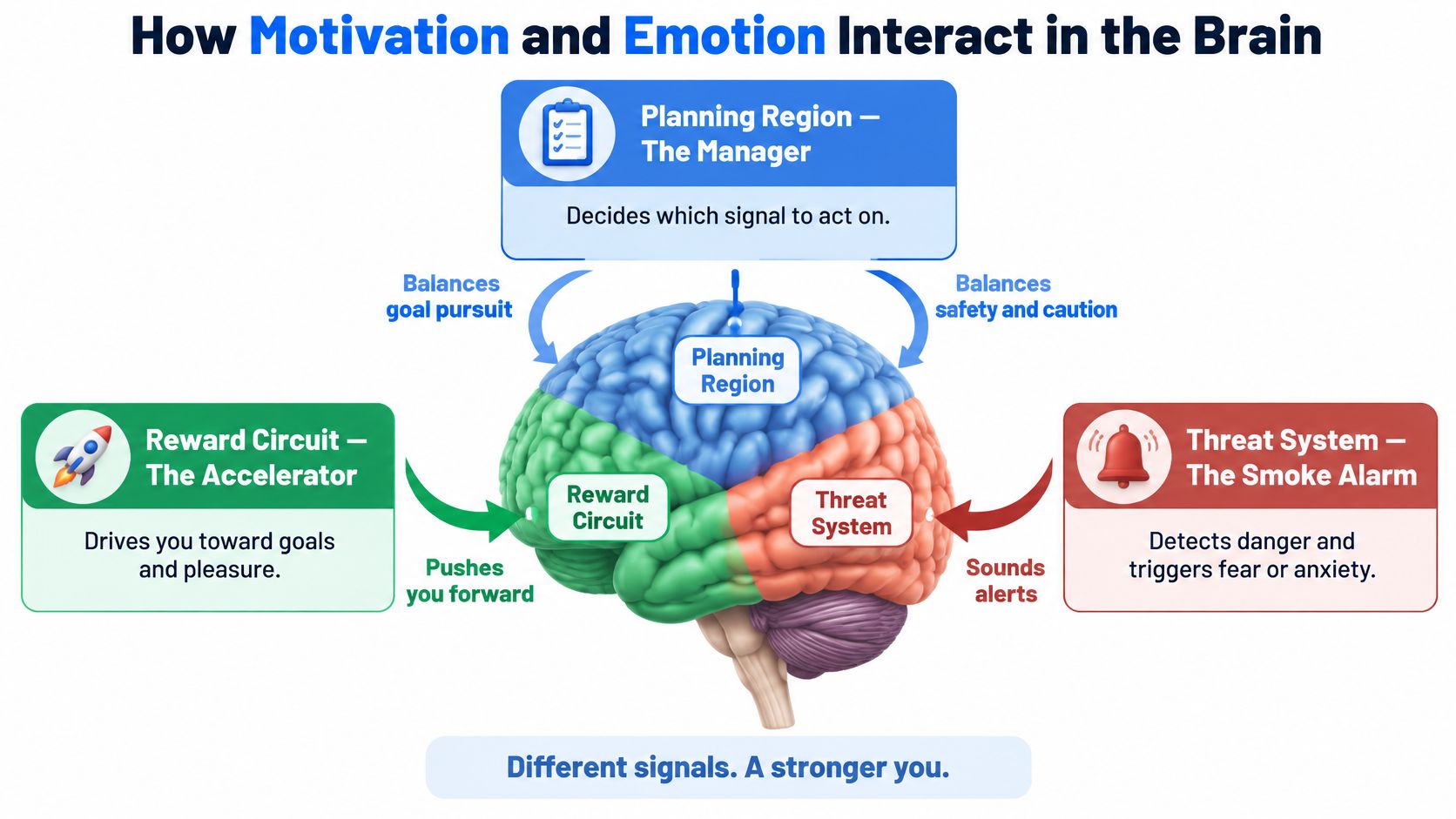
A useful teaching analogy is a team with an accelerator, a smoke alarm and a manager. None works alone, and none is good or bad.
The team behind everyday decisions
- Ventral striatum, the accelerator: This region participates in dopamine-linked reward pathways, particularly anticipation and wanting, rather than pleasure alone. It helps explain why imagining a promotion can pull you towards effort before any reward arrives.
- Amygdala, the smoke alarm: It helps identify emotionally important events, including possible threats. A manager's unexpected message might therefore attract your attention before you know whether anything is wrong.
- Prefrontal cortex, the manager: It supports planning, weighing options and regulating responses. It helps you decide whether to reply immediately, gather information or reconsider your first interpretation.
- Insula, the body reader: It contributes to awareness of internal sensations, such as a racing heart or unsettled stomach. Those sensations become part of how you experience an event.
- Hypothalamus, the basic-needs coordinator: It helps regulate hunger, thirst and arousal. Being hungry or physically depleted can therefore change what feels urgent or manageable.
The diagram offers a simplified view of this teamwork.
From a message to a response
Suppose you receive an invitation to present your work. You anticipate recognition, attach emotional importance to the opportunity and weigh whether to accept. Your planning systems help you organise preparation while responding to both excitement and apprehension.
That sequence is a teaching shortcut, not a fixed biological timetable. Real brain networks overlap, influence each other continuously and change with experience.
Stress, poor sleep and exhaustion can make deliberate planning and emotional regulation harder. You may want to succeed while feeling too overwhelmed to start, which isn't evidence that you've stopped caring.
Notice the bodily signal before judging the behaviour. A tight jaw or shallow breathing can prompt you to pause, check what you need and choose a manageable next action rather than automatically abandoning the task.
Major Theories of Motivation and Emotion Compared
A student may care about passing an exam yet struggle to begin studying. Motivation theories help explain the goal and the effort; emotion theories help explain the feelings that can accompany them. These are different questions about one connected system, not labels for a person's character.
Formal academic psychology developed at Indian universities such as Calcutta in the early twentieth century, supporting the systematic study of psychological processes beyond explanations based only on willpower or character. The history of psychology in India describes this development.
Needs and goals versus emotional responses
The first three theories below focus on motivation: what directs effort and helps sustain it. The remaining theories explain how emotions may arise. A theory offers one useful lens, not a complete account of someone's experience.
Key theories of motivation and emotion
| Theory | Core idea | What it explains | Limitation |
|---|---|---|---|
| Maslow's hierarchy of needs | Needs are met in stages, from basic needs to self-actualisation | Why worries about food or rent can override growth goals | Stage order isn't strictly rigid and evidence is limited |
| Self-Determination Theory | Autonomy, competence and relatedness support intrinsic motivation | Why controlling rewards can reduce interest in a previously enjoyable task | Cultural views of autonomy differ |
| Expectancy-value theory | Effort depends on expecting success and valuing the goal | Why a student may quit mathematics when success feels impossible | Expectancy is hard to measure directly |
| James-Lange theory | Bodily changes come before the felt emotion | Why noticing a racing heart may precede feeling afraid before an interview | Emotions can arise without clear bodily change |
| Cannon-Bard theory | Feeling and bodily response occur together | Why fear and a pounding heart can seem simultaneous | Says less about the role of thinking |
| Two-factor theory, Schachter and Singer | Physiological arousal plus a cognitive label creates emotion | Why similar arousal may feel like excitement at a celebration or anger during an argument | The role of the label is debated |
| Appraisal theory | Emotion depends on how an event is interpreted | Why colleagues experience the same feedback as helpful or humiliating | Appraisals are hard to observe directly |
Intrinsic motivation means doing something because it's interesting or satisfying in itself. External motivation involves an outcome beyond the activity, such as pay, marks or approval. Either kind of motivation can coexist with emotional distress, so effort alone does not show how someone feels.
A culturally grounded lens
Indian philosophical ideas can offer personally meaningful ways to consider purpose and emotional balance. A qualitative study in Frontiers in Psychology explored spiritual emotional intelligence through Bhagavad Gita concepts, including equanimity, ethical duty and non-attached action. Participants described duty and service as sources of motivation.
These ideas call for careful interpretation. Non-attachment does not mean avoidance, and acceptance does not mean resignation. Duty should not require tolerating mistreatment. A person can act conscientiously while seeking help, expressing anger appropriately or leaving an unsafe situation.
Choose a theory to match the question. If effort has faded, consider needs, choice and whether success seems possible. If distress is prominent, consider bodily responses and how the situation is being interpreted. The two can inform each other, and no single theory explains the whole person.
When to Seek Support and Your Next Step
A change in motivation can accompany temporary pressure, work-related exhaustion, anxiety or depression. These patterns can overlap, so use them to describe your experience rather than assign yourself a diagnosis.
Motivation and emotion patterns and when to seek help
| Pattern | Motivation signs | Emotion signs | When to seek help |
|---|---|---|---|
| Short-term stress | Temporary dip in focus and effort | Irritability and tension | Often eases within a few weeks with rest; seek help if it doesn't |
| Burnout | Loss of purpose and energy for work | Exhaustion, cynicism and detachment | Exhaustion continues after rest or time off |
| Generalised anxiety | Avoiding tasks out of fear | Constant worry and restlessness | Worry disrupts sleep, work or relationships |
| Depression | Little interest in work, study or hobbies | Persistent sadness, emptiness or hopelessness | Low mood or loss of interest lasts two weeks or more |
These are help-seeking guides, not diagnostic criteria. Burnout specifically concerns the occupational context, while exhaustion across life may require a broader assessment of mental and physical health.
A person living with depression may still meet deadlines. Someone experiencing anxiety may look exceptionally organised because they're working hard to prevent anything going wrong. Outward performance doesn't reliably tell you how much distress someone is carrying.
A nationally representative Indian study published in BMJ Open reported 2.68% current depressive-disorder prevalence, while 79.1% of people with current depression weren't receiving treatment from a formal or trained healthcare provider. These findings underline why access to care matters, without implying that everyone who feels unmotivated has depression.
A decision check without self-blame
You don't need to prove that your difficulties are severe enough before asking for help. Consider these questions:
- Duration: Has the pattern lasted more than two weeks, or does it keep returning?
- Daily functioning: Is it affecting work, study, sleep, relationships or your ability to manage ordinary responsibilities?
- Safety: Are you struggling to keep yourself safe?
- Support needs: Does self-help feel insufficient, difficult to use or like another source of pressure?
Persistent symptoms, disruption to daily life or insufficient support are good reasons to book a consultation with a qualified therapist or counsellor. You can also seek support earlier, especially if your distress is intense or you're unsure what's happening.
Don't wait for a time threshold if safety is at risk. Thoughts of self-harm, inability to care for yourself or severe difficulty functioning need prompt professional attention. Hopelessness lasting weeks also warrants assessment rather than continued self-pressure.
If you think you might act on thoughts of self-harm or can't stay safe, go to the nearest emergency department or contact local emergency services immediately. Tell a trusted person what's happening and ask them to stay with you while you obtain help.
You don't have to become less functional before you deserve support.
What a first conversation can involve
Therapy and counselling offer space to explore feelings, avoidance, relationships and the pressures surrounding your goals. A professional may ask about sleep, physical health, medication, family expectations and working conditions rather than focusing only on productivity.
Confidentiality is an important part of care, but it has safety and legal limits. Ask the professional to explain those limits, their qualifications, their approach and how you'll review whether the support is useful.
You can describe your experience in everyday language. Saying that you dread opening work messages, no longer enjoy cricket or keep postponing meals gives a clinician useful information without requiring you to identify a condition yourself.
Professional support can also focus on resilience, compassion and happiness, not only symptom reduction. That might mean learning to recover after disappointment, communicate needs or make room for enjoyable activities without turning happiness into another performance target.
Keep three supportive takeaways close:
- Your signals can be understood: Changes in drive and feeling deserve curiosity, not moral judgement.
- Emotional difficulties aren't rare: Struggling doesn't make you weak or less capable of growth.
- Reaching out early is a strength: Asking for support is a practical response to difficulty, not a promise or demand for an immediate cure.
Assessments can inform that conversation, but they never diagnose a condition. Only an appropriately qualified professional can interpret your symptoms in context and make a diagnosis.
Assessment Tools That Screen Motivation and Emotion
Screening assessments are informational, not diagnostic. They organise your answers into patterns that may be useful for reflection or a professional consultation, but a score can't establish why you feel the way you do.
Common screening tools for motivation and emotion
| Tool | What it measures | Items | Typical use |
|---|---|---|---|
| PHQ-9 | Depressive symptoms over the past two weeks | 9 | Screening only, not a diagnosis |
| GAD-7 | Anxiety symptoms over the past two weeks | 7 | Screening only, not a diagnosis |
| Perceived Stress Scale, PSS-10 | How unpredictable and overloaded life feels | 10 | Checking stress levels over time |
| PANAS | Positive and negative affect | 20 | Mood snapshot |
| Emotion Regulation Questionnaire, ERQ | Reappraisal and expressive suppression | 10 | Understanding regulation style |
| Academic Motivation Scale, AMS | Intrinsic, extrinsic and amotivation in learning | 28 | Student motivation patterns |
The PHQ-9 asks about experiences including little interest or pleasure in doing things. Answer based on actual frequency, not whether you believe you have a good enough reason to feel that way.
The GAD-7 includes feeling nervous, anxious or on edge. Count your experience even if you've continued attending classes or completing work.
Make the result useful
For the PSS-10, follow its stated timeframe rather than judging your whole life from today's worst moment. With PANAS, check the instructions carefully because the requested mood timeframe can differ between uses.
For the ERQ, don't choose answers that merely sound emotionally mature. For the AMS, distinguish enjoying learning from pursuing marks or feeling disconnected from the purpose of studying.
- Use the correct timeframe: Answer about the past two weeks for the PHQ-9 and GAD-7; follow each other tool's own instructions.
- Describe reality: Avoid answering how you think you should feel or how others expect you to respond.
- Retake thoughtfully: Reassess after a meaningful change or as professionally advised, rather than repeatedly checking for reassurance.
A concerning score is a prompt for discussion, not a verdict. Bring the tool's name, your results, examples of difficult situations and notes about sleep and functioning to a session.
DeTalks offers scientifically validated assessments, curated self-help content and access to qualified professionals whom you can browse and book. These resources can help you consider self-help, counselling, coaching or psychiatric care, while keeping assessment results informational rather than diagnostic.
Workplace Stress and Exam Pressure in Everyday Life
Consider these illustrative situations, not accounts of specific people. Each shows why visible effort alone tells an incomplete story.
Late-night work can look focused while feeling exhausting.

Different pressures behind similar behaviour
Meera, a 29-year-old software professional, remains ambitious after months of overtime, but she feels drained and fears falling behind. Her motivation is real; so is her emotional depletion. A better plan needs workload changes, not another productivity challenge.
Arjun, a Class 10 student, keeps postponing revision because exam worry prevents him from sleeping. A teacher might misread this as laziness, while a counselling conversation could reveal that fear and exhaustion are making concentration difficult.
A team leader notices that colleagues have stopped volunteering ideas. Private conversations reveal excessive workloads and unclear growth paths, suggesting that disengagement isn't an individual attitude problem.
Look beyond personal coping
Gallup's India workplace figures report that 28% of Indian employees experienced substantial stress on the previous day. Persistent workplace stress can accompany anxiety, disturbed sleep, reduced motivation and burnout.
Managers can clarify priorities, adjust unreasonable workloads and make it safer to ask for help. Anonymous well-being surveys can identify team-level concerns, but they're informational, not diagnostic, and shouldn't replace confidential support.
Use the video as a pause for reflection on your own situation.
Which situation feels closest to yours: sustained effort without recovery, avoidance driven by fear, or disengagement in an unsupportive environment? Identifying the pressure helps you decide whether to start with a personal conversation, an organisational change or professional care.
Strategies to Rebuild Motivation and Steady Emotions
Start with actions small enough to use on a difficult day. These practices are options to experiment with, not a test of discipline or a replacement for treatment.
A 2025 study of 500 Indian working professionals, published in Organizational Psychology, found that mindfulness was associated with reappraisal and expressive suppression, with self-efficacy partly mediating both relationships. Because it used cross-sectional self-report data, it doesn't establish that mindfulness caused those outcomes.
A practical checklist
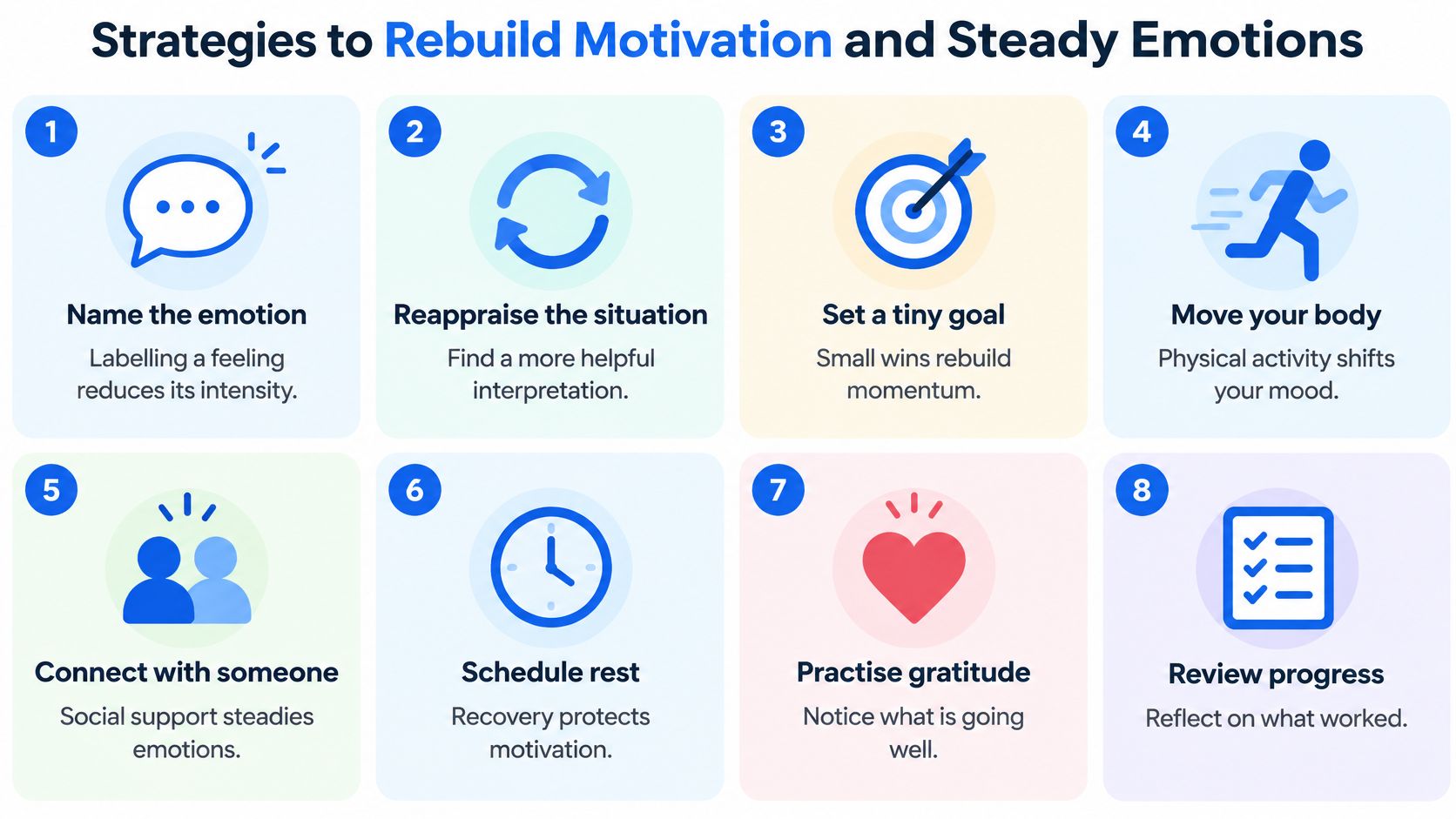
Name the emotion. Write a specific word such as disappointed, apprehensive or lonely before choosing what to do. Labelling can make an overwhelming experience easier to understand and may soften its intensity.
Reappraise the situation. Replace an absolute interpretation with a balanced alternative, such as treating feedback as information about a draft rather than your worth. This can make a stressful task feel more approachable without denying a genuine problem.
Build self-efficacy with a tiny goal. Complete a manageable action, such as opening your notes and outlining an answer. Evidence that you can act is more useful than demanding confidence before beginning.
Connect the goal to your values. Identify whether the task serves learning, independence, care or another personally meaningful priority. This helps distinguish chosen effort from effort driven only by comparison or fear.
Protect sleep and daily movement. Choose a consistent opportunity for rest and an accessible activity, such as walking or stretching. Supporting your physical needs makes emotional regulation less demanding.
Write a short gratitude note. Record something specific you appreciated that evening, without forcing yourself to feel cheerful. You can notice something good while acknowledging that the day was hard.
Take a self-compassion pause. When self-criticism rises, acknowledge the difficulty and choose the next kind, useful action. Compassion helps you respond to a setback without adding punishment.
Set a realistic boundary. Agree a finishing time, clarify an unreasonable deadline or protect time away from messages. Boundaries address the conditions around distress, not just your reaction to them.
For students who struggle to begin alone, Badger's guide to accountability pacts for late-night crammers offers a way to structure shared commitment. Keep accountability supportive rather than punitive, and don't let it replace sleep.
The visual checklist offers additional prompts for daily practice.
Healthy regulation isn't simply looking calm. Hiding emotional expression can leave substantial distress inside.
Progress can be gradual, and setbacks are part of learning. Resilience involves practising useful responses, accepting support and changing difficult circumstances where possible, not becoming unaffected by them.
If low motivation and difficult emotions are affecting your day, visit DeTalks to explore qualified therapists and counsellors, confidential assessments and curated self-help resources. You can start by noting what's changed in your sleep, feelings and daily activities, then bring those observations to a consultation; assessments can support that conversation, but they don't provide a diagnosis.