
OCD involves unwanted, intrusive thoughts and repetitive rituals, while OCPD is a long-standing personality pattern of perfectionism and control that the person usually experiences as their own standard.
If two people both check their work repeatedly, does that mean they're experiencing the same problem? Not necessarily. The difference between OCD and OCPD becomes clearer when you ask what drives the checking, how the person feels about it, and what it costs them.
In India, where discipline, academic achievement and responsibility may be strongly valued, that distinction can be easy to miss. Understanding it doesn't mean labelling yourself or someone else. It means finding a more useful starting point for support.
OCD and OCPD at a Glance
Obsessive-compulsive disorder (OCD) and obsessive-compulsive personality disorder (OCPD) sound similar, and both can involve checking, order or control. But outward behaviour alone doesn't tell you which condition, if either, is present.
Someone with OCD may feel trapped by a ritual they don't want to perform. Someone with OCPD may feel their approach is necessary and struggle when others don't follow it.
OCD and OCPD compared at a glance
| Feature | OCD | OCPD |
|---|---|---|
| Core experience | Intrusive, unwanted thoughts, images or urges, and/or repetitive rituals | Enduring pattern of order, control and perfectionism |
| Relationship to symptoms | Usually experienced as unwanted and distressing | Usually experienced as consistent with own standards |
| Insight | Often recognises thoughts or rituals as excessive, although insight can be limited | Often sees own rigidity as correct or necessary |
| Time and impact | Time-consuming rituals, marked distress or interference with daily life | Problems in work, relationships or efficiency across settings |
| Classification | Obsessive-compulsive and related disorders | Personality disorder |
| Treatment focus | Reducing the obsession-and-ritual cycle | Developing flexibility and changing enduring patterns |
How to read the comparison
The most useful row is relationship to symptoms, not how tidy someone is. A person can have OCD without an organised home, and being meticulous doesn't establish OCPD.
Think of the distinction as a starting question, not a rule that sorts everyone neatly. People with OCD can have limited awareness of their symptoms, while people with OCPD can recognise their difficulties and want help.
OCD is usually something the person wants to stop, while OCPD is usually something the person wants others to match.
That shorthand needs compassion. It doesn't mean someone with OCPD chooses relationship difficulties, or that someone with OCD never asks relatives to participate in rituals.
Neither condition is a character judgement. Impairment, meaning meaningful disruption to everyday life, matters much more than whether someone's habits seem unusual to others.
An article or assessment can help you describe a concern, but assessments are informational, not diagnostic. Only a qualified clinician can establish whether the overall pattern meets criteria for either condition or has another explanation.
What the Numbers Really Show
Prevalence figures can look contradictory because researchers study different people in different ways. A school survey, a community study and a psychiatric inpatient sample don't answer the same question.
OCD estimates in India
An Indian review of OCD epidemiology reports these findings:
- National estimate: The national epidemiological study identified in the review estimated 0.6% lifetime prevalence.
- Kerala school students: Among 7,380 students aged 12–18, point prevalence was 0.8%, including 1.1% in males and 0.5% in females.
- Kerala college students: Among 5,784 students aged 18–25 across 58 colleges, point prevalence was 3.3%, with another 8.5% meeting subthreshold OCD criteria.
“Lifetime prevalence” concerns whether someone has experienced the condition during their lifetime. “Point prevalence” concerns its presence at the time studied, while “subthreshold” means symptoms don't meet the full diagnostic criteria.
OCPD estimates need a different context
An OCPD research review describes 8.7% prevalence in an outpatient sample and 23.3% in a psychiatric inpatient sample under earlier DSM-III-R and DSM-IV criteria, alongside community estimates of approximately 7.2%–7.7% and clinical-population rates reaching 26%.
These aren't head-to-head comparisons with Indian OCD estimates. The populations, diagnostic systems and assessment methods differ, and India-specific OCPD prevalence evidence remains limited.
Under-recognition and methodological differences deserve more attention than a single headline percentage. Population figures can't tell you which label fits an individual; the person's experience and functioning remain central.
Intrusive Thoughts or Personality Traits
The distinction that matters is the person's relationship to the pattern: whether they are trying to escape an unwanted mental experience, or following an established standard they believe is right. The same visible behaviour, handwashing for twenty minutes, can carry entirely different meanings.
Two similar-looking behaviours with different meanings
A person returns home from a crowded bus journey with an intrusive contamination thought. They wash repeatedly, want the thought gone, and lose a substantial part of the evening to washing and restarting. The thought feels alien to them. They are not choosing cleanliness as a satisfying preference; they are trying to escape distress or reach a feeling of completeness.
A team lead rewrites every report into his exact format. He believes colleagues are careless, rejects equally workable alternatives and regards his own standards as professional. His concern may have little to do with an unwanted thought he is trying to neutralise. The difficulty may sit in a broader, inflexible approach to responsibility and control, particularly when it also appears at home and in friendships.
Neither example establishes a diagnosis. A clinician needs to understand the purpose, history and consequences of the behaviour.
What a clinician checks
The Indian Psychiatric Society's clinical practice guideline identifies OCD symptoms as clinically meaningful when they are time-consuming, typically more than one hour a day, or cause significant distress or functional interference.
That is not a stopwatch test. Nobody should wait for symptoms to fill a particular number of hours if they are already causing substantial suffering.
A careful assessment explores:
- Intrusiveness: Do thoughts, images or urges arrive unwanted?
- Resistance and rituals: What does the person do, physically or mentally, to respond?
- Avoidance: Are they staying away from people, places or responsibilities?
- Insight: How convincing does the feared consequence or personal rule feel?
- Impact and history: What happens at work, at home and with friends, and how long has this been happening?
Clinicians may use the Yale-Brown Obsessive Compulsive Scale (Y-BOCS) or a comparable checklist to understand OCD symptoms. A questionnaire does not replace a clinical interview, and it cannot substitute for a separate assessment of longstanding personality traits.
Common misunderstandings deserve careful answers
Recognising that a thought is excessive doesn't rule out OCD. Knowing that a fear is unreasonable and feeling able to resist the ritual are two different experiences, and the second does not follow automatically from the first.
Religious, moral or harm-related intrusive thoughts can be especially difficult to discuss. An Indian clinical overview of OCD highlights under-recognition and diagnostic difficulties, which makes sensitive assessment particularly important when symptoms are read through cultural or moral beliefs.
A clinician should ask what the experience means to the person rather than judge it solely by its subject matter. A religious practice, for example, needs to be understood in its cultural context and in relation to distress, freedom of choice and impairment.
OCPD isn't milder OCD. The conditions differ in motivation, emotional experience, relationship impact and treatment planning, and they can occur together. Reviews suggest OCD often appears alongside OCPD, so an assessment should investigate both patterns rather than assume that identifying one excludes the other.
Practical rule: Look at flexibility and cost, not just effort or discipline.
Conscientiousness becomes concerning when rules repeatedly cost sleep, health, relationships or completed work, yet the person struggles to adjust. Families can ask whether a standard serves a shared purpose and whether an acceptable alternative is allowed.
Where Each Pattern Shows Up in Work and Family Life
Ordinary situations can help you notice what deserves a conversation. They can't establish a diagnosis, because similar behaviours may also arise from workload, anxiety or other difficulties.
Everyday situations worth noticing
In a software team, a colleague repeatedly checks code and won't delegate. Ask whether they fear a specific disaster, distrust any method but their own, or are working under unrealistic quality demands.
Notice missed deadlines, exhaustion and strained collaboration. A helpful first step is a private discussion about expectations and support, rather than a public label.
For a college student, an exam preparation routine might involve restarting revision whenever an unwanted thought appears. If it takes up the evening and reduces sleep, a referral is more useful than advice to become more disciplined.
In a couple, one partner may treat any change to the household routine as a personal failure. Start with the effect on shared life, such as arguments or inability to rest, and agree on a calm conversation about flexibility.
For a parent, recurring arguments may centre on order, control and rules. Discuss a specific incident and its effect on the family rather than calling the parent controlling or diagnosing them during conflict.
The video below offers another way to engage with the topic.
Responding to workplace distress without labels
A review of mental health in Indian workplaces describes a 2022 study of 1,764 urban Indian white-collar employees in which 29% showed moderate-to-severe signs of depression, 55% moderate-to-severe anxiety and 78% moderate-to-high stress.
These findings support compassionate responses to workplace stress, not assumptions about OCD or OCPD. Burnout, low mood and demanding work environments deserve attention in their own right.
HR teams and managers can offer:
- Clear expectations: Agree on what completed, acceptable work looks like.
- Reasonable flexibility: Discuss workload, deadlines and practical adjustments privately.
- A referral route: Make confidential counselling and professional assessment easy to access.
Managers should address observable work difficulties while leaving diagnosis to clinicians.
Strengths That Support Recovery and Well-Being
Careful work, reliability and commitment to quality can be valuable qualities. Supporting someone doesn't mean asking them to stop caring or become careless.
The aim is to preserve useful strengths while reducing the distress or inflexibility that limits their choices. A person can value responsibility without treating every uncertainty as something they must eliminate.
Building resilience through small experiments
Resilience isn't an instruction to tolerate unlimited stress. It develops through manageable practice, appropriate support and permission to have difficult days.
For someone with OCD, a therapist might guide practice in delaying or leaving a ritual undone. For someone with rigid perfectionistic patterns, therapy may involve examining which standards are useful and which prevent collaboration or rest.
Practical examples include:
- A student practises delaying a nightly check with a clinician's guidance, without turning the practice into another test of perfection.
- A manager delegates a task each week and records what happens, including outcomes that differ from their expectations.
- A partner identifies a household rule that can flex and agrees on a trial period with the other person.
These are examples to discuss with a professional, not a self-directed treatment plan.
Making compassion practical
Compassion can mean noticing when a standard has become cruelty towards yourself or someone else. Instead of criticising a difficult day, identify what was hard and what support would make the next attempt manageable.
Protect sleep, make room for activities that aren't about achievement, and maintain meaningful contact with friends or family. Happiness doesn't need to become another target to perform perfectly.
Mindfulness can help someone notice an urge without immediately acting on it, but it shouldn't become a compulsory method for cancelling thoughts. Counselling and therapy can help distinguish supportive habits from new rituals.
Progress is gradual. Strengths and difficulties can exist together, and well-being doesn't require feeling calm or productive all the time.
Treatment Paths and Who to See
Choose a clinician whose training matches the difficulty, not someone who uses the words stress or perfectionism. An Indian OCD assessment and management review supports detailed evaluation and treatment planning rather than diagnosis through self-screening alone.
Treatment approaches and clinicians by condition
| Aspect | OCD | OCPD |
|---|---|---|
| Suitable first clinician | Psychiatrist or clinician trained in exposure-based CBT | Psychologist or therapist with personality-focused training |
| Common approaches | Exposure and response prevention, CBT, medication where indicated | Longer-term psychotherapy focused on patterns and relationships |
| Assessment tools | Y-BOCS or a comparable checklist, plus clinical interview | Structured clinical interview covering traits across settings |
| Family role | Work with the clinician to stop joining rituals or giving repeated reassurance | Discuss rigidity openly and without blame |
| Expected timeline | Structured treatment with regular review and between-session practice | Longer-term work addressing established patterns |
| Progress markers | Less time on rituals and improved everyday functioning | More flexibility, better relationships and work |
What the treatment involves
Exposure and response prevention (ERP) is a form of cognitive behavioural therapy. With a therapist, the person gradually encounters situations that trigger distress while practising not performing the usual ritual.
This isn't about forcing someone into overwhelming situations or proving that nothing bad can ever happen. The clinician and person agree on manageable practice and review its effect.
A psychiatrist may recommend medication when appropriate. Medication decisions require an individual assessment, including other symptoms, health needs and previous treatment.
For OCPD, personality-focused psychotherapy examines enduring standards, emotional responses and relationship patterns. Goals might include finishing work without endless revision, sharing decisions or tolerating another person's acceptable approach.
Choosing support and involving family
If you're comparing remote services, HearSmart's online therapy rankings can provide a starting point for exploring options. Check India availability, professional credentials, privacy arrangements and the individual clinician's relevant training before booking.
Ask at the first session:
- Approach: Do you provide ERP for OCD or personality-focused therapy for longstanding rigidity?
- Progress: How will we decide whether treatment is helping?
- Practice: What might I work on between sessions, and how will we review difficulties?
Families should change their involvement with guidance rather than abruptly withdrawing support. For OCD, that may mean reducing participation in rituals; for OCPD, it may mean discussing specific effects of rigidity while maintaining respectful boundaries.
Outcomes differ, and no single approach works for everyone. General counselling can support well-being, but suspected OCD deserves access to disorder-specific treatment.
Take a Supportive Next Step Without Self-Diagnosis
Book an assessment if the pattern is disrupting your life or relationships. You don't need to settle on the correct label before asking for help.
An article or self-check can help you find words for your experience. It remains informational, not diagnostic, and only a qualified clinician can confirm OCD or OCPD.
The checklist below offers a practical way to prepare for that conversation.
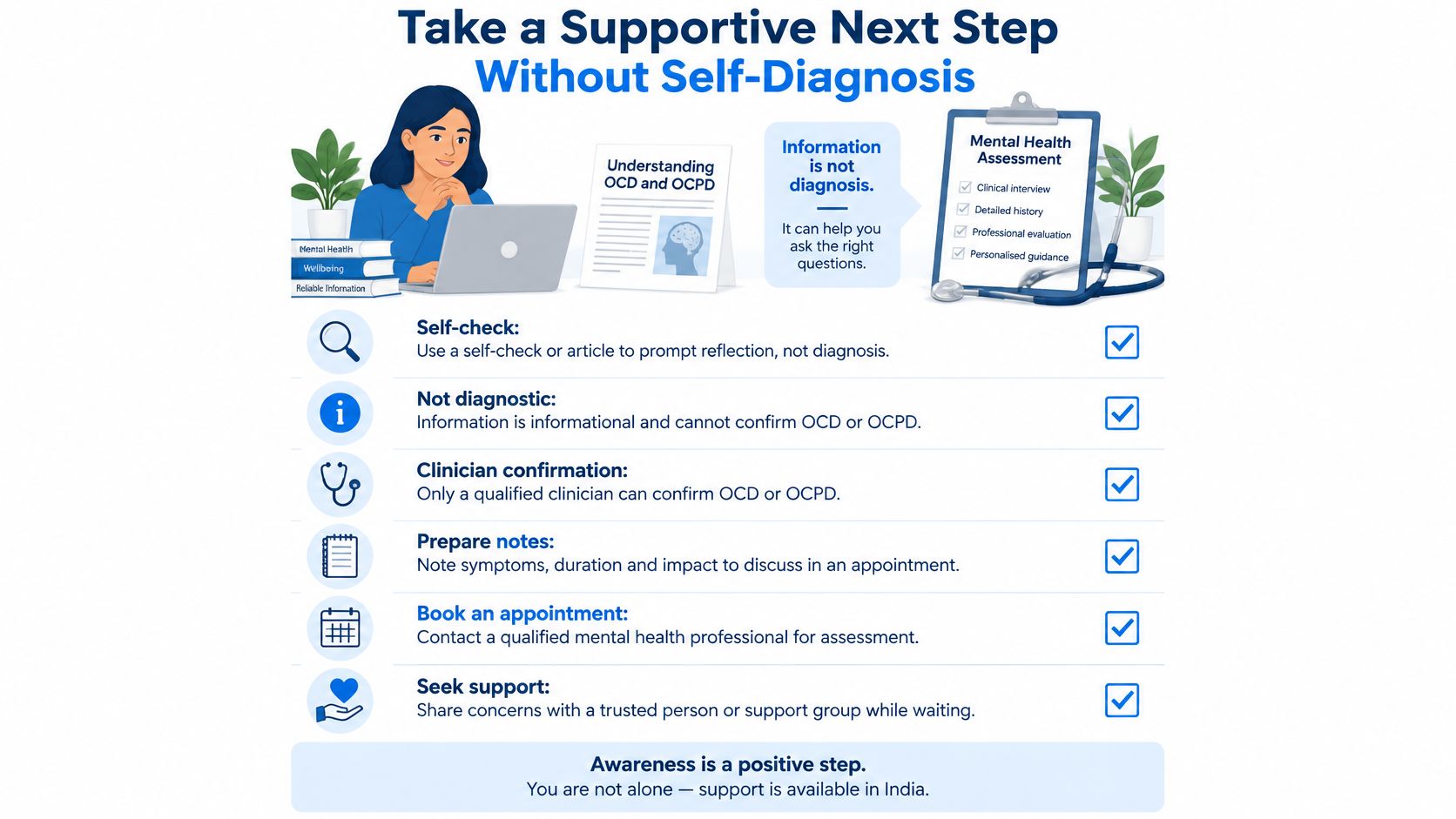
Bring observations rather than a verdict
Write brief notes about what happens before, during and after a difficult episode. Include less visible experiences, such as mentally reviewing events, repeating phrases or avoiding situations.
Useful appointment notes include:
- Time lost: How much of the day goes into thoughts, rituals, rules or restarting tasks?
- Distress: What emotions arise, and how difficult are they to manage?
- Impact: What happens to sleep, work, study, health and relationships?
- Duration: When did the pattern begin, and where does it appear?
- Previous support: What have you tried, and what helped or made things harder?
Bring these questions to the clinician: How many hours a day does the pattern take? What happens when the routine is interrupted? How long has the pattern been present?
You can also describe whether the pattern feels unwanted and what it costs in relationships. These are conversation starters, not questions with answers that automatically establish a diagnosis.
Support can include both difficulties and strengths
India's National Mental Health Survey 2015–16, conducted by NIMHANS, estimated that 10.6% of adults had a mental disorder, according to the Government of India's survey summary. Mental health difficulties aren't rare, and seeking support is nothing to be ashamed of.
While waiting for an appointment, keep ordinary sleep and meal routines, maintain supportive contact and avoid building your day around new ways to obtain certainty. If distress includes immediate danger or thoughts of harming yourself, seek urgent help through local emergency services or the nearest emergency department.
You don't need certainty about a diagnosis to deserve a careful, compassionate conversation.
Seek qualified care early, build resilience gradually and use mindfulness as observation rather than thought control. Treat yourself and others with kindness while working towards practical changes, without expecting a promise of cure.
DeTalks offers a directory of psychologists, therapists and counsellors, alongside validated informational assessments that can help you consider self-help, counselling, coaching or psychiatric care. If intrusive rituals or longstanding rigidity are affecting your life, visit DeTalks to explore qualified support and prepare for a professional assessment rather than self-diagnosing.