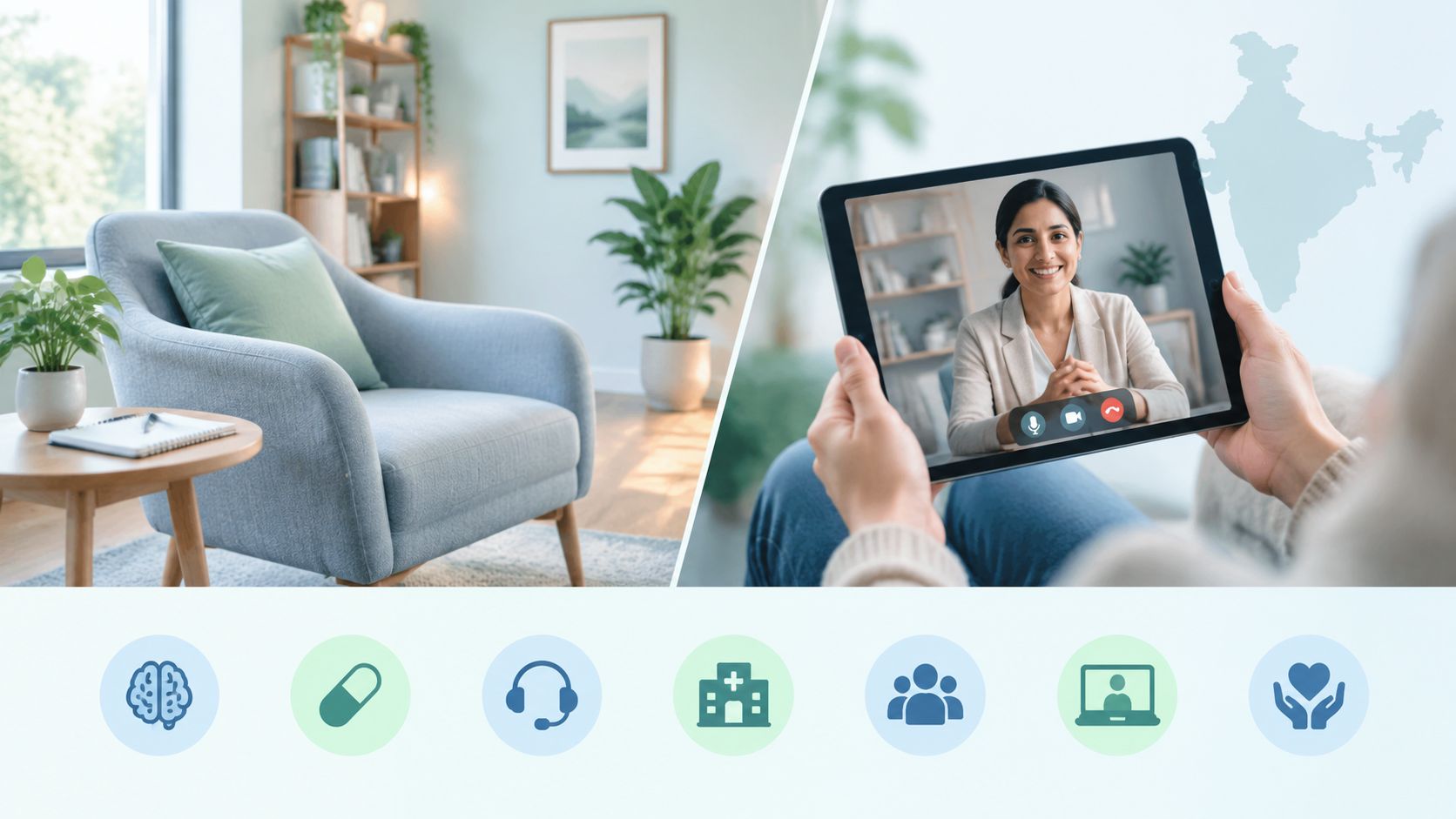
You're searching for help between work deadlines, poor sleep, and the constant mental noise of intrusive thoughts. Perhaps anxiety, workplace stress, burnout, or depression has made the compulsions harder to manage, while finding a trustworthy therapist feels like another task you can't postpone.
For many people, the strongest evidence-based pathway centres on cognitive behavioural therapy with Exposure and Response Prevention (CBT with ERP). Psychiatric assessment and medication, often an SSRI, may also be appropriate depending on symptom severity, past treatment, side effects, and access to trained therapy. Indian clinical guidance identifies SSRIs and CBT with ERP as first-line options, with combined treatment particularly relevant in severe OCD (Indian Psychiatric Society guidance).
Any online assessment or screening tool is informational, not diagnostic. A qualified professional needs to assess symptoms, safety, coexisting anxiety or depression, and the effect on daily life.
This roundup compares seven India-based care pathways, from public hospitals and private networks to residential programmes, teletherapy-friendly services, and neuromodulation clinics. The right option depends less on a universal ranking and more on treatment intensity, genuine ERP access, geography, continuity, affordability, and support for complex or treatment-resistant OCD.
1. NIMHANS OCD and Related Disorders Services in Bengaluru
NIMHANS is one of India's best-known public mental-health institutions and a national referral centre for complex psychiatric care. Its Department of Psychiatry and related specialty services can offer a multidisciplinary route, bringing psychiatric evaluation, clinical psychology, medication management, and psychotherapy into the same public-sector setting.
OCD care may involve an SSRI or another serotonin reuptake inhibitor when indicated, alongside therapist-delivered CBT with ERP. The value of this model lies in coordination. A psychiatrist can review medication, while a clinical psychologist works on exposure exercises, response prevention, avoidance, family accommodation, and gradual return to ordinary activities.
Indian guidance highlights the importance of structured OCD treatment and better awareness among general physicians because specialist access remains limited in many regions (Indian Journal of Psychiatry clinical practice guideline). NIMHANS is therefore particularly relevant for people who need a high-volume academic environment or a second opinion on a complicated presentation.

Where NIMHANS fits best
Public-sector pricing can make specialist assessment more accessible than private hospital care. The institute also offers exposure to advanced treatments, clinical training, and a broad case mix, which can matter when OCD overlaps with depression, anxiety, trauma, tic symptoms, or significant functional impairment.
The trade-off is convenience. Queues, registration procedures, appointment availability, and repeated visits can make the process demanding, especially for someone travelling from another state or managing workplace stress. ERP may also require regular sessions and homework, so ask about the realistic therapy pathway rather than assuming that a first psychiatric consultation automatically includes ongoing ERP.
Practical rule: Choose NIMHANS when specialist depth and public-sector access matter more than speed and appointment flexibility.
2. AIIMS Delhi Department of Psychiatry
AIIMS Delhi offers a tertiary academic route for OCD assessment and treatment, with psychiatrist-led medication management and psychologist-led psychotherapy where available. Its public hospital setting may suit people looking for lower-cost care, while its academic environment can appeal to patients interested in research-informed practice and broader medical support.
The treatment conversation should still centre on ERP, not on the institution's reputation alone. Ask whether a named psychologist will deliver structured exposure and response prevention, how often sessions can occur, and how medication reviews will be coordinated. The National Medical Journal of India review notes that no SSRI is clearly superior in efficacy and that decisions should consider cost, adverse effects, and previous response (National Medical Journal of India review).
AIIMS also has a Digital Psychiatry Lab associated with the development of digital and ERP-support tools, including an OCD Prototype. That doesn't mean an app replaces therapy. It does show how academic services are exploring technology that may support education, monitoring, and practice between sessions.

The access trade-off
Demand can exceed supply in large government institutions. Appointment slots may be competitive, and starting therapy can require multiple visits, which may be difficult for people outside Delhi or those managing demanding jobs, burnout, or family responsibilities.
AIIMS is strongest as a research-oriented, medically integrated public option. It may be less suitable when you need immediate, highly flexible weekly counselling. Before travelling, confirm registration requirements, current service availability, and whether remote follow-up or referrals are possible.
- Ask about ERP: Confirm that therapy includes planned exposure and response prevention, not only supportive counselling.
- Clarify continuity: Find out whether the same clinician can follow your progress.
- Plan travel: Consider the practical burden of repeated visits before choosing a distant public centre.
3. Cadabam's Hospitals and Cadabam's Group in Bengaluru
Cadabam's offers a private mental-health network with outpatient OCD services and longer-term rehabilitation options. Its model is useful for people who need more than isolated consultations, particularly when OCD has disrupted education, employment, relationships, sleep, or independent living.
The central therapy question is whether CBT with ERP is delivered by trained psychologists as part of an integrated plan. Psychiatric care can address medication, sleep, anxiety, depression, and other clinical concerns, while family-inclusive planning can help reduce unintentional reassurance and accommodation of rituals.
A stepped-care private model
Cadabam's strength is continuity across levels of support. A person might begin with outpatient treatment, move to a day programme if ordinary appointments aren't enough, and consider residential rehabilitation when symptoms or the home environment make consistent practice difficult. That step-up and step-down structure can be valuable for complex OCD because transitions between providers often interrupt progress.
The private setting usually brings higher costs than public hospitals, and pricing can vary by programme intensity. Ask for a written explanation of what each level includes, including psychiatrist reviews, individual ERP, group work, family meetings, accommodation, follow-up, and emergency arrangements.
A good programme should explain what happens between sessions. ERP depends on planned practice in daily life, not just discussion inside a consulting room.
This option may suit people who want an organised pathway and can manage private-sector fees. It may not be the best fit for someone seeking the lowest-cost entry point or only occasional counselling. Compare the actual therapist's ERP training and caseload, rather than relying only on the network's size.
4. Athena Behavioral Health in Gurugram, Delhi NCR, and Guwahati
Athena Behavioral Health positions ERP as a core part of its OCD programme, with psychiatrist oversight and services across Gurugram, Delhi, Noida, and Guwahati. That multi-location footprint makes it a practical option for people in North India who want an OCD-specific private service without travelling to a single national centre.
The integrated approach can also help when OCD exists alongside anxiety or depression. A treatment plan might combine ERP-focused therapy, psychiatric review, medication management, and attention to sleep, work functioning, family relationships, and avoidance. Workplace stress can intensify distress, but it shouldn't become a reason to postpone evidence-based care.
Geographic access is only part of the decision
A nearby clinic can improve attendance, but proximity doesn't prove that ERP is available at the required frequency. Ask who designs the exposure hierarchy, how response prevention is monitored, whether between-session tasks are reviewed, and how the team handles mental rituals, reassurance seeking, or family accommodation.
Private-sector pricing is another clear trade-off. Session or package costs need to be confirmed directly, and people should ask whether psychiatric appointments, therapy, assessments, medication coordination, and follow-up are billed separately.
The evidence from India supports considering remote delivery when specialist access is limited. An Indian pilot found videoconferencing-delivered ERP feasible, acceptable, and comparable to in-person ERP, while a broader review found that available videoconferencing trials performed better than control conditions and were equivalent to in-person treatment (review of videoconferencing ERP and CBT). Athena's locations may therefore be most useful when paired with a clear plan for continuity if travel becomes difficult.
5. Abhasa Rehabilitation and Wellness in Maharashtra and Tamil Nadu
Abhasa offers residential and intensive OCD programmes built around ERP, psychoeducation about SSRIs, family involvement, and stepped-care planning. This setting is designed for people who need a consistent environment to practise response prevention, especially when home routines reinforce rituals or relatives become involved in repeated reassurance.
Residential care changes the treatment conditions. Instead of attempting exposure homework after a stressful commute or during a crisis at home, a person can receive structured support and practise skills repeatedly in a supervised setting. That doesn't make treatment effortless. ERP still involves approaching feared situations and resisting compulsions, and the work has to transfer back into ordinary life.
When intensity helps, and when it doesn't
An intensive programme may be appropriate when outpatient appointments haven't created enough structure, when family accommodation is substantial, or when symptoms have affected basic routines. It may also provide space to address coexisting anxiety, depression, burnout, and workplace stress without treating each concern in isolation.
The costs are higher than standard outpatient therapy, and residential care requires time away from work, education, and family. Programme length, staffing, inclusions, and follow-up arrangements vary, so request those details before making a decision through the Abhasa OCD treatment centre.
- Confirm ERP delivery: Ask how much individual ERP is included and who supervises it.
- Discuss family work: Find out how relatives will learn to support recovery without reinforcing compulsions.
- Plan discharge: Ask how exposures will continue after returning home.
Abhasa is best viewed as a structured intensity option, not a universal answer. A person with manageable symptoms and reliable local ERP may prefer outpatient treatment, while someone facing severe disruption may need more containment and continuity.
6. Asha Neuromodulation Clinic at Asha Hospital in Hyderabad
The Asha Neuromodulation Clinic offers hospital-based Deep TMS for OCD, including the BrainsWay H7 coil and neuronavigation, with psychiatrist oversight. This pathway is intended for people whose OCD hasn't improved enough with standard approaches such as CBT with ERP and serotonin reuptake inhibitors.
Neuromodulation shouldn't replace a careful treatment review. The psychiatrist needs to assess the diagnosis, previous medication trials, therapy engagement, physical health, safety considerations, and whether ERP can be continued alongside the procedure. The clinic describes neuromodulation as part of a broader treatment plan, and combining it with ERP may help preserve the behavioural learning that medication or stimulation alone can't provide.
A later-line option with practical demands
Deep TMS is more intensive financially than ordinary therapy, and it generally requires repeated clinic attendance, often on a daily schedule over several weeks. That creates travel and workplace challenges, particularly for people coming from outside Hyderabad. Ask about the full course, psychiatric supervision, therapist involvement, maintenance planning, and what happens if symptoms change during treatment.
The Indian evidence base is developing around access and treatment-resistant care, but no clinic can guarantee a particular result. A sensible consultation should explain why neuromodulation is being considered now, what alternatives remain, and how progress will be measured without presenting the device as a cure.
This pathway is most relevant when first-line treatment has been adequate yet insufficient, or when a specialist believes neuromodulation may help someone engage more effectively with ERP. It's less suitable as a first response to new intrusive thoughts without a proper psychiatric assessment.
7. Mindful TMS Clinics in Bengaluru, Delhi NCR, and Other Cities
Mindful TMS Clinics provide a multicity route to rTMS and Deep TMS protocols for OCD, with psychiatrist and therapist support. The network model may reduce geography-related barriers for people who need a neuromodulation consultation but can't easily reach a single hospital.
The important distinction is between access to a device and access to a complete OCD pathway. Neuromodulation is generally positioned as an adjunct to core behavioural treatment, medication management, or both. Ask whether the clinic can coordinate with your existing psychiatrist and ERP therapist, or whether it provides a connected team that will follow the case from assessment through review.
Questions that protect continuity
Private-sector costs are protocol-driven and usually confirmed after clinical assessment. Multiple sessions are typically required, so ask for the expected schedule, total treatment components, travel implications, possible additional consultations, and the plan after the course ends.
- Check clinical oversight: Identify the psychiatrist responsible for suitability, consent, and review.
- Check ERP access: Confirm whether ERP is available in the same service or through a coordinated referral.
- Check location options: Ask whether follow-up can continue at another clinic in the network.
- Check expectations: Request a balanced explanation of potential benefits, limitations, and alternatives.
The multicity footprint may be useful, but it shouldn't decide the treatment by itself. The best match is the service that can offer appropriate assessment, safe monitoring, realistic continuity, and a clear role for ERP. You can review the provider's approach through Mindful TMS Clinics, then discuss suitability with a qualified clinician.
Top 7 OCD Treatment Centers in India, Comparison
| Service | Implementation complexity (🔄) | Access & resources (⚡) | Expected outcomes (⭐) | Ideal use cases (💡) | Key advantages (📊) |
|---|---|---|---|---|---|
| NIMHANS – OCD and Related Disorders services (Bengaluru) | Moderate–high: multidisciplinary pathways and administrative steps | Public-sector pricing, high clinical volume; longer wait times | High-quality evidence-based CBT/ERP + medication when accessed | Patients seeking multidisciplinary, evidence-based care at lower cost | National referral center; extensive case mix and training programs |
| AIIMS Delhi – Department of Psychiatry (Digital Psychiatry Lab) | Moderate–high: tertiary academic workflows with research components | Low-cost public services; limited appointment slots; digital lab resources | Research-driven outcomes; access to digital adjuncts (pilot apps) | People wanting research-oriented or tech-enabled care at low cost | Strong research infrastructure and digital tool development |
| Cadabam's Hospitals and Cadabam's Group (Bengaluru) | Moderate: integrated private protocols across care levels | Private pricing varies; offers OPD, day programs, residential rehab | Good for complex/severe cases due to continuity of care | Patients needing step-up/step-down care or residential rehab | Continuum of care and family-inclusive planning for complex cases |
| Athena Behavioral Health (Gurugram / Delhi–NCR / Guwahati) | Low–moderate: ERP-centered programs with psychiatrist oversight | Private-sector costs; multiple centers across NCR and beyond | Effective ERP-focused therapy when adhered to | Patients in North India seeking ERP-specific programs | Clear ERP emphasis and improved geographic access |
| Abhasa Rehabilitation and Wellness (Maharashtra / Tamil Nadu) | High: intensive residential ERP programs with structured protocols | Time- and cost-intensive residential model; family involvement | Strong impact where home context reinforces symptoms | Individuals needing intensive/residential support to reduce relapse | Structured residential environment and psychoeducation on SSRIs |
| Asha Neuromodulation Clinic (Deep TMS) (Hyderabad) | High: specialized neuromodulation with neuronavigation | Higher cost; multiple daily sessions over weeks; hospital-based | Potentially beneficial for treatment‑resistant OCD when combined with ERP/meds | Treatment‑resistant cases not responding to CBT/SSRIs | Access to BrainsWay Deep TMS (H7 coil) and neuromodulation modalities |
| Mindful TMS Clinics (Bengaluru, Delhi–NCR, others) | Moderate–high: protocol-driven rTMS/Deep TMS with clinician oversight | Private costs; multicity clinic network; assessment-driven pricing | Adjunctive benefit for nonresponders when combined with therapy | Patients seeking neuromodulation across multiple cities | Network access and emphasis on FDA-cleared protocols for OCD |
Choose Support, Not a Perfect Promise
Searching for the “best OCD treatment in India” can make care feel like a ranking exercise. Indian guidelines point to a more useful answer: SSRIs and CBT with ERP are first-line options, while the choice depends on symptom severity, cost, side effects, prior response, and whether trained CBT is available (Indian Psychiatric Society OCD guidance).
For mild-to-moderate OCD, CBT with ERP may be used alone when suitable facilities exist. Severe OCD may require combined SSRI and CBT, while specialist referral becomes especially important when illness is severe, initial treatment hasn't helped, CBT is needed, serious psychiatric coexisting conditions are present, or suicidal thoughts occur (National Medical Journal of India review.
Before contacting a provider, ask practical questions:
- Who delivers ERP? Ask about the clinician's specific training and experience with exposure and response prevention.
- How is medication coordinated? Confirm whether a psychiatrist reviews medication, side effects, interactions, and progress.
- Is remote therapy possible? Videoconferencing ERP has shown practical promise in low-resource Indian settings, so ask whether secure teletherapy can protect continuity when travel is difficult.
- What will treatment involve? Request the likely session frequency, between-session practice, review points, and total cost structure.
- How will family and work be included? A good plan can address reassurance, accommodation, workplace stress, anxiety, depression, burnout, and the need to maintain ordinary responsibilities.
- What happens if progress stalls? Ask when the team would reconsider the formulation, seek a second opinion, or discuss a higher level of care.
Public hospitals such as NIMHANS and AIIMS may offer affordability and academic depth, but waiting and travel can be difficult. Private networks can offer faster access and continuity, though fees may be higher. Residential care provides structure but takes time away from home, while TMS services may be relevant only after a specialist reviews treatment resistance and the role of ongoing ERP.
Platforms such as DeTalks can help people browse and book therapists and counselling support in India. Its psychological assessments and screening tools may offer useful personal insight, but they're informational, not diagnostic, and they shouldn't replace psychiatric evaluation when symptoms are severe or confusing.
OCD care can also make room for strengths beyond symptom management. Resilience, compassion, happiness, emotional balance, and well-being are meaningful goals alongside reducing compulsions. Progress may look like responding differently to fear, returning to work, reconnecting with family, or building confidence in daily decisions. It isn't a promise of an instant cure, and you don't have to make the decision alone.
If distress feels overwhelming, or you're worried about immediate safety, seek urgent professional help through a hospital emergency service or an appropriate crisis pathway. Healthcare professionals and support systems can also use this guidance on crisis intervention for healthcare pros.
DeTalks helps people in India browse qualified psychologists, therapists, and mental-health professionals for OCD, anxiety, depression, workplace stress, burnout, and broader well-being support. Explore confidential counselling options and informational assessments, then take a practical next step by visiting DeTalks.