You may be answering emails late into the evening, waking with a tight chest, or losing interest in things that once made you happy. Perhaps you've searched for an online psychiatry consultation because travelling to a clinic feels difficult, privacy matters, or you're unsure whether your symptoms are “serious enough” to deserve professional support.
You don't need to wait until life becomes unmanageable. Online care can offer a structured way to discuss anxiety, depression, workplace stress, burnout, sleep changes, or persistent low mood with a qualified professional. It can also become part of a longer plan for therapy, counselling, medication review, resilience, and overall well-being.
Understanding Your Mental Health Needs
Consider a person who keeps saying, “I'm just tired.” Their workload has increased, sleep feels broken, and small decisions now feel overwhelming. They may still be attending meetings and caring for family, but inside they're struggling with anxiety and a growing sense of disconnection.
That experience deserves attention even if the person is still functioning. Mental health concerns often appear gradually, and early support can help someone understand patterns before distress begins to control work, relationships, or daily routines.
Understanding support without self-diagnosis
An online psychiatry consultation is a medical appointment with a psychiatrist through a digital platform. The clinician listens to your concerns, asks about your symptoms and history, considers safety, and discusses appropriate care. Depending on the assessment, that care may include therapy, counselling, lifestyle support, medication, or referral for in-person evaluation.
Online assessments and screening tools serve a different purpose. They can help you notice patterns in mood, anxiety, stress, sleep, personality, or resilience, but they're informational, not diagnostic. A score can suggest that a conversation with a professional may be useful. It can't establish a diagnosis or determine medication by itself.
A useful rule: Use an assessment to prepare for care, not to label yourself.
Mental health care also involves more than reducing symptoms. Positive psychology asks how people build compassion, purpose, emotional balance, happiness, and resilience alongside treatment for distress. Someone may seek help for depression while also wanting to rebuild confidence, reconnect with friends, or regain pleasure in ordinary activities.
For readers in India, online care can be a practical first step when specialist access, travel, work schedules, or stigma create barriers. It's also globally relatable. People everywhere need support that fits real lives, while still meeting professional and safety standards.
How Telepsychiatry Works in India
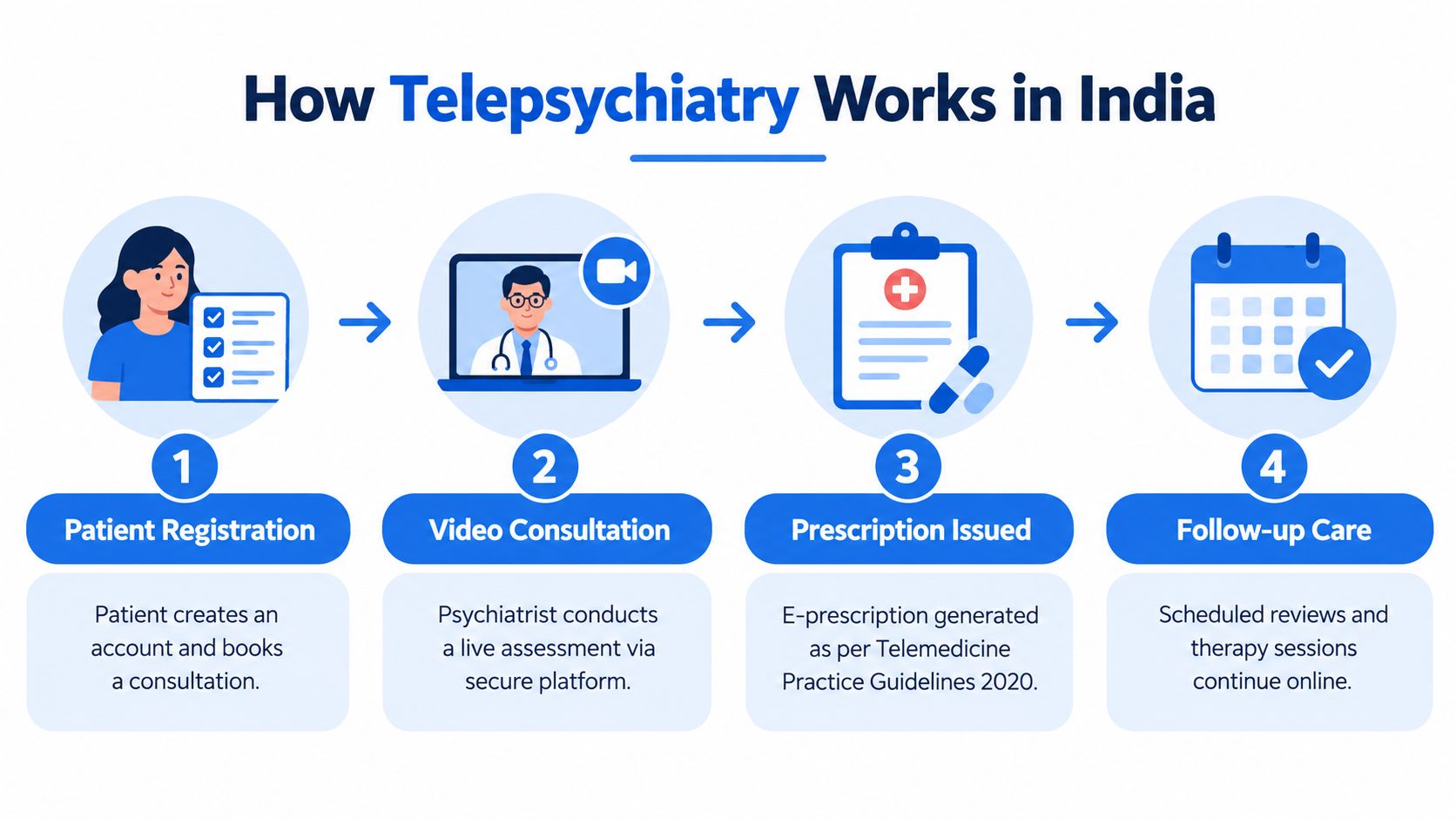
India formally made telemedicine consultations legally permissible on 25 March 2020, when the Ministry of Health and Family Welfare issued the Telemedicine Practice Guidelines. Those rules created the regulatory basis for online psychiatry consultation across the country. The framework was expanded in 2020 through the Indian Psychiatric Society, the Telemedicine Society of India, and NIMHANS, which released the Telepsychiatry Operational Guidelines-2020. The Indian Journal of Psychiatry explains India's telemedicine framework.
The process usually begins with registration, identity and consent procedures, and a booked appointment. A psychiatrist then speaks with you through an approved digital channel, gathers relevant medical and personal information, discusses safety, and decides whether remote care is suitable.
What the medicine categories mean
The operational guidelines created a prescribing structure with four medicine categories, known as Lists O, A, B, and C. The category affects whether and how a medicine may be prescribed through telemedicine. Patients don't need to memorise these lists, but they should understand that an online psychiatrist can't prescribe every medicine in every situation.
For first-time prescribing of List A medicines, the guidelines require a live video consultation. This requirement allows the psychiatrist to assess the patient directly before making a decision. A prescription, when clinically appropriate, must follow the applicable rules and include the required professional details.
Follow-up care has more flexibility. Under defined conditions, follow-up consultations may take place through audio, text, or video. Tele-follow-up means the patient is seeing the same clinician for the same condition within six months of a previous in-person visit, an important provision because it recognises ongoing psychiatric care rather than limiting telepsychiatry to emergencies.
What to expect from the appointment
Your psychiatrist may ask about mood, anxiety, sleep, concentration, appetite, relationships, work, past treatment, physical health, medicines, alcohol or substance use, and thoughts about safety. You can also ask how the proposed treatment works, what side effects to watch for, how follow-up will happen, and when an in-person review might be needed.
A stable internet connection and a private space support better communication. If you're learning how remote healthcare platforms work more broadly, TOOLii's guide to remote care offers useful context about digital consultation design and patient access.
Choosing Between Helplines and Private Care
Not every mental health need calls for the same doorway. A helpline can provide immediate listening, counselling, triage, and direction. A private online psychiatry platform may be more appropriate when you need a detailed assessment, a consistent clinician, medication management, or a planned course of therapy and follow-up.
India's Tele-MANAS programme was launched on 10 October 2022 as the national tele-mental-health service. It provides free, 24/7 access through 14416 and 1800-89-14416, with counselling, video consultations with specialists, e-prescriptions, follow-up services, and linkage to in-person care. The Directorate General of Health Services describes Tele-MANAS services and access.
Feature
National Helplines, e.g. Tele-MANAS
Private Online Psychiatry Platforms
Main purpose
Immediate support, counselling, triage, and escalation
Structured assessment, treatment planning, and continuity
Cost
Free through the national service
Fees vary by practitioner or platform
Clinician continuity
May depend on service pathways and availability
You can usually seek an ongoing relationship with a chosen clinician
Suitable for
Acute distress, uncertainty about where to start, and referral guidance
Chronic anxiety, depression, medication review, therapy, and planned follow-up
Care pathway
Can connect callers with specialists or local services
Can coordinate online reviews and recommend in-person care when needed
Choosing the right starting point
Call a helpline when you feel overwhelmed, need someone to speak with promptly, or aren't sure what kind of help is suitable. It can be especially useful when you need triage rather than a long-term treatment decision.
Book an online psychiatry consultation when symptoms have persisted, repeatedly interfere with daily life, or require monitoring. Ongoing depression, recurring anxiety, burnout, medication questions, and changes in sleep or functioning usually benefit from a planned relationship with a mental health professional.
If you may act on thoughts of self-harm, feel unable to stay safe, or face an immediate medical emergency, prioritise emergency services and nearby trusted people. An article, screening tool, or routine appointment isn't a substitute for urgent help.
Real World Benefits and Clinical Limits
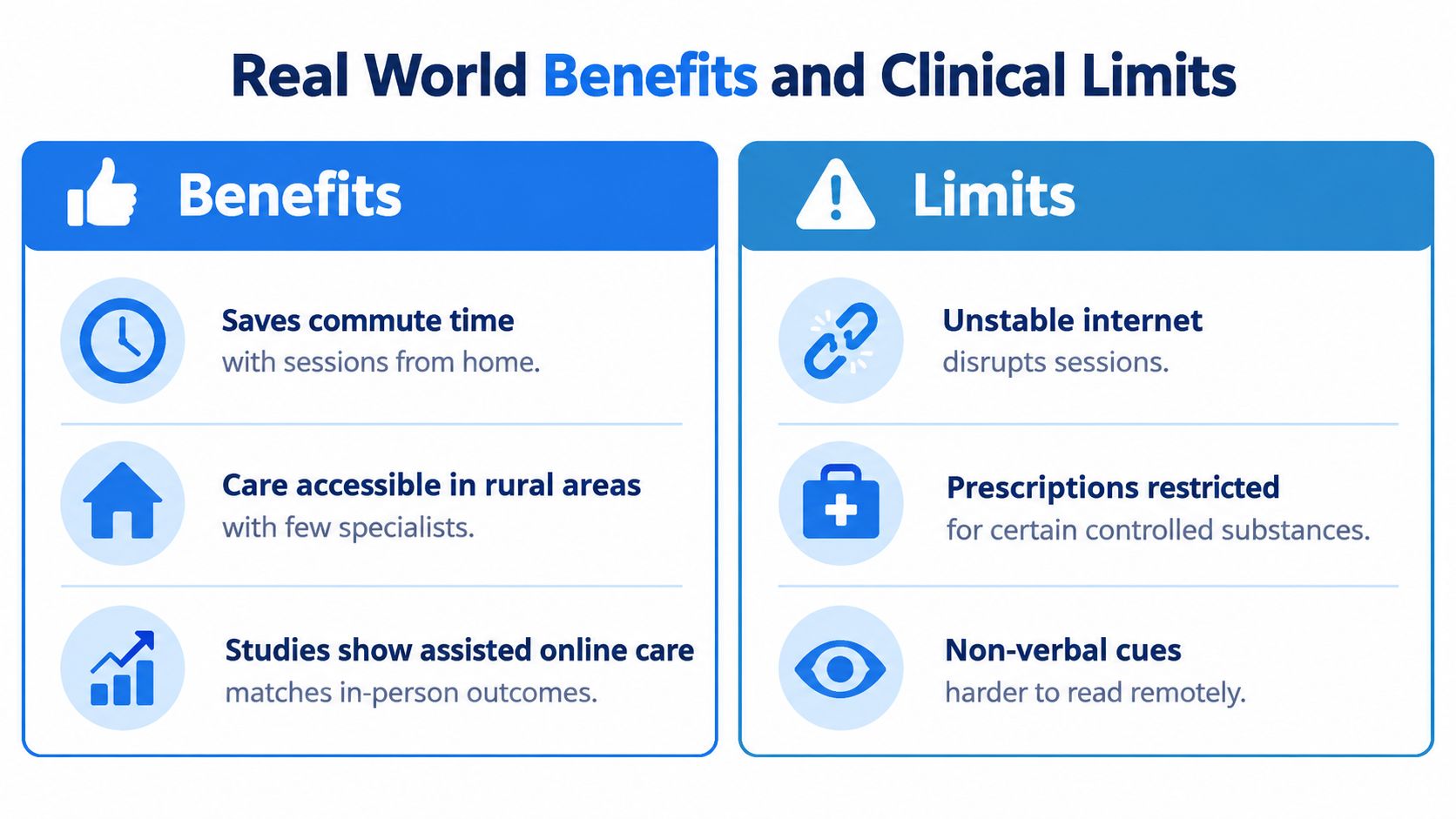
Remote care can produce clinical improvement, not just convenience. In a feasibility study from Goa, patients receiving assisted tele-consultations had statistically significant reductions in GHQ-12 and WHODAS 2.0 scores from baseline to follow-up, indicating lower psychological distress and disability. The Goa feasibility study examines assisted telepsychiatry in primary healthcare.
A separate India-based routine-care study reported that 81% of participants had a planned discharge, while psychological distress and disability also fell significantly during follow-up. In that study, 58 of 126 patients received psychiatrist-only tele-consultation, showing how remote psychiatric support can operate through both assisted and more direct models. The wider lesson is that remote care works best when the service matches the person's circumstances.
Where online care helps
A video appointment can remove travel demands and make it easier to fit care around work, study, parenting, or physical limitations. It may also connect people in rural areas with specialists who aren't available nearby.
Assisted telepsychiatry adds another layer of support. A local health worker or care coordinator can help with technology, medication routines, symptom observation, and follow-up. That local connection can be valuable when someone has limited digital confidence or needs help translating a treatment plan into daily habits.
Where it needs care
Some people communicate more comfortably in person. A 2022 survey of practising psychiatrists found that 67.06% still felt in-person consultation was better, even though telepsychiatry use had become widespread. The same survey reported smartphone use by 76.47% of respondents, audio consultations by 57.65%, and electronic prescription use by 73.4%. The Indian Journal of Psychiatry reports these findings on telepsychiatry practice in India.
Poor connectivity, lack of privacy, limited access to devices, and difficulty reading non-verbal cues can reduce the quality of a session. Older adults and people in rural areas may need practical assistance. A psychiatrist may also recommend in-person assessment when symptoms, medication risks, physical health concerns, or safety issues require it.
Making Telepsychiatry Stick Long Term
Booking the first appointment is only the beginning. Convenience may help someone start treatment, but it doesn't automatically create the trust, routine, privacy, and continuity needed for chronic conditions.
A 2025 mixed-methods study of 165 telepsychiatry patients in north India found a 56.4% dropout rate after physical outpatient departments reopened. Participants described brief sessions, changing doctors, privacy problems at home or work, technology barriers affecting older or rural users, and higher local pharmacy costs as reasons for leaving care. The study on telepsychiatry dropout in north India is available through PubMed.
Build continuity into the plan
Ask whether you can continue with the same psychiatrist for the same condition. Familiarity helps the clinician understand changes over time, while you won't need to retell your entire history at every appointment.
Discuss the follow-up rhythm before ending the first session. Put reviews in your calendar, clarify how prescriptions will be renewed, and ask what to do if you experience side effects, worsening symptoms, or a technology problem.
Practical rule: A treatment plan should include the next point of contact, not just the first appointment.
Privacy deserves equal attention. A bedroom may not be private if family members enter without warning, and a workplace may not be suitable if colleagues can overhear. Use headphones where appropriate, tell others that you need uninterrupted time, and consider a trusted local setting if home privacy isn't possible.
Here's a short video reminder of how to approach a remote consultation as a real healthcare appointment:
Make adherence realistic
If sessions feel too brief, tell the clinician what remains unresolved. If changing doctors has disrupted care, explain that continuity matters to you. If medicine costs or pharmacy access create problems, raise them directly so the clinician can consider safe, practical alternatives.
Track useful observations between appointments, such as sleep, mood, anxiety, energy, side effects, and important stressors. You don't need a perfect journal. A few honest notes can help both of you decide whether the plan is working and what needs adjustment.
Preparing for Your First Online Session
Preparation can reduce the nervousness that comes with speaking about personal experiences. You don't need to tell your story perfectly. You only need enough information for the psychiatrist to understand what has changed and how it affects your life.
Start with the practical details
Use a device with a charged battery, test the camera and microphone, and check that your connection is reliable. Keep a backup option, such as a phone connection, if your main device fails.
Choose a quiet, private place with enough light for the clinician to see you clearly. If you share your home, arrange a time when interruptions are less likely. Headphones may improve privacy, but use them only if they're comfortable and safe.
Prepare your health information
Write down when your main concerns began and whether they appear constantly or in patterns. Note changes in sleep, appetite, energy, concentration, work performance, relationships, and enjoyment.
Keep a list of current medicines, supplements, allergies, previous treatments, and relevant physical health conditions. Include anything you're unsure about. The psychiatrist can decide what matters clinically.
Prepare your questions
Bring questions about treatment options, therapy, counselling, medication, side effects, costs, privacy, follow-up, and referral. You can also ask whether an online psychiatry consultation remains suitable for your needs or whether an in-person assessment would offer greater safety.
During the appointment, answer as candidly as you can, including information about alcohol, substances, or thoughts of self-harm. These questions aren't moral judgements. They help the clinician make safer decisions.
Assessments you complete before or after the session can provide useful context, but they remain informational and not diagnostic. The psychiatrist's clinical assessment, your history, and ongoing observation guide care.
Building a Resilient and Meaningful Life
Online psychiatry is one part of mental health care, not a promise of instant recovery. It can help you access medical assessment, discuss medication when appropriate, connect with therapy or counselling, and create a follow-up plan that fits your life.
The larger aim is not only to reduce anxiety or depression. It's also to strengthen resilience, practise self-compassion, restore meaningful relationships, and make room for happiness and purpose. Positive psychology doesn't ask you to ignore pain. It helps you identify strengths and values that can support you while you address pain.
India's need for accessible care is substantial. The Global Burden of Disease estimates for 2017 recorded 197.3 million people living with mental disorders, including 45.7 million with depressive disorders and 44.9 million with anxiety disorders. Depression accounted for 33.8% of mental-disorder DALYs, while anxiety accounted for 19.0%. The ICMR report presents India's mental-disorder burden estimates.
Supportive takeaway: Asking for help isn't a failure of resilience. It's one way resilience grows.
You can begin with a helpline, a therapist, a counsellor, a psychiatrist, or an assessment that helps you organise your concerns. You can also combine online and in-person care when that provides better continuity. Move at a pace that respects your safety, and seek urgent assistance immediately if you may harm yourself or cannot remain safe.
DeTalks helps people explore confidential psychological assessments, connect with psychologists and therapists for online counselling, and receive psychiatric referral when appropriate. Visit DeTalks to find support for anxiety, depression, workplace stress, relationships, resilience, and broader well-being.
You're checking work messages at midnight, replaying a conversation from the day, or planning how to avoid tomorrow's meeting. You may still be functioning, yet your sleep, concentration, relationships, and sense of ease are becoming harder to protect. At some point, the question appears: does therapy help with anxiety, or should I try harder to manage it myself?
Therapy isn't a promise that worry will disappear forever. It's a structured way to understand anxiety, practise new responses, and rebuild well-being, confidence, and flexibility. Indian research is especially relevant because anxiety is common while access to care remains uneven. This guide looks at what therapy can do, which approaches may fit different problems, when medication or psychiatric care matters, and how to find appropriate support in India.
When Worry Starts to Run Your Day
Some worry is a normal response to uncertainty. You might feel tense before an interview, concerned about a family member, or alert during a demanding period at work. The concern usually settles when the situation changes or when you take a practical step.
Anxiety becomes more disruptive when it starts making decisions for you. You keep checking an email because you fear a mistake, cancel plans because leaving home feels overwhelming, or avoid speaking in a meeting because your mind predicts humiliation. The immediate relief from avoidance can reinforce the fear, making the next situation feel even harder.
The difference between concern and control
A useful question is not, “Am I anxious?” Almost everyone feels anxious at times. Ask instead, “What is anxiety stopping me from doing?”
Look at the pattern across ordinary parts of life:
Sleep: Your body is tired, but your mind keeps scanning for problems.
Work: You reread simple messages, postpone decisions, or remain available long after working hours.
Relationships: You seek repeated reassurance, withdraw, or become irritable because your internal alarm is constantly active.
Daily choices: You organise your life around avoiding places, sensations, people, or possibilities that feel threatening.
These patterns don't mean you're weak or incapable. Anxiety is a learned protective response that can become overactive. A counsellor helps you identify the cycle, understand what maintains it, and practise alternatives in a safe and organised way.
India has a substantial unmet need. The National Mental Health Survey evidence summarised by the National Academy of Medical Sciences reported that 10.6% of Indian adults had a mental disorder overall, with anxiety disorders among the common conditions. Later summaries of the same survey reported 3.6% prevalence for any anxiety disorder and treatment gaps of 70% to 92% for mental disorders generally. The same evidence notes that about 15% of India's adult population may require proactive help for stress- or anxiety-related problems.
A practical starting point: If anxiety is shrinking your choices, disturbing sleep, or keeping you from responsibilities and relationships, a professional conversation is reasonable even if you're still managing to function.
Therapy may be useful for generalised anxiety, panic, social anxiety, phobias, workplace stress, or anxiety connected with depression and trauma. The right assessment can also clarify whether counselling is enough or whether you'd benefit from a psychiatrist's review.
What the Evidence Says About Therapy for Anxiety
A student may understand that an exam is manageable, yet spend the night rehearsing every possible failure. An employee may keep meeting deadlines while anxiety drains concentration and sleep. These examples show why the useful question is not whether therapy works, but for whom, for which symptoms, and under what conditions.
The evidence supports therapy as a practical treatment for anxiety, while outcomes vary. The type of anxiety, treatment method, therapeutic relationship, practice between sessions, and need for medical care can all affect progress. Therapy may reduce symptoms and improve daily functioning, but it is not a guaranteed quick fix or a substitute for assessment.
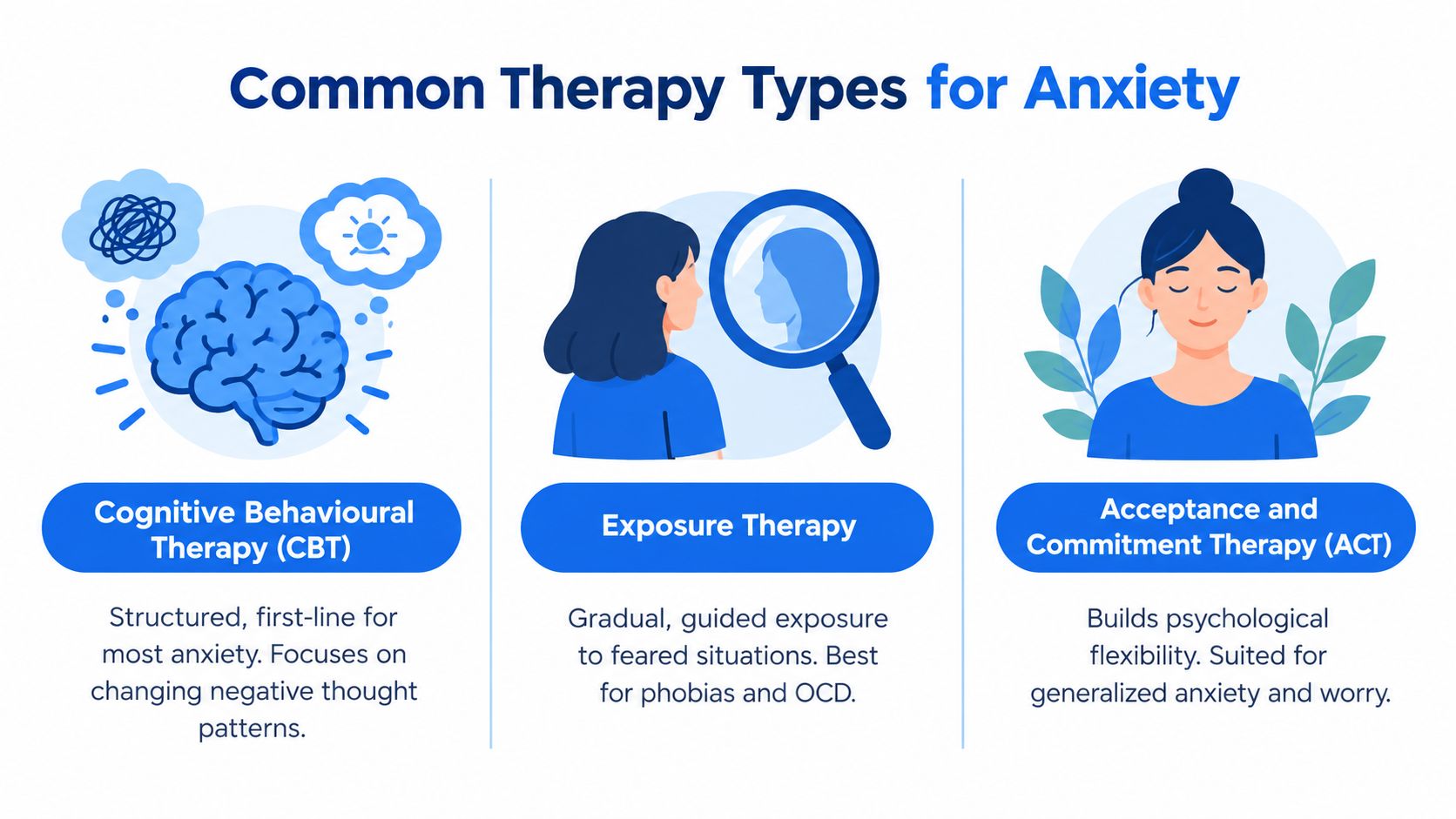
Cognitive Behavioural Therapy, or CBT, remains one of the most studied approaches. It helps people examine anxious predictions, reduce avoidance, and test new behaviours gradually. Someone with social anxiety might question the belief that every pause will be judged negatively, then practise a manageable conversation rather than avoiding it.
Indian research supports the use of psychotherapy in local settings. A systematic review in the Indian Journal of Psychiatry summarises an Indian trial by Manjula et al. (2014) involving 30 patients with panic disorder, divided into CBT and behaviour-therapy groups of 15 each. The review also describes Indian research comparing meditation with pharmacotherapy. In that setting, meditation was reported as effective as medication in controlling anxiety symptoms after five weeks.
Indian delivery models matter
Access can shape whether someone receives help. Therapy may begin through a university service, primary-care clinic, or guided online programme rather than a specialist hospital. A randomised controlled feasibility trial among Indian university students found that internet-delivered guided self-help based on CBT was feasible and efficacious for students with clinical or subthreshold generalised anxiety disorder. Compared with a waitlist, the intervention produced greater reductions in GAD symptoms, worry, and depressive symptoms, with reported effect sizes around d = -0.40 to -0.53 in the Indian trial report.
For a student living far from specialist services, guided online therapy can reduce travel and scheduling barriers. The guidance remains important. A therapist or trained supporter can clarify exercises, notice worsening symptoms, and help decide when a higher level of care is needed. Fully automated self-help may not offer the same support.
A Goan primary-care trial tested a collaborative stepped-care model led by lay health counsellors. In the MANAS trial findings, 65.0% of people receiving the intervention had recovered at six months, compared with 52.9% receiving usual care, a difference of 12.1 percentage points. The model shows how structured counselling can be included in routine care, rather than being limited to people who can reach a psychiatrist.
Workplace data also show why accessible support matters. A study of 1,764 Indian white-collar employees found 55% showed moderate-to-severe signs of anxiety, while 78% showed moderate-to-high stress, as reported in the Indian Journal of Psychiatry. These findings describe a group-level pattern, not a diagnosis for every employee, but they underline the value of earlier assessment and practical support at work.
Together, these studies support a measured conclusion. Therapy can meaningfully reduce anxiety, but the suitable format depends on the person and the setting. Someone with mild, recent worry may benefit from structured skills and support. Persistent panic, trauma symptoms, depression, or major disruption to work and relationships may call for coordinated psychological and psychiatric care.
Common Therapy Types and How They Work
Anxiety can keep a worry, physical sensation, or feared situation in a repeating loop. Different therapies work on different parts of that loop. A therapist considers your symptoms, goals, history, preferences, and readiness before recommending an approach.
CBT and exposure-based work
CBT is structured and practical. If you think, “I'll definitely fail,” therapy helps you examine the evidence and develop a more balanced response. You then practise responding differently in daily life. That may involve reducing avoidance, repeated checking, reassurance-seeking, or escape.
Exposure therapy is often used for phobias, panic-related avoidance, social anxiety, and some obsessive-compulsive symptoms. You and the therapist create a gradual plan for approaching feared situations while reducing reliance on safety behaviours. The process should be collaborative and paced. It does not mean being pushed into the most frightening situation at once.
For a student avoiding presentations, this might begin with speaking briefly to one trusted person, then progress towards a small group. The aim is to learn through experience that anxiety can rise and fall without controlling every decision.
ACT, DBT, and mindfulness
Acceptance and Commitment Therapy, or ACT, takes a different route. Rather than debating every anxious thought, it teaches you to notice thoughts and feelings without letting them dictate each action. You practise moving towards values such as family connection, learning, health, or meaningful work, even when discomfort is present.
Dialectical Behaviour Therapy, or DBT, can help when anxiety occurs alongside intense emotional reactions, impulsive coping, self-harm risk, or difficulty returning to balance after distress. It develops skills in emotional regulation, distress tolerance, mindfulness, and relationships.
Mindfulness-based therapy trains attention so that a worry is noticed without being followed automatically. Indian research has examined meditation-based approaches and anxiety symptoms, as summarised in this psychotherapy review. The practice may suit some people, while others need a more active, structured method.
Longer-term approaches
Psychodynamic and interpersonal therapies explore how relationships, loss, early experiences, conflict, or repeated patterns may shape present anxiety. They may fit someone whose worry is closely tied to attachment, shame, family roles, grief, or difficulty expressing needs.
The strongest option is usually the approach that fits the problem and that you can practise consistently. A well-supported method can still be a poor personal fit if the therapist does not explain it clearly or listen to your priorities.
What a Typical Course of Therapy Looks Like
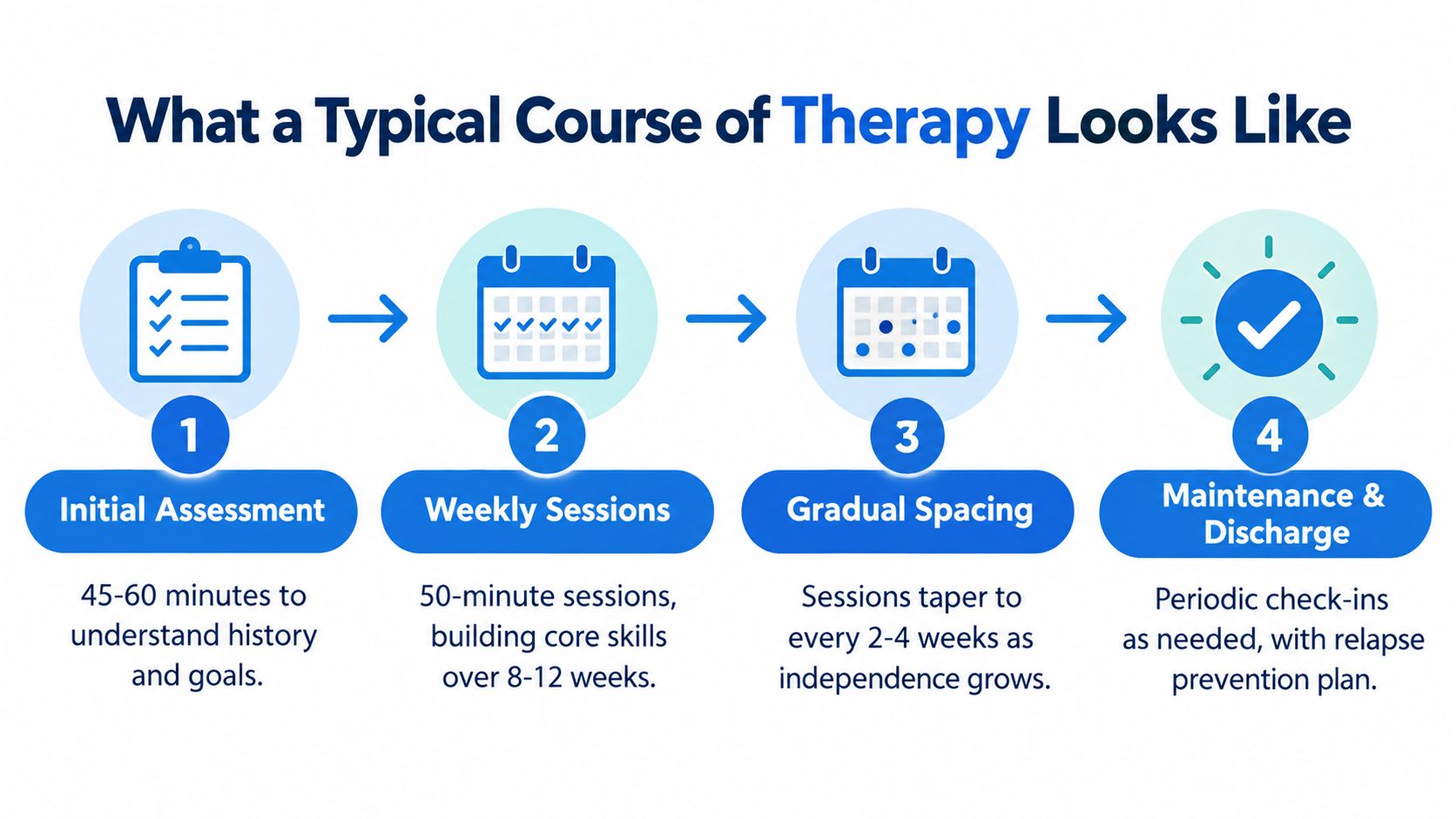
A first appointment usually focuses on understanding what brings you in, how anxiety affects your life, relevant health and relationship history, and what you want to change. Sessions may last around 45 to 60 minutes, although the exact format depends on the clinician and service.
A therapist might ask how often panic occurs, what situations you avoid, how sleep has changed, and whether depression, trauma, substance use, or physical health concerns are also present. This is an assessment, not a final judgement about your identity or worth.
How the work develops
Weekly sessions often last about 50 minutes. Many CBT protocols for generalised anxiety run across 12 to 20 sessions over three to six months, while focused work for a specific phobia may be shorter, often four to eight sessions. These figures are planning guides, not rules.
The work commonly develops in stages:
Early sessions: You learn how anxiety operates, define goals, and identify triggers, thoughts, body sensations, and avoidance.
Middle sessions: You practise skills such as cognitive restructuring, breathing regulation, attention training, behavioural experiments, or gradual exposure.
Later sessions: You apply those tools to real situations, including difficult conversations, travel, presentations, health worries, or workplace stress.
Ending phase: You review progress, anticipate setbacks, and create a relapse-prevention plan.
Between-session practice often makes the difference between understanding an idea and being able to use it under pressure. A person who wants to speak in meetings might rehearse a short contribution, record what they predicted would happen, and compare that prediction with the actual outcome.
Progress rarely moves in a straight line. One week may feel flat, while a later week brings several changes after repeated practice. Track more than symptom scores. Notice whether you're checking less, sleeping more consistently, accepting invitations, completing tasks, or recovering faster after an anxious moment.
This short video on anxiety therapy can help you recognise common treatment principles.
Therapy usually ends when your goals have been met and you can use the skills independently, not because a fixed number of appointments has passed. Some people benefit from occasional maintenance sessions, while others return when a new life stage creates fresh pressure.
Combining Therapy with Medication and Self-Help
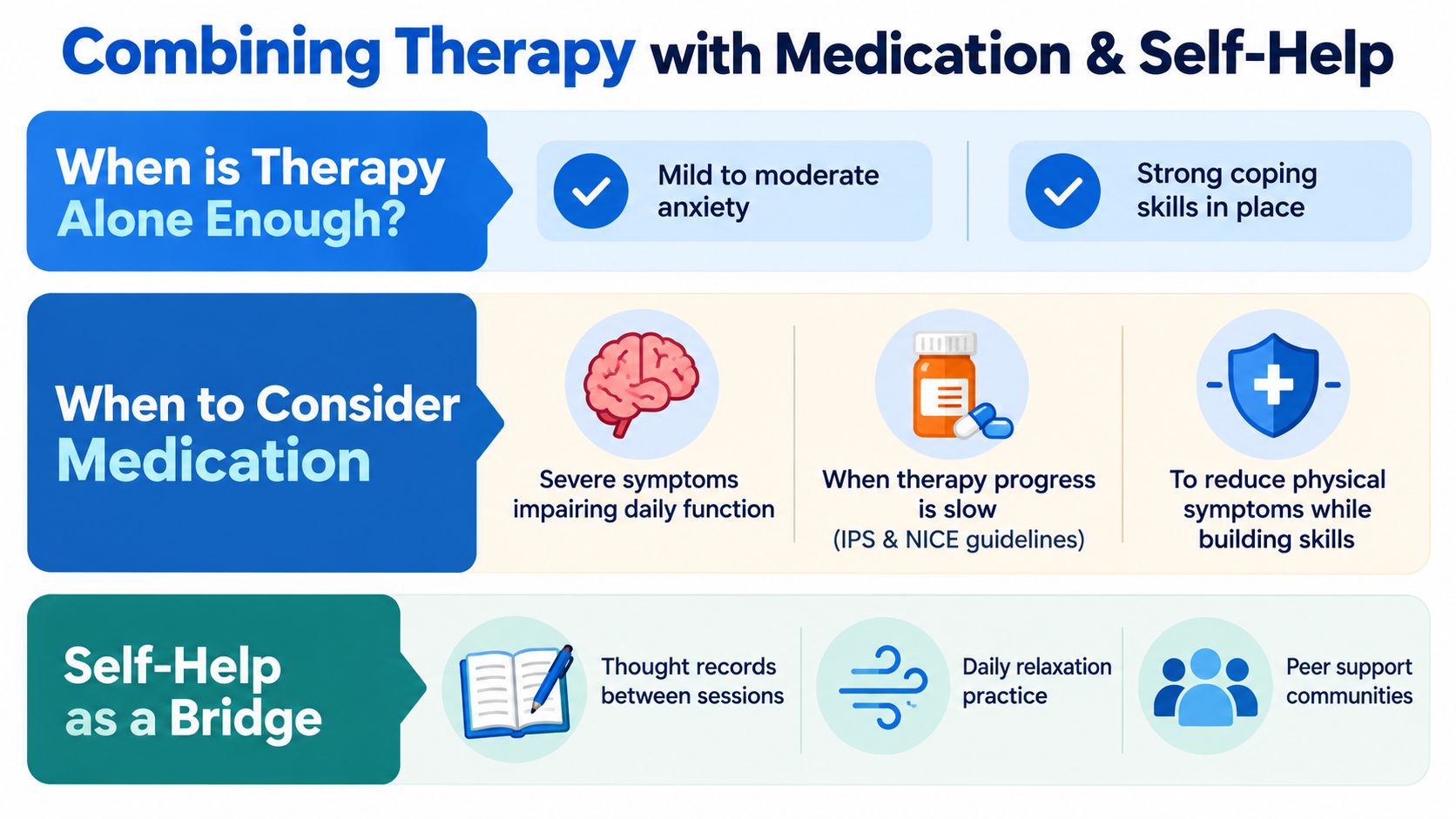
Therapy and medication aren't competing choices. For mild to moderate anxiety, counselling may provide enough support, particularly when you can sleep, work, and maintain relationships while learning new skills. Medication becomes more relevant when symptoms are severe, persistent, physically exhausting, or preventing you from engaging with therapy.
Indian Psychiatry Society guidance and NICE guidance commonly place SSRIs and SNRIs among first-line medication options for moderate-to-severe generalised anxiety, panic disorder, and social anxiety. A psychiatrist should assess whether medication is appropriate, explain likely benefits and side effects, and review your response. Don't start, stop, or change psychiatric medication without medical advice.
Medication may reduce the intensity of symptoms such as racing thoughts, physical agitation, or sleep disruption. It doesn't teach you how to respond to anxious predictions, set boundaries, reduce avoidance, or handle future setbacks, which is why therapy remains valuable even when medication helps.
Small actions that support the main treatment
Self-help works best as a bridge rather than a replacement for care when anxiety is significantly impairing. Discuss practical experiments with your therapist and choose actions you can repeat:
Protect sleep: Keep a steady routine and write down late-night worries for discussion during the day instead of solving every problem in bed.
Move regularly: Gentle or aerobic exercise can support mood and stress regulation when it fits your health and circumstances.
Review caffeine: Notice whether tea, coffee, energy drinks, or pre-workout products intensify physical anxiety.
Practise between sessions: Use breathing drills, thought records, or grounding exercises when calm, so they're more familiar during distress.
Build connection: Trusted friends, family, peer groups, and community support can reduce isolation.
If you're curious about digital tools, you can compare AI meditation tools as supplementary resources. Use them for guided practice, not as a substitute for a clinical assessment or therapist-supported care.
A psychiatry referral matters when panic is severe, trauma symptoms are prominent, suicidal thoughts are present, functioning has sharply declined, or there's no meaningful response after six to eight therapy sessions. Severe or treatment-resistant anxiety may require a stepped-care plan and a careful review of diagnosis, medication, physical health, and therapy fit.
How to Choose the Right Therapist in India
A therapist's profile may look reassuring, but training and professional accountability matter more. For assessment and treatment, look for an RCI-registered clinical psychologist, a qualified counsellor with relevant training and certification, or a psychiatrist when medication review may be part of care. Be careful with unregistered “life coaches” or practitioners who promise a guaranteed cure, discourage medical support, or cannot clearly describe their qualifications.
Match the approach to the difficulty
Ask how the therapist usually treats your concern. CBT and behavioural methods can help with generalised anxiety, panic, social anxiety, and phobias. ACT may be useful when chronic worry keeps you from acting on your values. Anxiety connected to trauma calls for a clinician trained in trauma-focused methods, such as EMDR. Psychodynamic therapy may suit anxiety linked to long-standing relationship patterns or earlier experiences.
The format also needs to fit your circumstances. In-person sessions are not automatically better than online counselling. Indian research on internet-delivered CBT supports guided online treatment for university students. This option may suit students living away from home, people in tier-two or tier-three cities, or anyone who needs more flexibility with language, travel, or scheduling.
Use a practical shortlist
Before booking, check:
Language: Can you speak comfortably in Hindi, English, Tamil, or another language that makes private experiences easier to describe?
Specialisation: Does the therapist regularly work with anxiety, panic, depression, burnout, workplace stress, or trauma?
Format: Would video, audio, chat-supported work, or clinic visits feel most workable?
Practical fit: Can you attend at the available time and pay the fee consistently?
First-session comfort: Do you feel heard, respected, and free to ask questions?
Fees vary by professional, city, training, and format. Confirm the current fee directly before booking. DeTalks lets people browse mental-health professionals, review specialisation and language information, explore assessments, and check booking options.
A suitable therapist does not need to agree with every interpretation you have. They should explain the treatment plan, invite your questions, respect your decisions, and discuss confidentiality clearly. Warning signs include pressure to disclose more than you are ready to share, blame, guaranteed-results claims, unexplained confidentiality limits, or advice to stop prescribed medication without consulting the prescriber. A good fit is someone whose training, method, communication style, and practical arrangements allow you to participate steadily in treatment.
Practical Questions Readers Often Ask
A first-time caller often asks, “Will I have to talk about everything immediately?” No. You can begin with what is happening now, such as panic before work, poor sleep, constant checking, or avoiding social plans. A good therapist will help you decide what to explore and at what pace.
Someone returning after a gap may worry that needing therapy again means they failed. It doesn't. Anxiety can return during grief, illness, relationship change, exams, financial pressure, or workplace stress. A return to counselling can be a chance to refresh skills, identify a new trigger, and respond earlier than before.
Parents sometimes notice a teenager withdrawing, refusing school activities, losing sleep, or repeatedly seeking reassurance. Start with a calm conversation and arrange an appropriate professional assessment. Remember that a screening result or online assessment is informational, not diagnostic. It can help organise concerns, but only a qualified professional can evaluate symptoms in context.
What improvement can look like
Progress isn't always feeling cheerful. It may look like fewer panic episodes, more settled sleep, less avoidance, a quicker recovery after a difficult message, or the ability to attend an event while feeling nervous. It may also include greater self-compassion, clearer boundaries, more resilience, and renewed interest in relationships or meaningful activities.
A rough week doesn't automatically mean treatment has stopped working. Contact your therapist when symptoms are escalating, daily functioning is deteriorating, you're using substances or unsafe behaviours to cope, or the tools no longer feel adequate. Seek urgent local help if you're at immediate risk of harming yourself or someone else.
Some people fear relapse after therapy ends. The aim isn't to create a life without difficult emotions. It's to help you recognise early warning signs, respond with practiced skills, ask for support sooner, and keep anxiety from directing every decision.
Silence can be an important signal. If you've stopped replying to people, cancelled plans repeatedly, or keep telling yourself you'll seek help “after one more difficult week”, consider booking an initial conversation. Therapy, counselling, positive psychology, compassion, and practical self-help can work together to support a steadier form of well-being.
If anxiety is affecting your sleep, work, relationships, or confidence, use DeTalks to browse mental-health professionals and explore support options suited to your concerns. You can also use its informational assessments to organise your thoughts before contacting a therapist, while remembering that an assessment is not a diagnosis.
You're trying to function normally, but anxiety keeps interrupting your day. Perhaps workplace stress follows you home, burnout has reduced your energy, a relationship feels difficult, or low mood has made simple decisions feel heavy. You know counselling could help, yet choosing a therapist in India can feel confusing.
This guide compares seven counselling options by clinical focus, inclusivity, delivery format, access, fee information, and likely user fit. It doesn't claim there's one universal winner. The best counselling psychologist for you is the professional whose training, approach, availability, and communication match your needs.
Therapy and counselling can support well-being, resilience, compassion, happiness, and practical emotional skills. Positive psychology can also help you build strengths rather than focus only on distress. Any assessment you complete is informational, not diagnostic. A questionnaire may suggest that further support is worth exploring, but diagnosis requires clinical assessment, as NICE guidance on psychological questionnaires explains. For therapist education context, see this psychologist curriculum overview. You can also use DeTalks to compare psychologists and book support. If you're in immediate danger or facing an urgent safety concern, contact appropriate emergency or professional help without waiting for an online appointment.
1. Dr. Prerna Kohli & Associates
Dr. Prerna Kohli & Associates is a strong choice for people seeking established clinical psychology leadership in Gurugram and the wider Delhi NCR region. The practice offers both in-person and online therapy, making it useful for local clients who prefer a clinic as well as people who need remote counselling.
Dr. Prerna Kohli is presented as an RCI-registered clinical psychologist with more than three decades of practice. The wider team supports individual counselling, couples and marital counselling, child and adolescent concerns, family work, anxiety, depression, relationship difficulties, and psychological assessments.
Best fit and trade-offs
Choose this practice if senior clinical experience, marriage counselling, or access to more than one therapist matters to you. A multi-therapist setting can make it easier to find a better personal fit when the first professional isn't quite right.
The main limitation is fee transparency. Session charges aren't clearly listed online, so you'll need to enquire before booking. In-person care is also concentrated in the NCR, while online therapy offers broader access.
Practical rule: Ask which clinician is the best match for your concern, what qualifications they hold, whether sessions are online or in person, and what the total fee will be before you commit.
The practice's educational blog and FAQs can help first-time clients understand the difference between therapy and psychiatry and prepare for an initial conversation. It's a practical starting point for families, couples, adolescents, and adults who want a recognised private practice rather than an anonymous marketplace listing.
2. Inner Space Counselling
Inner Space Counselling stands out for clear therapist information and a mindfulness-informed approach. Based in Mumbai, the centre provides in-person care as well as online therapy across India, so clients can choose the format that feels safer and more practical.
Therapist bios explain experience levels and therapeutic modalities, while the structured intake process helps narrow the search. This is valuable if you don't want to choose solely from a photograph, a short slogan, or a generic list of specialities.
Best fit and trade-offs
Inner Space is a good fit for clients who want mindfulness integrated into counselling without treating it as a substitute for professional care. Mindfulness can support awareness of thoughts, emotions, and bodily responses, while therapy addresses the patterns and concerns that bring you to treatment.
The centre publishes therapist fee tiers, including an example of ₹2,848 plus GST per session for experienced therapists, as shown on its website. Confirm the current amount before booking because fees and availability can change.
Choose for transparency: Therapist bios, modalities, and fee tiers help you compare options.
Choose for mindfulness: The approach can suit people interested in attention, self-compassion, and emotional regulation.
Plan for availability: Experienced therapists' peak-hour appointments may fill quickly.
Higher-tier sessions may be difficult for some budgets, particularly when counselling is likely to continue over time. Ask whether another therapist with a suitable approach is available, and discuss frequency before starting. The right choice should support your well-being without creating additional financial strain.
3. The Alternative Story
The Alternative Story is the clearest choice on this list for people actively seeking intersectional, queer-affirmative, trauma-informed care. The organisation has a presence in Bengaluru and Mumbai and provides online services across India.
Its work includes individual therapy, couples and family counselling, support groups, corporate programmes, and workshops. That range can be useful when your needs involve identity, relationships, community, trauma, workplace stress, or a desire to learn alongside others.
Best fit and trade-offs
The organisation offers a free 15-minute “Step 0” therapist-matching call, which gives prospective clients a way to discuss fit before making a larger commitment. This matters when you're unsure whether a therapist understands your cultural context, identity, relationship structure, or trauma history.
The practice follows an affordable-care philosophy and may offer low-cost or trainee-led options when available. Exact per-session fees aren't publicly listed, however, so you'll need to enquire and ask what options currently exist.
Inclusive therapy should leave room for your identity, language, relationships, and lived experience, not ask you to explain why they matter.
The main trade-off is availability. Reduced-fee places depend on capacity, and the therapist you prefer may not have an immediate opening. Still, the matching process makes this a particularly useful option for clients who want culturally sensitive counselling rather than a one-size-fits-all model.
4. Amaha, formerly InnerHour
Amaha works well for people who want integrated mental-health care in one ecosystem. Its services combine online therapy, psychiatry, group programmes, digital tools, and physical centres in Delhi, Mumbai, and Bengaluru.
This model can be helpful when you're unsure whether counselling alone is enough. A psychologist may support emotional and behavioural change, while psychiatric care can address situations where medication assessment or medical oversight is appropriate. The platform also offers specialty pathways, including structured adult ADHD services.
Best fit and trade-offs
Amaha is a practical fit for clients who want therapy, psychiatry, group support, and app-based tools without coordinating every service independently. Its larger multidisciplinary network can also help when concerns overlap, such as anxiety and sleep problems, depression and workplace stress, or attention difficulties and low motivation.
The platform describes a network of more than 200 experts on its website. Fees can require contacting support, and session costs vary by clinician, so confirm the price and cancellation terms before booking.
Choose integrated care: Useful when therapy and psychiatric support may need to work together.
Choose digital support: App-based tools can complement, but shouldn't replace, counselling.
Check individual fit: A large network means your experience depends heavily on the clinician you select.
Amaha's breadth is its advantage, but it can also make the choice feel less personal. Read the profile carefully, identify your primary concern, and ask how the clinician's experience relates to it. If you're looking for a single counselling psychologist for a focused concern, a smaller practice may feel more direct.
5. Mpower, Aditya Birla Education Trust
Mpower suits clients seeking multidisciplinary, clinic-based mental-health care with online access across India. Its services cover individual, couples, and family psychotherapy, child and adolescent support, psychological assessments, psychiatry, and structured skills programmes.
Group options include DBT skills programmes, which teach practical methods for managing emotions, tolerating distress, improving relationships, and responding more deliberately under pressure. They can complement individual therapy, though group work does not provide the same privacy or personalisation.
Best fit and trade-offs
Mpower fits families, adolescents, and adults who want coordinated clinical services rather than one independent practitioner. Its helplines, outreach, education initiatives, and corporate programmes also suit employers and institutions seeking mental-health support.
Fees are not transparently listed online and may vary by city or clinician. Contact the nearest centre to confirm current charges, schedules, assessment details, and whether a group is accepting participants.
Before booking an assessment: Ask what question it is designed to explore, who will interpret it, and what follow-up support is available.
An assessment can provide useful information without establishing a diagnosis. A workplace mental health survey report by the White Swan Foundation explains that screening questionnaires can indicate whether further evaluation may be needed, while a qualified professional must consider your history, functioning, context, and current concerns. NICE's explanation of screening tools and clinical assessment is not the source for that distinction, so ask Mpower what its assessment includes and how results will guide care.
Choose individual therapy first if privacy, flexible scheduling, or highly personalised support matters most. Group care may be valuable, but it should match your comfort, goals, and availability.
6. Mind Piper
Mind Piper is a strong value-oriented option for students and young professionals who need accessible counselling in Delhi or online across India. The practice offers face-to-face, phone, and video sessions, giving clients more control over how they receive therapy.
Its approach is contextualised and evidence-based, with attention to practical access. Published clinic hours and contact information make the first step less complicated, especially when anxiety or burnout has already reduced your decision-making energy.
Best fit and trade-offs
Mind Piper publishes an indicative example of ₹1,800 for a 60-minute counselling session on its website. Treat that as a reference point, not a guaranteed current quote. Ask about the clinician's present fee, reduced-fee availability, session length, and whether the same rate applies to phone and video appointments.
Choose for access: Multiple delivery formats can help when travel, privacy, or location is a concern.
Choose for budgeting: An indicative published rate makes early planning easier.
Confirm availability: Preferred therapists and appointment times can differ by centre.
This option may suit someone managing workplace stress, exam pressure, relationship strain, anxiety, or low mood who wants professional support without starting with a highly specialised clinic. It's also useful when you're testing whether regular counselling can fit into your routine.
The main limitation is that reduced-fee places and therapist availability can change. Don't judge fit only by price. Ask how the therapist works, what concerns they commonly support, and what happens if you need a different level of care.
7. Anna Chandy & Associates
Anna Chandy & Associates appeals to clients who place a high value on supervision, ethical practice, and therapist development. Based in Bengaluru with online services across India, the practice provides individual and couples counselling.
Its supervision-rich culture is a central differentiator. Team members receive ongoing supervision, and the practice requires them to undergo therapy themselves. For a client, this signals an organisation that takes reflective practice and professional development seriously.
Best fit and trade-offs
Choose this practice if you want counselling supported by a strong quality culture rather than a quick algorithmic match. The team includes counsellors at different experience levels, which may give you more choice around budget, style, and availability.
The practice is particularly relevant for couples who want structured support for communication, conflict, or relationship decisions. It may also suit individuals who want a thoughtful therapeutic relationship and care grounded in professional boundaries.
Fees aren't published publicly, so enquire before scheduling. Senior counsellors may have limited availability, and online access doesn't guarantee an immediate appointment with the person you prefer.
Ask directly: Who supervises the therapist, how often supervision takes place, and what happens if your needs fall outside the therapist's scope.
That question isn't meant to challenge a clinician. It helps you understand how the practice protects quality and manages referrals. A responsible therapist should be able to explain their training, relevant experience, confidentiality arrangements, and next steps in clear language.
Strong supervision culture; emphasis on therapist development and ethics
Choose Support That Fits Your Real Life
Start with the concern that feels most urgent. You might be looking for help with anxiety, depression, workplace stress, burnout, relationship conflict, trauma, low motivation, or family strain. You might also want support for positive goals such as compassion, happiness, confidence, resilience, or a stronger sense of purpose. Naming the main reason for seeking help makes therapist matching more useful.
Then verify the basics. Check the professional's qualifications, registration where relevant, supervised practice, experience with your concern, and scope of care. India's mental-health need is substantial. The National Mental Health Survey reported that about 10.6% of Indian adults had a diagnosable mental disorder at a given time, while 15% needed active intervention and lifetime prevalence was 13.7%, according to the Press Information Bureau summary of the National Mental Health Survey. That scale makes qualified access and appropriate matching more important than online visibility alone.
Practical questions matter just as much as credentials. Confirm whether sessions are online or in person, ask about fees and any insurance or reimbursement that may apply, and discuss confidentiality, cancellations, rescheduling, and communication between sessions. If you're seeking couples or family counselling, ask whether everyone will be included in the format you need.
Reviews can help you notice patterns in communication and scheduling, but they aren't proof of clinical outcomes. Reassess the fit after an initial conversation. You should be able to discuss your concerns without feeling judged, understand the proposed approach, and know what will happen next.
Psychological assessments are informational, not diagnostic. Depending on your needs, support may include therapy, counselling, psychiatry, coaching, self-help, or a combination guided by qualified professionals. India's workforce shortage makes verification especially important, as discussed in BMJ's reporting on clinical psychology capacity, while satisfaction research highlights the value of easy booking, reliable audio and video, clinician attentiveness, and time spent listening in telepsychiatry services, as reported in this Indian patient satisfaction survey.
You don't need to wait until anxiety, depression, workplace stress, or burnout becomes overwhelming. You can seek counselling while also building resilience, compassion, happiness, and broader well-being. Take one practical step, compare suitable professionals, and choose support that fits your real life.
DeTalks helps you compare psychologists, therapists, and other mental-health professionals, explore confidential assessments, and book sessions suited to concerns such as anxiety, depression, workplace stress, relationships, and personal growth. Visit DeTalks to review counselling options and take a practical next step toward therapy and well-being.
You've had a long week, and at the end of it you type the same thing into your phone, mental therapy near me. Maybe you're dealing with anxiety that won't settle, workplace stress that follows you home, a rough patch in a relationship, or just a heavy, stuck feeling you can't quite name.
That search is more common than people admit. In India, the lifetime prevalence of mental morbidity was 13.7%, the current prevalence was 10.6%, and nearly 150 million people needed active mental health interventions, while treatment gaps were huge, reaching about 83% for common mental disorders and 88% for severe mental disorders (National Mental Health Survey figures summarised here). So if your search feels messy, slow, or overwhelming, that's not a personal failure. It's what happens when need is widespread and access is uneven.
Why Looking for Mental Therapy Near Me Feels So Hard
A lot of people start their search at midnight, tired, frustrated, and hoping the answer will be obvious. It usually isn't. You scroll through names, ratings, clinic listings, and platform profiles, and still can't tell who understands depression, anxiety, or the burnout sitting in your chest.
The deeper problem is simple. India doesn't have enough mental health capacity relative to need, and the workforce is thin. Policy discussions drawing on the WHO Mental Health Atlas cite about 0.75 psychiatrists per 100,000 people in India, and the National Mental Health Programme has been trying to expand district-level services since 1982 (workforce context).
Practical rule: If the first search feels confusing, don't treat that as a sign to give up. Treat it as a sign to search more deliberately.
The reason “near me” feels hard is that proximity doesn't guarantee fit, speed, or continuity. A therapist may be close by, but fully booked, outside your budget, or not right for your concern. In India, the treatment gap is so large that many people aren't choosing between five great options, they're trying to find one workable option that won't fall apart after the first call.
Three Practical Ways to Search for a Therapist
Start with local routes
A local search still matters. Check hospital psychology departments, trusted directories, community mental health programmes, and referrals from people you trust. If you're in a city, this often gives you the fastest path to someone you can see in person.
Think of a 28-year-old in Bengaluru with anxiety. A local directory search can help them find an in-city therapist, but it should also include hospital-based options, because those often have clearer processes and broader support systems.
Use telehealth without treating it as second best
Online counselling widens the search instantly. It turns “near me” into “available in my language, in my time zone, and at a slot I can keep after work.” That matters for working professionals, parents, and students who can't keep driving across the city for every session.
A college student in a Tier-2 town may not need the nearest therapist on paper, they may need a counsellor who offers evening slots and speaks their mother tongue well. That's a real fit, not a compromise.
Ask for a referral before you spiral into endless tabs
Primary care doctors, college counselling cells, HR teams, and helplines can save you weeks. They're especially useful when you don't know whether you need counselling, psychotherapy, or psychiatric care.
A new parent dealing with postpartum stress may not need to build the search from scratch. A referral route can get them to the right level of support faster.
Use the search like a funnel. Start broad, then narrow by language, timing, and care type. Don't try to pick the perfect name on the first pass.
Matching Therapists to Your Specific Concern
The right therapist for workplace stress isn't always the right therapist for panic, grief, or family conflict. Two people in the same city can need completely different kinds of help, even if they both typed the same search phrase.
If your issue is anxiety, look for someone who works with worry, panic, and overthinking. If it's depression, you want a therapist who is comfortable with low mood, loss of energy, and day-to-day functioning. If you're dealing with relationship or marital strain, you'll usually want someone who works with couples or family dynamics rather than only individual stress.
Match the method to the problem
Plain-language matters here. CBT is often used for structured thought-and-behaviour work. Person-centred counselling gives more room to talk and feel heard. EMDR is commonly used in trauma-focused work, so it makes more sense when the concern is trauma or distress tied to past events.
Language matters too. A therapist can have strong credentials and still be a poor fit if you can't speak freely. If you're more comfortable in Hindi, Tamil, Bengali, Marathi, Malayalam, or another mother tongue, that's not a small preference. It affects how honest you can be.
Ask yourself these questions before booking
What am I bringing in? Is it anxiety, burnout, grief, exam pressure, parenting stress, or something broader like wanting more resilience and self-esteem?
Do I want structured guidance or space to talk? Some people want tools. Others want reflection first.
Will I speak more openly in a certain language? Choose the option that makes honesty easier.
Do I need in-person support, online sessions, or either? Availability shapes follow-through.
Good matching beats a random nearby name. The goal isn't just to find someone close. It's to find someone whose way of working fits your concern.
Checking Credentials Without Feeling Awkward
It's normal to feel shy about asking a therapist about training. Ask anyway. You're not being rude, you're checking whether the person is properly qualified to hold your trust.
Look for recognised training such as an MPhil in Clinical Psychology, a Master's in Counselling, or other formal mental health education. Registration, supervised experience, and ongoing training also matter, especially when you're deciding who should help with something as personal as counselling or therapy.
What to ask on a first call
Keep it plain. Ask what they're trained in, what kinds of concerns they usually work with, and how they handle confidentiality. If their answer feels evasive, vague, or salesy, trust that feeling.
A few red flags are hard to ignore. Promises of a guaranteed cure, pressure to keep booking even when the fit feels wrong, or casual treatment of confidentiality are all signs to step back. Good therapists don't need to push you. They explain, listen, and let you decide.
Online platforms often use “verified” badges, but those badges usually cover specific platform checks, not everything you might want to know. Use them as a starting point, not as the final word.
Understanding Costs, Insurance, and Affordable Options
Money is the part many people avoid talking about, and that silence makes the search harder. In India, cost is often the deciding factor after the first few search results. If you're worried about the price, ask upfront. That's normal.
The fee you're quoted may reflect session length, the therapist's seniority, follow-up notes, or brief check-ins between appointments. A hospital psychologist, a private practitioner, and an online platform may all price things differently, so comparing them as if they were the same service doesn't help.
If you want a fuller sense of how platforms describe session fees, the fee explainer from reVIBE Mental Health therapist fees is a useful place to read the language people use around cost, without assuming every provider works the same way.
Typical mental therapy cost options in India
Option
Relative Cost
Best For
Hospital psychologist
Usually lower
People who want structured care and can work within a hospital system
Private therapist
Usually higher
People who want more choice in specialist fit and scheduling
Online counselling platform
Varies
People who need convenience, language choice, or remote access
College counselling cell
Usually free
Students who need an easy first step
Employer support route
Usually free for eligible employees
Working professionals who want a private entry point
Community or NGO support
Usually lower
People looking for a more affordable starting point
Read the first-session signs carefully
Bring your questions, your budget reality, and your comfort level. Notice whether the therapist explains fees clearly, respects limits, and offers a path you can realistically sustain. A lower-cost option that you can keep attending is often better than a shiny one that disappears after two sessions.
Preparing for Your First Session With Confidence
The first session usually feels bigger in your head than it is in the room. You don't need a perfect story. You only need enough clarity to start.
Write down a few rough bullet points before you go. Include what's been bothering you, when it started, what makes it worse, and what you'd like to change. That stops the blank-out moment when the session begins and your mind goes empty.
Good first-session mindset: You're checking fit as much as you're sharing history.
A first session often includes background, current concerns, and a basic check on goals. It may not go deep into everything straight away, and that's fine. You're seeing whether the therapist listens well, explains clearly, and leaves you feeling understood rather than scrambled.
If it's online, get the basics right. Find a private space, test your internet, and use headphones if you can. You want the first conversation to be about your well-being, not whether someone in the next room can hear you.
Using Assessments and Self-Help Alongside Therapy
Therapy works best when it sits inside a wider support system. That can include assessment tools, self-help, rest, and small habits that help you notice patterns before they become crises.
At DeTalks, the directory and the assessment library are built to work together. That matters because a screening tool can help you notice whether anxiety, stress, sleep trouble, or low mood is becoming harder to ignore, and then point you towards the kind of support that makes sense next. The key word is informational. An assessment can guide a conversation, but it is not a diagnosis.
Positive psychology belongs here too. Resilience, compassion, gratitude, mindfulness, and happiness are not fluffy extras. They help people build steadier days while they work through workplace stress, family tension, or recovery from a hard season.
The bigger point is simple. If you're searching for therapy, you're already doing something brave. That search can be one anchor in a broader plan that includes counselling, self-help, and honest pacing. If you want another supportive tool to pair with therapy search and sleep routine work, the piece on achieve deep calm with Sensate is worth reading because it fits the same idea of using one practical support alongside another, not instead of them.
Keep the next step small. Choose one search path this week, ask one therapist the training questions you've been holding back, and give yourself permission to change course if the fit is off. The nearest option isn't always the right one, and the right one doesn't have to be forever.
DeTalks brings together therapist directories, confidential assessments, and self-help resources in one place, so you can search with more clarity and less guesswork. If you're ready to look for support that fits your language, concern, and budget reality, visit DeTalks and start with the option that feels manageable today.
You open your phone, search for a therapist in Delhi, and suddenly you're looking at dozens of profiles, unfamiliar titles, and booking buttons that all seem to promise support. If you're already carrying workplace stress, anxiety, low mood, grief, or simple emotional exhaustion, that much choice can feel like one more burden.
Delhi is a city where people often keep going even when they're overwhelmed. Students push through exam pressure, professionals absorb burnout, parents juggle family demands, and many people wait until things feel unmanageable before seeking therapy or counselling. The hopeful part is that support is easier to access than it once was, especially online.
A useful way to choose is to keep it simple. Start with four questions. Does this provider match your concern, such as anxiety, depression, trauma, relationship conflict, or resilience building? Can you verify the clinician's training and role? Does the format fit your life, online, in person, or both? And does the first interaction feel clear, respectful, and non-judgmental?
That clarity matters in India, where many people still struggle to access mental health care. An India mental-health market review notes that a large share of people with mental disorders do not receive adequate care, and that psychological interventions make up more than 60.52% of the treatment market, which reinforces how central talk-based support is for everyday help-seeking in cities like Delhi (India mental-health market analysis).
You open a dozen tabs after a long day in Delhi. One therapist profile sounds warm, another lists degrees you do not fully understand, and a third asks you to book before you even know what kind of help you need. DeTalks fits this early stage well because it brings the first steps into one place. You can read, reflect, use confidential assessments, and then decide whether to book a session.
That matters because choosing a therapist is often less like buying a service and more like finding the right guide for a difficult stretch of road. Before you commit, you usually need help with three things. Understanding your concern. Checking whether the clinician's role and training match that concern. Finding a format you can sustain, especially if your schedule is packed.
DeTalks supports that process with therapist discovery tools, self-help resources, and informational assessments that help you put words to what you are feeling. The assessments are not diagnostic. They work more like a starting map. If your thoughts feel tangled, a simple structure can make the first conversation with a professional much easier.
Why DeTalks works well for Delhi users
People looking for therapy in Delhi often get stuck on one question. Who is the right kind of professional for this problem? A psychologist, counsellor, psychotherapist, or psychiatrist can each play a different role, and the differences are not always explained clearly on directory-style pages. A Psychology Today page discussing therapist search intent in Delhi reflects this confusion and the trust gap many people feel while trying to choose care (Delhi therapist search context).
DeTalks is helpful because it does more than list names. It gives people a way to sort their needs before booking. That is useful for someone dealing with anxiety, depression, trauma, grief, relationship stress, work burnout, or exam pressure. It also suits people who are not in crisis but still want support with resilience, mindfulness, emotional awareness, or day-to-day well-being.
For parents seeking a therapist in Delhi for a child, and for adults trying therapy for the first time, that broader entry point can lower the pressure. You do not need a perfect label for what you are feeling before you start.
Practical rule: If you are unsure what kind of support fits, begin with an informational assessment and then book a first conversation. Clarity often comes from talking things through with a qualified professional, not from trying to solve the whole question alone.
What makes it different
Another useful sign is that DeTalks also serves practitioners. That may sound like a background detail, but it affects the client experience. A platform that pays attention to professional standards, practice operations, legal awareness, and clinician support is more likely to create a clearer and safer process for the people booking sessions.
A few points are worth keeping in mind. Public pricing is not always easy to compare upfront, so you may need to enquire directly before deciding. The platform is also primarily focused on India, which is helpful for local relevance, though broader expansion appears to be a future direction rather than a current core feature.
Best for
First-time seekers: Helpful if you are still working out what kind of support you need.
Busy professionals and students: A good fit for online therapy, counselling, and flexible booking.
Growth-focused users: Useful for support with distress as well as resilience and well-being.
Practitioners too: Psychologists may appreciate a platform that considers both care quality and practice realities.
2. Sukoon Health
Sukoon Health suits people who want therapy inside a larger, coordinated mental health system. That can be reassuring if you're not sure whether you only need counselling, or whether you may also want psychiatric input, medication support, or a more structured care plan later.
Its setup is especially useful for someone whose situation feels layered. For example, you might be dealing with anxiety and sleep disruption, or burnout that's starting to affect your relationships and work functioning. In those cases, having psychologists, counsellors, and psychiatrists within one provider can make the process feel less fragmented.
Why someone might choose it
Sukoon Health publishes therapist profiles and sample fee ranges for many clinicians, which helps if you prefer more transparency before reaching out. It also offers online and in-person care, so you can start in the format that feels easiest and switch if needed.
A hospital-style or chain-style setting isn't everyone's preference. Some people feel more comfortable in a smaller private clinic because it feels less formal. But if your priority is structure, multidisciplinary oversight, and a provider with clear clinical systems, Sukoon Health is a strong option.
Some people don't want to retell their story to three different providers. Integrated settings can reduce that friction.
Good fit and possible trade-offs
Why it may fit
Coordinated care: Helpful if therapy and psychiatry may need to work together.
Multiple access points: Useful for Delhi NCR users who want more than one location option.
Transparent browsing: Published profiles and fee examples make early comparison easier.
What to watch
Longer waits for senior clinicians: Popular providers often book up quickly.
Less boutique feel: If you want a quieter, highly personal private-practice atmosphere, this may feel more institutional.
You can review services and clinician information on Sukoon Health.
3. CIMBS
CIMBS, also known as Cosmos Institute of Mental Health & Behavioural Sciences, is a practical choice if you want a clinic that brings psychiatry and psychology together without the scale of a big hospital network. Many people prefer that middle ground. It feels more focused than a large hospital, but still offers integrated care if your needs shift over time.
Its New Friends Colony presence makes it especially relevant for South and Central Delhi users who want an established centre rather than a broad marketplace. If you already know you're looking for structured psychotherapy, this can be a useful place to start.
What stands out here
CIMBS highlights approaches such as CBT, DBT-informed work, family therapy, and care for both adults and children. That matters because therapy often works best when the method matches the concern. Someone handling panic or repetitive worry may want a structured framework. A family dealing with repeated conflict may need a very different kind of room and conversation.
The centre also offers online and in-person appointments. In a city like Delhi, that flexibility isn't just convenient. It helps people stay consistent when commuting, work hours, or family duties get in the way.
Best matched for
People who want both therapy and psychiatry available
Parents seeking one centre for adult and child support
Clients who prefer a recognised clinic over a marketplace directory
A note on digital convenience
Online therapy in India is no longer a side option. It's becoming a central part of how people access support. An IMARC market projection values the India online mental health market at USD 151.4 million in 2025 and projects growth to USD 464.4 million by 2034, which helps explain why providers with online booking and digital access are increasingly relevant for Delhi users (India online mental health market projection).
CIMBS appears well positioned for that shift. The trade-off is that a busy, established centre can mean premium fees and peak-slot wait times.
You can explore appointments and services through CIMBS.
4. Fortis Healthcare Mental Health & Behavioural Sciences
Fortis is the option many people consider when they want therapy within a large medical network. That can be especially useful if emotional distress overlaps with sleep issues, chronic health concerns, adolescent behavioural changes, or a need for formal reports and medical documentation.
For some people, hospital infrastructure feels too clinical. For others, it feels safer because everything is in one place. If you're someone who likes clear departments, established protocols, and the ability to move between mental health and other medical services, Fortis makes sense.
Where it can help most
Fortis Mental Health & Behavioural Sciences departments across Delhi NCR include psychologists and psychiatrists, with options for individual, couples, and family therapy. That broad network can be helpful if you want a known healthcare brand or if family members may also need support through the same system.
This kind of setting can also be practical when school documentation, workplace paperwork, or coordinated referrals matter. It won't feel as intimate as a small therapy-first clinic, but it may feel more straightforward for people who are used to hospital-based care.
A useful question for your first call: “Will I be seeing a therapist only, or is there a broader care team if I need one later?”
Strengths and limitations
Strengths
Large network: Easier to find a location across Delhi NCR.
Medical coordination: Helpful when mental and physical health concerns overlap.
Structured pathways: Good if you prefer formal systems and referrals.
Limitations
Pricing can be less transparent online: You may need to call for specifics.
Hospital feel: Not ideal if you want a softer, more private-practice atmosphere.
One broader reason providers like Fortis matter is that India's specialist supply remains limited. A review in the Indian Journal of Psychiatry reported that India had about 9,000 psychiatrists, or roughly 0.75 psychiatrists per 100,000 people, and estimated that around 36,000 would be needed to reach a benchmark of 3 per 100,000. It also noted that about 700 psychiatrists graduate each year, yet the country remains far below need (Indian psychiatrist workforce review). In practical terms, larger systems often become important access points because demand is high.
You can find locations and mental health services on Fortis Healthcare.
5. VIMHANS
VIMHANS is one of the names many Delhi residents already recognise, especially when the need goes beyond straightforward weekly therapy. It's a dedicated mental health and neuro-allied setting, which makes it relevant for people who may need assessment, psychotherapy, psychiatry, rehabilitation, or multiple services under one roof.
That doesn't mean it's only for severe situations. It can also be a good choice when someone wants a fuller evaluation because the picture is complicated. Maybe a person is experiencing depression along with concentration problems, or a family is trying to understand behavioural changes and needs more than one specialist perspective.
When this setting can be helpful
VIMHANS may suit people who want access to allied therapies and rehabilitation in addition to counselling. That's different from a simple therapist directory. It's more of a campus-style mental health environment, where care can become more extensive if required.
The downside is emotional, not just logistical. Some people feel uneasy entering a hospital-like setting for therapy because they want the experience to feel less clinical and more conversational. That's a valid preference. The best fit often depends on whether you're seeking warmth and privacy first, or breadth of services first.
A strong fit for
Complex cases: When therapy may need assessment or rehab support alongside it
Families seeking multidisciplinary input
People who prefer established referral pathways inside one institution
A simple way to decide
If your main goal is talk therapy for stress, anxiety, relationship issues, or workplace burnout, a platform like DeTalks or a smaller clinic may feel easier to start with. If your concerns seem layered, long-standing, or connected with functioning in several areas of life, VIMHANS may be worth considering.
Children First is the most specialised option on this list. If you're searching for a therapist in Delhi for a child, teenager, or young adult, this is the one to keep near the top. Its work is developmentally informed, which matters because young people don't present distress the same way adults do.
A teenager with anxiety may look irritable rather than frightened. A child under stress may show it through sleep changes, school avoidance, clinginess, or emotional outbursts. General adult therapy services can miss those patterns. Children First is designed for that age-specific reality.
Why families often need this kind of care
The service includes therapy, standardised assessments, parental guidance, family-based work, and school liaison. That broader ecosystem is often what families need. A child doesn't live in isolation. Home routines, school demands, friendships, and parent stress all affect well-being.
The Amaha connection may also help with continuity as a young person grows older and their needs change. That can matter for families who don't want to restart the search every few years.
Children often need support around them, not just support directed at them.
Best fit and limits
Best fit
Children and teens: Especially for school, emotional, behavioural, or family concerns
Parents who want guidance too: Useful when adults need help supporting a child at home
Young adults in transition: Helpful where developmental context matters
Less ideal for
Adults seeking only individual therapy: Other options on this list are better suited
People who want instant cost comparison: Pricing isn't clearly listed online
One local signal of online readiness in Delhi comes from a therapist directory page for New Delhi. It reports that listed therapists there average 19 years of experience, and that all listed profiles offer online sessions. The same page shows stress, trauma and PTSD, and loss or grief appearing across the listed profiles, alongside self-esteem, depression, and anxiety or fears (New Delhi therapist listing overview). That doesn't replace direct vetting, but it does show how normal digital access has become.
Antarman MHS feels different from the hospital and multi-specialty options above. It's more of a therapy-first clinic, which can be exactly what some people want. If a large institution feels intimidating, a smaller setting in Green Park with online continuity may feel easier to approach.
This is the kind of option people often prefer when they want regular psychotherapy without the atmosphere of a hospital. It may appeal to adults dealing with anxiety, depression, trauma, relationship concerns, burnout, or ADHD-related challenges who want a quieter, more focused therapeutic experience.
What stands out in practice
Antarman MHS emphasizes RCI-licensed clinical psychologists, confidentiality, and evidence-based approaches. That's reassuring if you care about clinician qualifications and don't want to sort through a huge directory on your own.
A smaller team has pros and cons. You may get a more personal feel, but you'll usually have fewer on-site add-ons than in a larger centre. If you later need psychiatry, testing, or a highly multidisciplinary setup, you may need an external referral.
Why people choose boutique clinics
More personal atmosphere: Often feels less formal than a hospital
Therapy focus: Better if you know talk therapy is your main priority
Location plus online flexibility: Useful for South Delhi users who want both
One thing to ask before booking
Ask how they handle referrals if your needs change. Good therapy doesn't mean staying in one model forever. It means getting the right level of support at the right time.
Your Path Forward Supportive Steps for Your Well-being
You finally decide to look for a therapist in Delhi after another difficult week. Then the primary question shows up. Who feels qualified, practical to book, and right for your situation?
That is why it helps to use a simple choosing framework instead of relying on guesswork. Start with fit. Are you looking for support with anxiety, low mood, grief, relationship strain, work stress, parenting concerns, or something more medically complex? Then check clarity. A trustworthy provider should make it easy to understand who they serve, what kind of therapy or treatment they offer, and what the first step looks like. Last, check access. In a city like Delhi, timing, travel, privacy, and online options often matter just as much as credentials.
DeTalks can be a practical starting point because it brings these decisions into one place. You can review therapist options, use confidential informational assessments to organize what you have been feeling, and book support without having to sort out every clinical title on your own at the start. Those assessments do not diagnose a condition. They work more like a map. They help you describe where you are before you meet someone trained to guide the next step.
Therapy also serves more than moments of crisis. People reach out to improve communication, build emotional resilience, understand patterns, strengthen self-esteem, or handle stress in healthier ways. That still counts. Support does not need to wait until life feels unmanageable.
Different providers suit different kinds of needs. Larger centres such as Sukoon Health, CIMBS, Fortis, and VIMHANS may be a better match for urgent concerns, psychiatric input, or care that involves several specialists. Children First fits child and adolescent needs more naturally. Antarman MHS may appeal to adults or couples who prefer a smaller therapy-focused setting.
Keep one final point in mind. An article, profile, or screening result can guide your choice, but only a qualified clinician can assess your concerns in context. You do not need perfect language before booking. You only need an honest starting point.
One conversation can be enough to begin. For a practical place to start, DeTalks offers a clear way to search, compare, and book a qualified therapist in Delhi while keeping the process private and manageable.
You finish dinner, open your phone, and type “behavioural therapist near me” into a search bar. That search often comes after weeks of poor sleep, repeated arguments, exam stress, work pressure, or the quiet feeling that coping is taking too much effort.
That moment can feel private, even heavy. It is also common, and it does not mean you have failed. Reaching out for therapy is a practical health decision, much like seeing a doctor when pain keeps returning instead of hoping it will fade on its own.
Behavioural therapy helps by focusing on patterns you can observe and change. A simple way to understand it is to picture daily life as a set of loops. A stressful thought leads to avoidance, avoidance brings short relief, and the problem grows. Therapy helps you notice those loops, test new responses, and build skills that make everyday life feel more manageable.
That matters in the Indian context, where people often balance family expectations, academic pressure, demanding work cultures, long commutes, and concerns about privacy. Finding the right support is not only about locating the nearest clinic. It is also about choosing a therapist whose style, language, availability, fees, and mode of care fit your life.
This guide is built for that real-world decision. You will find seven therapy providers in India, along with practical help on what behavioural therapy usually involves, how to compare options, what first sessions may feel like, and how to book care through platforms such as DeTalks if you want a more direct way to filter by need, format, and budget.
Therapy is not only for moments of crisis. It can also help you build steadiness, clearer habits, and healthier ways to respond to stress, anxiety, low mood, and relationship strain.
1. Amaha formerly InnerHour
Amaha is one of the better-known names for people who want a combination of therapy, psychiatry, and a structured care pathway in one place. If your search for a behavioural therapist near me is really a search for “someone who can help me figure out what kind of support I need”, Amaha is a practical place to start.
It works well for adults dealing with anxiety, depression, OCD-like concerns, workplace stress, addictions, and mood difficulties. It also has a stronger youth and family angle than many general platforms because of its integration with Children First.
Why it stands out
Amaha offers care through centres in Bengaluru, Mumbai, and New Delhi, along with online support. That matters if you want the option to begin online and shift to in-person care later, or if you want therapy with access to psychiatry when needed.
The service also presents itself as a multidisciplinary ecosystem rather than a single-clinician practice. For some people, that reduces the friction of searching separately for a therapist, a psychiatrist, and developmental support for a child or teenager.
Integrated support: You can move from assessment to therapy and, if needed, psychiatric care without starting from scratch elsewhere.
Useful for families: The Children First tie-in makes it easier for parents seeking behavioural support for children, adolescents, and young adults.
Good for mixed needs: It suits people who may need counselling now but want a broader support network available later.
Amaha can also feel reassuring if you’re unsure whether your difficulty is “serious enough” for therapy. You don't need to arrive with a fixed label. A good intake process should help match you with the right kind of care.
Best fit and limits
Amaha is a strong fit if you value continuity. Maybe you’re a working professional with burnout and anxiety, or a parent juggling school stress, behaviour concerns, and family conflict. In those cases, a system that can coordinate different professionals may feel easier than managing separate clinics on your own.
One thing to know is that pricing isn’t clearly posted in a central public format, so you may need to enquire before deciding. The physical centres are also limited to three cities, which means many people across India will rely on online therapy rather than nearby in-person care.
Practical rule: Ask the intake team who will actually work with you, what their training is, and whether the first session is assessment-focused or therapy-focused. That small question can make expectations much clearer.
If you want structured, mainstream, urban mental healthcare with online reach, Amaha is one of the easiest names to shortlist.
2. Mpower
You search for a behavioural therapist near you because the problem does not sit neatly in one box. Maybe your child is struggling at school and also needs speech support. Maybe you want couples counselling, but one partner may also need individual therapy or a psychiatry referral. In those cases, Mpower can make sense because it offers more than standard counselling.
Mpower works like a multi-room clinic rather than a single-doctor setup. Alongside therapy and psychiatry, it also offers services such as occupational therapy, speech support, dance movement therapy, and remedial interventions. That mix can reduce the back-and-forth that families often face when they have to contact separate providers on their own.
Its metro presence also matters. Mpower has centres across cities such as Mumbai, Bengaluru, Kolkata, Pune, and New Delhi, so it is easier to tell whether in-person care is a realistic option before you spend time enquiring.
Where Mpower can be especially useful
Mpower is often a practical fit when support needs overlap across roles, settings, or age groups. A parent may be looking for behavioural help for a child, while also needing guidance on routines, school stress, and communication at home. A college student may want therapy, but may also benefit from structured skill-building. A couple may need joint sessions within a setting that can also point them toward individual care if the therapist feels that would help.
A useful way to compare options is this. An independent therapist can feel like a focused one-to-one room. A centre like Mpower can feel more like a clinic with several doors, where different kinds of support sit in the same place. Neither is automatically better. The better choice depends on whether your concerns are straightforward or layered.
Here is where Mpower stands out:
Several services in one centre: Therapy, psychiatry, and allied supports are available within the same system.
Clear metro footprint: You can quickly check whether face-to-face sessions are possible in your city.
Public-facing mental health work: Its outreach and campus programmes suggest a stronger focus on awareness and access, not only appointments inside the clinic.
That matters in India, where mental healthcare access can still vary sharply by city and region. As noted earlier in this guide, specialist care is often easier to find in large urban centres than in smaller towns or rural areas. For some families, a centre that brings multiple services together can save time, confusion, and repeated assessments.
What to ask before booking
Mpower may suit you well if you want care in a formal clinical setting and like the idea of related services being available in one place. That can feel reassuring if you are not fully sure what kind of help you need yet.
Before you book, ask simple questions. Who will conduct the first session. Is it mainly an assessment, or will therapy begin in that meeting. If your child may need speech or occupational support, can the team coordinate referrals internally. If you are comparing online platforms such as DeTalks with clinic-based care, this is a good checkpoint. DeTalks can help you filter therapists by issue, language, format, and availability. Mpower may fit better if you already know you want a centre-based setup with possible add-on services.
Fees may require a direct enquiry, and busy metro clinics can have waiting periods for specific clinicians. If speed matters more than seeing one named professional, ask for the earliest suitable appointment and confirm the therapist’s qualifications before you finalise.
Some people do best with one steady therapist. Others benefit from a centre where therapy, psychiatry, and developmental services can be coordinated. The right choice is the one that matches the shape of your need.
3. Fortis Healthcare Department of Mental Health and Behavioural Sciences
You may already be seeing one doctor for migraines, another for thyroid issues, and still be wondering whether anxiety or low mood is part of the same story. In that situation, a hospital-based mental health department can feel easier to trust because your care sits within one recognised medical system.
Fortis Mental Health and Behavioural Sciences offers therapy and psychiatry within the wider Fortis network. That matters when emotional concerns do not sit neatly in one box. Sleep problems, chronic illness, medication questions, stress, panic, hormonal changes, and depression often overlap. A hospital setting can help connect those dots.
Why some people choose a hospital setting
A private therapist’s practice can feel like a quiet studio. A hospital mental health department works more like a connected hub. If your therapist needs input from a psychiatrist, physician, neurologist, or another specialist, that coordination may be simpler inside the same system.
This can be reassuring for families too. If you are booking for a parent, spouse, or teenager and you are not sure whether they need behavioural therapy, a psychiatric opinion, or both, a hospital department gives you more than one path forward without starting your search from scratch.
The wider India context matters here. The Mental Healthcare Act, 2017 strengthened the legal framework around mental healthcare access and patient rights. For someone searching behavioural therapist near me, that shift matters because it has helped make formal mental healthcare feel more visible and legitimate, especially in larger health systems.
Who may find Fortis a good fit
Fortis may suit you if your situation feels medically layered rather than straightforward. That includes people managing chronic conditions alongside anxiety, those who may need both therapy and medication review, and families who feel safer in a hospital environment with established processes.
Its multi-city presence can also help if you prefer in-person care and want a recognised provider rather than a single-clinic option. In practical terms, this means your search can start with location and department availability, then narrow down to the right clinician.
If you are comparing Fortis with a platform such as DeTalks, the difference is simple. DeTalks helps you filter by concern, language, session format, and availability so you can book quickly. Fortis may be the stronger choice when you expect therapy to sit alongside medical care or psychiatric review.
Connected care: Useful if therapy may need coordination with doctors or psychiatry.
Formal clinical setup: Can feel reassuring if you want clear systems and hospital processes.
Wider network presence: Increases the chance of finding support in cities where Fortis operates.
There are trade-offs. Fees may vary by city and clinician, and hospital departments can feel less personal than a smaller private practice. Before booking, ask who conducts the first appointment, whether therapy starts in session one or after an assessment, and whether you can review the clinician’s profile in advance.
Fortis works well for people who want mental healthcare in the same place they handle the rest of their health. For many first-time therapy seekers, that familiarity lowers the barrier to starting.
4. Cadabams Group MindTalk
You have been putting off therapy because one question keeps coming up. What exactly happens after I book? If that uncertainty is the main barrier, Cadabams MindTalk stands out because it answers the practical questions early. Its website presents a defined CBT programme with 12 live sessions across 90 days, daily exercises, progress tracking, guided breathwork, and a listed package price of ₹7,799.
That kind of structure can make therapy feel less mysterious.
MindTalk may suit people who do better with a plan, especially those dealing with stress, anxiety, burnout, or recurring patterns in relationships and daily behaviour. CBT often works best when you can spot a pattern, test a new response, and repeat that practice between sessions. A fixed programme supports that process well. It works a bit like following a guided fitness plan instead of walking into a gym and guessing what to do first.
This can be especially appealing for working professionals in India who want support they can fit around job demands, family responsibilities, and commute-heavy routines. If your search for a behavioural therapist near me is really a search for something practical, time-bound, and clear on cost, MindTalk is easier to evaluate than a clinic that asks you to begin with no sense of length or budget.
Why this format helps some first-time therapy seekers
A common fear about therapy is that it will become endless or too vague. MindTalk reduces that fear by showing the broad shape of care upfront. You know the session count, the time frame, and the fact that there is work between appointments.
That matters because behavioural therapy is usually active. You are not only talking about problems. You are learning to notice triggers, question unhelpful thought loops, practise new habits, and track what changes. For someone who likes goals and routine, that can feel reassuring rather than restrictive.
It also gives you a simple screening question for yourself. Do I want a therapist-led process with a clear track, or do I need a more open space to explore several overlapping concerns at my own pace?
Where it fits well, and where it may not
MindTalk is a good fit if you want clarity from day one.
Visible pricing: You can judge affordability before booking.
Defined timeline: The programme has a clear beginning, middle, and end point.
Between-session practice: Daily exercises can help lessons carry into real life.
The trade-off is that fixed programmes do not suit everyone. If your schedule changes often, if you want a slower pace, or if your concerns are layered across trauma, family conflict, substance use, or severe mood symptoms, you may need a more personalised format. In those cases, ask whether the therapist can adapt the plan or whether another provider would be a better match.
This is also where comparison becomes useful. A structured provider like MindTalk gives you a ready-made path. A platform such as DeTalks helps you filter therapists by concern, language, format, and availability, which can be useful if you are still figuring out what kind of care fits you best. One offers a clearer programme. The other helps you choose among clinicians.
Before booking, ask three simple questions. Will the first session start therapy right away or mainly assess fit? How much homework is expected between sessions? If the programme does not suit me after the first few sessions, what are the next options?
Progress tracking can be helpful, but it is still only one part of the picture. Self-ratings and app-based check-ins can support the conversation. They should not be treated as a diagnosis or as a substitute for a clinician's judgement.
5. Sukoon Health
A common situation looks like this. Someone begins by searching behavioural therapist near me because sleep has fallen apart, work is slipping, or family members are worried. Then a practical question follows. Is weekly talk therapy enough, or do they need a centre that can offer closer monitoring if symptoms get heavier?
Sukoon Health is designed for the second kind of situation. It offers outpatient behavioural therapies and psychiatric care, while also giving patients a path into day care, inpatient treatment, and other higher-support services when clinicians believe that level of care is appropriate. For people in Delhi NCR, that makes it a useful option when the need is more than short-term counselling.
What makes Sukoon different
Sukoon brings several forms of care into one setting. Alongside CBT, it lists services such as art therapy, remediation, occupational therapy, and psychoanalytic work. It also offers advanced interventions including rTMS, ECT, and ketamine treatment in selected clinical contexts.
That range matters because mental health care is not always linear. Some people improve with regular therapy sessions and home practice. Others need a setup that works more like a hospital-linked support system, where therapy, psychiatry, medication review, and higher-intensity care can be coordinated without sending the family to three or four different places.
In India, depression and other serious mental health conditions create a large treatment need, especially when symptoms begin to affect functioning, safety, appetite, or the ability to get through a normal day. In those cases, Sukoon sits on the higher-support end of the spectrum.
Who may find it a better fit
Sukoon is often better suited to moderate or severe cases than to mild, situational stress. It can also make sense for someone who has already tried standard therapy and now needs more structure, more supervision, or a team that can review several treatment options together.
A few practical signs can help you judge fit before booking:
Symptoms are disrupting daily life: Work, sleep, eating, or self-care have become hard to maintain.
You may need psychiatry and therapy together: A combined setup can save time and reduce confusion.
Your family wants one centre to coordinate care: This is often easier than piecing support together across separate clinics.
You want escalation options available: If weekly sessions are not enough, the next level of care is already in the same system.
This is also where a platform such as DeTalks can help if you are still comparing options. You can filter for concerns, therapy style, language, and appointment format, then decide whether you need an individual behavioural therapist or a centre like Sukoon that can offer more intensive support.
There are trade-offs. Sukoon’s in-person access is concentrated in Gurgaon and the wider Delhi NCR area, so it is less convenient for people elsewhere in India. Public pricing is also not presented as one simple list, which means you may need to ask directly about session fees, psychiatric consultations, and how costs change if a higher level of care is recommended.
If you are considering Sukoon, ask clear questions in the first call. Will treatment begin with an assessment only, or with therapy as well? Which services are needed now, and which are only backup options? If progress is slow, how does the team decide whether to adjust therapy, add psychiatry, or suggest a more supervised setting?
For someone seeking basic stress counselling, this may be more infrastructure than they need. For someone whose symptoms feel bigger, more persistent, or harder to contain, Sukoon can offer a safer and more coordinated starting point.
6. Children First Delhi and Gurgaon
A parent notices that school complaints are increasing, homework ends in tears, and simple routines at home are turning into daily battles. At that point, searching behavioural therapist near me is rarely about one neat problem. It is often a search for clarity.
Children First stands out because it is designed for that exact stage of uncertainty. It focuses on children, adolescents, and young adults up to age 25, and it looks at behaviour in context. That matters. A child’s behaviour is often the visible part of a larger pattern involving emotions, learning, sensory needs, family stress, or developmental differences.
This centre is especially useful when parents are asking, “What exactly is going on here?” rather than “Can we start weekly therapy right away?” Children First brings together psychiatrists, clinical and counselling psychologists, family therapists, and developmental specialists. It also offers assessment pathways such as cognitive, psychoeducational, and neurodevelopmental evaluations.
That combination helps when the concern could be ADHD, autism-related differences, emotional regulation problems, school refusal, anxiety showing up as irritability, or behaviour that makes more sense once the child’s learning profile is understood. Therapy for children often works like solving a puzzle. Sessions with the child are one piece, but parent guidance, school input, and assessment can be just as important.
For Indian families, that practical mix can be reassuring. Many parents are not only choosing a therapist. They are also trying to decide whether they need an assessment first, how much school involvement is helpful, and whether online sessions will work for their child. A platform such as DeTalks can help narrow those choices before you book, especially if you want to compare child specialists by language, format, and area of focus. Children First is the kind of option that usually makes sense when you want specialised youth care rather than a general adult practice adapting its methods for younger clients.
What the process may feel like
Children First is often a better fit for families who are comfortable with a careful start. The first step may involve detailed history-taking, parent conversations, observation, or formal assessments before a full treatment plan is mapped out. That can feel slow if you are hoping for instant answers, but it often prevents the wrong kind of therapy from being started too quickly.
A useful way to think about it is this. If a child has a fever, a doctor does not prescribe everything at once without first asking why it is happening. Behavioural therapy works similarly. The behaviour matters, but the reason behind it matters more.
A few strengths tend to stand out:
Age-specific expertise: The service is built around children, teens, and young adults, with methods shaped for those stages of life.
Family involvement: Parent work is part of the care process, which is often necessary because children live inside family routines, not outside them.
Assessment depth: This is helpful when the picture is mixed and the family needs explanation as much as treatment.
There are trade-offs. Demand for specialised child clinicians can mean waiting periods, especially for popular slots or specific experts. In-person care is concentrated in Delhi and Gurgaon, so families outside NCR may need to ask carefully about remote options and whether tele-consults are suitable for the child’s age and needs.
If you are considering Children First, use the first call well. Ask whether the first appointment is mainly an intake, whether parent-only sessions are recommended, how school concerns are handled, and what signs would suggest an assessment before regular therapy. Those questions can save time and help you choose the right starting point.
When a child is struggling, good therapy should replace blame with understanding and give parents tools they can use in ordinary life, not just inside the clinic.
One final reminder. Developmental or behavioural assessments can be very helpful, but their value depends on proper interpretation within a clinical process. A label on paper is only useful if it leads to clearer support at home, at school, and in therapy.
7. Mentriq by Dr. Prerna Kohli
A common search starts like this. You want help, but a large hospital setup feels intimidating, and a therapy app can feel too distant. You may want a real person, clear communication, and options that fit daily life in India. Mentriq sits in that middle ground.
The practice, led by Dr. Prerna Kohli, has a more boutique style than bigger mental health networks. It offers one-to-one counselling, marriage and relationship support, child and adolescent counselling, corporate programmes, online sessions across India, and home visits in Delhi NCR. For someone comparing providers, that matters because the right choice is not only about credentials. It is also about format, comfort, and whether the service fits your routine well enough that you will continue.
One useful detail is the amount of practical information Mentriq shares before you book. Its FAQs explain session length, frequency, and how therapy may unfold over time. That kind of clarity lowers the friction for first-time clients. Therapy often feels less mysterious when you know what the first few steps look like.
Mentriq also notes that some concerns may be addressed over roughly 10 to 12 sessions, depending on the issue and the person. That should not be read as a fixed promise. It works more like a rough travel estimate than a timetable. Some people need a short, focused piece of work. Others need more time to understand patterns, practise new responses, and build trust with the therapist.
This can be especially relevant for students, young professionals, couples, and families who want support in a setting that feels personal rather than institutional. In India, where schedules, family expectations, commute times, and privacy concerns often shape care choices, those details are not small details. They often decide whether therapy remains a plan or becomes an appointment.
Why some people choose Mentriq
Mentriq fits best for people who value flexibility and a direct therapeutic relationship from the start.
Format choice: In-person, online, and home visits in Delhi NCR give clients different ways to begin and continue care.
Personal setting: A smaller practice can feel easier to approach if you do not want a hospital environment.
Relationship and family support: This is useful if your search includes couple conflict, marriage counselling, parenting stress, or family communication problems.
There are limits, and they are worth asking about early. Public fee details are not as clear as they are on some larger platforms. In-person care is concentrated in NCR, so people in other parts of India will usually be choosing online sessions.
If you are comparing Mentriq with providers listed on platforms such as DeTalks, use the profile and enquiry stage well. Filter for language, session mode, concern area, and availability. Then ask three simple questions before booking: Is the first session mainly assessment or active therapy? How often are sessions usually recommended at the start? What would progress look like after the first month? Those questions help you compare options on more than brand name alone.
Mentriq is a strong fit if you want therapy to feel personal, structured enough to understand, and flexible enough to work in ordinary life.
7-Provider Behavioural Therapy Comparison
Service
🔄 Implementation complexity
⚡ Resource requirements
📊 Expected outcomes
💡 Ideal use cases
⭐ Key advantages
Amaha (formerly InnerHour)
Moderate, integrated pathways requiring coordination between therapy & psychiatry
High, 200+ experts; centres in Bengaluru, Mumbai, Delhi + online
Consistent continuity of care across assessment → therapy → psychiatry
Adults, families, youth needing CBT/DBT and developmental child services
⭐ Integrated care pathway; broad specialisation; Children First tie‑in
Mpower (Aditya Birla Education Trust)
Moderate, multi‑centre operations with outreach programmes
High, multi‑city clinics, allied services (OT, speech, DMT) and helplines
Improved access and reduced referrals via one‑stop multidisciplinary care
In‑person multidisciplinary needs in major metros; community outreach
⭐ Wide footprint; full clinical stack; community programmes
Fortis Healthcare – Dept. of Mental Health & Behavioural Sciences
High, hospital protocols, medical integration and standardisation
High, networked hospitals, senior clinicians and sub‑specialists
Strong medical oversight for comorbid or medically complex presentations
Cases needing combined medical and behavioural management
⭐ Hospital ecosystem; access to senior clinicians and sub‑specialists
Cadabams Group – MindTalk (90‑day CBT)
Low, fixed 12‑session programme with app supports and tracking
Low–Medium, licensed psychologists + 24/7 AI companion; single transparent price
Goal‑driven, measurable CBT outcomes with progress tracking
First‑timers or goal‑oriented clients seeking structured CBT tracks
You type “behavioural therapist near me” after a difficult week, open five tabs, and end up more confused than when you started. One profile mentions CBT. Another offers psychiatry and therapy. A third looks promising, but you are not sure what a first session will even be like. That confusion is common, especially in India, where your options can vary a lot depending on your city, language preference, budget, and whether you want online or in-person care.
Choosing a therapist works a lot like choosing a teacher or physiotherapist. Qualifications matter, but so does fit. You are looking for someone who understands the problem you want help with, explains their approach clearly, and gives you a setting in which you can speak openly.
A useful starting point is the issue in front of you. Anxiety, low mood, burnout, exam stress, grief, parenting strain, relationship conflict, child behaviour concerns, and habit change can all bring someone to behavioural therapy. You do not need a perfect long-term plan before booking. You only need a sensible first appointment.
Here is a practical way to narrow your options:
Pick a broad mental health centre if you may need therapy, psychiatry, assessment, or coordinated care under one roof.
Pick a specialist clinic if the main concern involves child development, ADHD, autism support, severe depression, or family-based care.
Pick a structured programme if you want a clear process, regular exercises, and visible progress from session to session.
Pick an independent or boutique practice if flexibility, a more personal style, or home and online options matter more to you.
Format matters too. In many parts of India, the right therapist may not be close to home, and that does not mean you have run out of options. Online therapy can still offer consistent, evidence-based care. For many people, it is the format that makes help possible in the first place.
The first call or message with a clinic does not need to be polished. Keep it simple. Ask what concerns they commonly work with. Ask whether they offer CBT, DBT-informed therapy, parent guidance, family sessions, or behavioural work for children if that is relevant. Ask what the first session covers, how often sessions are usually scheduled, and whether the therapist tends to work in a structured way or a more open-ended one.
That first session is usually an assessment, not a test you can fail. A therapist may ask about current stress, patterns you have noticed, what you have already tried, your sleep, support system, and what you want to feel different in daily life. If behavioural therapy is a good fit, they may map out the chain between situations, thoughts, feelings, body responses, and actions. It sounds technical on paper. In practice, it often feels like finally seeing the wiring behind reactions that seemed random before.
If you use an online assessment, treat it as a screening tool. It can help you put words to what you are experiencing and prepare for a better conversation in therapy. It cannot diagnose you on its own.
For readers who want an action step, DeTalks can make the search less tiring because it combines therapist discovery, filters, appointment booking, and informational assessments in one place. That matters if you are comparing providers across Indian cities or trying to choose between online and in-person sessions without calling multiple clinics one by one. If you are also trying to sort out the practical side of care, such as prescriptions after a consultation, this guide on finding a pharmacy near you may help with the next part of the process.
If you are ready to move from searching to speaking with someone, DeTalks can help you find therapists across India, filter by need and format, and explore science-backed assessments that are informational, not diagnostic. It is a practical next step whether you are dealing with anxiety, depression, workplace stress, relationship difficulties, or you want better coping skills and steadier well-being.
Therapy is not about becoming a different person. It is about understanding your patterns, learning skills that make daily life easier, and building a little more stability each week. Some people start because they feel overwhelmed. Others start because life is functioning on the outside but feels heavy on the inside. Both are real reasons to seek support.
If one option from this list feels close, start there. One conversation can tell you a lot. Notice whether you feel heard, whether the therapist explains the next step clearly, and whether the plan makes sense for your life. Good therapy often begins with that small, ordinary decision to show up.
Some evenings in India feel heavier than they should. You finish work, answer family messages, scroll through your phone, and still carry a tight chest, a restless mind, or that dull sense that you’re not coping as well as you used to.
For some people, it looks like workplace stress that doesn’t switch off. For others, it’s anxiety, low mood, irritability, burnout, or the feeling of being emotionally tired without knowing why. You might still be functioning. You might still be smiling. But inside, things feel crowded.
That’s often where online therapy for mental health enters the picture. Not as a last option, and not as something only for crisis, but as a practical way to get support from a trained professional without needing to travel across the city, rearrange your whole day, or explain your appointment to everyone around you.
Your First Step Towards Mental Well-being
A lot of people first consider therapy in very ordinary moments. A college student sits up late before exams, unable to calm racing thoughts. A young professional in Bengaluru joins one more office call and realises they’ve been exhausted for months. A new parent in Pune feels overwhelmed but keeps telling themselves they should be grateful and strong.
These moments matter. They’re often the first signs that your mind needs the same care you’d give a strained back or a lingering fever.
Online counselling has become part of that care for many people in India. More than 50% of mental health consultations had shifted online, and 62% of urban Indians aged 18 to 35 preferred digital therapy for anxiety and depression, with convenience and stigma reduction named as key reasons, according to figures cited in teletherapy statistics covering India’s shift to digital care.
That preference makes sense in daily life. If you live in a busy metro, online sessions can save travel and waiting. If you live in a smaller town, they can widen your options. If privacy is your concern, logging in from a quiet room may feel easier than walking into a clinic where someone might know you.
Seeking support isn’t a sign that you’ve failed at coping. It often means you’ve noticed your limits with honesty.
Mental health support also isn’t only about reducing distress. Therapy can help you build resilience, strengthen self-compassion, improve relationships, and create more room for calm, clarity, and well-being. In that sense, it’s less like an emergency button and more like learning to care for your inner life with skill.
If you’re unsure whether your feelings are “serious enough,” that hesitation is common. Therapy isn’t reserved for the worst moments. It can be useful when you feel stuck, confused, emotionally drained, or ready to understand yourself better.
Understanding Online Therapy and How It Works
Online therapy is still therapy. The main difference is the setting. Instead of meeting in a clinic, you meet through a secure digital format such as video, phone, or text-based communication.
Imagine having a skilled guide for your mind. While a friend can walk beside you and listen with love, a therapist offers a different kind of support. These professionals are trained to notice patterns, ask careful questions, help you name what you’re feeling, and support change in a structured way.
Online care has grown quickly in India, and that’s tied to access. The market is projected to reach US$ 6,344.3 million by 2033, and one reason is the shortage of professionals. The same data summary also notes a 2023 NIMHANS study in which videoconference-based CBT for anxiety disorders showed 78% symptom reduction, with 92% retention compared with 81% for in-person therapy, as described in APA Monitor coverage on online therapy.
The main formats you’ll see
Not every person feels comfortable in the same mode. That’s normal.
Format
What it feels like
What many people like about it
What to consider
Video sessions
Closest to face-to-face therapy
You can see expressions and build connection more easily
You need a private space and steady internet
Phone sessions
A voice-only conversation
Helpful if video feels awkward or bandwidth is limited
The therapist can’t see body language
Live chat or messaging
Writing instead of speaking
Good for people who express themselves better in words
It can feel slower and may not suit complex emotional work
What happens in a typical session
Most sessions feel more ordinary than people expect. You log in, greet the therapist, and talk about what brought you there. They may ask about your mood, sleep, stress, relationships, work pressure, or past experiences.
Over time, you begin to notice themes. Maybe your anxiety rises before performance reviews. Maybe your sadness deepens when you isolate. Maybe you’re hard on yourself in ways you hadn’t fully realised.
Practical rule: The best format is the one you can use consistently and honestly.
How online therapy differs from advice
Many readers get confused here. Therapy isn’t someone telling you what to do in a lecture style. Good counselling is collaborative. The therapist helps you make sense of your own experience and test healthier ways of thinking, responding, and caring for yourself.
A simple example helps. If you say, “I’m always failing,” a friend might reply, “No, you’re amazing.” That can be comforting. A therapist may help you slow down and ask what “always” means, what evidence you’re using, what pressure you’re under, and how that thought affects your behaviour. That’s where change begins.
Why some people prefer it
For many Indians, online therapy works because it fits around real life. It can sit between office meetings, after college classes, or during a quieter hour at home. It may also feel less intimidating than walking into a clinic for the first time.
Still, online therapy isn’t one-size-fits-all. Some people love video. Some prefer the privacy of a phone call. Some start with text because speaking about depression or anxiety feels too hard at first. What matters is choosing a format that helps you show up as yourself.
Who Can Benefit From Online Counselling
Online counselling can help more people than many assume. It’s useful for someone in deep distress, but it can also support the person who says, “Nothing is terribly wrong, but I don’t feel like myself.”
That includes students carrying academic pressure, professionals dealing with burnout, couples facing communication strain, parents handling emotional overload, and adults who want stronger self-awareness. Therapy can meet you where you are, not only where things have fallen apart.
India’s National Mental Health Survey reports 10.6% adult depression prevalence, and a 2024 AIIMS trial found that video-delivered therapy reduced burnout in IT sector employees by 65%, with 85% session adherence, according to APA Monitor reporting on online therapy services. That finding speaks to something many working adults know well. Flexibility matters when your schedule is already stretched.
Common reasons people seek support
Some concerns are easy to name. Others are not.
Anxiety that follows you all day This may show up as overthinking, restlessness, physical tension, or a mind that keeps jumping to worst-case outcomes.
Depression or persistent low mood A person might feel numb, exhausted, disconnected, or unable to enjoy things that used to matter.
Workplace stress and burnout This can include long hours, blurred work-home boundaries, difficult managers, job insecurity, or the sense that you’re always “on”.
Relationship strain Couples, family members, or individuals often seek counselling when conflict keeps repeating and no conversation seems to help.
Life transitions Moving cities, changing careers, marriage, break-ups, parenting, caregiving, or grief can all stir intense emotions.
Therapy isn’t only for crisis
Many people still think therapy is only for severe problems. That idea stops people from getting help earlier, when support may feel gentler and more manageable.
Online therapy can also help you build positive psychological strengths such as:
Resilience Learning how to recover after setbacks instead of feeling defined by them.
Self-compassion Replacing the harsh inner voice with one that is honest but kinder.
Emotional balance Not becoming emotionless, but becoming less controlled by every emotional wave.
Meaning and happiness Exploring what gives your days energy, purpose, connection, and steadiness.
Therapy can help with pain, and it can also help with growth. Both reasons are valid.
A few relatable examples
A student may use online counselling to manage exam stress, procrastination, and self-doubt. A software engineer may seek therapy for burnout and sleep trouble after months of pressure. A couple may want help discussing conflict without shutting down or blaming each other.
An older adult may use phone-based counselling because travel is tiring. Someone in a smaller town may finally find a therapist who understands trauma, parenting stress, or relationship patterns that local options didn’t address.
When it may be especially useful
Online counselling often suits people who need convenience, privacy, or broader choice. It can also be a good fit for those who feel more comfortable opening up from familiar surroundings.
At the same time, not every issue feels simple to discuss on a screen. Some people need time to adjust. That’s alright. Starting carefully still counts as starting.
How to Choose the Right Therapist and Platform
Finding a therapist can feel a bit like finding the right teacher. Qualifications matter, but fit matters too. You want someone competent, yes, but also someone whose style helps you feel safe enough to speak openly.
Many people get stuck because all profiles look similar at first glance. A clearer way is to treat the search like a shortlist, not a lifetime commitment. Your first goal is not to find the perfect person on day one. It’s to find a good, safe starting point.
Start with the problem you want help with
You don’t need polished language. Simple clarity is enough.
Ask yourself:
What’s bothering me most right now Anxiety, depression, grief, relationship conflict, trauma, parenting stress, or workplace stress all call for slightly different experience.
What do I want from therapy Relief, better coping, stronger boundaries, clearer thinking, improved communication, or greater resilience.
What format will I use Some people say they want video but keep postponing it. If phone sessions feel easier, that may be the wiser starting point.
Check qualifications and relevant experience
A therapist’s profile should help you understand their training, areas of work, and approach. If you’re looking for support around couples issues, trauma, or maternal mental health, focused experience matters.
That’s especially true in specialised areas. For example, if someone is looking for support around pregnancy, postpartum changes, or the emotional transition into parenthood, it helps to understand the value of exploring perinatal mental health credentials so you know what relevant expertise can look like.
A few useful checks:
Look for relevant focus areas If your main issue is anxiety, a therapist who regularly works with anxiety is often a better match than someone with only broad descriptions.
Read how they describe their work Some profiles sound warm and collaborative. Others sound more structured and skills-based. Notice what feels right for you.
Notice language and sensitivity A good profile usually feels respectful, clear, and free from judgement.
Pay attention to privacy and platform safety
Privacy is a major concern for first-time users in India, and rightly so. Before you book, check whether the platform clearly explains confidentiality, consent, session process, and data handling.
You can use this simple screen:
What to check
Why it matters
Confidentiality policy
You should know what stays private and what the limits are
Secure session process
It reduces the risk of casual exposure or session disruption
Clear booking and cancellation terms
This prevents practical confusion and stress
Therapist identity and credentials
You deserve to know who you’re speaking with
A trustworthy platform doesn’t hide the basics. It makes privacy, consent, and professional details easy to find.
Questions you can ask before committing
Some people worry that asking questions will seem rude. It won’t. Therapy is professional care, and it’s okay to seek clarity.
Try asking:
Have you worked with concerns like mine before
How do your sessions usually work
What should I expect in the first few meetings
How do you handle confidentiality
What happens if I feel the fit isn’t right
Judge fit after a few sessions, not a few minutes
The first session can feel awkward even with a very good therapist. You may be nervous, unsure, or emotionally guarded. That alone doesn’t mean the match is wrong.
Instead, notice these signs over time:
You feel heard, not rushed
The therapist helps you think more clearly
You don’t feel judged for what you share
There is structure, not just pleasant conversation
You feel able to disagree or ask questions
A strong therapeutic relationship often feels steady rather than dramatic. You may not leave every session feeling “fixed,” but you should usually leave feeling understood, guided, or gently challenged in a helpful way.
Navigating Your Therapy Journey
The first session often begins straightforwardly. The therapist asks what brought you there, and you try to explain something that may have been sitting inside for months or years. You might speak easily, or you might stumble and say, “I don’t know where to start.” Both are normal.
Many people are surprised by how ordinary the conversation feels. It’s less like an interrogation and more like slowly unpacking a bag you’ve been carrying for too long.
What the early sessions are like
In the beginning, the therapist is learning your context. They may ask about your current stress, relationships, routines, emotional patterns, and what support you already have. You don’t need to tell your whole life story in one sitting.
A person seeking help for anxiety may begin by talking about panic before presentations. Another person may come for low mood and slowly realise that burnout, grief, and loneliness are all tangled together. Therapy often works like untangling a knot. You don’t pull at everything at once. You loosen one thread at a time.
Goals are usually practical, not dramatic
Some readers expect therapy goals to sound grand. Usually, they’re more grounded.
A goal might be:
Sleeping more regularly
Reducing workplace stress reactions
Speaking more openly in a relationship
Learning to respond to self-criticism
Creating routines that support well-being
These goals may change as therapy continues. That’s not a problem. It often means your understanding is deepening.
A useful mindset: You don’t have to arrive with perfect clarity. Therapy often helps create the clarity you were missing.
How to get more from each session
Online sessions work best when you prepare a little. Not in a rigid way, just enough to make the space feel intentional.
Try this before a session:
Choose privacy where you can A closed room, parked car, terrace corner, or even headphones during a phone call can help you speak more freely.
Note one or two recent moments Instead of saying “I was stressed all week,” mention a specific argument, panic moment, or difficult workday.
Let yourself be honest about the small things Therapy often moves forward when you share what seems minor, such as guilt after resting or fear of disappointing others.
The role of assessments
Some platforms offer self-report questionnaires or mental health screening tools before or during care. These can be helpful for reflection. They may highlight patterns in mood, stress, resilience, or coping style.
But this part needs to be clear. Assessments are informational, not diagnostic. They can support self-understanding and help guide a conversation with a therapist, but they don’t replace professional evaluation.
Here’s a simple analogy. An assessment is like a map with highlighted areas. It can show where to look more closely. It doesn’t, by itself, tell the full story of the journey.
What if therapy feels uncomfortable
Sometimes therapy brings relief. Sometimes it brings sadness, resistance, or fatigue. That doesn’t always mean something is wrong. Growth can feel uncomfortable because you’re facing patterns you’ve avoided, tolerated, or never had language for.
If something doesn’t sit right, say so. You can tell your therapist you felt confused, rushed, or disconnected. Good counselling makes room for that feedback.
The process doesn’t need perfection to be useful. It needs honesty, patience, and enough trust to keep showing up.
Understanding Costs and Insurance in India
For many people in India, the biggest obstacle to therapy isn’t willingness. It’s affordability. Someone may be ready for help and still postpone it because the monthly cost feels hard to manage.
That concern is real, not superficial. Financial stress can affect whether care begins, how long it continues, and whether a person feels safe committing to regular sessions.
A major access gap remains. Eighty-three percent of individuals with mental disorders in India receive no treatment, and average annual mental health spending per person is INR 37 (USD 0.45), according to figures summarised in reporting on the telehealth mental health access gap. The same source notes out-of-pocket costs of INR 500 to 2000 per session and a 40% dropout rate in urban pilots linked to cost barriers.
Why costs vary so much
Session fees can differ for several practical reasons:
Factor
How it can affect cost
Therapist experience
More specialised or senior professionals may charge more
Session format
Some formats are priced differently depending on platform or therapist
City and market context
Metro-linked pricing can influence online rates too
Type of support
Individual, couples, or specialised counselling may be priced differently
This variation can confuse first-time users. One therapist’s fee may seem manageable, while another’s may feel out of reach. That doesn’t mean one is automatically better than the other. It means you need a realistic plan.
The insurance gap many people discover late
One common misunderstanding is that if a health policy mentions mental health, online therapy will be automatically covered. In practice, things are often less straightforward.
Some people find that outpatient counselling isn’t clearly included. Others discover that telehealth reimbursement is unclear, limited, or inconsistent. Employer support also varies widely, especially outside larger companies.
This can feel discouraging, but it helps to ask direct questions early:
Does my insurance cover outpatient mental health care
Are online therapy sessions included
Do I need reimbursement paperwork
Is there a session limit or provider condition
Does my employer offer any counselling benefit
Ways to make therapy more manageable
You don’t always need to abandon the idea if weekly sessions feel expensive. Some people work with a therapist on a different rhythm, depending on need and budget.
You can ask about:
Reduced frequency Some people begin weekly and later shift to less frequent sessions.
Sliding scale options Some professionals adjust fees for students or people with financial constraints.
Short-term focused counselling A specific concern, such as exam stress or workplace stress, may be addressed in a more structured short-term plan.
Budget planning Treating therapy like a health expense, rather than an optional extra, can help you evaluate trade-offs more clearly.
If cost is stopping you, say so directly. Money is part of real life, and a good therapist won’t treat that as an embarrassing topic.
A balanced way to think about affordability
Therapy should not become another source of shame. If you can afford only limited support right now, limited support may still be meaningful. If you need to pause and return later, that also counts as caring for yourself responsibly.
What matters is making an informed decision. Understand the fee. Ask about policies. Check whether insurance or workplace support applies. Then choose a pace that protects both your mental health and your financial stability.
Supportive Takeaways and Common Questions
If you’ve read this far, you may already be closer to starting than you think. Not because every doubt has vanished, but because things often feel less mysterious once they’re named clearly.
Online therapy for mental health can be a practical, private, and respectful way to seek support in India. It can help with depression, anxiety, burnout, relationship strain, and everyday emotional overload. It can also support resilience, compassion, better habits, and a steadier sense of self.
A few takeaways to hold on to
Your reason is valid You don’t need to wait for things to become unbearable before seeking counselling.
Fit matters A therapist can be qualified and still not feel right for you. That’s part of the process, not a failure.
Progress is often gradual Therapy may bring insight first, then small changes, then stronger patterns over time.
Practical concerns matter too Privacy, timing, internet access, cost, and comfort with technology all shape the experience.
Common questions people still ask
Is what I share confidential
In most standard therapy settings, confidentiality is a core part of care. A therapist or platform should explain this clearly, including any limits related to safety or legal requirements. If the explanation feels vague, ask for clarity before continuing.
What if I don’t feel a connection with my therapist
That happens more often than people think. Sometimes the issue is early nervousness. Sometimes the fit isn’t there. You’re allowed to discuss it openly or look for another professional. A better match can make a big difference.
How long will therapy take
There isn’t one fixed timeline. Some people seek focused support around a specific issue. Others stay longer to work on deeper patterns, relationships, or personal growth. It depends on your goals, your pace, and what kind of support you need.
Can online sessions feel as real as in-person ones
For many people, yes. The emotional work can still be deep, honest, and effective. The screen may feel unfamiliar at first, but the quality of the therapeutic relationship often matters more than the room itself.
Should I take an online mental health test before therapy
You can, if it helps you reflect. But remember this clearly. Assessments are informational, not diagnostic. They can point to areas worth discussing, but they don’t replace speaking with a qualified professional.
Start where you are, with the clarity you have, and let support meet you there.
Therapy doesn’t promise a perfect life. It doesn’t remove every stress, conflict, or painful memory. What it can offer is a steadier way to understand yourself, care for your mind, and respond to life with more awareness and strength.
That’s a meaningful beginning.
If you’re ready to explore support in a practical, private way, DeTalks can help you find therapists, counsellors, and mental health resources that match your needs. You can use it to begin gently, learn more about yourself, and take one informed step towards better well-being.
Some people start by saying, “I don’t feel like myself anymore.” Others say, “My mood changes make no sense.” A family member may notice stretches of deep sadness, then periods of unusual energy, less sleep, fast talking, overspending, irritability, or big plans that seem out of character.
That mix can feel frightening, confusing, and lonely. It can also be hard to tell whether you’re dealing with anxiety, depression, workplace stress, burnout, or something more specific that needs a different kind of care.
A bipolar disorder specialist helps make sense of those patterns. They don’t just look at one bad week or one emotional reaction. They look at the whole picture over time, so treatment, therapy, counselling, and support are better matched to what’s really happening.
The First Step on a Path to Balance
A young professional in Bengaluru starts sleeping only a few hours a night and feels unusually confident at work. Friends first admire the energy. A few weeks later, that same person crashes into heavy depression, misses deadlines, withdraws from family, and wonders why life feels impossible again.
A parent in Jaipur may see something similar in an adult child. At first it looks like stress, ambition, or exam pressure. Then it starts affecting relationships, money, sleep, and safety. That’s often the moment families realise this is more than an ordinary mood swing.
In India, bipolar disorder affects an estimated 5.7 to 7.5 million adults, or about 0.45% to 1.5% of the adult population, and only 10% to 20% of those affected seek psychiatric help, according to bipolar disorder statistics summarised here. Those numbers matter because they remind us that this struggle is real, common, and often unsupported for far too long.
When confusion starts to feel personal
Many people blame themselves before they seek help. They think they’re lazy, too emotional, irresponsible, weak, or failing at well-being. Families may think the person just needs more discipline, rest, prayer, routine, or positive thinking.
None of those assumptions is kind, and many of them are wrong.
A specialist brings structure to a situation that may have felt chaotic for months or years.
A bipolar disorder specialist can help you sort out whether these experiences fit bipolar disorder, another condition, or a mix of concerns such as anxiety, depression, trauma, burnout, or substance use. That clarity often brings relief, even before treatment fully begins.
Hope starts with a clearer map
The first step isn’t having all the answers. It’s recognising that your experience deserves informed attention.
If you want a simple, human explanation that may help you or a loved one feel less alone, this blog from Providers for Healthy Living offers a thoughtful starting point. Sometimes understanding begins with hearing the condition described in plain language.
Why Specialist Care for Bipolar Disorder Matters
Bipolar disorder isn’t just “feeling very up” and “feeling very down.” A more useful way to think about it is a mood thermostat that doesn’t regulate steadily. At times it may run too high, with unusually heightened or irritable mood, high energy, less sleep, impulsive behaviour, or racing thoughts. At other times it may drop into depression, slowing everything down.
General therapy can be very helpful for stress, anxiety, relationship strain, and low mood. But bipolar disorder often needs more than supportive counselling alone, because the treatment plan has to account for mood patterns over time, possible medication needs, relapse prevention, and safety.
Why ordinary stress support may not be enough
A person with workplace stress may benefit from rest, boundaries, and coping tools. A person with depression may need therapy focused on hopelessness, routine, and behavioural activation. Those supports can still matter in bipolar disorder, but they don’t fully address the shifts in energy, sleep, impulsivity, and mood intensity that define the condition.
That’s why specialist care matters. A bipolar disorder specialist knows how to ask different questions.
For example, if someone says, “I’ve been productive and confident lately,” a general mental health approach might celebrate that improvement straight away. A specialist may ask whether sleep has dropped sharply, whether spending has changed, whether speech feels pressured, or whether the person feels unusually invincible. Those details change treatment decisions.
What a specialist adds
A specialist usually brings several layers of expertise:
Pattern recognition. They look for cycles, triggers, and warning signs rather than reacting to a single visit.
Treatment matching. They understand when therapy is enough, when medication may be needed, and how the two can work together.
Risk awareness. They pay attention to impulsivity, suicidal thinking, substance use, and sudden changes in functioning.
Long-term planning. They help build stability, not just short-term relief.
Practical rule: If mood changes affect sleep, spending, work, relationships, or safety, it’s wise to seek a clinician who understands bipolar disorder specifically.
Specialist care isn’t a label of “severe” or “hopeless.” It’s a careful fit, the same way you’d see a heart specialist for certain symptoms instead of relying only on general advice.
For readers who want a concise overview of what formal care can include, this page on bipolar disorder treatment can help you see the bigger picture. It’s useful when you’re trying to understand why an individualized plan matters more than one-size-fits-all support.
A Guide to Your Professional Care Team
Many people search for a bipolar disorder specialist as if they need to find one perfect person who does everything. In reality, care often works better when it’s viewed as a team. One professional may lead diagnosis and medication. Another may focus on therapy, coping skills, family support, or daily functioning.
A simple way to picture it is building a house. One person draws the plans. Another helps shape the inside so it works for real life. Others keep the structure safe and practical. Mental health care often works the same way.
Who does what
A psychiatrist is the medical doctor on the team. They assess symptoms, make diagnoses, prescribe medication, and may also provide psychotherapy. If medication like a mood stabiliser or antipsychotic becomes part of care, this professional is central.
A clinical psychologist usually focuses on assessment and therapy. They help a person understand patterns, build coping tools, improve resilience, and work through anxiety, depression, shame, trauma, or relationship strain that may sit around the mood disorder.
A therapist or counsellor may provide regular talk therapy and practical support. This can include emotional regulation, routine building, family communication, managing workplace stress, and navigating the emotional impact of the diagnosis itself.
A social worker often helps with systems and support. They may guide families, connect people with resources, support advocacy, and help reduce friction around work, education, caregiving, or community services.
A primary care physician remains important too. Bipolar care doesn’t happen in a separate body. Sleep, thyroid concerns, general health, side effects, and overall medical monitoring matter.
Comparing Bipolar Disorder Specialists
Professional Role
Primary Focus
Can Prescribe Medication?
Key Contribution to Care
Psychiatrist
Diagnosis, medication management, sometimes psychotherapy
Yes
Matches medical treatment to mood patterns and monitors response
Clinical Psychologist
Assessment, therapy, behavioural strategies
No
Clarifies patterns and provides structured psychological treatment
Therapist/Counsellor
Ongoing talk therapy, coping, emotional support
No
Helps with daily functioning, relationships, and life skills
Social Worker
Family support, advocacy, care coordination
No
Helps people navigate practical barriers and social stressors
Primary Care Physician
General health, referrals, medication monitoring support
Sometimes, depending on setting and scope
Watches physical health and supports continuity of care
What integrated care looks like
Some people see only one clinician. Others benefit from a coordinated approach where the psychiatrist and therapist communicate, with the person’s permission. That can be especially helpful when symptoms affect work performance, family conflict, anxiety, depression, or burnout.
The strongest care teams don’t just treat episodes. They help the person protect sleep, routines, relationships, confidence, and hope.
If you’re not sure where to begin, starting with either a psychiatrist or a clinical psychologist is often reasonable. The right first step depends on what feels most urgent. If there are concerns about safety, severe mood changes, or medication, a psychiatrist is often the best entry point. If the picture is less clear and you want careful assessment plus therapy, a psychologist can be an excellent start.
The Specialist Approach to Diagnosis and Assessment
A proper bipolar assessment shouldn’t feel like a rushed label. It’s closer to careful detective work. The specialist listens for patterns, asks about timing, and looks at how mood changes affect sleep, work, finances, relationships, and well-being over time.
That matters because bipolar disorder can be mistaken for ordinary depression, anxiety, personality difficulties, burnout, or stress. Someone may seek help during a depressive phase and never mention periods of unusual energy because those episodes didn’t feel like a problem at the time.
What happens in a structured assessment
A reliable diagnosis usually involves a structured clinical interview, often supported by screening tools such as the Mood Disorder Questionnaire, and a person’s report of “frequent ups and downs” is an especially strong predictor. Even so, people often face a 5 to 10 year delay between symptom onset and accurate diagnosis, as explained in this guide to recognising bipolar disorder.
The specialist may ask about:
Mood history. When did changes begin, and how long do they last?
Sleep changes. Do you need far less sleep during certain periods?
Energy and behaviour. Are there phases of restlessness, unusual confidence, impulsive spending, or intense goal-driven activity?
Depression signs. What happens during low periods?
Family history. Have relatives had bipolar disorder, schizophrenia, or other major mental health conditions?
Life impact. What happens to work, study, parenting, money, or relationships during these shifts?
Why screening tools help, but don't diagnose
Online assessments can be useful for reflection. They can help you notice patterns you may not have named before. They may also make it easier to describe your experience when you speak to a clinician.
But it’s important to be clear. Assessments are informational, not diagnostic. A score on a screener cannot confirm bipolar disorder, and a low score cannot fully rule it out. Good clinicians use tools to support judgement, not replace it.
Important reminder: If a questionnaire raises concern, treat it as a reason to seek a proper evaluation, not as a final answer.
What makes people feel afraid of assessment
Some people worry they’ll be judged. Others fear being “put in a box” or pushed into medication straight away. A careful specialist should do the opposite. They should explain what they’re seeing, invite your questions, and help you understand why certain possibilities are being considered.
The best assessment leaves you feeling more informed, not more ashamed. It should give you a map for next steps in therapy, counselling, medical review, and daily support.
Crafting Your Personalised Care Pathway
Once the picture becomes clearer, treatment usually works best as a personalised pathway, not a rigid formula. Bipolar disorder care often includes two main supports. One helps stabilise mood biologically. The other helps you manage life, relationships, stress, habits, and meaning.
People sometimes worry that treatment will erase their personality or reduce their life to prescriptions. Good care aims for the opposite. It tries to protect your stability while helping you build resilience, self-awareness, and a fuller sense of well-being.
The foundation and the tools
Medication is often part of long-term management. Options may include lithium or antipsychotic medicines, depending on the person’s symptom pattern, treatment history, and safety needs. Medication can help reduce mood extremes and create a steadier base for daily life.
Therapy then helps you live on that steadier base. It can help you notice warning signs, protect sleep, handle anxiety, repair relationships, reduce shame, and respond earlier when your mood starts shifting.
A useful way to think about it is this:
Medication supports stability
Therapy builds skills
Routine protects recovery
Supportive relationships strengthen resilience
Therapy approaches that often matter
Cognitive Behavioural Therapy, often called CBT, can help people examine thought patterns, challenge all-or-nothing thinking, and respond more effectively to depressive thinking spirals. It can also support routine, problem-solving, and practical coping.
Dialectical Behaviour Therapy, or DBT, can be especially helpful when intense emotions, impulsivity, or suicidal ideation are part of the picture. Effective long-term care often combines medication with specialised psychotherapy, and DBT is noted as particularly useful for people with bipolar disorder who also experience suicidal ideation in this review on long-term management of bipolar disorder.
Other therapy work may include family sessions, relapse prevention planning, stress management, and support around work, studies, parenting, or identity. For many people, that wider support matters just as much as symptom reduction.
Treatment plans work best when they are visible
People cope better when they can see the logic of their care. A treatment plan doesn’t have to be stiff or intimidating. It can outline goals, warning signs, responsibilities, and what to do if symptoms change.
If you’d like to understand what a structured plan can look like, these expert-annotated treatment plan templates offer a practical example. They’re not a substitute for care, but they can help you ask better questions in appointments.
Good bipolar care doesn’t ask you to “just cope.” It gives you a system for staying connected to yourself when mood changes try to pull you off course.
What personalised care can include
A specialist may tailor your pathway around things like these:
Sleep protection. Regular sleep often becomes a treatment priority, not just a lifestyle tip.
Stress mapping. The clinician may look at workplace stress, conflict, grief, or burnout that worsens instability.
Family involvement. With your consent, loved ones can learn what support is helpful and what makes things harder.
Early action. The aim is to catch change early, before a crisis develops.
Self-compassion. Recovery is more sustainable when it includes kindness, not just control.
How to Find and Choose the Right Specialist in India
A family in a smaller city may spend months trying to make sense of sudden mood changes. One doctor says depression. Another focuses only on sleep. A relative calls it stress, personality, or a spiritual problem. By the time someone suggests bipolar disorder, the person at the centre of it all may already feel frightened, ashamed, or too tired to keep searching.
That is why finding the right specialist matters so much in India. The challenge is not only about symptoms. It is also about distance, cost, language, family expectations, and the wide gap between mental health care in major cities and care in smaller towns or rural areas.
Why tele-health matters in the Indian context
For someone in Delhi, Mumbai, Bengaluru, or Hyderabad, the problem may be sorting through long waiting lists and choosing among many clinicians. For someone in a district town or village, the problem may be finding even one clinician with real experience in bipolar disorder.
Tele-health helps close part of that gap. It gives people a way to speak with psychiatrists, psychologists, and therapists across city boundaries without losing a full day to travel. It can also make follow-up care more realistic for students, working adults, caregivers, and people who want privacy because stigma at home or in the community still feels heavy.
Platforms such as DeTalks can play an important role here. They can connect people to mental health professionals beyond their immediate area, which matters when local options are limited or when a person wants a second opinion from someone more familiar with bipolar presentations.
Online care is not right for every situation. If someone is at immediate risk, severely unwell, or unable to stay safe, in-person assessment or emergency help is still the safer choice.
Questions worth asking before you book
You do not need to test a clinician like an examiner. You are checking whether this person knows the condition well and can work with you respectfully.
These questions help:
Experience with bipolar disorder. “How often do you assess or treat people with bipolar disorder?”
Approach to diagnosis. “How do you tell bipolar disorder apart from depression, anxiety, psychosis, trauma, or stress-related problems?”
Medication approach. “If you recommend medicine, how will you choose it and monitor side effects?”
Therapy support. “Will therapy be part of the plan, and do you work with a psychologist or counsellor if needed?”
Follow-up care. “How often do you usually review someone when symptoms are changing?”
Relapse prevention. “How do you help patients spot early warning signs?”
Urgent concerns. “What should I do if things get worse between appointments?”
Family involvement. “If I want family included, how do you do that in a helpful way?”
Cultural understanding. “How do you handle language differences, stigma, family pressure, or beliefs that may affect treatment?”
Clear answers matter. A good specialist usually explains their thinking in plain language.
Signs that a clinician may be a good fit
A strong profile or famous hospital name can be reassuring, but the true test is often the conversation itself.
Look for someone who:
Listens for patterns over time instead of deciding too quickly from one bad week or one intense episode
Explains bipolar disorder clearly so you understand why they are considering it
Asks about sleep, energy, behaviour, spending, relationships, and work or study, not only sadness or anxiety
Takes your worries seriously, including fears about medication, stigma, marriage prospects, pregnancy, or job security
Works collaboratively, so treatment feels like a shared plan rather than a lecture
You are looking for steadiness. Bipolar care often works best when the clinician is calm, curious, and careful.
A short video can also help some readers understand bipolar care more calmly before a first consultation:
Pay close attention to how they assess diagnosis
This point deserves extra care. Bipolar disorder is not diagnosed from a single mood swing or one low period. A careful assessment is more like putting together a timeline than snapping a quick photograph.
Many people first seek help during depression. Others come in during irritability, agitation, overspending, reduced sleep, or unusual confidence that relatives may mistake for ambition, anger, substance use, or “bad behaviour.” In some families, manic symptoms may even be described in moral or spiritual terms before anyone thinks of psychiatric care.
Ask how the clinician handles this kind of differential diagnosis. You want someone who checks the full pattern, asks about past periods of high energy or risky behaviour, and considers whether another condition might explain the symptoms better.
If possible, verify credentials too. Psychiatrists should have recognised medical qualifications and professional registration. Psychologists and therapists should have relevant training, supervised experience, and a clear scope of practice. Good care is built on both competence and trust.
Your Role in the Journey to Well-being and Resilience
A specialist can guide treatment, but they can’t live your daily life for you. Your role matters. Not in a blaming way, but in an active one.
Living well with bipolar disorder often means learning your own patterns with honesty and compassion. You begin to notice what helps you stay steady, what tends to pull you off balance, and which supports protect your mental health when anxiety, depression, burnout, or workplace stress start building.
Small practices that support resilience
Resilience doesn’t mean forcing yourself to stay cheerful. It means developing ways to return to balance more reliably.
That may include:
Keeping a regular sleep routine as much as possible
Tracking mood changes without judging yourself
Taking medication as prescribed and discussing concerns early
Attending therapy or counselling consistently
Reducing overload when stress is rising
Telling one trusted person about your warning signs
Self-compassion is not a soft extra
Many people with bipolar disorder become harsh with themselves. They feel guilty about past episodes, ashamed of what happened during periods of instability, or frustrated that they need ongoing care.
Self-compassion doesn’t erase accountability. It makes growth possible.
You are not required to hate yourself into better mental health.
Positive psychology can help here. Practices that support gratitude, purpose, connection, and meaning don’t replace treatment, but they can strengthen recovery. Happiness may not look like constant good mood. Often, it looks like steadier days, healthier relationships, clearer choices, and the return of hope.
Well-being grows from many ordinary acts. A protected bedtime. A therapy session attended even when you’re tempted to skip it. A kind conversation with yourself after a difficult week. A decision to ask for help before things get worse.
There may not be a quick cure, but there can be a steady path. Many people build lives with more stability, resilience, compassion, and purpose than they thought possible.
Frequently Asked Questions About Bipolar Disorder Care
Questions often become most urgent at home. A family may be trying to make sense of mood changes, treatment advice, travel time to a city clinic, and the cost of ongoing care, all at once. Clear answers can make the next step feel more manageable.
How do I talk to a specialist about long-term treatment costs
Start with the practical side. Ask how often follow-up visits are usually needed, which appointments matter most in the current phase, and whether some reviews can be done online.
This matters a great deal in India, where the gap between metro cities and smaller towns can shape what care is realistically possible. If travel, missed work, or medication costs are becoming hard to manage, say so plainly. A good specialist will help you prioritise care, adjust the follow-up plan where medically appropriate, and discuss options such as tele-consultations through services like DeTalks, which can reduce the burden of distance.
How can family help without becoming controlling
Helpful family support works like a steady hand on a railing. It offers balance without pulling the person in every direction.
That may mean noticing early warning signs, protecting regular sleep, encouraging follow-through with treatment, and keeping conversations calm when mood symptoms are rising. It also means asking before stepping in. A simple question such as, “What would help you today?” is often more useful than checking constantly, criticising, or treating every disagreement as a symptom.
Many families in India carry both care and stigma at the same time. They want to help, but fear, shame, or confusion can make support feel harsh. Learning about bipolar disorder together can reduce blame and make home feel safer.
What if I think I'm being misdiagnosed
Bring up the concern directly. You can ask how the clinician is telling bipolar disorder apart from depression, anxiety, trauma-related difficulties, schizophrenia, or severe stress.
This question is especially important in India, where diagnosis may be delayed or confused by limited specialist access, brief consultations, or cultural beliefs about mental illness. For example, a person in a rural area may first see a general doctor, then a local healer, and only later reach a psychiatrist. By then, the story can look fragmented. Asking the clinician to explain their reasoning step by step often helps. You are not being difficult. You are trying to understand your care.
If the explanation still does not make sense, a second opinion is reasonable.
What should I do if I feel unsafe or fear a crisis right now
Treat it as urgent.
Contact a trusted family member or friend. Reach your treating clinician if you can. If there is immediate risk, go to the nearest hospital or emergency service without waiting for the next appointment.
If suicidal thoughts, severe agitation, risky behaviour, or loss of touch with reality are present, get in-person help quickly. In a crisis, safety comes before perfect planning.
Some evenings look calm from the outside. A teenager is at a desk, books open, phone face down, headphones on. A parent walks past and thinks, “At least they’re studying.”
Inside, though, that teen may be juggling fear of disappointing the family, pressure from boards or entrance exams, friendship drama, body image worries, loneliness, or the heavy feeling that nothing they do is enough. Many teenagers don’t have the words for all of this yet. Many parents sense something is wrong, but don’t know whether to give space, step in, or seek therapy.
Counselling for teens can help make that confusion less frightening. It offers a steady place to sort thoughts, understand feelings, and build practical skills for stress, anxiety, low mood, burnout, relationships, and everyday well-being. It isn’t about “fixing” a teen. It’s about helping them feel supported, understood, and more able to handle life.
Navigating Teen Years Why Counselling Can Help
A Class 11 student might say she’s “just tired” when what she means is, “I’m scared all the time.” A boy preparing for JEE may become short-tempered at home, not because he’s rude, but because he feels cornered by expectations. A teen who used to laugh freely may suddenly want to stay alone in their room. These moments are easy to dismiss as “just teenage behaviour”, but they can also be signals that extra support would help.
In India, these struggles are far from rare. 20.1% of teenagers aged 13 to 17 experienced mental disorders in the past 12 months, and the treatment gap for mental disorders among youth is over 80%, which means only about one in five teens who need help receive professional support, according to the National Mental Health Survey details summarised here.
That matters because adolescence is a training ground for adult life. The ways a young person learns to respond to stress, conflict, disappointment, and self-doubt can shape their future relationships, studies, and even workplace stress later on. Counselling gives them healthier tools early.
What counselling changes
Think of counselling like having a skilled guide on a difficult trek. The guide doesn’t walk the path for the teen, but helps them read the map, pace themselves, avoid risky turns, and keep moving when the climb feels steep.
That support can help with:
Stress management: Handling pressure without falling apart.
Emotional awareness: Naming feelings instead of bottling them up.
Resilience: Recovering after setbacks such as exam results, rejection, or conflict.
Self-compassion: Learning that struggling doesn’t mean failing.
Communication: Saying “I need help” or “I feel overwhelmed” more clearly.
Counselling works best when it’s seen as support for growth, not evidence that something has gone terribly wrong.
Why parents and teens often hesitate
Families often wait too long because they hope the phase will pass on its own. Teens may worry they’ll be judged, lectured, or forced to talk. Parents may worry that therapy will label their child.
In reality, counselling for teens is often most useful before things reach a crisis. A calm conversation now can prevent deeper distress later. The earlier a teen learns how to handle anxiety, sadness, pressure, and conflict, the more confident they usually feel in facing the next challenge.
Understanding Teen Counselling A Safe Space for Growth
Many teens think counselling means sitting in a room while an adult analyses them. Many parents imagine the counsellor will tell the child what to do. Neither picture is accurate.
Counselling is closer to mental fitness training. If a sports coach helps a player improve stamina, form, and focus, a therapist helps a teen strengthen emotional skills. Those skills may include calming anxiety, handling anger, challenging harsh self-talk, coping with depression, improving sleep routines, or building confidence in relationships.
What counselling is
A counselling session is a structured conversation with a trained professional. The teen talks, but they don’t have to arrive with perfect words or a clear story. A good therapist helps them slow things down and make sense of what’s happening.
The space is meant to be:
Private: So the teen can speak openly.
Non-judgemental: So they don’t feel scolded or shamed.
Collaborative: So goals are set together, not imposed.
Practical: So the teen leaves with ideas, tools, or a better understanding of themselves.
A session might focus on school pressure one week and friendship conflict the next. It might include talking, journalling, drawing connections between thoughts and feelings, or practising a coping skill.
What counselling is not
It isn’t a punishment for “bad behaviour”.
It isn’t only for severe crisis.
It isn’t a place where the therapist takes sides against parents or against the teen.
It also isn’t magic. Therapy helps best when the teen feels safe enough to engage and when the adults around them support the process with patience.
Practical rule: Counselling should help a teen feel more understood and more capable, not more controlled.
Why teens often open up more in therapy
Parents sometimes ask, “Why would my child tell a stranger things they won’t tell me?” The answer is simple. A therapist is not part of the daily argument, reminder, comparison, or expectation system.
That distance can make it easier for a teen to say, “I’m not coping,” “I feel anxious all the time,” or “I don’t know who I am anymore.” Once those words are out, the work can begin.
Growth matters as much as symptom relief
Counselling for teens isn’t only about reducing anxiety or depression. It can also help a young person grow in ways that last well beyond school years.
A teen may come to therapy because of stress, but stay long enough to learn how to:
Set boundaries: With friends, social media, or family pressure.
Build resilience: After failure, embarrassment, or change.
Increase self-awareness: Noticing patterns before they spiral.
Develop compassion: Toward themselves and others.
Strengthen happiness habits: Creating routines that support well-being.
The role of assessments
Some therapists and platforms use questionnaires or screening tools early on. These can be helpful because they organise what the teen is experiencing and highlight themes that need attention.
Still, one point matters. Assessments are informational, not diagnostic. They can guide the conversation, but they don’t replace a proper professional evaluation. Think of them like a torch in a dark room. They help you see more clearly, but they don’t tell the whole story on their own.
Signs It Is Time to Talk Common Reasons for Teen Therapy
Parents often ask the same question in different words. “Is this normal teenage stress, or is my child struggling?” Teens ask their own version. “Am I overreacting, or do I need help?” Both questions are valid.
The simplest answer is this. If distress is lasting, affecting daily life, or making a teen feel stuck, counselling may help. You don’t need to wait for everything to become dramatic.
Signs parents often notice
Sometimes the first clues are behavioural. A teen who used to be steady may become unusually quiet, irritable, tearful, or explosive. Another may look “lazy” when they’re mentally exhausted.
Look for patterns such as:
Pulling away: Avoiding friends, family meals, hobbies, or school activities.
Sudden drop in motivation: Homework piles up, focus slips, and routine tasks feel too hard.
Frequent arguments: Small issues turn into big reactions.
Changes in habits: Sleep, appetite, energy, or screen use shifts noticeably.
Loss of enjoyment: Things they once liked no longer seem to matter.
These signs don’t automatically mean a disorder. They do suggest the teen may need a better space to talk and cope.
Feelings teens often hide
Teens don’t always show pain in obvious ways. A young person may still attend school, reply “fine”, and keep going, while internally feeling flooded.
They may be dealing with thoughts like:
“I can’t switch my brain off.” This often shows up in anxiety.
“Everyone else is managing better than me.” Shame and comparison feed low mood.
“If I fail once, everything is over.” This kind of all-or-nothing thinking is common under pressure.
“I don’t want to burden anyone.” Many teens stay silent for this reason.
“I’m tired of pretending I’m okay.” That sentence alone is enough reason to seek support.
If a teen is suffering quietly, waiting for them to “speak up properly” often delays help.
The Indian reality of academic pressure
In many Indian homes, education carries hope, sacrifice, status, and fear all at once. A board exam result can feel like a family event. Entrance tests such as JEE and NEET can turn one child’s stress into a whole household’s tension.
This pressure is not minor. In India, 70% of adolescents aged 13 to 17 report high stress from board exams and entrance tests like JEE and NEET, and this academic pressure is described as a leading contributor to anxiety disorders among teens in the referenced summary here.
A teen under exam strain may need help with:
Burnout: Feeling empty, numb, or unable to start.
Fear of failure: Treating one result as a verdict on self-worth.
Body stress: Headaches, stomach discomfort, panic, or poor sleep.
Family tension: Feeling loved, but also constantly monitored.
Not every teen starts counselling because things are falling apart. Some come because they want to understand themselves better, become more confident, or improve relationships at home.
A teenager might seek therapy to:
manage social anxiety before college interviews
recover confidence after bullying
communicate better with parents
handle friendship breakups more maturely
build resilience for future change
That’s a healthy reason to come. Counselling for teens can support both pain and growth.
Finding the Right Fit Types of Counselling for Teenagers
One of the most confusing parts for families is that “therapy” is a broad word. It can describe different methods, different settings, and different goals. The best fit depends on what the teen is dealing with, how they prefer to communicate, and what support is available.
Four common options
Some teens need structure. Some need warmth and space. Some need the whole family involved. Here are four common approaches that parents and teenagers often encounter.
Cognitive Behavioural Therapy
CBT helps a teen notice the link between thoughts, feelings, and actions. If a student thinks, “I’m going to mess this up”, their body may tense, their anxiety may rise, and they may avoid studying or overwork in panic.
A CBT-focused therapist helps the teen test those patterns and replace them with more balanced responses. This can be especially useful for anxiety, low mood, perfectionism, and exam stress.
Family therapy
Family therapy doesn’t assume the teen is “the problem”. It looks at how the family communicates, reacts, and supports one another.
This can help when there are repeated conflicts around studies, independence, phone use, routines, or misunderstandings. The aim is to improve the whole team’s communication, not to assign blame.
School-based counselling
Some schools offer access to a counsellor on campus. This can be easier for teens who are nervous about formal therapy or who need support linked directly to school life.
School counselling may help with peer conflict, academic stress, adjustment issues, and emotional support during difficult periods. It’s often a useful first step, though some teens later need more specialised outside care.
Person-centred therapy
This approach focuses on helping the teen feel understood and accepted. The therapist doesn’t rush to “correct” them. Instead, they create a trusting space where the teen can understand themselves better.
This can work well for teens exploring identity, self-esteem, loneliness, or the feeling that no one really gets what they’re going through.
Comparing Teen Counselling Approaches
Therapy Type
What It Is
Best For…
How It Works
Cognitive Behavioural Therapy
A practical form of therapy that links thoughts, feelings, and behaviours
The therapist helps the teen feel safe enough to explore and grow at their own pace
How to choose between them
A practical way to decide is to ask, “What’s the main difficulty right now?”
If the teen says, “My thoughts spiral and I can’t calm down”, CBT may be useful. If everyone at home feels stuck in the same fights, family therapy may help more. If the teen needs accessible support linked to school, start there. If they mainly need a trusted adult and room to process, person-centred therapy may be the right fit.
Online therapy and digital access
Online therapy has become an important option for many families. It can be especially helpful when travel is difficult, privacy matters, or there aren’t many local adolescent specialists.
For teens, online sessions sometimes feel less intimidating because they happen in a familiar environment. For parents, they can reduce logistical strain. The key is still fit. The therapist’s experience with adolescents matters more than whether the session happens in a clinic or on a screen.
The best therapy is often the one a teen can actually access, attend consistently, and feel safe enough to use.
It’s okay to change course
Families sometimes worry that choosing the “wrong” type of counselling will waste time. In reality, therapy is often adjusted along the way.
A teen may begin with supportive talk therapy, then move into more structured CBT once trust grows. A parent may start by arranging individual sessions and later realise family sessions are also needed. That’s normal. Good care is responsive, not rigid.
Your First Steps What Happens in a Teen Counselling Session
Starting therapy can feel awkward for both teen and parent. The unknown is often the hardest part. Once people understand what usually happens, the process tends to feel less mysterious.
In India, this need for safe support is urgent. India has the highest adolescent suicide rate globally for ages 15 to 19, and early intervention matters. The Tele-MANAS helpline handled over 1.2 million calls by mid-2024, with 40% from youth seeking crisis counselling, as described in this summary of teen mental health data. Numbers like these remind us that confidential spaces for young people are not optional.
Step one is usually a booking conversation
The process often begins with a parent, guardian, or older teen making an enquiry. They may ask about the therapist’s experience, availability, format, and whether the professional works regularly with adolescents.
This first contact is not a full therapy session. It’s more like checking whether the door feels safe to open.
The first session is about understanding, not judging
At the first appointment, the therapist usually tries to understand the teen’s world. They may ask about school, stress, sleep, mood, family relationships, friendships, and what led the family to seek help now.
A teen does not need to “perform honesty perfectly” in session one. It’s common to be quiet, guarded, silly, vague, or unsure. Trust takes time.
A therapist may also use brief screening tools or questionnaires to organise concerns. Again, these are informational, not diagnostic. They help shape the conversation.
What confidentiality usually means
This is one of the biggest worries. Teens often ask, “Will you tell my parents everything?” Parents often ask, “Will I be left in the dark?”
Most therapists explain confidentiality at the start in plain language. A teen’s private details are generally respected so they can speak freely. At the same time, if there is serious concern about safety, such as risk of self-harm or harm to others, the therapist may need to involve a parent or relevant support person.
A good therapist doesn’t use secrecy to divide families. They use clear boundaries to protect trust and safety.
This balance matters. Teens need privacy. Parents need to know that genuine safety concerns won’t be hidden.
Ongoing sessions usually follow a rhythm
After the first session, therapy often becomes more focused. The therapist and teen may agree on goals such as reducing anxiety before exams, improving communication at home, managing depression symptoms, or building resilience after a difficult event.
A regular session may include:
Checking in: What has the week been like?
Looking closely at one issue: A fight, a panic moment, a thought spiral, a low mood.
Practising a skill: Breathing, reframing thoughts, planning conversations, calming routines.
Ending with one takeaway: Something small to notice or try before the next session.
Later in the process, some therapists may invite parents in for part of a session if that would help support progress.
A short explainer can make the flow feel less intimidating:
What if the teen says very little
That happens often. Silence in therapy doesn’t mean failure.
Some teenagers need several sessions before they test whether the room is safe. A skilled therapist won’t rush, interrogate, or force a breakthrough. They may work through simple questions, drawings, examples from school, or present-day stress rather than asking for deep feelings immediately.
What matters most at the beginning is not dramatic disclosure. It’s the gradual building of trust.
How to Find the Right Therapist for Your Teen
Finding the right therapist can feel like trying to choose a teacher, doctor, and mentor all at once. Credentials matter, but so does human fit. A highly qualified professional may still not be the right person for your teenager.
The search becomes easier when you treat it like a series of filters rather than one perfect guess. You’re not looking for the “best therapist in general”. You’re looking for the right match for this teen, at this time.
Start with the teen’s current need
Write down the top one or two concerns in plain language. For example, “constant anxiety before exams”, “withdraws and cries often”, “family conflict”, “identity questions”, or “burnout and loss of motivation”.
That list helps you look for therapists who work with those concerns. If the issue is school pressure, choose someone experienced with adolescents and academic stress. If the issue is family tension, ask whether they also offer family sessions.
Use directories and screening tools carefully
Online directories can save time because they let families compare therapists in one place. Many also allow filtering by specialty, language, location, and session format, which is useful in an Indian context where comfort with language and family values can affect trust.
Digital screening tools can also help. They may highlight whether a teen’s main struggle seems related to anxiety, depression, stress, burnout, or relationship strain. But keep this distinction clear. These assessments are informational, not diagnostic. They are starting points, not labels.
What to check in a therapist profile
A profile should tell you more than “I help people feel better”. Look for specific details.
Useful things to check include:
Age group: Do they regularly work with teens?
Focus areas: Anxiety, depression, exam stress, family conflict, self-esteem, identity.
Approach: CBT, family therapy, person-centred work, or a mix.
Language comfort: Can the teen speak in the language they naturally use when emotional?
Format: In-person, online, or both.
A profile that feels clear and grounded is often a better sign than one packed with vague promises.
Questions to ask before booking
A short fit call can help. You don’t need to ask everything at once. A few thoughtful questions are enough.
Consider asking:
How do you usually work with teenagers?
How do you involve parents while protecting the teen’s privacy?
What happens if my teen is hesitant to talk?
Do you have experience with exam stress, anxiety, depression, or family conflict?
Would you suggest individual sessions, family sessions, or both?
The answers should sound calm, concrete, and respectful. Be cautious if someone sounds dismissive, overly certain, or eager to make sweeping conclusions too early.
One helpful test: After the first interaction, does your teen feel slightly more at ease, or more shut down?
Let the teen have a voice
Parents still make practical decisions, especially for younger adolescents. But the teen should have some say. They might prefer a therapist of a certain gender, someone who works online, or someone whose style feels less formal.
That doesn’t mean the teen gets to avoid all discomfort. Therapy requires effort. But a young person who has some ownership in the process usually engages more openly.
Give it a little time, then review
The first session is rarely enough to decide everything. A better question is, “After a few sessions, does this feel safe and useful?” If the answer is no, it’s okay to reconsider.
Changing therapists isn’t failure. It’s part of finding the right support. The goal is not loyalty to the first option. The goal is effective counselling for teens that supports well-being and resilience.
The Journey Forward Building Resilience and Well-Being
Teen years can feel intense because so much is changing at once. Body, identity, friendships, studies, family roles, and future plans all move at the same time. That’s why support matters.
Counselling for teens offers more than a place to talk about anxiety, depression, stress, or burnout. It helps young people build habits of reflection, courage, self-compassion, and resilience. Those are life skills, not temporary fixes.
For parents, choosing therapy can be an act of steadiness rather than alarm. It says, “You don’t have to handle everything alone.” For teens, attending counselling can be a quiet form of strength. It means learning how to understand your own mind instead of being pushed around by it.
There may not be one dramatic breakthrough moment. Often progress looks smaller and steadier. A teen pauses before panicking. They ask for help sooner. They recover faster after a setback. They speak more kindly to themselves.
That’s real change. And it can carry into college, relationships, and even later challenges such as workplace stress. Support now can become resilience later.
Common Questions About Teen Counselling
How much does teen counselling cost in India
Fees vary widely by city, therapist experience, and whether sessions are online or in person. Some schools and community services may offer lower-cost support. It’s worth asking directly about session fees, cancellation policy, and whether any packages or sliding scale options exist.
What if my teen refuses therapy
Start with curiosity, not pressure. A resistant teen is often worried about being judged, forced, or misunderstood. Try saying, “You don’t have to be in crisis to talk to someone,” or “We can try one session and see how it feels.”
Giving them some choice helps. Let them help shortlist the therapist, choose online or in-person format, or decide what concern to mention first.
How do I know if a therapist is right for my child
Look for three things. The therapist should be qualified, experienced with adolescents, and able to explain their approach clearly. Just as important, your teen should feel reasonably safe with them, even if they’re still nervous.
Is counselling only for anxiety or depression
No. Teens also come to therapy for stress, burnout, grief, confidence issues, friendship problems, family conflict, identity questions, and general well-being. Counselling can support both distress and growth.
How can LGBTQ+ teens find affirming support
This is an important need. In India, a 2024 survey showed that 45% of queer teens sought help post-decriminalization of Section 377, but only 15% found affirming counsellors, and suicide ideation is doubled in sexual minority youth, according to the survey summary referenced here. When searching, ask directly whether the therapist has experience supporting LGBTQ+ adolescents in a respectful, affirming way.
Parents can help by focusing on safety and acceptance first. A teen shouldn’t have to educate their therapist about who they are while also trying to heal.
If you’re ready to take the first step, DeTalks can help you explore therapists, counsellors, and informational screening tools in one place. It’s a practical way to begin, whether your teen is struggling with anxiety, depression, exam stress, burnout, family conflict, or wants support for well-being, resilience, and personal growth.
Some days collapse all at once. A difficult message arrives from work, someone you love stops replying, your body feels tight and restless, and even small tasks start to look impossible.
When when everything goes wrong is the only phrase that fits, people often assume they should already know how to cope. They do not. In real life, the first need is not wisdom. It is steadiness.
You Are Not Alone in This Feeling
A familiar counselling moment starts with someone saying, “It is not just one thing.” Work feels uncertain. Sleep has gone off track. A family argument keeps replaying. Messages keep coming in, and even reading them feels like effort.
That pattern is common in real life, especially when several parts of life become unstable at once. One stressor can be manageable. A stack of stressors can push the nervous system into constant alert, where everything starts to feel urgent and harder than it usually would.
Why this feeling can become so intense
When pressure builds without enough recovery, the mind begins scanning for threat. Small setbacks carry more weight. Simple choices take longer. You may notice anxiety, irritability, mental fog, low mood, or a strong urge to pull away from people.
This is a human stress response.
In India, this experience is often made heavier by practical barriers and stigma. Support may be hard to access quickly, privacy at home may be limited, and many people are still told to keep going without speaking up rather than ask for help early. That combination can turn ordinary overwhelm into isolation.
What many people get wrong
Two habits tend to make a hard period worse.
Some people minimise their distress. They tell themselves other people have bigger problems, so they should stop complaining and carry on. Others treat the current moment as proof that the future is finished. A painful week becomes a permanent conclusion.
Both reactions block useful action. Minimising delays care. Catastrophic thinking makes the situation feel larger and less workable than it is.
Try this instead: “Several things are hard right now, and I can deal with them one at a time.”
It is a small sentence, but it does an important job. It names the pressure clearly, without turning it into a verdict about your worth, your competence, or your whole life.
Start with validation, not self-criticism
Accurate self-talk helps. Say what is true. You are overwhelmed right now. You are carrying strain. That is different from making your struggle into an identity.
This matters in a crisis because shame narrows attention and drains problem-solving. Clear, calm naming creates a little space. From there, you can steady yourself, decide what needs attention first, and, if needed, reach for support through a trusted person or a service like DeTalks without waiting until things become unbearable.
The First Five Minutes Grounding Yourself in the Storm
In the first five minutes of overwhelm, thinking harder rarely helps. The body needs a signal of safety before the mind can sort anything out.
Use the next few minutes as emotional first aid. Do the steps in order if you can. If one does not suit you, move to the next.
Begin with your breath
Try box breathing.
Breathe in for a count of four.
Hold for four.
Breathe out for four.
Pause for four.
Repeat for a few rounds.
Why it helps is straightforward. Slow breathing gives your body a repetitive pattern to follow. That pattern can reduce the feeling of being chased by your own thoughts.
If counting feels irritating, skip the structure and lengthen the exhale. A slower out-breath is often easier than a perfect breathing exercise.
Use the room around you
Try the 5-4-3-2-1 sensory check.
Five things you see Name them plainly. Curtain. Mug. Window. Shoe. Charger.
Four things you feel Chair under your legs. Shirt on your arms. Floor under your feet. Air on your face.
Three things you hear Fan. Traffic. A distant voice.
Two things you smell Tea. Soap. Or even “nothing strong” if that is true.
One thing you taste Water, toothpaste, or the taste already in your mouth.
This exercise works because panic pulls attention into imagined disaster. Sensory grounding returns attention to what is present.
Give your body a physical anchor
Place one hand on your chest or upper arm. Press gently. Feel warmth and pressure.
This small action can be surprisingly effective. It tells the body, “I am here, and I am not abandoning myself.” For many people, that matters more than any motivational phrase.
If you cannot calm your thoughts, calm one physical sensation. Loosen your jaw. Drop your shoulders. Unclench your hands.
Make one small movement
Acute stress creates a trapped feeling. Movement breaks that loop.
A useful sequence is:
Stand up slowly
Roll your shoulders back
Plant both feet on the floor
Take one sip of water
Walk to a doorway or window
None of this solves the problem. That is not the point. The point is to interrupt helplessness.
What does not work well in the first five minutes
Some responses feel natural but usually make distress worse.
Response
Why it backfires
Trying to solve everything immediately
Your thinking is less organised when you are flooded
Scrolling for distraction
It often adds noise, comparison, or more bad news
Arguing with yourself
“Calm down” is not a strategy
Sending reactive messages
You may create a second problem while upset
If your distress remains high after grounding, repeat one exercise rather than trying five new ones. Repetition helps more than novelty in a crisis.
Finding Your Footing for Short-Term Stabilisation
By this point, the goal is steadier functioning. You do not need to solve your whole life tonight. You need a version of tomorrow that is survivable.
In practice, at this stage stress often starts spreading. Work pressure, family expectations, financial strain, and relationship tension can begin feeding each other, especially in India, where privacy is limited for many people and emotional distress is still treated as something to hide or "manage without public acknowledgment." The impact of burnout is significant because it narrows patience, concentration, and emotional capacity. Even ordinary decisions can start to feel heavier than they are.
Reduce the load around you
People in distress often respond by pushing themselves harder. That usually creates more friction, not more control.
For the next 24 to 48 hours, reduce what your mind has to carry:
Clear one visible surface A desk, bedside table, or one chair is enough. One orderly patch can make the day feel less chaotic.
Limit incoming noise Mute non-essential notifications. Let non-urgent calls wait if you can.
Choose one anchor task Reply to one important email. Shower. Attend one meeting. Pay one bill.
This is how stabilisation often looks. Small, plain, repeatable.
Use short boundaries, not emotional speeches
Under pressure, many people either over-explain or disappear. Neither gives much relief. A short boundary is easier to hold, and other people can understand it without a long conversation.
A few examples:
“I can do the urgent part today. I will handle the rest tomorrow.”
“I want to talk about this. I need some time first.”
“I need one quiet hour before I decide.”
These are stabilisation tools. They are also respectful. They protect your energy without turning the moment into a larger conflict.
That matters in families and workplaces where saying "I am overwhelmed" can be met with dismissal, advice, or shame. A brief, clear limit is often more effective than asking others to fully understand your inner state while you are still trying to steady yourself.
Build a 24-hour safety bubble
Treat the next day as protected time. Keep expectations low and structure simple.
A useful checklist looks like this:
Sleep first: one better night can improve judgement and impulse control
Eat predictably: regular meals help more than aiming for the perfect diet
Stay hydrated: water will not fix the crisis, but it helps your body function under strain
Delay major decisions: do not resign, end a relationship, or send a harsh message while highly distressed unless immediate safety requires action
Stay connected to one safe person: choose someone calming, steady, and discreet
If you do not have that person nearby, use the next best option. A cousin who listens without lecturing. A friend who does not turn your pain into gossip. A therapist or support platform such as DeTalks, where guidance can feel more private and less socially risky than opening up in a family system that may not respond well.
What helps versus what only feels urgent
Helpful in the short term
Usually unhelpful in the short term
Routine meals and sleep
Skipping both while “powering through”
One priority at a time
Keeping ten tabs open in your mind
Temporary boundaries
Explaining yourself to everyone
Quiet support
Advice from too many people
Short-term stabilisation often looks ordinary, and that is exactly why people dismiss it. In counselling work, these ordinary actions are often what create the first real shift. They lower the pressure enough for clearer thinking, better choices, and real recovery to begin.
Changing the Lens to Reframe and Problem-Solve
Once the first wave of distress settles, the mind can do more than react. It can sort, assess, and choose. This stage is less about calming down and more about seeing clearly enough to respond well.
That shift matters because crisis tends to flatten everything into one conclusion: my whole life is going wrong. In practice, people are usually dealing with several different problems at once, each with a different level of urgency, consequence, and control. Good counselling often starts by separating those threads.
Reframing without pretending
Reframing means describing the situation in a way that is accurate enough to act on.
Compare these two statements:
“Everything is falling apart.”
“My relationship is tense, work is draining, and I have not been sleeping well.”
The second statement does not reduce the pain. It makes the pain more specific. Specific problems are easier to address than a global sense of collapse.
A useful question is: What is hard, what is uncertain, and what is still intact?
This last part needs attention. Even during a painful period, some parts of life often remain usable. One supportive friend. The ability to get through part of the workday. The fact that you are still looking for help instead of giving up. In therapy, these are not small comforts. They are starting points.
This distinction is especially important in India, where emotional stress is often intensified by family pressure, privacy concerns, and delayed access to mental health care. If support is hard to reach or feels socially risky, clear thinking becomes even more valuable. It helps you use limited energy where it will be most effective.
A relationship example
Relationship stress can make life feel unstable very quickly. It touches daily routine, belonging, trust, money, and future plans. In many Indian homes, it also pulls in extended family, social expectations, and stigma around conflict or separation.
That does not mean every conflict points to a breakup. It means relationship strain deserves practical attention, not dismissal.
When couples or families are under pressure, the conversation often turns into a case for the prosecution. Each person gathers proof. Each person repeats old injuries. Very little changes. Structured problem-solving works better because it lowers heat and increases clarity.
Try this sequence:
Name the actual issue Replace “we are a disaster” with something observable, such as “we keep arguing about money,” “we avoid difficult conversations,” or “trust has been damaged.”
Separate fact from interpretation “They did not answer my calls” is a fact. “They do not care about me” is a conclusion. The conclusion may feel true, but it still needs testing.
Choose one problem for one conversation Do not combine finances, intimacy, in-laws, housework, and past betrayals into a single talk. That usually creates overload, not resolution.
Ask for one concrete action “Can we talk tonight for 20 minutes without interruptions?” is clearer than “you need to communicate better.”
Review the outcome objectively Ask whether the conversation reduced confusion, repeated the same pattern, or became harmful. That answer helps you decide whether to try again, set firmer boundaries, or bring in outside support.
Agency often starts small
People in crisis often assume change should feel decisive. It rarely does.
Early agency is usually discreet. Writing down the three real problems. Postponing one avoidable conflict. Sending one message to clarify one misunderstanding. Booking one counselling session because the same issue keeps repeating.
Small actions count because they interrupt helplessness. They also show you where influence still exists and where it does not.
When reframing becomes avoidance
Reframing can help. It can also be misused.
Some people turn it into forced optimism. They tell themselves to be grateful, stay strong, or stop overreacting before they have fully acknowledged what hurts. In counselling work, this often creates more strain because the mind knows the truth has been skipped.
A better approach is simpler. Name the loss. Name the fear. Name the part that feels unfair.
Then ask: Given this reality, what can I influence today?
That question supports both immediate coping and longer-term resilience. It moves attention from total overwhelm to the next workable step. For many people, especially those trying to manage distress discreetly in environments where stigma is still strong, that is where recovery begins.
When to Seek Help and How DeTalks Can Guide You
Some crises can be steadied with rest, grounding, and practical support from people close to you. Some need trained help.
Reaching out to a therapist, counsellor, or psychiatrist is often the most responsible step, rather than a dramatic one. In practice, support tends to work better when people seek it before exhaustion, panic, conflict, or hopelessness become their normal.
Signs it is time to reach out
Professional support is worth considering if any of the following are happening:
The distress keeps returning You get brief relief, then the same fear, heaviness, or agitation comes back.
Daily functioning is slipping Work, study, sleep, hygiene, parenting, or basic routines are becoming hard to manage.
Your mind will not settle The same arguments, regrets, or worst-case thoughts keep repeating without resolution.
Your coping is starting to hurt you You are withdrawing, lashing out, overusing substances, doom-scrolling for hours, or avoiding problems until they grow.
You do not feel safe with your own thoughts If there is any immediate risk of self-harm, contact emergency support or a trusted person now and do not stay alone with it.
A clinician can help sort out whether you are dealing with acute stress, burnout, anxiety, depression, trauma responses, or a mix of factors. That matters, because the right support is not the same for every problem.
In India, delay is often about access and stigma
Many people in India do not postpone therapy because they do not care about their mental health. They postpone because appointments can be hard to get, privacy can be limited at home, and family or community attitudes may make help-seeking feel loaded with shame.
Those barriers are real. They also create a risky gap between "I am struggling" and "I finally got support."
Digital options can be practical in this situation. They do not solve every access problem, and they are not a substitute for emergency care. They can shorten the distance between recognising that you need help and taking the first concrete step.
What to look for in a platform or service
When energy is low, the search itself can become another burden. A useful service should reduce friction, not add to it.
What you may need
What to look for
A clear starting point
Therapist listings that are easy to scan and booking that does not take multiple calls
Better self-understanding
Screening tools or assessments explained in plain language
Support matched to your concern
Filters for anxiety, grief, relationship stress, burnout, exam pressure, or family conflict
Privacy and convenience
A process that feels manageable if you are tired, ashamed, or unsure where to begin
One option is DeTalks, which offers therapist discovery, booking, and psychological assessments. Those assessments are informational, not diagnostic. They can help you spot patterns, prepare for a first session, and decide what kind of support to ask for.
What works better than waiting
People often get stuck because they assume help-seeking must be a major decision. It usually starts smaller than that.
Useful first steps include:
Booking one session instead of trying to map your whole recovery
Taking one assessment for insight, while remembering it is not a diagnosis
Asking a GP, counsellor, or therapist what level of care fits your situation
Telling one trusted person that things are not okay right now
I often tell clients this in simple terms. Support should increase your agency, not replace it.
Good care helps you understand your patterns, choose steadier responses, and build resilience over time. That is especially important in settings where people are expected to stay silent, cope privately, and keep functioning no matter the cost.
Building Your Foundation for Long-Term Resilience
Crisis skills help you get through the day. Long-term resilience helps you keep recovering after the immediate surge has passed.
In practice, resilience means you can feel shaken, adapt, and return to a steadier state without abandoning yourself. It usually develops through repeated ordinary choices. Sleep. Boundaries. Honest support. Rest that comes before burnout, not only after it.
Self-compassion supports recovery
Many people slow their own healing by adding harsh self-criticism to an already difficult period. They push, blame, and shame themselves while expecting to feel better.
A steadier inner script sounds like this:
“This is a hard week.”
“I do not need to solve it all tonight.”
“I can be firm with myself without being cruel.”
Self-compassion improves stamina by reducing the extra burden of shame. It does not lower standards. It helps you use your energy for repair instead of self-attack.
Build habits that support emotional balance
Positive psychology is often reduced to forced positivity, which misses the point. Used well, it focuses on the conditions that help people stay connected to meaning, hope, and daily functioning even during strain.
A few repeatable practices tend to work better than ambitious resets:
Keep a brief gratitude note Skip the performance. Write down one thing that felt supportive, steady, or kind today.
Protect one nourishing routine Tea on the balcony, a short walk, evening prayer, journalling, stretching, or quiet music.
Strengthen one relationship on purpose Send one honest message. Make one call. Sit with one person who helps you feel more settled.
Notice what restores energy Some people recover through solitude. Others recover through company. Learn your pattern instead of copying someone else’s.
The India-specific challenge
Long-term resilience in India is shaped by more than personal mindset. Family systems, privacy limits, financial pressure, patchy access to care, and stigma all affect how recovery unfolds.
For many people, the problem is not a lack of insight. It is the difficulty of asking for help in an environment that may minimise distress or treat mental health support as a moral failure. That is one reason resilience needs to include both inner skills and practical ways to access support.
Personal resilience becomes concrete here. It helps you stay grounded while you build a life with more support than silence.
Resilience practices that fit cultural pressure
If family or community stigma is part of your reality, these responses are often useful:
Situation
A resilient response
Family dismisses therapy
Keep your language simple. “I need support for stress and well-being.”
You fear judgement
Start privately with journalling, counselling, or one trusted ally
You feel guilty for resting
Reframe rest as necessary maintenance instead of laziness
You keep comparing yourself
Return to your own pace and your own values
Resilience grows when your daily actions match your needs, not just other people’s expectations.
A steadier way forward
Long-term well-being usually comes from repetition more than intensity. Small practices done consistently tend to hold up better under pressure than dramatic promises made on a difficult night.
You do not need to become fearless. You need practice returning to yourself, asking for support earlier, and building systems that make that support easier to reach.
That is where immediate coping and long-term resilience meet. The same person who learns to ground themselves in the first five minutes can also learn to create a life with better protection, better support, and fewer collapses into crisis. In settings where access is uneven and stigma remains strong, practical tools such as therapy discovery, simple booking, and informational assessments can make that path easier to start.